Counter-Currents
  • Advertise
  • Private Events
  • T&C
  • About
  • Contact
  • RSS
    • Main feed
    • Podcast feed
    • Videos feed
    • Comments feed
  • Welcome
  • Webzine
  • Books
  • Merch
  • Podcasts
  • Videos
  • Donate
  • Patrons
  • Subscribe
  • Crypto

LEVEL2

Donate Now Mailing list

Writers of May

(2 votes) Morris van de Camp David M. Zsutty Derek Stark Jayant Bhandari Greg Johnson

Articles of May

The Lunch Wars by David M. Zsutty Heidegger on Nietzsche, Part One by Collin Cleary 2 votes
  • Welcome
  • Webzine
  • Books
  • Merch
  • Podcasts
  • Videos
  • Donate
  • Patrons
  • Subscribe
  • Crypto
    • Small Is Beautiful:
      The Napoleon of Notting Hill and G. K. Chesterton Upon Defending One’s Homeland from Others—and Itself

      Steven Tucker

      2

    • The Psychology Behind MrBeast’s Moronic Thought Experiment

      Endeavour

      9

    • On the Roots of Anti-Immigrant Sentiment in Contemporary Britain

      Lipton Matthews

      7

    • Remembering Enoch Powell:
      June 16, 1912–February 8, 1998

      Greg Johnson

      17

    • Counter-Currents Radio Podcast No. 691
      Rob Rundo Returns

      Counter-Currents Radio

    • The Fragile Polity that is Syria

      Morris van de Camp

      2

    • Nigel Farage Calls Britain a Two-Tier State

      Mark Gullick

      4

    • Nationalism This Week
      Letter to J. D. Vance

      Greg Johnson

      32

    • Lost In Trans-Mission:
      How the Media Fails To Reveal the Inconvenient Truth About the Usual Suspects

      Steven Tucker

      10

    • Liar, Liar, Pants on Fire!

      Beau Albrecht

      7

    • Editor’s Update
      Rob Rundo on Counter-Currents Radio, Fundraiser Update, & a New $20,000 Matching Grant

      Greg Johnson

    • The Bitter End of Western Metaphysics:
      Heidegger on Nietzsche, Part Three

      Collin Cleary

      10

    • Uncivil War

      Mark Gullick

      50

    • Exclusive Interview with Karel Veliky:
      The Final Chapter in the Film Series! Part II

      Ondrej Mann

      2

    • Happy Birthday to Us!

      Greg Johnson

      6

    • Zsutty’s Maximum

      David M. Zsutty

      16

    • Exclusive Interview with Karel Veliky:
      The Final Chapter in the Film Series! Part I

      Ondrej Mann

      2

    • The Union Jackal, June 2026

      Mark Gullick

      23

    • The Inferiority Behind Immigrant Superiority

      Jayant Bhandari

      15

    • Counter-Currents Radio Podcast No. 690
      Greg Johnson & David Zsutty Discuss Current Things: AI, Henry Nowak, the Iran Crisis, & More

      Counter-Currents Radio

      7

    • Collin Cleary: What Rome Means to Me

      Collin Cleary

      4

    • Paul Krugman: Closet Bolshevik

      Spencer J. Quinn

      21

    • Fugue of Ideas:
      Ibram X. Kendi’s Chain of Ideas

      Greg Johnson

      19

    • Based Blacks

      Lipton Matthews

      24

    • Black Intellectual Fatigue

      Derek Stark

      41

    • Why White Advocates Should Avoid “Based Blacks”

      Dani Vypont

      32

    • Nietzsche & Race

      Mark Gullick

    • Editor’s Update
      Rob Rundo Rescheduled to Next Week on Counter-Currents Radio;
      Tonight Greg Johnson & David Zsutty Answer Your Questions;
      Fundraiser Update & a New $20,000 Matching Grant

      Greg Johnson

    • The Counter-Currents 2026 Fundraiser
      Lifetime Subscriber Welcome Packages Extended

      Greg Johnson

    • Nationalism This Week
      Who’s Looking Back?

      Greg Johnson

      29

    • China’s Threat to American Security:
      Food, Farmland, Foreign Control, & Energy Policy

      Lipton Matthews

      5

    • The Bitter End of Western Metaphysics:
      Heidegger on Nietzsche, Part Two

      Collin Cleary

      16

    • The Killing of Henry Nowak

      Mark Gullick

      38

    • The Crisis of Chinese Technology Thieves

      Morris van de Camp

      1

    • The Strange World of Gender Bender Fiction:
      & What This Genre Tells Us About Autosexuality

      Dani Vypont

      3

    • Watching the Watchers:
      The Dark Triad Question

      David M. Zsutty

      14

    • The Remigration Movement Solidifies

      F. Roger Devlin

      2

    • Casting Aspersions:
      The Fatal Consequences of Race-Swapped Casting, From Helen of Troy to Henry of Southampton

      Steven Tucker

      20

    • The Murder of Henry Nowak

      Millennial Woes

      23

    • Don’t Forget to Vote in Our Writer & Article of the Month Poll

      Greg Johnson

    • The Robot Hotdog Stand

      Greg Johnson

      37

    • Laughing Our Way to Victory

      Dave Chambers

      7

    • The Zodiac Killer

      Mark Gullick

      11

    • Jared Taylor: What Rome Means to Me

      Jared Taylor

      1

    • An Interview with Endeavour:
      My Way of Life Is an Adventure!

      Ondrej Mann

      6

    • José Pedro Zúquete’s The Identitarians

      Greg Johnson

      3

    • Editor’s Update
      Fundraiser Update & How to Watch the Remigration Summit

      Greg Johnson

      5

    • The Bitter End of Western Metaphysics:
      Heidegger on Nietzsche, Part One

      Collin Cleary

      12

    • Berlin: City of Stones

      Spencer J. Quinn

      6

    • True Folk-Horror Is Horror of Your Own Folk:
      Mark Gatiss vs the Brexit Blind Dead  

      Steven Tucker

      4

    • Joe Gould

      On the Roots of Anti-Immigrant Sentiment in Contemporary Britain

      It's too late to discuss whether the antiwhitism, hypocrisy, and injustice of the ruling...

    • Bertrand russell

      Is the Anti-Defamation League a Hate Group?

      Read False Flags by the late Michael Collins Piper, available at Unz Review and Archive.org. Piper...

    • Beau Albrecht

      Remembering Enoch Powell:
      June 16, 1912–February 8, 1998

      At the time, Britain was still only experiencing the thin end of the wedge as far as migration goes...

    • Peter Quint

      Remembering Enoch Powell:
      June 16, 1912–February 8, 1998

      Okay, so he has two White Nationalist speeches to his credit. 🦈

    • CC Reader

      Remembering Enoch Powell:
      June 16, 1912–February 8, 1998

      The best Prime Minister England never had. Powell went on the Dick Cavett show and was treated...

    • Livla

      The Psychology Behind MrBeast’s Moronic Thought Experiment

      From a biological perspective, this thought experiment is the equivalent of a selection event that...

    • Adrian Roberts

      Remembering Enoch Powell:
      June 16, 1912–February 8, 1998

      In Mein Kampf, Hitler argued that the side which makes war inevitable is the side most responsible...

    • Adrian Roberts

      Remembering Enoch Powell:
      June 16, 1912–February 8, 1998

      So the English owe everybody reparations? Damn.

    • Wasili

      The Psychology Behind MrBeast’s Moronic Thought Experiment

      Great article!  Indeed, the following point can’t be emphasized enough: The [insert non-white...

    • Will Williams

      On the Roots of Anti-Immigrant Sentiment in Contemporary Britain

      Ecological experts call the replacement of one species by another as habitat succession. In my...

    • Douglas Mercer

      Remembering Enoch Powell:
      June 16, 1912–February 8, 1998

      In 1977 Powell gave a speech called The Road To National Suicide: “On the other hand there are at...

    • JayeRyanOD

      The Fragile Polity that is Syria

      I strongly support ex Syrian President Assad supported by my kinsmen the Russians . Before the...

    • Joe Gould

      The Psychology Behind MrBeast’s Moronic Thought Experiment

      I don’t see the decline of real, useful work as alarming or surprising, rather it is inevitable.We...

    • E_Perez

      On the Roots of Anti-Immigrant Sentiment in Contemporary Britain

      A little soft, the article, especially when its title promised to go to the roots. "The...

    • Elear

      Small Is Beautiful:
      The Napoleon of Notting Hill and G. K. Chesterton Upon Defending One’s Homeland from Others—and Itself

      A wonderful essay about things so small yet so precious. Fighting off the invaders is meaningless if...

    • Quu

      The Psychology Behind MrBeast’s Moronic Thought Experiment

      Thank you, yes, it's very interesting, revealing a predisposition that isn't globally normal, and...

    • The Laughing cavalier

      Remembering Enoch Powell:
      June 16, 1912–February 8, 1998

      It was England who declared war - both times - and neither time was England under any threat. It'...

    • TheLau ghin gCavalier

      The Psychology Behind MrBeast’s Moronic Thought Experiment

      A version of this scenario did the rounds on 4chan where red was "nothing happens" and blue was "50...

    • Peter Quint

      Small Is Beautiful:
      The Napoleon of Notting Hill and G. K. Chesterton Upon Defending One’s Homeland from Others—and Itself

      The Secret People G. K. ChestertonThey have given us into the hands of new unhappy lords,Lords...

    • Douglas Mercer

      Remembering Enoch Powell:
      June 16, 1912–February 8, 1998

      The UK now has 19 percent non-White which is more than double what it had in 2001 which was 8...

    • Earth Day Special

      John Morgan

      12

    • A Robertson Roundup
      Remembering Wilmot Robertson
      (April 16, 1915 – July 8, 2005)

      Margot Metroland

      13

    • The Paranoid Style in White Nationalism

      Greg Johnson

      30

    • Join the Dance!

      Andrew Hamilton

      1

    • We Can’t Save the Earth Without Reducing African Birth Rates

      James Dunphy

      36

    • “I’m Not a Conspiracy Theorist, but . . .”:
      Jeffrey Epstein’s Death Gives New Life to “Conspiracy Theories”

      Greg Johnson

      22

    • Sylvia Plath: Stasis in Darkness

      Vic Olvir

      17

    • Vanguardism, Vantardism, & Mainstreaming

      Greg Johnson

      80

    • Aviation, Geography, & Race

      Charles Lindbergh

      3

    • Some Thoughts on Yule

      Collin Cleary

      4

    • Living in Truth:
      A Yuletide Homily

      Jef Costello

      7

    • John Kennedy Toole’s A Confederacy of Dunces

      Greg Johnson

      20

    • On Aleksandr Solzhenitsyn’s Warning to the West

      Spencer J. Quinn

      7

    • Elitism, British Modernism, & Wyndham Lewis

      Jonathan Bowden

      6

    • Philip K. Dick’s Do Androids Dream of Electric Sheep? as Anti-Semitic/Christian-Gnostic Allegory

      Greg Johnson

      20

    • “Conspiracy Theory” or Conspiracy?

      Andrew Hamilton

      21

    • Remembering H. P. Lovecraft
      (August 20, 1890–March 15, 1937)

      Greg Johnson

      3

    • Who Are We?
      Nordics, Aryans, & Whites

      Greg Johnson

      71

    • Remembering William Gayley Simpson
      (July 23, 1892–December 31, 1990)
      A Pleasant Afternoon with Harriet & Bill Simpson

      Margot Metroland

      18

    • Here are the Young Men
      Remembering Ian Curtis
      (July 15, 1956–May 18, 1980)

      Mark Gullick

      18

    • Percy Grainger
      Artist of the Right

      Alex Graham

      7

    • Remembering Revilo Oliver
      (July 7, 1908–August 20, 1994)

      Greg Johnson

      18

    • The Meaning of July 4th for the White Man

      Gregory Hood

      13

    • The Front National’s Evolution

      Bruno Mégret

    • Merwin K. Hart
      Forgotten American Hero & Man of the Right

      Morris van de Camp

      10

    • George Orwell’s Nineteen Eighty-Four

      Jonathan Bowden

      8

    • Carleton S. Coon
      Scientist & Reluctant White Advocate

      Morris van de Camp

      3

    • The Kwanzaa Absurdity Will Be Dwarfed by Juneteenth

      Robert Hampton

      10

    • Stravinsky

      Alex Graham

      7

    • Like the Roman:
      Remembering Enoch Powell (1912-1998)

      Mark Gullick

      23

    • About Film “From the Right”

      Karel Veliky

    • The 1970s: The Golden Age of Hijacking

      Morris van de Camp

      21

    • Jonathan Bowden’s Deliverance
      Part 6

      Jonathan Bowden

    • Do You Want to Play a Game?

      Mark Gullick

      1

    • Sexually Incontinent on the Indian Subcontinent:
      Who Rapes More Animals, Indians or Pakistanis? The Battle Continues!

      Steven Tucker

      3

    • Neo-Fascism in Film
      Part 5

      Karel Veliky

      15

    • The Game of Tarot

      Mark Gullick

      2

    • Institutions Cannot Be Transplanted

      Jayant Bhandari

      5

    • Jonathan Bowden’s Deliverance
      Part 5

      Jonathan Bowden

    • Crosstown Traffic:
      Jimi Hendrix & The Post-War Rock ‘N’ Roll Revolution

      Mark Gullick

      1

    • Slaves from the North:
      Finns & Karelians in the East European Slave Trade, 900–1600

      Lipton Matthews

      14

    • Neo-Fascism in Film
      Part 4

      Karel Veliky

      2

    • David Lean’s A Passage to India

      Spencer J. Quinn

      1

    • Elites are Essential to Development

      Lipton Matthews

      7

    • Jonathan Bowden’s Deliverance
      Part 4

      Jonathan Bowden

    • Neo-Fascism in Film
      Part 3

      Karel Veliky

      6

    • E. M. Forster’s A Passage to India & the Indian Mentality

      Spencer J. Quinn

      25

    • Jonathan Bowden’s Deliverance
      Part 3

      Jonathan Bowden

    • The Rest Is Silence
      Heidegger’s Quietism

      Mark Gullick

      2

    • Dispelling the Historical Fallacy of Indian Nationalism

      Lipton Matthews

      8

    • Neo-Fascism in Film
      Part 2

      Karel Veliky

      8

    • Jonathan Bowden’s Deliverance
      Part 2

      Jonathan Bowden

    • Life of a Klansman

      Mark Gullick

      8

    • Jonathan Bowden’s Deliverance, Part 1

      Jonathan Bowden

    • Decolonial Ideas are Holding Back Developing Countries

      Lipton Matthews

      8

    • Neo-fascism in Film, Part 1

      Karel Veliky

      21

    • Jonathan Bowden’s Onslaught, Part 8
      Divigations on Decadence

      Jonathan Bowden

    • Jonathan Bowden’s Onslaught, Part 7
      Intrigues in the National Front

      Jonathan Bowden

      1

    • Rotten to the Core

      Mark Gullick

      8

    • Strauss on Husserl’s “Philosophy as Rigorous Science”

      Greg Johnson

    • András László
    • Derek Hawthorne
    • Beau Albrecht
    • Alain de Benoist
    • Kerry Bolton
    • Jonathan Bowden
    • Collin Cleary
    • Jef Costello
    • Savitri Devi
    • Julius Evola
    • Jim Goad
    • Gregory Hood
    • Juleigh Howard-Hobson
    • Greg Johnson
    • Charles Krafft
    • Anthony M. Ludovici
    • Trevor Lynch
    • H. L. Mencken
    • J. A. Nicholl
    • James J. O’Meara
    • Christopher Pankhurst
    • Tito Perdue
    • Michael Polignano
    • Spencer J. Quinn
    • Fenek Solère
    • Irmin Vinson
    • Leo Yankevich
    • Francis Parker Yockey
    • Multiple authors
  • Editor-in-Chief

    • Greg Johnson, Ph.D.

    Featured Writers

    • Beau Albrecht
    • Gunnar Alfredsson
    • Collin Cleary, Ph.D.
    • Jef Costello
    • Morris V. de Camp
    • F. Roger Devlin, Ph.D.
    • Stephen Paul Foster, Ph.D.
    • Jim Goad
    • Alex Graham
    • Mark Gullick, Ph.D.
    • Greg Johnson, Ph.D.
    • Travis LeBlanc
    • Trevor Lynch
    • Margot Metroland
    • James J. O’Meara
    • Angelo Plume
    • Spencer J. Quinn
    • Fred Reed
    • Clarissa Schnabel
    • Michael Walker
    • David M. Zsutty

    Frequent Writers

    • Asier Abadroa
    • Aquilonius
    • Alain de Benoist
    • Kerry Bolton, Ph.D.
    • Dave Chambers
    • Steven Clark
    • James Dunphy
    • Endeavour
    • Richard Houck
    • Jason Kessler
    • Titus Livius
    • Ondrej Mann
    • Lipton Matthews
    • Mark Mazari
    • John Morgan
    • Jaroslav Ostrogniew
    • Kathryn S.
    • Christian Secor
    • Anne Wilson Smith
    • Thomas Steuben
    • William De Vere
    • Kenneth Vinther
    • Max West

    Classic Authors

    • Maurice Bardèche
    • Jonathan Bowden
    • Julius Evola
    • Guillaume Faye
    • Ernst Jünger
    • Kevin MacDonald, Ph.D.
    • D. H. Lawrence
    • Charles Lindbergh
    • Jack London
    • H. P. Lovecraft
    • Anthony M. Ludovici
    • Sir Oswald Mosley
    • National Vanguard
    • Friedrich Nietzsche
    • Revilo Oliver
    • William Pierce
    • Ezra Pound
    • Saint-Loup
    • Savitri Devi
    • Carl Schmitt
    • Miguel Serrano
    • Oswald Spengler
    • P. R. Stephensen
    • Jean Thiriart
    • John Tyndall
    • Dominique Venner
    • Leo Yankevich
    • Francis Parker Yockey

    Other Authors

    • Howe Abbott-Hiss
    • Michael Bell
    • Giles Corey
    • Jack Donovan
    • Richardo Duchesne, Ph.D.
    • Emile Durand
    • Guillaume Durocher
    • Mark Dyal
    • Tom Goodroch
    • Andrew Hamilton
    • Robert Hampton
    • Huntley Haverstock
    • Derek Hawthorne
    • Gregory Hood
    • Juleigh Howard-Hobson
    • Alexander Jacob
    • Ruuben Kaalep
    • Tobias Langdon
    • Julian Langness
    • Patrick Le Brun
    • G A Malvicini
    • John Michael McCloughlin
    • Millennial Woes
    • Michael O’Meara
    • Christopher Pankhurst
    • Michael Polignano
    • J. J. Przybylski
    • Quintilian
    • Edouard Rix
    • C. B. Robertson
    • C. F. Robinson
    • Herve Ryssen
    • Alan Smithee
    • Fenek Solere
    • Ann Sterzinger
    • Robert Steuckers
    • Tomislav Sunic
    • Donald Thoresen
    • Marian Van Court
    • Irmin Vinson
    • Book Reviews
    • Movie Reviews
    • TV Reviews
    • Music Reviews
    • Art Criticism
    • Graphic Novels & Comics
    • Video Game Reviews
    • Fiction
    • Poems
    • Interviews
    • Videos
    • English Translations
    • Other Languages
      • Arabic
      • Bulgarian
      • Croatian
      • Czech
      • Danish
      • Dutch
      • Estonian
      • Finnish
      • French
      • German
      • Greek
      • Hungarian
      • Italian
      • Lithuanian
      • Norwegian
      • Polish
      • Portuguese
      • Romanian
      • Russian
      • Slovak
      • Spanish
      • Swedish
      • Ukrainian
    • Commemorations
    • Why We Write
  • Archives
  • Top 100 Commenters
  • The Looney Bin
  • Advertise
  • Private Events
  • T&C
  • About
  • Contact
  • RSS
    • Main feed
    • Podcast feed
    • Videos feed
    • Comments feed
Sponsored Links
Europa.com Above Time Coffee Antelope Hill Publishing Paul Waggener IHR-Store Spencer J. Quinn American Renaissance Jim Goad The Occidental Observer
Print December 24, 2019 12 comments

My Five Favorite Books of 2019

Margot Metroland

2,921 words

1. John Sutherland
Orwell’s Nose: A Pathological Biography
London: Reaktion Books, 2016

This small but brilliant volume is a joy to read, maybe the best single Orwell critique in recent years. “A Quirky and Snarky Treat” somebody at Amazon called it, and that it certainly is. “The lower classes smell,” Orwell famously offers as an upper-class folk belief, in The Road to Wigan Pier. This reminds me, inevitably, that just about everything in that particular book literally stinks. The boarding-house bedroom smells like a ferret cage in the morning; chamber pots are under the kitchen table.

But you find this sort of thing everywhere in Orwell’s odoriferous writing. Here’s another line, from a different book, which you’ll certainly recognize: “The hallway smelt of boiled cabbage and old rag mats.”

Biographers and critics always touch upon Orwell’s obsession with odors, but here we have an author who focuses almost entirely upon the subject, though this discussion is accompanied by discussion of Orwell’s other peculiarities and bad habits, not least of which is his sexual behavior. Sex obsessed him, and he was promiscuous, but he wasn’t much of a lover in the usual sense: little foreplay or cuddling.

John Sutherland is a retired professor who seems to have digested just about everything anyone else has ever written on Orwell. I suspect a non-aficionado coming to this book might easily mistake it for a thoroughgoing hatchet job. George Orwell was in many ways a nasty piece of work. Sadism and disgust are the fuel of his writing. Sutherland seizes this fact with both hands and makes it a thing of delight.
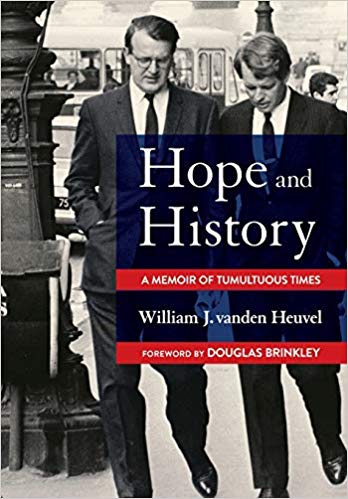
2. William J. vanden Heuvel
Hope and History: A Memoir of Tumultuous Times
Ithaca: Cornell University Press, 2019

Bill vanden Heuvel (b. 1930) is the father of Leftist gadfly and The Nation editor Katrina vanden Heuvel (via his first wife, the writer-editor Jean Stein, which may explain a few things). But this is sort of like describing Henry Fonda as being the grandfather of Bridget. The career of William vanden Heuvel is so vast and nebulous it’s very hard to describe him in a few words. There’s no single achievement to focus upon. He was at various times chief aide to Col. William “Wild Bill” Donovan, the Wall Street lawyer who founded the OSS and CIA. He also served as two kinds of ambassador to the UN. He was an aide to Bobby Kennedy. He was counsel or advisor to all sorts of governors and mayors. And he was a longtime friend of Eleanor Roosevelt, whom he first met as a boy. It’s hardly worth noting that he’s a member of the Council of Foreign Relations.

The only reason I have the book is that the author is a friend of a friend, and I was obligated to read the book and give some kind of descriptive feedback. Here it is. This is a useful time-capsule from mid-to-late 20th century public-policy thinkery. It consists largely of extensive speeches and papers that Bill gave during his long career. Rather short autobiographical sections separate these, which is nice, because those speeches go on and on, and are printed in something like 7.5-point type. (Terrible blunder; were we supposed to skip over these? Was that the idea?)

I gather the book was pulled together at the behest of daughter Katrina, perhaps to make sure that her father’s major pronouncements were all gathered in one convenient place.

As to the autobiographical sections, I must say that Bill is one of the least egotistical and most self-effacing public figures I’ve ever come across. No wonder we don’t have any previous memoirs from him. The rather lame title is a measure of his modesty. Other high-profile memoirists would have leaned toward something like Reflections of Jack Sprat: My Life in Public Service. Bill’s early life is beguiling. His parents were immigrants in Rochester, NY. The father was Dutch and worked in the French’s mustard factory. The mother was Belgian (Flemish, as one would guess) and worked as a cleaning woman. Somehow Bill got a scholarship to Deep Springs College, a big-brain experimental school in the California desert; after which he shot into a special program at Cornell, finished law school, worked for Bill Donovan, and flew high for the rest of his life.

What makes the book useful is that it goes a long way to explaining the mindset of these idealistic old-school liberals from the 1950s and 60s. A lot of them, those who are still with us like Bill at age 89, remain dewy-eyed idealists, still carrying a torch for Left-liberal social activism, civil rights, and so forth. Such a mindset must be very comforting and reassuring. You can tell yourself you were on the side of the angels, you did the right thing, and if something went awry it’s just because you didn’t try hard enough, or there were bad people around who sabotaged your plans. In the end you have kept your noble ideals intact. I’m reminded of those interviews with Allen Dulles toward the end of life, when he was being challenged about some CIA capers and fiascos he had overseen. Allen regretted nothing. If Bay of Pigs failed, it was because JFK didn’t provide air support.

The book’s defects are mainly in its typography. That tiny type used for the long extracts is unforgivable. This problem is endemic to university presses, I find. It’s too bad, because the book production is first quality every other way.
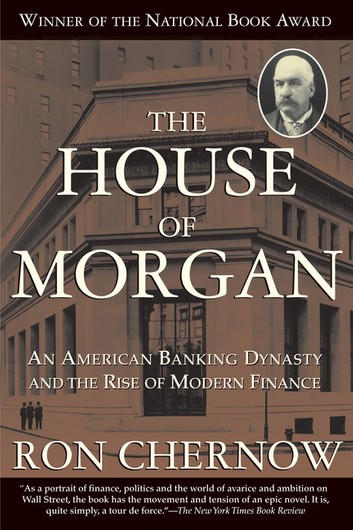
3. Ron Chernow
The House of Morgan: An American Banking Dynasty and the Rise of Modern Finance
New York: Atlantic Monthly Press, 1990 (first edition, hardcover).

I can’t say I ever spent much time wondering how Ron Chernow became a perennial fixture on the book scene; it seems he was just always there, cranking out yet another thick tome about a President or a tycoon. But here’s where it all began: writing about J. P. Morgan. Chernow’s bookmaking career started with this massive multi-generational biography, which he completed in 1989.

Now you’ve all heard of J. P. Morgan. There were two of them, actually. There was the elder one (J. Pierpont Morgan) with the bulbous nose, who ran banking houses out of New York and London from about 1870 till his death in 1913; owned the White Star Line and the Titanic and many other (generally less tragic) things; and founded the Morgan Library and Museum. And then his son J. P. Jr., or “Jack,” who carried on the family business for another thirty years, survived a couple of assassination attempts, and was famously photographed once in a Senate hearing room with a Ringing Bros. circus midget on his lap. But then there was also Junius Morgan, Pierpont’s father, the Connecticut Yankee (b. 1813) who founded the dynasty in mid-1800s London, and set the style for his descendants. There were other, later Morgans, of course, as well as a multitude of commercial and merchant banking firms with the name (Morgan Grenfell, Drexel & Morgan, Morgan Guaranty Trust, Morgan Stanley, Morgan Harjes, JPMorganChase), some of which persist to this day.

It’s a fascinating, interwoven skein of stories: how some brilliant, driven but invariably neurotic American Everymen not only established themselves as tycoons but wrested the financial and political pivot of the world from the City of London and replanted it in Wall Street. This move took nearly a century, and required the Morgans themselves to spend half their time in London as merchant bankers, making themselves agreeable while currying favor with Lombard Street, the Bank of England, and the Archbishop of Canterbury.

Their Anglophilia came naturally enough, but it was also an absolute necessity for anyone engaged in high-level finance and commerce in the mid-to-late 1800s. To put it simply, in the 1800s the City owned the world. Contrariwise the USA, pre-Morgans, looked to be a perennial deadbeat republic, always defaulting on loans—rather like the Latin American countries that the 20th century Morgan companies were always making dodgy loans to. It was Junius and Pierpont Morgan who pulled America out of that swamp and made it Top Nation.

And just as the Bank of England was the hidden hand behind the British government of the 18th and 19th centuries, so the House of Morgan often directed American foreign policy in the 20th. Often it’s hard to tell where the private sector begins and ends.

Many big names from the 19th and 20th centuries get a look-in here. There’s Charles Dickens, whose original, heavily hand-edited 1843 manuscript of A Christmas Carol Jack Morgan would read to his children every year . . . because he owned it . . . because he was J. P. Morgan Jr.! (Incidentally, this Morocco-bound ms. is on display at this very moment at the Morgan Library in New York.) There’s Commodore Vanderbilt (“The public be damned!”). There’s Charles Lindbergh, whose wife Anne Morrow was the daughter of Ambassador Dwight Morrow, a sometime Morgan partner. Lindbergh, son of an irksome Minnesota congressman, was often an annoyance to the House of Morgan, particularly in the 1940–41 period when he was a spokesman for the America First Committee. Eventually Morgan partners and their families just cut the Lindberghs dead: shunned them socially, didn’t speak to them. This is interesting to consider, because while many people today would agree with Lindbergh’s aims, his anti-war comments struck people like his mother-in-law and Morgan head Thomas Lamont as being absolutely toxic. It probably wasn’t his politics per se but something about Charlie’s personality, and his tendency to allude to dark and malign forces behind the scene—something that struck close to home at the House of Morgan.

The last quarter of the book would be of more interest to modern finance historians than anyone else. Since the book was written in the late 1980s, treatment of that era suffers from parallax error: there’s a lot on leveraged buyouts (LBOs), which loomed so large in ’80s business news, but really were not unique to the time. Hostile acquisitions and company-gutting had been going on since the 1950s. They became big news in the ’80s because the market was hot, Wall Street was now cool, “hedge funds” and “M&A’s” and “derivatives” all sounded glamorous. To put it another way, a lot more people were reading business news. But the expansive narrative does not bore. It brings back into the light certain front-page swindlers of the era, such as Tony Gebauer, the Latin America expert and Morgan high-flyer of the ’70s and ’80s, who got nabbed for embezzling many millions from private accounts in 1986, then spent some time in prison and emerged again in New York as an A-list socialite in the 1990s.

4. Cecily Mackworth and Jan Stransky
Czechoslovakia
London: Macdonald & Co. 1944

This is a rare oddment I read on closed reserve at the New York Public Library around mid-year. For some reason I was trying to discover the whole rationale for creating Czechoslovakia in the first place. Volumes on this subject make up a small shelf indeed; most writings on the country’s founding, and the interwar period, tend to be vapid, short on insight. They mainly tell you what a brave, industrious little country it was, and how it was such a tragedy that the West allowed Hitler to tear it apart into its component pieces in 1938–39. The why and how of its creation is always ignored, beyond a glib suggestion that at the Versailles Conference in 1919, someone thought it was a good idea to give the Czechs their own country. Self-determination, you know: Wilson’s Fourteen Points. And while they were at it, the Czechs and Moravians might as well rope in the Slovaks and Ruthenians too, since none of these folks had any centralized, operative government after the breakup of the Austro-Hungarian Empire. So much for self-determination.
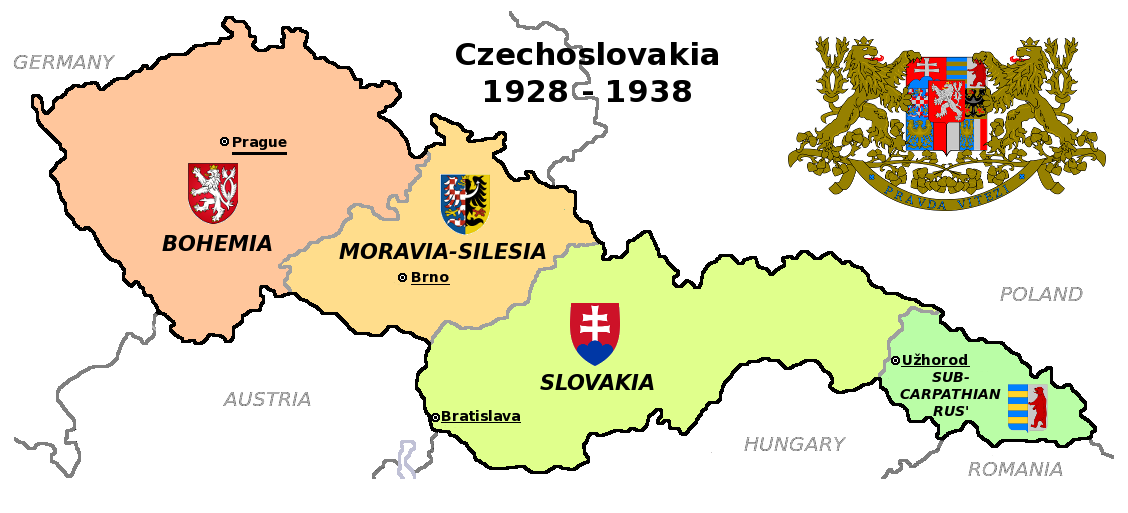
The “Czech” part of Czechoslovakia (Bohemia and Moravia) was very much a First World country at that time, equivalent to the industrialized portions of nearby Germany. That’s because it had been in fact the industrial center of the Hapsburg Empire. In other words, the Versailles schemers took away the brawny, smokestack part of Austria—the region where they made munitions, and vehicles, and glass—and declared it a nation. (They must have really hated the Habsburgs.)

In this new, made-up country, the old ruling class of Bohemia (Austrians, and Germanized Czechs) were chased out or deposed. The new country would be ruled by Czechs, with a few Slovaks thrown in. The only trouble was, there really was no experienced Czech ruling caste, beyond the Germanized classes now out of favor. Thus, Czechoslovakia not only looked very wobbly on the map, it was inherently unstable from the day it was formed. The only cultural cohesion it had was a romantic, rather fairy-tale tradition of having once been a great country, back in Medieval times.

Turning this airy romanticism into the rationale for a nation was the life’s work of Tomas Masaryk (1850–1937), “father of Czechoslovakia” and its first president. Masaryk was an unlikely nation-builder. He was neither a soldier nor a diplomat. He was a philosophy professor who wrote a doctoral thesis on “Suicide as a Mass Phenomenon.” How this rather dreamy, abstracted figure ended up creating a nation had a lot to do with the friends he made. He married an upper-class American girl and spent some fine sojourns in the United States, moving among diplomats and statesmen and fellow academics. During the First World War he convinced Woodrow Wilson that a Czechoslovak nation might be a worthy pet project for America to pursue. At another time, Masaryk famously defended a Jew in his homeland from the charge of ritual murder. Thus Tomas Masaryk came to be known as Friend to the Jews.

Masaryk’s patchwork nation did not long survive him. His cult of personality held the nation together only while he lived. Under his weak and vacillating successors, it almost immediately disintegrated. Czechoslovakia was partitioned in 1938–39 not because Hitler was threatening to invade, but because Presidents Benes and Hacha were unable to give the British and French governments any strong and cogent reason why this hodgepodge carved out of the old Austria-Hungary should exist in the first place.

In 1945 it was reconstituted on paper, but its “democratic” coalition government was little more than a USSR puppet regime from the start. For a while, Masaryk’s loquacious, unstable son Jan was foreign minister, and it looked as though Czechoslovakia might yet find a place in the Western camp. But then in early 1948 the Communists staged a coup, threw Jan out his bathroom window, and that was that. Of course Communists took over; that’s what happens to people who don’t have a ruling caste. The polity that survived for the next four decades was the most artificial one of all, held together by the force of Soviet tanks and bayonets.

This small book, written toward the end of the Second World War, manages to sketch in enough Czech history and nationalistic self-regard to explain why the country was founded, and why anyone cared. What it doesn’t address is the country’s weak foundation, particularly in its lack of a coherent ruling stratum or even what we’d now call a Deep State. Most likely Bohemia, Moravia, Slovakia, and Ruthenia would have thrived after 1918 if the Allies had left them right where they were, as provinces of Austria and/or Hungary. But Austria was an old monarchy, a tyrant that needed to be punished. So its seacoast and northern marches were ripped away, and seemingly out of nowhere we got something called Czechoslovakia, a jumble of lands and peoples stuck together with cotter pins and library paste.

5. Nigel Hamilton’s FDR trilogy:
The Mantle of Command, Commander in Chief, War and Peace
All published 2014–2019 by Houghton Mifflin Harcourt.

There are three big volumes here, and I will not go into them in detail except to say that they are all very readable and enlightening. They are also rather radical and revisionist in argument. Essentially, Hamilton maintains that FDR was the Allies’ prime mover in wartime strategy. Not Gen. Marshall, not Adm. King, certainly not Winston Churchill and his grumpy commanders.

Unlike Churchill, who wrote many volumes of self-puffery, Roosevelt left no memoir or testament. The vision of him that we have in popular memory is pretty much the Hollywood one: a smiling, genial fellow, rather guileless and easily persuaded. Actually, per Hamilton, it was Roosevelt who kept the Allies’ European and Mediterranean theater focused on the single main objective of preparing for the D-Day invasion in Normandy. It had to be Normandy because that provided the flat, lowland approach necessary for a quick victory: a straight shot to the Rhine and the Ruhr. But Churchill and his commanders (notably Alan Brooke) didn’t want a cross-channel invasion at all; they’d been thoroughly demoralized by the fiascos of 1940-42. Churchill preferred to dream up sideshows: commando raids in the Aegean, or a proposed invasion of Austria through the mountain fastnesses of Italy and Slovenia. Roosevelt was steadfast in his strategy. He let the British know that if they were not going to be cooperative and do it his way, he and George Marshall were ready to swing the major war effort to defeating Japan before all else.

One key point Hamilton grasps at the outset is that Franklin Roosevelt was a maritime man. He had been assistant secretary of the Navy during the First World War, but quite beyond that, he was always fascinated by ships, shipping routes, and maps in general. It was in his blood. His forebears had been shipping tycoons, with clipper ships to China. By instinct he thought globally.

My Five Favorite Books of 2019

My%20Five%20Favorite%20Books%20of%202019

Share

  • Gab

Enjoyed this article?

Be the first to leave a tip in the jar!

Instant Echeck GreenPay™

Related

  • A Novel Approach: Roberto Bolaño’s 2666

  • Restoring American Deterrence through Innovation and Industry

  • E. M. Forster’s A Passage to India & the Indian Mentality

  • The Theology Behind Ruby Ridge

  • The Rest Is Silence: Heidegger’s Quietism

  • Matt’s Negative Gloss: Matt Goodwin’s Suicide of a Nation, Part Two

  • Matt GPT? Matt Goodwin’s Suicide of a Nation, Part One

  • Hitler’s UFOs: Steven Tucker’s Nazi UFOs & The Saucer & the Swastika

Tags

2019 roundupsbankingbook reviewsCzechoslovakiaFranklin Delano RooseveltGeorge OrwellMargot Metroland

12 comments

  1. Dlh says:
    December 24, 2019 at 6:05 am

    It’s hard to believe feather duster was the leading force in the ww2. Perhaps he was the mouthpiece for other forces as a high functioning psychopath but do we really think he had this mapped out alone ? More like the Kushner behind the FDIC’s is who we must search for.

    0
    0
  2. Merfolk says:
    December 24, 2019 at 7:03 am

    Wow, thanks for this. How you guys read and digest so much I’ll never understand. I was most intrigued by the Morgan book. I wish the author of the article had explored the division betwixt Morgan and Lindbergh. Do you allude to the Usual Suspects?

    0
    0
    1. Margot Metroland says:
      December 24, 2019 at 11:45 am

      As to Lindbergh and the House of Morgan: as mentioned, Charles and Anne Lindbergh were part of the extended family of Morgan partners. Anne’s father Dwight Morrow had been a Morgan partner, and their family were friends and neighbors of the Thomas Lamonts. Lamont was the longtime PR fixer at the firm, and he succeeded to CEO or head partner when JPM Jr. died.

      The sympathies of the Morgan enterprises were very much pro-intervention and pro-British both in 1914-1918, and at the start of the Second War. (Bear in mind that half the Morgan concerns were in London and Paris.) This is notwithstanding the fact that Tom Lamont was a close friend of Nancy Astor and other antiwar Cliveden Set people, as well as American anti-interventionists like the Lindberghs. But Charles and Anne got to be an embarrassment, and Charles acted very huffy when Lamont asked him to tone it down.

      Reflexively one asks today: did the Morgan-Lindbergh alienation have anything to do with the JQ? Not really, or at least Chernow does not make that case. The Morgan enterprises were themselves highly ‘restricted,’ so to speak. Pierpont and Jack Morgan are both repeatedly described by Chernow as being anti-Jewish. Charles Lindbergh, not so much.

      0
      0
      1. Jud Jackson says:
        December 25, 2019 at 1:17 am

        Nice Article. Can you say anything about the relation between Morgan and (Harding and Coolidge) who are my two favorite 20th Century presidents? I believe that Lindberg’s father-in-law, Dwight Morrow, was in the Coolidge Administration.

        0
        0
        1. margot metroland says:
          December 30, 2019 at 6:23 am

          Calvin Coolidge and Dwight Morrow were both class of 1895 at Amherst, roomed together one year, and were thereafter steady friends. According to this book, the friendship drooped when Coolidge became President and didn’t give Morrow a cabinet post. Apparently the President was chary of associating himself with the House of Morgan. He did however appoint Morrow ambassador to Mexico, a post regarded as a “tin whistle” consolation prize by Morrow’s friends. However Mexico was in crisis, and mending American-Mexican relations was of immediate importance, so Morrow became quite the diplomatic star. Afterwards he ran for Senator of New Jersey, exhausting himself so much in the campaign (he won in a massive landslide) that he dropped dead of a heart attack one year into his Senate term.

          Warren G. Harding was not highly regarded by Tom Lamont and Jack Morgan. Harding was isolationist and viewed as a yokel; the House of Morgan was internationalist. Treasury Secretary Andrew Mellon was eager to squeeze war-debt payments out of Britain and France; the Morgan people wanted to tread lightly, in the interests of goodwill, even to the point of proposing debt cancellation. The Administration demanded that all further foreign loans needed to be certified by Treasury and State, and the Morgans and their fellow bankers had no choice but to go along with that.

          0
          0
  3. Arthur Konrad says:
    December 25, 2019 at 4:03 am

    I do not understand why Czechoslovakia gets all the scorn. I mean, I understand that pro-German revisionism was always a big thing on the Right, but to declare that Czechs having a nation was a “bad idea” as a rationale against the existence of that state is kinda very odd, especially given the fact that American Whites aspire to a state of their own on a much flimsier rationale.

    An interesting and brief overview of Czechoslovakia’s political circumstances can be found in Lothrop Stoddard’s “Racial Realities in Europe”. Interestingly enough, Stoddard is actually full of praise for Czechoslovakian leadership (Masaryk and Benes), and describes ethnic diversity and the proximity of Germany as the greatest impediments to country’s eventual prosperity. He does lament the break-up of the KuK, but not based on any who-has-right-and-who-has-not jesuitisms, but his distaste for the new provincial reality of Europe in general.

    “Of course Communists took over; that’s what happens to people who don’t have a ruling caste” I’m sure this has everything to do with them not having a ruling caste, and nothing with Soviet tanks.

    0
    0
    1. Greg Johnson says:
      December 25, 2019 at 4:49 am

      I think you are missing the point. I certainly don’t begrudge the Czechs a homeland. But Czechoslovakia was not a Czech homeland. It was a multiethbic empire ruled by Czechs with significant German, Slovak, and Hubgarian populations.

      0
      0
  4. James J Omeara says:
    December 25, 2019 at 11:08 am

    One of my fellow grad students was married to a rather older woman, a medical researcher from McGill, who was a Czech immigrant or refugee or whatever. Like many such, she was well schooled in American culture (“Grease,” I learned, was wildly popular as a symbol of freedom from Communism). One thing, however, puzzled her: the Two Czecholovakian Brothers on SNL (aka the “Wild and Crazy Guys”). Why this mockery of Czechs, she wondered; she had never encountered this in North America. “Then one day (imagine your version of a Czech accent) then mentioned Bratislava, and I realized, they were not Czech, they were Slovaks! Now I understood the laughter, and joined in heartily!” I was not surprised when the country immediately split up after the Fall.

    On a related note, for the longest time I thought Elaine’s character on Seinfeld was surnamed “Venice” (spelled however) and then suddenly realized (this was pre-Internet research) it was Benes (the B and the V being the same, as the Firesign Theater would say), as in the Czech leader. Why she was supposed to be of Czech ancestry was never clear to me, especially as her father, played by the pre-Reservoir Dogs Lawrence Tierney, seemed more like Mickey Spillane.

    0
    0
  5. Randy says:
    December 25, 2019 at 9:09 pm

    Ha! You had the chance to use the word defenestration and you didn’t. Respect.

    0
    0
  6. Petronius says:
    December 26, 2019 at 3:26 am

    Don’t know if this war time book about Czechoslovakia does downplay this, but the most crucial thing not highlighted by Margot as well is that the “Czech” parts Bohemia and Moravia had a huge ethnic German population of 3.5 million people (czech population was around 6.3 million) that lived in mostly cohesive, homogenous parts.

    These were (somewhat misleadingly) labeled “Sudeten-Germans” (after the Sudeten mountain range), became increasingly nationalist after 1918/19, and the Munich agreement of 1938, based on the “right of self-determination” basically added the German chunks of both Bohemia and Moravia to the German Reich, splitting up what was a territorial unity for centuries.

    After this, Czechoslovakia was a mutilated state that was bound to collapse sooner or later. In 1939 Slovakia split (certainly with considerable “pushing” from Berlin, but it split again in 1993, so the Slovak will to divorce the Czech from a forced marriage was always there), and what was left would be occupied by Germany in March 1939. Only the massive ethnic cleansings of 1945/46, where hundreds of thousands of Sudeten Germans perished, allowed to create an ethnostate called Czechia in Bohemia and Moravia.

    0
    0
    1. margot metroland says:
      December 30, 2019 at 5:48 am

      @Petronius: Good question. The book does cover the Sudeten crisis, but only with the expected partisan slant. We are told that the ‘German-speaking’ population were treated fairly, treated as equals, etc. by the Prague government, but were seduced by Konrad Heinlein and the Sudeten Nazis. And then, instead of the Czechoslovaks being allowed to defend themselves (which they might have done very well, as their army was well-trained and -equipped), they were forced by Britain and France to cede their mountainous western frontier where all their fortifications were—i.e., the Sudetenland.

      This is pretty much the standard telling one reads in histories today. What such tellings tend to slide over is that the Germans/Austrians had been gradually shoved out of central Bohemia for a half-century or more. They ended up in the west, northwest, and southwest of Bohemia much in the same way that 6th-century Britons concentrated themselves in Cornwall and Wales. In 1918-19 there was a formal plan to attach these areas to Germany as the Province of German Bohemia. This was certainly in accord with the ideal of self-determination, but the new Czechoslovak Republic (as it was by then) didn’t want it, and the Allies went along with them. The occupying Czech army shot down ‘German Bohemian’ protestors. So the Sudeten problem was a canker that went much farther back than the 1930s.

      0
      0
  7. HungarianFashionista says:
    December 30, 2019 at 9:16 am

    Bratislava, capital of Slovakia (formerly known as Pozsony/Pressburg).

    1910 census, population by first language:
    German ~42%
    Hungarian ~41%
    Slovak ~15%

    2011 census, population by first language:
    Slovak ~91%
    Hungarian ~3%
    German ~0%

    Imagine being a Slovak intellectual.

    0
    0

Comments are closed.

If you have a Subscriber access,
simply login first to see your comment auto-approved.

Note on comments privacy & moderation

Your email is never published nor shared.

Comments are moderated. If you don't see your comment, please be patient. If approved, it will appear here soon. Do not post your comment a second time.

Writers of May

(2 votes) Morris van de Camp David M. Zsutty Derek Stark Jayant Bhandari Greg Johnson

Articles of May

The Lunch Wars by David M. Zsutty Heidegger on Nietzsche, Part One by Collin Cleary 2 votes
    • Small Is Beautiful:
      The Napoleon of Notting Hill and G. K. Chesterton Upon Defending One’s Homeland from Others—and Itself

      Steven Tucker

      2

    • The Psychology Behind MrBeast’s Moronic Thought Experiment

      Endeavour

      9

    • On the Roots of Anti-Immigrant Sentiment in Contemporary Britain

      Lipton Matthews

      7

    • Remembering Enoch Powell:
      June 16, 1912–February 8, 1998

      Greg Johnson

      17

    • Counter-Currents Radio Podcast No. 691
      Rob Rundo Returns

      Counter-Currents Radio

    • The Fragile Polity that is Syria

      Morris van de Camp

      2

    • Nigel Farage Calls Britain a Two-Tier State

      Mark Gullick

      4

    • Nationalism This Week
      Letter to J. D. Vance

      Greg Johnson

      32

    • Lost In Trans-Mission:
      How the Media Fails To Reveal the Inconvenient Truth About the Usual Suspects

      Steven Tucker

      10

    • Liar, Liar, Pants on Fire!

      Beau Albrecht

      7

    • Editor’s Update
      Rob Rundo on Counter-Currents Radio, Fundraiser Update, & a New $20,000 Matching Grant

      Greg Johnson

    • The Bitter End of Western Metaphysics:
      Heidegger on Nietzsche, Part Three

      Collin Cleary

      10

    • Uncivil War

      Mark Gullick

      50

    • Exclusive Interview with Karel Veliky:
      The Final Chapter in the Film Series! Part II

      Ondrej Mann

      2

    • Happy Birthday to Us!

      Greg Johnson

      6

    • Zsutty’s Maximum

      David M. Zsutty

      16

    • Exclusive Interview with Karel Veliky:
      The Final Chapter in the Film Series! Part I

      Ondrej Mann

      2

    • The Union Jackal, June 2026

      Mark Gullick

      23

    • The Inferiority Behind Immigrant Superiority

      Jayant Bhandari

      15

    • Counter-Currents Radio Podcast No. 690
      Greg Johnson & David Zsutty Discuss Current Things: AI, Henry Nowak, the Iran Crisis, & More

      Counter-Currents Radio

      7

    • Collin Cleary: What Rome Means to Me

      Collin Cleary

      4

    • Paul Krugman: Closet Bolshevik

      Spencer J. Quinn

      21

    • Fugue of Ideas:
      Ibram X. Kendi’s Chain of Ideas

      Greg Johnson

      19

    • Based Blacks

      Lipton Matthews

      24

    • Black Intellectual Fatigue

      Derek Stark

      41

    • Why White Advocates Should Avoid “Based Blacks”

      Dani Vypont

      32

    • Nietzsche & Race

      Mark Gullick

    • Editor’s Update
      Rob Rundo Rescheduled to Next Week on Counter-Currents Radio;
      Tonight Greg Johnson & David Zsutty Answer Your Questions;
      Fundraiser Update & a New $20,000 Matching Grant

      Greg Johnson

    • The Counter-Currents 2026 Fundraiser
      Lifetime Subscriber Welcome Packages Extended

      Greg Johnson

    • Nationalism This Week
      Who’s Looking Back?

      Greg Johnson

      29

    • China’s Threat to American Security:
      Food, Farmland, Foreign Control, & Energy Policy

      Lipton Matthews

      5

    • The Bitter End of Western Metaphysics:
      Heidegger on Nietzsche, Part Two

      Collin Cleary

      16

    • The Killing of Henry Nowak

      Mark Gullick

      38

    • The Crisis of Chinese Technology Thieves

      Morris van de Camp

      1

    • The Strange World of Gender Bender Fiction:
      & What This Genre Tells Us About Autosexuality

      Dani Vypont

      3

    • Watching the Watchers:
      The Dark Triad Question

      David M. Zsutty

      14

    • The Remigration Movement Solidifies

      F. Roger Devlin

      2

    • Casting Aspersions:
      The Fatal Consequences of Race-Swapped Casting, From Helen of Troy to Henry of Southampton

      Steven Tucker

      20

    • The Murder of Henry Nowak

      Millennial Woes

      23

    • Don’t Forget to Vote in Our Writer & Article of the Month Poll

      Greg Johnson

    • The Robot Hotdog Stand

      Greg Johnson

      37

    • Laughing Our Way to Victory

      Dave Chambers

      7

    • The Zodiac Killer

      Mark Gullick

      11

    • Jared Taylor: What Rome Means to Me

      Jared Taylor

      1

    • An Interview with Endeavour:
      My Way of Life Is an Adventure!

      Ondrej Mann

      6

    • José Pedro Zúquete’s The Identitarians

      Greg Johnson

      3

    • Editor’s Update
      Fundraiser Update & How to Watch the Remigration Summit

      Greg Johnson

      5

    • The Bitter End of Western Metaphysics:
      Heidegger on Nietzsche, Part One

      Collin Cleary

      12

    • Berlin: City of Stones

      Spencer J. Quinn

      6

    • True Folk-Horror Is Horror of Your Own Folk:
      Mark Gatiss vs the Brexit Blind Dead  

      Steven Tucker

      4

    • Joe Gould

      On the Roots of Anti-Immigrant Sentiment in Contemporary Britain

      It's too late to discuss whether the antiwhitism, hypocrisy, and injustice of the ruling...

    • Bertrand russell

      Is the Anti-Defamation League a Hate Group?

      Read False Flags by the late Michael Collins Piper, available at Unz Review and Archive.org. Piper...

    • Beau Albrecht

      Remembering Enoch Powell:
      June 16, 1912–February 8, 1998

      At the time, Britain was still only experiencing the thin end of the wedge as far as migration goes...

    • Peter Quint

      Remembering Enoch Powell:
      June 16, 1912–February 8, 1998

      Okay, so he has two White Nationalist speeches to his credit. 🦈

    • CC Reader

      Remembering Enoch Powell:
      June 16, 1912–February 8, 1998

      The best Prime Minister England never had. Powell went on the Dick Cavett show and was treated...

    • Livla

      The Psychology Behind MrBeast’s Moronic Thought Experiment

      From a biological perspective, this thought experiment is the equivalent of a selection event that...

    • Adrian Roberts

      Remembering Enoch Powell:
      June 16, 1912–February 8, 1998

      In Mein Kampf, Hitler argued that the side which makes war inevitable is the side most responsible...

    • Adrian Roberts

      Remembering Enoch Powell:
      June 16, 1912–February 8, 1998

      So the English owe everybody reparations? Damn.

    • Wasili

      The Psychology Behind MrBeast’s Moronic Thought Experiment

      Great article!  Indeed, the following point can’t be emphasized enough: The [insert non-white...

    • Will Williams

      On the Roots of Anti-Immigrant Sentiment in Contemporary Britain

      Ecological experts call the replacement of one species by another as habitat succession. In my...

    • Douglas Mercer

      Remembering Enoch Powell:
      June 16, 1912–February 8, 1998

      In 1977 Powell gave a speech called The Road To National Suicide: “On the other hand there are at...

    • JayeRyanOD

      The Fragile Polity that is Syria

      I strongly support ex Syrian President Assad supported by my kinsmen the Russians . Before the...

    • Joe Gould

      The Psychology Behind MrBeast’s Moronic Thought Experiment

      I don’t see the decline of real, useful work as alarming or surprising, rather it is inevitable.We...

    • E_Perez

      On the Roots of Anti-Immigrant Sentiment in Contemporary Britain

      A little soft, the article, especially when its title promised to go to the roots. "The...

    • Elear

      Small Is Beautiful:
      The Napoleon of Notting Hill and G. K. Chesterton Upon Defending One’s Homeland from Others—and Itself

      A wonderful essay about things so small yet so precious. Fighting off the invaders is meaningless if...

    • Quu

      The Psychology Behind MrBeast’s Moronic Thought Experiment

      Thank you, yes, it's very interesting, revealing a predisposition that isn't globally normal, and...

    • The Laughing cavalier

      Remembering Enoch Powell:
      June 16, 1912–February 8, 1998

      It was England who declared war - both times - and neither time was England under any threat. It'...

    • TheLau ghin gCavalier

      The Psychology Behind MrBeast’s Moronic Thought Experiment

      A version of this scenario did the rounds on 4chan where red was "nothing happens" and blue was "50...

    • Peter Quint

      Small Is Beautiful:
      The Napoleon of Notting Hill and G. K. Chesterton Upon Defending One’s Homeland from Others—and Itself

      The Secret People G. K. ChestertonThey have given us into the hands of new unhappy lords,Lords...

    • Douglas Mercer

      Remembering Enoch Powell:
      June 16, 1912–February 8, 1998

      The UK now has 19 percent non-White which is more than double what it had in 2001 which was 8...

    • Earth Day Special

      John Morgan

      12

    • A Robertson Roundup
      Remembering Wilmot Robertson
      (April 16, 1915 – July 8, 2005)

      Margot Metroland

      13

    • The Paranoid Style in White Nationalism

      Greg Johnson

      30

    • Join the Dance!

      Andrew Hamilton

      1

    • We Can’t Save the Earth Without Reducing African Birth Rates

      James Dunphy

      36

    • “I’m Not a Conspiracy Theorist, but . . .”:
      Jeffrey Epstein’s Death Gives New Life to “Conspiracy Theories”

      Greg Johnson

      22

    • Sylvia Plath: Stasis in Darkness

      Vic Olvir

      17

    • Vanguardism, Vantardism, & Mainstreaming

      Greg Johnson

      80

    • Aviation, Geography, & Race

      Charles Lindbergh

      3

    • Some Thoughts on Yule

      Collin Cleary

      4

    • Living in Truth:
      A Yuletide Homily

      Jef Costello

      7

    • John Kennedy Toole’s A Confederacy of Dunces

      Greg Johnson

      20

    • On Aleksandr Solzhenitsyn’s Warning to the West

      Spencer J. Quinn

      7

    • Elitism, British Modernism, & Wyndham Lewis

      Jonathan Bowden

      6

    • Philip K. Dick’s Do Androids Dream of Electric Sheep? as Anti-Semitic/Christian-Gnostic Allegory

      Greg Johnson

      20

    • “Conspiracy Theory” or Conspiracy?

      Andrew Hamilton

      21

    • Remembering H. P. Lovecraft
      (August 20, 1890–March 15, 1937)

      Greg Johnson

      3

    • Who Are We?
      Nordics, Aryans, & Whites

      Greg Johnson

      71

    • Remembering William Gayley Simpson
      (July 23, 1892–December 31, 1990)
      A Pleasant Afternoon with Harriet & Bill Simpson

      Margot Metroland

      18

    • Here are the Young Men
      Remembering Ian Curtis
      (July 15, 1956–May 18, 1980)

      Mark Gullick

      18

    • Percy Grainger
      Artist of the Right

      Alex Graham

      7

    • Remembering Revilo Oliver
      (July 7, 1908–August 20, 1994)

      Greg Johnson

      18

    • The Meaning of July 4th for the White Man

      Gregory Hood

      13

    • The Front National’s Evolution

      Bruno Mégret

    • Merwin K. Hart
      Forgotten American Hero & Man of the Right

      Morris van de Camp

      10

    • George Orwell’s Nineteen Eighty-Four

      Jonathan Bowden

      8

    • Carleton S. Coon
      Scientist & Reluctant White Advocate

      Morris van de Camp

      3

    • The Kwanzaa Absurdity Will Be Dwarfed by Juneteenth

      Robert Hampton

      10

    • Stravinsky

      Alex Graham

      7

    • Like the Roman:
      Remembering Enoch Powell (1912-1998)

      Mark Gullick

      23

    • About Film “From the Right”

      Karel Veliky

    • The 1970s: The Golden Age of Hijacking

      Morris van de Camp

      21

    • Jonathan Bowden’s Deliverance
      Part 6

      Jonathan Bowden

    • Do You Want to Play a Game?

      Mark Gullick

      1

    • Sexually Incontinent on the Indian Subcontinent:
      Who Rapes More Animals, Indians or Pakistanis? The Battle Continues!

      Steven Tucker

      3

    • Neo-Fascism in Film
      Part 5

      Karel Veliky

      15

    • The Game of Tarot

      Mark Gullick

      2

    • Institutions Cannot Be Transplanted

      Jayant Bhandari

      5

    • Jonathan Bowden’s Deliverance
      Part 5

      Jonathan Bowden

    • Crosstown Traffic:
      Jimi Hendrix & The Post-War Rock ‘N’ Roll Revolution

      Mark Gullick

      1

    • Slaves from the North:
      Finns & Karelians in the East European Slave Trade, 900–1600

      Lipton Matthews

      14

    • Neo-Fascism in Film
      Part 4

      Karel Veliky

      2

    • David Lean’s A Passage to India

      Spencer J. Quinn

      1

    • Elites are Essential to Development

      Lipton Matthews

      7

    • Jonathan Bowden’s Deliverance
      Part 4

      Jonathan Bowden

    • Neo-Fascism in Film
      Part 3

      Karel Veliky

      6

    • E. M. Forster’s A Passage to India & the Indian Mentality

      Spencer J. Quinn

      25

    • Jonathan Bowden’s Deliverance
      Part 3

      Jonathan Bowden

    • The Rest Is Silence
      Heidegger’s Quietism

      Mark Gullick

      2

    • Dispelling the Historical Fallacy of Indian Nationalism

      Lipton Matthews

      8

    • Neo-Fascism in Film
      Part 2

      Karel Veliky

      8

    • Jonathan Bowden’s Deliverance
      Part 2

      Jonathan Bowden

    • Life of a Klansman

      Mark Gullick

      8

    • Jonathan Bowden’s Deliverance, Part 1

      Jonathan Bowden

    • Decolonial Ideas are Holding Back Developing Countries

      Lipton Matthews

      8

    • Neo-fascism in Film, Part 1

      Karel Veliky

      21

    • Jonathan Bowden’s Onslaught, Part 8
      Divigations on Decadence

      Jonathan Bowden

    • Jonathan Bowden’s Onslaught, Part 7
      Intrigues in the National Front

      Jonathan Bowden

      1

    • Rotten to the Core

      Mark Gullick

      8

    • Strauss on Husserl’s “Philosophy as Rigorous Science”

      Greg Johnson

    • András László
    • Derek Hawthorne
    • Beau Albrecht
    • Alain de Benoist
    • Kerry Bolton
    • Jonathan Bowden
    • Collin Cleary
    • Jef Costello
    • Savitri Devi
    • Julius Evola
    • Jim Goad
    • Gregory Hood
    • Juleigh Howard-Hobson
    • Greg Johnson
    • Charles Krafft
    • Anthony M. Ludovici
    • Trevor Lynch
    • H. L. Mencken
    • J. A. Nicholl
    • James J. O’Meara
    • Christopher Pankhurst
    • Tito Perdue
    • Michael Polignano
    • Spencer J. Quinn
    • Fenek Solère
    • Irmin Vinson
    • Leo Yankevich
    • Francis Parker Yockey
    • Multiple authors
  • Editor-in-Chief

    • Greg Johnson, Ph.D.

    Featured Writers

    • Beau Albrecht
    • Gunnar Alfredsson
    • Collin Cleary, Ph.D.
    • Jef Costello
    • Morris V. de Camp
    • F. Roger Devlin, Ph.D.
    • Stephen Paul Foster, Ph.D.
    • Jim Goad
    • Alex Graham
    • Mark Gullick, Ph.D.
    • Greg Johnson, Ph.D.
    • Travis LeBlanc
    • Trevor Lynch
    • Margot Metroland
    • James J. O’Meara
    • Angelo Plume
    • Spencer J. Quinn
    • Fred Reed
    • Clarissa Schnabel
    • Michael Walker
    • David M. Zsutty

    Frequent Writers

    • Asier Abadroa
    • Aquilonius
    • Alain de Benoist
    • Kerry Bolton, Ph.D.
    • Dave Chambers
    • Steven Clark
    • James Dunphy
    • Endeavour
    • Richard Houck
    • Jason Kessler
    • Titus Livius
    • Ondrej Mann
    • Lipton Matthews
    • Mark Mazari
    • John Morgan
    • Jaroslav Ostrogniew
    • Kathryn S.
    • Christian Secor
    • Anne Wilson Smith
    • Thomas Steuben
    • William De Vere
    • Kenneth Vinther
    • Max West

    Classic Authors

    • Maurice Bardèche
    • Jonathan Bowden
    • Julius Evola
    • Guillaume Faye
    • Ernst Jünger
    • Kevin MacDonald, Ph.D.
    • D. H. Lawrence
    • Charles Lindbergh
    • Jack London
    • H. P. Lovecraft
    • Anthony M. Ludovici
    • Sir Oswald Mosley
    • National Vanguard
    • Friedrich Nietzsche
    • Revilo Oliver
    • William Pierce
    • Ezra Pound
    • Saint-Loup
    • Savitri Devi
    • Carl Schmitt
    • Miguel Serrano
    • Oswald Spengler
    • P. R. Stephensen
    • Jean Thiriart
    • John Tyndall
    • Dominique Venner
    • Leo Yankevich
    • Francis Parker Yockey

    Other Authors

    • Howe Abbott-Hiss
    • Michael Bell
    • Giles Corey
    • Jack Donovan
    • Richardo Duchesne, Ph.D.
    • Emile Durand
    • Guillaume Durocher
    • Mark Dyal
    • Tom Goodroch
    • Andrew Hamilton
    • Robert Hampton
    • Huntley Haverstock
    • Derek Hawthorne
    • Gregory Hood
    • Juleigh Howard-Hobson
    • Alexander Jacob
    • Ruuben Kaalep
    • Tobias Langdon
    • Julian Langness
    • Patrick Le Brun
    • G A Malvicini
    • John Michael McCloughlin
    • Millennial Woes
    • Michael O’Meara
    • Christopher Pankhurst
    • Michael Polignano
    • J. J. Przybylski
    • Quintilian
    • Edouard Rix
    • C. B. Robertson
    • C. F. Robinson
    • Herve Ryssen
    • Alan Smithee
    • Fenek Solere
    • Ann Sterzinger
    • Robert Steuckers
    • Tomislav Sunic
    • Donald Thoresen
    • Marian Van Court
    • Irmin Vinson
    • Book Reviews
    • Movie Reviews
    • TV Reviews
    • Music Reviews
    • Art Criticism
    • Graphic Novels & Comics
    • Video Game Reviews
    • Fiction
    • Poems
    • Interviews
    • Videos
    • English Translations
    • Other Languages
      • Arabic
      • Bulgarian
      • Croatian
      • Czech
      • Danish
      • Dutch
      • Estonian
      • Finnish
      • French
      • German
      • Greek
      • Hungarian
      • Italian
      • Lithuanian
      • Norwegian
      • Polish
      • Portuguese
      • Romanian
      • Russian
      • Slovak
      • Spanish
      • Swedish
      • Ukrainian
    • Commemorations
    • Why We Write
  • Archives
  • Top 100 Commenters
  • The Looney Bin
Sponsored Links
Europa.com Above Time Coffee Antelope Hill Publishing Paul Waggener IHR-Store Spencer J. Quinn American Renaissance Jim Goad The Occidental Observer
Donate Now Mailing list
Books for sale
  • The Philosopher Is In
  • Sexual Utopia in Power (Expanded Edition)
  • In Defense of Prejudice
  • Loving Our Own
  • Tyranny & Wisdom
  • The Populist Moment
  • Is America Doomed?
  • To all books
Copyright © 2026 Counter-Currents Publishing, Ltd.

Paywall Access


Please enter your email address.

Lost your password?

Edit your comment

Writer & Article of the Month May 2026

Voting for this month has concluded. Here are the final results!

Top Writers

  • #1 Morris van de Camp 2 votes
  • #2 David M. Zsutty 2 votes
  • #3 Derek Stark 2 votes
  • #4 Jayant Bhandari 2 votes
  • #5 Greg Johnson 2 votes
  • #6 Jared Taylor 1 vote
  • #7 Collin Cleary 1 vote
  • #8 Spencer J. Quinn 1 vote
  • #9 Mark Gullick 1 vote
  • #10 Lipton Matthews 1 vote
  • #11 Keith Woods 1 vote
  • #12 Steven Tucker 1 vote

Top Articles

  • #1 The Lunch Wars 2 votes
  • #2 Heidegger on Nietzsche, Part One 2 votes
  • #3 Lothrop Stoddard’s The Revolt Against Civilization 1 vote
  • #4 Could Fascism Work? 1 vote
  • #5 Jared Taylor's Elevator Pitch to a Billionaire 1 vote
  • #6 Predation Wearing the Mask of Civilization 1 vote
  • #7 Peak Fatigue in Fort Wayne 1 vote
  • #8 Keith Wood's Elevator Pitch to a Billionaire 1 vote
  • #9 Do You Want to Play a Game? 1 vote
  • #10 Why Billionaires Should Fund White Identity Politics 1 vote
  • #11 The 1970s: The Golden Age of Hijacking 1 vote
  • #12 True Folk-Horror Is Horror of Your Own Folk 1 vote
  • #13 Finding Atlantis Part 4 1 vote
  • #14 Berlin: City of Stones 1 vote
  • #15 The Ghost of the Confederacy 1 vote

Total votes cast: 17