Counter-Currents
  • Advertise
  • Private Events
  • T&C
  • About
  • Contact
  • RSS
    • Main feed
    • Podcast feed
    • Videos feed
    • Comments feed
  • Welcome
  • Webzine
  • Books
  • Merch
  • Podcasts
  • Videos
  • Donate
  • Patrons
  • Subscribe
  • Crypto

LEVEL2

Donate Now Mailing list
Upcoming podcasts
  • Rob Rundo on Counter-Currents Radio

    Rob Rundo on Counter-Currents Radio

    Counter-Currents Radio

    06/13/2026 — 3 pm EST / 9 pm CET
  • Daniel Tyrie on Counter-Currents Radio

    Daniel Tyrie on Counter-Currents Radio

    Counter-Currents Radio

    06/20/2026 — 3 pm EST / 9 pm CET

Writers of May

(2 votes) Morris van de Camp David M. Zsutty Derek Stark Jayant Bhandari Greg Johnson

Articles of May

The Lunch Wars by David M. Zsutty Heidegger on Nietzsche, Part One by Collin Cleary 2 votes
  • Welcome
  • Webzine
  • Books
  • Merch
  • Podcasts
  • Videos
  • Donate
  • Patrons
  • Subscribe
  • Crypto
    • The Union Jackal, June 2026

      Mark Gullick

      10

    • The Inferiority Behind Immigrant Superiority

      Jayant Bhandari

      9

    • Counter-Currents Radio Podcast No. 690
      Greg Johnson & David Zsutty Discuss Current Things: AI, Henry Nowak, the Iran Crisis, & More

      Counter-Currents Radio

      2

    • Collin Cleary: What Rome Means to Me

      Collin Cleary

      4

    • Paul Krugman: Closet Bolshevik

      Spencer J. Quinn

      13

    • Fugue of Ideas:
      Ibram X. Kendi’s Chain of Ideas

      Greg Johnson

      17

    • Based Blacks

      Lipton Matthews

      8

    • Black Intellectual Fatigue

      Derek Stark

      35

    • Why White Advocates Should Avoid “Based Blacks”

      Dani Vypont

      21

    • Nietzsche & Race

      Mark Gullick

    • Editor’s Update
      Rob Rundo Rescheduled to Next Week on Counter-Currents Radio;
      Tonight Greg Johnson & David Zsutty Answer Your Questions;
      Fundraiser Update & a New $20,000 Matching Grant

      Greg Johnson

    • The Counter-Currents 2026 Fundraiser
      Lifetime Subscriber Welcome Packages Extended

      Greg Johnson

    • Nationalism This Week
      Who’s Looking Back?

      Greg Johnson

      29

    • China’s Threat to American Security:
      Food, Farmland, Foreign Control, & Energy Policy

      Lipton Matthews

      5

    • The Bitter End of Western Metaphysics:
      Heidegger on Nietzsche, Part Two

      Collin Cleary

      16

    • The Killing of Henry Nowak

      Mark Gullick

      38

    • The Crisis of Chinese Technology Thieves

      Morris van de Camp

      1

    • The Strange World of Gender Bender Fiction:
      & What This Genre Tells Us About Autosexuality

      Dani Vypont

      3

    • Watching the Watchers:
      The Dark Triad Question

      David M. Zsutty

      14

    • The Remigration Movement Solidifies

      F. Roger Devlin

      1

    • Casting Aspersions:
      The Fatal Consequences of Race-Swapped Casting, From Helen of Troy to Henry of Southampton

      Steven Tucker

      20

    • The Murder of Henry Nowak

      Millennial Woes

      23

    • Don’t Forget to Vote in Our Writer & Article of the Month Poll

      Greg Johnson

    • The Robot Hotdog Stand

      Greg Johnson

      37

    • Laughing Our Way to Victory

      Dave Chambers

      7

    • The Zodiac Killer

      Mark Gullick

      11

    • Jared Taylor: What Rome Means to Me

      Jared Taylor

      1

    • An Interview with Endeavour:
      My Way of Life Is an Adventure!

      Ondrej Mann

      6

    • José Pedro Zúquete’s The Identitarians

      Greg Johnson

      3

    • Editor’s Update
      Fundraiser Update & How to Watch the Remigration Summit

      Greg Johnson

      5

    • The Bitter End of Western Metaphysics:
      Heidegger on Nietzsche, Part One

      Collin Cleary

      11

    • Berlin: City of Stones

      Spencer J. Quinn

      6

    • True Folk-Horror Is Horror of Your Own Folk:
      Mark Gatiss vs the Brexit Blind Dead  

      Steven Tucker

      4

    • Counter-Currents Radio Podcast No. 689
      Thomas Massie, the America 2050 Bust, the Need for Whites to Divest from America, the AI Economic Apocalypse, & Pro-White Project Pitches to Billionaires

      Counter-Currents Radio

      7

    • Nationalism This Week
      Remigration is Inevitable, Part 3

      Greg Johnson

      27

    • Why Billionaires Should Fund White Identity Politics

      Lipton Matthews

      8

    • How Cold War Two Came About

      Morris van de Camp

      5

    • Now Available for Pre-Order at a Special Price!
      Greg Johnson’s The Philosopher Is In

      Greg Johnson

    • David Zsutty’s Elevator Pitch to a Billionaire

      David M. Zsutty

      1

    • Headbanging Lite

      Mark Gullick

      5

    • White Advocacy Past and Present

      Peter Bradley

      13

    • The Lunch Wars

      David M. Zsutty

      47

    • The Russians are Coming/The Russians are Coming

      Steven Clark

      1

    • Peak Fatigue in Fort Wayne

      Gabriel Anderson

      24

    • Keith Woods’ Elevator Pitch to a Billionaire

      Keith Woods

    • The Cruelty of Kindness

      Morris van de Camp

      9

    • Predation Wearing the Mask of Civilization

      Jayant Bhandari

      13

    • The Mandalorian & Grogu

      Trevor Lynch

      24

    • Editor’s Update
      Fundraiser Update & a New $20,000 Matching Grant
      Greg Johnson & David Zsutty Discuss Thomas Massie on Counter-Currents Radio

      Greg Johnson

      2

    • How the Jews Defeated Thomas Massie—& Themselves

      David M. Zsutty

      27

    • YT

      The Union Jackal, June 2026

      One of the links said JDVance was “very good friends” with this Lammy creature. I hope that isn’t...

    • Zarathustra

      The Inferiority Behind Immigrant Superiority

      I abhor Jews, but geography cannot be invalidated. Professor Diamond doesn't mention or even allude...

    • TiredofBoomers

      Black Intellectual Fatigue

      I am Mr. Tired of Boomers, not Miss. Regarding "Scott," I have no idea. I wasn't involved in that...

    • Will Williams

      Black Intellectual Fatigue

      Bigfoot: June 10, 2026  [Leftkowitz] is a Jew… an academic will sometimes point out the lies of...

    • YT

      Why White Advocates Should Avoid “Based Blacks”

      I call total bs. I agree there are a lot of goofy “conservatives” who’ve bought into racial...

    • Flel

      Fugue of Ideas: Ibram X. Kendi’s Chain of Ideas

      *phonebook

    • Flel

      Fugue of Ideas: Ibram X. Kendi’s Chain of Ideas

      Fine review. I’d rather read the phone in pig Latin than read a page from this pompous ass. White...

    • New Flyer

      The Inferiority Behind Immigrant Superiority

      It's the same inferiority complex of the weakling who believes he's the hard man and has to keep...

    • Glide Ratio 0:1

      The Inferiority Behind Immigrant Superiority

      Dancing around a fire half naked is not culture. Giant buoyancy labs, space programs, colossal...

    • WayDown

      The Inferiority Behind Immigrant Superiority

      The rationale in that book doesn't make sense to me. It basically says black are interchangeable...

    • WayDown

      The Union Jackal, June 2026

      I think the Makerfield byelection is overblown. If Labour wins then there is a good chance Burnham...

    • Malaparte

      Heidegger on Nietzsche, Part Two

      Off topic, but I'm curious if Cleary is familiar with Emanuele Severino?  Bloomsbury has recently...

    • Derek Stark

      The Inferiority Behind Immigrant Superiority

      If you wish to follow the Jew view that there is nothing unique about whites that led them to...

    • E_Perez

      The Union Jackal, June 2026

      Being defeated is difficult for anybody, but nobody could foresee that the British would be treated...

    • Anonymous

      The Inferiority Behind Immigrant Superiority

      One phenomenon I observed on the internet is the phrase 'Proud Indian' proclaimed by many Indians on...

    • Zarathustra

      The Inferiority Behind Immigrant Superiority

      I recently read "Guns, Germs, and Steel" and found its rationale rather convincing.

    • Stronza

      Based Blacks

      Re the killing of Charlie Kirk.  Maybe it's some third party, neither Israel nor Robinson.  Maybe...

    • Will Williams

      Dispatches from the Fallout Shelter

      Gunnar: April 22,2026 ...A ten-day ceasefire was finally declared between Israel and Lebanon....

    • Jank

      Counter-Currents Radio Podcast No. 690

      "I want 40% of the FBI hunting down antifa" Bad News. 40% of the FBI is antifa.

    • John

      Collin Cleary: What Rome Means to Me

      Christianity is universal, unlike Judaism which is racial. What good is a religion if it does not...

    • Earth Day Special

      John Morgan

      12

    • A Robertson Roundup
      Remembering Wilmot Robertson
      (April 16, 1915 – July 8, 2005)

      Margot Metroland

      13

    • The Paranoid Style in White Nationalism

      Greg Johnson

      30

    • Join the Dance!

      Andrew Hamilton

      1

    • We Can’t Save the Earth Without Reducing African Birth Rates

      James Dunphy

      36

    • “I’m Not a Conspiracy Theorist, but . . .”:
      Jeffrey Epstein’s Death Gives New Life to “Conspiracy Theories”

      Greg Johnson

      22

    • Sylvia Plath: Stasis in Darkness

      Vic Olvir

      17

    • Vanguardism, Vantardism, & Mainstreaming

      Greg Johnson

      80

    • Aviation, Geography, & Race

      Charles Lindbergh

      3

    • Some Thoughts on Yule

      Collin Cleary

      4

    • Living in Truth:
      A Yuletide Homily

      Jef Costello

      7

    • John Kennedy Toole’s A Confederacy of Dunces

      Greg Johnson

      20

    • On Aleksandr Solzhenitsyn’s Warning to the West

      Spencer J. Quinn

      7

    • Elitism, British Modernism, & Wyndham Lewis

      Jonathan Bowden

      6

    • Philip K. Dick’s Do Androids Dream of Electric Sheep? as Anti-Semitic/Christian-Gnostic Allegory

      Greg Johnson

      20

    • “Conspiracy Theory” or Conspiracy?

      Andrew Hamilton

      21

    • Remembering H. P. Lovecraft
      (August 20, 1890–March 15, 1937)

      Greg Johnson

      3

    • Who Are We?
      Nordics, Aryans, & Whites

      Greg Johnson

      71

    • Remembering William Gayley Simpson
      (July 23, 1892–December 31, 1990)
      A Pleasant Afternoon with Harriet & Bill Simpson

      Margot Metroland

      18

    • Here are the Young Men
      Remembering Ian Curtis
      (July 15, 1956–May 18, 1980)

      Mark Gullick

      18

    • Percy Grainger
      Artist of the Right

      Alex Graham

      7

    • Remembering Revilo Oliver
      (July 7, 1908–August 20, 1994)

      Greg Johnson

      18

    • The Meaning of July 4th for the White Man

      Gregory Hood

      13

    • The Front National’s Evolution

      Bruno Mégret

    • Merwin K. Hart
      Forgotten American Hero & Man of the Right

      Morris van de Camp

      10

    • George Orwell’s Nineteen Eighty-Four

      Jonathan Bowden

      8

    • Carleton S. Coon
      Scientist & Reluctant White Advocate

      Morris van de Camp

      3

    • The Kwanzaa Absurdity Will Be Dwarfed by Juneteenth

      Robert Hampton

      10

    • Stravinsky

      Alex Graham

      7

    • Like the Roman:
      Remembering Enoch Powell (1912-1998)

      Mark Gullick

      23

    • Neo-Fascism in Film
      Part 5

      Karel Veliky

      15

    • The Game of Tarot

      Mark Gullick

      2

    • Institutions Cannot Be Transplanted

      Jayant Bhandari

      5

    • Jonathan Bowden’s Deliverance
      Part 5

      Jonathan Bowden

    • Crosstown Traffic:
      Jimi Hendrix & The Post-War Rock ‘N’ Roll Revolution

      Mark Gullick

      1

    • Slaves from the North:
      Finns & Karelians in the East European Slave Trade, 900–1600

      Lipton Matthews

      14

    • Neo-Fascism in Film
      Part 4

      Karel Veliky

      2

    • David Lean’s A Passage to India

      Spencer J. Quinn

      1

    • Elites are Essential to Development

      Lipton Matthews

      7

    • Jonathan Bowden’s Deliverance
      Part 4

      Jonathan Bowden

    • Neo-Fascism in Film
      Part 3

      Karel Veliky

      6

    • E. M. Forster’s A Passage to India & the Indian Mentality

      Spencer J. Quinn

      25

    • Jonathan Bowden’s Deliverance
      Part 3

      Jonathan Bowden

    • The Rest Is Silence
      Heidegger’s Quietism

      Mark Gullick

      2

    • Dispelling the Historical Fallacy of Indian Nationalism

      Lipton Matthews

      8

    • Neo-Fascism in Film
      Part 2

      Karel Veliky

      8

    • Jonathan Bowden’s Deliverance
      Part 2

      Jonathan Bowden

    • Life of a Klansman

      Mark Gullick

      8

    • Jonathan Bowden’s Deliverance, Part 1

      Jonathan Bowden

    • Decolonial Ideas are Holding Back Developing Countries

      Lipton Matthews

      8

    • Neo-fascism in Film, Part 1

      Karel Veliky

      21

    • Jonathan Bowden’s Onslaught, Part 8
      Divigations on Decadence

      Jonathan Bowden

    • Jonathan Bowden’s Onslaught, Part 7
      Intrigues in the National Front

      Jonathan Bowden

      1

    • Rotten to the Core

      Mark Gullick

      8

    • Strauss on Husserl’s “Philosophy as Rigorous Science”

      Greg Johnson

    • Jonathan Bowden’s Onslaught, Part 6
      Francis Bacon & Right-Wing Nihilism

      Jonathan Bowden

    • London After (& Before) Midnight:
      Aleister Crowley, The Landlord’s Worst Nightmare

      James J. O'Meara

      2

    • Jonathan Bowden’s Onslaught, Part 5
      The Post-War British Far Right

      Jonathan Bowden

    • No Rules: Rollerball

      Mark Gullick

      4

    • Jonathan Bowden’s Onslaught, Part 3
      Brett Easton Ellis’ American Psycho

      Jonathan Bowden

    • András László
    • Derek Hawthorne
    • Beau Albrecht
    • Alain de Benoist
    • Kerry Bolton
    • Jonathan Bowden
    • Collin Cleary
    • Jef Costello
    • Savitri Devi
    • Julius Evola
    • Jim Goad
    • Gregory Hood
    • Juleigh Howard-Hobson
    • Greg Johnson
    • Charles Krafft
    • Anthony M. Ludovici
    • Trevor Lynch
    • H. L. Mencken
    • J. A. Nicholl
    • James J. O’Meara
    • Christopher Pankhurst
    • Tito Perdue
    • Michael Polignano
    • Spencer J. Quinn
    • Fenek Solère
    • Irmin Vinson
    • Leo Yankevich
    • Francis Parker Yockey
    • Multiple authors
  • Editor-in-Chief

    • Greg Johnson, Ph.D.

    Featured Writers

    • Beau Albrecht
    • Gunnar Alfredsson
    • Collin Cleary, Ph.D.
    • Jef Costello
    • Morris V. de Camp
    • F. Roger Devlin, Ph.D.
    • Stephen Paul Foster, Ph.D.
    • Jim Goad
    • Alex Graham
    • Mark Gullick, Ph.D.
    • Greg Johnson, Ph.D.
    • Travis LeBlanc
    • Trevor Lynch
    • Margot Metroland
    • James J. O’Meara
    • Angelo Plume
    • Spencer J. Quinn
    • Fred Reed
    • Clarissa Schnabel
    • Michael Walker
    • David M. Zsutty

    Frequent Writers

    • Asier Abadroa
    • Aquilonius
    • Alain de Benoist
    • Kerry Bolton, Ph.D.
    • Dave Chambers
    • Steven Clark
    • James Dunphy
    • Endeavour
    • Richard Houck
    • Jason Kessler
    • Titus Livius
    • Ondrej Mann
    • Lipton Matthews
    • Mark Mazari
    • John Morgan
    • Jaroslav Ostrogniew
    • Kathryn S.
    • Christian Secor
    • Anne Wilson Smith
    • Thomas Steuben
    • William De Vere
    • Kenneth Vinther
    • Max West

    Classic Authors

    • Maurice Bardèche
    • Jonathan Bowden
    • Julius Evola
    • Guillaume Faye
    • Ernst Jünger
    • Kevin MacDonald, Ph.D.
    • D. H. Lawrence
    • Charles Lindbergh
    • Jack London
    • H. P. Lovecraft
    • Anthony M. Ludovici
    • Sir Oswald Mosley
    • National Vanguard
    • Friedrich Nietzsche
    • Revilo Oliver
    • William Pierce
    • Ezra Pound
    • Saint-Loup
    • Savitri Devi
    • Carl Schmitt
    • Miguel Serrano
    • Oswald Spengler
    • P. R. Stephensen
    • Jean Thiriart
    • John Tyndall
    • Dominique Venner
    • Leo Yankevich
    • Francis Parker Yockey

    Other Authors

    • Howe Abbott-Hiss
    • Michael Bell
    • Giles Corey
    • Jack Donovan
    • Richardo Duchesne, Ph.D.
    • Emile Durand
    • Guillaume Durocher
    • Mark Dyal
    • Tom Goodroch
    • Andrew Hamilton
    • Robert Hampton
    • Huntley Haverstock
    • Derek Hawthorne
    • Gregory Hood
    • Juleigh Howard-Hobson
    • Alexander Jacob
    • Ruuben Kaalep
    • Tobias Langdon
    • Julian Langness
    • Patrick Le Brun
    • G A Malvicini
    • John Michael McCloughlin
    • Millennial Woes
    • Michael O’Meara
    • Christopher Pankhurst
    • Michael Polignano
    • J. J. Przybylski
    • Quintilian
    • Edouard Rix
    • C. B. Robertson
    • C. F. Robinson
    • Herve Ryssen
    • Alan Smithee
    • Fenek Solere
    • Ann Sterzinger
    • Robert Steuckers
    • Tomislav Sunic
    • Donald Thoresen
    • Marian Van Court
    • Irmin Vinson
    • Book Reviews
    • Movie Reviews
    • TV Reviews
    • Music Reviews
    • Art Criticism
    • Graphic Novels & Comics
    • Video Game Reviews
    • Fiction
    • Poems
    • Interviews
    • Videos
    • English Translations
    • Other Languages
      • Arabic
      • Bulgarian
      • Croatian
      • Czech
      • Danish
      • Dutch
      • Estonian
      • Finnish
      • French
      • German
      • Greek
      • Hungarian
      • Italian
      • Lithuanian
      • Norwegian
      • Polish
      • Portuguese
      • Romanian
      • Russian
      • Slovak
      • Spanish
      • Swedish
      • Ukrainian
    • Commemorations
    • Why We Write
  • Archives
  • Top 100 Commenters
  • The Looney Bin
  • Advertise
  • Private Events
  • T&C
  • About
  • Contact
  • RSS
    • Main feed
    • Podcast feed
    • Videos feed
    • Comments feed
Sponsored Links
Europa.com Above Time Coffee Antelope Hill Publishing Paul Waggener IHR-Store Spencer J. Quinn American Renaissance Jim Goad The Occidental Observer
Print December 18, 2023 3 comments

“The Rich Man’s Wealth Is His Strong City”

Clarissa Schnabel

3,268 words

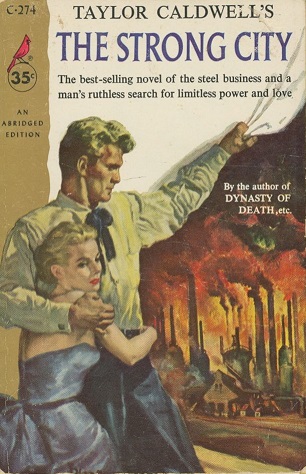
Taylor Caldwell
The Strong City
Originally published in 1942; republished by Open Road Integrated Media, Inc. (New York: 2018)

This has taken me much longer to write than originally planned. I blame annoying love stories for the delay.

The way I find new books to read is sometimes convoluted. This time, it was via Doenitz at Nuremberg: A Re-Appraisal (1983), a collection of statements by high-ranking officers, politicians, diplomats, and other public persons on the 1946 trial that condemned Grand Admiral Karl Dönitz, the Reich’s last head of state, to ten years in prison.

The book was edited by Francis Parker Yockey’s friend H. Keith Thompson and Henry Strutz. One voice in the collection was that of a certain Taylor Caldwell, identified as an “American novelist.” I had never heard of her before, but I liked what she had to say. Her fiery condemnation of Grand Admiral Karl Dönitz’s Nuremberg trial was a sharp contrast to the equally sympathetic, but much more formal statements elsewhere in the book:

I have been boiling mad for years over the “war crimes trials,” which I think were despicable and contemptible, and smack more of ancient Rome’s barbarism than of a so-called civilized country. Our country’s hands are not free of blood and crime, in spite of our vaunted “democracy” and “noble aspirations,” etc., etc., ad nauseum. Not only were the “war crime trials” one of the blackest spots on our recent black (and Red) history, but the bombing of the only two Christian cities in Japan in August 1945 via the atomic bomb calls to high heaven for retribution… To say that the trial of Admiral Karl Doenitz is a “bare-faced hypocrisy,” as you state in your letter, is the understatement of all time. It is outrageous that a man serving his country in all honesty and patriotism should be considered a “criminal” by a country which has its own share of criminals, and not honest and patriotic ones, either . . .

This is almost worthy of Savitri Devi! And what was a female novelist doing among all those military men and politicians, anyway? So I looked her up. Janet Miriam Caldwell (1900-1985), according to Wikipedia, was “a British-born American novelist and prolific author of popular fiction” under several pen names, and — oh, dear:

She was an outspoken conservative and for a time wrote for the John Birch Society‘s monthly journal American Opinion and even associated with the antisemitic Liberty Lobby. . . .

Many of Caldwell’s books centered on the idea that a small cabal of rich, powerful men secretly control the world.

Well, her portfolio sounded interesting, so why not? Not surprisingly, I chose The Strong City, because

Caldwell’s heroes are self-made men of pronounced ethnic background, such as the German immigrants in The Strong City (1942) and The Balance Wheel (1951).

A novel about German-Americans published in 1942? I’m on it!

While The Strong City has long been out of print, it was reissued as an e-book in 2018. From its description:

The son of German immigrants, Franz Stoessel comes of age at the end of the nineteenth century with the conviction that nothing matters in America except wealth and power. As a foreman at the local steel mill in Nazareth, Pennsylvania, he is brutal to his fellow workers, believing that a man’s sins can be buried beneath his fortune.

When a charismatic Englishman attempts to form a union at Schmidt Steel Company, Franz meets the threat with violent force. Nothing will stand in his way — not the health and safety of his colleagues, nor his tender feelings for a beautiful cousin who disapproves of his materialism. Time and time again, Franz makes the cold-hearted decision to put himself above all others — and reaps the rewards that elude his friends and family. But are his choices driven by strength or fear? And when the reckoning comes, who will stand by his side?

That is perhaps a little overdramatic, but it gives you a good idea of what the novel is about. As might be surmised from the summary, Franz is not a likeable character at all. He is, in fact, extremely unlikeable. And yet, you get the feeling that Caldwell did not consider him “the bad guy” per se. There is a certain sympathy there for the strong, even brutal man, especially the strong German man; a guilty pleasure at the time, I would imagine. This is ironic since Franz himself is more an internationalist than anything else. But I suppose internationalists — globalists in today’s terminology — are still rooted in their ethnicity, more than they realize or care to think about.

This is a sort of theme in The Strong City. Franz, who does not give a damn about his German heritage, has been uprooted from his native country by his parents, mainly his mother (we’ll come to her in a moment), who dragged young Franz first to France, then to England, and finally to the United States in search of “the dream” after German unification under Prussian leadership, which Franz’s mother finds utterly unbearable. Only late in life does she realize that the dream had been at her fingertips all along: home, Volk, soil. Even Franz understands in the end that what is wrong with him is the loss of his true self, his roots — his ethnic soul, if you will. I’ll be quoting from his great final monologue below.

You can buy Francis Parker Yockey’s The Enemy of Europe here.

The senior Stoessels are clearly based on Taylor Caldwell’s own parents, albeit portrayed in a much gentler light. (Her parents must have been a nightmare, going by her hypnotic regressions in The Search for a Soul — Taylor Caldwell’s Psychic Lives). Emmi, the Prussian-hating half-Prussian, is the dominant force in the Stoessel household, her harsh nature masking her homesickness and disappointment with the choices she made in life. Franz is too much like her for the two of them to get along, their only common ground being their love for Egon, the quiet, gentle nominal paterfamilias, who has his own regrets and whose main fault, the reader feels, is that he never put his foot down and asserted his place as head of the household.

Into this volatile environment comes the “beautiful cousin” Irmgard, the daughter of Emmi’s deceased younger sister who, instead of gentle Egon, had married a revolutionary firebrand (we assume from the 1848 risings). Irmgard, who is now an orphan, had promised her father on his deathbed to emigrate to America and to realize his dreams there. Emmi, in typical maternal fashion, secretly hopes for a match between Irmgard and Franz, and indeed they display an instant dislike as well as fascination for one another.

While Franz and Irmgard struggle with their fatal attraction, we get to know the Schmidt family. Hans Schmidt is the boss of the steel company that Franz and his father work for, a ruthless Bavarian immigrant who married a rich American heiress whom he despises. Frances is an overprotected woman from high society who never learned to stand on her own feet and who hides from life through constant illness.

The Schmidts nevertheless managed to produce two children: Ernestine, a spinster, as she would have been regarded at that time, almost 30 and still unmarried; and her younger brother Baldur, artistic and highly intelligent, but a cripple. Baldur knows that his father hates him, and his father knows that he knows.

Hans’ only love is for his daughter, and when he notices her taking an interest in the young worker who used to come and look at their house (that being Franz), he is ecstatic. Since he had almost given up hope of her ever finding a man to take care of her, Schmidt now pulls strings to elevate Franz to an appropriate status for his future son-in-law.

At the same time, Irmgard begins to work as a companion for Mrs. Schmidt. Under her influence, the mother and her children who are virtually prisoners in their own house as a result of their own fear, weakness, and passivity begin to blossom. Baldur falls in love with Irmgard, but because of his physical deficiencies feels it would be a sin to ask her to marry him.

Meanwhile, Franz is scheming as well. One of the two co-workers he calls his friends — a big, decent, but slow Hungarian immigrant named Jan — claims to have found a solution to the problem the Schmidt Steel Company has with breaking molds. Franz plans to find out what Jan’s solution is so he can present it as his own.

The third man in their band is said “charismatic Englishman” Tom, a classic socialist who tries to improve the workers’ lives by standing up to the bosses. Franz knows that Tom has the right ideas; he also knows that those ideas will get in his way. Franz is a Social Darwinist; he believes those on top got there because they were smarter, more capable, and more ruthless than the dull masses. In Franz’s view, any man who can climb to the top deserves to be there. The rest do not. And as Franz has ambitions to climb to the top, Tom’s notions of equality and workers’ rights are dangerous to him.

When Tom plans a strike on the very day Franz is to start in his new white-collar position in the Schmidt Company, Franz rats him out to the bosses. Schmidt calls in the Burnley Detective Agency (a stand-in for the Pinkertons, one assumes) to break up the strike before it has even started. While walking home with Franz, Tom is attacked by two agents and beaten to death.

As all of this is going on, Franz and Irmgard finally — hm — do the deed, and this is when I stopped reading for a while because it annoyed me so much. The whole setup feels forced. Perhaps it was new when Caldwell wrote her book, but the whole “decent, honorable woman can’t stand arrogant, domineering guy but falls for him anyway” trope has been done to death at this point, from so-called romance novels to Twilight. And not once has it been convincing, nor could it be anything other than a recipe for disaster in real life. Irmgard, of course, instantly plans her marriage, while Franz has no intention of making an honest woman out of her while the boss’ daughter is a real prospect and he can keep Irmgard around on the side.

At least Caldwell portrays the whole sorry affair in the classic tradition of the elements and the environment telling the reader what’s really going on. Franz and Irmgard get stranded during a storm in a cheap, disgusting little inn run by a greedy innkeeper who hates all foreigners. (Franz’s attitude toward him certainly doesn’t help.) So in case we didn’t before, we now know that this relationship is neither healthy nor built on a lasting foundation.

The story then takes both predictable and unpredictable twists and turns. The most surprising element for me — although I remembered that it had been hinted at earlier — is Emmi’s decision to leave the city and live among the Amish. Here we are getting into a strong theme of the book: the contrast between the city that crushes and kills men’s souls, and the life-giving countryside. There is the cold, mechanized work of men such as Franz and Mr. Schmidt and the organic, creative work such as Baldur’s painting and music, or Emmi’s household and farm work. Franz himself had played the piano and organ at one time, but had given it up in his quest for money. Taylor Caldwell portrays this as the loss of “soul,” the loss of any connection to beauty, tradition, and soil:

But something in him shrank from music, so that he would close his doors, or leave the house, when Baldur played. The music, when he could not flee from it, produced in him a sort of thick smoldering despair and bitter hunger, which he dared not analyze. Something strange and dark and mournful stirred in him, when he could not escape, something which made Irmgard appear before him, vivid, lost, and warm. But it was even beyond Irmgard; she was only a symbol. He no longer read, not even his favorite poets. Once he picked up a volume of Shakespeare, but a few passages aroused in him such a hot tormenting fever, such a sensation of complete desolation, that he flung the book from him with a loud cry.

Yet even in this, we see varying degrees. Hans Schmidt built his company — ruthlessly, yes, but by his own hands. His son-in-law Franz is a modern industrialist, more concerned with riches than the company itself, and planning to sell it out to shareholders.

Another theme of the book is, interestingly, the “Prussian spirit.” This was, in fact, a major talking point of the western Allies in the Second World War. It seems unfamiliar to us today, where everything is simply considered “Nazi,” but at the time, National Socialism was often seen only as a result of Prussian militarism, and it was the latter the western Allies determined to destroy. Accordingly, Taylor Caldwell presented the Prussian spirit at least as suspect, while at the same time she is to be commended for knowing about and making distinctions between the subtleties of the various German “tribes” at all. (Nominally, as the Bavarian Schmidt is no less a ruthless, grasping capitalist than “Prussian” Franz.) Yet, as interesting as I found it to see Germans through American eyes, there came the point where it all became very tedious. You know, after about four dozen or so paragraphs of analysis. Caldwell might have devoted some of that space to the other major theme of her book: “What is America?” The question remains unanswered.

Still, was her work, published as it was smack in the middle of the Second World War, perhaps a plea for the German people?

“And then, there was my poor mother, believing that the wolf-pack was really a gentle herd of sheep! I began to hate her for her foolishness; because I could feel the pack right at our heels. I knew that the weak were always destroyed by the pack; the pack waited, its tongues lolling, its eyes full of fire — I — I was afraid,” he added, with moving simplicity. “I began to tell myself that I wasn’t really a sheep — I was a hunter, one of the predatory ones.” His voice lost the inflections of the English language, and now it was the voice of a German who had never left his native hearth.

“I believed it. I had to believe it, because I was so frightened. I saw that I had to hate, and I persuaded myself that hatred was strength. That has always been the curse of the German, his belief that hatred is strong. That is because he is afraid, and has no real defense against the packs that roam the rest of the world. He has no spiritual fortitude. He believes he must hate and destroy, all in a rapture of terrified hysteria, when all the time he is only a docile herd animal threatened by the packs. And in his hysteria there is a great danger to all the rest of the world, which won’t let him munch with the herd — His very ferocity is only terror and panic.”

It would be interesting to compare Caldwell’s assessment from 1942 with The Balance Wheel from 1951; I might read that one next.

You can buy Collin Cleary’s Wagner’s Ring & the Germanic Tradition here.

Although the characters reminded me quite early on of Wilhelmine von Hillern’s Geier-Wally, a novel that explicitly refers to the Nibelungenlied as its inspiration, it took me an embarrassingly long time to realize that this was what Taylor Caldwell was aiming at: a German epic for the modern age, leaning heavily on the Nibelungenlied and Wagner’s Ring, even though Caldwell was, as American Krogan called it in his BioShock videos, “playing narrative Legos” with the various elements. Franz is alternately Alberich who renounces love for riches, treacherous Hagen, and Siegmund of Die Walküre in his incestuous relationship with Irmgard (tellingly, the son born from their affair is named Siegfried). He is also in part Siegfried, who is apprenticed in the smithy/Schmidt(!) Steel Company and discards the Valkyrie/Irmgard for the princess/Ernestine. Irmgard is both Brünhild and vengeful Kriemhild.

An interesting element from a mythological point of view — even though I was groaning inwardly at Caldwell going for the third generation of the same old messed-up characters — are Franz and Ernestine’s twin sons, Sigmund and Joseph. Here we find more mythology: Romulus and Remus, perhaps, although elements of the Wayland story, especially the connection to a smith and smithy, might also have played into it. Of course, the reader’s attention is instantly on the boys’ names. Yes, I do believe Caldwell chose them quite deliberately. Sigmund — who grows taller than his brother despite the boys being identical twins — is quiet and insightful, yet prone to fly into terrible rages at times. Joseph is a demanding, sly bully who hogs everybody’s affection except Baldur’s.

And as for names, there is more! I have already mentioned the Schmidt Steel Company as a stand-in for Mime’s smithy; Schmidt (=Schmied) literally means smith in German. We have the character named Baldur, after the Nordic/Germanic god of light, a character beautiful of face and soul, but crippled in body. (Is this again the Wayland or even the Hephaestus story?)

Likewise, Irmgard is a strongly suggestive name, even though it was quite common at the time and might have been chosen just for that reason — but I doubt it. Irm-, irmin-, or irmen- has a connection to Irminsul, the world pillar of Nordic/Germanic belief. In Old High German, according to Vorname., it means “all-encompassing” or “overlooking everything.” Gard- has Nordic roots as well; think Midgard, for example. It describes an enclosed space of some kind — the English “garden” probably has its origin there, but I’m no philologist. In Old High German, again according to Vorname, the meaning has shifted to “fence” and therefore “protection.” Thus, Irmgard is the all-encompassing protector. At the same time, the image of the enclosed space fits Irmgard’s self-contained nature.

Now, all this would make for a tremendous “meta” story if it had been put together properly. Sadly, these highly interesting themes often get lost in the drama of a generational saga that simply goes over the same ground again and again. A good chunk of the later chapters in particular should have been cut. Also, Caldwell’s characters seem to suffer from frequent mood swings, probably according to the author’s own mood at the time of writing. At least Caldwell herself acknowledged this in what appears to be a tongue-in-cheek comment: “Consistency in character, thought Baldur, is found only in the novels of Charles Dickens and others of his school. The one real fact in human nature is inconsistency.”

Despite its flaws, The Strong City is a captivating read. Emmi Stoessel emerged as my favorite character, and not just because she shares the same first name as my paternal grandmother. (In memoriam Emmi Schnabel, 1909-1974.) She is the most complex of all the characters and shows the greatest development, from a bitter, disappointed household tyrant to a much wiser, softer, spiritual woman who is finally at peace.

I wonder if it was a gamble to publish a novel about Germans in 1942 that did not portray them as evil monsters, but rather as secretly romantic people of blood and soil frightened of the harsh outside world to which they presented a cold, brutal, and warlike façade. The only contemporary review that I was able to find with a cursory search, in the Waterbury Evening Democrat of April 16, 1942, gives nothing away.


“The Rich Man’s Wealth Is His Strong City”

%E2%80%9CThe%20Rich%20Man%E2%80%99s%20Wealth%20Is%20His%20Strong%20City%E2%80%9D

Share

  • Gab

Enjoyed this article?

Be the first to leave a tip in the jar!

Instant Echeck GreenPay™

*  *  *

Counter-Currents has extended special privileges to those who donate at least $10/month or $120/year.

  1. Donors will have immediate access to all Counter-Currents posts. Everyone else will find that one post a day, five posts a week will be behind a “paywall” and will be available to the general public after 30 days. Naturally, we do not grant permission to other websites to repost paywall content before 30 days have passed.
  2. Paywall member comments will appear immediately instead of waiting in a moderation queue. (People who abuse this privilege will lose it.)
  3. Paywall members have the option of editing their comments.
  4. Paywall members get an Badge badge on their comments.
  5. Paywall members can “like” comments.
  6. Paywall members can “commission” a yearly article from Counter-Currents. Just send a question that you’d like to have discussed to [email protected]. (Obviously, the topics must be suitable to Counter-Currents and its broader project, as well as the interests and expertise of our writers.)

To get full access to all content behind the paywall, please visit our redesigned Paywall page. 

Related

  • Nietzsche & Race

  • Finding Atlantis Part 4

  • A Novel Approach: Roberto Bolaño’s 2666

  • Neo-Fascism in Film, Part 3

  • Restoring American Deterrence through Innovation and Industry

  • E. M. Forster’s A Passage to India & the Indian Mentality

  • The Theology Behind Ruby Ridge

  • Jonathan Bowden’s Deliverance, Part 3

Tags

book reviewsClarissa SchnabelDer Ring des NibelungenDoenitz at NurembergFrancis Parker YockeyGerman-AmericansGermanic mythologyGermanic paganismGermans in AmericaH. Keith ThompsonHenry StrutzIrminsulKarl DönitzNibelungenliedNuremberg trialspaywallPrussiaRichard WagnerTaylor Caldwellthe Prussian spiritThe Strong CityWaylandWilhelmine von Hillern

3 comments

  1. Traddles says:
    December 20, 2023 at 9:19 am

    As I recall from my childhood, Taylor Caldwell was a huge name in popular fiction, widely recognized, with TV programs made from her work.  It’s telling that a writer with her views was accepted by publishers and Hollywood back in her day.  There’s an interesting little bio of her at https://www.taylorcaldwell.com/bio

    The bit about Franz wrestling with music and Shakespeare was especially interesting to me.

    Thank you for this interesting and enjoyable review!

    0
    0
  2. Kök Böri says:
    January 18, 2024 at 4:35 am

    Erich von Salomon’s “Die Stadt” is too worth to read. I do not know if this German book was translated into the English, there is a Russian translation.

    0
    0
    1. Kök Böri says:
      January 18, 2024 at 8:22 am

      Ernst von Salomon, not Erich, my mistake.

      He was a member of Freikorps.

      0
      0

Comments are closed.

If you have a Subscriber access,
simply login first to see your comment auto-approved.

Note on comments privacy & moderation

Your email is never published nor shared.

Comments are moderated. If you don't see your comment, please be patient. If approved, it will appear here soon. Do not post your comment a second time.

Upcoming podcasts
  • Rob Rundo on Counter-Currents Radio

    Rob Rundo on Counter-Currents Radio

    Counter-Currents Radio

    Sat, Jun 13th — 3 pm EST / 9 pm CET
  • Daniel Tyrie on Counter-Currents Radio

    Daniel Tyrie on Counter-Currents Radio

    Counter-Currents Radio

    Sat, Jun 20th — 3 pm EST / 9 pm CET

Writers of May

(2 votes) Morris van de Camp David M. Zsutty Derek Stark Jayant Bhandari Greg Johnson

Articles of May

The Lunch Wars by David M. Zsutty Heidegger on Nietzsche, Part One by Collin Cleary 2 votes
    • The Union Jackal, June 2026

      Mark Gullick

      10

    • The Inferiority Behind Immigrant Superiority

      Jayant Bhandari

      9

    • Counter-Currents Radio Podcast No. 690
      Greg Johnson & David Zsutty Discuss Current Things: AI, Henry Nowak, the Iran Crisis, & More

      Counter-Currents Radio

      2

    • Collin Cleary: What Rome Means to Me

      Collin Cleary

      4

    • Paul Krugman: Closet Bolshevik

      Spencer J. Quinn

      13

    • Fugue of Ideas:
      Ibram X. Kendi’s Chain of Ideas

      Greg Johnson

      17

    • Based Blacks

      Lipton Matthews

      8

    • Black Intellectual Fatigue

      Derek Stark

      35

    • Why White Advocates Should Avoid “Based Blacks”

      Dani Vypont

      21

    • Nietzsche & Race

      Mark Gullick

    • Editor’s Update
      Rob Rundo Rescheduled to Next Week on Counter-Currents Radio;
      Tonight Greg Johnson & David Zsutty Answer Your Questions;
      Fundraiser Update & a New $20,000 Matching Grant

      Greg Johnson

    • The Counter-Currents 2026 Fundraiser
      Lifetime Subscriber Welcome Packages Extended

      Greg Johnson

    • Nationalism This Week
      Who’s Looking Back?

      Greg Johnson

      29

    • China’s Threat to American Security:
      Food, Farmland, Foreign Control, & Energy Policy

      Lipton Matthews

      5

    • The Bitter End of Western Metaphysics:
      Heidegger on Nietzsche, Part Two

      Collin Cleary

      16

    • The Killing of Henry Nowak

      Mark Gullick

      38

    • The Crisis of Chinese Technology Thieves

      Morris van de Camp

      1

    • The Strange World of Gender Bender Fiction:
      & What This Genre Tells Us About Autosexuality

      Dani Vypont

      3

    • Watching the Watchers:
      The Dark Triad Question

      David M. Zsutty

      14

    • The Remigration Movement Solidifies

      F. Roger Devlin

      1

    • Casting Aspersions:
      The Fatal Consequences of Race-Swapped Casting, From Helen of Troy to Henry of Southampton

      Steven Tucker

      20

    • The Murder of Henry Nowak

      Millennial Woes

      23

    • Don’t Forget to Vote in Our Writer & Article of the Month Poll

      Greg Johnson

    • The Robot Hotdog Stand

      Greg Johnson

      37

    • Laughing Our Way to Victory

      Dave Chambers

      7

    • The Zodiac Killer

      Mark Gullick

      11

    • Jared Taylor: What Rome Means to Me

      Jared Taylor

      1

    • An Interview with Endeavour:
      My Way of Life Is an Adventure!

      Ondrej Mann

      6

    • José Pedro Zúquete’s The Identitarians

      Greg Johnson

      3

    • Editor’s Update
      Fundraiser Update & How to Watch the Remigration Summit

      Greg Johnson

      5

    • The Bitter End of Western Metaphysics:
      Heidegger on Nietzsche, Part One

      Collin Cleary

      11

    • Berlin: City of Stones

      Spencer J. Quinn

      6

    • True Folk-Horror Is Horror of Your Own Folk:
      Mark Gatiss vs the Brexit Blind Dead  

      Steven Tucker

      4

    • Counter-Currents Radio Podcast No. 689
      Thomas Massie, the America 2050 Bust, the Need for Whites to Divest from America, the AI Economic Apocalypse, & Pro-White Project Pitches to Billionaires

      Counter-Currents Radio

      7

    • Nationalism This Week
      Remigration is Inevitable, Part 3

      Greg Johnson

      27

    • Why Billionaires Should Fund White Identity Politics

      Lipton Matthews

      8

    • How Cold War Two Came About

      Morris van de Camp

      5

    • Now Available for Pre-Order at a Special Price!
      Greg Johnson’s The Philosopher Is In

      Greg Johnson

    • David Zsutty’s Elevator Pitch to a Billionaire

      David M. Zsutty

      1

    • Headbanging Lite

      Mark Gullick

      5

    • White Advocacy Past and Present

      Peter Bradley

      13

    • The Lunch Wars

      David M. Zsutty

      47

    • The Russians are Coming/The Russians are Coming

      Steven Clark

      1

    • Peak Fatigue in Fort Wayne

      Gabriel Anderson

      24

    • Keith Woods’ Elevator Pitch to a Billionaire

      Keith Woods

    • The Cruelty of Kindness

      Morris van de Camp

      9

    • Predation Wearing the Mask of Civilization

      Jayant Bhandari

      13

    • The Mandalorian & Grogu

      Trevor Lynch

      24

    • Editor’s Update
      Fundraiser Update & a New $20,000 Matching Grant
      Greg Johnson & David Zsutty Discuss Thomas Massie on Counter-Currents Radio

      Greg Johnson

      2

    • How the Jews Defeated Thomas Massie—& Themselves

      David M. Zsutty

      27

    • YT

      The Union Jackal, June 2026

      One of the links said JDVance was “very good friends” with this Lammy creature. I hope that isn’t...

    • Zarathustra

      The Inferiority Behind Immigrant Superiority

      I abhor Jews, but geography cannot be invalidated. Professor Diamond doesn't mention or even allude...

    • TiredofBoomers

      Black Intellectual Fatigue

      I am Mr. Tired of Boomers, not Miss. Regarding "Scott," I have no idea. I wasn't involved in that...

    • Will Williams

      Black Intellectual Fatigue

      Bigfoot: June 10, 2026  [Leftkowitz] is a Jew… an academic will sometimes point out the lies of...

    • YT

      Why White Advocates Should Avoid “Based Blacks”

      I call total bs. I agree there are a lot of goofy “conservatives” who’ve bought into racial...

    • Flel

      Fugue of Ideas: Ibram X. Kendi’s Chain of Ideas

      *phonebook

    • Flel

      Fugue of Ideas: Ibram X. Kendi’s Chain of Ideas

      Fine review. I’d rather read the phone in pig Latin than read a page from this pompous ass. White...

    • New Flyer

      The Inferiority Behind Immigrant Superiority

      It's the same inferiority complex of the weakling who believes he's the hard man and has to keep...

    • Glide Ratio 0:1

      The Inferiority Behind Immigrant Superiority

      Dancing around a fire half naked is not culture. Giant buoyancy labs, space programs, colossal...

    • WayDown

      The Inferiority Behind Immigrant Superiority

      The rationale in that book doesn't make sense to me. It basically says black are interchangeable...

    • WayDown

      The Union Jackal, June 2026

      I think the Makerfield byelection is overblown. If Labour wins then there is a good chance Burnham...

    • Malaparte

      Heidegger on Nietzsche, Part Two

      Off topic, but I'm curious if Cleary is familiar with Emanuele Severino?  Bloomsbury has recently...

    • Derek Stark

      The Inferiority Behind Immigrant Superiority

      If you wish to follow the Jew view that there is nothing unique about whites that led them to...

    • E_Perez

      The Union Jackal, June 2026

      Being defeated is difficult for anybody, but nobody could foresee that the British would be treated...

    • Anonymous

      The Inferiority Behind Immigrant Superiority

      One phenomenon I observed on the internet is the phrase 'Proud Indian' proclaimed by many Indians on...

    • Zarathustra

      The Inferiority Behind Immigrant Superiority

      I recently read "Guns, Germs, and Steel" and found its rationale rather convincing.

    • Stronza

      Based Blacks

      Re the killing of Charlie Kirk.  Maybe it's some third party, neither Israel nor Robinson.  Maybe...

    • Will Williams

      Dispatches from the Fallout Shelter

      Gunnar: April 22,2026 ...A ten-day ceasefire was finally declared between Israel and Lebanon....

    • Jank

      Counter-Currents Radio Podcast No. 690

      "I want 40% of the FBI hunting down antifa" Bad News. 40% of the FBI is antifa.

    • John

      Collin Cleary: What Rome Means to Me

      Christianity is universal, unlike Judaism which is racial. What good is a religion if it does not...

    • Earth Day Special

      John Morgan

      12

    • A Robertson Roundup
      Remembering Wilmot Robertson
      (April 16, 1915 – July 8, 2005)

      Margot Metroland

      13

    • The Paranoid Style in White Nationalism

      Greg Johnson

      30

    • Join the Dance!

      Andrew Hamilton

      1

    • We Can’t Save the Earth Without Reducing African Birth Rates

      James Dunphy

      36

    • “I’m Not a Conspiracy Theorist, but . . .”:
      Jeffrey Epstein’s Death Gives New Life to “Conspiracy Theories”

      Greg Johnson

      22

    • Sylvia Plath: Stasis in Darkness

      Vic Olvir

      17

    • Vanguardism, Vantardism, & Mainstreaming

      Greg Johnson

      80

    • Aviation, Geography, & Race

      Charles Lindbergh

      3

    • Some Thoughts on Yule

      Collin Cleary

      4

    • Living in Truth:
      A Yuletide Homily

      Jef Costello

      7

    • John Kennedy Toole’s A Confederacy of Dunces

      Greg Johnson

      20

    • On Aleksandr Solzhenitsyn’s Warning to the West

      Spencer J. Quinn

      7

    • Elitism, British Modernism, & Wyndham Lewis

      Jonathan Bowden

      6

    • Philip K. Dick’s Do Androids Dream of Electric Sheep? as Anti-Semitic/Christian-Gnostic Allegory

      Greg Johnson

      20

    • “Conspiracy Theory” or Conspiracy?

      Andrew Hamilton

      21

    • Remembering H. P. Lovecraft
      (August 20, 1890–March 15, 1937)

      Greg Johnson

      3

    • Who Are We?
      Nordics, Aryans, & Whites

      Greg Johnson

      71

    • Remembering William Gayley Simpson
      (July 23, 1892–December 31, 1990)
      A Pleasant Afternoon with Harriet & Bill Simpson

      Margot Metroland

      18

    • Here are the Young Men
      Remembering Ian Curtis
      (July 15, 1956–May 18, 1980)

      Mark Gullick

      18

    • Percy Grainger
      Artist of the Right

      Alex Graham

      7

    • Remembering Revilo Oliver
      (July 7, 1908–August 20, 1994)

      Greg Johnson

      18

    • The Meaning of July 4th for the White Man

      Gregory Hood

      13

    • The Front National’s Evolution

      Bruno Mégret

    • Merwin K. Hart
      Forgotten American Hero & Man of the Right

      Morris van de Camp

      10

    • George Orwell’s Nineteen Eighty-Four

      Jonathan Bowden

      8

    • Carleton S. Coon
      Scientist & Reluctant White Advocate

      Morris van de Camp

      3

    • The Kwanzaa Absurdity Will Be Dwarfed by Juneteenth

      Robert Hampton

      10

    • Stravinsky

      Alex Graham

      7

    • Like the Roman:
      Remembering Enoch Powell (1912-1998)

      Mark Gullick

      23

    • Neo-Fascism in Film
      Part 5

      Karel Veliky

      15

    • The Game of Tarot

      Mark Gullick

      2

    • Institutions Cannot Be Transplanted

      Jayant Bhandari

      5

    • Jonathan Bowden’s Deliverance
      Part 5

      Jonathan Bowden

    • Crosstown Traffic:
      Jimi Hendrix & The Post-War Rock ‘N’ Roll Revolution

      Mark Gullick

      1

    • Slaves from the North:
      Finns & Karelians in the East European Slave Trade, 900–1600

      Lipton Matthews

      14

    • Neo-Fascism in Film
      Part 4

      Karel Veliky

      2

    • David Lean’s A Passage to India

      Spencer J. Quinn

      1

    • Elites are Essential to Development

      Lipton Matthews

      7

    • Jonathan Bowden’s Deliverance
      Part 4

      Jonathan Bowden

    • Neo-Fascism in Film
      Part 3

      Karel Veliky

      6

    • E. M. Forster’s A Passage to India & the Indian Mentality

      Spencer J. Quinn

      25

    • Jonathan Bowden’s Deliverance
      Part 3

      Jonathan Bowden

    • The Rest Is Silence
      Heidegger’s Quietism

      Mark Gullick

      2

    • Dispelling the Historical Fallacy of Indian Nationalism

      Lipton Matthews

      8

    • Neo-Fascism in Film
      Part 2

      Karel Veliky

      8

    • Jonathan Bowden’s Deliverance
      Part 2

      Jonathan Bowden

    • Life of a Klansman

      Mark Gullick

      8

    • Jonathan Bowden’s Deliverance, Part 1

      Jonathan Bowden

    • Decolonial Ideas are Holding Back Developing Countries

      Lipton Matthews

      8

    • Neo-fascism in Film, Part 1

      Karel Veliky

      21

    • Jonathan Bowden’s Onslaught, Part 8
      Divigations on Decadence

      Jonathan Bowden

    • Jonathan Bowden’s Onslaught, Part 7
      Intrigues in the National Front

      Jonathan Bowden

      1

    • Rotten to the Core

      Mark Gullick

      8

    • Strauss on Husserl’s “Philosophy as Rigorous Science”

      Greg Johnson

    • Jonathan Bowden’s Onslaught, Part 6
      Francis Bacon & Right-Wing Nihilism

      Jonathan Bowden

    • London After (& Before) Midnight:
      Aleister Crowley, The Landlord’s Worst Nightmare

      James J. O'Meara

      2

    • Jonathan Bowden’s Onslaught, Part 5
      The Post-War British Far Right

      Jonathan Bowden

    • No Rules: Rollerball

      Mark Gullick

      4

    • Jonathan Bowden’s Onslaught, Part 3
      Brett Easton Ellis’ American Psycho

      Jonathan Bowden

    • András László
    • Derek Hawthorne
    • Beau Albrecht
    • Alain de Benoist
    • Kerry Bolton
    • Jonathan Bowden
    • Collin Cleary
    • Jef Costello
    • Savitri Devi
    • Julius Evola
    • Jim Goad
    • Gregory Hood
    • Juleigh Howard-Hobson
    • Greg Johnson
    • Charles Krafft
    • Anthony M. Ludovici
    • Trevor Lynch
    • H. L. Mencken
    • J. A. Nicholl
    • James J. O’Meara
    • Christopher Pankhurst
    • Tito Perdue
    • Michael Polignano
    • Spencer J. Quinn
    • Fenek Solère
    • Irmin Vinson
    • Leo Yankevich
    • Francis Parker Yockey
    • Multiple authors
  • Editor-in-Chief

    • Greg Johnson, Ph.D.

    Featured Writers

    • Beau Albrecht
    • Gunnar Alfredsson
    • Collin Cleary, Ph.D.
    • Jef Costello
    • Morris V. de Camp
    • F. Roger Devlin, Ph.D.
    • Stephen Paul Foster, Ph.D.
    • Jim Goad
    • Alex Graham
    • Mark Gullick, Ph.D.
    • Greg Johnson, Ph.D.
    • Travis LeBlanc
    • Trevor Lynch
    • Margot Metroland
    • James J. O’Meara
    • Angelo Plume
    • Spencer J. Quinn
    • Fred Reed
    • Clarissa Schnabel
    • Michael Walker
    • David M. Zsutty

    Frequent Writers

    • Asier Abadroa
    • Aquilonius
    • Alain de Benoist
    • Kerry Bolton, Ph.D.
    • Dave Chambers
    • Steven Clark
    • James Dunphy
    • Endeavour
    • Richard Houck
    • Jason Kessler
    • Titus Livius
    • Ondrej Mann
    • Lipton Matthews
    • Mark Mazari
    • John Morgan
    • Jaroslav Ostrogniew
    • Kathryn S.
    • Christian Secor
    • Anne Wilson Smith
    • Thomas Steuben
    • William De Vere
    • Kenneth Vinther
    • Max West

    Classic Authors

    • Maurice Bardèche
    • Jonathan Bowden
    • Julius Evola
    • Guillaume Faye
    • Ernst Jünger
    • Kevin MacDonald, Ph.D.
    • D. H. Lawrence
    • Charles Lindbergh
    • Jack London
    • H. P. Lovecraft
    • Anthony M. Ludovici
    • Sir Oswald Mosley
    • National Vanguard
    • Friedrich Nietzsche
    • Revilo Oliver
    • William Pierce
    • Ezra Pound
    • Saint-Loup
    • Savitri Devi
    • Carl Schmitt
    • Miguel Serrano
    • Oswald Spengler
    • P. R. Stephensen
    • Jean Thiriart
    • John Tyndall
    • Dominique Venner
    • Leo Yankevich
    • Francis Parker Yockey

    Other Authors

    • Howe Abbott-Hiss
    • Michael Bell
    • Giles Corey
    • Jack Donovan
    • Richardo Duchesne, Ph.D.
    • Emile Durand
    • Guillaume Durocher
    • Mark Dyal
    • Tom Goodroch
    • Andrew Hamilton
    • Robert Hampton
    • Huntley Haverstock
    • Derek Hawthorne
    • Gregory Hood
    • Juleigh Howard-Hobson
    • Alexander Jacob
    • Ruuben Kaalep
    • Tobias Langdon
    • Julian Langness
    • Patrick Le Brun
    • G A Malvicini
    • John Michael McCloughlin
    • Millennial Woes
    • Michael O’Meara
    • Christopher Pankhurst
    • Michael Polignano
    • J. J. Przybylski
    • Quintilian
    • Edouard Rix
    • C. B. Robertson
    • C. F. Robinson
    • Herve Ryssen
    • Alan Smithee
    • Fenek Solere
    • Ann Sterzinger
    • Robert Steuckers
    • Tomislav Sunic
    • Donald Thoresen
    • Marian Van Court
    • Irmin Vinson
    • Book Reviews
    • Movie Reviews
    • TV Reviews
    • Music Reviews
    • Art Criticism
    • Graphic Novels & Comics
    • Video Game Reviews
    • Fiction
    • Poems
    • Interviews
    • Videos
    • English Translations
    • Other Languages
      • Arabic
      • Bulgarian
      • Croatian
      • Czech
      • Danish
      • Dutch
      • Estonian
      • Finnish
      • French
      • German
      • Greek
      • Hungarian
      • Italian
      • Lithuanian
      • Norwegian
      • Polish
      • Portuguese
      • Romanian
      • Russian
      • Slovak
      • Spanish
      • Swedish
      • Ukrainian
    • Commemorations
    • Why We Write
  • Archives
  • Top 100 Commenters
  • The Looney Bin
Sponsored Links
Europa.com Above Time Coffee Antelope Hill Publishing Paul Waggener IHR-Store Spencer J. Quinn American Renaissance Jim Goad The Occidental Observer
Donate Now Mailing list
Books for sale
  • The Philosopher Is In
  • Sexual Utopia in Power (Expanded Edition)
  • In Defense of Prejudice
  • Loving Our Own
  • Tyranny & Wisdom
  • The Populist Moment
  • Is America Doomed?
  • To all books
Copyright © 2026 Counter-Currents Publishing, Ltd.

Paywall Access


Please enter your email address.

Lost your password?

Edit your comment

Writer & Article of the Month May 2026

Voting for this month has concluded. Here are the final results!

Top Writers

  • #1 Morris van de Camp 2 votes
  • #2 David M. Zsutty 2 votes
  • #3 Derek Stark 2 votes
  • #4 Jayant Bhandari 2 votes
  • #5 Greg Johnson 2 votes
  • #6 Jared Taylor 1 vote
  • #7 Collin Cleary 1 vote
  • #8 Spencer J. Quinn 1 vote
  • #9 Mark Gullick 1 vote
  • #10 Lipton Matthews 1 vote
  • #11 Keith Woods 1 vote
  • #12 Steven Tucker 1 vote

Top Articles

  • #1 The Lunch Wars 2 votes
  • #2 Heidegger on Nietzsche, Part One 2 votes
  • #3 Predation Wearing the Mask of Civilization 1 vote
  • #4 Peak Fatigue in Fort Wayne 1 vote
  • #5 Keith Wood's Elevator Pitch to a Billionaire 1 vote
  • #6 Do You Want to Play a Game? 1 vote
  • #7 Why Billionaires Should Fund White Identity Politics 1 vote
  • #8 The 1970s: The Golden Age of Hijacking 1 vote
  • #9 True Folk-Horror Is Horror of Your Own Folk 1 vote
  • #10 Finding Atlantis Part 4 1 vote
  • #11 Berlin: City of Stones 1 vote
  • #12 The Ghost of the Confederacy 1 vote
  • #13 Lothrop Stoddard’s The Revolt Against Civilization 1 vote
  • #14 Could Fascism Work? 1 vote
  • #15 Jared Taylor's Elevator Pitch to a Billionaire 1 vote

Total votes cast: 17