 1,338 words
Prepare, prepare the iron helm of war,
Bring forth the lots, cast in the spacious orb;
Th’ Angel of Fate turns them with mighty hands,
And casts them out upon the darken’d earth!
Prepare, prepare!
— William Blake, “A War Song to Englishmen” (1783)
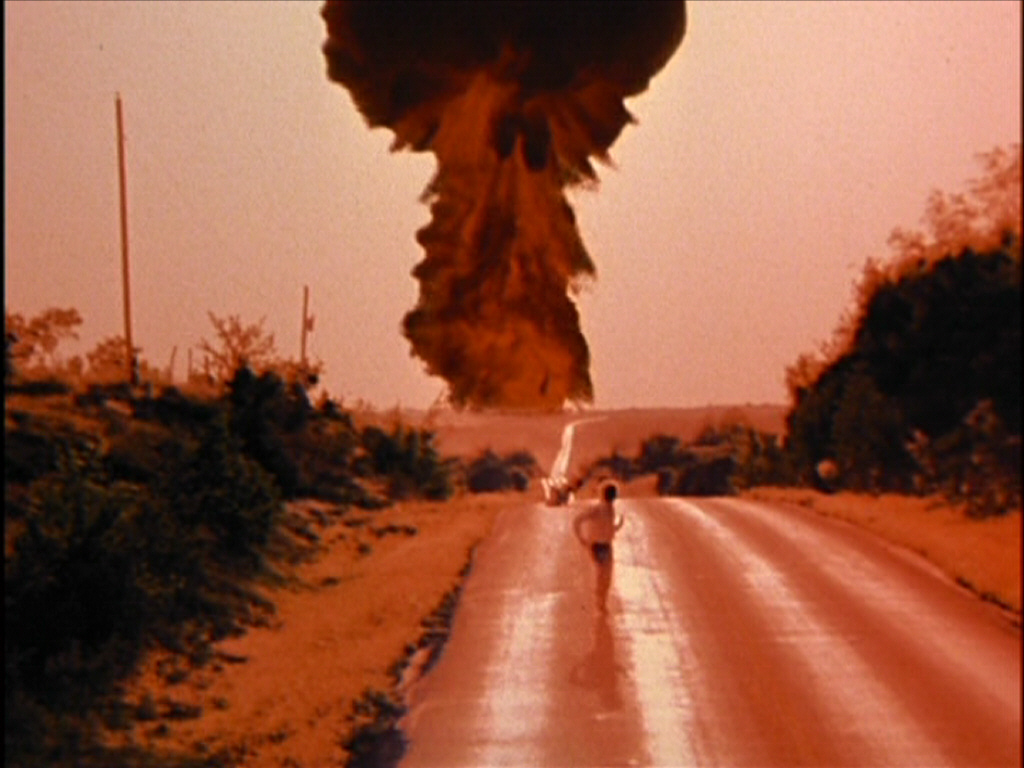
The world is nothing but a smoking, vaporized ruin. To use the parlance of the time, everything was completely obliterated in the light of a thousand nuclear suns. Luckily, though, you have managed to hold on to the last remaining Internet connection on the planet, and Counter-Currents is miraculously still online thanks to arcane magicks. My suburban backyard radiation-proof bunker in the planet’s ultimate north is stocked full of Spam, pemmican, irradiated water, and a whole array of tinned sea life (I’m looking at you, canned sardines), among other things.
How did we get here, though? I reckon we climbed the escalation ladder of legend until the idiots at the top decided to destroy the entire planet. Fret not, my dear friends, for all is not lost. Let us now explore how we are to negotiate this new apocalyptic world with or without a millennium.
How did it happen?
I have managed to piece together a few bits of historical parchment that were not incinerated in the atomic firestorms. Here is what I’ve gleaned so far from these precious documents: In the year 2026, after weeks of intense aerial bombardment and international fuel-shortage panics, President Donald J. Trump announced a tentative ceasefire with the Iranian regime. The truce was on a knife’s edge, with Israel acting in typical Israeli fashion: blowing up targets in Lebanon as the Jewish state continued its ruthless expansion north to the Litani River. The purported reasoning for this was that the truce between the United States and Iran did not include this Israeli bellicosity, which is nonsense of course. The Israelis never wanted peace; they wanted the war to continue ad infinitum.

You can buy Fenek Solère’s novel Rising here
Citing the Wall Street Journal, Revolver News revealed that Israeli officials were quite angry about Trump’s short-lived ceasefire deal with the Iranians. The Israelis in power, especially Benjamin Netanyahu and the Israel Lobby that had a stranglehold on the United States, wanted the war to continue indefinitely as they attempted to use American power to destroy their many enemies.
Direct talks between the United States and Iran took place, as per The Washington Post, on April 17, 2026, and were an abject failure. It seems they were merely theatrical in nature, designed to buy time while American forces in the region rested, refitted, and rearmed. The New York Times reported that China was taking a more active role in the conflict. Intelligence reports at the time suggested that the Chinese were most likely providing the Iranians with chemicals, fuel, and components that could have been used in military armaments production. (Incidentally, Turkey’s President Recep Tayyip Erdogan called Israeli Prime Minister Benjamin Netanyahu “the Hitler of our time,” which is an insult to Der Führer if ever there was one.)
John Mearsheimer appeared on the Switzerland podcast to argue that the US blockade of Iranian oil would not work. Moreover, Kevin MacDonald discussed the US failure to blockade and/or use force to open the Strait of Hormuz.
Early in the war, fuel shortages became acute. Kerosene was in short supply in the aviation industry, and was crucial for them. In mid-April 2026, International Energy Agency (IEA) Executive Director Fatih Birol said that Europe had six weeks of jet fuel left because of the Iran War. Furthermore, Professor Linda Bilmes, a public policy scholar with the Harvard Kennedy School, estimated that the war would be costly, saying that “I am certain we will reach $1 trillion for the Iran war.”
When he appeared on Judging Freedom with Andrew Napolitano, on April 14, 2026, John Mearsheimer made the argument that Israel was in the driver’s seat and that the war would go on interminably until Israel achieved one of two goals: regime change or the destruction of Iran. It is no wonder that American Vice President J. D. Vance’s so-called peace negotiations failed; in fact, they were doomed from the beginning. They were by and large performative, and only served to allow time to gear up for round two. Mearsheimer articulated his core argument:
My central point to the judge was that Trump is in no position to work out a deal with Iran that settles the ongoing war in a meaningful way. The reason is simple: Israel has no interest in a ceasefire, much less an agreement that satisfies any of Iran’s demands, especially its demand that it maintain the capability to enrich uranium. Israel would prefer to wreck Iran, much the way Syria was wrecked. And Israel and its enormously powerful lobby have the means to make Trump dance to their tune, as they have demonstrated repeatedly since Trump moved back into the White House in January 2025. The only circumstance where Trump might stand up to Israel and the lobby is if the world economy is on the verge of disaster, and the president feels that eventuality would be so dire that he has no choice but to stand up to Israel.
Mearsheimer repeatedly made the argument that the Israel Lobby controlled American foreign policy in the Middle East, and he was correct. It was this Lobby’s hubris and pathological, paranoid thirst for blood and vengeance that sent the world over the precipice.
A ten-day ceasefire was finally declared between Israel and Lebanon. President Trump’s declaration that the Strait of Hormuz was open again on April 17, 2026 was rather meaningless given that it was closed again by the Iranians the following day. Nor did Israel end up showing any sign of reigning in their campaign of destruction in Lebanon. The world was thrown into darkness shortly thereafter. Could it have been that the nuclear arms race was reinvigorated at the time by all the uncertainty? The details are spotty as to how it ultimately happened, but that matters little now. This is why I am writing to you from my fortified concrete bunker here in the blasted land of chill in the Far North.
Home Sweet Home
In order to properly prepare for the apocalypse, you need what I alluded to in my opening paragraph: a radiation-proof fallout shelter. Others refer to it as their home base, their bunker, their Bug Out Location (BOL), or even, in more niche French-speaking milieus, their Sustainable Autonomous Base (SAB).

You can buy Anthony M. Ludovici’s Confessions of an Anti-Feminist here.
In the prepper lexicon, a Bug Out Location (BOL), in a nutshell, is “an alternate location from your home where you plan to retreat when trigger events occur.”
Similarly, in a book entitled Survive the Economic Collapse, its author, Piero San Giorgio, prefers the term Sustainable Autonomous Base for this remote, protected location. Not only should it be secure, but it should also be self-sustaining. After his exhaustive research into survivalist and prepper literature, San Giorgio concluded that “the only way to make it through the collapse is to settle in a place distant from potential trouble spots and acquire as much sustainable autonomy as one can with regards to water, food, and energy. . .” [1]
The author explains that to survive in this home away from home, your own sanctuary fortress away from the madding hordes, it is crucial to be mindful of the seven fundamental principles: water, food, hygiene and health, energy, knowledge, defense, and the social bond.[2] The book goes on to expound at length in the subsequent chapters on how to address these fundamental needs.
As the insufferable New York Times reported, homesteading became popular in the United States before everything in the world exploded. Homesteaders, who were mostly white people in rural areas, went to great lengths to become self-sufficient. Although it is well beyond the scope of this article to go into exhaustive detail about how to survive following a convergence of catastrophes, it is not too late to take the necessary steps to survive. So, in the meantime: prepare, prepare!
Notes
[1] Piero San Giorgio, Survive the Economic Collapse: A Practical Guide (Whitefish, Mont.: Washington Summit Publishers, 2013), 250.
[2] Ibid., 251.
12 comments
A wiser admonition could be “Prepare to die well” for what good is a bunker but a few weeks or months of inertia, perhaps. Even surviving that, the larger question would then be: how do you make the most of a post-apocalyptic landscape? You die well. What does this mean? Die fighting the remaining horde? Die trying to protect your new homestead or crop supply? Die defending a new nation from attack? The point is you’re going to die so how you die becomes the pertinent question.
Keep calm and learn Chinese.
Heng hao, xie xie!
One phrase is enough:
我放弃
Wǒ fàngqì
(I surrender)
I already live in my “bug out” place.
Rural Maine.
Great article! Fie, what’s the point of “hunkering down,” alone, in the middle of nowhere? If you really want to survive, you would create self-sustaining farming communities, which network, after all you have to sleep sometime. As for the world being destroyed in a nuclear apocalypse, did you know that Nagasaki, and Hiroshima have been rebuilt, and are thriving? I will wager that even if you detonated every nuclear bomb on the planet, the cities will be rebuilt in twenty years, and life will go on. 🙃
” if you really want to survive you would create self-sustaining farming communities, that network”
This is the entire story of the human species. As the ancient hunter-gathers begin to settle down and farm, they get raided by all the other hunter-gathers still roaming, forcing the settled farmers to form armies to protect their shit. Eventually all the hunter-gathers form communities that evolve into the nation states we have today. Now instead of hunter-gathers attacking farmers, it’s nation states attacking each other. Germans attacking Russians, French attacking British, Japanese attacking Chinese, Cherokee attacking Iroquois, etc. The planet get locked down into warboxes called nation states. As the weapons evolve from crossbows to h-bombs, until one of the other warboxes finally develops the doomsday device.
Point is, the pattern repeats ad infinity, until the human species extincts itself. You can run away into the woods somewhere and start the whole process over again, but you won’t outrun the modern weapons…this time
I’d like to imagine a maximalist prepper done right and cool is Burt in Tremors. “Broke into the wrong goddamn rec room, didn’t ya, you bastard?!”
It has always irritated me how Leftists existentially catastrophize popping off some nukes as “the end of the world.”
I don’t wish to dismiss the disaster and suffering that would be nuclear war ─ or any other kind of war ─ but wars are a part of the human experience, and all wars are disastrous in no small measure for the few and for the many.
Leftists chuff at the old “Baby Boomer” Fallout Shelter mentality of the 1950s where a hospital basement or many such buildings were prepared in times of peace for times of disaster to turn into public spaces filled with food, water, medicine, blankets, etc. for many people to shelter from radioactive fallout ─ or maybe just something more pedestrian like a Cat. 5 hurricane or a twister.
While Science Fiction parody has old shot-up Nazis planning for the next Aryan breeding farms in hundred-year mineshafts, that is not the reality about how nuclear fallout works.
The reality is that maximum radioactive fallout occurs in the next 48 hours following a nuclear event.
So, if you are not injured in the actual attack and can do something as simple as wash the dust off your clothes, and hunker indoors for a few days or for a few weeks, then you can get right back to the Sieging and the Heiling.
The 7/10 rule is that for every seven-fold amount of time since an atomic event, the radioactive fallout has diminished by a factor of ten.
And as at Hiroshima and Nagasaki, which were deliberately made air bursts, there may not be any radioactive fallout at all (or very little).
1 Hour: 100% radioactive fallout.
7 Hours: 10%
49 Hours (approx. 2 days): 1%
2 Weeks (approx. 343 hours): 0.1% (or slightly higher, depending on the isotope mix).
Safety Status:
After two to three weeks, the most dangerous, short-lived radionuclides have decayed, allowing for limited activity outside for essential tasks.
So if you plan your Fallout Shelter for a stay of about three or four weeks, and double the occupancy that you orginally intended, then you are pretty well protected from the unthinkable. Some people have Blu-Ray collections that would take longer to go through.
You will of course have to contend with a post-attack environment where the 911 operator might not be at your beck and call, so you will have to give some thought to survival and resource procurement afterwards. The need for community does not decrease after a disaster.
But we have already seen glimpses of what happens when the electrical grid goes down for just a few hours, and swarthy demographics, inflamed by the reporting of the corporate news media, engage in “unrest.”
None of this is anything new.
A thing to ask oneself is how would my society fare if the electricity went out for a few weeks, or would we have to form armed militias just to prevent predation from roaming mobs?
Do I live in a society like the one wiped out when the Teton Dam burst in 1976 and the Idaho community and neighboring states rallied to get through the crisis?
Or do I live in a “Chocolate City” where a hurricane makes landfall and the survivors are reduced to hunkering in wrecked sportsball stadiums surrounded by sewage and looters?
I think it is worth giving such ideas some thought.
🙂
Hurricane Katrina was a good example of what happens when law and order break down. You get a state of anarchy for a few days or a few weeks. And unlike a nuclear war, you don’t get the radioactive fallout. American Renaissance had a good article detailing the chaos in New Orleans afterwards. One interesting aspect was the perspective of the White, European tourists who were trapped inside the Superdome for a few days. I’ve never read about what the Europeans had to go through in any other article or news cast.
Another thing that I never read about was the increase in crime and looting in smaller lesser-known cities just north of New Orleans and the Mississippi Gulf Coast. Liquor stores in these cities were looted hard, as were discount stores like Dollar General. That received little, if any, news coverage.
During Hurricane Katrina in the Autumn of 2005, it was found that a lot of emergency power systems in places like hospitals and nursing homes were not designed very well. Emergency generators at like a major hospital are designed to maybe run about ten percent of the most vital equipment for a month or so on a tank of diesel fuel, assuming that any breakdowns are minor. Here we found that a lot of generator sets were in the basement where they got flooded, or on the roof where tornados wiped them out.
On a related note, after a massive 2011 earthquake and a tsunami at Fukushima in Japan, the emergency diesel backup power at the reactor site was flooded and they could not keep the nuclear reactor cooling functional to allow a cool-down of the cores and ended up with some hydrogen gas explosions and a breach of containment with borderline obsolete commercial reactor designs.
Fukushima was the worst nuclear disaster since 1986 at Chernobyl, which had a similar problem, although there was no Soviet reactor containment dome at all in that case. Anyway, only one employee (at worst) was killed that can be attributed to the Fukushima nuclear power plant compared to the 20 thousand plus that were killed or missing from the Japanese tsunami and earthquake itself ─ and the hardship conditions created by the overkill “urban exclusion zone” that displaced 100 thousand persons living “nearby” the plant and prevented repair of the urban infrastructure already destroyed by the quake.
Having some experience with emergency power systems as a former Radio and TV Broadcasting Engineer, and who has worked on many telecommunications systems as well, I took a particular interest in the Katrina problem.
Also, at the time I had just gotten out of the hospital after having been run over by a car earlier that year. I was convalescing at home with access to a computer and TV but still could not walk; that took many more weeks of physical therapy with my Dad and others taking care of me.
Some of the non-ambulatory patients and elderly in the New Orleans nursing homes were just left there to die by the “Chocolate City” staff when, after Katrina, the power went out and the flood waters rose.
🙂
When I remember this correctly, in Ray Bradbury’s short story THERE WILL COME SOFT RAINS (published in 1950), the nuclear war happens just in 2026.
If you have a Subscriber access,
simply login first to see your comment auto-approved.
Note on comments privacy & moderation
Your email is never published nor shared.
Comments are moderated. If you don't see your comment, please be patient. If approved, it will appear here soon. Do not post your comment a second time.