Counter-Currents
  • Advertise
  • Private Events
  • T&C
  • About
  • Contact
  • RSS
    • Main feed
    • Podcast feed
    • Videos feed
    • Comments feed
  • Welcome
  • Webzine
  • Books
  • Merch
  • Podcasts
  • Videos
  • Donate
  • Patrons
  • Subscribe
  • Crypto

LEVEL2

Donate Now Mailing list
Upcoming podcasts
  • Rob Rundo on Counter-Currents Radio

    Rob Rundo on Counter-Currents Radio

    Counter-Currents Radio

    06/13/2026 — 3 pm EST / 9 pm CET
  • Daniel Tyrie on Counter-Currents Radio

    Daniel Tyrie on Counter-Currents Radio

    Counter-Currents Radio

    06/20/2026 — 3 pm EST / 9 pm CET

Writers of May

(2 votes) Morris van de Camp David M. Zsutty Derek Stark Jayant Bhandari Greg Johnson

Articles of May

Heidegger on Nietzsche, Part One by Collin Cleary The Lunch Wars by David M. Zsutty 2 votes
  • Welcome
  • Webzine
  • Books
  • Merch
  • Podcasts
  • Videos
  • Donate
  • Patrons
  • Subscribe
  • Crypto
    • The Bitter End of Western Metaphysics:
      Heidegger on Nietzsche, Part Three

      Collin Cleary

    • Uncivil War

      Mark Gullick

      12

    • Exclusive Interview with Karel Veliky:
      The Final Chapter in the Film Series! Part II

      Ondrej Mann

    • Happy Birthday to Us!

      Greg Johnson

      6

    • Zsutty’s Maximum

      David M. Zsutty

      12

    • Exclusive Interview with Karel Veliky:
      The Final Chapter in the Film Series! Part I

      Ondrej Mann

      2

    • The Union Jackal, June 2026

      Mark Gullick

      23

    • The Inferiority Behind Immigrant Superiority

      Jayant Bhandari

      15

    • Counter-Currents Radio Podcast No. 690
      Greg Johnson & David Zsutty Discuss Current Things: AI, Henry Nowak, the Iran Crisis, & More

      Counter-Currents Radio

      5

    • Collin Cleary: What Rome Means to Me

      Collin Cleary

      4

    • Paul Krugman: Closet Bolshevik

      Spencer J. Quinn

      16

    • Fugue of Ideas:
      Ibram X. Kendi’s Chain of Ideas

      Greg Johnson

      18

    • Based Blacks

      Lipton Matthews

      11

    • Black Intellectual Fatigue

      Derek Stark

      36

    • Why White Advocates Should Avoid “Based Blacks”

      Dani Vypont

      24

    • Nietzsche & Race

      Mark Gullick

    • Editor’s Update
      Rob Rundo Rescheduled to Next Week on Counter-Currents Radio;
      Tonight Greg Johnson & David Zsutty Answer Your Questions;
      Fundraiser Update & a New $20,000 Matching Grant

      Greg Johnson

    • The Counter-Currents 2026 Fundraiser
      Lifetime Subscriber Welcome Packages Extended

      Greg Johnson

    • Nationalism This Week
      Who’s Looking Back?

      Greg Johnson

      29

    • China’s Threat to American Security:
      Food, Farmland, Foreign Control, & Energy Policy

      Lipton Matthews

      5

    • The Bitter End of Western Metaphysics:
      Heidegger on Nietzsche, Part Two

      Collin Cleary

      16

    • The Killing of Henry Nowak

      Mark Gullick

      38

    • The Crisis of Chinese Technology Thieves

      Morris van de Camp

      1

    • The Strange World of Gender Bender Fiction:
      & What This Genre Tells Us About Autosexuality

      Dani Vypont

      3

    • Watching the Watchers:
      The Dark Triad Question

      David M. Zsutty

      14

    • The Remigration Movement Solidifies

      F. Roger Devlin

      1

    • Casting Aspersions:
      The Fatal Consequences of Race-Swapped Casting, From Helen of Troy to Henry of Southampton

      Steven Tucker

      20

    • The Murder of Henry Nowak

      Millennial Woes

      23

    • Don’t Forget to Vote in Our Writer & Article of the Month Poll

      Greg Johnson

    • The Robot Hotdog Stand

      Greg Johnson

      37

    • Laughing Our Way to Victory

      Dave Chambers

      7

    • The Zodiac Killer

      Mark Gullick

      11

    • Jared Taylor: What Rome Means to Me

      Jared Taylor

      1

    • An Interview with Endeavour:
      My Way of Life Is an Adventure!

      Ondrej Mann

      6

    • José Pedro Zúquete’s The Identitarians

      Greg Johnson

      3

    • Editor’s Update
      Fundraiser Update & How to Watch the Remigration Summit

      Greg Johnson

      5

    • The Bitter End of Western Metaphysics:
      Heidegger on Nietzsche, Part One

      Collin Cleary

      12

    • Berlin: City of Stones

      Spencer J. Quinn

      6

    • True Folk-Horror Is Horror of Your Own Folk:
      Mark Gatiss vs the Brexit Blind Dead  

      Steven Tucker

      4

    • Counter-Currents Radio Podcast No. 689
      Thomas Massie, the America 2050 Bust, the Need for Whites to Divest from America, the AI Economic Apocalypse, & Pro-White Project Pitches to Billionaires

      Counter-Currents Radio

      7

    • Nationalism This Week
      Remigration is Inevitable, Part 3

      Greg Johnson

      27

    • Why Billionaires Should Fund White Identity Politics

      Lipton Matthews

      8

    • How Cold War Two Came About

      Morris van de Camp

      5

    • Now Available for Pre-Order at a Special Price!
      Greg Johnson’s The Philosopher Is In

      Greg Johnson

    • David Zsutty’s Elevator Pitch to a Billionaire

      David M. Zsutty

      1

    • Headbanging Lite

      Mark Gullick

      5

    • White Advocacy Past and Present

      Peter Bradley

      13

    • The Lunch Wars

      David M. Zsutty

      47

    • The Russians are Coming/The Russians are Coming

      Steven Clark

      1

    • Peak Fatigue in Fort Wayne

      Gabriel Anderson

      24

    • Adrian Roberts

      Uncivil War

      In Belfast, the police are the PSNI, not the Gardai (unless I am hopelessly misinformed).

    • Adrian Roberts

      The Union Jackal, June 2026

      If stopping Andy Burnham is the top priority, then the parties of 'the right' need to take some...

    • Jocelynn Cordes

      Uncivil War

      The immigration policies may be foolish, but they are conducted with fervor. But why fervor?

    • Jocelynn Cordes

      Uncivil War

      An army heavy on gays and chicks are hardly Mongol hordes.  Gold.

    • Adrian Roberts

      Zsutty’s Maximum

      Counter-Currents would not need to exist if whites were never mean to other whites.

    • Mark Gullick

      Uncivil War

      I would say genocidal immigration rather than suicidal, but your point holds. Even Blackadder knew...

    • ArminiusMaximus

      Uncivil War

      Thank you. I neglected to mention that the main grocery store that was by my hotel had two security...

    • Mark Gullick

      The Union Jackal, June 2026

      Good point well made. That said, as far as I am aware, the only big tennis match ever to be halted...

    • Dominic Fox

      Zsutty’s Maximum

      Thank you! This one will be added to my list. I've always been obsessed with condensing insights...

    • Mark Gullick

      Uncivil War

      One of many things I like about CC is that you can read whole essays in the comments section. You...

    • ArminiusMaximus

      Uncivil War

      I was just in Brescia where I counted at least 5 Chinese owned cafes. One used the mud world as...

    • Thomas Johnson

      Uncivil War

      "Recently, [Professor Betz] made an interesting comment. If civil war or something similar starts in...

    • Joe Gould

      Uncivil War

      Good. There is not a branch of our great family that ought to be quiet in the face of White genocide...

    • Mark Gullick

      Uncivil War

      I absolutely agree. There is much talk of the "people-smuggling gangs", but no one ever sees one....

    • Fred C. Dobbs

      Uncivil War

      I highly doubt that the retarded Sudanese man figured out how to game the immigration system on his...

    • Elear

      Uncivil War

      I've seen claims on social media that the rioters are predominantly Scots-Irish, not Irish. Same for...

    • Ondrej Mann

      Exclusive Interview with Karel Veliky:
      The Final Chapter in the Film Series! Part I

      This is a matter of aesthetics and historical context, and that is always problematic. As for the...

    • Greg Johnson

      Happy Birthday to Us!

      Thank you! The Philosopher Is In is now shipping. Take a look and let me know what you think

    • Joe Gould

      Zsutty’s Maximum

      Uniquely, Whites typically favor morally defined in-groups.* That means you can get us to treat you...

    • CC Reader

      Happy Birthday to Us!

      Happy birthday

    • Earth Day Special

      John Morgan

      12

    • A Robertson Roundup
      Remembering Wilmot Robertson
      (April 16, 1915 – July 8, 2005)

      Margot Metroland

      13

    • The Paranoid Style in White Nationalism

      Greg Johnson

      30

    • Join the Dance!

      Andrew Hamilton

      1

    • We Can’t Save the Earth Without Reducing African Birth Rates

      James Dunphy

      36

    • “I’m Not a Conspiracy Theorist, but . . .”:
      Jeffrey Epstein’s Death Gives New Life to “Conspiracy Theories”

      Greg Johnson

      22

    • Sylvia Plath: Stasis in Darkness

      Vic Olvir

      17

    • Vanguardism, Vantardism, & Mainstreaming

      Greg Johnson

      80

    • Aviation, Geography, & Race

      Charles Lindbergh

      3

    • Some Thoughts on Yule

      Collin Cleary

      4

    • Living in Truth:
      A Yuletide Homily

      Jef Costello

      7

    • John Kennedy Toole’s A Confederacy of Dunces

      Greg Johnson

      20

    • On Aleksandr Solzhenitsyn’s Warning to the West

      Spencer J. Quinn

      7

    • Elitism, British Modernism, & Wyndham Lewis

      Jonathan Bowden

      6

    • Philip K. Dick’s Do Androids Dream of Electric Sheep? as Anti-Semitic/Christian-Gnostic Allegory

      Greg Johnson

      20

    • “Conspiracy Theory” or Conspiracy?

      Andrew Hamilton

      21

    • Remembering H. P. Lovecraft
      (August 20, 1890–March 15, 1937)

      Greg Johnson

      3

    • Who Are We?
      Nordics, Aryans, & Whites

      Greg Johnson

      71

    • Remembering William Gayley Simpson
      (July 23, 1892–December 31, 1990)
      A Pleasant Afternoon with Harriet & Bill Simpson

      Margot Metroland

      18

    • Here are the Young Men
      Remembering Ian Curtis
      (July 15, 1956–May 18, 1980)

      Mark Gullick

      18

    • Percy Grainger
      Artist of the Right

      Alex Graham

      7

    • Remembering Revilo Oliver
      (July 7, 1908–August 20, 1994)

      Greg Johnson

      18

    • The Meaning of July 4th for the White Man

      Gregory Hood

      13

    • The Front National’s Evolution

      Bruno Mégret

    • Merwin K. Hart
      Forgotten American Hero & Man of the Right

      Morris van de Camp

      10

    • George Orwell’s Nineteen Eighty-Four

      Jonathan Bowden

      8

    • Carleton S. Coon
      Scientist & Reluctant White Advocate

      Morris van de Camp

      3

    • The Kwanzaa Absurdity Will Be Dwarfed by Juneteenth

      Robert Hampton

      10

    • Stravinsky

      Alex Graham

      7

    • Like the Roman:
      Remembering Enoch Powell (1912-1998)

      Mark Gullick

      23

    • Sexually Incontinent on the Indian Subcontinent:
      Who Rapes More Animals, Indians or Pakistanis? The Battle Continues!

      Steven Tucker

      3

    • Neo-Fascism in Film
      Part 5

      Karel Veliky

      15

    • The Game of Tarot

      Mark Gullick

      2

    • Institutions Cannot Be Transplanted

      Jayant Bhandari

      5

    • Jonathan Bowden’s Deliverance
      Part 5

      Jonathan Bowden

    • Crosstown Traffic:
      Jimi Hendrix & The Post-War Rock ‘N’ Roll Revolution

      Mark Gullick

      1

    • Slaves from the North:
      Finns & Karelians in the East European Slave Trade, 900–1600

      Lipton Matthews

      14

    • Neo-Fascism in Film
      Part 4

      Karel Veliky

      2

    • David Lean’s A Passage to India

      Spencer J. Quinn

      1

    • Elites are Essential to Development

      Lipton Matthews

      7

    • Jonathan Bowden’s Deliverance
      Part 4

      Jonathan Bowden

    • Neo-Fascism in Film
      Part 3

      Karel Veliky

      6

    • E. M. Forster’s A Passage to India & the Indian Mentality

      Spencer J. Quinn

      25

    • Jonathan Bowden’s Deliverance
      Part 3

      Jonathan Bowden

    • The Rest Is Silence
      Heidegger’s Quietism

      Mark Gullick

      2

    • Dispelling the Historical Fallacy of Indian Nationalism

      Lipton Matthews

      8

    • Neo-Fascism in Film
      Part 2

      Karel Veliky

      8

    • Jonathan Bowden’s Deliverance
      Part 2

      Jonathan Bowden

    • Life of a Klansman

      Mark Gullick

      8

    • Jonathan Bowden’s Deliverance, Part 1

      Jonathan Bowden

    • Decolonial Ideas are Holding Back Developing Countries

      Lipton Matthews

      8

    • Neo-fascism in Film, Part 1

      Karel Veliky

      21

    • Jonathan Bowden’s Onslaught, Part 8
      Divigations on Decadence

      Jonathan Bowden

    • Jonathan Bowden’s Onslaught, Part 7
      Intrigues in the National Front

      Jonathan Bowden

      1

    • Rotten to the Core

      Mark Gullick

      8

    • Strauss on Husserl’s “Philosophy as Rigorous Science”

      Greg Johnson

    • Jonathan Bowden’s Onslaught, Part 6
      Francis Bacon & Right-Wing Nihilism

      Jonathan Bowden

    • London After (& Before) Midnight:
      Aleister Crowley, The Landlord’s Worst Nightmare

      James J. O'Meara

      2

    • Jonathan Bowden’s Onslaught, Part 5
      The Post-War British Far Right

      Jonathan Bowden

    • No Rules: Rollerball

      Mark Gullick

      4

    • András László
    • Derek Hawthorne
    • Beau Albrecht
    • Alain de Benoist
    • Kerry Bolton
    • Jonathan Bowden
    • Collin Cleary
    • Jef Costello
    • Savitri Devi
    • Julius Evola
    • Jim Goad
    • Gregory Hood
    • Juleigh Howard-Hobson
    • Greg Johnson
    • Charles Krafft
    • Anthony M. Ludovici
    • Trevor Lynch
    • H. L. Mencken
    • J. A. Nicholl
    • James J. O’Meara
    • Christopher Pankhurst
    • Tito Perdue
    • Michael Polignano
    • Spencer J. Quinn
    • Fenek Solère
    • Irmin Vinson
    • Leo Yankevich
    • Francis Parker Yockey
    • Multiple authors
  • Editor-in-Chief

    • Greg Johnson, Ph.D.

    Featured Writers

    • Beau Albrecht
    • Gunnar Alfredsson
    • Collin Cleary, Ph.D.
    • Jef Costello
    • Morris V. de Camp
    • F. Roger Devlin, Ph.D.
    • Stephen Paul Foster, Ph.D.
    • Jim Goad
    • Alex Graham
    • Mark Gullick, Ph.D.
    • Greg Johnson, Ph.D.
    • Travis LeBlanc
    • Trevor Lynch
    • Margot Metroland
    • James J. O’Meara
    • Angelo Plume
    • Spencer J. Quinn
    • Fred Reed
    • Clarissa Schnabel
    • Michael Walker
    • David M. Zsutty

    Frequent Writers

    • Asier Abadroa
    • Aquilonius
    • Alain de Benoist
    • Kerry Bolton, Ph.D.
    • Dave Chambers
    • Steven Clark
    • James Dunphy
    • Endeavour
    • Richard Houck
    • Jason Kessler
    • Titus Livius
    • Ondrej Mann
    • Lipton Matthews
    • Mark Mazari
    • John Morgan
    • Jaroslav Ostrogniew
    • Kathryn S.
    • Christian Secor
    • Anne Wilson Smith
    • Thomas Steuben
    • William De Vere
    • Kenneth Vinther
    • Max West

    Classic Authors

    • Maurice Bardèche
    • Jonathan Bowden
    • Julius Evola
    • Guillaume Faye
    • Ernst Jünger
    • Kevin MacDonald, Ph.D.
    • D. H. Lawrence
    • Charles Lindbergh
    • Jack London
    • H. P. Lovecraft
    • Anthony M. Ludovici
    • Sir Oswald Mosley
    • National Vanguard
    • Friedrich Nietzsche
    • Revilo Oliver
    • William Pierce
    • Ezra Pound
    • Saint-Loup
    • Savitri Devi
    • Carl Schmitt
    • Miguel Serrano
    • Oswald Spengler
    • P. R. Stephensen
    • Jean Thiriart
    • John Tyndall
    • Dominique Venner
    • Leo Yankevich
    • Francis Parker Yockey

    Other Authors

    • Howe Abbott-Hiss
    • Michael Bell
    • Giles Corey
    • Jack Donovan
    • Richardo Duchesne, Ph.D.
    • Emile Durand
    • Guillaume Durocher
    • Mark Dyal
    • Tom Goodroch
    • Andrew Hamilton
    • Robert Hampton
    • Huntley Haverstock
    • Derek Hawthorne
    • Gregory Hood
    • Juleigh Howard-Hobson
    • Alexander Jacob
    • Ruuben Kaalep
    • Tobias Langdon
    • Julian Langness
    • Patrick Le Brun
    • G A Malvicini
    • John Michael McCloughlin
    • Millennial Woes
    • Michael O’Meara
    • Christopher Pankhurst
    • Michael Polignano
    • J. J. Przybylski
    • Quintilian
    • Edouard Rix
    • C. B. Robertson
    • C. F. Robinson
    • Herve Ryssen
    • Alan Smithee
    • Fenek Solere
    • Ann Sterzinger
    • Robert Steuckers
    • Tomislav Sunic
    • Donald Thoresen
    • Marian Van Court
    • Irmin Vinson
    • Book Reviews
    • Movie Reviews
    • TV Reviews
    • Music Reviews
    • Art Criticism
    • Graphic Novels & Comics
    • Video Game Reviews
    • Fiction
    • Poems
    • Interviews
    • Videos
    • English Translations
    • Other Languages
      • Arabic
      • Bulgarian
      • Croatian
      • Czech
      • Danish
      • Dutch
      • Estonian
      • Finnish
      • French
      • German
      • Greek
      • Hungarian
      • Italian
      • Lithuanian
      • Norwegian
      • Polish
      • Portuguese
      • Romanian
      • Russian
      • Slovak
      • Spanish
      • Swedish
      • Ukrainian
    • Commemorations
    • Why We Write
  • Archives
  • Top 100 Commenters
  • The Looney Bin
  • Advertise
  • Private Events
  • T&C
  • About
  • Contact
  • RSS
    • Main feed
    • Podcast feed
    • Videos feed
    • Comments feed
Sponsored Links
Europa.com Above Time Coffee Antelope Hill Publishing Paul Waggener IHR-Store Spencer J. Quinn American Renaissance Jim Goad The Occidental Observer
Print December 11, 2023 2 comments

Hitler the Peacemaker
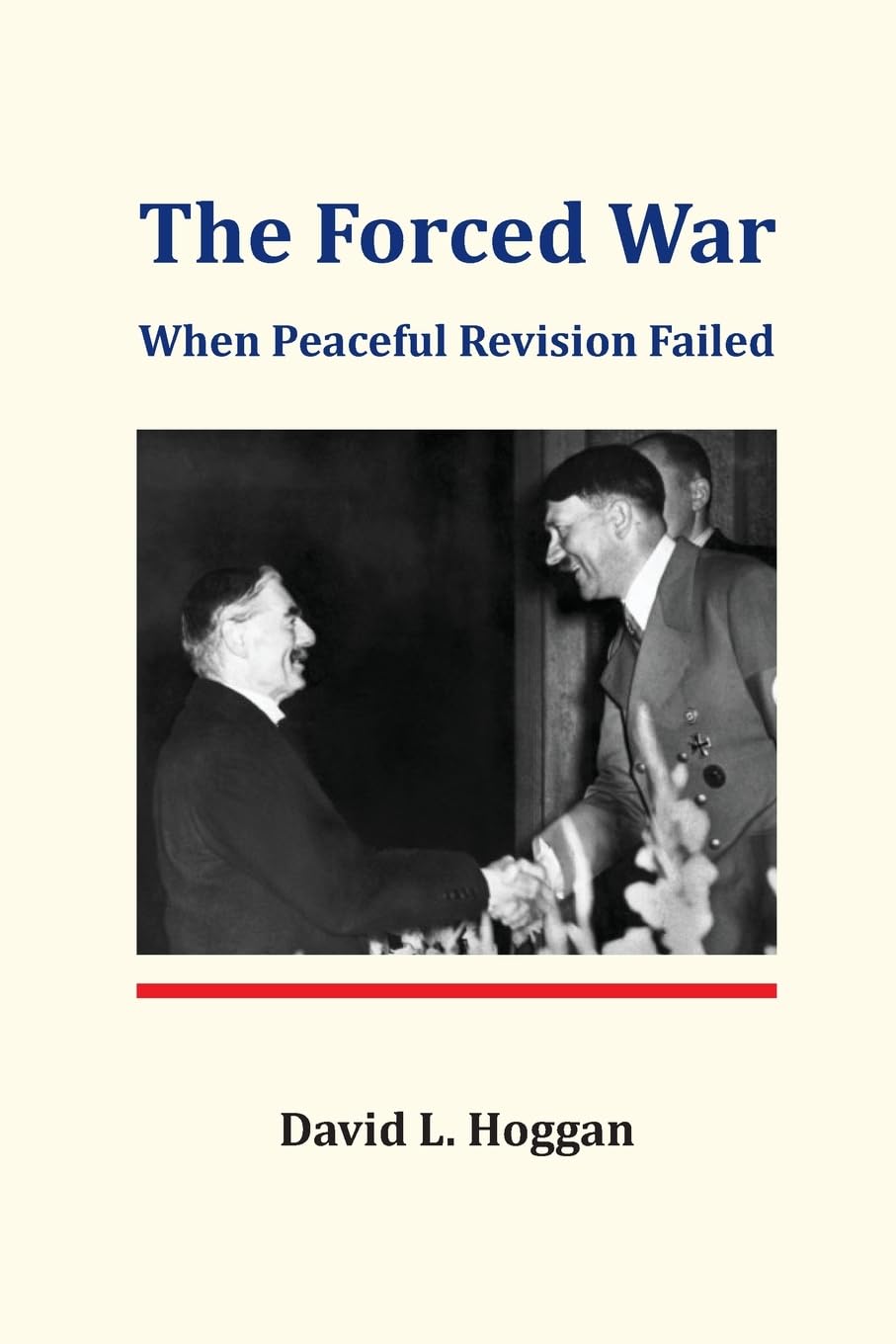
David L. Hoggan’s The Forced War
Part 1

F. Roger Devlin

2,781 words

Part 1 of 5 (Part 2 here)

David L. Hoggan
The Forced War: When Peaceful Revision Failed, 2nd ed.
Newport Beach, Calif.: Institute for Historical Review, 2023

David Hoggan (1923-1988) was an American historian who received his doctorate from Harvard University in 1948 with a dissertation on The Breakdown of German-Polish Relations in 1939. The influential and well-respected historian Harry Elmer Barnes was so impressed with it that he encouraged Hoggan to expand it into the book currently under review.It first appeared in 1961 in a German translation (Der Erzwungene Krieg). With its thesis that Hitler and Germany did not bear primary responsibility for the outbreak of the Second World War in 1939, the work triggered predictable outrage among the West German political and cultural establishment, but met with a grateful reception from thousands of ordinary Germans. Mainstream German historians produced critiques, and were able to point out instances of questionable documentation, some of which the author later corrected. However, as German historian Kurt Glaser wrote of the controversy: “It is hardly necessary to repeat here that Hoggan was not attacked because he had erred here and there — albeit some of his errors are material — but because he had committed heresy against the creed of historical orthodoxy.”

It took another 28 years for Hoggan’s book to appear in English, as Mark Weber explains in his Introduction to this new edition:

As he was finishing work on the manuscript, the author became embroiled in a dispute with Barnes, who pleaded with Hoggan to revise or remove a few troublesome passages that, in his view, were not adequately supported by the evidence. Hoggan, proud and somewhat temperamental, refused to budge. He also quarreled with Devin-Adair, the publisher that was preparing the book for release. Because these disputes were not resolved, Devin-Adair withdrew from the project. Eventually the Institute for Historical Review obtained the rights to the book. But a devastating arson attack on the IHR’s offices in July 1984, which destroyed the book’s layout and proof sheets, art work and other key files, delayed publication several more years.

The first English edition of The Forced War finally appeared in 1989. Despite his disagreements with a few of the author’s formulations, Harry Elmer Barnes said of the book: “it not only constitutes the first thorough study of the responsibility for the causes of the Second World War, but is likely to remain the definitive revisionist work on this subject for many years.” The 1989 edition has long been out of print. This new edition has been completely reset, with a new index, photographs, map, and Introduction, as well as corrections and expansions to the appendix, bibliography, and notes.

* * *

An important consequence of the First World War was the reappearance of a sovereign Poland on the map of Europe. The new state was unenviably located between Germany and Russia — two much larger powers with a combined population eight times its own. Under such circumstances, prudence dictated the cultivating of friendly relations with at least one of these two states as insurance against possible threats from the other. Long before independence was recovered in 1918, Polish nationalists had been debating whether a pro-German or pro-Russian policy would be in the country’s best interest. As Hoggan writes, a hostile Polish policy toward both neighbors “would have been like a canary seeking to devour two cats.”

Success in foreign relations requires adaptation to constantly changing circumstances, and the author credits Marshal Józef Piłsudski, the dominant figure in interwar Poland, with the necessary flexibility. In 1933, for example, the Marshal had considered a possible preventive war against a still-weak Germany, yet by the end of that year he had given his approval for a German-Polish non-aggression pact. In March 1935 he came out in opposition to efforts to challenge Hitler’s defiance of the Versailles Treaty, believing the time when Germany might have been dealt with through intimidation had passed.

Piłsudski died in May 1935, and Hoggan characterizes his successors as epigoni: lesser figures who sought to perpetuate the Marshal’s legacy but lacked his breadth of views. Polish foreign policy became the responsibility of Piłsudski’s longtime collaborator, Col. Józef Beck, who failed to display the Marshal’s flexibility in relations with Poland’s two powerful neighbors. Unalterably opposed to any collaboration with the Soviet Union, Beck would consistently reject all overtures from Hitler. This proved to be a luxury Poland could not afford.

Ten months after Piłsudski’s death, Hitler ordered German troops into the Rhineland, which had been demilitarized under the Versailles Treaty. Polish Foreign Minister Beck responded by summoning the French ambassador and offering to attack Germany from the east if France would agree to invade from the west. It was symptomatic of what was to come. As Hoggan explains, Beck

believed that the unpopular Polish regime would acquire tremendous prestige and advantages from a military victory over Germany. His attitude illustrates the deceptiveness of the friendship between Germany and Poland during these years, which on the Polish side was pure treachery, beneath the façade.

Though revealing, the incident proved inconsequential: The French were not interested. Beck covered his tracks by having the Polish news agency issue a pro-German statement the following day.

The Versailles Treaty of 1919 was a disaster for German-speaking Central Europe. It broke up the Austro-Hungarian Empire, leaving seven million Germans in a newly-constituted Austrian rump state none of them desired, and three million more within “Czechoslovakia,” a new multi-ethnic state dominated by the Czechs. Nearly all these people would have preferred to see their lands become part of Germany, but this was forbidden by the victorious powers.

The German state itself also suffered large punitive reductions in territory under Versailles and other post-war treaties, including the annexation of Alsace-Lorraine by France, the Eupen district by Belgium, and northern Schleswig by Denmark. By far the greatest amount of territory, however, was lost to the new Polish state, including most of the provinces of Posen and West Prussia, along with the industrial region of East Upper Silesia. These regions amounted to more than 25,000 square miles — about the size of today’s Lithuania — and were home to over five million people, many of them German. The awarding of this land to Poland contravened the November 1918 armistice agreement under which Germany declared it would accept the results of self-determination in the German-Polish borderlands.

The agreement had also stipulated that Poland was to obtain access to the sea, a result which could have been achieved by granting her free harbor facilities in German ports. The Germans living there would have been glad to get the business. Instead, the Versailles Treaty assigned Poland political sovereignty over a corridor to the Baltic that cut the province of East Prussia off from the rest of Germany — without bothering to ask the local inhabitants what they thought.
You Can buy F. Roger Devlin’s Sexual Utopia in Power here.

Danzig, a medium-sized provincial German port city, was subjected to what Hoggan calls “the least defensible territorial provision of the Versailles Treaty.” Against the will of its citizens, it was detached from Germany and placed under the administration of the League of Nations. Geographically, it lay sandwiched between East Prussia and the Polish Corridor, which had the effect of exciting Polish covetousness while also preventing its satisfaction. In short, no one was happy with the arrangement.

In November 1937, Germany and Poland concluded a pact regarding their ethnic minorities in one another’s countries. It prohibited forced assimilation and restrictions on use of the mother tongue, protected peaceful ethnic associations and schools, and forbade policies of economic discrimination. The pact was especially welcome to ethnic Germans in Poland, who had been treated harshly after 1918. Hundreds of thousands had already migrated to the Reich.

It is difficult to get an accurate count of the total number of Germans living in interwar Poland at any given time. The author notes, “A critical study of the 1931 Polish census, which contained startling inaccuracies in several directions, showed that the given figure of 727,000 Germans was short of the real figure by more than 400,000.” It is even more difficult to get an idea of how many Poles lived in Germany; the German census allowed native speakers of Polish to declare themselves ethnically German if they wished, resulting in a count of fewer than 15,000 Poles in the entire country. The German government estimated there ought to have been 260,000 by objective criteria, while the Polish government alleged there were one and a half million! This last claim is certainly fanciful: Hoggan describes the German minority in Poland as “much larger.”

Unfortunately, the 1937 agreement on minorities was ignored by the Polish authorities, and subsequent months saw conditions for the German minority in Poland deteriorate rather than improve. German schools were closed and Poland’s land reform program was carried out in a manner heavily biased against German interests. In 1938, for example, Germans had to supply two-thirds of the land for confiscation and redistribution. The German government forbade newspapers to report on anti-German incidents for fear of damaging diplomatic relations with Poland.

In spite of all this, a leading member of the Polish Parliament publicly declared in April 1938 that conditions were far worse for Poles in Germany. The speech “had a disastrous effect on the attitude of the Polish masses toward the Germans in Poland, and the theme of the speech was constantly reiterated in the Polish popular press.” The German Ministry of the Interior investigated the claim and found no more than a few instances of “discrimination against Polish students and restrictions on the distribution of books by Polish cooperatives.” But this had no effect on ordinary Poles, and anti-German hostility grew.

The year 1938 witnessed two stunning diplomatic victories for Adolf Hitler which temporarily relegated German-Polish relations to the background: the annexation of Austria in March and that of the Sudetenland, or German-speaking periphery of the Czech lands, in October. Without a shot being fired, two of the Versailles Treaty’s punitive anti-German provisions were undone and ten million Germans brought into the German state.

As demonstrated by British historian A. J. P. Taylor in The Origins of the Second World War (1961), and contrary to the picture painted at the Nuremburg Trials, these were not preplanned stages in a program of conquest, but opportunistic responses to events over which Hitler had little control. For example, as late as four days before the Anschluss, or the annexation of Austria on March 12, 1938, Hitler had no plans for such an action and no idea it was going to occur. The previous month he had met with Austrian Chancellor Kurt Schuschnigg who, in Hoggan’s words,

agreed to cease persecuting Austrian National Socialists, to admit the National Socialist Austrian leader, [Arthur] Seyss-Inquart, to the Cabinet as Minister of the Interior, and to permit Hitler to broadcast a speech to Austria in return for a Schuschnigg speech to Germany.

The Austrian leader later regretted these concessions and began to consider how to repudiate them. On March 9, 1938, he announced a plebiscite on the future of Austria in just four days’ time. Voting would not to be anonymous, and “a vote-of-confidence question in Schuschnigg was to be phrased in terms as confusing and misleading as possible.” The breathtaking speed of the events which followed resulted from Schuschnigg’s insistence on holding his plebiscite within such a short time.

Schuschnigg was informed by Seyss-Inquart on March 11, 1938, at 10:00 a.m., that he must agree within one hour to revoke the fraudulent plebiscite, and agree to a fair and secret-ballot plebiscite within three to four weeks, on the question of whether Austria should remain independent or be reunited with the rest of Germany. Otherwise the German Army would occupy Austria. The failure of a reply within the specified time produced a new ultimatum demanding that Seyss-Inquart succeed Schuschnigg as Chancellor of Austria.

The German army entered Austrian territory to install Seyss-Inquart, and the Austrian public’s ecstatic reaction convinced Hitler to simply annex the country the following day.

The Czech crisis later that year presented important analogies to what had happened in Austria. At Versailles, the Czech leaders had assured the victorious powers that they intended to give their new state of Czechoslovakia a Swiss-style decentralized constitution involving a loose confederation between the various nationalities. What they went on to create was a kind of Czech empire in which their own group wielded power over all the others, Slovaks included. Accordingly, the annexation of Austria produced wild excitement among three million disaffected Sudeten Germans. By the end of March, their leader, Konrad Heinlein, was “pleading for the curtailment of all propaganda efforts to arouse the Sudeten people who were already too much aroused.” Heinlein collaborated with the German leadership to formulate a list of demands which he announced on April 24.

The Czech leadership was placed in an awkward position, and on May 21 they made a tactical blunder not unlike Schuschnigg’s announcement of a fraudulent plebiscite: They ordered partial mobilization based on a false accusation that German troops were concentrating on the Czech border. They hoped that “the resulting emotional confusion would commit the British and the French to the Czech position before a policy favoring concessions to the Sudeten Germans could be implemented.” This did not happen, and British military experts soon determined there were no hostile German troop concentrations. The fiasco led to Hitler’s decision to force the Sudeten issue that same year.

A British fact-finding mission to Czechoslovakia

completed its labors early in September 1938, and reported that the main difficulty in the Sudeten area had been the disinclination of the Czechs to grant reforms. This development was accompanied by the final rupture of negotiations between the Sudeten German and Czech leaders. It was evident that the crisis was close at hand.

The Czech and German leaders traded defiant messages, and British Prime Minister Neville Chamberlain made two abortive efforts to intercede with Hitler on September 15 and 23-24. Hitler was determined to resolve the matter militarily on October 1. However, on September 28 Italy launched a last-minute mediation effort to which Hitler agreed.

The British Ambassador was able to telephone London at 3:15 p.m. that Hitler wished to invite Chamberlain, [French Prime Minister] Daladier, and Mussolini to Munich the next day to discuss a peaceful solution of the Czech problem. The British Prime Minister received this news while delivering a tense speech to the House of Commons on the imminent danger of war. When he announced the news of Hitler’s invitation and his intention to accept, he received the greatest ovation in the history of the British Parliament.

The events which followed have been among the most misrepresented and mythologized of the twentieth century. At the Munich Conference, Britain and France declined to go to war over the Sudetenland, and all peripheral districts of the Czech lands with a German population of over 50% were assigned to Germany. Hoggan writes:

Never was an agreement more clearly in the interest of all Powers concerned. Great Britain had won time to continue to gain on the German lead in aerial armament. France extricated herself from the danger of a desperate war after having abandoned her military hegemony in Europe in 1936 [when she permitted Germany’s occupation of the Rhineland]. Italy was spared the danger of involvement in a war when she was woefully unprepared. Germany won a great bloodless victory in her program of peaceful territorial revision. By resisting the temptation to fight merely because she had the momentary military advantage, she increased her stature and prestige.

Contrary to legend, there was never any split within the British leadership, either at the time of the Munich Conference or later, between the advocates of craven “appeasement” and manly resistance to “Nazi aggression.” Britain faced no “Nazi aggression.” As an American embassy official in Berlin noted that same year, “an English-German understanding is Hitler’s first principle of diplomacy in 1938, just as it was in 1934, or in 1924 when he wrote Mein Kampf.”

An anti-German stance predominated within the British Conservative Party at this time, including among those later referred to contemptuously as “appeasers.” The only serious disagreement focused on whether to go to war with Germany immediately or to play for time. Chamberlain once remarked that “one should select a favorable hour to stop Hitler rather than to permit the German leader to pick both the time and the place for the conflict” — hardly the view of a man willing to sacrifice all other considerations to the maintenance of peace.

As Hoggan notes, one reason Britain acquiesced in the Munich settlement was her perceived need to beef up aerial munitions before the final showdown that was already being planned. She did so, in fact, over the next 11 months. Whereas Germany possessed mainly light and medium bombers for tactical operations in support of ground troops, the British armaments program emphasized heavy bombers that were capable of attacking civilian objectives far behind the front. British targeting of Germany’s women and children was planned at least as early as 1936.

Hitler the Peacemaker David L. Hoggan’s The Forced War Part 1

Hitler%20the%20Peacemaker%0ADavid%20L.%20Hogganand%238217%3Bs%20The%20Forced%20War%0APart%201%0A

Share

  • Gab

Enjoyed this article?

Be the first to leave a tip in the jar!

Instant Echeck GreenPay™

*  *  *

Counter-Currents has extended special privileges to those who donate at least $10/month or $120/year.

  1. Donors will have immediate access to all Counter-Currents posts. Everyone else will find that one post a day, five posts a week will be behind a “paywall” and will be available to the general public after 30 days. Naturally, we do not grant permission to other websites to repost paywall content before 30 days have passed.
  2. Paywall member comments will appear immediately instead of waiting in a moderation queue. (People who abuse this privilege will lose it.)
  3. Paywall members have the option of editing their comments.
  4. Paywall members get an Badge badge on their comments.
  5. Paywall members can “like” comments.
  6. Paywall members can “commission” a yearly article from Counter-Currents. Just send a question that you’d like to have discussed to [email protected]. (Obviously, the topics must be suitable to Counter-Currents and its broader project, as well as the interests and expertise of our writers.)

To get full access to all content behind the paywall, please visit our redesigned Paywall page. 

Related

  • Nietzsche & Race

  • The Remigration Movement Solidifies 

  • Could Fascism Work?

  • Finding Atlantis Part 4

  • Barbara Will’s Unlikely Collaboration

  • Curtis Dozier’s The White Pedestal

  • Counter-Currents Radio Podcast No. 686

  • Counter-Currents in Rome

Tags

A. J. P. TaylorAdolf HitlerAustriaAustro-Hungarian Empirebook reviewsBritain in the Second World WarCzechoslovakiaDanzigDavid HogganDavid L. HogganEast PrussiaF. Roger DevlinFirst World WarFranceGermans in PolandGermanyHarry Elmer BarnesInstitute for Historical ReviewJózef BeckJózef PiłsudskiKonrad HeinleinMark WeberMunich AgreementNeville ChamberlainPolandSecond World WarSudeten Germansthe Anschlussthe First World WarThe Forced Warthe origins of the Second World Warthe Second World Warthe Sudetenlandthe Treaty of VersaillesWorld War IWorld War IIWorld War Two

2 comments

  1. Antipodean says:
    December 11, 2023 at 5:59 pm

    Thank you for the review. The reprinting of Hoggan’s magnum opus is great news for historical revision. Unfortunately the on-line English versions that I have seen lacked footnotes and given nearly every paragraph in the book contradicts some dearly held shibboleth of the court historians, the book is somewhat useless without them. I notice Dr Devlin hasn’t provided any either and for contestable claims about German troops on borders, surprise invasions/liberations and possibly convenient excuses about the absence of newspaper reports on Polish abuses. I am merely anticipating the rebuttal and I certainly hope that Hoggan’s work stands up to the intense scrutiny it will surely attract if it gains any popularity.

    0
    0
  2. Scott says:
    December 11, 2023 at 10:29 pm

    A pretty straightforward explanation of a complex book about a very complicated and misunderstood subject.

    🙂

    0
    0

Comments are closed.

If you have a Subscriber access,
simply login first to see your comment auto-approved.

Note on comments privacy & moderation

Your email is never published nor shared.

Comments are moderated. If you don't see your comment, please be patient. If approved, it will appear here soon. Do not post your comment a second time.

Upcoming podcasts
  • Rob Rundo on Counter-Currents Radio

    Rob Rundo on Counter-Currents Radio

    Counter-Currents Radio

    Sat, Jun 13th — 3 pm EST / 9 pm CET
  • Daniel Tyrie on Counter-Currents Radio

    Daniel Tyrie on Counter-Currents Radio

    Counter-Currents Radio

    Sat, Jun 20th — 3 pm EST / 9 pm CET

Writers of May

(2 votes) Morris van de Camp David M. Zsutty Derek Stark Jayant Bhandari Greg Johnson

Articles of May

Heidegger on Nietzsche, Part One by Collin Cleary The Lunch Wars by David M. Zsutty 2 votes
    • The Bitter End of Western Metaphysics:
      Heidegger on Nietzsche, Part Three

      Collin Cleary

    • Uncivil War

      Mark Gullick

      12

    • Exclusive Interview with Karel Veliky:
      The Final Chapter in the Film Series! Part II

      Ondrej Mann

    • Happy Birthday to Us!

      Greg Johnson

      6

    • Zsutty’s Maximum

      David M. Zsutty

      12

    • Exclusive Interview with Karel Veliky:
      The Final Chapter in the Film Series! Part I

      Ondrej Mann

      2

    • The Union Jackal, June 2026

      Mark Gullick

      23

    • The Inferiority Behind Immigrant Superiority

      Jayant Bhandari

      15

    • Counter-Currents Radio Podcast No. 690
      Greg Johnson & David Zsutty Discuss Current Things: AI, Henry Nowak, the Iran Crisis, & More

      Counter-Currents Radio

      5

    • Collin Cleary: What Rome Means to Me

      Collin Cleary

      4

    • Paul Krugman: Closet Bolshevik

      Spencer J. Quinn

      16

    • Fugue of Ideas:
      Ibram X. Kendi’s Chain of Ideas

      Greg Johnson

      18

    • Based Blacks

      Lipton Matthews

      11

    • Black Intellectual Fatigue

      Derek Stark

      36

    • Why White Advocates Should Avoid “Based Blacks”

      Dani Vypont

      24

    • Nietzsche & Race

      Mark Gullick

    • Editor’s Update
      Rob Rundo Rescheduled to Next Week on Counter-Currents Radio;
      Tonight Greg Johnson & David Zsutty Answer Your Questions;
      Fundraiser Update & a New $20,000 Matching Grant

      Greg Johnson

    • The Counter-Currents 2026 Fundraiser
      Lifetime Subscriber Welcome Packages Extended

      Greg Johnson

    • Nationalism This Week
      Who’s Looking Back?

      Greg Johnson

      29

    • China’s Threat to American Security:
      Food, Farmland, Foreign Control, & Energy Policy

      Lipton Matthews

      5

    • The Bitter End of Western Metaphysics:
      Heidegger on Nietzsche, Part Two

      Collin Cleary

      16

    • The Killing of Henry Nowak

      Mark Gullick

      38

    • The Crisis of Chinese Technology Thieves

      Morris van de Camp

      1

    • The Strange World of Gender Bender Fiction:
      & What This Genre Tells Us About Autosexuality

      Dani Vypont

      3

    • Watching the Watchers:
      The Dark Triad Question

      David M. Zsutty

      14

    • The Remigration Movement Solidifies

      F. Roger Devlin

      1

    • Casting Aspersions:
      The Fatal Consequences of Race-Swapped Casting, From Helen of Troy to Henry of Southampton

      Steven Tucker

      20

    • The Murder of Henry Nowak

      Millennial Woes

      23

    • Don’t Forget to Vote in Our Writer & Article of the Month Poll

      Greg Johnson

    • The Robot Hotdog Stand

      Greg Johnson

      37

    • Laughing Our Way to Victory

      Dave Chambers

      7

    • The Zodiac Killer

      Mark Gullick

      11

    • Jared Taylor: What Rome Means to Me

      Jared Taylor

      1

    • An Interview with Endeavour:
      My Way of Life Is an Adventure!

      Ondrej Mann

      6

    • José Pedro Zúquete’s The Identitarians

      Greg Johnson

      3

    • Editor’s Update
      Fundraiser Update & How to Watch the Remigration Summit

      Greg Johnson

      5

    • The Bitter End of Western Metaphysics:
      Heidegger on Nietzsche, Part One

      Collin Cleary

      12

    • Berlin: City of Stones

      Spencer J. Quinn

      6

    • True Folk-Horror Is Horror of Your Own Folk:
      Mark Gatiss vs the Brexit Blind Dead  

      Steven Tucker

      4

    • Counter-Currents Radio Podcast No. 689
      Thomas Massie, the America 2050 Bust, the Need for Whites to Divest from America, the AI Economic Apocalypse, & Pro-White Project Pitches to Billionaires

      Counter-Currents Radio

      7

    • Nationalism This Week
      Remigration is Inevitable, Part 3

      Greg Johnson

      27

    • Why Billionaires Should Fund White Identity Politics

      Lipton Matthews

      8

    • How Cold War Two Came About

      Morris van de Camp

      5

    • Now Available for Pre-Order at a Special Price!
      Greg Johnson’s The Philosopher Is In

      Greg Johnson

    • David Zsutty’s Elevator Pitch to a Billionaire

      David M. Zsutty

      1

    • Headbanging Lite

      Mark Gullick

      5

    • White Advocacy Past and Present

      Peter Bradley

      13

    • The Lunch Wars

      David M. Zsutty

      47

    • The Russians are Coming/The Russians are Coming

      Steven Clark

      1

    • Peak Fatigue in Fort Wayne

      Gabriel Anderson

      24

    • Adrian Roberts

      Uncivil War

      In Belfast, the police are the PSNI, not the Gardai (unless I am hopelessly misinformed).

    • Adrian Roberts

      The Union Jackal, June 2026

      If stopping Andy Burnham is the top priority, then the parties of 'the right' need to take some...

    • Jocelynn Cordes

      Uncivil War

      The immigration policies may be foolish, but they are conducted with fervor. But why fervor?

    • Jocelynn Cordes

      Uncivil War

      An army heavy on gays and chicks are hardly Mongol hordes.  Gold.

    • Adrian Roberts

      Zsutty’s Maximum

      Counter-Currents would not need to exist if whites were never mean to other whites.

    • Mark Gullick

      Uncivil War

      I would say genocidal immigration rather than suicidal, but your point holds. Even Blackadder knew...

    • ArminiusMaximus

      Uncivil War

      Thank you. I neglected to mention that the main grocery store that was by my hotel had two security...

    • Mark Gullick

      The Union Jackal, June 2026

      Good point well made. That said, as far as I am aware, the only big tennis match ever to be halted...

    • Dominic Fox

      Zsutty’s Maximum

      Thank you! This one will be added to my list. I've always been obsessed with condensing insights...

    • Mark Gullick

      Uncivil War

      One of many things I like about CC is that you can read whole essays in the comments section. You...

    • ArminiusMaximus

      Uncivil War

      I was just in Brescia where I counted at least 5 Chinese owned cafes. One used the mud world as...

    • Thomas Johnson

      Uncivil War

      "Recently, [Professor Betz] made an interesting comment. If civil war or something similar starts in...

    • Joe Gould

      Uncivil War

      Good. There is not a branch of our great family that ought to be quiet in the face of White genocide...

    • Mark Gullick

      Uncivil War

      I absolutely agree. There is much talk of the "people-smuggling gangs", but no one ever sees one....

    • Fred C. Dobbs

      Uncivil War

      I highly doubt that the retarded Sudanese man figured out how to game the immigration system on his...

    • Elear

      Uncivil War

      I've seen claims on social media that the rioters are predominantly Scots-Irish, not Irish. Same for...

    • Ondrej Mann

      Exclusive Interview with Karel Veliky:
      The Final Chapter in the Film Series! Part I

      This is a matter of aesthetics and historical context, and that is always problematic. As for the...

    • Greg Johnson

      Happy Birthday to Us!

      Thank you! The Philosopher Is In is now shipping. Take a look and let me know what you think

    • Joe Gould

      Zsutty’s Maximum

      Uniquely, Whites typically favor morally defined in-groups.* That means you can get us to treat you...

    • CC Reader

      Happy Birthday to Us!

      Happy birthday

    • Earth Day Special

      John Morgan

      12

    • A Robertson Roundup
      Remembering Wilmot Robertson
      (April 16, 1915 – July 8, 2005)

      Margot Metroland

      13

    • The Paranoid Style in White Nationalism

      Greg Johnson

      30

    • Join the Dance!

      Andrew Hamilton

      1

    • We Can’t Save the Earth Without Reducing African Birth Rates

      James Dunphy

      36

    • “I’m Not a Conspiracy Theorist, but . . .”:
      Jeffrey Epstein’s Death Gives New Life to “Conspiracy Theories”

      Greg Johnson

      22

    • Sylvia Plath: Stasis in Darkness

      Vic Olvir

      17

    • Vanguardism, Vantardism, & Mainstreaming

      Greg Johnson

      80

    • Aviation, Geography, & Race

      Charles Lindbergh

      3

    • Some Thoughts on Yule

      Collin Cleary

      4

    • Living in Truth:
      A Yuletide Homily

      Jef Costello

      7

    • John Kennedy Toole’s A Confederacy of Dunces

      Greg Johnson

      20

    • On Aleksandr Solzhenitsyn’s Warning to the West

      Spencer J. Quinn

      7

    • Elitism, British Modernism, & Wyndham Lewis

      Jonathan Bowden

      6

    • Philip K. Dick’s Do Androids Dream of Electric Sheep? as Anti-Semitic/Christian-Gnostic Allegory

      Greg Johnson

      20

    • “Conspiracy Theory” or Conspiracy?

      Andrew Hamilton

      21

    • Remembering H. P. Lovecraft
      (August 20, 1890–March 15, 1937)

      Greg Johnson

      3

    • Who Are We?
      Nordics, Aryans, & Whites

      Greg Johnson

      71

    • Remembering William Gayley Simpson
      (July 23, 1892–December 31, 1990)
      A Pleasant Afternoon with Harriet & Bill Simpson

      Margot Metroland

      18

    • Here are the Young Men
      Remembering Ian Curtis
      (July 15, 1956–May 18, 1980)

      Mark Gullick

      18

    • Percy Grainger
      Artist of the Right

      Alex Graham

      7

    • Remembering Revilo Oliver
      (July 7, 1908–August 20, 1994)

      Greg Johnson

      18

    • The Meaning of July 4th for the White Man

      Gregory Hood

      13

    • The Front National’s Evolution

      Bruno Mégret

    • Merwin K. Hart
      Forgotten American Hero & Man of the Right

      Morris van de Camp

      10

    • George Orwell’s Nineteen Eighty-Four

      Jonathan Bowden

      8

    • Carleton S. Coon
      Scientist & Reluctant White Advocate

      Morris van de Camp

      3

    • The Kwanzaa Absurdity Will Be Dwarfed by Juneteenth

      Robert Hampton

      10

    • Stravinsky

      Alex Graham

      7

    • Like the Roman:
      Remembering Enoch Powell (1912-1998)

      Mark Gullick

      23

    • Sexually Incontinent on the Indian Subcontinent:
      Who Rapes More Animals, Indians or Pakistanis? The Battle Continues!

      Steven Tucker

      3

    • Neo-Fascism in Film
      Part 5

      Karel Veliky

      15

    • The Game of Tarot

      Mark Gullick

      2

    • Institutions Cannot Be Transplanted

      Jayant Bhandari

      5

    • Jonathan Bowden’s Deliverance
      Part 5

      Jonathan Bowden

    • Crosstown Traffic:
      Jimi Hendrix & The Post-War Rock ‘N’ Roll Revolution

      Mark Gullick

      1

    • Slaves from the North:
      Finns & Karelians in the East European Slave Trade, 900–1600

      Lipton Matthews

      14

    • Neo-Fascism in Film
      Part 4

      Karel Veliky

      2

    • David Lean’s A Passage to India

      Spencer J. Quinn

      1

    • Elites are Essential to Development

      Lipton Matthews

      7

    • Jonathan Bowden’s Deliverance
      Part 4

      Jonathan Bowden

    • Neo-Fascism in Film
      Part 3

      Karel Veliky

      6

    • E. M. Forster’s A Passage to India & the Indian Mentality

      Spencer J. Quinn

      25

    • Jonathan Bowden’s Deliverance
      Part 3

      Jonathan Bowden

    • The Rest Is Silence
      Heidegger’s Quietism

      Mark Gullick

      2

    • Dispelling the Historical Fallacy of Indian Nationalism

      Lipton Matthews

      8

    • Neo-Fascism in Film
      Part 2

      Karel Veliky

      8

    • Jonathan Bowden’s Deliverance
      Part 2

      Jonathan Bowden

    • Life of a Klansman

      Mark Gullick

      8

    • Jonathan Bowden’s Deliverance, Part 1

      Jonathan Bowden

    • Decolonial Ideas are Holding Back Developing Countries

      Lipton Matthews

      8

    • Neo-fascism in Film, Part 1

      Karel Veliky

      21

    • Jonathan Bowden’s Onslaught, Part 8
      Divigations on Decadence

      Jonathan Bowden

    • Jonathan Bowden’s Onslaught, Part 7
      Intrigues in the National Front

      Jonathan Bowden

      1

    • Rotten to the Core

      Mark Gullick

      8

    • Strauss on Husserl’s “Philosophy as Rigorous Science”

      Greg Johnson

    • Jonathan Bowden’s Onslaught, Part 6
      Francis Bacon & Right-Wing Nihilism

      Jonathan Bowden

    • London After (& Before) Midnight:
      Aleister Crowley, The Landlord’s Worst Nightmare

      James J. O'Meara

      2

    • Jonathan Bowden’s Onslaught, Part 5
      The Post-War British Far Right

      Jonathan Bowden

    • No Rules: Rollerball

      Mark Gullick

      4

    • András László
    • Derek Hawthorne
    • Beau Albrecht
    • Alain de Benoist
    • Kerry Bolton
    • Jonathan Bowden
    • Collin Cleary
    • Jef Costello
    • Savitri Devi
    • Julius Evola
    • Jim Goad
    • Gregory Hood
    • Juleigh Howard-Hobson
    • Greg Johnson
    • Charles Krafft
    • Anthony M. Ludovici
    • Trevor Lynch
    • H. L. Mencken
    • J. A. Nicholl
    • James J. O’Meara
    • Christopher Pankhurst
    • Tito Perdue
    • Michael Polignano
    • Spencer J. Quinn
    • Fenek Solère
    • Irmin Vinson
    • Leo Yankevich
    • Francis Parker Yockey
    • Multiple authors
  • Editor-in-Chief

    • Greg Johnson, Ph.D.

    Featured Writers

    • Beau Albrecht
    • Gunnar Alfredsson
    • Collin Cleary, Ph.D.
    • Jef Costello
    • Morris V. de Camp
    • F. Roger Devlin, Ph.D.
    • Stephen Paul Foster, Ph.D.
    • Jim Goad
    • Alex Graham
    • Mark Gullick, Ph.D.
    • Greg Johnson, Ph.D.
    • Travis LeBlanc
    • Trevor Lynch
    • Margot Metroland
    • James J. O’Meara
    • Angelo Plume
    • Spencer J. Quinn
    • Fred Reed
    • Clarissa Schnabel
    • Michael Walker
    • David M. Zsutty

    Frequent Writers

    • Asier Abadroa
    • Aquilonius
    • Alain de Benoist
    • Kerry Bolton, Ph.D.
    • Dave Chambers
    • Steven Clark
    • James Dunphy
    • Endeavour
    • Richard Houck
    • Jason Kessler
    • Titus Livius
    • Ondrej Mann
    • Lipton Matthews
    • Mark Mazari
    • John Morgan
    • Jaroslav Ostrogniew
    • Kathryn S.
    • Christian Secor
    • Anne Wilson Smith
    • Thomas Steuben
    • William De Vere
    • Kenneth Vinther
    • Max West

    Classic Authors

    • Maurice Bardèche
    • Jonathan Bowden
    • Julius Evola
    • Guillaume Faye
    • Ernst Jünger
    • Kevin MacDonald, Ph.D.
    • D. H. Lawrence
    • Charles Lindbergh
    • Jack London
    • H. P. Lovecraft
    • Anthony M. Ludovici
    • Sir Oswald Mosley
    • National Vanguard
    • Friedrich Nietzsche
    • Revilo Oliver
    • William Pierce
    • Ezra Pound
    • Saint-Loup
    • Savitri Devi
    • Carl Schmitt
    • Miguel Serrano
    • Oswald Spengler
    • P. R. Stephensen
    • Jean Thiriart
    • John Tyndall
    • Dominique Venner
    • Leo Yankevich
    • Francis Parker Yockey

    Other Authors

    • Howe Abbott-Hiss
    • Michael Bell
    • Giles Corey
    • Jack Donovan
    • Richardo Duchesne, Ph.D.
    • Emile Durand
    • Guillaume Durocher
    • Mark Dyal
    • Tom Goodroch
    • Andrew Hamilton
    • Robert Hampton
    • Huntley Haverstock
    • Derek Hawthorne
    • Gregory Hood
    • Juleigh Howard-Hobson
    • Alexander Jacob
    • Ruuben Kaalep
    • Tobias Langdon
    • Julian Langness
    • Patrick Le Brun
    • G A Malvicini
    • John Michael McCloughlin
    • Millennial Woes
    • Michael O’Meara
    • Christopher Pankhurst
    • Michael Polignano
    • J. J. Przybylski
    • Quintilian
    • Edouard Rix
    • C. B. Robertson
    • C. F. Robinson
    • Herve Ryssen
    • Alan Smithee
    • Fenek Solere
    • Ann Sterzinger
    • Robert Steuckers
    • Tomislav Sunic
    • Donald Thoresen
    • Marian Van Court
    • Irmin Vinson
    • Book Reviews
    • Movie Reviews
    • TV Reviews
    • Music Reviews
    • Art Criticism
    • Graphic Novels & Comics
    • Video Game Reviews
    • Fiction
    • Poems
    • Interviews
    • Videos
    • English Translations
    • Other Languages
      • Arabic
      • Bulgarian
      • Croatian
      • Czech
      • Danish
      • Dutch
      • Estonian
      • Finnish
      • French
      • German
      • Greek
      • Hungarian
      • Italian
      • Lithuanian
      • Norwegian
      • Polish
      • Portuguese
      • Romanian
      • Russian
      • Slovak
      • Spanish
      • Swedish
      • Ukrainian
    • Commemorations
    • Why We Write
  • Archives
  • Top 100 Commenters
  • The Looney Bin
Sponsored Links
Europa.com Above Time Coffee Antelope Hill Publishing Paul Waggener IHR-Store Spencer J. Quinn American Renaissance Jim Goad The Occidental Observer
Donate Now Mailing list
Books for sale
  • The Philosopher Is In
  • Sexual Utopia in Power (Expanded Edition)
  • In Defense of Prejudice
  • Loving Our Own
  • Tyranny & Wisdom
  • The Populist Moment
  • Is America Doomed?
  • To all books
Copyright © 2026 Counter-Currents Publishing, Ltd.

Paywall Access


Please enter your email address.

Lost your password?

Edit your comment

Writer & Article of the Month May 2026

Voting for this month has concluded. Here are the final results!

Top Writers

  • #1 Morris van de Camp 2 votes
  • #2 David M. Zsutty 2 votes
  • #3 Derek Stark 2 votes
  • #4 Jayant Bhandari 2 votes
  • #5 Greg Johnson 2 votes
  • #6 Jared Taylor 1 vote
  • #7 Collin Cleary 1 vote
  • #8 Spencer J. Quinn 1 vote
  • #9 Mark Gullick 1 vote
  • #10 Lipton Matthews 1 vote
  • #11 Keith Woods 1 vote
  • #12 Steven Tucker 1 vote

Top Articles

  • #1 Heidegger on Nietzsche, Part One 2 votes
  • #2 The Lunch Wars 2 votes
  • #3 The Ghost of the Confederacy 1 vote
  • #4 Lothrop Stoddard’s The Revolt Against Civilization 1 vote
  • #5 Could Fascism Work? 1 vote
  • #6 Jared Taylor's Elevator Pitch to a Billionaire 1 vote
  • #7 Predation Wearing the Mask of Civilization 1 vote
  • #8 Peak Fatigue in Fort Wayne 1 vote
  • #9 Keith Wood's Elevator Pitch to a Billionaire 1 vote
  • #10 Do You Want to Play a Game? 1 vote
  • #11 Why Billionaires Should Fund White Identity Politics 1 vote
  • #12 The 1970s: The Golden Age of Hijacking 1 vote
  • #13 True Folk-Horror Is Horror of Your Own Folk 1 vote
  • #14 Finding Atlantis Part 4 1 vote
  • #15 Berlin: City of Stones 1 vote

Total votes cast: 17