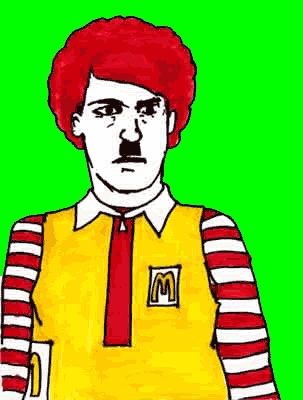
In the previous entry of this two-part series, we examined how, now that 80 years have passed since the end of WWII, the face and image of Adolf Hitler have increasingly become a kind of easily-recognized McDonald’s-type advertising logo, whose meaning is now wholly empty to many of those who encounter it. (more…)
Tag: World War Two
-
New Europe
It is beyond our scope to provide even a brief overview of the state of cinema in each European country. We can only note that in Belgium, the Netherlands, Norway, Denmark, and the Balkan countries, film production remained modest even in the pre-war years [1] and that while American and French films dominated continental Europe before the war, they were replaced by German and Italian films during the war. (more…)
-
I regularly take part in online surveys to earn a bit of cash on the side. Now, mostly it’s boring, standard surveys about some new toothpaste or the public image of insurance companies and banks. But ever so often there are political polls (especially before elections, naturally), which I always enjoy, or you learn about new films or new developments on streaming platforms ahead of time. (more…)
-
The familiar narrative surrounding World War Two involves a main theater of war in Europe and Russia, with a late intervention from the USA. But it was, of course, a World War, with fighting taking place across Africa, Asia, and Latin America. Much of the world was involved in some way. Even former socialist utopia Sweden, who supposedly remained neutral throughout the war, was not really as uninvolved as it would like to have the world believe. (more…)
-
In America, Jews and commercial interests have made it taboo for whites to express any solidarity with their race or ethnicity. In this vacuum, a weird sort of career-based tribalism has emerged. Foremost of these is solidarity among police officers. It’s not exactly an implicit white identity since minorities except for Asians are just about as likely to be cops. (more…)
-
Editor’s Note: March 31st marks the 116th birthday of Robert Brasillach, the French journalist, novelist, film historian, and man of the right who was sentenced to death and executed by firing squad for “intellectual crimes” he was alleged to have committed as a German collaborator during the Second World War. The translation below is offered as a commemoration, and links to other resources regarding Brasillach’s life and work are at the end. (more…)
-
3,818 words
There’s a cloud[1] over nationalism. As soon as you say that nations should put their own citizens and interests first, people immediately raise the specter of wars and genocides. Since the Second World War, National Socialism and the Holocaust are always evoked. But before the Second World War, anti-nationalists evoked the horrors of the First World War. Before that, it was the Napoleonic Wars, and before that catastrophes like the Seven Years’ War, the War of the Austrian Succession, the War of the Spanish Succession, the English Civil Wars, and the Thirty Years’ War. (more…)
-
“Ah, that deceit should steal such gentle shape,
And with a virtuous visor hide deep vice.”William Shakespeare, Richard III
Archeology: “the study of human history and prehistory through the excavation of sites and the analysis of artifacts and other physical remains.” (more…)
-

Ysselsteyn War Cemetery. Image courtesy of Wikimedia Commons
1,568 words

Ysselsteyn War Cemetery. Image courtesy of Wikimedia Commons
I have contemplated writing about this for a while now. “What’s the point?” I thought to myself. “We all know the drill.” But it continues to rankle. Which, I guess, was exactly the purpose. (more…)
-
2,746 words
Part 5 of 5 (Part 1 here, Part 4 here)
A German war with Poland was now a certainty, but a new continental war involving Britain and France was not. The most important obstacle to the widening of the conflict was that Britain quietly viewed French participation as an indispensable precondition of her own involvement, and the French had not committed themselves to action against Poland. (more…)
-
1,907 words
Part 4 of 5 (Part 1 here, Part 3 here, Part 5 here)
Hitler’s cancellation of military operations for August 26 left him with only five days before September 1, after which, according to his generals, a military campaign in Poland would no longer be feasible. If war was to be prevented, it had to be done within this time. (more…)
-

Joseph Stalin and Joachim von Ribbentrop during the signing of the German-Soviet Non-Aggression Pact on August 23, 1939.
1,852 words
Part 3 of 5 (Part 1 here, Part 2 here, Part 4 here)
By August 1939, everyone understood that a war between Germany and Poland was extremely probable. The great question was whether it might still be prevented from developing into a general European war. Hitler was under an important time constraint: since October rains transform Poland into a sea of mud, German military leaders warned him it would be unsafe to postpone the launch of hostilities past September 1. (more…)
-
4,041 words
Part 2 of 5 (Part 1 here, Part 3 here)
Given that both the United States and the Soviet Union were far larger and more powerful than Germany, and that the British themselves were still presiding over an enormous empire, one may wonder why Britain’s leadership was in such agreement on the supposedly urgent need to resist a far smaller power’s efforts to consolidate more of the German-speaking population of Central Europe within her borders. (more…)