Counter-Currents
  • Advertise
  • Private Events
  • T&C
  • About
  • Contact
  • RSS
    • Main feed
    • Podcast feed
    • Videos feed
    • Comments feed
  • Welcome
  • Webzine
  • Books
  • Merch
  • Podcasts
  • Videos
  • Donate
  • Patrons
  • Subscribe
  • Crypto

LEVEL2

Donate Now Mailing list
Upcoming podcasts
  • Rob Rundo on Counter-Currents Radio

    Rob Rundo on Counter-Currents Radio

    Counter-Currents Radio

    06/13/2026 — 3 pm EST / 9 pm CET
  • Daniel Tyrie on Counter-Currents Radio

    Daniel Tyrie on Counter-Currents Radio

    Counter-Currents Radio

    06/20/2026 — 3 pm EST / 9 pm CET

Writers of May

(2 votes) Morris van de Camp David M. Zsutty Derek Stark Jayant Bhandari Greg Johnson

Articles of May

Heidegger on Nietzsche, Part One by Collin Cleary The Lunch Wars by David M. Zsutty 2 votes
  • Welcome
  • Webzine
  • Books
  • Merch
  • Podcasts
  • Videos
  • Donate
  • Patrons
  • Subscribe
  • Crypto
    • Zsutty’s Maximum

      David M. Zsutty

    • Exclusive Interview with Karel Veliky:
      The Final Chapter in the Film Series! Part I

      Ondrej Mann

    • The Union Jackal, June 2026

      Mark Gullick

      15

    • The Inferiority Behind Immigrant Superiority

      Jayant Bhandari

      12

    • Counter-Currents Radio Podcast No. 690
      Greg Johnson & David Zsutty Discuss Current Things: AI, Henry Nowak, the Iran Crisis, & More

      Counter-Currents Radio

      4

    • Collin Cleary: What Rome Means to Me

      Collin Cleary

      4

    • Paul Krugman: Closet Bolshevik

      Spencer J. Quinn

      14

    • Fugue of Ideas:
      Ibram X. Kendi’s Chain of Ideas

      Greg Johnson

      18

    • Based Blacks

      Lipton Matthews

      10

    • Black Intellectual Fatigue

      Derek Stark

      36

    • Why White Advocates Should Avoid “Based Blacks”

      Dani Vypont

      23

    • Nietzsche & Race

      Mark Gullick

    • Editor’s Update
      Rob Rundo Rescheduled to Next Week on Counter-Currents Radio;
      Tonight Greg Johnson & David Zsutty Answer Your Questions;
      Fundraiser Update & a New $20,000 Matching Grant

      Greg Johnson

    • The Counter-Currents 2026 Fundraiser
      Lifetime Subscriber Welcome Packages Extended

      Greg Johnson

    • Nationalism This Week
      Who’s Looking Back?

      Greg Johnson

      29

    • China’s Threat to American Security:
      Food, Farmland, Foreign Control, & Energy Policy

      Lipton Matthews

      5

    • The Bitter End of Western Metaphysics:
      Heidegger on Nietzsche, Part Two

      Collin Cleary

      16

    • The Killing of Henry Nowak

      Mark Gullick

      38

    • The Crisis of Chinese Technology Thieves

      Morris van de Camp

      1

    • The Strange World of Gender Bender Fiction:
      & What This Genre Tells Us About Autosexuality

      Dani Vypont

      3

    • Watching the Watchers:
      The Dark Triad Question

      David M. Zsutty

      14

    • The Remigration Movement Solidifies

      F. Roger Devlin

      1

    • Casting Aspersions:
      The Fatal Consequences of Race-Swapped Casting, From Helen of Troy to Henry of Southampton

      Steven Tucker

      20

    • The Murder of Henry Nowak

      Millennial Woes

      23

    • Don’t Forget to Vote in Our Writer & Article of the Month Poll

      Greg Johnson

    • The Robot Hotdog Stand

      Greg Johnson

      37

    • Laughing Our Way to Victory

      Dave Chambers

      7

    • The Zodiac Killer

      Mark Gullick

      11

    • Jared Taylor: What Rome Means to Me

      Jared Taylor

      1

    • An Interview with Endeavour:
      My Way of Life Is an Adventure!

      Ondrej Mann

      6

    • José Pedro Zúquete’s The Identitarians

      Greg Johnson

      3

    • Editor’s Update
      Fundraiser Update & How to Watch the Remigration Summit

      Greg Johnson

      5

    • The Bitter End of Western Metaphysics:
      Heidegger on Nietzsche, Part One

      Collin Cleary

      12

    • Berlin: City of Stones

      Spencer J. Quinn

      6

    • True Folk-Horror Is Horror of Your Own Folk:
      Mark Gatiss vs the Brexit Blind Dead  

      Steven Tucker

      4

    • Counter-Currents Radio Podcast No. 689
      Thomas Massie, the America 2050 Bust, the Need for Whites to Divest from America, the AI Economic Apocalypse, & Pro-White Project Pitches to Billionaires

      Counter-Currents Radio

      7

    • Nationalism This Week
      Remigration is Inevitable, Part 3

      Greg Johnson

      27

    • Why Billionaires Should Fund White Identity Politics

      Lipton Matthews

      8

    • How Cold War Two Came About

      Morris van de Camp

      5

    • Now Available for Pre-Order at a Special Price!
      Greg Johnson’s The Philosopher Is In

      Greg Johnson

    • David Zsutty’s Elevator Pitch to a Billionaire

      David M. Zsutty

      1

    • Headbanging Lite

      Mark Gullick

      5

    • White Advocacy Past and Present

      Peter Bradley

      13

    • The Lunch Wars

      David M. Zsutty

      47

    • The Russians are Coming/The Russians are Coming

      Steven Clark

      1

    • Peak Fatigue in Fort Wayne

      Gabriel Anderson

      24

    • Keith Woods’ Elevator Pitch to a Billionaire

      Keith Woods

    • The Cruelty of Kindness

      Morris van de Camp

      9

    • Predation Wearing the Mask of Civilization

      Jayant Bhandari

      13

    • The Mandalorian & Grogu

      Trevor Lynch

      24

    • Stronza

      The Union Jackal, June 2026

      What did that cute little opossum Pogo say?

    • Collin Cleary

      The Bitter End of Western Metaphysics:
      Heidegger on Nietzsche, Part One

      This is a joke, right?

    • Vauquelin

      Why White Advocates Should Avoid “Based Blacks”

      Blacks and whites are two nations inhabiting one territory. This is the source of all problems...

    • New Flyer

      The Union Jackal, June 2026

      Was listening to a Collett stream where he went over a police policy that dictates the 'racism" must...

    • Glide Ratio 0:1

      The Union Jackal, June 2026

      As to the World Cup, lets not forget the Czechs and the Croats did not kneel for the degenerate...

    • Beau Albrecht

      The Union Jackal, June 2026

      It's just mind-boggling.  There was an orc with a bloody sword, and a White man bleeding to death. ...

    • Silva

      The Inferiority Behind Immigrant Superiority

      Understanding Human History also contains geography, but points flaws in that of Guns, Germs, and...

    • Leroy Patterson

      Second, none of these videos displayed a shred of cynicism, irony, sarcasm, or coarseness, but...

    • Nicholas

      Paul Krugman: Closet Bolshevik

      Regarding the link for: "Has Paul Krugman ever said anything anti-white?" The link directs me to...

    • Scott

      Based Blacks

      The craziest conspiracy clickbait and AI slop translates into more views and ad revenue, so that is...

    • Connor McDowell

      The Union Jackal, June 2026

      So according to the Belfast attempted  beheading victim’s insane family, having your loved ones...

    • Will Williams

      Black Intellectual Fatigue

      TiredofBoomers, addresses a Boomer: June 10, 2026  I am Mr. Tired of Boomers, not Miss… and...

    • Scott

      Based Blacks

      Tyler Robinson’s trial should be most interesting.Although it has not yet been released to the...

    • DM

      Counter-Currents Radio Podcast No. 690
      Greg Johnson & David Zsutty Discuss Current Things: AI, Henry Nowak, the Iran Crisis, & More

      Clear, incisive ... fantastic talk. The best I've heard in a while. I agree completely. I can hardly...

    • Oleg

      Fugue of Ideas:
      Ibram X. Kendi’s Chain of Ideas

      A fugue of a fugitive, Ibram Unchained. Thanks, Mr. Johnson, that's just hilarious! The fact...

    • DarkPlato

      Counter-Currents Radio Podcast No. 690
      Greg Johnson & David Zsutty Discuss Current Things: AI, Henry Nowak, the Iran Crisis, & More

      That’s interesting.  Thanks for writing these sorts of posts.  This is the type of area where I...

    • Derek Stark

      The Inferiority Behind Immigrant Superiority

      You may abhor Jews, but you're buying into the perspective that Franz Boas (a Jew) pushed into the...

    • Zarathustra

      The Inferiority Behind Immigrant Superiority

      That is not the conclusion I came to. Here is a short clip summarising the book.

    • Oleg

      Why White Advocates Should Avoid “Based Blacks”

      That's curious. I thought Buckley was a Con-Servative project from the very beginning and did not...

    • YT

      The Union Jackal, June 2026

      One of the links said JDVance was “very good friends” with this Lammy creature. I hope that isn’t...

    • Earth Day Special

      John Morgan

      12

    • A Robertson Roundup
      Remembering Wilmot Robertson
      (April 16, 1915 – July 8, 2005)

      Margot Metroland

      13

    • The Paranoid Style in White Nationalism

      Greg Johnson

      30

    • Join the Dance!

      Andrew Hamilton

      1

    • We Can’t Save the Earth Without Reducing African Birth Rates

      James Dunphy

      36

    • “I’m Not a Conspiracy Theorist, but . . .”:
      Jeffrey Epstein’s Death Gives New Life to “Conspiracy Theories”

      Greg Johnson

      22

    • Sylvia Plath: Stasis in Darkness

      Vic Olvir

      17

    • Vanguardism, Vantardism, & Mainstreaming

      Greg Johnson

      80

    • Aviation, Geography, & Race

      Charles Lindbergh

      3

    • Some Thoughts on Yule

      Collin Cleary

      4

    • Living in Truth:
      A Yuletide Homily

      Jef Costello

      7

    • John Kennedy Toole’s A Confederacy of Dunces

      Greg Johnson

      20

    • On Aleksandr Solzhenitsyn’s Warning to the West

      Spencer J. Quinn

      7

    • Elitism, British Modernism, & Wyndham Lewis

      Jonathan Bowden

      6

    • Philip K. Dick’s Do Androids Dream of Electric Sheep? as Anti-Semitic/Christian-Gnostic Allegory

      Greg Johnson

      20

    • “Conspiracy Theory” or Conspiracy?

      Andrew Hamilton

      21

    • Remembering H. P. Lovecraft
      (August 20, 1890–March 15, 1937)

      Greg Johnson

      3

    • Who Are We?
      Nordics, Aryans, & Whites

      Greg Johnson

      71

    • Remembering William Gayley Simpson
      (July 23, 1892–December 31, 1990)
      A Pleasant Afternoon with Harriet & Bill Simpson

      Margot Metroland

      18

    • Here are the Young Men
      Remembering Ian Curtis
      (July 15, 1956–May 18, 1980)

      Mark Gullick

      18

    • Percy Grainger
      Artist of the Right

      Alex Graham

      7

    • Remembering Revilo Oliver
      (July 7, 1908–August 20, 1994)

      Greg Johnson

      18

    • The Meaning of July 4th for the White Man

      Gregory Hood

      13

    • The Front National’s Evolution

      Bruno Mégret

    • Merwin K. Hart
      Forgotten American Hero & Man of the Right

      Morris van de Camp

      10

    • George Orwell’s Nineteen Eighty-Four

      Jonathan Bowden

      8

    • Carleton S. Coon
      Scientist & Reluctant White Advocate

      Morris van de Camp

      3

    • The Kwanzaa Absurdity Will Be Dwarfed by Juneteenth

      Robert Hampton

      10

    • Stravinsky

      Alex Graham

      7

    • Like the Roman:
      Remembering Enoch Powell (1912-1998)

      Mark Gullick

      23

    • Sexually Incontinent on the Indian Subcontinent:
      Who Rapes More Animals, Indians or Pakistanis? The Battle Continues!

      Steven Tucker

      3

    • Neo-Fascism in Film
      Part 5

      Karel Veliky

      15

    • The Game of Tarot

      Mark Gullick

      2

    • Institutions Cannot Be Transplanted

      Jayant Bhandari

      5

    • Jonathan Bowden’s Deliverance
      Part 5

      Jonathan Bowden

    • Crosstown Traffic:
      Jimi Hendrix & The Post-War Rock ‘N’ Roll Revolution

      Mark Gullick

      1

    • Slaves from the North:
      Finns & Karelians in the East European Slave Trade, 900–1600

      Lipton Matthews

      14

    • Neo-Fascism in Film
      Part 4

      Karel Veliky

      2

    • David Lean’s A Passage to India

      Spencer J. Quinn

      1

    • Elites are Essential to Development

      Lipton Matthews

      7

    • Jonathan Bowden’s Deliverance
      Part 4

      Jonathan Bowden

    • Neo-Fascism in Film
      Part 3

      Karel Veliky

      6

    • E. M. Forster’s A Passage to India & the Indian Mentality

      Spencer J. Quinn

      25

    • Jonathan Bowden’s Deliverance
      Part 3

      Jonathan Bowden

    • The Rest Is Silence
      Heidegger’s Quietism

      Mark Gullick

      2

    • Dispelling the Historical Fallacy of Indian Nationalism

      Lipton Matthews

      8

    • Neo-Fascism in Film
      Part 2

      Karel Veliky

      8

    • Jonathan Bowden’s Deliverance
      Part 2

      Jonathan Bowden

    • Life of a Klansman

      Mark Gullick

      8

    • Jonathan Bowden’s Deliverance, Part 1

      Jonathan Bowden

    • Decolonial Ideas are Holding Back Developing Countries

      Lipton Matthews

      8

    • Neo-fascism in Film, Part 1

      Karel Veliky

      21

    • Jonathan Bowden’s Onslaught, Part 8
      Divigations on Decadence

      Jonathan Bowden

    • Jonathan Bowden’s Onslaught, Part 7
      Intrigues in the National Front

      Jonathan Bowden

      1

    • Rotten to the Core

      Mark Gullick

      8

    • Strauss on Husserl’s “Philosophy as Rigorous Science”

      Greg Johnson

    • Jonathan Bowden’s Onslaught, Part 6
      Francis Bacon & Right-Wing Nihilism

      Jonathan Bowden

    • London After (& Before) Midnight:
      Aleister Crowley, The Landlord’s Worst Nightmare

      James J. O'Meara

      2

    • Jonathan Bowden’s Onslaught, Part 5
      The Post-War British Far Right

      Jonathan Bowden

    • No Rules: Rollerball

      Mark Gullick

      4

    • András László
    • Derek Hawthorne
    • Beau Albrecht
    • Alain de Benoist
    • Kerry Bolton
    • Jonathan Bowden
    • Collin Cleary
    • Jef Costello
    • Savitri Devi
    • Julius Evola
    • Jim Goad
    • Gregory Hood
    • Juleigh Howard-Hobson
    • Greg Johnson
    • Charles Krafft
    • Anthony M. Ludovici
    • Trevor Lynch
    • H. L. Mencken
    • J. A. Nicholl
    • James J. O’Meara
    • Christopher Pankhurst
    • Tito Perdue
    • Michael Polignano
    • Spencer J. Quinn
    • Fenek Solère
    • Irmin Vinson
    • Leo Yankevich
    • Francis Parker Yockey
    • Multiple authors
  • Editor-in-Chief

    • Greg Johnson, Ph.D.

    Featured Writers

    • Beau Albrecht
    • Gunnar Alfredsson
    • Collin Cleary, Ph.D.
    • Jef Costello
    • Morris V. de Camp
    • F. Roger Devlin, Ph.D.
    • Stephen Paul Foster, Ph.D.
    • Jim Goad
    • Alex Graham
    • Mark Gullick, Ph.D.
    • Greg Johnson, Ph.D.
    • Travis LeBlanc
    • Trevor Lynch
    • Margot Metroland
    • James J. O’Meara
    • Angelo Plume
    • Spencer J. Quinn
    • Fred Reed
    • Clarissa Schnabel
    • Michael Walker
    • David M. Zsutty

    Frequent Writers

    • Asier Abadroa
    • Aquilonius
    • Alain de Benoist
    • Kerry Bolton, Ph.D.
    • Dave Chambers
    • Steven Clark
    • James Dunphy
    • Endeavour
    • Richard Houck
    • Jason Kessler
    • Titus Livius
    • Ondrej Mann
    • Lipton Matthews
    • Mark Mazari
    • John Morgan
    • Jaroslav Ostrogniew
    • Kathryn S.
    • Christian Secor
    • Anne Wilson Smith
    • Thomas Steuben
    • William De Vere
    • Kenneth Vinther
    • Max West

    Classic Authors

    • Maurice Bardèche
    • Jonathan Bowden
    • Julius Evola
    • Guillaume Faye
    • Ernst Jünger
    • Kevin MacDonald, Ph.D.
    • D. H. Lawrence
    • Charles Lindbergh
    • Jack London
    • H. P. Lovecraft
    • Anthony M. Ludovici
    • Sir Oswald Mosley
    • National Vanguard
    • Friedrich Nietzsche
    • Revilo Oliver
    • William Pierce
    • Ezra Pound
    • Saint-Loup
    • Savitri Devi
    • Carl Schmitt
    • Miguel Serrano
    • Oswald Spengler
    • P. R. Stephensen
    • Jean Thiriart
    • John Tyndall
    • Dominique Venner
    • Leo Yankevich
    • Francis Parker Yockey

    Other Authors

    • Howe Abbott-Hiss
    • Michael Bell
    • Giles Corey
    • Jack Donovan
    • Richardo Duchesne, Ph.D.
    • Emile Durand
    • Guillaume Durocher
    • Mark Dyal
    • Tom Goodroch
    • Andrew Hamilton
    • Robert Hampton
    • Huntley Haverstock
    • Derek Hawthorne
    • Gregory Hood
    • Juleigh Howard-Hobson
    • Alexander Jacob
    • Ruuben Kaalep
    • Tobias Langdon
    • Julian Langness
    • Patrick Le Brun
    • G A Malvicini
    • John Michael McCloughlin
    • Millennial Woes
    • Michael O’Meara
    • Christopher Pankhurst
    • Michael Polignano
    • J. J. Przybylski
    • Quintilian
    • Edouard Rix
    • C. B. Robertson
    • C. F. Robinson
    • Herve Ryssen
    • Alan Smithee
    • Fenek Solere
    • Ann Sterzinger
    • Robert Steuckers
    • Tomislav Sunic
    • Donald Thoresen
    • Marian Van Court
    • Irmin Vinson
    • Book Reviews
    • Movie Reviews
    • TV Reviews
    • Music Reviews
    • Art Criticism
    • Graphic Novels & Comics
    • Video Game Reviews
    • Fiction
    • Poems
    • Interviews
    • Videos
    • English Translations
    • Other Languages
      • Arabic
      • Bulgarian
      • Croatian
      • Czech
      • Danish
      • Dutch
      • Estonian
      • Finnish
      • French
      • German
      • Greek
      • Hungarian
      • Italian
      • Lithuanian
      • Norwegian
      • Polish
      • Portuguese
      • Romanian
      • Russian
      • Slovak
      • Spanish
      • Swedish
      • Ukrainian
    • Commemorations
    • Why We Write
  • Archives
  • Top 100 Commenters
  • The Looney Bin
  • Advertise
  • Private Events
  • T&C
  • About
  • Contact
  • RSS
    • Main feed
    • Podcast feed
    • Videos feed
    • Comments feed
Sponsored Links
Europa.com Above Time Coffee Antelope Hill Publishing Paul Waggener IHR-Store Spencer J. Quinn American Renaissance Jim Goad The Occidental Observer
Print July 19, 2023 4 comments

The Bard Across Three Reichs:
Germany, Shakespeare, & Andreas Höfele’s No Hamlets,
Part II

Kathryn S.

Johann (Jan) Toorop, Stefan George, 1896; George took great pride in the fact that his profile favored that of Dante’s.

4,669 words

Part 2 of 2 (Part 1 here)

Stefan George’s Dead Poets Society

The chapters about Stefan George (1868-1933) and those of his inner circle are the most interesting and even-handed of the book. Unlike Nietzsche, George was not primarily a philosopher, but a poet. His verse, however, was deeply influenced by French symbolism, as well as Nietzsche’s muscular ideas that emphasized will, vigor, and a profound dislike of both bourgeois conservatism and egalitarian progressivism. Höfele claims that “the native idiom” of George’s poetry doesn’t translate well.[1] His piece “Afternoon” — pastoral, but militarily dynamic — may yet allow the English reader a taste of his unique style:

Smoulder of sunrays guttering downward,
Down from the cloudless cupola of heaven,
Smoulder of sunrays in flashing assault.

The limpid southern air in noonday silence,
Tumult of throngs has died before the palace,
Died on flagstones glutted with radiance.
The soundless rampart and desolate terrace,
The walls in long battalions blindly loom
Like ovens afire with fuel of victims . . .

Smoulder of sunrays guttering downward,
Down from the cloudless cupola of heaven.

He is lonely. They fall on his shoulders and hair
Ceaselessly, and he feels them with boundless delight,
For he fled from the chamber’s fragrant coolness,
Seeking counter-blaze for destroying blazes,
Until faintness reprieves him. He yields and sinks
Down-sliding close to a column’s base.
Smoulder of sunrays guttering downward.[2]

Readers may also perceive in this example an instance of George’s worship of male youth and the subtle, but definite homoeroticism that pervaded his work. It was the kind of homoeroticism that completely rejected the “homosexual” type that proclaimed in modern terms the rise of a new, effeminate identity defined solely on the basis of sexual attraction. Instead, George looked to the ancients and embraced their exaltation of masculine beauty and power. There were no limp wrists or breathy lisps tolerated here.

George himself exuded a kind of hypnotic charisma that drew young men (and a few young women) to his secretive inner circle. The rings of Saturn all but shivered in his wake. Höfele quotes several of his acolytes and their almost helpless thrall to this singular personality, but Ernst Glöckner’s account stands out for its nearly Gothic shades: George was tall, “eerily tall . . . and his eyes were those of a frightening dream.” When he spoke, “his voice was hard and full of metal.” George greeted him, then “invited himself in” to Glöckner’s Munich flat. Next, the poet admonished his host for not seeking him out sooner. His features “became that of a devil. I never knew that a man could look like that.” “And now,” Glöckner despaired, “my only wish is that I had never met this man.” His anguished expressions of devotion that evening (“Master, what shall I do?”) were “beyond my control, I acted as in a dream,” for “I had no will of my own . . . I was a toy in his hands. I loved and hated at once.”[3]

It was George’s quiet, but intense magnetism that inspired sociologist Max Weber to famously theorize about the all-consuming force that personal charisma could have. George’s star catch was Friedrich Gundolf, a name given to him by George himself when the 18-year-old first met the poet (George was 30 at the time). It was a fast marriage of the minds, and they set out to translate all of Shakespeare’s sonnets into German[4] — an “undertaking only for the darlings of the gods.”[5] They were especially drawn to those (Sonnets 42 and particularly 104, I believe) that spoke of a male “friend” whom Shakespeare’s narrator praised, “Ere you were born was beauty’s summer dead.”[6]

All of Höfele’s subjects treated Shakespeare’s narrators and characters as if Shakespeare himself were speaking through them, revealing the Bard’s own inmost thoughts and desires, his own passions and beliefs. While Höfele mentions this fact on occasion (the Nietzschean notion “that one cannot invent these things, only draw them from oneself”[7]), he does not make of this all that he could: that it was a key element in the German love of Shakespeare and their enthusiastic adoption of him into their private canon, for he’d supposedly allowed them access to the private recesses of his own mind. They saw themselves in Shakespeare, and not in Hamlet alone. The sonnets’ rhapsody about this “friend” could only have meant that Shakespeare was like they were: enamored with youth and vitality, with that German idealization that crowned golden, summery beauty as the image of absolute Divine.

But like so many German thinkers who worshiped this kind of sunny grace, George’s aura was of a darker hue — one more like Hamlet’s — and intellectual, rather than physical. His short piece “In the Park,” “cast the nighted shades” of Hamlet:

The poet, whom the birds serenely face,
In wide and shadowed arches dreams alone
[and] Who . . .
Intensely knows . . .
The poet also hears the lure of sound,
And yet today he must not yield to spells,
Because his speech with spirits, holds him bound.
His hand must goad the pen — though it rebels.[8]

A simple case of writer’s block? We can all sympathize. I detect the inner conflict present here that defined the plot of Hamlet, so heavy with soliloquies and pregnant with moments of introspection. The “poet” sits “alone” in his “shadowed” melancholy, unable to transform his visions into reality on the page. Like Hamlet, the hand is willing, but the heart “intensely knows,” has looked into the cosmic abyss and “rebels.”

His disposition was not George’s only Hamletian similarity; he, too, dissented from the official court culture and state. Three years after his joint publication of Shakespeare Sonnette with Gundulf, the George Circle released its 1912 Yearbook for the Spiritual Movement that began with a “sweeping condemnation” of the current state-of-affairs: “Everyone from the Emperor [Kaiser Wilhelm II] to the lowest field worker [understands] that it cannot possibly go on like this . . . No one can still honestly believe in the foundations of the” modern world. The chichi present needed the infusion of sterner stuff, the molding of a “nobler breed of men.” If it did go on like this, the Germans, “as the French already have and the Americans will,” would turn “into a feminized people.” This would be a worse “social danger than the thousand particular ills described by the newspapers . . . Never again [could] a great man go forth from such desubstanced, uprooted . . . stock.” The spirits of future Caesars, Napoleons, and Goethes would be smothered in their cradles. Höfele calls this a “paroxysm of misogyny,” but all we need to do is look around to see what the effects of denigrating manliness have wrought.[9] The Preface went on to extol the great Platonic eros that fired the souls of Shakespeare and Dante — the one for his “friend,” and the other for Beatrice — and made them great creators (not simply masters) of language.
You can buy Collin Cleary’s Wagner’s Ring & the Germanic Tradition here.

The members of George’s Circle began to refer to their organization as “the state,” an elitist vanguard that would expand outward to shape an entire people. Poetry and a “philosophy of life” had emerged within the “Secret Germany” that George had galvanized. And at the center of this Platonic state sat the poet/philosopher-king, himself, in all his great and terrible wisdom.

It was one thing to write poetry about war and glorious, manly suffering — the purifying act of a bloodletting. It was another to practice such a conviction. Soon after the Circle published George’s militaristic volume of poetry, entitled Star of the Covenant, the Great War broke out. Like almost everyone else, Gundolf and the Circle’s young members were carried away with enthusiasm. They even cheered the Kaiser’s parliamentary exclamation that he knew “no parties anymore, only Germans.”[10] As Nietzsche before him, George was on a Swiss vacation when Germany declared war, and — despite entreaties made by his wildly anxious followers — did not shorten his visit. In fact, they noticed that the Master remained strangely aloof from the entire affair — almost as if his Secret Germany had been impinged upon by “real life,” and he resented it. It also caused him personal agony, for with each passing week, more and more of his young members were dying at the Front. This was not the hypothetical war that anyone, philosopher-king or apostle, had envisioned. In the second edition of Star of the Covenant, George wrote with quiet indignity that the volume “was courted by misunderstandings . . . it was said that the poet had dealt with actualities of the present, rather than with distance and dream.” Covenant was originally intended to be read only by “a circle of intimate friends,” and not meant as “a breviary for the people” at large.[11]

George’s misgivings about the war were prescient, and the regime that replaced the second German Empire was less than “purified.” Once again, the Secret Germany was opposed to the official state. But it was the shock in the personal lives of George and Gundolf that most ruined the latter and embittered the former. According to Höfele, George allowed his favorites to have affairs with women, as long as they weren’t too serious. Gundolf, however, fell seriously in love with a young woman named Elisabeth Saloman. After she nursed him through a nearly fatal bout of pneumonia during the winter of 1918-19, “there was no question of his parting from her.”[12] He disobeyed the Master and married Elisabeth at the age of 39. The final nail in the coffin of their relationship was Gundolf’s unapproved dedication to his new wife, located in the flyleaf of his latest book of scholarship. From then on, George refused to acknowledge him at all.

Gundolf never regretted his marriage, and also held faith that the Master would eventually forgive his “transgression.” He began comparing his situation to that of Shakespeare’s Brutus and Caesar. In 1919 he wrote a dialogue poem of an imagined confrontation between the two men after the Battle of Pharsalus. In it, a defeated Brutus declared to a victorious Caesar:

Hate you I don’t.
But grieve for us
That I can’t love you as I would:
For the sake of justice.

Because “justice” is a feminine noun in German, Höfele argues that this poem was actually “pleading for a woman.”

O could you see her
As truly as you see yourself and me!
Caesar, she lives And I for her . . .[13]

Despite his “pleading,” reconciliation never came, and Gundolf died of cancer at the age of 51; “none of his friends was in any doubt that what had [really] killed him was banishment from the Master’s Circle.”[14]

Selfish behavior that outdid even Hamlet’s aside, George and his work are worthy of recommendation. There isn’t any of the swishy “gayness” that so distort today’s raunchy “literary works” (I hesitate to dignify them with the phrase), and I enjoyed exploring his opus beyond Höfele. This German author was so much more than the poet who might have inadvertently helped to inspire National Socialism.

Carl Schmitt’s “Blackamoor”
You can buy Greg Johnson’s Here’s the Thing here.

It was to George’s advantage that he kept no incriminating personal diaries of the sort that Carl Schmitt (1888-1985) left behind. The impression that these extensive entries made — at least in Höfele’s pointed use of them — was that of “a deeply conflicted personality, subject to [violent] mood swings . . . [and] a man plagued by anxiety and self-doubt, [lurching] between extremes of elation and despair,” of which his outward life would seem to have given little indication.[15] All of Höfele’s chapters include heavy doses of psychologizing, but Schmitt gets the full Freudian treatment.

Carl Schmitt came from a lower middle-class Catholic background, and his political philosophy was a unique blend of radicalism and conservatism. He is best known for his theories on sovereignty, the figure of the Roman-inflected “Dictator,” and the “friend-enemy” dichotomy that he argued defines politics. His brilliant insight that all modern political concepts are secular derivatives of religious ones has become axiomatic. He is also notorious for having joined the NSDAP. In December of 1923, well into the Weimar era and shortly after Hitler’s failed Beer Hall Putsch, Schmitt noted in his diary that “‘Germany is Hamlet’ — Oh, alas, not for a long time anymore.”[16] Schmitt was not referring to Hamlet’s notorious dithering; the Weimar parliamentary system that he abhorred did plenty of that. By 1923, inflation had increased the price of a newspaper to half a trillion Reichsmarks. Things had certainly reached a “state of emergency.” No, Schmitt lamented that Germany no longer had the nobility of a Hamlet. Germany was “no Hamlet,” and that was something to mourn.

All of this seems sober enough, but Höfele does not focus on Schmitt’s mentioning of Hamlet. Rather, he hones in on his apparent obsession with another tragic Shakespearean character: the jealous hero — Othello, or “Otto,” as he sometimes called him. “Othello haunts me,” he wrote to his Australian mistress in November of 1921. The Moor seemed to represent the “blackness” that he feared lurked inside of him, like a Hyde within Dr. Jekyll’s educated, “everyday normality.”[17] After suddenly “interrupting a string of thoughts on Othello,” he exclaimed:

At 8 o’clock I was ready to commit suicide, to sink into the world of night and into silence in calm superiority . . . A few hours later I did not care about anything and wanted to become a soldier. This inconstancy is driving me mad; what shall I do? In an hour, I will shoot myself out of fury over my own triviality![18]

Next, Höfele cites another desperate, soul-searching entry:

What a jumble of things I am! A money-grubbing, ambitious serveling; a lazy, a solitary, proud Roman, a vain, anxious to please sensualist; all poise and dissolute; cruel and compassionate; hard and soft; believing and unbelieving![19]

These examples, however, were separated by over a decade, the first written in 1915 and the second jotted down in his diaries that span the years 1925-29. If those who maintained records didn’t want to engage in the occasional “self-dramatization,” they would keep planners, not diaries.[20]

But it was his “erotomania” that Höfele chooses to highlight in his chapter about Schmitt, his analysis more than once veering into prurience. Readers might come away with the idea that the author enjoys exploring these sexual obsessions too much. The world was a slightly happier place before I was aware of Schmitt’s degenerate affairs, and the constant, guilty logging of his “ejaculations.” Are we better off knowing that Schmitt once “[snuck away] from a conference so horny [that he had] to bite [his] fingers”?[21] More matter with less dirt.

There are moments of clarity in this largely disorganized, messy chapter when Höfele more seriously links Schmitt’s clichéd “permanent crisis of faith” (how Catholic!) to Othello and his political philosophy. In Shakespeare’s play, Othello was a “blackamoor” who had “done the [Venetian] state some service.”[22] Partly in exchange for his loyalty, he married a wealthy Venetian’s daughter, Desdemona — a union that served only to emphasize his “otherness,” rather than his belonging to an adopted land. His insecurity caused his suspicion towards the faithful and credulousness towards the faithless to skyrocket. In the end, Othello murdered his wife — presumably to avenge her (made-up) infidelity, but perhaps more importantly, to prevent her from ever being unfaithful in the future. Desdemona’s actual guilt was immaterial. Othello was the perpetual stranger; he was not the alien wanderer, because unlike the latter, the stranger does not leave. He remains within the body politic, but is not of it — a peculiar melding of closeness and distance that has bedeviled many a society and its Othellos.

For Schmitt, Othello represented a special kind of “homelessness . . . [which was] the impossibility of trust: ‘I think my wife be honest and think she is not; I think that thou art just and think thou art not.’”[23] In a manner strikingly similar to Nietzsche’s constant accusations of treachery (his signing off as the “Crucified One”), Schmitt lamented that he “must always be the betrayed one.” And yet, like Hamlet and Othello, he had trouble believing in his own suspicions. Such is the curse of the eternal doubter — that even mistrust is mistrusted. We can perceive how the sexual jealousies and lingering disbelief in Schmitt’s own mind might have contributed to his appreciation of this particular Shakespearean tragedy, and how these meditations on Othello might have then led to the maturation of the “friend-enemy” binary for which Schmitt was so famous. Or, the “logic of xenophobia,” in Höfele’s rather hostile interpretation.[24]
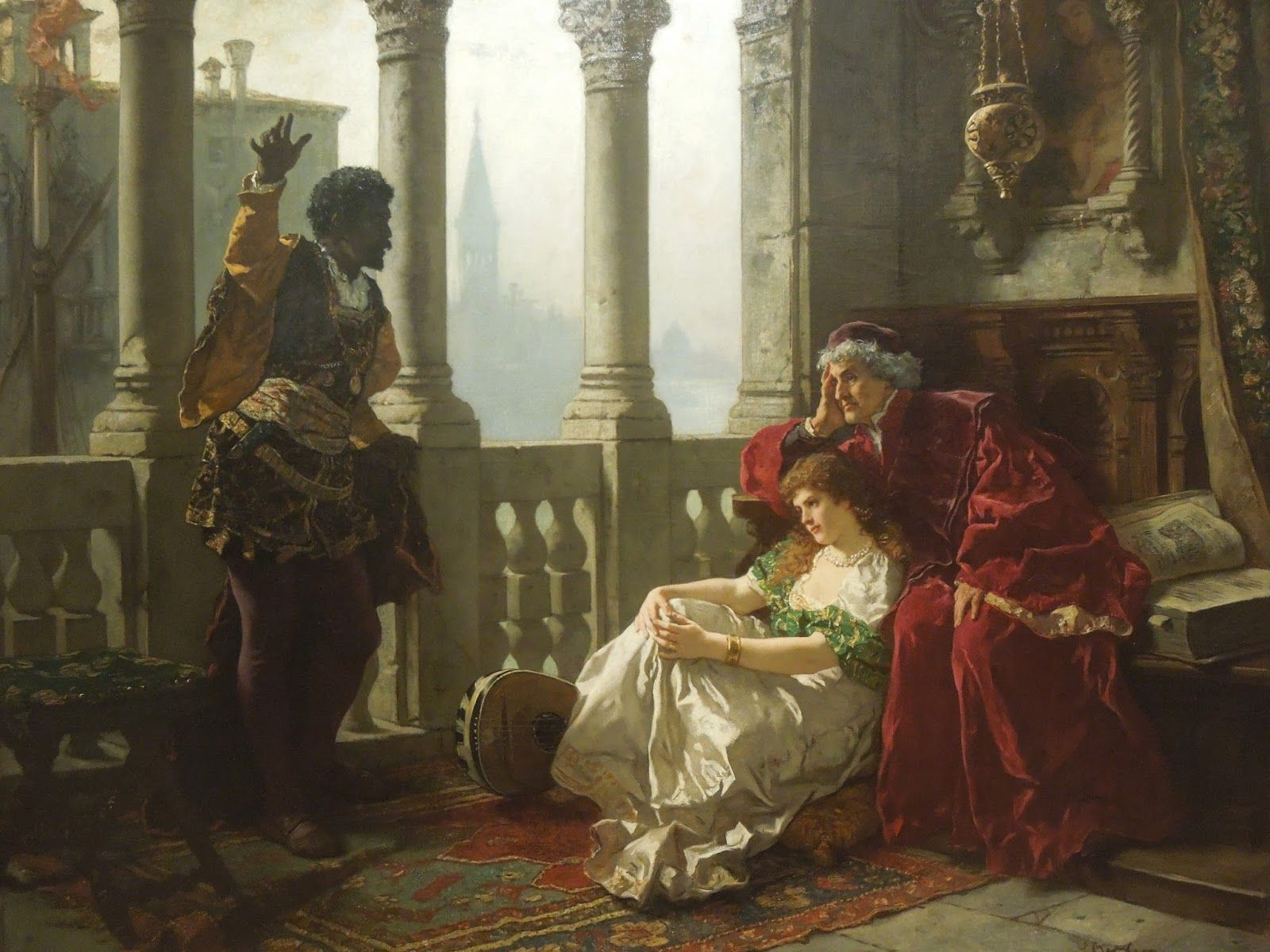
Carl Becker, Othello Relating His Adventures, ca. 1900

Only at the very end of the book does he discuss Schmitt’s provocative 1956 essay Hamlet or Hecuba, and it, too, receives uncharitable treatment: supposedly little more than Schmitt’s “crass” attempt to wheedle out of any guilt by association that linked him with Hitler and the Nazis. The “mask of Hamlet enable[d] him to enshroud the moral and political shortcomings of his life with the sombre radiance of tragedy.”[25] At a time when almost everyone was/is shrilly demanding an “explanation,” or an “apology” from ex-“Nazis” and German thinkers, should they have expressed shock or contempt when their targets answered them? To rephrase a near-contemporary of Shakespeare, what else is to be concluded from this but that you first make apologists, then punish them?[26]

On another note, let this unfortunate Schmitt analysis be a warning: Discretion is not only the better part of valor, but the better part of glamor. Make arrangements to burn your sensitive papers.

Joseph Goebbels’ “Sorrows of Young Michael”

The inclusion of Joseph Goebbels (1897-1945) — devoted Hitler follower and Propaganda Minister for the Third Reich — in No Hamlets is both mysterious and predictable. Mysterious, because he was never considered to be an intellectual on par with Nietzsche, Schmitt, George, or Gundolf; nor did he have much to do with Shakespeare, or Hamlet. Predictable, because Höfele’s primary mission is, like most German studies it seems, to talk about Nazis. It is on page 125 of the book that we see what Höfele has been after all along:

Railing at outrageous fortune, forever yearning but forever unable to achieve, Hamlet epitomizes the unresolved tensions . . . of a time drifting towards cataclysmic upheaval. We have encountered this mood in the millennialism of George’s New Reich. Hamlet is clearly not . . . “the one who . . . breaks the chains and sweeps aside the rubble.” But he spoke to, and was made to speak for, the fears and frustrations from which such millennial hopes arose and drew their dangerous attraction.[27]
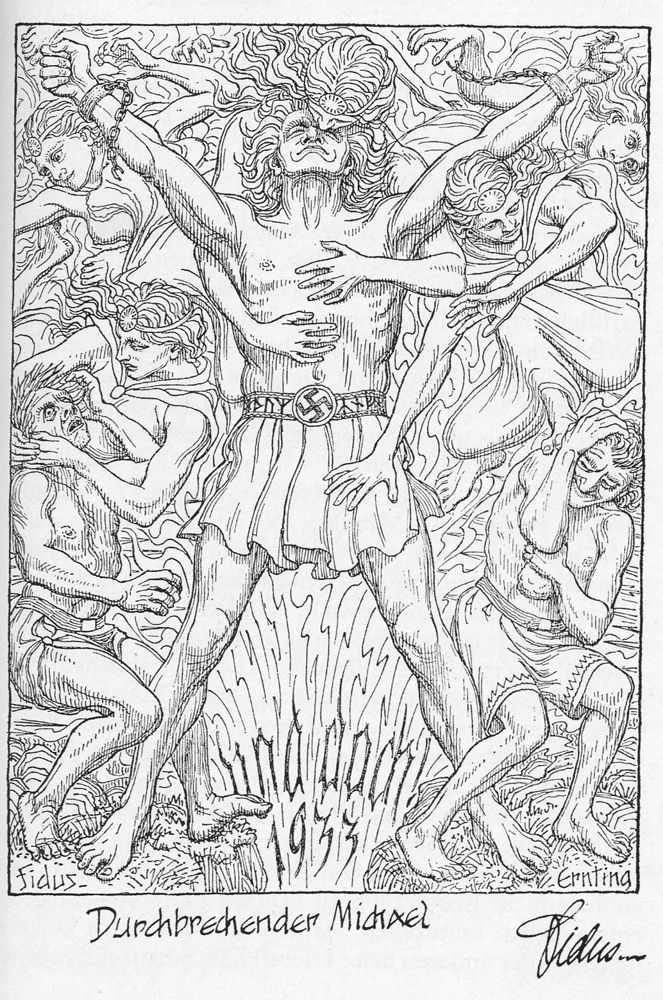
Fidus, Michael Breaks the Chain,1933

One of the men “dangerous[ly] attract[ed]” to these chialistic fantasies was a young Joseph Goebbels, fresh from the bad ending of the First World War and embittered at the subsequent “rummage in the land.”[28] Contemporary and more recent studies have proven that Germany’s defeat in 1918 was “a close-run thing.”[29] The Stab-in-the-Back story that many Germans clung to had as much truth as it did myth. During the profligate 1920s, Hamlet did not disappear from German minds or stages, and Höfele mentions several interesting Weimar performances, including Asta Nielsen’s female Hamlet and Fritz Portner’s blond-bewigged, but obviously Jewish Hamlet.

The bulk of his Weimar chapter, however, is concerned with Goebbels’ 1929 book, Michael, A German Fate on Diary Pages. He had tried to have it released in 1922, but failed to find a willing publisher. Years later, and against his wishes, the NSDAP published a revised version. Höfele describes it as a “shelf-warmer,” but nevertheless considers it important enough to warrant an extended analysis.[30] The only allusion to Hamlet in Goebbels’ book is the quick (misquoted) line: “Commerce, Horatio!”[31] Höfele justifies Michael’s inclusion by explaining that its antecedent was Goethe’s The Sorrows of Young Werther, a much earlier German classic whose author did not hide the fact that his inspiration was the “melancholy prince” of Denmark.

Michael was a thinly-veiled autobiographical novel that followed the young male protagonist — a veteran of the Great War — around 1920s Germany as he confronted various romantic, social, and political crises, then suffered a Christ-like sacrificial death. It was nationalistic and deeply conflicted about the German state, making it somewhat similar to the oppositional literature written by our other Right-wing dissidents. Goebbels could not fight in the Great War due to a congenital handicap, but he clearly idolized the returned soldiers, and prefaced his novel with a dedication to a friend who had died in a mine blast. In half-prose, half-verse that mirrored the pastoral militarism and youth-worship of George, Goebbels began:

We wait for the day that brings the wind storm.
At the present moment, we have the courage
The will to pull together for the Fatherland.
We want life: therefore we will win life.
Michael’s diary is a monument of German fervor, dedication,

And the will of fortitude.[32]

While Michael attends university, he goes for long, contemplative walks:

Around noon, I sit in the quiet, old cemetery.
I stood before a fountain
And felt its fine water in this hot air . . .

Blackbirds are singing!

Nothing disturbs the peace of the dead.
A bee buzzes.
I read Nietzsche’s Zarathustra from noon to devotions.
Still . . . Still. . . Everything is going on in space.
Everything.[33]

Frequent interjections such as, “Oh, you mountains! You Ashlar towers!”, “Blessed hiking!”, and “Year! I reflect” all make for hilarious reading.[34] He shot out Nietzschean lines like cannonballs. But then, he was an ad-man. Michael evolved from a “melancholy” thinker who meandered through graveyards to a soldier, once again. Before death he exhorted his countrymen to

[A]ttack. The attacker is always stronger than the defender.
Let us free ourselves, then we can also free the community of workers
Which will loosen the chains from our country . . .
The most beautiful thing is that you live by your words of truth.
You do not just say phrases like the others.
You act.[35]

Here, we recall the poem that began No Hamlets: Freiligrath’s piece criticizing his country for its dreaminess, for its Hamletian vacillation. Germany, “You [must] act!” in order to break free of history and claim your birthright, Freiligrath and Michael/Goebbels declared as one Teutonic voice. Michael’s usefulness lay in its being an example of how the intellectual currents of the previous half-century filtered into the public consciousness. We perceive echoes of Nietzsche and George (if not Shakespeare) in Goebbels’ narrative message and style. Höfele is correct that Michael does not rise to great, or even good, literary standards.[36] Let’s just call it bad.

You can buy Irmin Vinson’s Some Thoughts on Hitler & Other Essays here.

But Höfele can’t help himself. He gilds the derogatory lily with relentless put-downs, like: “drab mediocrity,” and “penniless suitor with a limp.” Goebbels was “smarting under [a] double handicap, physical and social.” His idol was a “creator of vapid watercolors ranting at those who had dared to thwart his artistic ambitions.” “If Hitler was a failed artist, his most devoted disciple was a failed writer.” Burning books “must have been deeply satisfying to the man who could now triumphantly obliterate those whom he had struggled in vain to emulate.” Michael was indicative of “glaring immodesty,” “foaming bombast,” “‘flatulent inanity,’” not to mention “‘laughable inadequacy.’” His entries were the obvious “ravings of a fanatic sociopath.”[37]

More scholarly distance would be preferable. No one would mistake the rest of No Hamlets for a paean to Right-wing German thought; to whom Höfele is writing and why he feels the need to express his anti-Nazi bonafides again, and again . . . and again is the puzzler. There is a Hamlet gibe that would be appropriate to quote here, but pundits doth use it too much, methinks. So, I won’t.

As in the Weimar period, Shakespearean interest remained active during the Third Reich. Goebbels himself was instrumental in blocking the movement to replace the official translation of Shakespeare’s works from the old-fashioned Schlegel-Tieck German into more modern language, but not before giving the matter due consideration. Performances continued under National Socialist auspices, including that of Gustaf Gründgens’ famous portrayal of Hamlet during the 1936 season, to which “he brought all his technical brilliance and physical dynamism.” Whether or not Germany was Hamlet, Hamlet and its “exemplary Nordic ‘soul drama’ ”[38] transcended each passing empire, and like the German spirit itself, outlived them.
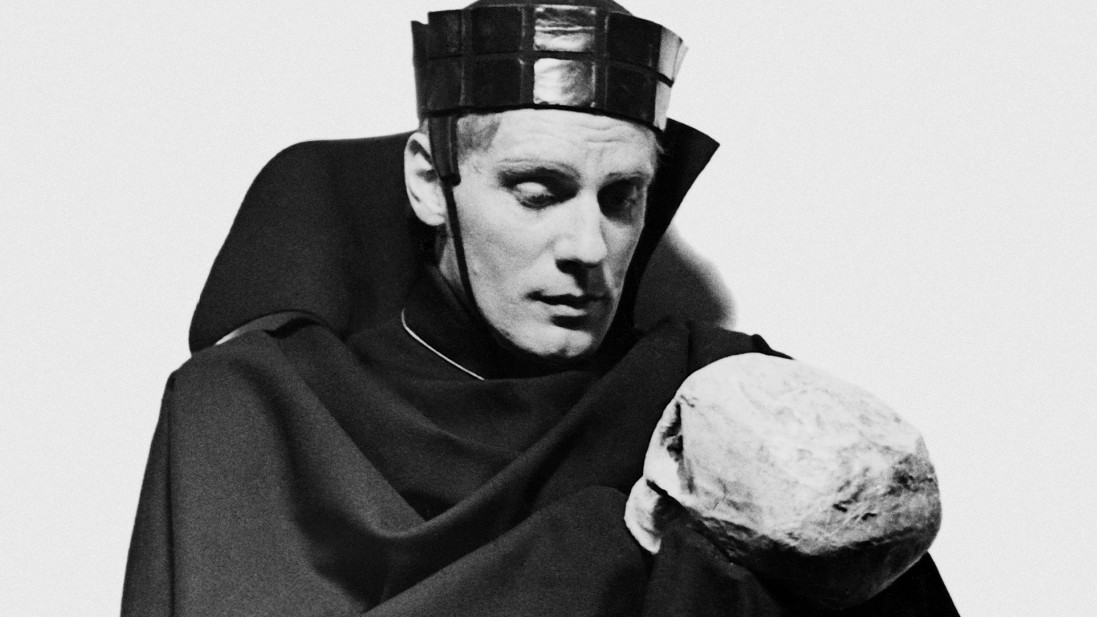
Gustaf Gründgens as Hamlet, 1936

Should we blame philosophers, composers, poets — or a 500-year-old playwright — for Germany’s catastrophic twentieth century? Is “this” what happens after reading too much Shakespeare? The book’s fundamental premise is that intellectuals — even marginalized ones — can wield enormous power; can decide the fate of nations and whole worlds. This would seem to contradict the figure in Hamlet, a story about a disaffected and ineffectual student-“loiterer.” But was he ineffectual, or simply a late-bloomer? Most of the thinkers surveyed here were complex, even contradictory men whose philosophies altered over time. Shakespeare’s characters, too, invited multiple interpretations. After every rereading of Hamlet, I draw slightly different conclusions about his character. Was Hamlet a slothful boor whose unkind behavior towards Ophelia was only matched by his inability to perform elsewhere — in the Roman arena of revenge? Or, was he a noble soul, a Prince possessed of a temper that warred with painful self-awareness, staying his hand in doubt? How should we judge the jealous Othello, the tyrant Caesar, or his assassin Brutus? Macbeth and his Lady were certainly villains, but ones whose humanity often matched their wickedness. These characters are sometimes hard to like, but also hard to dismiss for the flashes of ourselves we see in them. Hamlet is one of the purest examples of dramatic tragedy and its eternal question: What is to be done?

Höfele does something else that is valuable and that Counter-Currents has sought to do as well: talk about “second nations” opposed to their official regimes, and to complicate what “Right” really means. If I have learned one thing about the Right and political history, it is that conservatism, as promoted by the representatives from the “bourgeoisie,” will conserve nothing in the face of their greater raison d’etre, which is to preserve their status. If it is to emerge at all, true political victory of a Rightist nature — that is, anti-progressive and truly pro-Life — will be from its small, revolutionary wing that looks for rebirth, not “conservation.” The latter is but a rearguard action ordered by generals who have acknowledged the battle’s loss before they have ever ordered it. We need men who see paths to victory, not those who seek to temper defeat.

Hamlet has always been a popular literary topic, in Germany and elsewhere, but I have rarely come across anyone who has explored the significance of Fortinbras’ name, including Höfele: French for “Strong” in “Arm.” He and his name were foils for the intellectual Hamlet. We are still left with the question of how to hold such intellectuals responsible. Should we expect them to be action-men; would it even be advisable? Philosopher-statesmen, or philosopher-kings are that rare combination, that sum of the golden-mean: High-of-Mind + Strong-in-Arm = Noble-of-Deed. Hamlet and Fortinbras in one, heroic ideal. Should we await the coming of this future Platonic king of the air, or look back and “seek for [our] noble father[s] in the dust?”[39] The central question at the core of all tragedies is “What do I do?” — and it is also ours.

* * *

Like all journals of dissident ideas, Counter-Currents depends on the support of readers like you. Help us compete with the censors of the Left and the violent accelerationists of the Right with a donation today. (The easiest way to help is with an e-check donation. All you need is your checkbook.)

GreenPay™ by Green Payment

Select donation type

Select or enter an amount to give

Select or enter an amount to give monthly

For other ways to donate, click here.

Notes

[1] Ibid, 55.

[2] Stefan George, “Afternoon” in The Works of Stefan George, Olga Marx and Ernst Morwitz, trans. (Chapel Hill, NC: University of North Carolina Press, 1974), 12. Access the full collection here.

[3] Höfele, 58.

[4] There are 154 Shakespearean sonnets.

[5] Höfele, 63.

[6] William Shakespeare, “Sonnet 104,” in Shakespeare’s Sonnets (New York: Folger Shakespeare Library), 112.

[7] Höfele, 90.

[8] George, “In the Park” in The Works of Stefan George, 10.

[9] Höfele, 69-70.

[10] Höfele, 79.

[11] Ibid, 80.

[12] Ibid, 82.

[13] Ibid, 82-3.

[14] Ibid, 85.

[15] Ibid, 162-63.

[16] Ibid, 160.

[17] Ibid, 163.

[18] Ibid, 163.

[19] Ibid, 164.

[20] Ibid, 163.

[21] Ibid, 165; these are far from the most graphic examples from which Höfele quotes.

[22] William Shakespeare, Othello (New York: Folger Shakespeare Library), V.ii., 263.

[23] Höfele, 184.

[24] Ibid, 187.

[25] Ibid, 275.

[26] A reference to Sir Thomas More (1478-1535). William Shakespeare is thought to have lived from 1564 to 1616.

[27] Höfele, 125.

[28] Hamlet, I.i., 15.

[29] See, for example, Holger Afflerbach’s On a Knife Edge: How Germany Lost the First World War (2022).

[30] Höfele, 137.

[31] Joseph Goebbels, Michael: Pages from a German Destiny, Joey McGoebbels[!], trans. (Jett and Jahn Media), 106; the original line from Hamlet, Act I, scene ii, reads: “Thrift, thrift, Horatio.”

[32] Goebbels, 4.

[33] Ibid, 10.

[34] Ibid, 109.

[35] Ibid, 180.

[36] The poor English translation doesn’t help matters.

[37] Höfele, 136, 137, 136, 198, 137, 139, 140, 147.

[38] Ibid, 230.

[39] Hamlet, I.ii., 25.

The Bard Across Three Reichs: Germany, Shakespeare, & Andreas Höfele’s No Hamlets, Part II

The%20Bard%20Across%20Three%20Reichs%3A%0AGermany%2C%20Shakespeare%2C%20andamp%3B%20Andreas%20H%C3%B6fele%E2%80%99s%20No%20Hamlets%2C%20%0APart%20II%0A

Share

  • Gab

Enjoyed this article?

Be the first to leave a tip in the jar!

Instant Echeck GreenPay™

Related

  • Counter-Currents Radio Podcast No. 686

  • A Novel Approach: Roberto Bolaño’s 2666

  • Neo-Fascism in Film, Part 3

  • Restoring American Deterrence through Innovation and Industry

  • E. M. Forster’s A Passage to India & the Indian Mentality

  • The Theology Behind Ruby Ridge

  • Jonathan Bowden’s Deliverance, Part 3

  • The Rest Is Silence: Heidegger’s Quietism

Tags

Andreas Höfelebook reviewsCarl SchmittFidusFriedrich GundolfGermanyHamlethomoeroticismJoseph GoebbelsKathryn SMichaelNo HamletsOthellopaywallSecret GermanyShakespeare in GermanyStefan Georgethe First World Warthe George CircleWilliam Shakespeare

4 comments

  1. Antipodean says:
    July 21, 2023 at 2:25 am

    I gather that you learnt much from Hofele’s book but had to wade through too much muck to recommend us to follow suit. I learnt muxh from your precis and found it a thoroughly enjoyable ten thousand words. A beautiful prose poem of a review. Thank you.

    0
    0
    1. Kathryn S says:
      July 21, 2023 at 10:10 pm

      I’m glad you enjoyed it, Antipodean, and thank you!

      Yes, No Hamlets had some value, and it did make an overall successful case that, since the Romantic era, Shakespeare influenced German Right-wing intellectuals.  But instead of reading Hofele, I’d recommend  reading (or re-reading) Shakespeare’s Hamlet, itself , or Stefan George’s collected works — both of which are linked in the footnotes.

      0
      0
  2. Teutonic Path says:
    July 23, 2023 at 4:11 pm

    Many thanks for a very fine pair of articles. It is disappointing that any pretense of scholarliness goes out the window when discussing national socialism, and once respectable people turn into zealots frothing at the mouth.


    0
    0
    1. Kathryn S says:
      July 24, 2023 at 3:24 pm

      Thanks for reading and commenting, Teutonic Path (an apt name). Yes, and their insults are rarely original, or imaginative. How many times have we heard about Hitler, the “failed artist?”

      0
      0

Comments are closed.

If you have a Subscriber access,
simply login first to see your comment auto-approved.

Note on comments privacy & moderation

Your email is never published nor shared.

Comments are moderated. If you don't see your comment, please be patient. If approved, it will appear here soon. Do not post your comment a second time.

Upcoming podcasts
  • Rob Rundo on Counter-Currents Radio

    Rob Rundo on Counter-Currents Radio

    Counter-Currents Radio

    Sat, Jun 13th — 3 pm EST / 9 pm CET
  • Daniel Tyrie on Counter-Currents Radio

    Daniel Tyrie on Counter-Currents Radio

    Counter-Currents Radio

    Sat, Jun 20th — 3 pm EST / 9 pm CET

Writers of May

(2 votes) Morris van de Camp David M. Zsutty Derek Stark Jayant Bhandari Greg Johnson

Articles of May

Heidegger on Nietzsche, Part One by Collin Cleary The Lunch Wars by David M. Zsutty 2 votes
    • Zsutty’s Maximum

      David M. Zsutty

    • Exclusive Interview with Karel Veliky:
      The Final Chapter in the Film Series! Part I

      Ondrej Mann

    • The Union Jackal, June 2026

      Mark Gullick

      15

    • The Inferiority Behind Immigrant Superiority

      Jayant Bhandari

      12

    • Counter-Currents Radio Podcast No. 690
      Greg Johnson & David Zsutty Discuss Current Things: AI, Henry Nowak, the Iran Crisis, & More

      Counter-Currents Radio

      4

    • Collin Cleary: What Rome Means to Me

      Collin Cleary

      4

    • Paul Krugman: Closet Bolshevik

      Spencer J. Quinn

      14

    • Fugue of Ideas:
      Ibram X. Kendi’s Chain of Ideas

      Greg Johnson

      18

    • Based Blacks

      Lipton Matthews

      10

    • Black Intellectual Fatigue

      Derek Stark

      36

    • Why White Advocates Should Avoid “Based Blacks”

      Dani Vypont

      23

    • Nietzsche & Race

      Mark Gullick

    • Editor’s Update
      Rob Rundo Rescheduled to Next Week on Counter-Currents Radio;
      Tonight Greg Johnson & David Zsutty Answer Your Questions;
      Fundraiser Update & a New $20,000 Matching Grant

      Greg Johnson

    • The Counter-Currents 2026 Fundraiser
      Lifetime Subscriber Welcome Packages Extended

      Greg Johnson

    • Nationalism This Week
      Who’s Looking Back?

      Greg Johnson

      29

    • China’s Threat to American Security:
      Food, Farmland, Foreign Control, & Energy Policy

      Lipton Matthews

      5

    • The Bitter End of Western Metaphysics:
      Heidegger on Nietzsche, Part Two

      Collin Cleary

      16

    • The Killing of Henry Nowak

      Mark Gullick

      38

    • The Crisis of Chinese Technology Thieves

      Morris van de Camp

      1

    • The Strange World of Gender Bender Fiction:
      & What This Genre Tells Us About Autosexuality

      Dani Vypont

      3

    • Watching the Watchers:
      The Dark Triad Question

      David M. Zsutty

      14

    • The Remigration Movement Solidifies

      F. Roger Devlin

      1

    • Casting Aspersions:
      The Fatal Consequences of Race-Swapped Casting, From Helen of Troy to Henry of Southampton

      Steven Tucker

      20

    • The Murder of Henry Nowak

      Millennial Woes

      23

    • Don’t Forget to Vote in Our Writer & Article of the Month Poll

      Greg Johnson

    • The Robot Hotdog Stand

      Greg Johnson

      37

    • Laughing Our Way to Victory

      Dave Chambers

      7

    • The Zodiac Killer

      Mark Gullick

      11

    • Jared Taylor: What Rome Means to Me

      Jared Taylor

      1

    • An Interview with Endeavour:
      My Way of Life Is an Adventure!

      Ondrej Mann

      6

    • José Pedro Zúquete’s The Identitarians

      Greg Johnson

      3

    • Editor’s Update
      Fundraiser Update & How to Watch the Remigration Summit

      Greg Johnson

      5

    • The Bitter End of Western Metaphysics:
      Heidegger on Nietzsche, Part One

      Collin Cleary

      12

    • Berlin: City of Stones

      Spencer J. Quinn

      6

    • True Folk-Horror Is Horror of Your Own Folk:
      Mark Gatiss vs the Brexit Blind Dead  

      Steven Tucker

      4

    • Counter-Currents Radio Podcast No. 689
      Thomas Massie, the America 2050 Bust, the Need for Whites to Divest from America, the AI Economic Apocalypse, & Pro-White Project Pitches to Billionaires

      Counter-Currents Radio

      7

    • Nationalism This Week
      Remigration is Inevitable, Part 3

      Greg Johnson

      27

    • Why Billionaires Should Fund White Identity Politics

      Lipton Matthews

      8

    • How Cold War Two Came About

      Morris van de Camp

      5

    • Now Available for Pre-Order at a Special Price!
      Greg Johnson’s The Philosopher Is In

      Greg Johnson

    • David Zsutty’s Elevator Pitch to a Billionaire

      David M. Zsutty

      1

    • Headbanging Lite

      Mark Gullick

      5

    • White Advocacy Past and Present

      Peter Bradley

      13

    • The Lunch Wars

      David M. Zsutty

      47

    • The Russians are Coming/The Russians are Coming

      Steven Clark

      1

    • Peak Fatigue in Fort Wayne

      Gabriel Anderson

      24

    • Keith Woods’ Elevator Pitch to a Billionaire

      Keith Woods

    • The Cruelty of Kindness

      Morris van de Camp

      9

    • Predation Wearing the Mask of Civilization

      Jayant Bhandari

      13

    • The Mandalorian & Grogu

      Trevor Lynch

      24

    • Stronza

      The Union Jackal, June 2026

      What did that cute little opossum Pogo say?

    • Collin Cleary

      The Bitter End of Western Metaphysics:
      Heidegger on Nietzsche, Part One

      This is a joke, right?

    • Vauquelin

      Why White Advocates Should Avoid “Based Blacks”

      Blacks and whites are two nations inhabiting one territory. This is the source of all problems...

    • New Flyer

      The Union Jackal, June 2026

      Was listening to a Collett stream where he went over a police policy that dictates the 'racism" must...

    • Glide Ratio 0:1

      The Union Jackal, June 2026

      As to the World Cup, lets not forget the Czechs and the Croats did not kneel for the degenerate...

    • Beau Albrecht

      The Union Jackal, June 2026

      It's just mind-boggling.  There was an orc with a bloody sword, and a White man bleeding to death. ...

    • Silva

      The Inferiority Behind Immigrant Superiority

      Understanding Human History also contains geography, but points flaws in that of Guns, Germs, and...

    • Leroy Patterson

      Second, none of these videos displayed a shred of cynicism, irony, sarcasm, or coarseness, but...

    • Nicholas

      Paul Krugman: Closet Bolshevik

      Regarding the link for: "Has Paul Krugman ever said anything anti-white?" The link directs me to...

    • Scott

      Based Blacks

      The craziest conspiracy clickbait and AI slop translates into more views and ad revenue, so that is...

    • Connor McDowell

      The Union Jackal, June 2026

      So according to the Belfast attempted  beheading victim’s insane family, having your loved ones...

    • Will Williams

      Black Intellectual Fatigue

      TiredofBoomers, addresses a Boomer: June 10, 2026  I am Mr. Tired of Boomers, not Miss… and...

    • Scott

      Based Blacks

      Tyler Robinson’s trial should be most interesting.Although it has not yet been released to the...

    • DM

      Counter-Currents Radio Podcast No. 690
      Greg Johnson & David Zsutty Discuss Current Things: AI, Henry Nowak, the Iran Crisis, & More

      Clear, incisive ... fantastic talk. The best I've heard in a while. I agree completely. I can hardly...

    • Oleg

      Fugue of Ideas:
      Ibram X. Kendi’s Chain of Ideas

      A fugue of a fugitive, Ibram Unchained. Thanks, Mr. Johnson, that's just hilarious! The fact...

    • DarkPlato

      Counter-Currents Radio Podcast No. 690
      Greg Johnson & David Zsutty Discuss Current Things: AI, Henry Nowak, the Iran Crisis, & More

      That’s interesting.  Thanks for writing these sorts of posts.  This is the type of area where I...

    • Derek Stark

      The Inferiority Behind Immigrant Superiority

      You may abhor Jews, but you're buying into the perspective that Franz Boas (a Jew) pushed into the...

    • Zarathustra

      The Inferiority Behind Immigrant Superiority

      That is not the conclusion I came to. Here is a short clip summarising the book.

    • Oleg

      Why White Advocates Should Avoid “Based Blacks”

      That's curious. I thought Buckley was a Con-Servative project from the very beginning and did not...

    • YT

      The Union Jackal, June 2026

      One of the links said JDVance was “very good friends” with this Lammy creature. I hope that isn’t...

    • Earth Day Special

      John Morgan

      12

    • A Robertson Roundup
      Remembering Wilmot Robertson
      (April 16, 1915 – July 8, 2005)

      Margot Metroland

      13

    • The Paranoid Style in White Nationalism

      Greg Johnson

      30

    • Join the Dance!

      Andrew Hamilton

      1

    • We Can’t Save the Earth Without Reducing African Birth Rates

      James Dunphy

      36

    • “I’m Not a Conspiracy Theorist, but . . .”:
      Jeffrey Epstein’s Death Gives New Life to “Conspiracy Theories”

      Greg Johnson

      22

    • Sylvia Plath: Stasis in Darkness

      Vic Olvir

      17

    • Vanguardism, Vantardism, & Mainstreaming

      Greg Johnson

      80

    • Aviation, Geography, & Race

      Charles Lindbergh

      3

    • Some Thoughts on Yule

      Collin Cleary

      4

    • Living in Truth:
      A Yuletide Homily

      Jef Costello

      7

    • John Kennedy Toole’s A Confederacy of Dunces

      Greg Johnson

      20

    • On Aleksandr Solzhenitsyn’s Warning to the West

      Spencer J. Quinn

      7

    • Elitism, British Modernism, & Wyndham Lewis

      Jonathan Bowden

      6

    • Philip K. Dick’s Do Androids Dream of Electric Sheep? as Anti-Semitic/Christian-Gnostic Allegory

      Greg Johnson

      20

    • “Conspiracy Theory” or Conspiracy?

      Andrew Hamilton

      21

    • Remembering H. P. Lovecraft
      (August 20, 1890–March 15, 1937)

      Greg Johnson

      3

    • Who Are We?
      Nordics, Aryans, & Whites

      Greg Johnson

      71

    • Remembering William Gayley Simpson
      (July 23, 1892–December 31, 1990)
      A Pleasant Afternoon with Harriet & Bill Simpson

      Margot Metroland

      18

    • Here are the Young Men
      Remembering Ian Curtis
      (July 15, 1956–May 18, 1980)

      Mark Gullick

      18

    • Percy Grainger
      Artist of the Right

      Alex Graham

      7

    • Remembering Revilo Oliver
      (July 7, 1908–August 20, 1994)

      Greg Johnson

      18

    • The Meaning of July 4th for the White Man

      Gregory Hood

      13

    • The Front National’s Evolution

      Bruno Mégret

    • Merwin K. Hart
      Forgotten American Hero & Man of the Right

      Morris van de Camp

      10

    • George Orwell’s Nineteen Eighty-Four

      Jonathan Bowden

      8

    • Carleton S. Coon
      Scientist & Reluctant White Advocate

      Morris van de Camp

      3

    • The Kwanzaa Absurdity Will Be Dwarfed by Juneteenth

      Robert Hampton

      10

    • Stravinsky

      Alex Graham

      7

    • Like the Roman:
      Remembering Enoch Powell (1912-1998)

      Mark Gullick

      23

    • Sexually Incontinent on the Indian Subcontinent:
      Who Rapes More Animals, Indians or Pakistanis? The Battle Continues!

      Steven Tucker

      3

    • Neo-Fascism in Film
      Part 5

      Karel Veliky

      15

    • The Game of Tarot

      Mark Gullick

      2

    • Institutions Cannot Be Transplanted

      Jayant Bhandari

      5

    • Jonathan Bowden’s Deliverance
      Part 5

      Jonathan Bowden

    • Crosstown Traffic:
      Jimi Hendrix & The Post-War Rock ‘N’ Roll Revolution

      Mark Gullick

      1

    • Slaves from the North:
      Finns & Karelians in the East European Slave Trade, 900–1600

      Lipton Matthews

      14

    • Neo-Fascism in Film
      Part 4

      Karel Veliky

      2

    • David Lean’s A Passage to India

      Spencer J. Quinn

      1

    • Elites are Essential to Development

      Lipton Matthews

      7

    • Jonathan Bowden’s Deliverance
      Part 4

      Jonathan Bowden

    • Neo-Fascism in Film
      Part 3

      Karel Veliky

      6

    • E. M. Forster’s A Passage to India & the Indian Mentality

      Spencer J. Quinn

      25

    • Jonathan Bowden’s Deliverance
      Part 3

      Jonathan Bowden

    • The Rest Is Silence
      Heidegger’s Quietism

      Mark Gullick

      2

    • Dispelling the Historical Fallacy of Indian Nationalism

      Lipton Matthews

      8

    • Neo-Fascism in Film
      Part 2

      Karel Veliky

      8

    • Jonathan Bowden’s Deliverance
      Part 2

      Jonathan Bowden

    • Life of a Klansman

      Mark Gullick

      8

    • Jonathan Bowden’s Deliverance, Part 1

      Jonathan Bowden

    • Decolonial Ideas are Holding Back Developing Countries

      Lipton Matthews

      8

    • Neo-fascism in Film, Part 1

      Karel Veliky

      21

    • Jonathan Bowden’s Onslaught, Part 8
      Divigations on Decadence

      Jonathan Bowden

    • Jonathan Bowden’s Onslaught, Part 7
      Intrigues in the National Front

      Jonathan Bowden

      1

    • Rotten to the Core

      Mark Gullick

      8

    • Strauss on Husserl’s “Philosophy as Rigorous Science”

      Greg Johnson

    • Jonathan Bowden’s Onslaught, Part 6
      Francis Bacon & Right-Wing Nihilism

      Jonathan Bowden

    • London After (& Before) Midnight:
      Aleister Crowley, The Landlord’s Worst Nightmare

      James J. O'Meara

      2

    • Jonathan Bowden’s Onslaught, Part 5
      The Post-War British Far Right

      Jonathan Bowden

    • No Rules: Rollerball

      Mark Gullick

      4

    • András László
    • Derek Hawthorne
    • Beau Albrecht
    • Alain de Benoist
    • Kerry Bolton
    • Jonathan Bowden
    • Collin Cleary
    • Jef Costello
    • Savitri Devi
    • Julius Evola
    • Jim Goad
    • Gregory Hood
    • Juleigh Howard-Hobson
    • Greg Johnson
    • Charles Krafft
    • Anthony M. Ludovici
    • Trevor Lynch
    • H. L. Mencken
    • J. A. Nicholl
    • James J. O’Meara
    • Christopher Pankhurst
    • Tito Perdue
    • Michael Polignano
    • Spencer J. Quinn
    • Fenek Solère
    • Irmin Vinson
    • Leo Yankevich
    • Francis Parker Yockey
    • Multiple authors
  • Editor-in-Chief

    • Greg Johnson, Ph.D.

    Featured Writers

    • Beau Albrecht
    • Gunnar Alfredsson
    • Collin Cleary, Ph.D.
    • Jef Costello
    • Morris V. de Camp
    • F. Roger Devlin, Ph.D.
    • Stephen Paul Foster, Ph.D.
    • Jim Goad
    • Alex Graham
    • Mark Gullick, Ph.D.
    • Greg Johnson, Ph.D.
    • Travis LeBlanc
    • Trevor Lynch
    • Margot Metroland
    • James J. O’Meara
    • Angelo Plume
    • Spencer J. Quinn
    • Fred Reed
    • Clarissa Schnabel
    • Michael Walker
    • David M. Zsutty

    Frequent Writers

    • Asier Abadroa
    • Aquilonius
    • Alain de Benoist
    • Kerry Bolton, Ph.D.
    • Dave Chambers
    • Steven Clark
    • James Dunphy
    • Endeavour
    • Richard Houck
    • Jason Kessler
    • Titus Livius
    • Ondrej Mann
    • Lipton Matthews
    • Mark Mazari
    • John Morgan
    • Jaroslav Ostrogniew
    • Kathryn S.
    • Christian Secor
    • Anne Wilson Smith
    • Thomas Steuben
    • William De Vere
    • Kenneth Vinther
    • Max West

    Classic Authors

    • Maurice Bardèche
    • Jonathan Bowden
    • Julius Evola
    • Guillaume Faye
    • Ernst Jünger
    • Kevin MacDonald, Ph.D.
    • D. H. Lawrence
    • Charles Lindbergh
    • Jack London
    • H. P. Lovecraft
    • Anthony M. Ludovici
    • Sir Oswald Mosley
    • National Vanguard
    • Friedrich Nietzsche
    • Revilo Oliver
    • William Pierce
    • Ezra Pound
    • Saint-Loup
    • Savitri Devi
    • Carl Schmitt
    • Miguel Serrano
    • Oswald Spengler
    • P. R. Stephensen
    • Jean Thiriart
    • John Tyndall
    • Dominique Venner
    • Leo Yankevich
    • Francis Parker Yockey

    Other Authors

    • Howe Abbott-Hiss
    • Michael Bell
    • Giles Corey
    • Jack Donovan
    • Richardo Duchesne, Ph.D.
    • Emile Durand
    • Guillaume Durocher
    • Mark Dyal
    • Tom Goodroch
    • Andrew Hamilton
    • Robert Hampton
    • Huntley Haverstock
    • Derek Hawthorne
    • Gregory Hood
    • Juleigh Howard-Hobson
    • Alexander Jacob
    • Ruuben Kaalep
    • Tobias Langdon
    • Julian Langness
    • Patrick Le Brun
    • G A Malvicini
    • John Michael McCloughlin
    • Millennial Woes
    • Michael O’Meara
    • Christopher Pankhurst
    • Michael Polignano
    • J. J. Przybylski
    • Quintilian
    • Edouard Rix
    • C. B. Robertson
    • C. F. Robinson
    • Herve Ryssen
    • Alan Smithee
    • Fenek Solere
    • Ann Sterzinger
    • Robert Steuckers
    • Tomislav Sunic
    • Donald Thoresen
    • Marian Van Court
    • Irmin Vinson
    • Book Reviews
    • Movie Reviews
    • TV Reviews
    • Music Reviews
    • Art Criticism
    • Graphic Novels & Comics
    • Video Game Reviews
    • Fiction
    • Poems
    • Interviews
    • Videos
    • English Translations
    • Other Languages
      • Arabic
      • Bulgarian
      • Croatian
      • Czech
      • Danish
      • Dutch
      • Estonian
      • Finnish
      • French
      • German
      • Greek
      • Hungarian
      • Italian
      • Lithuanian
      • Norwegian
      • Polish
      • Portuguese
      • Romanian
      • Russian
      • Slovak
      • Spanish
      • Swedish
      • Ukrainian
    • Commemorations
    • Why We Write
  • Archives
  • Top 100 Commenters
  • The Looney Bin
Sponsored Links
Europa.com Above Time Coffee Antelope Hill Publishing Paul Waggener IHR-Store Spencer J. Quinn American Renaissance Jim Goad The Occidental Observer
Donate Now Mailing list
Books for sale
  • The Philosopher Is In
  • Sexual Utopia in Power (Expanded Edition)
  • In Defense of Prejudice
  • Loving Our Own
  • Tyranny & Wisdom
  • The Populist Moment
  • Is America Doomed?
  • To all books
Copyright © 2026 Counter-Currents Publishing, Ltd.

Paywall Access


Please enter your email address.

Lost your password?

Edit your comment

Writer & Article of the Month May 2026

Voting for this month has concluded. Here are the final results!

Top Writers

  • #1 Morris van de Camp 2 votes
  • #2 David M. Zsutty 2 votes
  • #3 Derek Stark 2 votes
  • #4 Jayant Bhandari 2 votes
  • #5 Greg Johnson 2 votes
  • #6 Jared Taylor 1 vote
  • #7 Collin Cleary 1 vote
  • #8 Spencer J. Quinn 1 vote
  • #9 Mark Gullick 1 vote
  • #10 Lipton Matthews 1 vote
  • #11 Keith Woods 1 vote
  • #12 Steven Tucker 1 vote

Top Articles

  • #1 Heidegger on Nietzsche, Part One 2 votes
  • #2 The Lunch Wars 2 votes
  • #3 The Ghost of the Confederacy 1 vote
  • #4 Lothrop Stoddard’s The Revolt Against Civilization 1 vote
  • #5 Could Fascism Work? 1 vote
  • #6 Jared Taylor's Elevator Pitch to a Billionaire 1 vote
  • #7 Predation Wearing the Mask of Civilization 1 vote
  • #8 Peak Fatigue in Fort Wayne 1 vote
  • #9 Keith Wood's Elevator Pitch to a Billionaire 1 vote
  • #10 Do You Want to Play a Game? 1 vote
  • #11 Why Billionaires Should Fund White Identity Politics 1 vote
  • #12 The 1970s: The Golden Age of Hijacking 1 vote
  • #13 True Folk-Horror Is Horror of Your Own Folk 1 vote
  • #14 Finding Atlantis Part 4 1 vote
  • #15 Berlin: City of Stones 1 vote

Total votes cast: 17