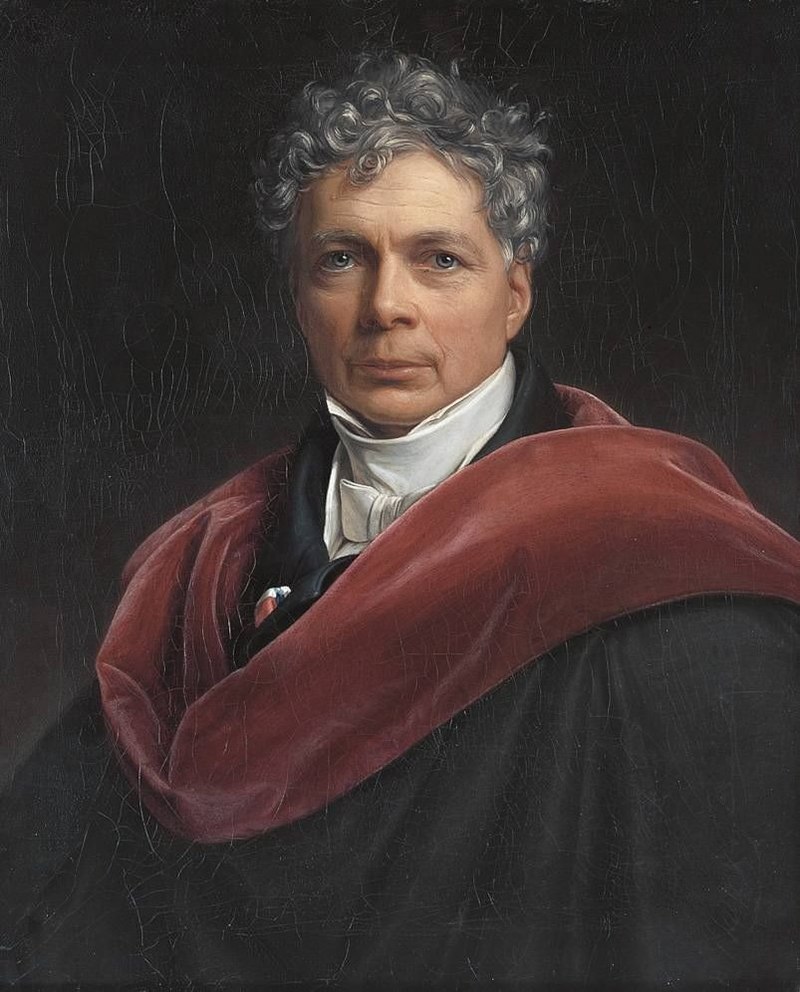
Portrait of Schelling by Karl Joseph Stieler
5,320 words
Part 2 of 2 (Part 1 here)
In the first part of this essay I introduced readers to Schelling, who is one of the first philosophers to react against what Heideggereans have called “the metaphysics of presence”: the hidden will in Western metaphysics that gives primacy to human subjectivity, adjusting our understanding of the Being of beings to the human desire that beings should be completely transparent to us, hiding nothing, and readily available for our manipulation. In response to this, Schelling argues that it is nature, not human subjectivity, that should be the starting point of philosophy. He understands nature as a teleological system whose purpose is to give rise to its own self-understanding. The vehicle for this is man. Because man is a product of nature, when he contemplates nature and seeks to understand it, this act is simultaneously nature understanding itself.
In Part Two, we will complete our survey of the early Schelling (the Schelling prior to the 1809 Philosophical Investigations into the Essence of Human Freedom) with a discussion of two of his most innovative ideas: (1) a new, “organic” conception of reason, and (2) the theory that art provides a sensuous intuition of the Absolute. The essay will conclude with some critical reflections on whether Schelling really has transcended the modern primacy of subjectivity.
1. Organic Reason
Schelling’s naturalism breaks with the mainstream of modern science and philosophy in that it rejects mechanistic materialism. In place of mechanism, he offers us “organicism.” We saw indications of this already in Part One, in the thesis that there is no discontinuity between the powers of nature and human subjectivity and that, instead, the latter is an organic development of the former. Indeed, in Of the World Soul (Von der Weltseele, 1798), Schelling tells us that nature itself is one boundless organism. However, in First Sketch of a System of Philosophy of Nature (Erster Entwurf eines Systems der Naturphilosophie, 1799) he insists that this does not mean that nature is a “substance,” à la Spinoza. It cannot be understood, in other words, as “thinglike,” for this would give a false impression of inactivity.
Instead, nature must be conceived as process: as infinite activity, and infinite productivity. As Frederick Beiser notes, Schelling is attributing to nature the very property Fichte had seen in the ego: that its nature is to be pure act.[1] The ego, Fichte had written, “is an act, and absolutely nothing more; we should not even call it an active something, for this expression refers to something subsistent in which activity inheres.”[2] Schelling’s organic conception of nature is thus much closer to the Greek phusis than to Latin natura. Heidegger argues that phusis was nature understood as dynamic process, and that it was the early Greek conception of Being. By contrast, natura came to connote nature merely as a totality of beings. (On Heidegger on phusis, see here.)
Modern scientists and philosophers (to this day, in fact) have attempted, without success, to explain organism in mechanical terms: In other words, they have attempted to “reduce” or to derive the higher from the lower. Schelling makes the revolutionary suggestion that we try reversing this procedure. He argues that non-living nature, which behaves mechanically, is explicable only in terms of what emerges from it at a more advanced stage of development: living, organic nature. This is implicit in the very idea of conceiving nature as a teleological system, which develops toward a specific end or goal. In such a system, every stage is explicable in terms of that goal. Organism is “that for the sake of which” mechanism exists at all, so mechanism must be understood, if you will, “backwards” from the organic.
Schelling writes in The System of Transcendental Idealism (System des transcendentalen Idealismus, 1800):
The completed theory of nature would be that whereby the whole of nature was resolved into an intelligence. — The dead and unconscious products of nature are merely abortive attempts that she makes to reflect herself; inanimate nature so-called is actually as such an immature intelligence, so that in her phenomena the still unwitting character of intelligence is already peeping through.[3]
Descartes and other philosophers had separated human subjectivity from nature because they conceived of nature entirely in terms of mechanism and saw (correctly) that subjectivity could not be explained in those terms (for one thing, as noted in Part One, mechanism leaves no room for free will). Fichte rejected a “naturalized” understanding of subjectivity precisely for this reason. But Schelling overcomes such difficulties, because his naturalism has eschewed reductionism; he has replaced a mechanistic conception of nature with an organic one. For Schelling, both life and mind are simply a higher-level organization of material forces. (The details of his account, however, are complex and obscure, and cannot occupy us in a short overview such as this.)
You can buy Greg Johnson’s From Plato to Postmodernism here
If mind is to be understood as an organic outgrowth of nature, then it should not surprise us that Schelling puts forward a new conception of human reason itself as, essentially, “organic thinking.” He argues that the existing conception of reason, which he seeks to overturn, is wedded to a mechanistic model of explanation. It conceives rational thought as explaining phenomena by seeking prior causes, according to the “principle of sufficient reason” (formulated by Leibniz as follows: “The fundamental principle of reasoning is that there is nothing without a reason [i.e., a cause]; or . . . that there is no truth for which a reason does not subsist”[4]).
Schelling argues that this type of reasoning is valid only within delimited contexts, and he chooses to refer to it not as reason (Vernunft), but as “understanding” (Verstand). (This distinction will also be extremely important for Hegel.) In order to comprehend the whole of nature, to engage in philosophy of nature, a different form of reason is necessary, one which involves an “intellectual intuition” (intellektuelle Anschauung). Kant had denied the possibility of intellectual intuition, but Schelling identifies it with the ability to intuit the universal in the particular, or to see the whole in the part. Schelling refers to this intellectual intuition simply as “reason” (Vernunft), but for him it is the true, or higher reason. He writes in Further Presentations from the System of Philosophy (Fernere Darstellungen aus dem System der Philosophie, 1802):
Intellectual intuition is the faculty in general of seeing the universal in the particular, the infinite in the finite, both unified in a living unity . . . to see the plant in the plant, the organ in the organ and, in a word, the concept or the indifference in the difference is possible only through intellectual intuition.[5]
To see how this constitutes “organic thinking,” simply consider how we understand an organ within the human body. An organ such as the heart or liver is always understood in terms of its place within the whole: What role, we ask, does it play in the body considered as a total system? As noted earlier, Schelling sees the universe itself as a great organism. All beings are “parts” within this whole, and to understand those beings involves seeing their place within it. Since some entities or forces in nature are opposed or antagonistic, this will, of necessity, involve understanding how oppositions are “reconciled” in a higher unity. In short, organic reason is dialectical.
Arguably, Schelling has identified the essence of philosophical thinking as such. If philosophy is the pursuit of wisdom, and wisdom is knowledge of the whole, then philosophical thinking must involve understanding the “parts” (the various phenomena of nature, as well as aspects of human life and human culture) in relation to the whole. Fichte had also put forward a concept of intellectual intuition, only in his philosophy intellectual intuition is the ego’s awareness of itself. By contrast, as Beiser puts it, for Schelling and Hegel “intellectual intuition consists in the knowledge of my identity with the universe as a whole.”[6]
In subsequent essays I will deal more extensively with Schelling’s debts to Jacob Boehme, the mystical cobbler of Görlitz (1775-1624), but here we may note that it is possible that Boehme influenced Schelling’s distinction between reason and understanding. In Boehme, the concepts of the two are remarkably similar, but the terminology is reversed: Boehme uses Vernunft for the lower-level understanding, and Verstand for higher-level reason. As one commentator on Boehme expresses it:
Vernunft (natural reason) is a superficial knowledge abstracted from the phenomenal world, apprehending only the external appearances of things, and descriptively relating isolated concepts. Verstand is a higher, intuitive power in which the knowing spirit penetrates into the essence of the object known. Verstand alone embraces in a single vision the living processes which are formed by all the interacting parts of an organic whole.[7]
Further, Boehme’s conception of Verstand is also clearly dialectical. In a letter from 1623, Boehme speaks of Verstand and Vernunft in the context of a discussion of Biblical hermeneutics:
The texts of scripture must stand true, and not oppose one another. But if they even appear to be in opposition, it is so only for those to whom Verstand is not given, and they have not been equipped for their interpretation. . . . But whoever wants to be able to interpret them must also have the understanding [Verstand] of union so that he knows how to harmonize those (passages) which appear to reason [Vernunft] to be contrary.[8]
2. Transcendental Idealism, Philosophy of Nature, and Philosophy of Art
As noted in Part One, Schelling sought some kind of rapprochement between Fichte’s idealism and Spinoza’s system of nature. In The System of Transcendental Idealism and other texts, this takes the form of an insistence that philosophy must consist in two major, complementary sciences: transcendental idealism and philosophy of nature. This pairing is a transformation of Fichte’s opposition between “idealism” (his own position) and “dogmatism” (Spinozism) — with the difference that while Schelling’s transcendental idealism closely follows Fichte’s Wissenschaftslehre, philosophy of nature amounts to the doctrine discussed in the previous installment, rather than simply a warmed-over Spinozism. Schelling writes that “[a] consistent dogmatism is to be found only in Spinozism; but as a real system Spinozism again can endure only as a science of nature [i.e., philosophy of nature], whose last outcome is once more the principle of transcendental philosophy [i.e., self-consciousness].”[9]
Schelling’s transcendental idealism begins with the subject and shows how it produces a world of objects as a necessary condition of its own achievement of self-consciousness.[10] Such a philosophy, Schelling maintains, is entirely legitimate. However, it is also one-sided. Philosophy of nature begins, as it were, from the other end: with the object, with nature, and shows how the subject emerges as a product of nature. Indeed, as we discussed in Part One, it shows how human subjectivity is the telos of nature itself. For transcendental idealism, nature is a means for human self-realization. Schelling’s philosophy of nature, however, completely reverses this: It argues that humanity is a means for the self-realization of nature. Human subjectivity, again, is an organic outgrowth of nature, and the means by which nature, the whole, achieves consciousness of itself.
According to Schelling, “The I think, I am, is, since Descartes, the basic mistake of all knowledge; thinking is not my thinking, and being is not my being, for everything is only of God or the totality.”[11] Thus, while transcendental idealism purports to show how subjectivity generates a world of objects in order to achieve self-consciousness, in the end we discover (through philosophy of nature) that our self-consciousness is in fact the same thing as the self-consciousness of the whole. Subject and object are identical in self-consciousness, on two levels, depending upon how “subject” and “object” are construed. In my personal self-consciousness, my subjectivity becomes my object, and my object becomes my subjectivity. But philosophy of nature provides the deeper insight that my self-consciousness is the self-knowing of a being who is the quintessence of nature itself, thus my self-consciousness is also nature, in its highest expression, knowing itself. In the achievement of this self-consciousness, the distinction between subjectivity as such and the objective world “out there” (aka, nature) therefore vanishes.[12]
In and through self-consciousness, the Absolute or God, the indifference point between subject and object, is thus realized in the world. It is realized in a perpetual act that we call nature itself: the arising of more and more complex forms, culminating in man, who reflects on this process and thus brings it to closure, but not to an end (the circle keeps being inscribed over and over again). In The System of Transcendental Idealism, furthermore, Schelling argues that human intellectual history is the story of the gradual development of self-consciousness (both that of man and nature — since these come to the same thing).
In a real sense, the concept of a “history of philosophy” only emerges with Schelling, given that it was Schelling who was the first to see the history of ideas not as a mere succession of differing theories, but as a process of development aiming at a specific end: man’s realization that philosophy (i.e., systematic self-knowledge) is the consummation of nature itself. Heidegger writes eloquently of the significance of this discovery:
Until [the German idealists], the history of Spirit, more or less crudely formulated, was a sequence of expressions of opinion of individual thinkers. Now, the history of thinking and knowing is known in its own law of movement and understood as what is innermost in history itself. And the thinkers of German Idealism are aware of themselves as necessary epochs in the history of Absolute Spirit. Only since the philosophy of German Idealism is there a history of philosophy in such a way that history itself is a path of absolute knowing on the way to itself. History is now no longer what is past, what one is finished with and has discarded, but it is the constant form of becoming of Spirit itself.[13]
You can buy Collin Cleary’sWhat is a Rune? here
Now, given the identity between human self-consciousness and the Absolute, Schelling can also say that history is the same thing as the progressive self-revelation of God. He offers a three-stage theory of history (not unlike that of the medieval apocalyptic thinker Joachim of Fiore), saying of the third, consummating period, “When this period will begin, we are unable to tell. But whenever it comes into existence, God also will then exist.”[14]
In The System of Transcendental Idealism, Schelling insists on the parity and complementarity of transcendental idealism and philosophy of nature, arguing that they are both paths to the truth — to the vanishing point between subject and object. He writes that “neither transcendental philosophy nor the philosophy of nature is adequate by itself; both sciences together are alone able to [depict the parallelism of nature and intelligence], though on that very account the two must forever be opposed to one another, and can never merge into one.”[15] This position once again echoes Fichte’s pairing of idealism and dogmatism, which he held were both rationally defensible positions. Unlike Fichte, however, Schelling does not ask us to choose between the two. Nevertheless, like Fichte he is also inconsistent. Despite Fichte’s claim that dogmatism is just as defensible as idealism, he goes on to speak (in the very same text) as if idealism is supported by better arguments. Similarly, despite his claims to the contrary, Schelling clearly favors philosophy of nature.
For one thing, it can easily be seen that philosophy of nature contains all his best ideas, for Schelling’s transcendental idealism is still quite beholden to Fichte (though some brilliant contributions are to be found in the details). Further, given that the truth of human subjectivity is only to be found through understanding its place in the scale of nature, Schelling effectively gives primacy to philosophy of nature over transcendental idealism. Writing of Schelling’s so-called Identitätssystem (System of Identity), which follows on the heels of The System of Transcendental Idealism, Beiser states that “[t]he Identitätssystem is really a Naturphilosophie whose highest level, stage, or ‘potency’ is [Fichtean] Wissenschaftslehre.”[16]
Now, to make matters even more complex, Schelling ends The System of Transcendental Idealism with a discussion of an entirely different area of philosophy, to which he attaches great importance. Early on in the text, Schelling introduces this topic as follows: “The objective world is simply the original, as yet unconscious, poetry of the spirit; the universal organon of philosophy — and the keystone of its entire arch — is the philosophy of art.”[17] Schelling had a gift for images (which is the only thing that enlivens his often dauntingly obscure prose), and there is a lot to unpack here. The “arch” of Schelling’s philosophy is composed of two “hinges”: transcendental idealism and philosophy of nature. A keystone is a wedge-shaped stone that links the two hinges of an arch and serves to hold them in place. In constructing the arch, the keystone is the very last piece to be put in place, and it allows the arch to bear weight. In just the same way, the philosophy of art is the last piece of The System of Transcendental Idealism put into place by Schelling (it is the subject of the text’s sixth and final division).
But how does the philosophy of art allow the “arch” formed by transcendental idealism and philosophy of nature to “bear weight”? Without it, would these two philosophical sciences come crashing down? Schelling argues that in addition to the elaborate philosophical theories offered in transcendental idealism and philosophy of nature, human beings also require a concrete presentation of the identity of subject and object. Human beings, in other words, need a sensible experience in which the identity of subject and object literally appears “in the flesh.” But why does Schelling insist on this? It may have a great deal to do with the fact that the idea of the Absolute as a vanishing point between subject and object is extraordinarily obscure and far removed from everyday experience. That Schelling would insist on a concrete experience of the Absolute is also entirely in keeping with his naturalism: We are, after all, embodied beings, not disembodied minds; we have senses, as well as intellect.
In any case, Schelling argues that this concrete experience of the Absolute is provided by the work of art. He notes that the contemplation of an artwork is accompanied by a feeling of boundless satisfaction. Why is this? Simply consider what an artwork is: it is some object, some hunk of matter, onto which a human being has imposed an ideal form. The simplest example of this would be sculpture. A sculptor like Arno Breker begins with a vision of a beautiful form he would like to see realized in matter. Then he takes a great block of marble and proceeds to reveal the ideal form slumbering away in this matter by chipping bits of it away. The result is Der Sieger or Bereitschaft.
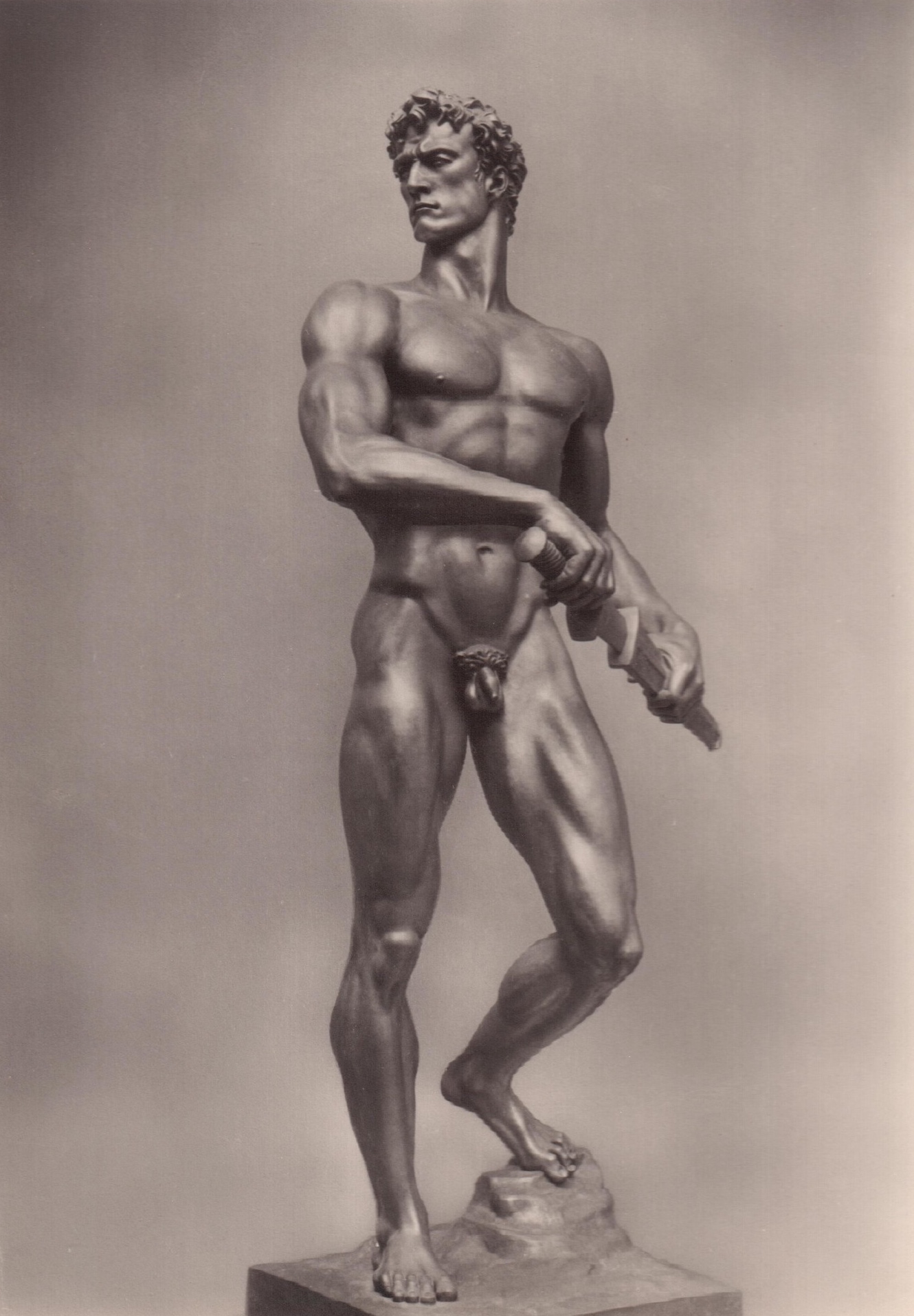
Arno Breker, Bereitschaft (Readiness)
The special pleasure we experience in contemplating this work of art consists in the fact that in it we encounter a marriage of ideal and real, subjective idea and objective natural being — or, quite simply, the marriage of subject and object. We could also say that we encounter the marriage of us and it (it being matter or nature). The contemplation of the work of art is an experience of self-consciousness, for in the artwork we are reflected back to ourselves; we experience the human spirit and its ideals literally set in stone (at least we do in the case of sculpture). The artwork is thus a physical expression of the Absolute, affording a physical (i.e., sensory and emotional) experience of it.
The emphasis Schelling places upon this aesthetic experience constitutes yet another significant move away from the Fichtean system of philosophy. Fichte had also spoken of an experience in which humanity witnesses the overcoming of the subject-object distinction. For Fichte, by contrast, this was moral experience: Humanity’s moral vocation is to cancel what is and to bring about what ought to be; to transform the real into the ideal. We thus witness the marriage of real and ideal when, for example, we succeed in damming a river, curing a case of the clap, or securing equal pay for equal work. Fichte offers no special treatment of art and has almost nothing to say about it. He is simply too much of a middle-class Protestant prig and philistine to have any real use for art. True to his reputation as a “Romantic philosopher,” Schelling shifts art to center stage.
Schelling also offers a curious metaphysics linking the productivity of nature to aesthetic creation. Just prior to the passage quoted above, Schelling writes that “[t]he ideal work of art and the real world of objects are . . . products of one and the same activity; the concurrence of the two (the conscious and the nonconscious) without consciousness yields the real, and with consciousness the aesthetic world.”[18] Recall that, for Schelling, nature’s telos is the coming into being of self-conscious spirit (i.e., humanity). In this process nature gives rise to increasingly complex forms, each of which is intelligible as a kind of approximation to man, the highest level of organic life. Schelling conceives the production of these forms as the result of a kind of “primal imagination” at work in nature itself.
Some brief etymological considerations, in the spirit of Heidegger, can help us here. One of the German words for imagination, Phantasie, connotes the sort of imagination that goes into aesthetic creation.[19] Phantasie derives from Greek phantasia, which is in turn derived from phantazein, “to appear,” or “to make apparent.” This word is in turn derived from phanein, meaning “to cause to appear,” or “to bring to light.” Related to this is phainomenon (from which we get “phenomenon”), derived from phainesthai, meaning “to be brought to light.” In Being and Time, Heidegger therefore interprets phainomenon as meaning “the manifest.”[20] All of these words, it is interesting to note, come from the Proto-Indo-European root bhā-, which means “to shine.” And amongst the many words derived from bhā- are “be,” “been,” “being,” and German bin (“I am”) and bist (“You are”). Thus, Being is inextricably linked with Phantasie, imagination, in its most primal sense. The “imaginative work” of nature itself is to cause myriad forms to manifest, to appear, to come to light, to be.
The “imagination” of nature, as Schelling states explicitly in the quote above, brings forth its products unconsciously. In man, the same activity (as Schelling also states explicitly) is conscious and deliberate, and it is aesthetic creation. Thus, what is at work in the artist is the primal creativity of nature itself, now come to consciousness. This should be unsurprising, given Schelling’s rejection of the Cartesian discontinuity of mind and nature. Not only is there no break between mind and nature, mind is a higher-level organization of the material world. We should therefore expect that human mental activity should mirror, in certain ways, the forces and processes found in nature.
3. Critique of Schelling
In Part One of this essay, I argued at length that Schelling rebels against the metaphysics of presence by “de-centering” the human subject, declaring his intention to make nature the foundation of philosophy, rather than human subjectivity. He rejects the Cartesian model of the detached, incorporeal subject gazing upon nature as upon an alien world. Instead, he argues for a naturalized model of human subjectivity — one that sees our minds as an outgrowth of natural processes. At the same time, Schelling rejects any form of reductionism (i.e., the procedure that sees mind as “reducible” to the mechanical interactions of material bodies). Instead, he argues for a teleological scheme of explanation in which the lower exists to bring forth the higher, and is therefore intelligible in terms of the higher — as opposed to the usual modern scientific procedure of explaining the higher in terms of the lower.
Does Schelling succeed in presenting us with a philosophical alternative that breaks with the metaphysics of presence and the modern “primacy of subjectivity”? Despite much that is innovative and profound in Schelling’s early philosophy, I think we must judge that it does not succeed at this, after all.
Gone, to be sure, is the Fichtean detached subject, and gone too is the Fichtean view of nature as nothing but raw material to be transformed by man. Nevertheless, Schelling argues that human subjectivity is the very apex of his teleological theory of nature. Human subjectivity is nature’s highest “potency”; i.e., the highest end or purpose of nature is giving rise to man. Schelling may have characterized the “I think, I am” as “the basic mistake of all knowledge [since Descartes]” — he may, in other words, have bemoaned the modern philosophical tendency to begin with the “I think.” But he allows the “I think” to slip right back in and claim primacy, not as beginning but as supreme end. Schelling thus winds up offering us just a different version of the primacy of subjectivity. And, arguably, his philosophy greatly magnifies that primacy. Descartes had begun with the ego cogito, the “I think,” but he ended with God. Schelling ends by effectively making human subjectivity into God — as the realization of the Absolute in nature.
Now, convinced Schellingians (and Hegelians) will reject this interpretation and respond that man must be seen only as the vehicle of nature’s self-consciousness — as a necessary condition of the realization of the Absolute, but not as the Absolute itself. After all, the lines just quoted from Schelling about the “I think, I am” conclude with “thinking is not my thinking, and being is not my being, for everything is only of God or the totality.” So, while human subjectivity is, indeed, the highest expression of nature, it exists to make possible the self-consciousness of the whole.
This response, however, is not entirely convincing. Even if we grant that man is “merely” a vehicle of the Absolute’s realization in the world, Schelling’s claim is essentially that man actualizes God; that without man, God could not be. Only the claim that man’s mind creates the entire world could be a more extreme version of the primacy of subjectivity. And, as we have discussed in earlier essays, neither Fichte nor anyone else in the history of philosophy has ever held such a position.
The structure of Schelling’s philosophy of nature is, broadly speaking, Aristotelian. Aristotle also viewed nature as a teleological system in which all elements, from lowest to highest, are approximating to self-consciousness. The difference between Aristotle and Schelling is just that the self-consciousness Aristotle speaks of belongs to a transcendent God (the “Unmoved Mover”). Schelling immanentizes God and argues that the divine self-consciousness is realized in the world through man, as the result of a historical process. For Aristotle, God is that for the sake of which everything lives and acts. Therefore, he concludes that God is the Being of all beings — the ultimate reason why anything is at all, or is the way it is. But when Schelling argues that human subjectivity is the highest expression of nature, which brings nature to consummation and closure, isn’t he likewise inviting us to identify human subjectivity with the Being of all beings?

You can buy Jef Costello’s Heidegger in Chicago here
In earlier essays, I discussed at length Heidegger’s thesis that in the modern period “representation” is inextricably bound up with will or willing (see here, for example). In brief, because the representationalist model of knowledge sees us as subjects abstracted from the world, facing “objects” standing opposed “out there,” we see those objects as material to be overcome — to be tortured for their secrets, and transformed according to our desires. Heidegger puts the point very strongly: Representation is not just “connected” with the will to mastery of nature, representation “is in itself, not extrinsically, a striving.” [21] Essentially, modern representation is nothing other than what Nietzsche will later call “will-to-power.”
Now, as discussed in Part One of this essay, Schelling critiques the representationalist theory. Yet, the same marriage of representation and will is to be found in his system. What we have characterized as teleology in nature can also be plausibly expressed in terms of will: Nature exhibits a will to self-revelation; a desire to become known to itself, to represent itself to itself. Every one of nature’s forms is an expression of this will, including man. Nature cannot settle for only a limited knowledge of itself; its will is to know the whole, without remainder. Thus, in man this will to self-revelation becomes a drive to produce a “world picture” — a total vision of the whole of nature itself, expressed in the form of a “system” of absolute knowledge.
Understood in this way, the telos of nature, for Schelling, is to consume itself; to become totally transparent to itself, concealing nothing. Thus, far from formulating a decisive response to the metaphysics of presence, Schelling simply winds up producing yet another iteration of it. We said in Part One that nature is like a great circle that returns to itself and reflects upon itself. We can now see that this circle is the alchemical ouroboros, consuming itself. The stage is now set for the Nietzschean identification of life with will-to-power, and the eternal recurrence of the same.
In his later years, however, Schelling came increasingly to embrace the idea that there is an impenetrable element of irrationality woven into the fabric of reality, which would make total knowledge impossible. He writes in the Philosophical Investigations into the Essence of Human Freedom: “This is the invisible base of reality in things, the indivisible remainder, that which with the greatest exertion cannot be resolved in understanding but rather remains eternally in the ground [of Being].”[22] In future essays, we will explore this text, and Heidegger’s interpretation of it. Heidegger’s encounter with Schelling was of decisive importance for his philosophy, and his reading of Schelling has extraordinary implications for our understanding of Western intellectual history.
* * *
Like all journals of dissident ideas, Counter-Currents depends on the support of readers like you. Help us compete with the censors of the Left and the violent accelerationists of the Right with a donation today. (The easiest way to help is with an e-check donation. All you need is your checkbook.)
For other ways to donate, click here.
Notes
[1] Frederick Beiser, German Idealism: The Struggle Against Subjectivism 1781-1801 (Cambridge, Mass.: Harvard University Press, 2002), 530.
[2] J. G. Fichte, The Science of Knowledge, trans. Peter Heath and John Lachs (Cambridge: Cambridge University Press, 1982), 21. Italics added.
[3] F. W. J. Schelling, The System of Transcendental Idealism, trans. Peter Heath (Charlottesville, Va.: The University Press of Virginia, 1978), 6.
[4] Gottfried Leibniz, Philosophical Writings, ed. & trans. G. H. R. Parkinson & Mary Morris (London: Everyman, 1995), 172.
[5] Quoted in Heidegger, Schelling’s Treatise on the Essence of Human Freedom, trans. Joan Stambaugh (Athens, Ohio: Ohio State University Press, 1985), 46. Italics added.
[6] Beiser, 583.
[7] Robert F. Brown, The Later Philosophy of Schelling: The Influence of Boehme on the Works of 1809-1815 (Lewisburg, Pa.: Bucknell University Press, 1977), 75. Brown cites Mysterium Magnum, 43: 2-3, and Six Theosophical Points, 6: 7.
[8] Quoted in Brown, 75. I have revised the translation slightly. Brown’s citation: “Theosophic Epistles, Schriften, vol. 9 [Part 21], 40: 4-5 [Letter to Dr. Friedrich Krausen, Feb. 19, 1623].”
[9] System of Transcendental Idealism, 17.
[10] Schelling’s interpretation of Fichte’s idealism pushes it in a more subjective idealist direction. Schelling does not endorse subjective idealism, however, for the simple reason that he conceives transcendental idealism as incomplete without the addition of philosophy of nature, which adopts a “realist” position about nature (i.e., it claims that nature really exists independently of our minds).
[11] Friedrich Wilhelm Joseph Schellings Sämmtliche Werke, ed. K. F. A. Schelling, Division I, Vol. 7 (Stuttgart: Cotta, 1856–61), 148. Italics added.
[12] This does not mean, however, that either subject or world cease to exist! Schelling is a realist about both.
[13] Heidegger, Schelling’s Treatise, 48.
[14] System of Transcendental Idealism, 212.
[15] System of Transcendental Idealism, 2.
[16] Beiser, 490.
[17] System of Transcendental Idealism, 12. Italics in original.
[18] System of Transcendental Idealism, 12.
[19] By contrast, Einbildungskraft is used by Schelling and Hegel to connote mechanical, reproductive imagination — as when I conjure a mental image of my grandmother. In other words, it is more or less recall of images.
[20] Martin Heidegger, Being and Time, trans. John Mcquarrie & Edward Robinson (New York: Harper & Row, 1962), 51.
[21] Martin Heidegger, Nietzsche, Vol. 3, ed. David Farrell Krell, trans. Joan Stambaugh et al. (New York: Harper and Row, 1987), 221.
[22] F. W. J. Schelling, Philosophical Investigations into the Essence of Human Freedom, trans. Jeff Love & Johannes Schmidt (Albany, N.Y.: State University of New York Press, 2006), 29.
7 comments
Thanks for your work, Mr. Collin.
I disagreement with Schelling understanding Principle of Sufficient Reason. For Leibniz, who cleary articulated this principle, “in many cases we do not know what that reason is; all we know is that there must be one.” [Strickland, 2014].
So, Principle of Sufficient Reason is not against mysticism of something Unknown and Unspeakable for human conditioned understanding. But Principle of Sufficient Reason against any garbage-like irrationaly as example Tarkovsky in Nostalgia that 2+2=1 or something similar.
So, Schelling is not right, although he, of course, great and very important philosopher.
***
Strickland, L. Leibniz’s Monadology: A New Translation and Guide (Edinburgh: Edinburgh University Press 2014)
Someone recently told me that 80% of Europeans in the entire world will not survive; it is Nature’s way to get rid of the defective gene. The 20% will b the strong survival type; but, we will lose much of our land & life will b hell on being a super minority which makes us even tougher. I am glad our ancestors cannot c what we have done w/what they passed on to us – it would break their hearts.
Have you looked into Charles Sanders Peirce much? Despite leaving the world with numerous contributions to logic, science, mathematics, and semiotics, Peirce’s best achievement is his phenomenology and his attempts to build an “architectonic” philosophy. He’s often described as the first “postmodern” philosopher (sometimes in the likes of Heidegger), and he himself was partial to the German idealists (especially Kant and his categories and Schelling and his Naturphilosophie). I always wondered how he and Heidegger would have engaged each other.
I’m not that familiar with Pierce, I’m afraid. James was the pragmatist I studied.
A shame. James is fine, but Peirce is on another level (and a strange anomaly in American philosophy). If you ever have the free time, I highly recommend him as a detour, especially the later Peirce (1880s and beyond).
The problem with Peirce is that he never wrote one comprehensive treatise detailing his work, so you have to find good secondary sources that can make sense of his corpus. But if you like Heidegger, then you’ll find Peirce fascinating as a phenomenologist in his own right.
To give a brief inkling of what makes Peirce so interesting, here’s a brief quote from “The Logical Method of Metaphysics: Peirce’s Meta-Critique of Kant’s Critical Philosophy” by Steven Matthew Levine, which illustrates the consequences of Peirce unraveling the pure intuitions of space and time as empirical concepts, mere representations.
“As Peirce says, Kant “takes the validity of sensibility and of the I think for granted”(CE 1: 76). In other words, Kant takes it that the limits in which reason can operate validly are not demonstrated by a critique of pure reason, but are already given by the posting of the pure forms of intuition and the ‘I think’. Peirce’s meta-critique of Kant is thus based upon the thesis that Kantian critical philosophy is itself grounded upon an unthematized dogmatism concerning the differentiation between the mental and the real,the inside and the outside.It is this dogmatism that allows Kant to hold that “the results of metaphysics are worthless,unless the study of the consciousness produces a warrant for the authority of consciousness”(CE 1: 73).
In other words, Peirce takes aim at the subject-object distinction in an unexpected yet radically refreshing way. From his Kantian upbringing, Peirce breaks free from transcendental idealism to become a “hyper-representationalist”, a fallibilist of the highest kind which leads him to destroying the subjectivist barriers implemented by the metaphysics of Early Modern philosophy and German idealism. Peirce’s representations, a schematic system of semiotics which in turn are connected to an architectonic, cosmological, and mathematical system, somehow pushes through to the other side of the usual representationalist pitfall and restores meaning to the whole.
I don’t think there’s any evidence that Heidegger knew much about Peirce due to his relative obscurity until lately, which is a damn shame. The French poststructuralist pillaged some of Peirce’s peripheral insights, not knowing the gold buried deep below, but very few people have touched upon its shining center.
Mr Cleary,
Are you familiar with Giovanni Gentile’s works? If so, would you be interested in writing about him and his philosophy of actualism sometime in the convenient future? I’ve been loving the essay series so far, and I especially loved the Heideggerian analysis of Evola. If only there was a confrontation between Gentile (the humanist par excellence) and Heidegger!
Comments are closed.
If you have a Subscriber access,
simply login first to see your comment auto-approved.
Note on comments privacy & moderation
Your email is never published nor shared.
Comments are moderated. If you don't see your comment, please be patient. If approved, it will appear here soon. Do not post your comment a second time.