6,100 words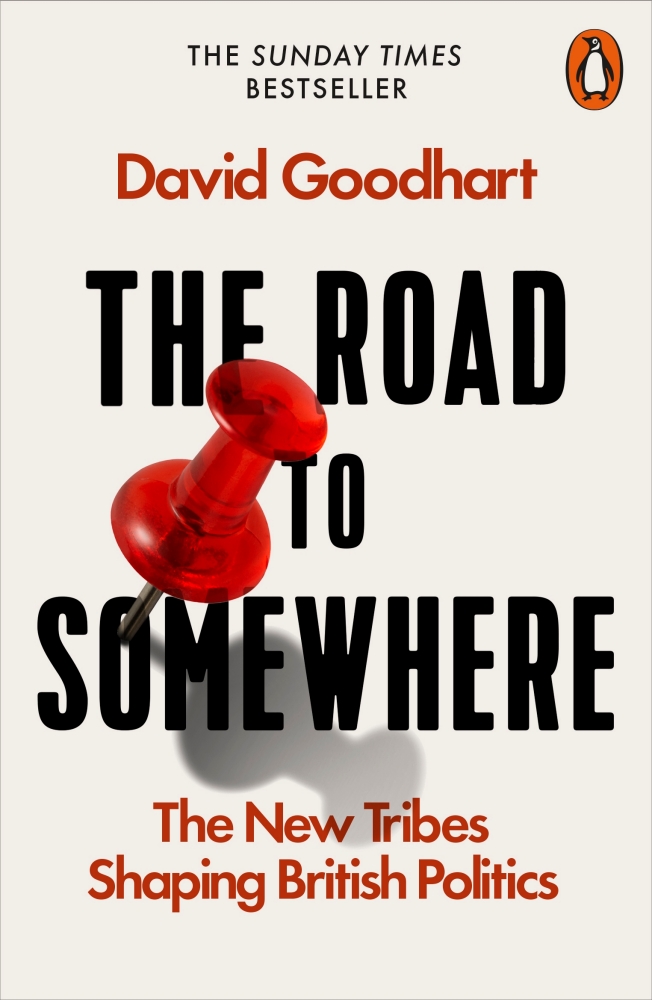
Audio version: To listen in a player, use the one above or click here. To download the mp3, right-click here and choose “save link as” or “save target as.” To subscribe to the CC podcast RSS feed, click here.
David Goodhart
The Road to Somewhere: The New Tribes Shaping British Politics
London: Penguin, 2017
“Where are you going?” “Pretty far.” Thus, or similarly, ends John Dos Passos’ novel The 42nd Parallel, which portrays the social destinies of different Americans at the beginning of the twentieth century. It is not certain where someone is going, maybe “somewhere” or maybe, who cares, just “anywhere.” The title of David Goodhart’s book intentionally echoes such imprecision of destination, for this book is not a prognosis but an analysis. In The Road to Somewhere Goodhart argues that society in contemporary Britain is divided between what he calls the “Somewheres” and the “Anywheres,” and that the difference between these two tribes and their often opposing interests and priorities underlies many social and political attitudes, policies, and decisions.
Somewheres are those whose attachment is to what the American sociologist Talcott Parsons called an ascribed identity, which is the Somewhere understanding of identity, in contrast to a chosen identity, which is the Anywhere understanding of identity. Somewheres feel most closely attached to what they recognize as akin to themselves in terms of their place of birth, their associations and history, where they grew up, the traditions to which they feel bound, and their ancestry. Their identity tends to be closely linked to their ethnicity, where they come from geographically, the social class into which they were born, and the nation to which they belong. Anywheres define themselves in terms of what they choose to become, in making full use of their talents to take advantage of whatever chance offers them; they define themselves primarily in terms of what they actually achieve as individuals, not in terms of what has been given to them, but in what they have made of themselves. Anywheres lack deep emotional attachment to places, and care little for where they were born, their ethnic groups, their gender, their nationality, or their class. Home is where they have chosen to live, not where they were born, for where they live is a matter of personal ambition and career. They define themselves primarily in terms of professional and personal resumés.
David Goodhart does not argue, as many do who have written about the recent rise of populism, that Left-wing and Right-wing divisions are now irrelevant or even redundant, having been replaced by a new division of “people” versus “elite.” However, his new distinction between Anywheres and Somewheres implies that, at the very least, the Left/Right divide is no longer the decisive political divide that it has been up until recently, or if it is, it has been radically transformed in character. The division Goodhart is describing is for him quite a recent phenomenon, one which began to emerge in the 1990s. He is at pains to second-guess the criticism that these are rough generalizations, as any such social analysis necessarily will be, and he acknowledges that many people can be partly Anywhere and Somewhere together, or may live in a grey area between the two groups, but he insists that, by and large, his social paradigm is accurate and that many social problems in Britain have been brought about by the investment of disproportionate power in the hands of the Anywhere tribe.
Who is David Goodhart? He is the founder of Prospect magazine, launched in 1995, significantly only two years before the first election landslide of Tony Blair’s “New Labour” party. Tony Blair (“Tony”, never “Anthony”) overhauled the Labour party’s structures and program in order to “appeal to the middle ground” of British politics and make Labour a natural party of government again. He overthrew the traditional socialism of his party, notably in his rejection of their commitment to nationalize major industries and to overcome the old socialist notion that profit was a dirty word. In fact, Tony Blair famously stated in an interview that he had “no problem with millionaires,” perhaps anticipating the day he would himself become one. He replaced hardline socialism with New Labour’s “Third Way,” a way which sought to espouse progressive social values along with hard-headed financial and economic pragmatism, a way dedicated to equality of opportunity, efficiency, innovation, and the overthrow of entrenched privilege and prejudice.
New Labour was markedly less committed to reducing overall nationwide inequalities of income, or nurturing social solidarity. Blair’s New Labour proclaimed a new modern Britain, which would shake off the hidebound prejudices of the past, be they conservative “homophobia” or hidebound socialist ideology. Britain was now a “cool Britannia.” Unlike the long-established socialist and conservative British weeklies, represented by The New Statesman and The Spectator respectively, which in many ways reflected the Labour versus Conservative feud, Prospect proclaimed that it valued compromise more highly than ideology, and pragmatism more highly than idealistic attachment. The intention of Prospect magazine, in keeping with the New Labour climate, was to maintain a non-prejudicial pragmatic rather than ideological outlook on events, to be a liberal publication that was nevertheless free of liberal ideology. As its name suggests, Prospect looked forward, not back at the past. This harmonized with the optimism of the early Blair years and the stress placed by the new Labour government on a “third way” alternative to the Conservative/Labour division.
This inclination to moderation and compromise is characteristic of Goodhart’s own writing and beliefs. Goodhart’s account in The Road to Somewhere describes how, after a short honeymoon period, he began to feel increasingly uneasy about the social course Blair’s New Labour was taking. Goodhart began to realize that Anywheres, the tribe of the well-educated with a major hub of their activity in London, were leaving a large part of society behind when devising their policies and innovations and not taking the wishes of large sections of society into account at all. Those who cared about “old ways,” their country and their roots, were being moved aside to make way for one Anywhere policy after another. More disturbing still, he gained the impression that Anywheres did not care about the fortunes of the millions of people in Britain who did not share their vision or priorities. There were many who profited from Blairite reforms and the increasing stress on individualism and anti-traditionalism, but there were many who could not or did not want to match the pace of Anywhere economic and social innovation. Most Anywheres were complacent about this. Goodhart, who defines himself as an Anywhere, was and is not.
Goodhart, like most of the successful and affluent advocates of the cause of the disadvantaged, himself comes from a privileged background, a fact which he readily acknowledges in his book. Not only does he hail from Anywhere, but for a large part of his life he has been a believer in the Anywhere vision. “For most of my adult life,” he writes, “I have been firmly in the Anywhere camp, and by background and life-style remain so.” (p. 14) His increasing sense of detachment from what might be called his tribe was brought about by his awareness that the altruism upon which society depends, for example in the maintenance of a welfare state, depends on trust and solidarity, and that trust and solidarity in national terms are not Anywhere concerns. Social solidarity is naturally and inevitably stronger towards one’s own kind, Goodhart insists. Therefore multiculturalism, stressing the divergence of people within a nation and not their similarity, is for Goodhart literally anti-social. Anywheres welcome immigration as a matter of principle, but immigration places great strain on those civic virtues which make all social solidarity possible in the first place, namely the solidarity created by familiarity and a shared outlook on life.
Goodhart reproaches multiculturalism with impeding the integration of immigrants into British society, something essential to ensure that social solidarity remains robust and reliable. He reproaches Anywheres for not caring and not even understanding why or how mass, uncontrolled immigration could have a negative impact on people’s lives. That those who most loudly applaud mass immigration themselves tend to live in gated communities or far from immigration “hot spots” is not a novel revelation. What is unusual is to read such acknowledgement from a renowned “middle of the roader” — the founder of, and to this day a leading contributor to, a successful liberal weekly publication. There are indications, at which Goodhart has hinted in his writing, that many Anywheres consider him disloyal to his tribe for the criticisms which he has made of an Anywhere hegemony.
Goodhart, for whom Brexit and the election of Donald Trump “marked not so much the arrival of the populist era in Western politics but its coming of age,” (p. 1) is hardly original in noting that there is a social loser/winner divide marking Western society, especially British society, as a result of globalization, but he brings to this argument a ready supply of data, and his book abounds with statistics and references to findings and surveys; he puts his case moderately and rationally. Equipped with an array of facts, he sets out to show that in Britain social structures are strongly biased in favor of the social, financial, and ethical concerns and interests of Anywheres at the cost of Somewheres. This inbuilt social bias (one might call it “institutional elitism”!), Goodhart argues, creates a kind of vicious circle of social privilege, whereby the advancing of Anywhere power enables Anywheres to further promote their own agenda and their own priorities, thereby enhancing their hold over British society, which advances their power, and so on.
Change for change’s sake is a keynote of Anywhere ideology. “Anywhere ideology,” Goodhart states, is “invariably a cheerleader for restless change.” (p. 7) He quotes from a speech by Tony Blair to the Labour Party Conference in 2005:
I hear people that we have to stop and debate globalisation. You might as well debate whether autumn should follow summer . . . The character of this changing world is indifferent to tradition. Unforgiving of frailty. No respecter of past reputations. It has no custom and practice. It is replete with opportunities, but they only go to those who are swift to adapt, slow to complain, open, willing and able to change. (p. 7)
The loyalties of Anywheres, what they will fight for, are chosen loyalties, and the right to choose is a fundamental “Anywhere” right. Those who speak of sentiment or values are standing in the way of “progress.” Values and lifestyles are served up to each of us à la carte. Everything is subjected to a rational, physical profit/loss value calculation. Goodhart sums the attitude up in one brief but telling understatement. For Anywheres, he writes, “The idea of the sacred is especially difficult to understand.” (p. 29) With his pragmatic leanings as a self-confessed “Anywhere,” Goodhart hones in on the detailed evidence which many critics of the modern world, when they display a high-falutin’ romanticism without much attention to data, tend to ignore. So it is that the value and significance of The Road to Somewhere lies primarily in its willingness to defend Somewheres, not with the sound and fury of romantic ideology, but in the name of a traditional sense of British fairness. Goodhart is not asserting that the world is about to collapse, he is not alleging there is a conspiracy to destroy all good in the world. He is simply stating, in a mannered and moderate, indeed an old-fashioned liberal way, that what successful people are doing is unfair to the less successful people, and that society needs to be drastically altered to reset the social balance.
Goodhart’s implicit desire to see more income equality has a socialist color to it, and by implication Goodhart’s book is arguably at least as socialist as it is liberal, but The Road to Somewhere takes a leap beyond current Left-leaning conceptions of reform, for it contains a critique of socialism too, and a grave one: for Goodhart, modern socialist leaders have joined the Anywheres; they prioritize the concerns of the rich and successful, and do so despite all their rhetoric to the contrary. In essence, Goodhart’s message to the Left could be couched in these terms: “Your kind of socialism (fighting prejudice) is pandering to Anywheres, your kind of liberalism (minority rights) is pandering to Anywheres. It is time you listened to the Somewheres, their kind of liberalism (fairness), and their kind of socialism (solidarity). What you are doing is deeply unfair and it is ultimately anti-social, because it is entrenching division and not seeking to heal it.” Goodhart writes on the real issues of concern to Somewheres and he does so not with regard to ideological traction, but with respect to facts: facts about income distribution, facts about education, and facts about immigration; essentially, facts of concern to the millions who are not part of the Anywhere success story and who do not share Anywhere priorities.
Goodhart closely associates the attitudes and beliefs of Anywheres with the ideology of liberalism, and understandably so. Liberalism is, after all, the ideology of rational choice aligned with a distrust of hindrances, barriers, and inherited duties of every kind. But such barriers, hindrances, and duties are exactly the loyalties and beliefs which the Somewheres hold dear. Duty, constancy, reliability, attachment to place and home — these are Somewhere values which are sold short in contemporary British society.
According to Goodhart, it is overwhelmingly Anywhere political manifestos which are written and Anywhere policies which are enacted in political, economic, and cultural life. Society has become dominated by Anywheres. Goodhart argues that British society is unbalanced in that it now favors transience, rational “here and now” calculations, the rights of individuals against collectives, and obsession with “growth,” “opportunity,” and “development” at the expense of “home,” “tradition,” “loyalty,” and “patriotism.” Anywheres thrive at the expense and detriment of a collective national British identity, an identity precious to Somewheres. The notion that “anyone can make it,” a typically Anywhere assertion, has become a mantra of modern British life. It is encouraging for those who can “make it” to know that “anyone can make it,” but it is a source of discouragement and envy and is liable to invoke a sense of personal worthlessness and failure for the many who do not “make it.” Goodhart wants to see balance restored between Anywhere and Somewhere aspirations, and that would mean acknowledging Somewhere priorities after decades of neglect and belittlement. Goodhart’s writing is mild, his criticism restrained and couched in euphemism and understatement, but the implications of his views are radical, perhaps more radical than he realizes.
The two developments in British society in recent decades of which Goodhart is especially critical (and incidentally the only times in his book when an aggrieved, even angry note, makes itself felt) is bias in education and the social, cultural, and economic bias in favor of London and the university hubs at the expense of the rest of the country. Goodhart underlines the significance of the expansion of higher education in Britain, a phenomenon whose importance he believes has been largely ignored. Britain’s educational system, writes Goodhart, is heavily weighted in favor of Anywheres. “Mass higher education in Britain is higher education written a little larger.” (p. 36) Those who go to universities are almost by definition Anywheres. Policymakers and Anywhere students have little regard for the educational aspirations of those who are not destined for university. Somewheres are not so much despised as wholly ignored. Somewheres “can find a job somewhere, somehow.” Their jobs are anyway unimportant. But if they have not “made it,” it’s because they have “not realized their full potential” — they have been bogged down in their own prejudices and brought it all on themselves. If Somewheres do not become famous writers or successful dentists, that is “their” problem. It’s not “my” problem. Losers count for little in a meritocracy, and those who fail to win a place at a university, so runs the Anywhere subtext, are losers.
While Anywheres continue to become ever more tolerant socially, they are highly and increasingly intolerant politically, and very touchy indeed about any perceived challenge to a hegemony which they do not even openly acknowledge, but which they are quick to defend and assume is theirs by superior intellectual right. But what of the socialist challenge to privilege in this context? After all, Blairites are on the retreat in a Labour party which seems to have rediscovered its radical roots under its popular new crypto-Marxist leader, Jeremy Corbyn, who is no friend of Tony Blair. Goodhart does not examine the extent to which the Somewhere/Anywhere divide has been superimposed on the divide in Britain between socialists and conservatives, or whether a resurgent populist Left can hold Anywhere liberals and traditional socialists together. He seemingly believes that Left-wing populism is an ephemeral phenomenon. He may be right, but his dismissal of the standard socialist challenge to capitalism as an economic model makes him open to the old charge that he is overly hasty in supposing that the Left/Right divide is redundant. A Marxist would perhaps opine that this is a classic example of bourgeois wishful thinking. Socialist hostility to people of privilege is alive and well in Britain and indeed is quite virulent, having returned to a Labour Party which has just been given a new lick of red paint. The red flags have been unrolled again and class war still manages to appeal simultaneously to Somewhere working class voters and Anywhere students. Goodhart himself quotes one survey according to which nearly one-third of Labour voters would be upset if one of their children intended to marry a Conservative! But what Goodhart calls the “top-down liberalism of the cognitive elites” (p. 35) marches on.
The resurgent socialism of the Labour party does not mean that Goodhart’s thesis is invalid, but it shows that Goodhart underplays divisions in British society which are not part of his Anywhere/Somewhere paradigm. Goodhart also pays no attention to religion or race as divisive elements in society, and here, perhaps, it would be racialists and the religiously committed who would claim that his ignoring of such divisions arises from his wishful thinking that they will not play a decisive role in the future. Goodhart could justifiably respond, and probably would respond, that Left and Right “extremists” have themselves hugely ignored the influence and strength of a moderate but deep adhesion to Anywhere and Somewhere visions of society. He does point out that successive elections point to the moderation of Somewhere ambitions. They are not extreme, still less ideological, class or race warriors, and this is exactly Goodhart’s point. Somewheres are for the most part not radical socialists but want social equity; they are not nostalgic reactionaries, but they do want patriotism and fundamental values to be reinstalled as part of the fabric of British national life.
Higher education is now the passport to membership of the Anywhere tribe. Class, race, locality, origin — none of this matters in respect to Anywhere membership. What does matter is a willingness to embrace Anywhere codes and beliefs, and, very simply — Goodhart insists on this point — to graduate from a university. Goodhart draws the reader’s attention to the seldom commented upon predominance of higher education in British society and its rapid expansion since Tony Blair’s victory in 1997. It has reached the point that, in 2016, half of the school leaders in Britain were destined for university. An astonishing ninety percent of Members of Parliament, according to Goodhart, are university graduates, while as late as the end of the 1970s, nearly a hundred Labour MPs came from manual-laborer class backgrounds, and did not have a university degree.
The Brexit vote, as Goodhart sees it, provided a unique opportunity for Somewheres to directly influence politics. As the major political parties are dominated by Anywhere leaders, voting for a political party is ineffective and frustrating for Somewheres, whereas in a referendum where each voter has only one vote, Somewheres and Anywheres enter into a trial of strength by numbers. Goodhart rightly notes that populism, and that classic populist expression of democracy, the referendum, exposes an inherent tension between the will of the majority on the one hand and the democratic structures and established political parties acting as filters to ensure that the judgements of professionals and experts (overwhelmingly Anywheres) prevail on the other. Goodhart is convinced that the balance has now shifted too far in the Anywheres’ favor, leaving Somewheres — about half the population — permanently disenfranchised.
Goodhart is not fighting a war or rallying troops to battle. He does not want to see Somewheres overthrowing Anywheres. He believes that social stability is best served by ensuring a balance of power between the two tribes. This reviewer wonders if Goodhart is not unconsciously nostalgic for the old two-party democracy of Conservative upper class versus Labour working class, both parties being nevertheless loyal to the notion of a national identity. Goodhart certainly places national unity above class, as well as above ethnic, cultural, or religious identity. For him, when the stakes are down, the nation should be the ultimate source of common civic loyalty and affection. He deplores the distancing of Anywheres from any sense of loyalty to their own nation, and worse still, their rejection of the notion of “belonging” to a nation at all. It is therefore fair to call Goodhart a moderate nationalist (or more precisely a moderate and a nationalist, because his nationalism is not by implication entirely moderate), even if the designation “nationalist” is not one he chooses to use himself.
The question of nationalism vis-à-vis other loyalties (notably loyalties of religion, race, or class) is unresolved, and Goodhart makes no attempt to tackle it in his book. Rather, he skirts around a subject too perilous and problematic for what he sets out to do, but the discerning reader may well feel that Goodhart has simplified his work at the cost of analytical depth. Religious or racial allegiance may harmonize with national unity, but there is no guarantee that they will, and the disharmony in a society caused by immigration is often owing to the fact that they have not. Does loyalty to a nation mean accepting all ethnic members belonging to that nation as part of the national family? If it does not, what is the identity of those who are rejected, yet believe they do belong to the nation? These questions and more arise in the course of reading The Road to Somewhere, but Goodhart evades them.
Goodhart’s vision is of a Britain where there is “fair play” and balance between the justified aspirations of talented Anywheres and the equally justified values of conservative-minded Somewheres. He does not claim that Anywheres are ipso facto flawed or “wrong,” just that they are overbearing and unfairly — even undemocratically — getting far too much of the social, cultural, and economic cake. His vision is of a Britain embracing modern technology and looking for new opportunities and experiences, while nevertheless taking into account and legislating for values of duty and solidarity, and other values dear to Somewheres.
Goodhart wants to see more recognition of Somewhere values throughout society, especially in lawmaking and education as well as in the recognition and protection of jobs for non-graduates. This dovetails with the critique which has brought criticism down on Goodhart from Anywheres, namely his belief in restraint regarding immigration. Goodhart reproaches the Blair government with greatly underestimating, and later underplaying, the spike in immigration to Britain from other EU countries, especially Romania, which took place after the Balkan states joined the European Union. He might have added in this context the Conservative Prime Minister David Cameron’s pleading the case for Turkish EU membership. (Under the rules of the Union, the citizen of any member state has the right to settle and work in any other member state.) The majority of jobs which the new immigrants were prepared to take were Somewhere jobs, so immigration was a prime example of a policy which appealed to Anywheres (ease of travel, internationalism, free-market labor competition, the breaking down of borders) but not welcomed by Somewheres (rapid change, fewer jobs, and the undermining of local identities by allowing in people from other backgrounds). Immigration is not only a matter of jobs. It is also a matter of identity, that which matters to Somewheres but hardly at all to Anywheres, and which is inherited and not chosen. Anywheres should accept, insists Goodhart, that in poll after poll in Britain, a majority of people — so high a majority as to necessarily include some Anywheres — have expressed the opinion that immigration is “high” or “much too high,” but Anywhere-dominated agendas balk at constructing barriers or imposing controls on what is most dear to them, namely the “free flow of goods and services.”
Public spending on higher education in Britain has reached seventeen billion pounds a year. It is ring-fenced from government cuts, while Britain’s adult skills budget, aimed principally at the training of non-graduates who have left school, has fallen to one and a half billion. Tony Blair’s Labour government introduced university tuition fees in 1998, a measure which encouraged universities to attract more foreign students, since they pay full tuition fees, unlike domestic students, whose fees are capped by law. The abolition of free university education, which has led to repeated fee hikes considerably higher than the annual retail price increase, was itself introduced in response to rapidly rising costs incurred by the Anywhere-driven expansion of universities. This is Goodhart’s point: investment of resources is focused on the interests of the successful and flexible, the Anywheres, while Somewhere interests (in this case improved basic education, investment in secondary school education in “the basics,” investment in vocational training, encouragement and protection of a skilled domestic labor force, and protection of industrial skills from foreign competition) are ignored. The education of a top student (and top-paying student) from the United States or China is prioritized because it is seen as a more valuable investment than practical training for that half of the population which does not go to university, although in few cases would someone who benefited from state-subsidized vocational training be taking his or her acquired skills out of the country. But Anywheres will say, “So what if skills are exported? That is how markets work. I don’t care.” For Anywheres, individual careers are always more important than national well-being or solidarity. Practical training falls in importance the more that skilled technical jobs are taken over by businesses based outside the UK, in countries where labor costs and social contributions are appreciably lower. This is the “Anywhere way.”
Goodhart wants radical political change here. He wants government to drastically shift focus from prioritizing academic qualifications towards concentrating on basic education and practical qualifications, and to protect those qualifications once obtained from outsourcing. Anywhere-encouraged large-scale immigration has made such a task hard to implement — another reason for curtailing immigration. It is worth noting that Goodhart’s proposal is more realistic than the aims of the radicalized British Labour party, which proclaims that it will heavily invest in basic education whilst also abolishing students’ fees, a major preoccupation of Anywheres, who are opposed to mandatory fees because they create high levels of debt among university graduates.
In this reviewer’s opinion, the best chapter of The Road to Somewhere is the one entitled “The Achievement Society.” Here, Goodhart argues that social mobility has replaced equality of income as a socialist/Labour priority. For example, equality of pay between men and women has become a more desirable objective for the Left than narrowing the salary gap between the highest- and the lowest-paid in Britain. Salary disparities between men and women among the top executives is much more worrisome for Anywheres than the yawning disparities of income between rich and poor in the country as a whole. Goodhart sounds a note of warning in his characteristically moderate language:
People on the left should be wary of the extent to which social mobility and meritocracy have become the consensus alternatives to a society with more equal starting points. . . . And when politicians talk about social mobility as an unqualified good they often seem not to understand the costs and trade-offs involved. (p. 181)
Globalization brings another menace:
The same phenomenon [global transparency and the notion of universal social mobility] is starting to drive global migration too. Ambitious and able young people in poor countries used to imagine how they would clamber to the top of their societies, now they are just as likely to imagine how they can escape across the oceans to the societies like ours that flaunt their attractions through the global media. (pp. 181-183)
As one would expect from tribe members, almost by definition of “tribe,” Anywheres in the great majority marry within their tribe, which in a society in which both parents work (arguably a social development which itself has much to do with the efforts of Anywhere social prioritizing and Anywhere-based feminism) reinforces the economic, and above all social, advantages which Anywheres enjoy in the first place. Doubly professional couples also double the advantageous social connections available to their children. Instead of continuing their bias in favor of the Anywhere class, Goodhart states what, in his opinion, the immediate government educational priority should be: “. . . so long as nearly 20 per cent of pupils leave secondary school each year barely able to read or to do simple sums the government should have one very big and very simple social mobility policy: improve basic education at the bottom.” (p. 190)
Goodhart does not state, but the implication is there, that prioritizing basic education (something like the American “no child left behind” scheme?) is hampered by the cultural and ethnic differences caused by immigration and multiracialism. Falling standards of “French,” “German,” and “British” pupils in recent years have as much or more to do with the cultural and ethnic incompatibility of immigrants as they do with Anywhere educational priorities. But I suspect that examining racial and cultural influences on education attainments would have taken our writer along a path which would have ensured his complete banishment from the Anywhere camp, and even a refusal by the prestigious Penguin publishing house to have anything to do with him or his book.
Well-paid middle class and working class jobs are in freefall. Britain’s old manufacturing jobs have gone. But if the curious traveller goes to London and peeps in at the high-priced but crowded pubs and restaurants, he will realize that Anywheres are above all that and are doing fine. They have been riding high on share hikes, the real estate bubble, and the opportunities presented to the well-educated by a global economy. In Britain, the Anywheres are focused on London, a city towards which Goodhart shows no affection. London may be the capital of the world, but is it still the capital of England? It is London and universities that bucked the English trend in the referendum on the EU and voted with a large majority for Remain. It is London and the London elites which are scheming to overturn, or at least water down, the consequences of the referendum result. It is London which boasts a Muslim mayor as the very symbol of multicultural tolerance and harmony, and it is London and its resolutely Anywhere culture scene which never ceases to sing the praises of universal tolerance, mass immigration, and the EU. Goodhart admits to voting himself for Remain, but his admission is not made with enthusiasm, and praise for the EU is notable in this book by its absence. No wonder. The EU itself is all about promoting Anywheres at the cost of Somewheres. In fact, a policy of promoting Anywhere at the cost of Somewhere would be a reasonably accurate definition of the raison d’être of the entire European Union project.
So what are David Goodhart’s solutions to the disproportionate domination of Anywhere values? Firstly, as already mentioned, he calls for concentration on education and job training for those who are not destined for university. There is an urgent need, according to Goodhart, to improve the status of humbler positions and humbler jobs, both in terms of pay as well as in training and recognition. There needs to be greater respect for Somewhere values, preference for one’s own kind, restraint on immigration, pride rather than shame in preferring one’s own nation, allowing import tariffs where necessary (an Anywhere bête noire) to protect the national interest should need arise, and a slowdown in meeting demands for more social justice for minorities and new minorities. Instead, there should be a state-sponsored drive to close the gap between the very poor and very wealthy, providing job and training opportunities for home-based industries and a home-based workforce. Government priorities should demonstrate a determination to integrate groups by abandoning the tolerance of parallel societies in the name of multiculturalism, and the state should be considerably less willing to pour money into Anywhere political and cultural initiatives.
This is an important and timely book. Goodhart’s description of the fault lines of Anywhere and Somewhere which became so evident during and after the EU referendum is persuasive and well supported with facts and figures. However, Goodhart ignores a telling inherent failing of Somewheres. At the risk of sounding typically Anywhere myself, I would say it is a self-created weakness. Somewheres lack the experience and expertise of Anywheres (were it otherwise, they would be Anywheres) and are therefore at a permanent disadvantage in political discourse and debate. They also lack the financial muscle and leisure time which Anywheres put to good effect in political, cultural, and social life. Consequently, Somewheres depend on charismatic, well-heeled leaders like Donald Trump or Nigel Farage to carry their banner. Anywheres do not depend on individual leaders in anything like the same way. It is a moot point how much trust can be placed in such self-appointed, wealthy popular and populist tribunes.
Secondly, Somewheres are more traditional, more “Somewhere” in their party political attachments than Goodhart recognizes (underestimating old party loyalties is an ever-recurring failing of Left- and Right-wing radicals, too). Evidence for traditional party affiliation was furnished by the UK general election which followed soon after the EU referendum. Having caused a dramatic electoral upset by voting to leave the European Union, Somewhere voters then promptly returned to their traditional voting folds of Conservative and Labour. The UKIP vote collapsed, and strongly pro-EU politicians were returned to Parliament by the very electors who had months before voted Leave. Somewhere voters showed no inclination or ability to exploit the influence which the referendum result had unexpectedly given them. Goodhart here and elsewhere downplays the strength of party loyalty and Left/Right in Britain, yet that division is a crucial element in understanding Anywhere hegemony. Somewheres are dazzled by established and successful political parties, even when those parties ignore their interests. It remains to be seen whether the swing to Left-wing populism in the Labour party will become a new Left-wing force or will be fatally weakened by the Somewhere/Anywhere fault line which Goodhart outlines in his book.
A final, material, criticism of The Road to Somewhere is that Goodhart was apparently not taught the basics of punctuation at his alma mater, Eton College, the most famous private school in the United Kingdom, and the Penguin Books copy editor was either too ignorant or too lazy to correct Goodhart’s abysmal punctuation. Goodhart’s weakness in the basic literacy skill of punctuation, despite his being educated in a top private school and published by a leading British publisher, is ironic evidence in support of his plea to promote literacy in English teaching, a Somewhere priority. If Goodhart’s book is anything to go by, it is not only Somewheres who could benefit from a return to the basics in English teaching!
The Road to Somewhere is an important work because it is a call for reconciliation between what are usually considered implacable foes: the elite and the mass. Goodhart insists that he is not a reactionary and not calling to “put the clock back” or restore a fictitious idyllic England of the 1950s, but that he is saying that British politics and social policy should acknowledge the need to take the patriotism and conservatism of Somewheres on board in future policymaking and prioritization. If they do not, if Somewhere values and aspirations and the proposals contained in what Robbie Millen of The Times called this “dangerously moderate” book continue to be ignored and undermined by Anywheres, British society may face bitterness and divisions more disruptive and destructive than those caused by the European referendum.
2 comments
In calling for reconciliation between nationalists of ‘left’ and ‘right’, I believe that Goodhart makes a very important point. The importance he places on loyalty to the nation, over class or locality, shows that he considers Anywheres (or what I’d call cosmopolitan globalists) to be the enemy, properly defined.
Just as there are globalists with a socialist economic outlook, there are globalist capitalists. Taken together, these varieties of globalism – and the small differences of emphasis between them – comprise what now passes for politics-as-usual.
The question of national belonging and what becomes of those who don’t belong – but feel like they do – is one that nationalist groups rarely seem to deal with. It would be interesting to see some discussion about this on CC in future.
A reveling review of an important work. Thanks Mr Walker.
.
“Citizens of the world” are colonialists of globalism and enemies of the nation. Perhaps they should be made downwardly mobile via defenestration.
Comments are closed.
If you have a Subscriber access,
simply login first to see your comment auto-approved.
Note on comments privacy & moderation
Your email is never published nor shared.
Comments are moderated. If you don't see your comment, please be patient. If approved, it will appear here soon. Do not post your comment a second time.