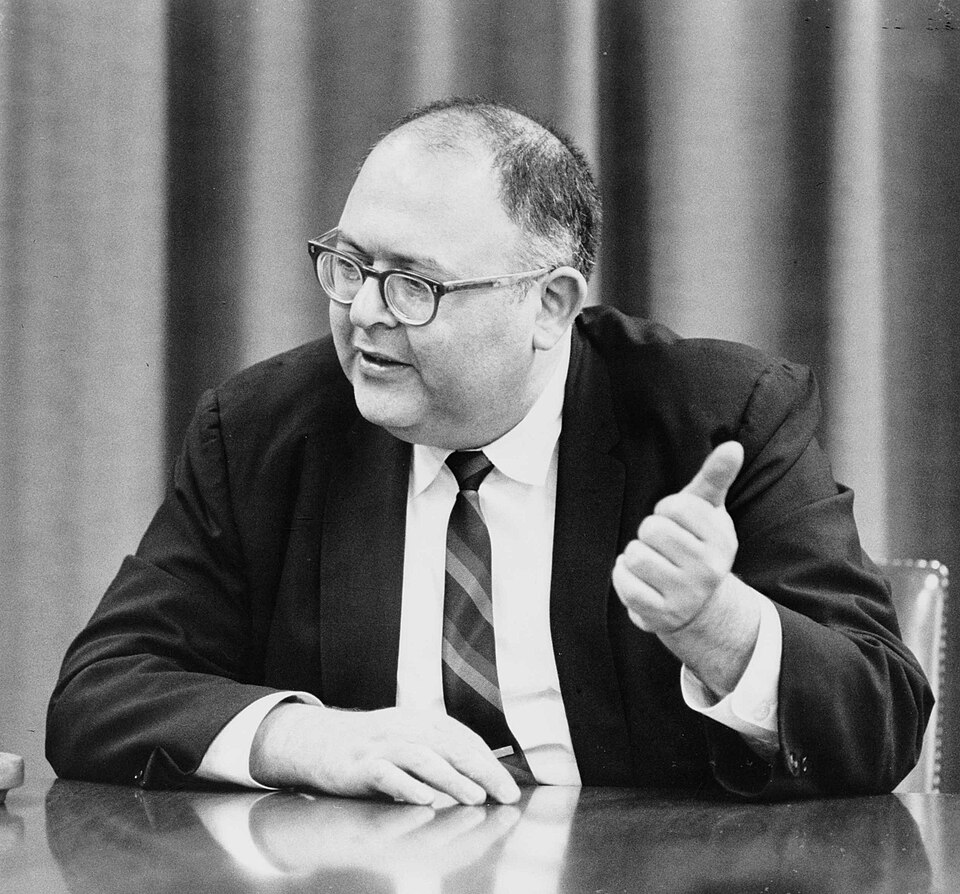
Herman Kahn, author of On Escalation.
1,672 words
So often in geopolitical discussions commentators invoke the specter of escalation and the prospect of climbing the “escalation ladder,” rung by rung, towards ultimate nuclear cataclysm. Unfortunately, we are in the midst of one of the worst global crises in living memory where escalation is being recklessly pursued by Benjamin Netanyahu in particular and the Israel Lobby more generally. Fitting the historic pattern, the Israel Lobby is using their gentile fall guy, President Donald Trump, to achieve their perceived goals.
America First policies have been subsumed by Israeli interests. What are Israel’s strategic goals? Greater Israel is the overarching strategic aim of this bull rush toward wider conflict in the Middle East; and failing that, the secondary goal of turning Iran into a destroyed, rump state is the other. That is why the sky is the limit as far as violence is concerned in this conflict. That is why the escalation ladder is being climbed so recklessly.
Origin & Core Idea
The escalation ladder is a conceptual framework used in geopolitics and strategic studies to model how conflicts between states (or other actors) can intensify in a stepwise, incremental manner: from low-level political or diplomatic actions all the way to full-scale nuclear war.
It is not a literal prediction of what will happen in every crisis, but a heuristic (a thinking tool) to analyze risk, decision-making, bargaining, and the potential for miscalculation. The idea emphasizes that escalation is often deliberate and controlled rather than an automatic slide into catastrophe; though once you start climbing, it can become very hard to climb back down without concessions or clever de-escalation.
The concept was formalized by American strategist Herman Kahn in his 1965 book On Escalation: Metaphors and Scenarios. Kahn, a Cold War nuclear theorist, developed it as part of his work on deterrence, limited war, and thermonuclear conflict.
He originally sketched versions with 16 steps, then expanded it into a famous 44-rung ladder (sometimes described with slight variations across his writings). The ladder is divided into broad phases or “thresholds” that mark psychological, political, or military breakpoints where the nature of the conflict changes dramatically. Crossing a threshold (e.g., from conventional to nuclear weapons) carries huge symbolic and practical weight.
Think of it like a game of “chicken” played at ever-higher stakes: each side escalates to signal resolve, hoping the other will back down first, but every rung increases the danger of uncontrollable spiral.
Broad Structure of Kahn’s Ladder
Kahn grouped the rungs into rough categories (not exhaustive—his full list is very detailed and scenario-specific):
- Rungs 1–6 or so: Subcrisis Maneuvering: Diplomatic protests, economic sanctions, shows of force, propaganda, covert actions, minor military deployments. Still “peaceful” competition.
- Higher conventional rungs: Traditional and Intense Crises: Blockades, limited conventional strikes, mobilization of forces, attacks on proxies or third parties, major ground/air operations short of all-out war.
- Nuclear thresholds (around rung 15–21): “Exemplary” or demonstration use of nuclear weapons (e.g., a single low-yield detonation in a remote area to signal seriousness), limited tactical nuclear strikes on military targets. This breaks the “nuclear taboo.”
- Even higher rungs: Bizarre Crises and Nuclear War phases: Counterforce strikes (hitting enemy nuclear forces), attacks on cities, massive retaliation, up to “spasm” or insensate war (all-out, civilization-ending exchange).
The key insight: escalation is not a smooth slope or a binary “peace or total war.” There are many discrete, observable steps, each with its own costs, signals, and potential off-ramps. Actors can choose to stop, pause, or even descend if the risks become too high.
Why It Matters in Geopolitics
The ladder helps strategists and leaders:
- Assess how far a crisis has already climbed.
- Anticipate what the next logical (or escalatory) move might be.
- Design deterrence or “escalation dominance” strategies: making it clear to an adversary that further climbing would be suicidal for them.
- Identify thresholds worth defending at all costs (e.g., preventing any nuclear use).
It is especially relevant in nuclear-armed great-power rivalries, where the ultimate rung is mutual destruction. Analysts also apply the metaphor to conventional wars, cyber conflicts, proxy fights, or even economic/tech rivalries (there are now “AI escalation ladders” modeled on Kahn’s idea).
John Mearsheimer’s Use of the Concept
Professor John Mearsheimer frequently invokes the escalation ladder when discussing contemporary conflicts. For him, it is a practical warning tool: in great-power competition, states often feel compelled to “go up the ladder” to protect vital interests, but miscalculation or domestic politics can push everyone higher than intended. Mearsheimer highlights how third parties can inadvertently drag superpowers toward dangerous rungs, and he stresses the difficulty of finding “off-ramps” once nuclear thresholds loom.
In short, Mearsheimer uses it to argue for restraint and realism: better to avoid climbing in the first place than to bet you can control the climb forever.
The escalation ladder remains influential because of its flexibility. It does not claim every conflict follows the exact 44 steps—real crises are more complex, even messy, with parallel ladders, cultural differences, or sudden jumps. It does, however, force clearer thinking about the risks of “just one more step.” It is an example of strategic theory making the complexities of escalation in war understandable.
Where are Things Now?
In early April 2026, the United States under President Donald Trump is pressing a multifaceted military campaign against Iran that has escalated far beyond initial targeted strikes. What began in late February with joint U.S.-Israeli operations—reportedly including the elimination of key Iranian leadership—has grown into sustained airstrikes, naval deployments, and explicit threats against critical infrastructure. Trump vacillates between boasts of objectives being attained and warnings of “obliteration” if Iran fails to reopen the Strait of Hormuz.
The ongoing conflict has disrupted global energy markets, injured hundreds of U.S. personnel, and has resulted in bizarre mixed signals from Trump: claims of “great progress” in negotiations are contradicted in short order with promises to strike Iran “extremely hard” over the next two to three weeks.
The Spark & Rapid Escalation
The current phase traces to late February 2026, when U.S. and Israeli forces launched extensive airstrikes on Iranian nuclear-related sites, munitions facilities, and leadership targets. Israel alone conducted hundreds of sorties, while the U.S. contributed precision strikes, including bunker-buster attacks on sites like Isfahan. Iranian retaliation has included missile and drone barrages affecting Gulf shipping and allies, with reports of fires at facilities in Kuwait and incidents near Qatar.
Trump has repeatedly stated that Iran’s nuclear program has been severely degraded, reducing the immediate threat of weaponization. However, the effective Iranian closure of the Strait of Hormuz—a vital chokepoint carrying roughly one-fifth of global oil—has kept pressure high. In Truth Social posts and other public remarks, Trump warned that failure to reopen the strait would lead to strikes on electric generating plants, oil wells, Kharg Island, and possibly desalinization facilities: “we will conclude our lovely ‘stay’ in Iran by blowing up and completely obliterating” these targets.
Inadvertent Revelations & Troop Deployments
A bizarre, viral element that added color and operational security concerns to the military buildup involves Charm Daze, a San Diego exotic dancer, whose TikTok about military patrons preparing for deployment went viral. She described troops from the region’s major naval base spending heavily while appearing depressed in anticipation of their deployment to the Middle East. Military influencers quickly criticized the post for potentially revealing troop movement timelines to a broad audience. This coincided with the arrival of additional U.S. forces, including Marines and sailors aboard the USS Tripoli, joining carrier strike groups and airborne assets. Roughly 10,000 additional troops have surged into theater, positioning assets for potential operations near Iran’s coast. Greg Johnson’s prediction of ground troops being deployed will undoubtedly come to pass.
Kharg Island: Leverage or Further Escalation?
Central to escalation scenarios is Kharg Island, Iran’s primary oil export terminal, which handles the vast majority of its crude shipments. Trump has publicly mused about seizing or neutralizing it: “Maybe we take Kharg Island, maybe we don’t. We have a lot of options.” Pentagon contingencies reportedly include options for amphibious or blocking actions to use the island as leverage for reopening the Strait of Hormuz.
Iran has warned that any landing would turn the island into a “death trap” for U.S. forces. Some reports detail how a temporary hold on Kharg could “get them by the balls” in negotiations, while others highlight the dangers of widening the conflict or provoking broader Iranian retaliation across the Gulf. U.S. strikes have already targeted military assets on the island while sparing core oil infrastructure in some cases, per Trump’s statements emphasizing “decency” in avoiding unnecessary economic damage.
Most recently over Easter weekend, however, Trump has said vituperatively that civilian infrastructure including power plants and desalination facilities will become part of the American target set if Iran does not capitulate. He had this to say on Truth Social:
Tuesday will be Power Plant Day, and Bridge Day, all wrapped up in one, in Iran. There will be nothing like it!!! Open the Fuckin’ Strait, you crazy bastards, or you’ll be living in Hell – JUST WATCH! Praise be to Allah.
This does not bode well for deescalation as the president becomes more volatile.
Diplomacy Amid Threats
Trump has alternated between bellicose rhetoric and claims of productive back-channel talks. He has postponed strikes on energy infrastructure multiple times—once for 48 hours, later for five days—citing conversations with Iranian representatives. Iranian officials, however, have denied meaningful negotiations or any authorization for tankers to resume passage.
In a primetime address, Trump reiterated that core objectives are nearing completion and that the strait could “open up naturally” once the conflict winds down, while still pledging aggressive action in the short term. He has urged oil-dependent nations to “get involved” in securing Hormuz if they want fuel flows restored, and expressed frustration with North Atlantic Treaty Organization (NATO) allies reluctant to assist.
Only War
As of early April 2026, the situation remains extremely precarious. With carrier groups remaining in theater, additional troops arriving in the region by the day, and with Iran showing no signs of capitulation, the escalation ladder will continue to be climbed.
14 comments
Great article! We will find out tonight if Iranian civilization will survive. 🙃
Iran is the innocent party in this conflict. Israel and its US colony are guilty of the most serious war crimes. Iran has a great civilization going back thousands of years. The Jews want to destroy it, using Trump as their tool.
The Iranian regime is bad, but that’s not American business. Just like the sins of Zelenski’s regime were and are not Russian business. The era of imperialism is over, and when somebody does not want accept it, he will pay for this not only with money, but with blood too.
Iran has taken a tit-for-tat or an eye-for-an-eye approach from the start. But man Trump’s Truth Social posts are getting bizarre. The above mentioned post caused Iranian embassies across the globe to answer using tongue-in-cheek responses. The most viral exchange occurred over Trump’s blunt demand to “Open the Strait”. The Iranian embassy in Zimbabwe casually said on X: “We’ve lost the keys”. The joke quickly snowballed across continents.
The articel misses one important point.
The United States has been strategically defeated since day one of the war. The U.S. can escalate militarily and increase the Gulf monarchies’ economic losses — or do nothing, and increase economic losses across the entire world. Both options would significantly impair the U.S.’s ability to prevent the dollar from collapsing and to maintain alliances.
But the U.S. cannot de-escalate either. The dominance in de-escalation lies with Israel. Iran made that clear again with its five-point proposal. A condition for peace is that Israel stops hostilities in Lebanon and Gaza. Politically, however, the U.S. is not able to use available levers against Israel.
So the situation is this: either Israel gives up voluntarily — or the US remains caught between Scylla and Charybdis.
Can there be talk of an escalation ladder now that Trump has skipped most if not all of the rings?
Escalation implies two sides. Our situation is different. Trump was ordered by Israel to attack Iran, and, as the weakest president since Jimmy Carter, he obeyed.
This is not trivial, not conpiracy-think, not even debatable. America hasn’t even a pretend stake in this conflict.
The USA will lose big. Or we will lose bigger. Thanks, Israel.
Jimmy Carter always put America first, never anyone else. He skillfully negotiated a lasting peace between Egypt and Israel
Donald Trump has always put Israel first, himself second, and America a distant third. He is a chicken-hawk, a war criminal and a philo-Semite.
James Earl Carter, Jr. got Egypt to play nice by giving them billions of dollars in foreign aid to nearly match what the USA gives to Israel, which was at least a third of the entire annual foreign aid budget at that time. U.S. Foreign Aid has gone up ten-fold since 1979, although about half of that is actually due to inflation. Regardless, the United States doesn’t have enough cash to give billions of dollars annually to all of Israel’s enemies.
🙂
Zionists absolutely hate Jimmy Carter for the Camp David Accords and strongarming Israel into giving up the Sinai. Remember that Jewish control wasn’t fully entrenched until the late Reagan era and the Zionist lobby had to make many compromises over the years. You just have to read Neo-Con writers and you find that they have an irrational hatred of Jimmy Carter. Actual older conservatives that aren’t braindead neo-cons are more tempered about him. He wasn’t exactly a great president, but he wasn’t this devil figure people make him out to be. I actually prefer him to Reagan.
The Carter administration was a massive step back for the Zionists. Jimmy Carter bribing Egypt into an expensive peace deal was done not at the behest of Jewish powers, Israel would’ve loved if Egypt remained an incompetent hostile state they could goad and slice land off. Egypt was already relatively isolated since Sadat expelled the Soviets, which was done because the Egyptians were getting pretty fearful of an internal Communist revolution. They had clicked on that the Soviets would never sell enough weaponry to actually destroy Israel. The Soviets wanted Egypt to just keep on trying and failing in their wars, as the Apartheid state in the middle east gave the Soviets legitimacy and room to expand their influence in the region. The expensive bill for peace was done because Jimmy Carter was operating off of genuine conviction.
Remember that the six day war was a war of Israeli aggression and a massive landgrab, it was only retroactively explained away as a preemptive strike. And after the Israelis were checked in the south with the peace deal, they focused their attention in the north. Lebanon became their bully target, which they destabilized, and grabbed land as part of their “security zone”.
I thought Jimmy was pretty gutsy when he effectively called Israel an Apartheid State, although I’ve never read his 2006 book.
Jewish theologian Prof. Deborah Lipstadt (who coined the Orwellian term Holocaust Denial) was horrified, although she did not dare criticize Mr. Carter directly.
🙂
Correct. We should greatly reduce all foreign aid, starting with Israel and Egypt. Despite this, I give Carter a lot of credit for advancing the cause of peace. Giving money to Egypt made sense back in 1979. But it should have been phased out by now.
AIPAC and other rich Jews are certainly getting their money’s worth from their stooge, Donald Trump. He has sold out American interests to the Jews, both domestically and in foreign policy.
Iran must never trust the honesty or morality of the American government, who are proven liars and killers. Never negotiate with the Trump regime. They will murder any honest negotiator. (Better to negotiate with Michael Corleone or Emilio Barzini than with Trump. They are more trustworthy.)
The Jews want war, not peace. They love death, especially mass death. They are the spawn of Satan. Trump is their willing tool.
“Iran must never trust the honesty or morality of the American government …”
Neither should anyone else.
There is a structural problem. By default, every nation has an interest in behaving in a way that will earn and keep a reputation for honorable behavior. This has many benefits, such as an increased ability to negotiate a way out of potentially catastrophic situations when trust is a must. However, when another nation influences the first nation’s elites the benefits of being honorable may be irrelevant. The “dual loyalty” influencers are likely to want results that suit the ambitions of the nation they are truly loyal to. If the means to those ends are dishonorable, that may have the benefit of making them surprising (if the influenced nation used to be reasonably honorable). As for the long term costs of a reputation for acting dishonorably, “dual loyalty” influencers have an incentive to pass them onto the nation they dominate but are not really loyal to. The influencers are unlikely to be deterred by reputational damage to the nation they are cheating.
If is a bad idea to trust a nation or a state swayed by “dual loyalty” influencers.
The escalation dynamic is greatly changed when it’s a case of let’s you and him fight.
An agency problem arises when an agent entrusted to protect certain interests in fact pursues other interests. (For example, in executing a will, if the executor is not honestly interested in carrying out the wishes of the deceased but is instead interested in disinheriting the heirs and making himself a beneficiary, that is a serious agency problem.)
When one of the belligerents or both of the belligerents have a serious agency problem the incentives and deterrents that would apply to a nation state ruled by those loyal to it don’t work, and different incentives and deterrents apply.
Those who influence the actions of a state but have other loyalties can influence the nation to pursue their own national ambitions. It may suit these influential parties if both sides go up the escalation ladder and pay the high costs of doing so.
If you have a Subscriber access,
simply login first to see your comment auto-approved.
Note on comments privacy & moderation
Your email is never published nor shared.
Comments are moderated. If you don't see your comment, please be patient. If approved, it will appear here soon. Do not post your comment a second time.