Counter-Currents
  • Advertise
  • Private Events
  • T&C
  • About
  • Contact
  • RSS
    • Main feed
    • Podcast feed
    • Videos feed
    • Comments feed
  • Welcome
  • Webzine
  • Books
  • Merch
  • Podcasts
  • Videos
  • Donate
  • Patrons
  • Subscribe
  • Crypto

LEVEL2

Donate Now Mailing list
Upcoming podcasts
  • Rob Rundo on Counter-Currents Radio

    Rob Rundo on Counter-Currents Radio

    Counter-Currents Radio

    06/13/2026 — 3 pm EST / 9 pm CET
  • Daniel Tyrie on Counter-Currents Radio

    Daniel Tyrie on Counter-Currents Radio

    Counter-Currents Radio

    06/20/2026 — 3 pm EST / 9 pm CET

Writers of May

(2 votes) Morris van de Camp David M. Zsutty Derek Stark Jayant Bhandari Greg Johnson

Articles of May

The Lunch Wars by David M. Zsutty Heidegger on Nietzsche, Part One by Collin Cleary 2 votes
  • Welcome
  • Webzine
  • Books
  • Merch
  • Podcasts
  • Videos
  • Donate
  • Patrons
  • Subscribe
  • Crypto
    • Black Intellectual Fatigue

      Derek Stark

      5

    • Why White Advocates Should Avoid “Based Blacks”

      Dani Vypont

      7

    • Nietzsche & Race

      Mark Gullick

    • Editor’s Update
      Rob Rundo Rescheduled to Next Week on Counter-Currents Radio;
      Tonight Greg Johnson & David Zsutty Answer Your Questions;
      Fundraiser Update & a New $20,000 Matching Grant

      Greg Johnson

    • The Counter-Currents 2026 Fundraiser
      Lifetime Subscriber Welcome Packages Extended

      Greg Johnson

    • Nationalism This Week
      Who’s Looking Back?

      Greg Johnson

      25

    • China’s Threat to American Security:
      Food, Farmland, Foreign Control, & Energy Policy

      Lipton Matthews

      4

    • The Bitter End of Western Metaphysics:
      Heidegger on Nietzsche, Part Two

      Collin Cleary

      13

    • The Killing of Henry Nowak

      Mark Gullick

      29

    • The Crisis of Chinese Technology Thieves

      Morris van de Camp

      1

    • The Strange World of Gender Bender Fiction:
      & What This Genre Tells Us About Autosexuality

      Dani Vypont

      3

    • Watching the Watchers:
      The Dark Triad Question

      David M. Zsutty

      14

    • The Remigration Movement Solidifies

      F. Roger Devlin

      1

    • Casting Aspersions:
      The Fatal Consequences of Race-Swapped Casting, From Helen of Troy to Henry of Southampton

      Steven Tucker

      20

    • The Murder of Henry Nowak

      Millennial Woes

      23

    • Don’t Forget to Vote in Our Writer & Article of the Month Poll

      Greg Johnson

    • The Robot Hotdog Stand

      Greg Johnson

      35

    • Laughing Our Way to Victory

      Dave Chambers

      7

    • The Zodiac Killer

      Mark Gullick

      11

    • Jared Taylor: What Rome Means to Me

      Jared Taylor

      1

    • An Interview with Endeavour:
      My Way of Life Is an Adventure!

      Ondrej Mann

      6

    • José Pedro Zúquete’s The Identitarians

      Greg Johnson

      3

    • Editor’s Update
      Fundraiser Update & How to Watch the Remigration Summit

      Greg Johnson

      5

    • The Bitter End of Western Metaphysics:
      Heidegger on Nietzsche, Part One

      Collin Cleary

      11

    • Berlin: City of Stones

      Spencer J. Quinn

      6

    • True Folk-Horror Is Horror of Your Own Folk:
      Mark Gatiss vs the Brexit Blind Dead  

      Steven Tucker

      4

    • Counter-Currents Radio Podcast No. 689
      Thomas Massie, the America 2050 Bust, the Need for Whites to Divest from America, the AI Economic Apocalypse, & Pro-White Project Pitches to Billionaires

      Counter-Currents Radio

      7

    • Nationalism This Week
      Remigration is Inevitable, Part 3

      Greg Johnson

      27

    • Why Billionaires Should Fund White Identity Politics

      Lipton Matthews

      8

    • How Cold War Two Came About

      Morris van de Camp

      5

    • Now Available for Pre-Order at a Special Price!
      Greg Johnson’s The Philosopher Is In

      Greg Johnson

    • David Zsutty’s Elevator Pitch to a Billionaire

      David M. Zsutty

      1

    • Headbanging Lite

      Mark Gullick

      5

    • White Advocacy Past and Present

      Peter Bradley

      13

    • The Lunch Wars

      David M. Zsutty

      47

    • The Russians are Coming/The Russians are Coming

      Steven Clark

      1

    • Peak Fatigue in Fort Wayne

      Gabriel Anderson

      24

    • Keith Woods’ Elevator Pitch to a Billionaire

      Keith Woods

    • The Cruelty of Kindness

      Morris van de Camp

      9

    • Predation Wearing the Mask of Civilization

      Jayant Bhandari

      13

    • The Mandalorian & Grogu

      Trevor Lynch

      24

    • Editor’s Update
      Fundraiser Update & a New $20,000 Matching Grant
      Greg Johnson & David Zsutty Discuss Thomas Massie on Counter-Currents Radio

      Greg Johnson

      2

    • How the Jews Defeated Thomas Massie—& Themselves

      David M. Zsutty

      25

    • Jared Taylor’s Elevator Pitch to a Billionaire

      Jared Taylor

      15

    • Nationalism This Week
      Remigration Is Inevitable, Part 2

      Greg Johnson

      8

    • Could Fascism Work?

      Mark Gullick

      40

    • Jonathan Bowden’s Deliverance
      Part 7

      Jonathan Bowden

    • China’s Quiet Hand:
      Influence, Infiltration, & the Western Blind Spot

      Lipton Matthews

      9

    • Counter-Currents Radio Podcast No. 688
      Tyler Dykes on Running for US Congress in South Carolina

      Counter-Currents Radio

      4

    • Lothrop Stoddard’s The Revolt Against Civilization

      Spencer J. Quinn

      14

    • Eric

      Black Intellectual Fatigue

      Greetings.  "Black intellectuals" are also known as, "professional negroes."

    • Collin Cleary

      Heidegger on Nietzsche, Part Two

      Perhaps the irony here is that he was mistaking appearance (what appears to a human subject) as...

    • Collin Cleary

      Heidegger on Nietzsche, Part Two

      No, Heidegger wasn't an influence on either.

    • Scott

      China’s Threat to American Security

      I don’t fear or hate the Chinese. But China is still a Communist nation and they will never be our...

    • Eric

      Black Intellectual Fatigue

      Thank you very much for this fine article.  One book opens another.  Mr. Stark has...

    • Scott

      Why White Advocates Should Avoid “Based Blacks”

      Agree with most of the article. Spot on about Negroes and the dusky grifter, Candace Owens.However,...

    • Will Williams

      Black Intellectual Fatigue

      Am I the only White racial nationalist who is fatigued from Black “intellectual” Lip Man Matthews...

    • Will Williams

      Why White Advocates Should Avoid “Based Blacks”

      Dani, your understanding of GLR is wanting. You and others would do well to read the eight-part...

    • Peter Quint

      Black Intellectual Fatigue

      Great article! “Black intellectuals,” if that’s not an oxymoron, I don’t know what is. 🙃

    • Peter Quint

      Why White Advocates Should Avoid “Based Blacks”

      Great article! It is “past-time” that each White person developed a “siege mentality.” Each White...

    • Fred C. Dobbs

      Black Intellectual Fatigue

      It’s great to see increasing movement in the right direction. Excellent review. I often wonder if...

    • Derek Stark

      China’s Threat to American Security

      Very good article. I remember back in the 1980s and 1990s how all the genius economists were saying...

    • Will Williams

      Counter-Currents Radio Podcast No. 688

      I rarely listen to long podcasts, but was interested in this one with Mr. Dykes, the American...

    • Tye

      Why White Advocates Should Avoid “Based Blacks”

      Exactly, enough of the precious exceptions.

    • Joe Gould

      Why White Advocates Should Avoid “Based Blacks”

      Amen to this whole article.

    • Peter Quint

      Why White Advocates Should Avoid “Based Blacks”

      That goes for all non-whites! 🙃

    • Moss

      The Killing of Henry Nowak

      Well said Joe. That bears repeating.

    • Fred C. Dobbs

      Why White Advocates Should Avoid “Based Blacks”

      I would advise all white people to never even befriend a black person. You will always get burned....

    • Hi-ya!

      Who’s Looking Back?

      the attraction of owning a radio is so much greater than the fear of propaganda Jacque ellul

    • Hi-ya!

      Who’s Looking Back?

      The Death of an Era My room was a block away I opened the bar at 5AM and closed it at 2AM Often...

    • Earth Day Special

      John Morgan

      12

    • A Robertson Roundup
      Remembering Wilmot Robertson
      (April 16, 1915 – July 8, 2005)

      Margot Metroland

      13

    • The Paranoid Style in White Nationalism

      Greg Johnson

      30

    • Join the Dance!

      Andrew Hamilton

      1

    • We Can’t Save the Earth Without Reducing African Birth Rates

      James Dunphy

      36

    • “I’m Not a Conspiracy Theorist, but . . .”:
      Jeffrey Epstein’s Death Gives New Life to “Conspiracy Theories”

      Greg Johnson

      22

    • Sylvia Plath: Stasis in Darkness

      Vic Olvir

      17

    • Vanguardism, Vantardism, & Mainstreaming

      Greg Johnson

      80

    • Aviation, Geography, & Race

      Charles Lindbergh

      3

    • Some Thoughts on Yule

      Collin Cleary

      4

    • Living in Truth:
      A Yuletide Homily

      Jef Costello

      7

    • John Kennedy Toole’s A Confederacy of Dunces

      Greg Johnson

      20

    • On Aleksandr Solzhenitsyn’s Warning to the West

      Spencer J. Quinn

      7

    • Elitism, British Modernism, & Wyndham Lewis

      Jonathan Bowden

      6

    • Philip K. Dick’s Do Androids Dream of Electric Sheep? as Anti-Semitic/Christian-Gnostic Allegory

      Greg Johnson

      20

    • “Conspiracy Theory” or Conspiracy?

      Andrew Hamilton

      21

    • Remembering H. P. Lovecraft
      (August 20, 1890–March 15, 1937)

      Greg Johnson

      3

    • Who Are We?
      Nordics, Aryans, & Whites

      Greg Johnson

      71

    • Remembering William Gayley Simpson
      (July 23, 1892–December 31, 1990)
      A Pleasant Afternoon with Harriet & Bill Simpson

      Margot Metroland

      18

    • Here are the Young Men
      Remembering Ian Curtis
      (July 15, 1956–May 18, 1980)

      Mark Gullick

      18

    • Percy Grainger
      Artist of the Right

      Alex Graham

      7

    • Remembering Revilo Oliver
      (July 7, 1908–August 20, 1994)

      Greg Johnson

      18

    • The Meaning of July 4th for the White Man

      Gregory Hood

      13

    • The Front National’s Evolution

      Bruno Mégret

    • Merwin K. Hart
      Forgotten American Hero & Man of the Right

      Morris van de Camp

      10

    • George Orwell’s Nineteen Eighty-Four

      Jonathan Bowden

      8

    • Carleton S. Coon
      Scientist & Reluctant White Advocate

      Morris van de Camp

      3

    • The Kwanzaa Absurdity Will Be Dwarfed by Juneteenth

      Robert Hampton

      10

    • Stravinsky

      Alex Graham

      7

    • Like the Roman:
      Remembering Enoch Powell (1912-1998)

      Mark Gullick

      23

    • Neo-Fascism in Film
      Part 5

      Karel Veliky

      15

    • The Game of Tarot

      Mark Gullick

      1

    • Institutions Cannot Be Transplanted

      Jayant Bhandari

      5

    • Jonathan Bowden’s Deliverance
      Part 5

      Jonathan Bowden

    • Crosstown Traffic:
      Jimi Hendrix & The Post-War Rock ‘N’ Roll Revolution

      Mark Gullick

      1

    • Slaves from the North:
      Finns & Karelians in the East European Slave Trade, 900–1600

      Lipton Matthews

      14

    • Neo-Fascism in Film
      Part 4

      Karel Veliky

      2

    • David Lean’s A Passage to India

      Spencer J. Quinn

      1

    • Elites are Essential to Development

      Lipton Matthews

      7

    • Jonathan Bowden’s Deliverance
      Part 4

      Jonathan Bowden

    • Neo-Fascism in Film
      Part 3

      Karel Veliky

      6

    • E. M. Forster’s A Passage to India & the Indian Mentality

      Spencer J. Quinn

      25

    • Jonathan Bowden’s Deliverance
      Part 3

      Jonathan Bowden

    • The Rest Is Silence
      Heidegger’s Quietism

      Mark Gullick

      2

    • Dispelling the Historical Fallacy of Indian Nationalism

      Lipton Matthews

      8

    • Neo-Fascism in Film
      Part 2

      Karel Veliky

      8

    • Jonathan Bowden’s Deliverance
      Part 2

      Jonathan Bowden

    • Life of a Klansman

      Mark Gullick

      8

    • Jonathan Bowden’s Deliverance, Part 1

      Jonathan Bowden

    • Decolonial Ideas are Holding Back Developing Countries

      Lipton Matthews

      8

    • Neo-fascism in Film, Part 1

      Karel Veliky

      21

    • Jonathan Bowden’s Onslaught, Part 8
      Divigations on Decadence

      Jonathan Bowden

    • Jonathan Bowden’s Onslaught, Part 7
      Intrigues in the National Front

      Jonathan Bowden

      1

    • Rotten to the Core

      Mark Gullick

      8

    • Strauss on Husserl’s “Philosophy as Rigorous Science”

      Greg Johnson

    • Jonathan Bowden’s Onslaught, Part 6
      Francis Bacon & Right-Wing Nihilism

      Jonathan Bowden

    • London After (& Before) Midnight:
      Aleister Crowley, The Landlord’s Worst Nightmare

      James J. O'Meara

      2

    • Jonathan Bowden’s Onslaught, Part 5
      The Post-War British Far Right

      Jonathan Bowden

    • No Rules: Rollerball

      Mark Gullick

      4

    • Jonathan Bowden’s Onslaught, Part 3
      Brett Easton Ellis’ American Psycho

      Jonathan Bowden

    • András László
    • Derek Hawthorne
    • Beau Albrecht
    • Alain de Benoist
    • Kerry Bolton
    • Jonathan Bowden
    • Collin Cleary
    • Jef Costello
    • Savitri Devi
    • Julius Evola
    • Jim Goad
    • Gregory Hood
    • Juleigh Howard-Hobson
    • Greg Johnson
    • Charles Krafft
    • Anthony M. Ludovici
    • Trevor Lynch
    • H. L. Mencken
    • J. A. Nicholl
    • James J. O’Meara
    • Christopher Pankhurst
    • Tito Perdue
    • Michael Polignano
    • Spencer J. Quinn
    • Fenek Solère
    • Irmin Vinson
    • Leo Yankevich
    • Francis Parker Yockey
    • Multiple authors
  • Editor-in-Chief

    • Greg Johnson, Ph.D.

    Featured Writers

    • Beau Albrecht
    • Gunnar Alfredsson
    • Collin Cleary, Ph.D.
    • Jef Costello
    • Morris V. de Camp
    • F. Roger Devlin, Ph.D.
    • Stephen Paul Foster, Ph.D.
    • Jim Goad
    • Alex Graham
    • Mark Gullick, Ph.D.
    • Greg Johnson, Ph.D.
    • Travis LeBlanc
    • Trevor Lynch
    • Margot Metroland
    • James J. O’Meara
    • Angelo Plume
    • Spencer J. Quinn
    • Fred Reed
    • Clarissa Schnabel
    • Michael Walker
    • David M. Zsutty

    Frequent Writers

    • Asier Abadroa
    • Aquilonius
    • Alain de Benoist
    • Kerry Bolton, Ph.D.
    • Dave Chambers
    • Steven Clark
    • James Dunphy
    • Endeavour
    • Richard Houck
    • Jason Kessler
    • Titus Livius
    • Ondrej Mann
    • Lipton Matthews
    • Mark Mazari
    • John Morgan
    • Jaroslav Ostrogniew
    • Kathryn S.
    • Christian Secor
    • Anne Wilson Smith
    • Thomas Steuben
    • William De Vere
    • Kenneth Vinther
    • Max West

    Classic Authors

    • Maurice Bardèche
    • Jonathan Bowden
    • Julius Evola
    • Guillaume Faye
    • Ernst Jünger
    • Kevin MacDonald, Ph.D.
    • D. H. Lawrence
    • Charles Lindbergh
    • Jack London
    • H. P. Lovecraft
    • Anthony M. Ludovici
    • Sir Oswald Mosley
    • National Vanguard
    • Friedrich Nietzsche
    • Revilo Oliver
    • William Pierce
    • Ezra Pound
    • Saint-Loup
    • Savitri Devi
    • Carl Schmitt
    • Miguel Serrano
    • Oswald Spengler
    • P. R. Stephensen
    • Jean Thiriart
    • John Tyndall
    • Dominique Venner
    • Leo Yankevich
    • Francis Parker Yockey

    Other Authors

    • Howe Abbott-Hiss
    • Michael Bell
    • Giles Corey
    • Jack Donovan
    • Richardo Duchesne, Ph.D.
    • Emile Durand
    • Guillaume Durocher
    • Mark Dyal
    • Tom Goodroch
    • Andrew Hamilton
    • Robert Hampton
    • Huntley Haverstock
    • Derek Hawthorne
    • Gregory Hood
    • Juleigh Howard-Hobson
    • Alexander Jacob
    • Ruuben Kaalep
    • Tobias Langdon
    • Julian Langness
    • Patrick Le Brun
    • G A Malvicini
    • John Michael McCloughlin
    • Millennial Woes
    • Michael O’Meara
    • Christopher Pankhurst
    • Michael Polignano
    • J. J. Przybylski
    • Quintilian
    • Edouard Rix
    • C. B. Robertson
    • C. F. Robinson
    • Herve Ryssen
    • Alan Smithee
    • Fenek Solere
    • Ann Sterzinger
    • Robert Steuckers
    • Tomislav Sunic
    • Donald Thoresen
    • Marian Van Court
    • Irmin Vinson
    • Book Reviews
    • Movie Reviews
    • TV Reviews
    • Music Reviews
    • Art Criticism
    • Graphic Novels & Comics
    • Video Game Reviews
    • Fiction
    • Poems
    • Interviews
    • Videos
    • English Translations
    • Other Languages
      • Arabic
      • Bulgarian
      • Croatian
      • Czech
      • Danish
      • Dutch
      • Estonian
      • Finnish
      • French
      • German
      • Greek
      • Hungarian
      • Italian
      • Lithuanian
      • Norwegian
      • Polish
      • Portuguese
      • Romanian
      • Russian
      • Slovak
      • Spanish
      • Swedish
      • Ukrainian
    • Commemorations
    • Why We Write
  • Archives
  • Top 100 Commenters
  • The Looney Bin
  • Advertise
  • Private Events
  • T&C
  • About
  • Contact
  • RSS
    • Main feed
    • Podcast feed
    • Videos feed
    • Comments feed
Sponsored Links
Europa.com Above Time Coffee Antelope Hill Publishing Paul Waggener IHR-Store Spencer J. Quinn American Renaissance Jim Goad The Occidental Observer
Print January 9, 2023 3 comments

The Bene Gesserit Books:
Frank Herbert’s Heretics of Dune & Chapterhouse: Dune

Greg Johnson

3,667 words

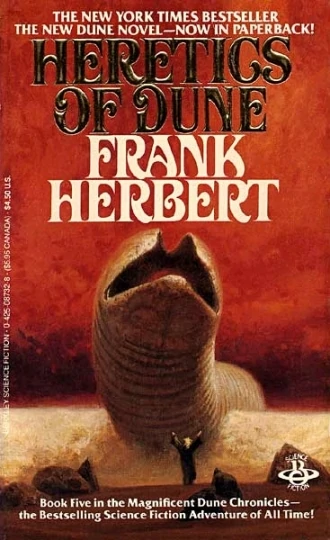
Frank Herbert’s six Dune novels fall into three pairs. Dune (1965) and Dune Messiah (1969) chart the rise and fall of Paul “Muad’Dib” Atreides, a man who becomes a superman and the God Emperor of the known universe. Children of Dune (1976) and God Emperor of Dune (1981) narrate the rise and fall of Paul’s son, Leto II, a superman who transforms himself into a monster and rules for 3,500 years. Heretics of Dune (1984)[1] and Chapterhouse: Dune (1985)[2] are set 1,500 years after God Emperor and focus on the Bene Gesserit Sisterhood’s struggle with their evil twin, a sisterhood that calls itself the Honored Matres.

The Bene Gesserit novels were great commercial successes for Herbert and his publishers, but artistically they are disappointing. The marvelous universe he built in the first four novels is still in place, but the stories take a long time to get going, with most of the action happening at the end — and often related in the sketchiest possible manner. The writing overall is prolix and self-indulgent. At one point in Chapterhouse, Herbert pauses to insert a soup recipe — and the story was not exactly flying along to begin with. The characterization is also weak, even for Herbert. But he was always more interested in recurring types than individuals, anyway.

The great failure of the Bene Gesserit books, though, is thematic. The first two Dune novels are unified by the grand, over-arching themes of religion and hero-worship, in both their positive and negative aspects. The second pair of novels focus on Leto II’s Golden Path, which is arguably one of the most audacious and bizarre stories in all of literature. But in the Bene Gesserit books, there is no comparably grand thematic architecture to the conflict between the Bene Gesserit and the Honored Matres, giving the series a routine, “pulp” feel: There’s plenty of conflict, but not conflict about anything that particularly matters.

This may in part be due to the fact that the story is unfinished. Frank Herbert planned to write at least one more book to complete the story arc he launched in Heretics. But he died after publishing Chapterhouse. His son Brian Herbert, with Kevin J. Anderson, used the notes for “Dune 7” to write two massive novels, Hunters of Dune and Sandworms of Dune. But these novels read like vast pulps as well. One also wonders how much of these notes would have made it into a final draft, so I won’t comment on them here.

Leto II’s “Golden Path” was his attempt to save the human race from tyranny and technological apocalypse by freeing it from the Imperium. Humanity was fastened to the Imperium by two chains. First, there was space travel’s dependence on the hallucinogenic “spice,” which is found only on one planet: Arrakis, also known as Dune. Second, humanity was fettered by the prescience created by the spice, including Leto’s own prescience: the ability to abolish space and time and render everything present.

Leto severed these bonds in three ways. First, he worked with the Ixians, a technological civilization, to develop a navigation machine that could fold space without using the spice. Second, he worked with Ix to create the no-globe, which made everything inside it invisible to all forms of knowledge, including prescience. The no-globe could be combined with the navigation device to create the no-ship, a stealth spacecraft that could travel anywhere in the universe unobserved, with no need to return to the Imperium (Heretics, p. 29). Third, using his own family as breeding stock, Leto managed to create human beings who were invisible to all forms of prescience, even his own (Heretics, p. 29).

But once Leto had assembled these elements, he still had to set them into motion. He wished to propel mankind outside his Imperium, to scatter us to every corner of the known universe, so no single gaze or power could encompass us, dragging us to our doom. To create such an explosion of exploration and adventure, Leto locked the human race into a post-political, post-historical dystopia for 3,500 years, suppressing human thumos and freedom while keeping alive a longing for them in literature and song. When the God Emperor died and his regime collapsed, both the chaos and the freedom that followed caused a great “Scattering” of humanity.
You can buy Greg Johnson’s From Plato to Postmodernism here.

The Scattering was also a sorting: The most adventurous and aggressive fled the Imperium, leaving behind the most rooted and sedate. At the opening of Heretics, 15 centuries have passed, allowing divergent evolution of the two populations: Imperium and Scattering. Conflict in the former Imperium is 2% of what it was before Leto’s reign (Heretics, p. 13).

It stands to reason that the peoples of the Scattering will be very different. Herbert envisioned them as warlike, competitive, and freedom-loving tribes. He believed that their ethos would generate immense diversity, wealth, and technological sophistication. Eventually, some of those peoples would start finding their way back to the Imperium, driven by conflict or curiosity. Some of these wanderers might even look on the Imperium as wolves look upon sheep.

After the death of the God Emperor, the Imperium lost central government. Sovereignty reverted to individual planets and planetary confederations. There is no talk of the Imperium’s old nobility. The Spacing Guild is a diminished power because they have lost their monopoly on space travel. A religion has grown up around Leto II. It can mobilize the masses, but it is not a civilizational force because it lacks guiding intelligence and serves only to perpetuate priestly dynasties and prosecute impossibly petty feuds. (Herbert clearly despised clerics.)

The most powerful players in the old Imperium, ruling over uncounted planets, are two rival initiatic spiritual orders: the Bene Gesserit Sisterhood and the Bene Tleilax brotherhood. Both orders are shadowy players in the first four Dune novels. In the last two, they take center stage, and here Herbert delivers handsomely.

Frank Herbert was fascinated by time-horizons. He believed that civilization required long-range planning, especially galactic civilization, due to the time needed to traverse interstellar space without faster-than-light travel. Liberal democracy, however, fosters short time-horizons and grants primacy to petty private interests. It is therefore incapable of the grand, long-range planning that will take us to the stars.

Instead, Herbert believed that interplanetary civilization would require the return of medieval institutions, such as feudalism (ideal for a decentralized realm spread over vast distances) as well as aristocratic dynasties, guilds, and initiatic spiritual orders, all of which are characterized by the ambition to persist through the ages, which requires collectivism, patience, and long-range thinking.

Herbert especially admired initiatic spiritual orders because they could survive for centuries, preserve and propagate their founding doctrines, and mobilize immense idealism and energy in service of their goals.

The Bene Gesserit Sisterhood is modeled on Catholic religious orders. Herbert took inspiration from the formidable nuns and crones he was exposed to as a child through his mother’s Irish Catholic family. The name is supposed to remind us of the Jesuits.

But the Bene Gesserit are hardly Catholic or celibate. They regard religion as merely a tool of statecraft. Their mission, moreover, is entirely this-worldly: the preservation and perfection of the human race. For thousands of years, they have presided over a eugenic program to improve the human stock. Many of the sisters breed prodigiously, but the Sisterhood allows no rival attachments, so most of their children are taken away and reared by others.

The Bene Gesserit have cultivated fine-grained conscious control of every voluntary and involuntary process of the body, which they use for enhanced health and extraordinary martial and marital skills alike. The Bene Gesserit also practice hyper-observation and abductive reasoning, which grant them “truthsense,” an uncanny ability to read other people’s emotions and intentions. Their powers are perceived as nothing short of magical, thus they are called “witches.”

The Sisterhood is especially interested in historical continuity. Thus, they have developed a way to remember and pass on the memories of their female ancestors, but male lines remain obscure to them. Naturally, the Bene Gesserit also wish to develop the ability to see the future, as do the Guild navigators. The principal goal of their eugenics program was therefore to breed a male who could access both past and future. They called him the Kwisatz Haderach, meaning the “shortener of the way.”

Five thousand years before Heretics begins, the Kwisatz Haderach was born as Paul Atreides. But he escaped the Sisterhood’s control and shattered the whole Imperium, setting himself up as God Emperor among the ruins. His powers and his Imperium were inherited by his son, Leto II, known to the Bene Gesserit simply as the Tyrant, whose reign lasted 3,500 years because he transformed himself into a monstrous hybrid of human being and sandworm.

Under Paul and the Tyrant, the Bene Gesserit were no longer in a position to pursue their own grand designs, but they demonstrated another feature of the best initiatic orders: the ability to roll with the punches, to adapt to and survive circumstances beyond their control.

After the death of the Tyrant, the Bene Gesserit became major political players in the ruins of the old Imperium. Their ultimate goal, the survival and perfection of humanity, remained unchanged, but was tempered by their experience under Paul and his son. In particular, they were terrified at the prospect of another Kwisatz Haderach and ruthlessly killed anyone who showed such potential.

But they could not eliminate the Atreides bloodline altogether, because by that time they were effectively all Atreides; specifically, descendants of Siona Atreides, in whom the Tyrant’s own eugenics program came to fruition with a genetic variant that made her and her descendants invisible to prescience, and thus they were “free” beings — on the assumption that those who can be predicted are somehow determined. After 15 centuries, practically the whole Sisterhood is descended from Siona. Their fear of another Tyrant is thus specifically a fear of the malign potential lurking in their own blood.

But the Sisterhood has arrived at a juncture in which a break with orthodoxy — a heresy — is required for the survival of their order and much of the human race, at least within the old Imperium.

In the first four novels, we learn that the Bene Tleilax brotherhood produce “twisted” mentats, namely human computers. (What makes them twisted, apparently, is that they have no ethical limitations.) The Tleilaxu have also mastered genetic engineering, using mysterious vessels known as “axlotl tanks,” which can produce clones (“gholas”), hybrid organisms (“chairdogs,” “sligs”), and even synthetic spice. But the most dangerous Tleilaxu invention is the “face dancer”: sterile and servile humans of indeterminate sex who can take on the appearance of another human, male or female.

In Heretics, we learn that the Tleilaxu are a Sufi Muslim secret society. They are ruled by a small population of human “masters,” who are tiny and physically repulsive men. They are served by a vast population of face dancer slaves. But the ultimate horror is the status of Tleilaxu women. They are the axlotl tanks: brain-dead female bodies hooked up to mechanical control mechanisms, mere incubators for mass-produced monstrosities. I can’t think of a more brutal and contemptuous depiction of “Oriental despotism” in all of literature.

In Heretics, the Tleilaxu have created a new kind of face dancer that they believe to be undetectable. Not only can it take on the appearance of another person, it can also absorb his memories and personalities, creating a perfect copy that just so happens to be a slave of the Tleilaxu. The Tleilaxu have been placing these face dancers in positions of power all over the old Imperium. Soon, they believe, they will be the masters of the universe. Only the Bene Gesserit stand in their way.

The Bene Gesserit and Bene Tleilax have existed for thousands of years, in a state of deep rivalry and distrust. They occasionally trade and cooperate. But they also plot against one another. Because both are secret societies, they naturally spy and counter-spy against one another, trying to learn the other’s secrets while preserving their own.

One of the Dune universe’s least plausible features is the ability of any organization to keep secrets for thousands of years, especially in a universe in which prescience in effect places us all in a panopticon. Herbert was horrified by the prospect of Artificial Intelligence. In fact, the Dune universe’s distant back story was the “Butlerian Jihad” that eliminated all thinking machines because they had enslaved humanity. Herbert died before the Internet and the “information age” came along, but he would have regarded them as sinister and dystopian.

The Bene Gesserit and Bene Tleilax are forced into an uneasy alliance by the appearance of the Honored Matres from the Scattering. By a combination of subversion and military force, they have taken control of a number of worlds in the old Imperium, and now wish to challenge its major players: the Bene Gesserit and the Bene Tleilax.

The Honored Matres were apparently formed in the Scattering by renegade Bene Gesserits and members of the Fish Speakers, the Tyrants’ female army and bureaucracy. They may have banded together simply for survival, but eventually they became a violent and predatory cult: paranoid, cruel, addicted to adrenaline and anger, and grasping after ever greater wealth and power. They are tactically shrewd, but seem to have no long-term ambitions. They seek control over nature, not balance with it. Thus, they are doomed to disaster (Chapterhouse, p. 101). The Bene Gesserit liken them to predators who exceed their ecological carrying capacity, then experience a mass mortality event to bring their numbers back down.

Despite their name, the Matres don’t seem to be especially maternal. They control men by sexual bonding, hence they are called “whores,” but they don’t reproduce sexually. Instead, they recruit. All told, Herbert’s characterization of the Honored Matres strikes me as hazy and muddled. They don’t come off as feminists so much as wizened old biker chicks picking catfights with one another.

One of these novels’ weaknesses is that most of the main characters are female. But it is hard for men to write female characters, and it is hard, at least for me, to comprehend plots driven exclusively by female psychology. I felt I was drowning in an ocean of estrogen.
You can buy Greg Johnson’s Graduate School with Heidegger here.

The most memorable character in these novels is Miles Teg, an Atreides descendant who looks remarkably like Duke Leto I. Teg was Supreme Bashar of the Bene Gesserit military forces until he retired. He is nearly 300 years old when he is approached by the Bene Gesserit leader Reverend Mother Taraza and asked to take charge of a project on Gammu, formerly known as Giedi Prime, the Harkonnen homeworld.

Teg is a military genius, but he’s also a master at de-escalation and mediation who can win battles without firing a shot. He was steeped in the Atreides ethos of honor, loyalty, and service. His men are willing to die for him, and he is willing to lay down his life for the Bene Gesserit.

But Reverend Mother Taraza wants even more from him. She senses that Bene Gesserit orthodoxy and Atreides loyalty are not equal to the challenges ahead. She wants Teg to follow in the footsteps of his mother, a Bene Gesserit “heretic” who taught her son more of their secrets than authorized. This, of course, reminds us of another Bene Gesserit heretic who bore and educated an Atreides son: Jessica, the mother of Paul, the Kwisatz Haderach. Like Paul, Teg was also trained as a mentat.

Taraza senses that Teg has the capacity to become another Atreides superman, but instead of suppressing it, she wants him to commit the ultimate Bene Gesserit heresy and realize his potential — which he proceeds to do. It is a rather inspiring story arc, and Heretics would have been a better book if some of the clutter were pared away to bring it into greater relief.

In Heretics and Chapterhouse, the Bene Gesserit are consistent mouthpieces for Herbert’s anti-liberal sentiments:

Atreides ancestors rose up in rebellion at the word [liberal] . . . lashed out at the unconscious assumptions and unexamined prejudices behind the concept. “Only liberals really think. Only liberals are intellectual. Only liberals understand the needs of their fellows.” How much viciousness lay concealed in that word! (Heretics, p. 12)

Herbert believed that states can accomplish wonders. But he believed that their actions must harmonize with nature, and any attempt to flout nature would lead to disaster:

In my estimation, more human misery has been created by reformers than by any other force in human history. Show me someone who says “Something must be done!” and I will show you a head full of vicious intentions that have no other outlet. What we must strive for always is to find the natural flow and go with it. (Heretics, p. 90)

Herbert pours scorn on bureaucracies. Good government holds them in check, because nature holds it in check. Bad government, however, seeks the impossible; that is, the unnatural, which causes bureaucracies to grow in size and power until they destroy society:

A top-heavy bureaucracy the electorate cannot touch always expands to the system’s limits of energy. Steal it from the aged, steal it from the retired, from anyone. Especially from those we once called the middle class because that’s where most of the energy originates. (Chapterhouse, p. 155)

Bureaucracies also make societies brittle and incapable of dealing with change: “Bureaucracy destroys initiative”; bureaucracy hates innovation (Heretics, p. 213); “Bureaucracy elevates conformity” (Chapterhouse, p. 100); “Educational bureaucracies dull a child’s questing sensitivity . . .” (Chapterhouse, p. 115).

Herbert respects power, but he despises those who seek it. “Power attracts pathological personalities. It is not power that corrupts, but that it is magnetic to the corruptible” (Chapterhouse, p. 59); “Trust no government! Not even mine! . . . Power attracts the corruptible. Suspect all who seek it” (Chapterhouse, 138; cf. 154).

Power is necessary. But if we cannot trust the people who want to wield it, then to whom should it be entrusted? Herbert’s answer is that power should be thrust upon the deserving (Chapterhouse, p. 138). Aristocratic families, initiatic orders, guilds, and other institutions should breed and/or recruit those with leadership potential, train them, and then promote the best candidates, who will also be the least willing. What, then, would motivate them? An ethos of duty, like the one cultivated by the Atreides.

Herbert values freedom, but he doesn’t identify it with doing whatever one feels like. That, he says, is merely slavery to desire. Freedom, rather, is identical with duty, which is built upon disciplining desire: “Seek freedom and become captive of your desires. Seek discipline and find your liberty” (Chapterhouse, p. 344).

The last two Dune novels incorporate some dark musings on banks and oligarchy. When Teg begins to size up the situation on Gammu, he realizes that it has become a galactic Switzerland: a hiding place for immense wealth, including from the Scattering. But the banks also work as forward positions for a hostile elite that will soon arrive in full force: the Honored Matres.

Given Herbert’s fascination with peoples who employ religion and crypsis to persist over eons, it is surprising that the Jews make their first appearance in the Dune saga only in Chapterhouse. I’m not quite sure Herbert meant it as a joke, but I laughed out loud to learn that they’ll still be kvetching about Cossacks 30,000 years from now.

These wouldn’t be Frank Herbert books without flashes of deep philosophy, such as Heideggerian ideas about science (Heretics, p. 148), and Sufi ideas about the magical universe (Heretics, pp. 148–49, 176) and active imagination (Heretics, pp. 148–49; Chapterhouse, p. 242).

There are also brilliant feats of imagination, both grand (the depiction of the Tleilaxu worlds and society) and small (the Harkonnen no-globe on Gammu).

It is interesting to note that aspects of the Dune saga which contradicted David Lynch’s Dune movie are in harmony with it here. For instance, in Dune, Giedi Prime is depicted quite differently than in Lynch’s movie, where the Harkonnen keep appears as a vast, black industrial block built above black, bubbling ooze in an industrial hellscape. In Heretics, the block appears with the name “Barony.” Herbert also mentions that the ooze and other industrial blights have been cleaned up. Moreover, in the first four Dune novels, there is no talk of “folding space.” But the idea appears in Lynch’s script as well as in Heretics (p. 69) and Chapterhouse (p. 336). Did Lynch influence Herbert, or did Herbert influence Lynch? Heretics was written at the same time as Lynch’s Dune script, so the influence could go either way.

You can find this essay and many others in Greg Johnson’s book Novel Takes: Essays on Literature, available for order here

Herbert weaves such a tangled web that he sometimes loses his own plot. At one point, he mentions that the Tyrant had foreseen a woman who would ride worms (Heretics, p. 4). But he could not have predicted the one who appears in Heretics, since she is a descendant of Siona and thus invisible to prescience. At several points, he mentions that the ghola of Duncan Idaho contains Atreides genes, which makes no sense if a ghola is a clone (Heretics, p. 467; Chapterhouse, p. 26). But the worst incoherence is on Heretics’ thudding final pages, when we are told that what has transpired was the grand design of Reverend Mother Taraza, when in fact it was brought about by Teg going off script and making entirely free, and thus “heretical,” decisions.

I see no point in ending with recommendations, since no force on Earth could have stopped me from reading Heretics of Dune. But I will say it was worth rereading. Despite its structural problems, it still offers genuine pleasures, and with a bit of streamlining, it could be magnificent on screen. Nothing, moreover, could have stopped me from reading Chapterhouse. But nothing could force me to read it a second time. It is a pity that the Dune saga ended on a low note. But there’s still some spice in these books. You’ve just got to sift through a lot of sand.

* * *

Like all journals of dissident ideas, Counter-Currents depends on the support of readers like you. Help us compete with the censors of the Left and the violent accelerationists of the Right with a donation today. (The easiest way to help is with an e-check donation. All you need is your checkbook.)

GreenPay™ by Green Payment

Select donation type

Select or enter an amount to give

Select or enter an amount to give monthly

For other ways to donate, click here.

Notes

[1] Citations are to the Ace paperback edition: Frank Herbert, Heretics of Dune (New York: Ace Books, 1987).

[2] Citations are to the Ace paperback edition: Frank Herbert, Chapterhouse: Dune (New York: Ace Books, 1987).

The Bene Gesserit Books: Frank Herbert’s Heretics of Dune & Chapterhouse: Dune

The%20Bene%20Gesserit%20Books%3A%0AFrank%20Herbert%E2%80%99s%20Heretics%20of%20Dune%20andamp%3B%20Chapterhouse%3A%20Dune%0A

Share

  • Gab

Enjoyed this article?

Be the first to leave a tip in the jar!

Instant Echeck GreenPay™

Related

  • Nietzsche & Race

  • Who’s Looking Back?

  • The Robot Hotdog Stand

  • Jared Taylor: What Rome Means to Me

  • José Pedro Zúquete’s The Identitarians

  • Counter-Currents Radio Podcast No. 689

  • Remigration is Inevitable Part 3

  • Why Billionaires Should Fund White Identity Politics

Tags

anti-liberalismaristocracyartificial intelligencebanksbureaucracycivilizationcrypsisDavid LynchDuneeugenicsfeudalismFrank HerbertfreedomgovernmentGreg Johnsonheresyinitiatic ordersinitiatic spiritualityJewsoligarchypaywallpowerreligionscience fictionsecret societiesthe Bene Gesseritthe Bene Tleilaxthe Honored Matresthe Kwisatz Haderachthe state

3 comments

  1. Hamburger Today says:
    January 11, 2023 at 9:55 am

    Thanks for this. Outside the Dune books, my favorite is the (very flawed) Dosadi Experiment.

    0
    0
    Reply
    1. Greg Johnson says:
      January 14, 2023 at 3:45 pm

      I haven’t yet read Dosadi Experiment. Now that I have written on all six Dune books, I will start reading Herbert’s other novels. I’ll report any interesting finds.

      0
      0
      Reply
      1. Hamburger Today says:
        January 15, 2023 at 9:15 am

        I look forward to it. Dosadi is not by any stretch of the imagination as well-constructed as Dune. In the mid-seventies, Herbert was cranking out material. As you may have noticed in the Dune series, Herbert had lots of interesting ideas that didn’t always get the careful treatment they deserved. Dosadi is a follow-up to Whipping Star (which I never read).

        0
        0
        Reply

If you have a Subscriber access,
simply login first to see your comment auto-approved.

Post a comment Cancel reply

Note on comments privacy & moderation

Your email is never published nor shared.

Comments are moderated. If you don't see your comment, please be patient. If approved, it will appear here soon. Do not post your comment a second time.

Upcoming podcasts
  • Rob Rundo on Counter-Currents Radio

    Rob Rundo on Counter-Currents Radio

    Counter-Currents Radio

    Sat, Jun 13th — 3 pm EST / 9 pm CET
  • Daniel Tyrie on Counter-Currents Radio

    Daniel Tyrie on Counter-Currents Radio

    Counter-Currents Radio

    Sat, Jun 20th — 3 pm EST / 9 pm CET

Writers of May

(2 votes) Morris van de Camp David M. Zsutty Derek Stark Jayant Bhandari Greg Johnson

Articles of May

The Lunch Wars by David M. Zsutty Heidegger on Nietzsche, Part One by Collin Cleary 2 votes
    • Black Intellectual Fatigue

      Derek Stark

      5

    • Why White Advocates Should Avoid “Based Blacks”

      Dani Vypont

      7

    • Nietzsche & Race

      Mark Gullick

    • Editor’s Update
      Rob Rundo Rescheduled to Next Week on Counter-Currents Radio;
      Tonight Greg Johnson & David Zsutty Answer Your Questions;
      Fundraiser Update & a New $20,000 Matching Grant

      Greg Johnson

    • The Counter-Currents 2026 Fundraiser
      Lifetime Subscriber Welcome Packages Extended

      Greg Johnson

    • Nationalism This Week
      Who’s Looking Back?

      Greg Johnson

      25

    • China’s Threat to American Security:
      Food, Farmland, Foreign Control, & Energy Policy

      Lipton Matthews

      4

    • The Bitter End of Western Metaphysics:
      Heidegger on Nietzsche, Part Two

      Collin Cleary

      13

    • The Killing of Henry Nowak

      Mark Gullick

      29

    • The Crisis of Chinese Technology Thieves

      Morris van de Camp

      1

    • The Strange World of Gender Bender Fiction:
      & What This Genre Tells Us About Autosexuality

      Dani Vypont

      3

    • Watching the Watchers:
      The Dark Triad Question

      David M. Zsutty

      14

    • The Remigration Movement Solidifies

      F. Roger Devlin

      1

    • Casting Aspersions:
      The Fatal Consequences of Race-Swapped Casting, From Helen of Troy to Henry of Southampton

      Steven Tucker

      20

    • The Murder of Henry Nowak

      Millennial Woes

      23

    • Don’t Forget to Vote in Our Writer & Article of the Month Poll

      Greg Johnson

    • The Robot Hotdog Stand

      Greg Johnson

      35

    • Laughing Our Way to Victory

      Dave Chambers

      7

    • The Zodiac Killer

      Mark Gullick

      11

    • Jared Taylor: What Rome Means to Me

      Jared Taylor

      1

    • An Interview with Endeavour:
      My Way of Life Is an Adventure!

      Ondrej Mann

      6

    • José Pedro Zúquete’s The Identitarians

      Greg Johnson

      3

    • Editor’s Update
      Fundraiser Update & How to Watch the Remigration Summit

      Greg Johnson

      5

    • The Bitter End of Western Metaphysics:
      Heidegger on Nietzsche, Part One

      Collin Cleary

      11

    • Berlin: City of Stones

      Spencer J. Quinn

      6

    • True Folk-Horror Is Horror of Your Own Folk:
      Mark Gatiss vs the Brexit Blind Dead  

      Steven Tucker

      4

    • Counter-Currents Radio Podcast No. 689
      Thomas Massie, the America 2050 Bust, the Need for Whites to Divest from America, the AI Economic Apocalypse, & Pro-White Project Pitches to Billionaires

      Counter-Currents Radio

      7

    • Nationalism This Week
      Remigration is Inevitable, Part 3

      Greg Johnson

      27

    • Why Billionaires Should Fund White Identity Politics

      Lipton Matthews

      8

    • How Cold War Two Came About

      Morris van de Camp

      5

    • Now Available for Pre-Order at a Special Price!
      Greg Johnson’s The Philosopher Is In

      Greg Johnson

    • David Zsutty’s Elevator Pitch to a Billionaire

      David M. Zsutty

      1

    • Headbanging Lite

      Mark Gullick

      5

    • White Advocacy Past and Present

      Peter Bradley

      13

    • The Lunch Wars

      David M. Zsutty

      47

    • The Russians are Coming/The Russians are Coming

      Steven Clark

      1

    • Peak Fatigue in Fort Wayne

      Gabriel Anderson

      24

    • Keith Woods’ Elevator Pitch to a Billionaire

      Keith Woods

    • The Cruelty of Kindness

      Morris van de Camp

      9

    • Predation Wearing the Mask of Civilization

      Jayant Bhandari

      13

    • The Mandalorian & Grogu

      Trevor Lynch

      24

    • Editor’s Update
      Fundraiser Update & a New $20,000 Matching Grant
      Greg Johnson & David Zsutty Discuss Thomas Massie on Counter-Currents Radio

      Greg Johnson

      2

    • How the Jews Defeated Thomas Massie—& Themselves

      David M. Zsutty

      25

    • Jared Taylor’s Elevator Pitch to a Billionaire

      Jared Taylor

      15

    • Nationalism This Week
      Remigration Is Inevitable, Part 2

      Greg Johnson

      8

    • Could Fascism Work?

      Mark Gullick

      40

    • Jonathan Bowden’s Deliverance
      Part 7

      Jonathan Bowden

    • China’s Quiet Hand:
      Influence, Infiltration, & the Western Blind Spot

      Lipton Matthews

      9

    • Counter-Currents Radio Podcast No. 688
      Tyler Dykes on Running for US Congress in South Carolina

      Counter-Currents Radio

      4

    • Lothrop Stoddard’s The Revolt Against Civilization

      Spencer J. Quinn

      14

    • Eric

      Black Intellectual Fatigue

      Greetings.  "Black intellectuals" are also known as, "professional negroes."

    • Collin Cleary

      Heidegger on Nietzsche, Part Two

      Perhaps the irony here is that he was mistaking appearance (what appears to a human subject) as...

    • Collin Cleary

      Heidegger on Nietzsche, Part Two

      No, Heidegger wasn't an influence on either.

    • Scott

      China’s Threat to American Security

      I don’t fear or hate the Chinese. But China is still a Communist nation and they will never be our...

    • Eric

      Black Intellectual Fatigue

      Thank you very much for this fine article.  One book opens another.  Mr. Stark has...

    • Scott

      Why White Advocates Should Avoid “Based Blacks”

      Agree with most of the article. Spot on about Negroes and the dusky grifter, Candace Owens.However,...

    • Will Williams

      Black Intellectual Fatigue

      Am I the only White racial nationalist who is fatigued from Black “intellectual” Lip Man Matthews...

    • Will Williams

      Why White Advocates Should Avoid “Based Blacks”

      Dani, your understanding of GLR is wanting. You and others would do well to read the eight-part...

    • Peter Quint

      Black Intellectual Fatigue

      Great article! “Black intellectuals,” if that’s not an oxymoron, I don’t know what is. 🙃

    • Peter Quint

      Why White Advocates Should Avoid “Based Blacks”

      Great article! It is “past-time” that each White person developed a “siege mentality.” Each White...

    • Fred C. Dobbs

      Black Intellectual Fatigue

      It’s great to see increasing movement in the right direction. Excellent review. I often wonder if...

    • Derek Stark

      China’s Threat to American Security

      Very good article. I remember back in the 1980s and 1990s how all the genius economists were saying...

    • Will Williams

      Counter-Currents Radio Podcast No. 688

      I rarely listen to long podcasts, but was interested in this one with Mr. Dykes, the American...

    • Tye

      Why White Advocates Should Avoid “Based Blacks”

      Exactly, enough of the precious exceptions.

    • Joe Gould

      Why White Advocates Should Avoid “Based Blacks”

      Amen to this whole article.

    • Peter Quint

      Why White Advocates Should Avoid “Based Blacks”

      That goes for all non-whites! 🙃

    • Moss

      The Killing of Henry Nowak

      Well said Joe. That bears repeating.

    • Fred C. Dobbs

      Why White Advocates Should Avoid “Based Blacks”

      I would advise all white people to never even befriend a black person. You will always get burned....

    • Hi-ya!

      Who’s Looking Back?

      the attraction of owning a radio is so much greater than the fear of propaganda Jacque ellul

    • Hi-ya!

      Who’s Looking Back?

      The Death of an Era My room was a block away I opened the bar at 5AM and closed it at 2AM Often...

    • Earth Day Special

      John Morgan

      12

    • A Robertson Roundup
      Remembering Wilmot Robertson
      (April 16, 1915 – July 8, 2005)

      Margot Metroland

      13

    • The Paranoid Style in White Nationalism

      Greg Johnson

      30

    • Join the Dance!

      Andrew Hamilton

      1

    • We Can’t Save the Earth Without Reducing African Birth Rates

      James Dunphy

      36

    • “I’m Not a Conspiracy Theorist, but . . .”:
      Jeffrey Epstein’s Death Gives New Life to “Conspiracy Theories”

      Greg Johnson

      22

    • Sylvia Plath: Stasis in Darkness

      Vic Olvir

      17

    • Vanguardism, Vantardism, & Mainstreaming

      Greg Johnson

      80

    • Aviation, Geography, & Race

      Charles Lindbergh

      3

    • Some Thoughts on Yule

      Collin Cleary

      4

    • Living in Truth:
      A Yuletide Homily

      Jef Costello

      7

    • John Kennedy Toole’s A Confederacy of Dunces

      Greg Johnson

      20

    • On Aleksandr Solzhenitsyn’s Warning to the West

      Spencer J. Quinn

      7

    • Elitism, British Modernism, & Wyndham Lewis

      Jonathan Bowden

      6

    • Philip K. Dick’s Do Androids Dream of Electric Sheep? as Anti-Semitic/Christian-Gnostic Allegory

      Greg Johnson

      20

    • “Conspiracy Theory” or Conspiracy?

      Andrew Hamilton

      21

    • Remembering H. P. Lovecraft
      (August 20, 1890–March 15, 1937)

      Greg Johnson

      3

    • Who Are We?
      Nordics, Aryans, & Whites

      Greg Johnson

      71

    • Remembering William Gayley Simpson
      (July 23, 1892–December 31, 1990)
      A Pleasant Afternoon with Harriet & Bill Simpson

      Margot Metroland

      18

    • Here are the Young Men
      Remembering Ian Curtis
      (July 15, 1956–May 18, 1980)

      Mark Gullick

      18

    • Percy Grainger
      Artist of the Right

      Alex Graham

      7

    • Remembering Revilo Oliver
      (July 7, 1908–August 20, 1994)

      Greg Johnson

      18

    • The Meaning of July 4th for the White Man

      Gregory Hood

      13

    • The Front National’s Evolution

      Bruno Mégret

    • Merwin K. Hart
      Forgotten American Hero & Man of the Right

      Morris van de Camp

      10

    • George Orwell’s Nineteen Eighty-Four

      Jonathan Bowden

      8

    • Carleton S. Coon
      Scientist & Reluctant White Advocate

      Morris van de Camp

      3

    • The Kwanzaa Absurdity Will Be Dwarfed by Juneteenth

      Robert Hampton

      10

    • Stravinsky

      Alex Graham

      7

    • Like the Roman:
      Remembering Enoch Powell (1912-1998)

      Mark Gullick

      23

    • Neo-Fascism in Film
      Part 5

      Karel Veliky

      15

    • The Game of Tarot

      Mark Gullick

      1

    • Institutions Cannot Be Transplanted

      Jayant Bhandari

      5

    • Jonathan Bowden’s Deliverance
      Part 5

      Jonathan Bowden

    • Crosstown Traffic:
      Jimi Hendrix & The Post-War Rock ‘N’ Roll Revolution

      Mark Gullick

      1

    • Slaves from the North:
      Finns & Karelians in the East European Slave Trade, 900–1600

      Lipton Matthews

      14

    • Neo-Fascism in Film
      Part 4

      Karel Veliky

      2

    • David Lean’s A Passage to India

      Spencer J. Quinn

      1

    • Elites are Essential to Development

      Lipton Matthews

      7

    • Jonathan Bowden’s Deliverance
      Part 4

      Jonathan Bowden

    • Neo-Fascism in Film
      Part 3

      Karel Veliky

      6

    • E. M. Forster’s A Passage to India & the Indian Mentality

      Spencer J. Quinn

      25

    • Jonathan Bowden’s Deliverance
      Part 3

      Jonathan Bowden

    • The Rest Is Silence
      Heidegger’s Quietism

      Mark Gullick

      2

    • Dispelling the Historical Fallacy of Indian Nationalism

      Lipton Matthews

      8

    • Neo-Fascism in Film
      Part 2

      Karel Veliky

      8

    • Jonathan Bowden’s Deliverance
      Part 2

      Jonathan Bowden

    • Life of a Klansman

      Mark Gullick

      8

    • Jonathan Bowden’s Deliverance, Part 1

      Jonathan Bowden

    • Decolonial Ideas are Holding Back Developing Countries

      Lipton Matthews

      8

    • Neo-fascism in Film, Part 1

      Karel Veliky

      21

    • Jonathan Bowden’s Onslaught, Part 8
      Divigations on Decadence

      Jonathan Bowden

    • Jonathan Bowden’s Onslaught, Part 7
      Intrigues in the National Front

      Jonathan Bowden

      1

    • Rotten to the Core

      Mark Gullick

      8

    • Strauss on Husserl’s “Philosophy as Rigorous Science”

      Greg Johnson

    • Jonathan Bowden’s Onslaught, Part 6
      Francis Bacon & Right-Wing Nihilism

      Jonathan Bowden

    • London After (& Before) Midnight:
      Aleister Crowley, The Landlord’s Worst Nightmare

      James J. O'Meara

      2

    • Jonathan Bowden’s Onslaught, Part 5
      The Post-War British Far Right

      Jonathan Bowden

    • No Rules: Rollerball

      Mark Gullick

      4

    • Jonathan Bowden’s Onslaught, Part 3
      Brett Easton Ellis’ American Psycho

      Jonathan Bowden

    • András László
    • Derek Hawthorne
    • Beau Albrecht
    • Alain de Benoist
    • Kerry Bolton
    • Jonathan Bowden
    • Collin Cleary
    • Jef Costello
    • Savitri Devi
    • Julius Evola
    • Jim Goad
    • Gregory Hood
    • Juleigh Howard-Hobson
    • Greg Johnson
    • Charles Krafft
    • Anthony M. Ludovici
    • Trevor Lynch
    • H. L. Mencken
    • J. A. Nicholl
    • James J. O’Meara
    • Christopher Pankhurst
    • Tito Perdue
    • Michael Polignano
    • Spencer J. Quinn
    • Fenek Solère
    • Irmin Vinson
    • Leo Yankevich
    • Francis Parker Yockey
    • Multiple authors
  • Editor-in-Chief

    • Greg Johnson, Ph.D.

    Featured Writers

    • Beau Albrecht
    • Gunnar Alfredsson
    • Collin Cleary, Ph.D.
    • Jef Costello
    • Morris V. de Camp
    • F. Roger Devlin, Ph.D.
    • Stephen Paul Foster, Ph.D.
    • Jim Goad
    • Alex Graham
    • Mark Gullick, Ph.D.
    • Greg Johnson, Ph.D.
    • Travis LeBlanc
    • Trevor Lynch
    • Margot Metroland
    • James J. O’Meara
    • Angelo Plume
    • Spencer J. Quinn
    • Fred Reed
    • Clarissa Schnabel
    • Michael Walker
    • David M. Zsutty

    Frequent Writers

    • Asier Abadroa
    • Aquilonius
    • Alain de Benoist
    • Kerry Bolton, Ph.D.
    • Dave Chambers
    • Steven Clark
    • James Dunphy
    • Endeavour
    • Richard Houck
    • Jason Kessler
    • Titus Livius
    • Ondrej Mann
    • Lipton Matthews
    • Mark Mazari
    • John Morgan
    • Jaroslav Ostrogniew
    • Kathryn S.
    • Christian Secor
    • Anne Wilson Smith
    • Thomas Steuben
    • William De Vere
    • Kenneth Vinther
    • Max West

    Classic Authors

    • Maurice Bardèche
    • Jonathan Bowden
    • Julius Evola
    • Guillaume Faye
    • Ernst Jünger
    • Kevin MacDonald, Ph.D.
    • D. H. Lawrence
    • Charles Lindbergh
    • Jack London
    • H. P. Lovecraft
    • Anthony M. Ludovici
    • Sir Oswald Mosley
    • National Vanguard
    • Friedrich Nietzsche
    • Revilo Oliver
    • William Pierce
    • Ezra Pound
    • Saint-Loup
    • Savitri Devi
    • Carl Schmitt
    • Miguel Serrano
    • Oswald Spengler
    • P. R. Stephensen
    • Jean Thiriart
    • John Tyndall
    • Dominique Venner
    • Leo Yankevich
    • Francis Parker Yockey

    Other Authors

    • Howe Abbott-Hiss
    • Michael Bell
    • Giles Corey
    • Jack Donovan
    • Richardo Duchesne, Ph.D.
    • Emile Durand
    • Guillaume Durocher
    • Mark Dyal
    • Tom Goodroch
    • Andrew Hamilton
    • Robert Hampton
    • Huntley Haverstock
    • Derek Hawthorne
    • Gregory Hood
    • Juleigh Howard-Hobson
    • Alexander Jacob
    • Ruuben Kaalep
    • Tobias Langdon
    • Julian Langness
    • Patrick Le Brun
    • G A Malvicini
    • John Michael McCloughlin
    • Millennial Woes
    • Michael O’Meara
    • Christopher Pankhurst
    • Michael Polignano
    • J. J. Przybylski
    • Quintilian
    • Edouard Rix
    • C. B. Robertson
    • C. F. Robinson
    • Herve Ryssen
    • Alan Smithee
    • Fenek Solere
    • Ann Sterzinger
    • Robert Steuckers
    • Tomislav Sunic
    • Donald Thoresen
    • Marian Van Court
    • Irmin Vinson
    • Book Reviews
    • Movie Reviews
    • TV Reviews
    • Music Reviews
    • Art Criticism
    • Graphic Novels & Comics
    • Video Game Reviews
    • Fiction
    • Poems
    • Interviews
    • Videos
    • English Translations
    • Other Languages
      • Arabic
      • Bulgarian
      • Croatian
      • Czech
      • Danish
      • Dutch
      • Estonian
      • Finnish
      • French
      • German
      • Greek
      • Hungarian
      • Italian
      • Lithuanian
      • Norwegian
      • Polish
      • Portuguese
      • Romanian
      • Russian
      • Slovak
      • Spanish
      • Swedish
      • Ukrainian
    • Commemorations
    • Why We Write
  • Archives
  • Top 100 Commenters
  • The Looney Bin
Sponsored Links
Europa.com Above Time Coffee Antelope Hill Publishing Paul Waggener IHR-Store Spencer J. Quinn American Renaissance Jim Goad The Occidental Observer
Donate Now Mailing list
Books for sale
  • The Philosopher Is In
  • Sexual Utopia in Power (Expanded Edition)
  • In Defense of Prejudice
  • Loving Our Own
  • Tyranny & Wisdom
  • The Populist Moment
  • Is America Doomed?
  • To all books
Copyright © 2026 Counter-Currents Publishing, Ltd.

Paywall Access


Please enter your email address.

Lost your password?

Edit your comment

Writer & Article of the Month May 2026

Voting for this month has concluded. Here are the final results!

Top Writers

  • #1 Morris van de Camp 2 votes
  • #2 David M. Zsutty 2 votes
  • #3 Derek Stark 2 votes
  • #4 Jayant Bhandari 2 votes
  • #5 Greg Johnson 2 votes
  • #6 Jared Taylor 1 vote
  • #7 Collin Cleary 1 vote
  • #8 Spencer J. Quinn 1 vote
  • #9 Mark Gullick 1 vote
  • #10 Lipton Matthews 1 vote
  • #11 Keith Woods 1 vote
  • #12 Steven Tucker 1 vote

Top Articles

  • #1 The Lunch Wars 2 votes
  • #2 Heidegger on Nietzsche, Part One 2 votes
  • #3 Could Fascism Work? 1 vote
  • #4 Jared Taylor's Elevator Pitch to a Billionaire 1 vote
  • #5 Predation Wearing the Mask of Civilization 1 vote
  • #6 Peak Fatigue in Fort Wayne 1 vote
  • #7 Keith Wood's Elevator Pitch to a Billionaire 1 vote
  • #8 Do You Want to Play a Game? 1 vote
  • #9 Why Billionaires Should Fund White Identity Politics 1 vote
  • #10 The 1970s: The Golden Age of Hijacking 1 vote
  • #11 True Folk-Horror Is Horror of Your Own Folk 1 vote
  • #12 Finding Atlantis Part 4 1 vote
  • #13 Berlin: City of Stones 1 vote
  • #14 The Ghost of the Confederacy 1 vote
  • #15 Lothrop Stoddard’s The Revolt Against Civilization 1 vote

Total votes cast: 17

Insert/edit link

Enter the destination URL

Or link to existing content

    No search term specified. Showing recent items. Search or use up and down arrow keys to select an item.