 6,227 words
1. Martin Heidegger Reads Fichte
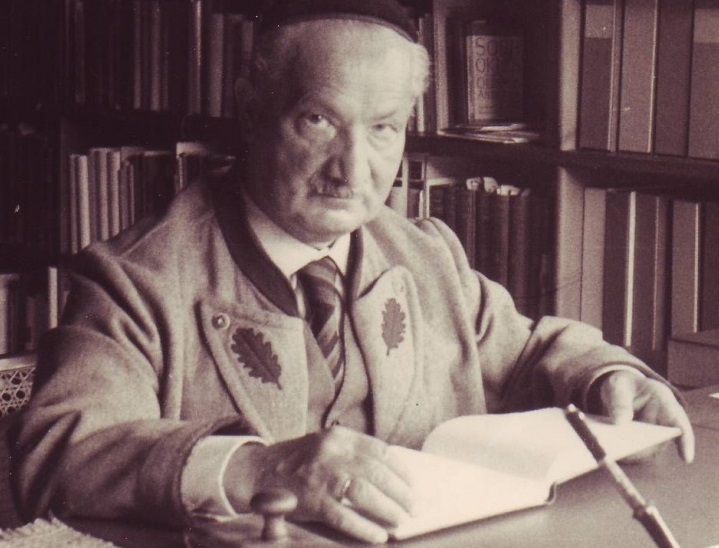
On June 25, 1929, Heidegger wrote to Karl Jaspers, “At the present moment I am lecturing on Fichte, Hegel, and Schelling for the first time — and once more a new world opens up before me. It is the same old experience: other people cannot do your reading for you.”[1] Those lectures have since been published (though not yet translated into English), and a substantial portion of them deal with J. G. Fichte, to whom I introduced readers in my last essay. I will have some things to say about Heidegger’s remarks on Fichte. Overall, however, his treatment of Fichte is rather disappointing.
As I noted in the previous essay (which readers need not have read before approaching this one), more than any other philosopher Fichte anticipates the mindset of late modernity, referred to by Heidegger as das Gestell (“enframing”): the modern attitude that nature is nothing more than raw material for human exploitation. Nature literally has no being for us; it waits upon us to confer some being (some purpose, some meaning) upon it. Das Gestell is the ultimate expression of Heidegger’s “metaphysics of presence”: the “hidden will” in Western intellectual history to distort our understanding of the Being of beings by accommodating it to the human desire that beings should be permanently present to us, hiding nothing, and available for our manipulation.
Fichte expresses the metaphysics of presence with astonishing clarity, yet this is not the focus of Heidegger’s treatment of him in the 1929 lectures. Nevertheless, Heidegger does clearly indicate that he sees Fichte and the other German Idealists as radicalizing the metaphysics of presence and preparing the way for the climax of Western metaphysics in the philosophy of Nietzsche. Some of the more quotable passages in which he makes this apparent are to be found elsewhere, however. For example, in the “Freiburg Lectures” of 1957, Heidegger writes,
[a]long a long and convoluted path, Western European thinking finally and wittingly reached the ambit of light formed by it and its reflection-character. This light-dimension is speculative dialectics that, after the precedent of Kant, develops itself into a system in the thinking of Fichte, Schelling, and Hegel. The system to be contemplated here would remain misunderstood were we to represent it as merely a woven net of concepts thrown over actuality. As “the thought” [der Gedanke] the system is Being itself, dissolving all beings in itself and thus sketching out the preliminary form of what now comes to the fore as the essence of the technological world.
To illuminate these puzzling remarks, let us consider another passage. In Heidegger’s lectures on Schelling, he asks, “why is ‘system’ precisely in the philosophy of German Idealism a battle call and an inmost requirement?” Heidegger here alludes to the fact that the Idealists were constantly referring to their “systems” and to the necessity of producing a “system of philosophy.” The basis for this approach was originally laid by Leibniz (to whom I have devoted an entire article), who insisted that philosophy must be a rational system of ideas on the model of Euclidean geometry. However, according to Heidegger the Idealists took this ideal of system a step further:
[To] the determinations of system, that it must be mathematical and a system of reason, the essential insight was added that such a system could only be found and formed in accordance with knowledge if knowledge were absolute knowledge. In German idealism “system” was explicitly understood as the requirement of absolute knowledge. In addition, system itself became the absolute requirement and thus the key term for philosophy as such. This change in the idea of system from the seventeenth and eighteenth centuries to that of German idealism at the beginning of the nineteenth century accordingly presupposes that philosophy understood itself as absolute, infinite cognition.[2]

You can buy Jef Costello’s Heidegger in Chicago here
These two passages are quite dense, but they contain fascinating insights. By “absolute knowledge” (absolutes Wissen, a term most closely associated with Hegel), Heidegger refers not just to the requirement that philosophy produce certainty — which had, after all, been Descartes’ aim — but to the fact that it must also involve total knowledge of all that exists, in a system that is demonstrably complete. In other words, everything is to be encompassed or absorbed into “the system”: “dissolving all beings into itself,” as Heidegger puts it. Thus, the system becomes Being itself: things are in virtue of having their place within the system; i.e., within the totalizing “world picture” envisioned by the philosopher.
Heidegger makes the striking claim that the system thus sketches out “the preliminary form of what now comes to the fore as the essence of the technological world.” The essence of the modern technological world, for Heidegger, is precisely that all beings are “requisitioned” by technology. Everything has its being through serving technology; all beings, including human beings, become replaceable and interchangeable commodities, to be used up (“dissolved into”) the system that is the modern, technological world. Thus, the systems of the Idealists, typified by Hegel’s system, can be seen as “preliminary sketches” of the world in which we are living today.
Heidegger takes the position that philosophers always unwittingly articulate the prevailing “dispensation of Being.” His critics are wrong, however, to accuse him of imputing too much world-historical importance to philosophers’ writings. Instead, he sees those writings as a window into the “spirit of the times,” which all thinking men, in one way or another, give expression to, even when they react against it. Alternatively, philosophers may also give expression to the spirit yet to come; i.e., the coming dispensation of Being. This is the case with Heidegger’s reading of the significance of “system” for the Idealists. For Heidegger, they are, in effect, the prophets of the modern technological world. And Heidegger very clearly sees himself as the prophet of some further dispensation of Being now in preparation, to which he struggles to give voice.
Though it is Hegel who presents us with the most elaborate expression of the Idealist “systematic” zeal, it is really Fichte, of all the Idealists, who expresses “the essence of the technological world” in its clearest and most virulent form. And yet we must note that at times it seems that Heidegger buys into a certain reading of Fichte’s Idealism that was once widely accepted but has now been thoroughly discredited by recent scholarship. That misinterpretation may be called the “Absolute Idealist” reading (or misreading). It imputes to Fichte the position that all of existence is the creation of something called the “Absolute Ego.” This Ego is neither my finite “I,” nor is it yours. Instead, it is related to my finite ego in the way that Vedanta juxtaposes Atman (the absolute or universal “self”) to jiv-atman (my little old self), the latter being an expression or specification of the former.
Why does the Absolute Ego create an external world? Fichte’s supposed answer was that it does so in order to provide man with material for moral overcoming. The world exists in order to be overcome; in order to be re-made in the image of our ideal of what ought to be. This is an infinite task, but its ultimate (unreachable) goal is the erasure of the distinction between subject and object, which would restore a kind of “original unity” that existed “prior” to the projection of the finite, imperfect world by the infinite, perfect Ego.
As I have mentioned, this interpretation of Fichte was once widely accepted. Recent scholarship has shown it to be the product of systematic misreading, however, based largely on disregarding key passages in which Fichte makes it clear that he rejects the “Absolute Idealism” just described.[3] Such a misreading was possible because of the extremely confusing manner in which Fichte chose to present his key arguments — often seeming to take certain positions, only then to reject them.
What was Fichte’s actual position? It is the task of these essays to explain precisely that. However, to put the matter briefly, Fichte asserts that the world ought to be the creation of the Absolute Ego, not that it actually is. He argued that we must work to transform the world in such a way that it is no longer an “other,” but has been completely made over into an image of ourselves. To be more specific, and a trifle more technical, he argued that we must work to transform the world according to rational ideals deduced from the nature of transcendental subjectivity itself (which he calls “Absolute Ego”). This is, however, an infinite task. The subject-object dichotomy will never be entirely erased, but the moral law demands that we keep working for its erasure.
One can easily see that the traditional (mis-)reading of Fichte does get certain things right. It correctly states that the task of transforming what is into what ought to be is an infinite one. However, it imputes to Fichte a metaphysical position that he does not in fact hold. Instead of an Absolute Idealism, or a Subjective Idealism, at least one author has suggested that we understand Fichte as offering a Pragmatic Idealism.[4] In other words, Fichte offers the erasure of the subject-object distinction and the absolutization of Ego as regulative ideals; we must behave as if these were ultimately possible and work tirelessly for their realization, even though they will never be fully and finally achieved.
It is important to note that even if Heidegger buys into the metaphysical, Absolute Idealist reading of Fichte, his basic analysis of the world-historical significance of Fichte and the other Idealists remains unaffected. (In other words, one could offer the exact same Heideggerean analysis even if Fichte’s Idealism is only a pragmatic one.) Further, my readers should also take note that the “Magical Idealism” advanced by Julius Evola seems, so far as I understand it, to be precisely such a Pragmatic Idealism: Evola asks me to live as if the world itself is a magical projection of my subjectivity, and everything in it an emblem of the ego. I will return to Evola’s Idealism, and his problematic dependence upon Fichte, in a later essay.

2. Fichte on the Nature of Philosophy
Fichte avoids the term “philosophy” in describing his own system of ideas, preferring instead the term Wissenschaftslehre, which is usually translated as “science of knowledge.” This is because “philosophy” literally means “love of wisdom.” The term itself implies that philosophy is a pursuit or a quest — perhaps one that will never be completed. Fichte, however, aspires to consummate the love of wisdom; to complete philosophy and thus put an end to it. What he offers us is not tentative steps towards wisdom, but what he claims is a science — a science which, at least in its outlines, is complete.[5]
In one text, he writes, “The term philosophy can hardly be retained. It has become unsuitable . . . Hence, philosophy, or what we seek, is science par excellence, Wissenschaftslehre.” In another, he tells us that once he has completed philosophy, “this science (if philosophy ever becomes a science) will be justified in casting off a few names which it has previously assumed out of (a by no means exaggerated) modesty: the names ‘esoteric amusement,’ ‘hobby,’ and dilettantism.’”[6] Here Fichte confesses his embarrassment at the low regard in which philosophy is currently held. But who is it that so disdains philosophy? Before whom is Fichte embarrassed? Answer: before other middle-class Protestant philistines. In answer to this modern philistinism, Fichte promises a new and improved philosophy that produces real results; a philosophy that is, in fact, science.
This idea that philosophy has been or must be completed is usually attributed to Hegel, but Hegel received it from Fichte. That is why the original title of the Phenomenology of Spirit was System of Science [System der Wissenschaft], First Part: Phenomenology of Spirit. This is also why, early in the Phenomenology’s famous Preface, Hegel writes, “To help bring philosophy closer to the form of science, to the goal where it can lay aside the title ‘love of knowing’ and be actual knowing — that is what I have set myself to do.”[7] I will not, however, follow Fichte in avoiding the term “philosophy,” and will continue to use it in referring to his body of work. I will reserve the term Wissenschaftslehre to refer to his 1794/95 work Grundlage der gesammten Wissenschaftslehre (and, much less often, as a term for his philosophical system).
So, what does Fichte see as the central task of philosophy, the task he claims to have completed? This he makes perfectly clear in the 1797 “First Introduction” to the Wissenschaftslehre. There he raises a question: “What is the source of the system of presentations which are accompanied by the feeling of necessity, and of this feeling of necessity itself?” What Fichte is referring to is simply experience. When I open my eyes, I encounter a world. I do not choose to encounter this world. Instead, it is as if it is forced upon me. Further, objects in the world present themselves as having certain qualities, and I do not get to choose these, either. I might decide to paint the shrubbery red, but on an initial encounter it presents itself as green, whether I like or not. Or, to take an example of an “internal” experience, I might choose to struggle against the sadness I feel, but there is no doubting that it is there. Fichte is asking why this world of necessities presents itself to me at all. “It is the task of philosophy,” he says, “to provide an answer to this question, and in my opinion nothing is philosophy save the science which performs this task.”[8]
In essential terms, Fichte saying that his system must answer what Heidegger will later assert is the most fundamental of all philosophical questions: “Why are there beings at all instead of nothing?” In other texts, he formulates his question very differently, however. For example, in one place he writes, “What is the basis for our claim that there is something outside of us which corresponds to our representations?” And, in another text, “Why do we believe that there are real things outside our representations?”[9] We can see from these passages that Fichte seems to wholly accept the modern representationalist paradigm, which I have discussed extensively in previous essays (especially here). Representationalism is the position that we do not know objects in the world directly; instead, all we are directly aware of is internal “ideas” or representations of things in the world.
The trouble with representationalism is that it artificially divides the mind from the world, creating an “in here”/“out there” dichotomy that is unique to modern thinking (it does not appear in the writings of ancient or medieval philosophers). Fichte’s question — “Why do we believe that there are real things outside our representations?” — expresses what is often called the “problem of the external world.” But this is a modern pseudo-problem, made possible by the assumption that we are subjects dwelling in an interior (an “in here”) that is cut off from “the world.” Only then can we conceive of such things as “internal images” contained in our boxlike interior, which may or may not correspond to anything “out there.” Only then, in other words, does Fichte’s question arise.
Representationalism is highly significant for Heidegger’s interpretation of the history of metaphysics, because it is an expression of the metaphysics of presence. In one text, he writes of it as follows: “Representation here means: to bring the present-at-hand before one as something standing over-and-against, to relate it to oneself, the representer, and, in this relation, to force it back to oneself as the norm-giving domain.”[10] Heidegger means that modern subjects not only relate beings back to themselves, they come to conceive of the Being of those beings as exhausted by that relation. “To be” becomes “to be related to a subject.”
This metaphysics is operative in all modern thinking (beginning with Descartes), down to the present age. For Heidegger, this metaphysics is, furthermore, the foundation of das Gestell: of the modern attitude that all that exists is nothing more than raw material for human use. That mindset was born precisely when we came to see beings as “objects” that are “set before” or “thrown against” us. The object challenges us in that it is taken as an other that stands opposed, that resists. So, in response, we challenge it: we put it on the rack and torture it for its secrets (to paraphrase Bacon’s famous words), and we transform it according to our designs.
Representationalism is thus the metaphysical foundation of the modern rape of nature. And I noted earlier that Fichte expresses das Gestell in very clear terms: it is a basic principle of his philosophy that the world around us is nothing more than “stuff” (Stoff — yes, he actually uses this word) to be made over according to human ideals. And now we see that the very first step in his thinking implies an endorsement of the representationalist paradigm. What is true of modernity in general is true of Fichte in particular: It is precisely because both accept the assumptions of representationalism that they wind up with this impoverished conception of nature. This is one of the major reasons why I have claimed that Fichte’s system expresses essential characteristics of modernity with astonishing clarity.
3. Criticism vs. Dogmatism
But let us set aside this meta-critique for the moment and turn to Fichte’s actual answer to the question of why we believe that real things exist outside our representations. First of all, he tantalizes us by telling us that, ultimately, there can be no theoretical answer to the question at all. Instead, the answer must be practical.[11] What Fichte means is that we are going to find that we cannot settle the question through a “proof” either for or against the external world. We will find the answer instead through “practice,” through action, and, most fundamentally, through moral philosophy. My readers will doubtless find this rather strange. But not only will all shortly be revealed, we will find that this is one of the more brilliantly innovative aspects of Fichte’s philosophy.
Fichte argues that there are two possible theoretical approaches to accounting for why we have the experience that our representations display to us with a world of necessities. The first of these he calls “idealism,” the second “dogmatism” (exactly why he chooses the latter word need not concern us here). Idealism explains the relation of the subject to objects essentially by absolutizing the subject; by contrast, dogmatism absolutizes the object. In other words, idealism explains experience entirely as a function of the subject; as due to its own activity. Dogmatism is just the reverse of this: it explains the subject as a product of the object. Experience, claims the dogmatist, is caused by objects.[12]
You can buy Greg Johnson’s Graduate School with Heidegger here
It is clear from Fichte’s description of idealism that he has in mind Kant’s “Transcendental Idealism” (Kant also employed the term “Critical Idealism,” hence Fichte sometimes opposes dogmatism to what he calls “criticism”). However, one of Fichte’s most notorious claims was that Kant had made a grave error in accepting the idea of a “thing-in-itself.” For Kant, this term refers to an object insofar as it can never be known to us. I know the laptop as it appears to me; but I can never know the laptop as it is in itself (i.e., as it really is apart from how it appears). This is one of the principal reasons why Fichte is frequently misunderstood as having advocated for an Absolute Idealism that eliminates any belief in independent objects.
What Fichte did maintain was that any idealism worth its name, while acknowledging the independent existence of a world, would explain our experience entirely in terms of the free activity of the subject. This is the “idealism” that Fichte opposes to dogmatism – a version of Kant’s Idealism made, in Fichte’s view, truer to its own spirit. It is the great virtue of this idealism, for Fichte, that it affirms the subject’s absolute freedom. By contrast, dogmatism negates that freedom. It explains experience by arguing that it is the result of objects acting upon us. Thus, we are caused to have experiences; we are determined; we are unfree.
Dogmatism seems to be a plausible position precisely because of the element of “necessity” in our experience, which I alluded to earlier. I have no choice but to see the shrubbery as green. I have no choice but to see this world when I open my eyes. It thus seems plausible to explain experience as the result of my undergoing a causal process, where the agents are things outside me, and I am the patient who is acted upon. The trouble is that this makes the self, or subjectivity, into an object in nature no different from any other object. Fichte finds this problematic because he accepts Kant’s insistence that transcendental subjectivity exists beyond the world of sensory appearances. Transcendental subjectivity (with all its a priori structures) is the condition for the possibility of those appearances. Thus, it does not itself appear and cannot be understand in the way that we understand things that do appear — i.e., it is not an object in the world that could be understood by the natural sciences. Heidegger fundamentally agrees with Kant when he places transcendental subjectivity (which Heidegger will eventually come to refer to as “the Clearing”) “beyond nature,” and thus beyond the reach of naturalism.
Indeed, dogmatism is simply Fichte’s description of the modern scientific worldview, the enormous success of which was very well-known to him. The trouble is that, once again, the modern scientific worldview has no place for freedom. It insists that everything that happens is governed by the principle of sufficient reason: everything is determined by causes or reasons. Science applies to human action the same principle it applies to the behavior of animals and non-living things: it searches for the causes that compel us to act in particular ways. “Freedom,” to the scientist, seems to be a cause that is itself uncaused; it seems to violate the principle of sufficient reason. Therefore, to be consistent, the scientist must reject it as a fantasy. Like Kant, Fichte finds the scientific elimination of freedom to be unacceptable, since it negates human dignity, reducing us merely to material beings buffeted about by forces over which we have no control, all the while deluding ourselves that we are free.[13]
Now, from the foregoing it may seem obvious that Fichte embraces idealism and rejects dogmatism as untenable. However, matters are not quite so simple. In the 1797 “First Introduction” to the Wissenschaftslehre, Fichte famously argues that there is no rational or theoretical way to decide between idealism and dogmatism. He writes, “Now which of the two should be taken as primary? Reason provides no principle of choice.”[14] Fichte takes this position because the only rational way to adjudicate the dispute between the two would be in terms of some principle of demonstration shared by the two camps. One would have to argue, in other words, “given X, which you both assent to, it follows that dogmatism/idealism is the only logically defensible position.” But the differences between the two camps are precisely in terms of the most fundamental principles one could identify. There is no common ground here.[15]
So how do we decide between them, or can we? Fichte holds that a choice is possible, but that it must be made on practical, not rational grounds. Elsewhere Fichte will cast this as a moral choice, asserting that we have a moral obligation to believe in human freedom, thus a moral obligation to be idealists. In the “First Introduction,” however, Fichte’s “practical” grounds come awfully close to seeming like pragmatic ones, and the choice of idealism over dogmatism seems like an act of supreme self-assertion, or self-affirmation.
Immediately after asserting that the choice cannot be made through reason, Fichte tells us that the choice will ultimately be governed by caprice, but that even capricious decisions are “governed by inclination and interest.”[16] And the basic difference between idealists and dogmatists has to do with their differing interests. Oddly, given his staunch commitment to Kantian morality, Fichte tells us that the “highest interest and the ground of all others is self-interest. This is also true of the philosopher. The desire not to lose, but to maintain and assert himself in the rational process, is the interest which invisibly governs all his thought.”[17] He then proceeds to describe two sorts of men, governed by very different sorts of interests.
Men of the first type “find themselves only in the presentation of things; they have that dispersed self-consciousness which attaches to objects, and has to be gleaned from their multiplicity.”[18] He is describing the sort of person we might call today an “extravert.” Fichte continues:
Their image is reflected back at them only by things, as by a mirror; if these were taken from them, their self would be lost as well; for the sake of their self they cannot give up belief in the independence of things, for they themselves exist only if things do. Everything they are, they have really become through the external world. Whoever is in fact a product of things, will never see himself as anything else.[19]
This is the sort of man who is attracted to dogmatism. The last sentence in the above quotation is crucial. However, perhaps Fichte should have written, “Whoever sees himself as a product of things, will never see himself as anything else.” Determination by things and circumstances — lack of freedom — becomes self-fulfilling for the dogmatist. Because he sees himself as determined, he will not act even when he could, and will allow external things to determine his fate — to cause him to be what he is, and to do what he does. “But how could it be any other way?” he will respond. And here he reveals that his position is not a rational choice, but a deeply rooted aspect of his character.
There is a very different sort of man, however. Fichte describes him as follows:
The man who becomes conscious of his self-sufficiency and independence of everything that is outside himself, however — and this can be achieved only by making oneself into something independent of everything else — does not need things for the support of himself, and cannot use them, because they destroy that self-sufficiency, and convert it into mere appearance. The self which he possesses, and which is the subject of his interest, annuls this belief in things; he believes in his independence out of inclination, he embraces it with feeling. His belief in himself is direct.[20]
This, of course, is the natural idealist. Like the dyed-in-the-wool dogmatist, he holds his basic convictions “out of inclination.” His nature inclines him to believe in his self-sufficiency and independence of everything “outside himself.” Yet if we look closely at Fichte’s wording, the idealist clearly believes that this self-sufficiency and independence are not yet fully actualized, for Fichte says that these “can be achieved only by making oneself into something independent of everything else.” In other words, the idealist’s inclination is to work to achieve this self-sufficiency. We have already seen that Fichte’s pragmatic idealism, laid out in the Wissenschaftslehre, will involve just this sort of work for independence, which is an infinite task. This idealism is simply the theoretical expression of the fundamental, unchosen character of a certain sort of man.
Thus, in a famous passage in the “First Introduction,” Fichte expresses his conclusions as follows:
What sort of philosophy one chooses depends, therefore, on what sort of man one is; for a philosophical system is not a dead piece of furniture that we can reject or accept as we wish; it is rather a thing animated by the soul of the person who holds it. A person indolent by nature or dulled and distorted by mental servitude, learned luxury, and vanity will never raise himself to the level of idealism.[21]
Note that while Fichte maintains that no rational choice between idealism and dogmatism is possible, this does not mean that he regards the two positions as somehow “equal,” or “equally valid.” This is because he does not regard the men who arrive at these positions as equals. He makes his contempt for the dogmatist abundantly clear, as we see in the last sentence of the above passage. Just prior to that passage, he addresses this issue explicitly. He states that “the idealist cannot readily refrain from regarding the dogmatist with a certain contempt.”[22] He describes how when the dogmatist is attacked by the idealist, he “flies into a passion, distorts, and would persecute if he had the power.”[23]
The dogmatist feels threatened, in other words. This is because when the idealist questions the dependence of the subject upon independent objects, this “exposes the dogmatist to the danger of losing his very self.” Recall that the dogmatist’s self-conception involves seeing himself as the product of things, and thus as yet another thing. Furthermore, the dogmatist is doubly threatened by the idealist’s criticisms because “there is something within him that sides with the attacker; hence he defends himself with passion and animosity.”[24] This “something else” is the dim realization of what Fichte would identify as his human potential; his potential to see himself as independent and self-sufficient. For whatever reasons, the dogmatist is constitutionally incapable of identifying with this and of realizing that potential, however. Hence, both the character of the idealist and his explicit philosophical positions constitute a reproach that the dogmatist finds insufferable.
We have all encountered just the sort of person Fichte describes here. Many times in my life I have met so-called intellectuals who coupled a commitment to determinism with cynicism and a sneering contempt for ideals of personal honor, nobility, and self-overcoming (often while finding liberal egalitarian “ideals” quite congenial). Determinism frequently serves as self-justification: I can’t be any better than I am because no one can be any better. No one can help what they are; no one ever changes. So only a fool tries to change. Thus, individuals who aspire to be more, or worse yet, have actually bettered themselves, are a walking reproach to this sort of man, and are the target of his hatred.
4. Conclusion: The Self-Assertion of the Ego
Despite all the things I have said in this essay and the last one about what is horribly wrong with Fichte’s philosophy, I am entirely with him up to this point. I am an “idealist” of just the sort he describes. As the preceding paragraph makes clear, I share his contempt for the “dogmatist.” I must also point out that the position Fichte has taken here is not only thought-provoking, it is revolutionary. Hitherto in the history of Western philosophy, it was always understood that the only possible grounds for accepting or rejecting a theory were rational ones; in other words, only arguments for or against a position could persuade us one way or another. Instead, Fichte is taking the radical position that philosophical theories flow from, to use his own terminology, “interests.” But what he is really saying is that philosophical choices are not made on rational grounds at all.
Thus, it follows from this that the Wissenschaftslehre was not written to persuade the hitherto unconverted — or, at least, it was not written to convince dogmatists to change their minds.[25] Fichte has no hope for those people at all. Instead, Fichte’s philosophy is an attempt to persuade natural “idealists” to adopt an explicitly idealistic philosophy, and to live that philosophy, not as the outcome of imbibing persuasive, rational arguments, but essentially as an act of radical self-assertion. Natural idealists are exhorted by Fichte to realize their own, deepest character — and to give that character free rein to change the world.

You can buy Collin Cleary’s Wagner’s Ring & the Germanic Tradition here.
And yet, just after explaining to us that no rational choice between idealism and dogmatism is possible, Fichte begins the next section of the “First Introduction” as follows: “But dogmatism is completely unable to explain what it must, and this demonstrates its untenability.”[26] Now he seems to be saying that there are rational grounds to prefer idealism to dogmatism: the latter cannot fully answer the question he claimed earlier as the fundamental question of all philosophy. Critics have noted this apparent inconsistency. And in other presentations of his philosophy, there is no trace of this “voluntarist” position that the sort of philosophy one chooses depends upon the kind of man one is. The result is that it has been claimed that the “First Introduction” is merely a “popular” work, and the voluntarist position it takes is “rhetorical.”
I am not persuaded by this, however. Instead, I think it more likely that in the “First Introduction” Fichte is being unusually frank about the basis for philosophical preferences. Further, the “inconsistency” we find there is, on closer examination, fully consistent with his position. The idealist takes the side of idealistic philosophy out of inclination. But this means that he is inclined to believe it; inclined to assert its truth. Hence, he cannot help but believe that idealism is the truer, more rational position, and cannot help but work to formulate arguments to this effect. This “inconsistency” is therefore a predictable expression of the inclination Fichte describes; this non-rational inclination to formulate rational arguments for positions that cannot be defended rationally. And over and over again, Fichte puts forward his arguments for idealism, continually fine-tuning them, hoping to find just the right approach that will awaken the kindred spirits amongst his readers and listeners.
It is now time to turn to the details of this idealism. Fichte is a philosophical foundationalist, following in the tradition of Descartes. In other words, he seeks to found his philosophy upon some first principle that is certain. Unsurprisingly, like Descartes, his foundation turns out to be the indubitability of “I am.” Fichte’s Archimedean point turns out to be the self-assertion of the ego, of what says “I.” But beneath this foundation, as we have seen, there lies a deeper one, a deeper self-assertion of the “I”: the choice to create a rational philosophy from the irrational, unchosen affirmation of the character of the “idealistic” subject, supremely confident of its absolute self-sufficiency — and its absolute superiority to all the countless slavish souls living in subjection to the not-I.
Where does Fichte go from here? As we shall see, he takes things to their logical and extreme conclusion: to the conclusion that self-sufficiency means that, ultimately, I am nothing but what I make of myself. Nature plays no role at all, claims the idealist, in making me what I am. But I will explore this idea, which has had such a baleful influence in the modern world, in my next essay.
* * *
Counter-Currents has extended special privileges to those who donate $120 or more per year.
- First, donor comments will appear immediately instead of waiting in a moderation queue. (People who abuse this privilege will lose it.)
- Second, donors will have immediate access to all Counter-Currents posts. Non-donors will find that one post a day, five posts a week will be behind a “paywall” and will be available to the general public after 30 days.
To get full access to all content behind the paywall, sign up here:
Paywall Gift Subscriptions
 If you are already behind the paywall and want to share the benefits, Counter-Currents also offers paywall gift subscriptions. We need just five things from you:
- your payment
- the recipient’s name
- the recipient’s email address
- your name
- your email address
To register, just fill out this form and we will walk you through the payment and registration process. There are a number of different payment options.
Notes
[1] Quoted in Jürgen Stolzenberg, “Martin Heidegger Reads Fichte,” in Fichte and the Phenomenological Tradition, Violetta L. Waibel, Daniel Breazeale, and Tom Rockmore, eds. (Berlin: De Gruyter, 2016), 208.
[2] Martin Heidegger, Schelling’s Treatise On the Essence of Human Freedom, trans. Joan Stambaugh (Athens, Ohio: Ohio University Press, 1985), 35.
[3] See Frederick Beiser, German Idealism: The Struggle Against Subjectivism 1781-1801 (Cambridge, Mass.: Harvard University Press, 2002), 217-221, for a review of the basic issues, and of the literature.
[4] See, again, Beiser 218-219.
[5] See J. G. Fichte, The System of Ethics, trans. Daniel Breazeale and Günter Zöller (Cambridge: Cambridge University Press, 2005), editors’ introduction, x. See also CC, Radrizzani, 222.
[6] Both quotes appear in Ives Radrizzani, “The Wissenschaftslehre and Historical Engagement,” in The Cambridge Companion to Fichte, ed. David James and Günter Zöller (Cambridge: Cambridge University Press, 2016), 241.
[7] G. W. F. Hegel, The Phenomenology of Spirit, trans. A. V. Miller (Oxford: Oxford University Press, 1977), 3.
[8] Fichte, The Science of Knowledge (henceforth, WL), trans. Peter Heath and John Lachs (Cambridge: Cambridge University Press, 1982), 6.
[9] Both are quoted in Beiser, 224.
[10] Martin Heidegger, Off the Beaten Track, trans. Julian Young and Kenneth Haynes (Cambridge: Cambridge University Press, 2002), 69.
[11] See, for example, WL 146-148.
[12] Because idealism absolutizes the subject, and dogmatism the object, Frederick Beiser points out that this is actually an opposition between “rival conceptions of the infinite or the unconditioned.” See Beiser, 263.
[13] Fichte bases his distinction between idealism and dogmatism on Kant’s distinction between idealism and “realism,” which Kant describes in very similar terms. With realism/dogmatism, both Kant and Fichte have in mind the approach of the modern natural sciences, but the reader may be surprised to learn that both also have in mind Spinoza’s philosophy. Spinoza was a major foil for the German Idealists, because he identified God with nature (thus inviting the accusation of atheism) and conceived man’s place in nature in such a way that there seemed to be no room for human freedom. At the same time, Spinoza put forward these positions with impressive logic, and in a way that many of the Idealists found inspiring. It became necessary, as a result, to provide an answer to Spinoza, and simultaneously to avoid at all costs the charge of “Spinozism” (equivalent to the charge of atheism, which cost Fichte his job at Jena, as I discussed in my last essay).
[14] WL, 14.
[15] See Beiser, 267, for a clear explanation of this issue.
[16] WL, 15. Italics in original.
[17] WL, 15.
[18] WL, 15.
[19] WL, 15.
[20] WL, 15.
[21] WL, 16.
[22] WL, 16.
[23] WL, 16.
[24] WL, 16.
[25] He writes, “Our science expects few converts, therefore, among those already formed; if it may have any hopes at all, they are set, rather, upon the young whose innate power has not yet foundered in the indolence of our age.” WL, 16. Italics in original.
[26] WL, 16.
4 comments
Great article. I was never able to process illustratively and grasp without much confusion the thought-worlds of complex philosophy like Being and Time. Just never quite understood or got what they were talking about or even if I was supposed to. Perhaps such penetrations are just for the intellectual elite, decoded thought accessed only by rigor and qualification. I do envy Greg’s Martin Heidegger autograph, though; it’s my cherished Steph Curry jersey. “Longing is the agony of the nearness of the distant.” Das ist wahr.
Thanks for the article! The last portion on the Idealist versus the Dogmatist put to simpler and more articulate terms of what I have come to believe are two types of men: those that choose to self-actualize and those that choose not to self-actualize. I have observed men that choose their lot in life and worked tirelessly to see their vision and dreams realized–though often the immutable reality does interfere in this quest.
And I have seen men who blamed “life” and “circumstances”, laying down like a loyal dog to accept their lot in life, even if when they do is to submit to their outer dogmatist, ignoring the possibility to self-actualize and resist the world.
I have found that my life is difficult, and I find myself in conflict with others more often than not. I thought it was a desire for conflict for many years, now I realize that it is merely, self-actualizing oneself in opposition to dogmatism, that philosophy so pervasive in the common man. I have beliefs and ideas and dreams, plans for the future, both near, far and distant; I know of a few other men who also have that same drive.
I also share the Idealist’s disdain for the Dogmatist, seeing them as “lesser” beings and not really worth my concern or investment. And frankly, they don’t like to be around me anyway.
The other point was the fact that philosophy is understood by by two different, irrational and incompatible paths of thought. One is entirely pragmatic and unfeeling, defined by “others” and divorced from internal dialogue. While the other is “free-spirited”, rebellious and stubbornly resistant to authority.
These last few articles are quite fascinating and help me to internalize and understand how our world became “modern” and threw off the protection of the old way of thinking.
I wish for an age without the Dogmatists and Pragmatists; free from the constraints of the common man.
Thanks again for the article!
And thank you, very much, for your articulate and thoughtful response.
Idealist types are found all over upper management either through rigorous training or a type of natural selection. A good modern example is former heavyweight boxing champion Wladimir Klitschko who has begun his own university associated business program based around “Challenge Management”.
Comments are closed.
If you have a Subscriber access,
simply login first to see your comment auto-approved.
Note on comments privacy & moderation
Your email is never published nor shared.
Comments are moderated. If you don't see your comment, please be patient. If approved, it will appear here soon. Do not post your comment a second time.