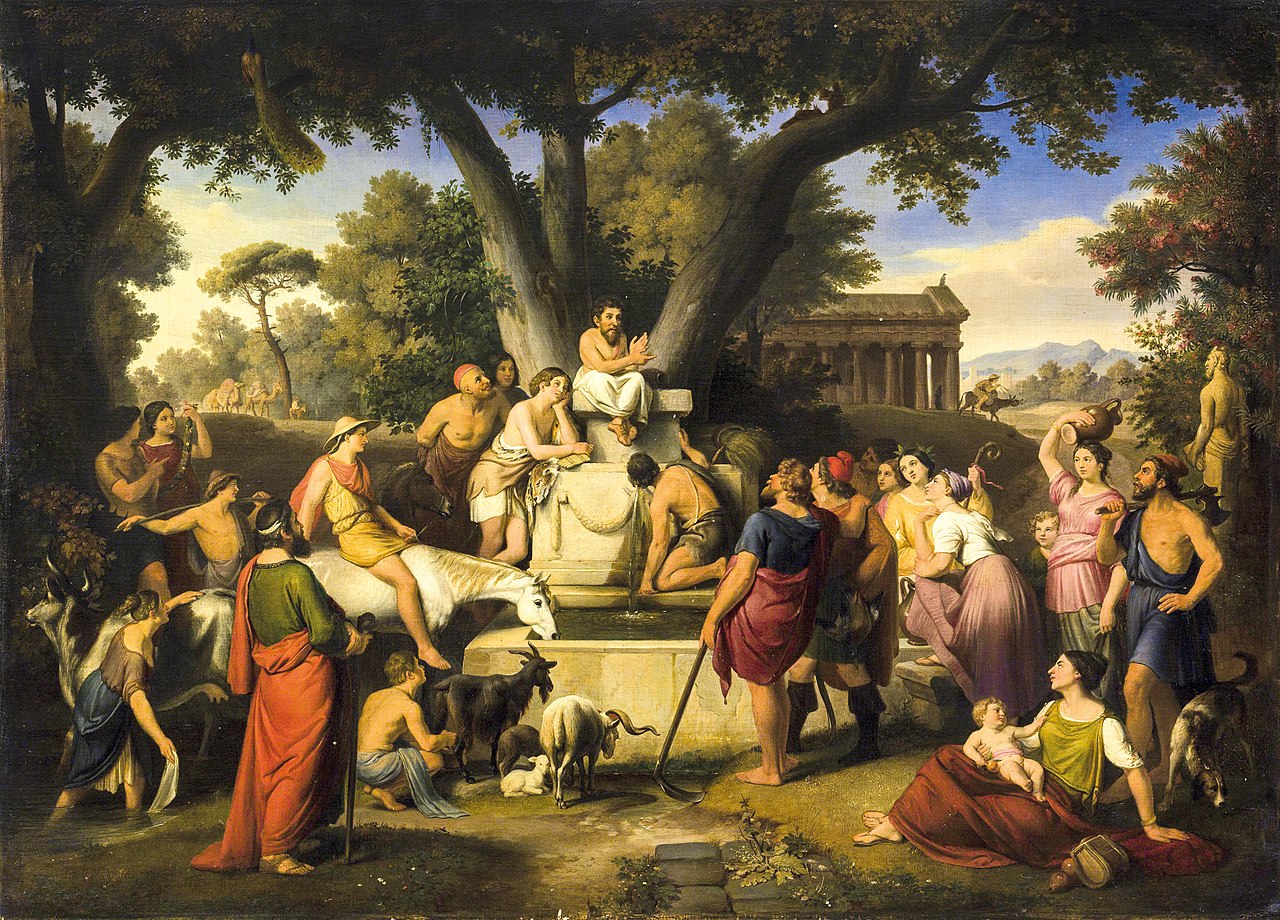
Aesop Tells his Fables by Johann Michael Wittmer. Courtesy of Wikimedia Commons.
1,617 words
As discussed in Part 2, the primary issue in Plato’s Atlantis story is the cyclical nature of time. Questions of close secondary importance are what do stories, regardless of their veracity, tell about how people see themselves and others? What are their values? What stories should we tell?
Plato has Critias’ grandfather claim that if Solon hadn’t had to focus on politics and war instead of poetry that he would have surpassed Homer, especially if he had been able to finish the Atlantis story. Thus, the Iliad and Odyssey became the most beloved stories of ancient Greece rather than Atlantis could have been determined by the dimly remembered geopolitics of the Archaic period.
This suggests that a disturbing amount of our stories are also decided by happenstance rather than by conscious decision by anyone, be they the masses or the elites. And because stories shape values, that also means that our values are decided in large part by happenstance. This explains in part why the Socratics regarded social convention with suspicion.
I would push back against this because for stories to become popular, they must resonate with at least some segment of society for some reason. One has the sense that great authors weren’t making stuff up, but rather discovering, interpreting, and sharing something outside of them and/or within us. The cliché of authors and artists dying broke in obscurity like HP Lovecraft only to become wildly famous after their deaths suggests that stories are not selected at random. Like prophets, great writers and artists often arrive ahead of their time and are misunderstood or even reviled. But as their respective Spenglerian world culture feeling unfolds, they are elevated. In a way, they are the heralds of their world culture feelings who must be sacrificed for civilizational greatness. This is an entirely objective and even mechanical process, and thus not subjective or fanciful in the slightest. Even the apparent exception of modern top-down propaganda still resonates with the hostile elite, thereby proving the general rule that stories must resonate with someone to be remembered.
I don’t entirely discard the role that chance plays in what stories are remembered, and thus that some of our values are ultimately random. For example, if the wife of the early Frankish King Clovis had been an Arian instead of a Catholic, the prevailing faith of the West could have been different for centuries. Likewise, if Maxentius instead of Constantine had won the Battle of the Milvian Bridge. And while the rebirth of sword and sorcery fantasy was going to happen one way or another, if J.R.R. Tolkien had died in WWI as many of his friends did, it would have happened latter and with lower quality. At the very least, the particular details may not have reflected Tolkien’s Catholic values. And while the histories of Titus Livius came to prominence in the Renaissance, only a quarter of his books survived. What other stories and associated values would have been immortalized in frescoes and oil paintings if by chance more of Livy’s books at survived?
Stories also tell a lot about the people who tell them. For example, we know that the Left hates white people and adores BIPOCs because their most beloved stories are anti-white victim narratives. They are also entirely suffused with slave morality.
This demonstrates the danger of trusting the masses to choose their own stories without at least some elite guidance. Somebody will promote their stories and associated values. And if not us, it will probably be someone subversive. At the very least, democracy in literature is like democracy in politics in that there is always a latent threat to degenerate towards the lowest common denominator.
You can buy Greg Johnson’s The Trial of Socrates here.
That real life bookstores have become overrun with “femslop” demonstrates this well. Femslop is partly top-down social engineering to corrupt women and discourage men from reading. But garbage like the bestselling Morning Glory Milking Farm has a strong organic audience, unfortunately. In contrast, woke videogames frequently go broke or at least severely underperform because male gamers have higher standards. A return to censorship is politically unrealistic even if it would be beneficial. Thus, we must focus on saying “yes” to good content rather than “no” to bad content. The government, parents, and men must select and promote good books.
Despite initially liking the series, I must include Harry Potter within the slop category. The books are overly formulaic and repetitive (it’s easy to confuse what happened in the seven books because they are so similar), have almost no world building despite ample opportunity, and conclude with post-Nuremberg slave morality. It’s the exact opposite of Tolkien’s The Lord of the Rings and C.S. Lewis’s The Chronicles of Narnia. Sometimes, we have to be brave and call millions of readers wrong, as Yale critic Harold Bloom did when he called Harry Potter “slop” (which in 2000 may have been one of the earliest uses of the term to criticize pop culture). My time certainly would have been better spent reading something else.
We may want to promote Warhammer 40K, because despite being fictional it contains a surprising amount of truth. In fact, its main inspiration, H.P. Lovecraft, probably went mad because he got closer to uncomfortable truths than anybody else. Confronting those truths, principally the perennial threat of entropy, has become necessary even if it is dangerous. Warhammer 40K certainly has more practical advice for survival in the grim dark, multicultural, and multipolar world of the early twentieth millennium than Maya Angelou’s drivel. Warhammer isn’t even that far out compared to Germanic fairy tales before Disney commercialized and sugar coated them for modern American audiences. And Warhammer’s themes are exactly what our people need this point in history (which is also why the Left has targeted it for deconstruction). It echoes Oswald Spengler’s defiance in the face of hopelessness:
We are born into this time and must bravely follow the path to the destined end. There is no other way. Our duty is to hold on to the lost position, without hope, without rescue, like that Roman soldier whose bones were found in front of a door in Pompeii, who, during the eruption of Vesuvius, died at his post because they forgot to relieve him. That is greatness. That is what it means to have race. The honorable end is the one thing that cannot be taken from a man.
The Lord of the Rings is about not losing hope even when everything seems hopeless and keeping faith that somehow good will prevail in the end. Warhammer takes this further and denies that the presence or absence of hope should have any relation whatsoever to duty.
Obviously, it is dangerous to allow a foreign people to dictate our myths. Not only are eusocial myths suppressed with soft power in the West, such as by toppling statues, purposefully wrecking beloved franchises, flooding media with slop, and perhaps most sinister, by omission (how many of us have had to become autodidact historians due to the anti-white education system?). But in many countries, belief in the most scared of liberal and Jewish myths, the holocaust, is enforced with hard power. Questioning the six million is several times more of a transgression than questioning Homer in ancient Athens.
Homer certainly had eusocial effects even if Plato and Socrates had their criticisms. Even if their criticisms of Homer originally had merit, Christianity and its offshoots like modern Leftism necessitate at least a slight shift away from the prevailing slave morality back towards the master morality of ancient Europe. This is actually in line with Socrates’s apparently strange advice to Glaucon in The Republic. The ideal state that Socrates describes to Glaucon is an allegory for the internal state of his soul. Because Glaucon is over-spirited, Socrates overcorrects him, like how a marksman shoots to the left of his target if all his shots are going to the right, instead of trying to directly shoot at the target. We clearly need a strong overcorrection against the prevailing Leftist wind which requires aiming at Homer and Tolkien at the very least, and most likely Warhammer 40K.
In contrast to Homer, Plato, and Christianity, the holocaust has zero eusocial effects. Whether it is true, or to what degree, is irrelevant. It is a guilt trip used to subvert any attempt at having a normal country in the West. Elevating the holocaust from generic history to myth only serves to benefit foreigners. I need not belabor the point that there are more museums and memorials for the holocaust in America than for WWII. Nor that it indicates that we are an occupied country and that the Jews are at best shockingly ungracious. In hindsight, one of the few apparent exceptions, Saving Private Ryan, was more about trash talking Germany than celebrating American valor.
Ironically, the Jews’ mythologizing WWII is backfiring now that they have revealed themselves as the villains. Young whites now look to the Axis as a source of inspiration, and men like Leon Degrelle are finally being discovered and appreciated. Their stories of heroism are close in time to us, rather than long ago or far away, and they are factually true.
That Leftist stories swept aside all others indicates that America had a clear civilizational split with its past. Despite material conditions, we have been culturally living in a post-apocalyptic wasteland. The upside to this is that we have an opportunity to start over fresh and intentionally choose which stories we want to tell. And in doing so, we can bring about new conventions which are closer to nature.
6 comments
Bravo, David. Your admittance to the Holy Ordos of the Emperor’s Inquisition is being considered. Keep swinging your chainsword.
The last time I swang my chainsword around they asked me to put it away because they were trying to plan something.
If you will humour a little conspiracy,
Steel manning the Holocaust story:
Get Europeans to stop committing war crimes against each other because of “what happened” to the Jews.
Ironically, the New Right is better at bringing Europeans together than the pity party was intended to do.
Ironically, the New Right is better at bringing Europeans together than the pity party was intended to do. Tell that to commentators like “striker” who always seems to slander WNs as rightoids (including criticizing Guillaume Faye) and is just generally a bitchy complainer with a penchant for overestimating his own importance.
I’ll be honest, I’m not impressed with Striker. He does seem to know his stuff concerning the Third Reich, but I came across a statement against Fuentes that was disproven as slander by accidentally digging. If the goal was to discredit Fuentes he did the opposite.
The myth of Atlantis is not a heroic myth. Greeks had many stories with heroes and heroic deeds, but Atlantis did not belong there.
If you have a Subscriber access,
simply login first to see your comment auto-approved.
Note on comments privacy & moderation
Your email is never published nor shared.
Comments are moderated. If you don't see your comment, please be patient. If approved, it will appear here soon. Do not post your comment a second time.