 2,379 words
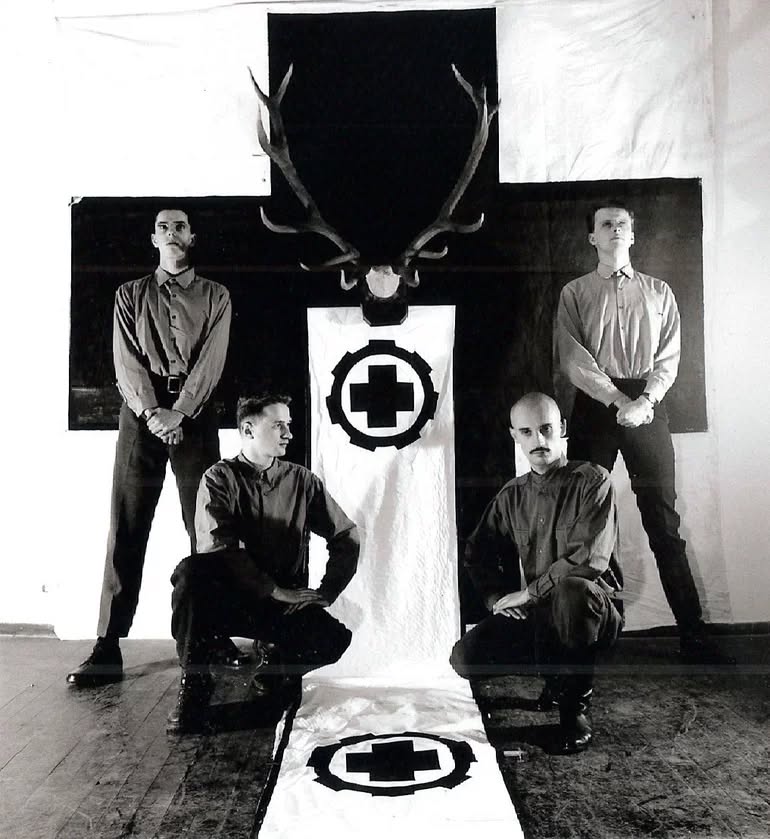
Here at Counter-Currents, we have already published a lot of material about Laibach, their music, and the cultural events surrounding the band. I believe that the band needs no further introduction to our readers. Personally, I like to play Laibach’s music at gothic parties, especially the songs Alle gegen Alle and Tanzt mit Laibach, but of course the band offers much more than just dance music. During their active years, Laibach has built a legacy that goes beyond music (they are one of the most influential bands in the genre today). Laibach is literally a cultural phenomenon today.
I had the honor of interviewing the band, which will hopefully shed some light on the mystery of Laibach and how they work—but we should keep in mind that some things should remain hidden forever.
Together, we talked about dreaming, Greatness, death, Adolf Hitler’s art, postmodernism, Trump, Rammstein, provocations and various taboos, misinformation about Laibach, their friendship with Charles Krafft, culture in Slovenia, and, of course, their great music and the search for the Holy Grail in the modern world.
Ondrej Mann: What was the story behind the suicide of Laibach founding member Tomaž Hostnik? Do you have any memories of him?
Laibach: We do not truly know why it happened, but Tomaž Hostnik’s death remains one of the most difficult chapters in Laibach’s history. He was not only a founding member of the group, but also a key early voice and an important intellectual entity. His suicide in December 1982 cannot be reduced to a single explanation. Any attempt to turn it into a heroic narrative would only simplify a deeply human tragedy. We remember Tomaž for what he gave us—his voice, his ideas, his intensity. His absence therefore remains profoundly present.
OM: Are there any other divisions of Laibach still active today, and are they preparing any new projects—NSK, Scipion Nasice Sisters Theatre, IRWIN, Novi Kolektivizem, etc.? What do these divisions do?
L: Today, the main NSK divisions still exist, but they operate as autonomous entities with their own internal logics: IRWIN continues as a visual art collective, dealing with painting, archives, exhibitions, and geopolitical projects such as NSK State in Time.
Novi Kolektivizem functions as a design and conceptual studio, engaged also in visual communication, posters, publications, and institutional projects.
NSK State exists as a living political-artistic construct, with citizens, passports, embassies, and ongoing forms of symbolic diplomacy.
Scipion Nasice Sisters Theatre no longer exists as a performing group, but as a completed historical and conceptual project whose legacy remains an integral part of NSK’s structure. SNST was followed by Noordung Cosmocinetic Cabinet.
Although all these groups generally share a common conceptual foundation rooted in Laibach, each of these divisions is not a “branch” of Laibach, but an equal component of a shared system. They do not collaborate by command, but by parallel logic.
Because of its own strategic decisions and the course of historical developments, Laibach distanced itself from the other groups more than a decade ago and no longer maintains systematic or programmatic collaboration with them.
OM: How is it that music has become the most famous aspect of the entire Laibach and NSK art movement?
L: Because music is the most direct and most transportable medium. Sound crosses borders faster than images, texts, or theories. A song can circulate where exhibitions cannot, and a concert can gather people who would never enter a gallery. Music therefore became the most visible surface of a much larger structure.
But Laibach never treated music solely as entertainment. From the outset, it functioned as a carrier of power, symbols, discipline, and ideology—as a machine of meaning. Music was not a decorative layer, but an operational tool. It was both artwork and interface: an access point into the NSK system.
Music did not become dominant because it was favored. It became dominant because it was the most efficient weapon, the most contagious medium, and the loudest ambassador of the entire complot.
OM: Can you describe the state of NSK a little?
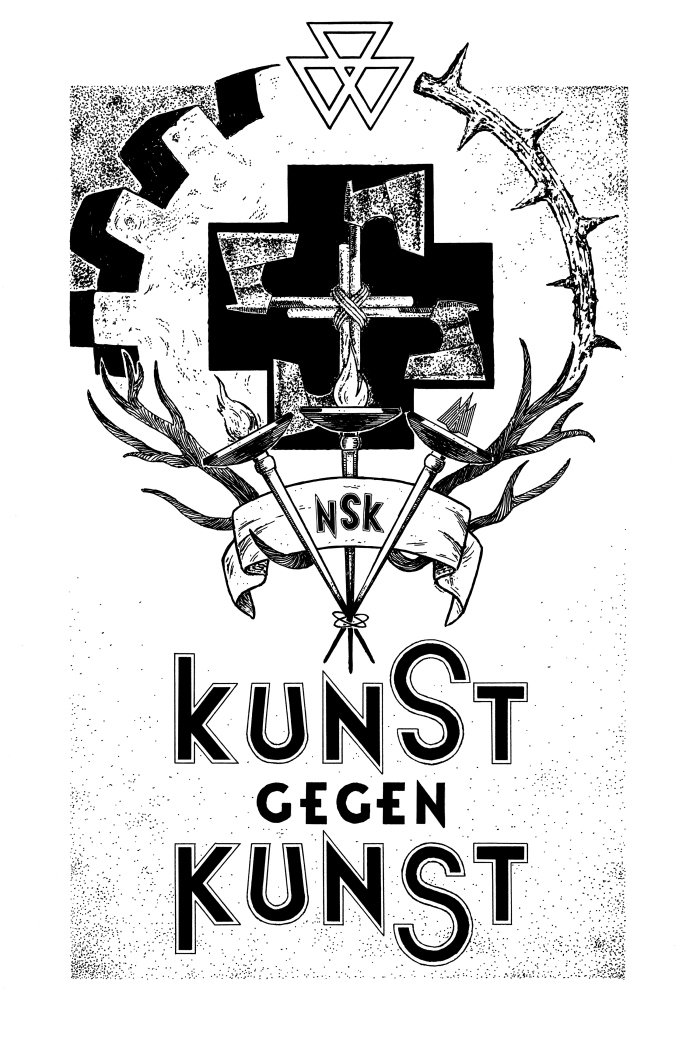 L: The NSK State (described by the IRWIN group also as a State in Time) was created at the moment when the Neue Slowenische Kunst movement began to dissolve as a unified organizational structure. It was proclaimed in 1992 in response to the collapse of Yugoslavia, the redrawing of borders, and the re-nationalization of identities in post-socialist Europe.
At a time when real states were fragmenting, NSK proposed a state that could not fragment—because it did not rely on territory, ethnicity, or power. The NSK State is therefore a conceptual and symbolic state that exists without land, borders, or government, sustained only through participation, recognition, and imagination of its citizens.
OM: Is it still possible to dream of greatness today, and can you dream up completely insane things and make those dreams come true? Owning a country, a flag, complex art, retrofuturism, etc. What does dreaming mean to Laibach?
L: It is very much possible—Donald Trump is clearly dreaming such dreams on a grand scale, and some of them he even manages to turn into reality. But in our view, greatness today is no longer a matter of size or power, but of persistence. We still believe it is possible to dream impossible dreams—not because they will all come true, but because without such dreams, reality would shrink into mere administration.
For Laibach, dreaming has never meant escape. It means construction. Flags, states, symbols, retrofuturism, complex projects—these are not fantasies, but instruments for testing reality. A dream becomes successful when it begins to function as a system.
We do not dream in order to flee the world, but to reorganize it symbolically. Even insanity, when structured, becomes a form of order. In this sense, dreaming for Laibach is a purely strategic conceptualized insanity.
OM: Is Laibach postmodern in any way?
L: Isn’t postmodernism already over? Are you trying to bury us with this question?
If Laibach is postmodern, then postmodernism is certainly not Laibach. Postmodernism hides behind irony, quotation, and distance. Laibach uses the same tools, but removes the safety net. Where postmodernism relativizes, Laibach weaponizes. Where postmodernism debates, Laibach commands. Postmodernism says: nothing is true. Laibach replies: everything is permitted—and therefore dangerous.
We do not recycle history to decorate it. We recycle it to make it operative again. In that sense, Laibach is not postmodern. It is post-postmodern: a system that uses irony without being ironical, and uses ideology without belonging to it.
In short—if postmodernism is a museum, Laibach is a military parade inside it.
OM: Do you use any elements of deconstruction?
L: What kind of question is this?
Of course we use deconstruction, but not in the academic sense and not as an ideology. We use it as a method. We dismantle symbols, myths, and power structures only in order to rebuild them in another form. Deconstruction for Laibach is not about destroying meaning, but about exposing how meaning is constructed—and how easily it can be reconstructed.
OM: What significance does experiment have in Laibach’s art?
L: Experiment is the operating principle for us. We use it to test the limits of form, audience, ideology, and ourselves. An experiment is valid only when it produces consequences. If nothing changes, it was not an experiment—only ornament.
OM: What meaning do song covers and visual collages have for Laibach?
L: We do not make covers—we make interpretations. Our musical interpretations follow the same method as our visual collages. We take selected material from one context and place it into another, in order to test how a symbol behaves when removed from its original authority and inserted into a different system.
We do not repeat existing material to glorify it, but to expose its hidden meanings.
OM: What is the biggest fake news story about you that the mainstream media has written?
L: That we were the first band from the West to perform in North Korea—when in fact we were the first band from the East to perform there.
OM: What significance does Laibach Gesamtkunstwerk have?
L: Quite significant—as Gesamtkunstwerk usually is, by definition. For Laibach, it means that no element of our work exists independently. Music, image, language, performance, and ideology form a single system. Meaning does not arise from individual works, but from their interaction.
OM: Do you have any personal memories of the American artist Charles Krafft?
 L: Yes, we do, we remember him gladly. He was a funny guy with a big sense of humor—at least when he was hanging with us. He went with us in occupied Sarajevo in 1995, during the war in Bosnia. We also remember him as a very skilled artist, especially in his work with Delft-style ceramics. It is regrettable that, toward the end of his life, his political views began to overshadow his work and affect the way he was publicly perceived.
OM: Which artists has Laibach collaborated with in the past?
L: Too many to name, but they were all great. Many of the artists we worked with came from the theatre world, where music, performance, and visual language naturally meet. The theatre scene has always been an important and inspiring environment for Laibach.
OM: You once claimed that you are as much fascists as Hitler was a painter. Could you tell us something about Adolf Hitler’s visual art?
L: Actually we stated that Laibach is as fascist as Hitler was an artist. That is a crucial distinction. He was a painter—not a very good one, but not entirely without skill either. Whether he can objectively truly be considered an artist, however, is highly questionable, unless one chooses to interpret his political career itself as a kind of radical artistic statement.
In the history of art, however, he will undoubtedly be remembered as the chief curator of one of the most significant exhibitions of the 20th century: Entartete Kunst. Under the pretext of “degenerate art,” this exhibition brought together some of the finest modernist artists and works of the time and, paradoxically, helped define the modernist canon of the early 20th century.
OM: You once said that Rammstein is Laibach for children and Laibach is Rammstein for adults. Is that still true?
L: Not anymore. Children became adults. Adults became seniors. Rammstein is getting older, Laibach is getting younger. But the paradox remains.
OM: Could you elaborate a little on your relationship to Rammstein?
L: There isn’t much of a relationship. Rammstein saw Laibach in the early 1990s and decided to become what they are now—with Laibach as a basic inspiration. Meanwhile, Laibach never decided to become Rammstein.
OM: Have you been influenced by the industrial/martial/neo-folk scene? Which specific bands?
L: Not that we would know. But we were influenced a lot by Werner Herzog and his films—and their soundtracks as well.
OM: How come you are the most successful band from this scene?
L: Which scene? We have no idea what you are talking about. We started as an experimental communist industrial band and we still like to experiment, but we do so across all genres. Despite this diversity, we see no connection with the neo-folk scene whatsoever.
OM: How do you perceive woke ideology in contemporary art?
L: As a wake-up call. For Laibach, art must remain a space of contradiction, discomfort, and ambiguity. Wokeness tends to eliminate precisely that.
OM: Is Laibach still provocative today?
L: Yes, it is.
OM: Is Donald Trump more of a politician or an artist?
L: Donald Trump is a comedian who does not like people to laugh at his jokes. But he certainly understands spectacle, and mass psychology better than most politicians, and he treats politics as a stage for presenting his aesthetic and moral dogmas. In that sense, he operates closer to performance art than to political theory.
OM: What were the taboos in communist Yugoslavia at the time, and what are the taboos in Slovenia today?
L: In communist Yugoslavia, certain foundations were effectively untouchable: the Partisan narrative, the figure of Tito, the unity of the state, and the leading role of the Party. Many things could be discussed, but questioning these core myths had clear limits.
Today in Slovenia, taboos are less centralized and more fragmented, but they still exist. They tend to form around questions of identity, moral consensus, and dominant interpretations of history. Positions are generally not prohibited by law, but they can be sanctioned socially.
Taboos have not disappeared. They only have changed their content.
OM: Do Laibach and NSK have a goal?
L: No, not in the conventional sense. Goals imply destinations. Laibach and NSK operate as processes. We cannot really speak on behalf of NSK, but Laibach’s goal—if there is one—is to make evil lose its nerves. Another long-term goal would be persistence.
OM: What is Laibach looking for in today’s world?
L: We are looking for the Holy Grail. Of course, we know it does not exist. But that is why the search continues.
OM: You are the most famous band from Slovenia, and the second most famous person in the world from Slovenia is Slavoj Žižek. Do you have any connection to this philosopher?
L: Yes, Slavoj is our dear friend and one of the smartest and wittiest people in the world. For a few years back in the 1980s we even lived in the same house—we stayed in the basement, and he lived on the first floor. And yes, we did collaborate occasionally.
OM: Would you recommend anything or anyone remarkable from contemporary Slovenia to American readers?
L: In addition to Slavoj Žižek, we would recommend the philosophical and essayistic works of Mladen Dolar, Alenka Zupančič, and Jela Krečič. In terms of literature, Srečko Kosovel could be particularly interesting for American readers—this year marks the 100th anniversary of his death—and perhaps also the books of Vitomil Zupan, for example Playing with the Devil’s Tail.
OM: Do you have any final message for our readers and your fans?
L: Do not believe yourself, least of all your own private taste and convictions. Do not become a slave to yourself. And do not trust others either—especially those you worship.
Death to fascism and Sieg Heil!
18 comments
Great article! I have heard of Rammstein, but not Laibach. 🙃
Time to fix it.
I think I saw them at a festival in 2010, but wasn’t aware of their relevance until much later. Good interview
Englishman here.
I’ve seen Laibach live many times, most recently about a year ago when they did an anniversary tour for their late 1980s ‘Opus Dei’ album. That night they played at the Islington Assembly Rooms here in north London. For readers not familiar with Islington, it is a pleasant, leafy part of London, known for being pretty much the epicentre of liberal, left-wing, bien pensant types, those who would probably sooner let a Rotherham ‘grooming’ gang defile their daughter than admit that the multicultural society was perhaps going less swimmingly than anyone might be admitting.
Thinking back to the recent frenzy over Elon Musk doing a ‘Roman salute’ (I’m sure he was doing no such thing)… that night Laibach led the crowd in a sing-long to their version of Queen’s ‘One Vision’, a version which really brings out the hilarious latent totalitarianism in the lyrics (“One flesh, one bone, one true religion. One race, one hope, one real decision”). Everyone was beating their breasts and extending their arms in what looked awfully like….Roman salutes. I laughed out loud at how the band could get a room full of right-on liberal Islington types looking like a night out at the Zeppelinfeld in Nuremburg. All with a totally straight face. They really are the pranksters supreme.
Best to you my American brothers.
It reminds me of a fun time when I sang Falangist anthems and Rock Against Communism numbers in Spanish to a crowd that was generally three steps to the left of Chairman Mao. They had no idea what I was singing and loved it! I’m sure Laibach drew a much greater crowd though 🙂
Yes, you already mentioned that. Was it for a pagan audience at the time? You certainly have a beautiful singing voice. It’s a shame you didn’t record this music for Boyd Rice or Laibach.
Good one, sir! 🙂
A lot of people can’t get enough of those catchy anthems…until they find out who wrote and performed them.
Too much nonsense to comment it all. They are just throwing cheap provocations and then hide their hands.
“For Laibach, art must remain a space of contradiction, discomfort, and ambiguity”
That I must feel uneasy when looking at art is a typical leftist, post-modern idea, Bert Brecht made it a Leitmotiv of his theater. The original idea of art was that it should provide spiritual uplifting and comfort after a hard days work.
“Laibach is as fascist as Hitler was an artist”
This leaves the kitchen window open to escape. For those considering Hitler an artist, Laibach is fascist, for others, Laibach is mainstream … remember, art must remain a space of ambiguity.
“Even insanity, when structured, becomes a form of order.”\
Maybe, but neither the insanity shows of Laibach nor their desperate attempts/negations to put a concept behind them are structured.
It’s remarkably hard to pin them down on anything. Ambiguity has served them well over the years. Still, I can see where it can get a bit maddening.
With Laibach, it’s more complicated; they are not an explicitly fascist band. But they use elements of National Socialism, Titoist communism, and anti-fascism for their unique mix of music and art. Try reading about how Greg Johnson and John Morgan attended their concert –
Resistance is Futile:
Laibach & the Lviv Philharmonic in Ljubljana, 2018. If you’re looking for authentic fascist music, try
Boyd Rice Presents: Death’s Gladsome Wedding or authentic Italian fascist songs on YouTube. My favorite is Me Ne Frego. If you’re interested in the Italian neo-fascist music scene, check out my article Alternativa di Destra.
“they use elements of National Socialism, Titoist communism, and anti-fascism for their unique mix of music and art”
Symbols are not arbitrary pieces of graphics, using them, you transmit something. What do you transmit showing NS, communist and antifa symbols together?
What is the ‘message’ of Laibach?
Do they have any message, apart from the pubertal drive to provoke ‘contradiction, discomfort, and ambiguity’ (the poorest reasons to create ‘art’)?
However, their evasive general ambiguity about art is in stark contrast with some of their firm beliefs, like
“Under the pretext of “degenerate art,” this exhibition brought together some of the finest modernist artists and works of the time and, paradoxically, helped define the modernist canon of the early 20th century”
Each of their albums has a message, but you have to look for it in the music and read their interviews. As I mentioned above, if you are looking for explicitly fascist music, try something else.
Good interview.
I’d almost forgotten about Laibach. The last time I heard them was quite a while ago when ‘Life Is Life’ and ‘One Vision’ got quite a bit of attention. Their videos were very impressive.
Yes, I’ve got ‘Death’s Gladsome Wedding’, gotta hand it to Mr Rice for getting that material out there! ‘Giovinezza’ is good too, Death In June looped it at the end of their ‘Take Care And Control’ album.
I remember their album of interpretations of Sympathy for the Devil.
By the way, this is a great album.
I saw Laibach twice in concert back in the early 90s in Texas. Really great shows. I love Laibach and I don’t really care what their political positions actually are.
If you get the chance, I recommend checking out their concert again. They put on really impressive shows. All of this is already described really well on CC. They just released a new album. It’s not really my cup of tea, but I’ll go see them live if I get the chance.
Comments are closed.
If you have a Subscriber access,
simply login first to see your comment auto-approved.
Note on comments privacy & moderation
Your email is never published nor shared.
Comments are moderated. If you don't see your comment, please be patient. If approved, it will appear here soon. Do not post your comment a second time.