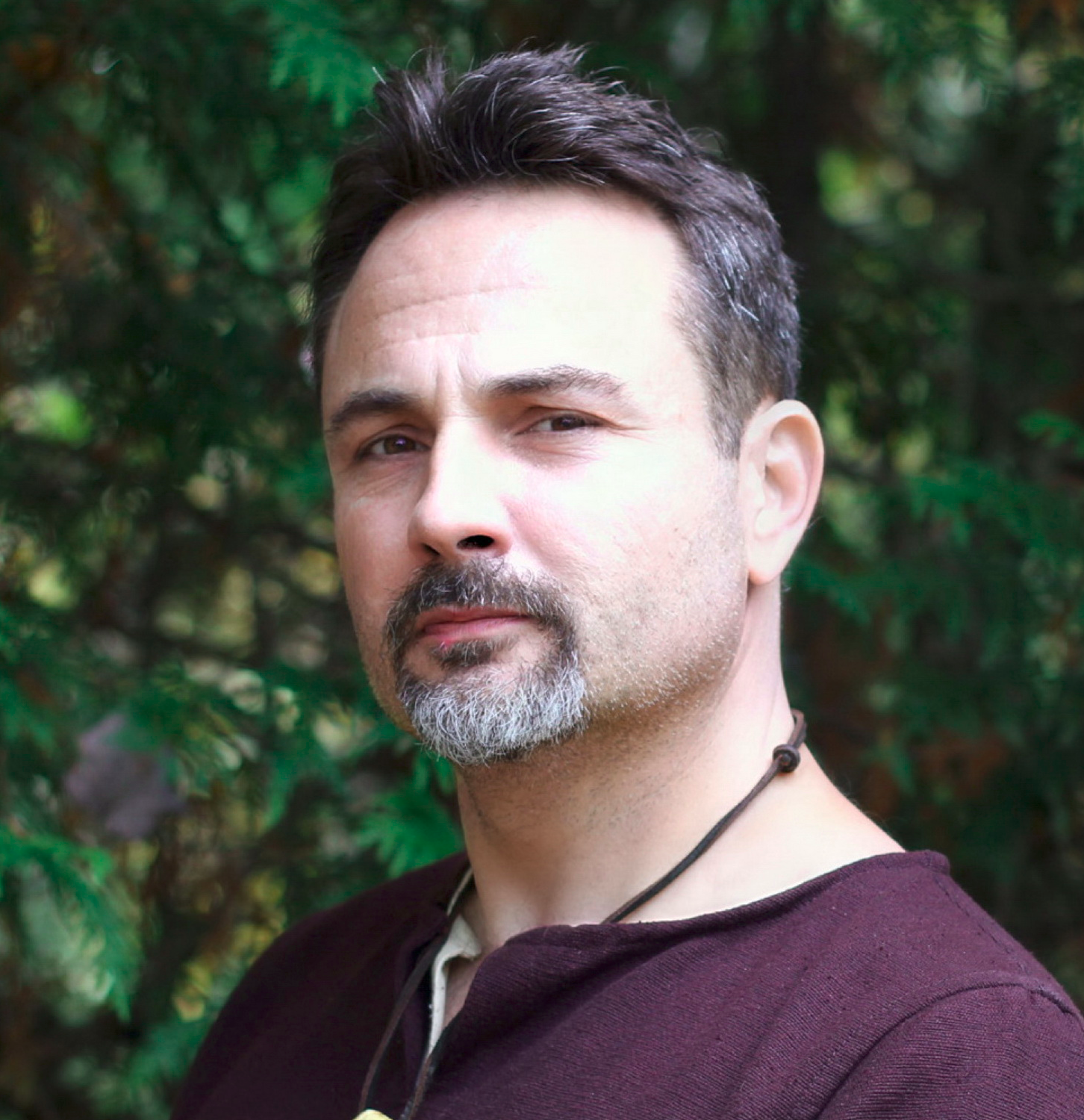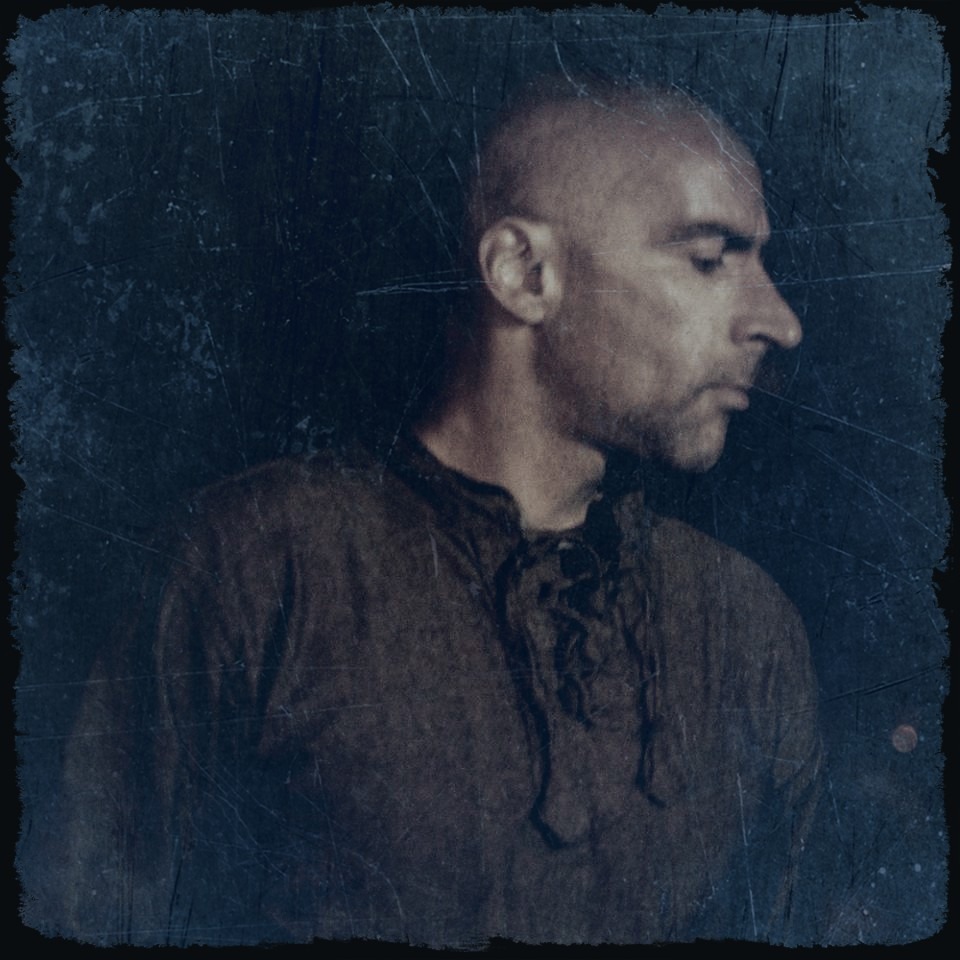
Gerhard Hallstatt is an Upper Austrian musician, photographer, and writer, though he currently focuses primarily on music with his experimental band Allerseelen. He previously served as the publisher of the small but influential underground magazines Aorta and Ahnstern, using the pseudonym Adam Kadmon. These limited-circulation publications focused primarily on esoteric philosophy, magic, sacred architecture, art history, and cultural poetry, as well as half-forgotten National Socialist artists and occultists. (more…)
Tag: esotericism
-

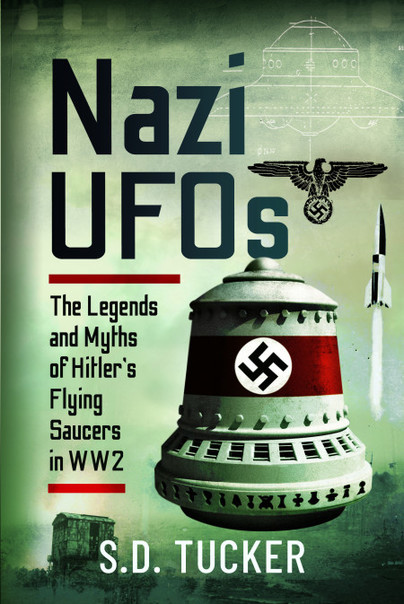
You can buy Steven Tucker’s Nazi UFOs here.

You can buy Steven Tucker’s Nazi UFOs here.
3,380 words
In Don DeLillo’s 1985 novel, White Noise, the central character is a professor at the Department of Hitler Studies in an American university. DeLillo has a minor obsession with Der Führer. His 1997 novel, Underworld, is one of the great American novels of the twentieth century, and its title is a translation of Unterwelt. This refers to a strange home movie at the center of the novel, one apparently filmed in the Bunker during its last days. Hitler is and will remain a source of fascination for writers and, as we shall see, his ambition to rule the skies apparently took some freakish turns. Or did they? (more…)
-
3,657 words
In my essay “Notes on Strauss and Husserl,”[1] I argued that Edmund Husserl’s phenomenology had a formative influence on Leo Strauss in two ways. First, Husserl’s method of dismantling traditional concepts in order to return to and describe the experiences they were based upon influenced Strauss’ recovery of the classical ideas of nature and natural right. Second, Husserl influenced Strauss’ hermeneutics, specifically his so-called “golden saying” on the surface of texts. (more…)
-
Phil Baker
City of the Beast: The London of Aleister Crowley
Foreword by Timothy D’Arch Smith
Strange Attractor Press, 2022“No news, no tobacco, no friends, no printer, no hope, no bloody nothing.”
—Aleister Crowley, London, Spring 1943“This desolating war!”
—Aleister Crowley, London, 1943, after a lunch of game pie, grapes, 1858 cognac and a Cabanas cigar.Constant Readers will recall my review of David J. Goodwin’s Midnight Rambles: H. P. Lovecraft In Gotham (Fordham University Press, 2023). Imagine then, my delight when this work by Phil Baker[1] crossed my path, described thus by the publisher: (more…)
-
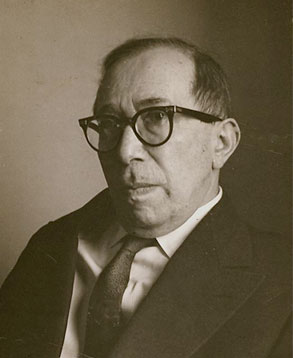
Leo Strauss is influential among certain circles, such as the Claremont Institute and the BAPsphere. For example, a few days ago, Costin Alamariu (a.k.a. Bronze Age Pervert), posted a supporter’s photo of his dissertation, Selective Breeding and the Birth of Philosophy, by Strauss’s grave.
I decided to give Strauss’s ideas a fair hearing. (more…)
-
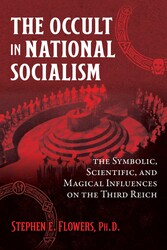
Stephen E. Flowers
The Occult in National Socialism: The Symbolic, Scientific, and Magical Influences on the Third Reich
Rochester, Vt.: Inner Traditions, 2022In the realm of the occult and its intersection with the Third Reich, Stephen E. Flowers’ The Occult in National Socialism: The Symbolic, Scientific, and Magical Influences on the Third Reich stands out as perhaps the most comprehensive, profound, and objective investigation to date. (more…)
-
1,577 words
We are not exactly sure when George Ivanovich Gurdjieff arrived on this Earth, but it was probably January 13, around 1866. He was born in Alexandropol, then part of the Russian Empire, to a Greek father (an ashik or singer-poet) and an Armenian mother. As a young man, Gurdjieff travelled through the Middle East and Central Asia for around 20 years, searching for enlightenment. (more…)
-
1,577 words
We are not exactly sure when George Ivanovich Gurdjieff arrived on this Earth, but it was probably January 13, around 1866. He was born in Alexandropol, then part of the Russian Empire, to a Greek father (an ashik or singer-poet) and an Armenian mother. As a young man, Gurdjieff travelled through the Middle East and Central Asia for around 20 years, searching for enlightenment. (more…)
-
6,192 words
From Esotericism, Religion, and Nature (Studies in Esotericism), ed. Arthur Versluis, Claire Fanger, Lee Irwin, and Melinda Phillips (Mankato, Minnesota: North American Academic Press, 2010).
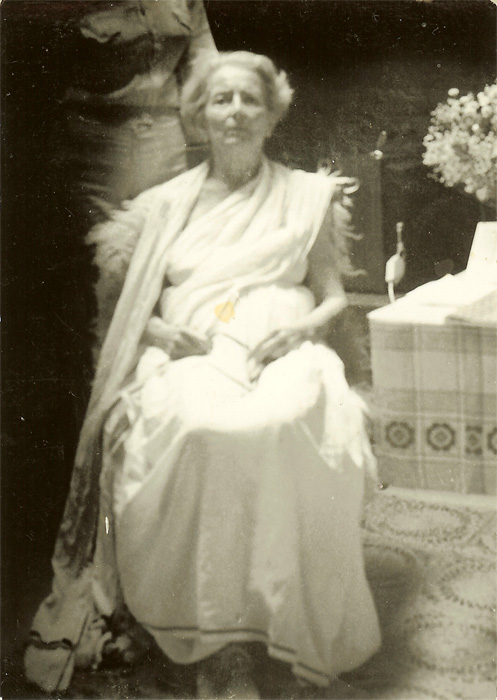
Savitri Devi (1905–1982[1]) was born Maximine Julia Portaz in Lyons, France, of English, Italian, and Greek ancestry.[2] She was a highly gifted and eccentric child. Early on, she embraced vegetarianism and animal rights out of a strong aesthetic revulsion to slaughter and other forms of cruelty to animals. (more…)
-
If we believe that we are living in the dark age, or Kali Yuga, then we must believe that things will only continue to get worse before they get better. We should therefore look for silver linings whenever we can find them. One such silver lining is that the traditional distinction between the Right-Hand Path and the Left-Hand Path has crumbled. This crumbling has positive implications both for esoteric initiation as well as exoteric politics, and has arguably created the possibility of a Third Path that is more suitable towards action than contemplation. (more…)
-
7,655 words
The Sphinx-riddle. Solve it, or be torn to bits, is the decree.
— D. H. Lawrence
A question, readers: what is the most profound of all human activities? With the previous sentence, I’ve already provided the answer, for it is the question itself — the thing that drives all exploration and philosophy. How can philosophy (or any knowledge) exist without first the riddle, the profound need for the answer? (more…)
-
-
2,079 words
George Burdi is the warhorse of the white nationalist scene. He first became famous with his symphonic metal band Rahowa through the unique album Cult Of The Holy War, and later he founded his own label, Resistance Records. (more…)