 2,191 words
Candace Owens
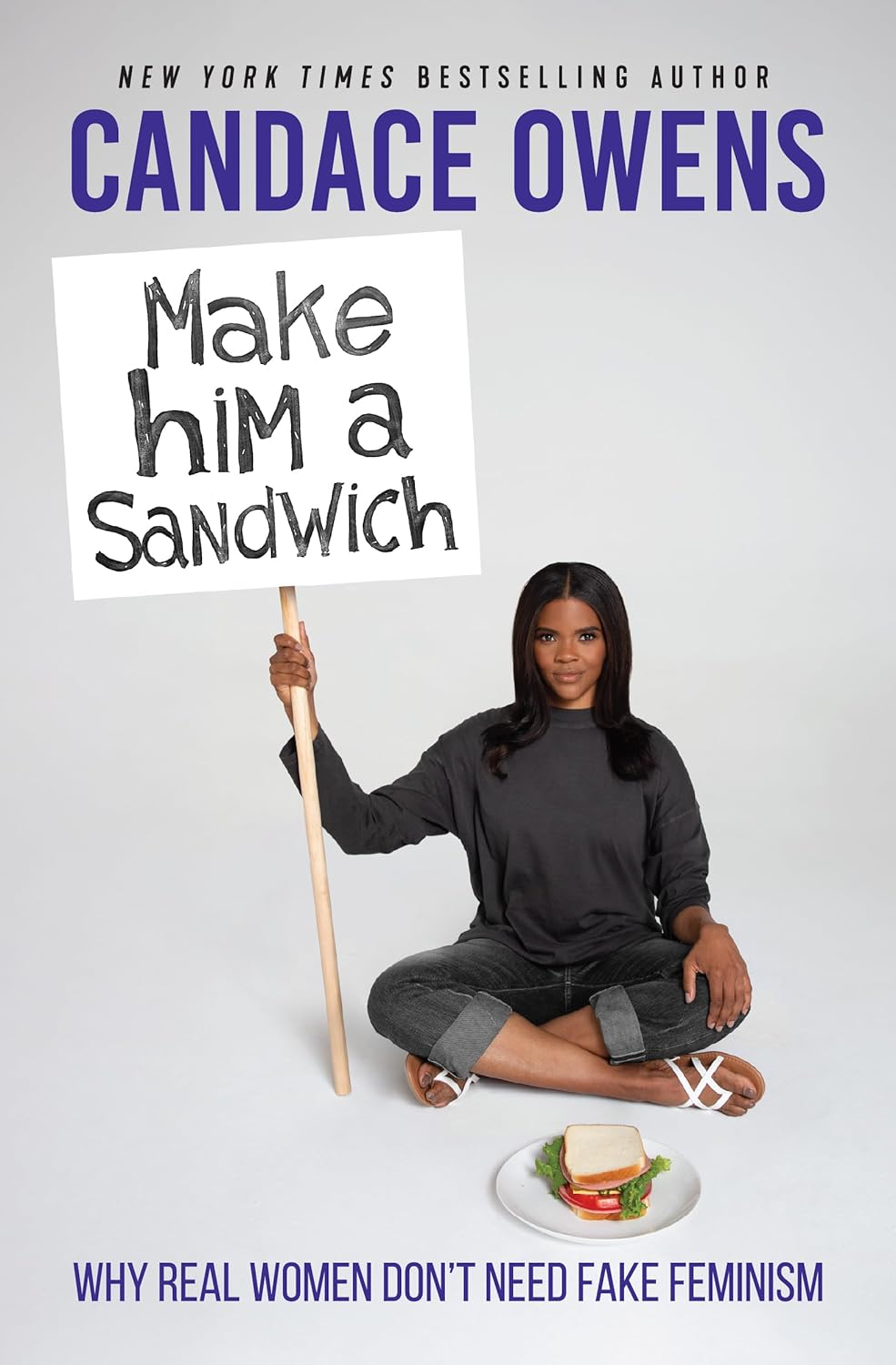
Make Him a Sandwich
Platform Press, 2025
I am aware that not many readers of this platform are fans of Candace Owens for various reasons, and so I am not going to discuss Candace Owens. I’m sure that will happen in the comments section without my help.
Recently, Owens published a book called Make Him a Sandwich—Why Real Women Don’t Need Fake Feminism. Well, feminism is not “fake” at all, so that part of the title doesn’t really make sense, but as Owens will go on to explain, much of the motivation of feminists, as well as their arguments, are very much fake.
The book is just 236 pages long with fairly large print, so you can get through it quite quickly. In fact, I read much of it while suffering through the test screening of a movie I’m not allowed to discuss, but suffice to say it was about a young woman trying to make her way in a typical men’s domain. Oh, the irony.
Owens sets the stage with the cover photo of herself parodying Gloria Steinem’s famous photograph. (The back cover features a selection of anti-endorsements, which is hilarious.) She then gets into some basic facts about feminism and biology. There is an anecdote that made me smile for personal reasons, as I will explain:
It didn’t take four children for me to understand that my husband and I were being guided by underlying and inextinguishable biological differences when it came to child rearing. When we were just two months into raising our firstborn, I vividly recall taking a shower and wondering how I was ever going to get used to the physical demand of nursing in addition to all the other tasks that needed tending. … Suddenly, my husband walked into the room and issued a statement,
“I need you to sign some documents.” …
“For what?” I asked.
“For our son’s college fund and life insurance,” he replied. …
While I had been thinking about diaper sizes and our son’s minute-to-minute needs, my husband had been thinking about the rest of his life.
Now, my own parents held different beliefs. After I had been born, my mother wouldn’t agree on having me baptized in the Protestant church, and my father (although he never actually went to church) wouldn’t agree on having me blessed in my mother’s belief system. So they at least agreed on letting me make the choice when I became of age. However, the way my mother tells the story, my father was devastated. “She can’t marry in white, then!” Well, by the time I celebrated my 18th birthday, women were allowed to marry in white even in civic marriages, and not long after, churches were glad when anyone still chose to marry in a Christian ritual, even if they were not baptized. And really, Dad, who marries before their 18th birthday anyway? But this is very much like how Candace Owens describes the dynamic. My mother was busy with their newborn, and my father was already envisioning her marriage. And I’m sure we’ve all witnessed the different approaches to tasks that need doing: Men are planners and devise strategies on how to best tackle the task at hand; women just start doing it. Cracks me up every time.
Owens continues:
The truth is that despite environmental factors that may help to accentuate or diminish our natural proclivities, differences between males and females from birth through adulthood have always been a “known known.” And despite feminist attempts to effectively rinse or categorize those differences as sexist or patriarchal, the truth remains that … no human society in the history of mankind has ever managed to defeat biology.
Now, for most readers of this platform, what Candace Owens writes about is nothing new. In fact, Eva Herman wrote basically the same things in 2006, from the perspective of her time, which did not yet include Owens’ fourth wave of feminism—transgenderism. There is a deep irony there. For the second wave feminists (the ones Eva Herman criticized in her books), gender was a social construct. Of course, they were talking about men and women being the same, nurture above nature, and all that. But the fourth wave feminists take that motto to its logical conclusion. If gender is indeed a social construct, then anyone can choose to be anything.
Of course, the idea that a man can magically transform into a woman is a social, biological, and mental absurdity, made further absurd by the idea that women would, to their own detriment, promote this fiction.
Feminists of previous generations immediately recognized the dilemma: If we erase the concept of what it means to be a woman by allowing men to simply claim they are women, wouldn’t that mean we eradicated ourselves? This is the reason behind the rise of the now famous “TERF” attribution. “Trans Exclusionary Radical Feminists”, aka TERFs, are those who stake a claim on the idea that to allow transgendered women into the feminist movement is to simply eradicate real women entirely.
It is important to remember that each wave of feminism was led by a very small contingent of radical women. In other words, despite not representing the viewpoint of the majority of women in society, they were able to effect sweeping social reforms. But how? Why didn’t other women in society stand up to the madness of a fringe minority? Simply put: because it wasn’t in their nature.
The majority of women in the world today do not agree with transgendered incursions into female spaces. But transgendered women (better referred to as men) are outwardly vicious toward any actual women who might stand in their way. That‘s because they are biologically male and much more willing to be aggressive to accomplish their goals. The stunning proliferation of the transgendered movement that we see today is taking place due to biological reasons. Women are allowing it to happen. We have discussed the female innate softness and compassion – a superpower when it comes to rearing children. But superpowers, when understood by forces of evil, can be used to further evil. Put simply, fringe feminists and pedophiles were able to appeal to the empathetic and compassionate nature of women everywhere to mass institute the perverted agenda of transgenderism.
And Owens points out:
Men are biologically hardwired toward aggression, not empathy. They would never allow such nonsense to seep into their spaces. So while men wearing bad wigs and makeup have managed to replace women in sports and modeling contracts, men haven’t had to suffer the same consequences.
Of course, this might also have to do with the fact that “trans men” are women who, as Candace Owens just explained, are less aggressive than men.

You can buy F. Roger Devlin’s Sexual Utopia in Power here.
The next chapter deals with something Eva Herman has also written and talked about extensively, the argument of women finding fulfillment, happiness, and freedom in the workplace. Now, I am definitely not saying that this is all a big lie. I am absolutely of the opinion that women should have their own income. But like Eva Herman pointed out, the argument is often skewed. We normally don’t hear of the fulfillment and freedom of women in low-paying jobs, it’s usually women in academia and journalism who are made to represent “women in the workforce.” In fact, those women are usually the ones making the argument. “My career is so fulfilling!” Yes, fine—but does the cashier at your local supermarket feel the same?
Owens lists a number of statistics that show the detrimental effects of women in the workforce both on women themselves and on the larger society. As to the infamous gender pay gap, Owens debunks it with the well-known fact that women are underrepresented in high-paying jobs because most lack the drive or even the interest to sacrifice so much of their time and energy to put in the necessary work.
A very interesting statistic, however, is that of the world’s top wealthiest women.
According to Forbes, the world’s three wealthiest woman [sic] are Alice Walton, Francois Bettencourt Meyers of the L’Oreal fortune, and Julia Koch. Alice Walton is worth $101B. She is the only daughter of Walmart founder Sam Walton. Bettencourt Meyers is worth $81B as of 2025. She inherited her wealth from her mother, who inherited it from her grandfather, who founded the company. Then comes Julia Koch of Koch Industries, worth a similarly mind-blowing $74B. She also inherited her wealth from her late husband, David Koch. See a trend?
As of 2025, of the thirty top wealthiest women in the world, only three women haven’t come into their wealth via birthright, divorce, or having been made a widow. Of those three women, two of them co-founded businesses with their husbands. That leaves just one woman on the list who earned her wealth solely. …
[It] is indeed interesting that virtually none of the world’s most financially successful women are those who have gone out and pioneered a business on their own. Certainly, women have been in the workforce long enough to have done so, were that their desire.
Quite opposingly, if we look at the top ten male billionaires, all of them are self-made.
The singular, self-made woman on the list is Zhou Qunfei. And if you, like me, now go “Who?”, Owens argues that the fact that Qunfei is basically unknown to the public is not due to sexism, as feminists would have it:
What it actually reveals is that women hold entirely different views than men regarding success. We simply do not equate it to wealth. It is male interest in financial success of men like Bezos and Musk that has turned them into household names. It is an utter lack of female interest in the financial success of Qunfei that has rendered her unrecognizable. Rather, if you asked women who they thought the most successful women in the world were, you’d likely hear names like Oprah, Taylor Swift, or Beyonce. …
It seems women measure success in terms of cultural influence, not bank accounts. And it must be pointed out that these women earned their success in ways that only further substantiates that there are biologically driven, innate traits of women.
More simply put, women achieve power by shaping industries that we inherently understand.
Next, Candace Owens goes into the history of feminism and points out the little-known fact that it was not Margaret Sanger who pioneered the idea of birth control, but rather Sanger’s mentor Emma Goldman.
She then describes what she considers the two main “schools” of modern feminism. One is the Dunham School of Feminism, named after Lena Dunham, which is the school of “body positivity,” aka celebrating obese women as healthy and beautiful. Now, I could be wrong, since I’m not into the latest trends, but I believe that particular school is on a sharp decline already, mainly because the health issues involved are just too obvious.
The second school is what Owens terms the Kardashian School of Plastic. This includes not only, as may be expected, plastic surgery, but also the cult of perpetual nudity, and inevitably the cult of perpetual youth. Owens lists Madonna as that cult’s most prominent adherent.
She then dedicates almost a full chapter to Taylor Swift whom she has also spoken about several times on her show. Yes, what went on with Taylor Swift is worth noticing, but a silly thing to do was to title this chapter “Hocus Pocus” and to sort of equal crowd manipulation to witchcraft. Sure, Owens is a traditional Catholic, but—really?
It is, however, in her last chapter that Owens makes perhaps the most important point of her book. She recalls her college days with three friends who all, in their own way, considered themselves feminists. One very much described to the Dunham School. Another maintained three boyfriends simultaneously, because she was fighting the “outdated concept on monogamy.” The third one was the classic crazy ex—“until cops were called, restraining orders were filed, and she learned that restraining her every impulse wasn’t a symbol of the patriarchy but of adulthood.” But then Owens addresses her own role:
I was arguably the worst among them because I was cheering them on. I was the dedicated audience laughing and applauding their every move. Never once did I attempt to reason or dissuade. … It is only today, and with the utmost clarity that only hindsight can provide, that I now recognize my previous insanity.
In fact, far from the idea that behind every crazy woman is a man who made her that way, the truth is that behind every crazy woman is another crazy woman egging her on.
It’s the woman in the comment section telling Lena Dunham she looks amazing when she so evidently does not. It’s the female journalist inexplicably applauding Kim Kardashian as she ruthlessly mauls a teenager online for daring to ask if she might have something more to offer than her nude body. …
Modern feminism has conditioned women to lie. To lie repeatedly and senselessly to one another – and perhaps worst all of – to lie to ourselves.
36 comments
Well I think it’s interesting the second school is exclusively tied to income and media exposure. The bills for Madonna are, I’ve seen estimates, between a quarter and half a million dollars in procedures and ongoing treatments, possibly more. Kardashian would be similar, although she’s younger.
Clarissa Schnabel: let me barge in with an unrelated question. Is Jenny Erpenbeck (specifically, The End of Days) worth reading? I occasionally enjoy post-war German writers, like Heinrich Boll, but the ones I’ve tried lately (although mostly non-fiction), are too eaten up by guilt or too preachy leftist to stomach. Just a good story-teller, please.
I have to admit that I hadn’t heard of her before now, not being into novels and especially contemporary ones very much. Sorry!
” it’s usually women in academia and journalism who are made to represent “women in the workforce.” In fact, those women are usually the ones making the argument. “My career is so fulfilling!” Yes, fine—but does the cashier at your local supermarket feel the same?”
Women have always worked and made money in western society. The stay-at-home housewife of the early 20th century in America was a historical aberration, and was class based. There were still hordes of poor women working on assembly lines full time, or sewing up clothes, that’d have loved to be a non-working housewife. It’s a huge form of historical revisionism that feminists have applied to make out that housewives were really chomping at the bit to escape the confines of the kitchen. When it actually they enjoyed their leisure time and flexing on the poors. You’re somewhat seeing this return on platforms like Tik-Tok with a lot of women flexing the fact that their boyfriend is wealthy enough for them to not have to work. I suspect as the cost of living crisis gets worse, the idle housewife will end up glamorized again. For most of human history free time in itself was considered a status marker. It’s only with the rise of the welfare state and NEETdom did leisure and free time come to be regarded as such a bad thing. David Graeber’s book “Bullshit jobs” details the changing mentality in regards to leisure. Historically it was an aristocratic privilege, and many of the early 20th century housewives had that mentality about it.
It’s also questionable how fulfilling those jobs in academia and journalism are now that there’s declining reputations, job opportunities and pay for both fields. This is due to the very oversaturation the feminist propaganda caused. A woman who studied a psychology undergraduate degree in the 1970s almost certainly had a prestigious career in front of her. In the 2020s such a degree pretty much gets you working in a daycare or kindergarten if you’re lucky. You’re expected to go for a post-grad to do anything worthwhile. Many of these people are ending up as the cashier at the supermarket still.
The “hordes of poor women working on assembly lines” were also a historical aberration, of course. It’s true that the 1950s American ideal that everyone seems to want to get back to was just a blip in time. The real historical way of working was family businesses. Women (and men and children) all worked in the family business, with only about 15% of men (so says my aging memory) working for another man.
To go one step further, Candace Owens points out that even for men, work was historically seen as a necessary evil, not a goal in itself. Now, opinions obviously might differ – we usually work to put food on the table, but if we like the work we’re doing, that’s an added bonus.
I might have to read the book “Bullshit Jobs”. One term that I have used in the past is the phrase “lazy-girl jobs”. I’m talking about corporate jobs given to women that have an important sounding title, but don’t require much work or intelligence. It’s a type of cronyism and a PR decision to look good. I’ve dealt with women like that in a corporate setting as have some CC commentators. These corporate positions I’m talking about only represent a small number of women of course.
“lazy-girl jobs” or also know as ‘jew daycare’
It’s fascinating how Candace can accept the biological reality of sex but gets very angry when anyone mentions the obvious biological reality of race and the fact that blacks ON AVERAGE are less intelligent than Whites. Suddenly then she’ll claim the differences are down to the environment and we’re actually all the same.
Regarding the infamous gender pay gap. If we accept that women are underrepresented in high-paying jobs, and would list such a high-paying job as being a board member in successful companies (which is often the case), then surely we must also accept the fact that board members are usually the same members who just change jobs within the board. This means, for example, that the CEO becomes Managing Director or holds some other position within the board. What this all means is that board members circulate while it is difficult for outsiders to infiltrate and become a board member – regardless of gender!
Good article. Two comments:
1. the decline in the Dunham worship of fat chicks is not at all due to them realizing it’s not healthy. It’s because of the advent of easily acquired drugs like tirzepitide that help you easily lose weight. Fatty Lena was the first one on that train, leaving all her fat cheerleaders in the dust.
2. the “hocus pocus” title isn’t actually that far off. Taylor spends a lot of time in witch costumes and devil-themed videos when she’s not at NFL games annoying everyone.
Maybe the fat chicks are just dying.
I have repeatedly seen small children on the tram get scared of the occasional Black person and ask their mothers, “Mommy, why is he black?”
For some reason (racism, perhaps?), I always feel a similar sense of wonder when I see a black man or woman in the media. Something like, “Yes, Candace Owens is a nice girl… but why is she so black?” comes to mind.
There have been too many niggas here over the past week. Black History Month, Black Invention Myths, Barack Obama, The Gods Must Be Crazy, Candace Owens, Lippton Matthews and his article about the king of niggas. This is not how we will build a white ethnostate, my friends.
Ahoy there, mate. Settle down. Let Capn’ Greg steer this barky the way he wants. A valued member of the crew you certainly are, but navigatin’ treacherous seas don’t allow for no peanut gallery. (spits out tobacco juice) Git on up to the foretop with you & yer grumblin’.
An’ when yer done w’ yer grumblin’ an’ watchin’ from yon foretop, get to ye whttlin’ and scrimsaw’n’ an’ make a capt’n’ ‘is samwich!
Hey [taps the sign] this is Black History Month.
The longest month of the year…
It only feels that way.
Black Histronic Month.
Please tap the correct sign:
https://xcancel.com/DaveDuricy/status/2019526505991422082#m
Well, I don’t know about this “make me a sandwich thing”; speaking as a bloke (man, dude; whatever your slang-term), I make the best sandwiches. Women don’t do “chunk ingredients” like blokes do. I think it should be more like “make me a cup of tea”. I’ve just thought of the corny ol’ classic, “Put Another Log On The Fire”…
Most accomplished cooks are male after all. On that subject, it’s interesting how greatly young men have contributed to the recent resurgence of home-cooking. I’ve known many young women who either lost or never bothered to learn cooking, jumping on the takeaway/delivery bandwagon. Many male colleagues and friends on the other hand took up cooking either to support their fitness plans and/or to save up money.
That right, Elear.
Aside from cooking from a recipe of sorts, men are the best at what I call, “rustling up something”, that is, making something good from leftovers, bits and pieces and putting it together. Low cost, too.
I had a girlfriend who grew up very poor. I would look in the refrigerator and the cupboards and conclude there was nothing much to eat. Half an hour later she would have produced supper with what was there.
Give a woman same sperm and she will make you a baby.
Give a woman some groceries and she will make you a meal.
Give a woman a hard time and she will make your life Hell.
I’m replying to myself here,
I meant to reference, “For The Love Of Him”, by Bobbi Martin. For all you old blokes out there.
For the Love of Him by Bobbi Martin (1970)
https://youtu.be/cVL1SvMfxnI?si=m5vcW5u3S7uLMJmL
Wives and Lovers by Jack Jones (1963)
https://youtu.be/4sAV6lLnrzg?si=pyRx_Hek2gjpMxjw
Both of these songs horrify feminists. The lyrics are from a distant past.
Oh yeah! Wives and Lovers is hilarious (haven’t heard it for years), my old mother thinks it’s hilarious.
Contrast those songs with…
I Am Woman by Helen Reddy (which became a feminist anthem in 1972) https://youtu.be/NUvmPfgVTGQ?si=lYx6gLKni7FRb-A4
Woman Is the Nigger of the World by John Lennon (1972)
https://youtu.be/j5RuCEhHcG4?si=s2LyojuKXG3IshFD
Someone said that the years between 1965 thru to 1975 were a vast cultural sea change. The late 60s and early 70s experienced a “cultural revolution”. Americans returning to the US after being abroad for those years commented on how different things became. It showed me how people, when tired of the old way of doing things, eagerly and often unthinkingly accept new ways. Media propaganda helped quite a bit. “All In The Family” TV show is a prime example.
[This is a reply to Old Bloke, because there is no reply button under his post]
Sean Lennon, who coproduced the brand-new rerelease of his father’s album Sometime in New York, was on board with the decision to delete the song “Woman Is the Nigger of the World.” They even deleted the song from live concerts that were included in the deluxe box set. If something is “deluxe,” shouldn’t that eclipse nonexistent outrage over the word “nigger”? Apparently not.
Nice article. I’ve never understood why women would be inviting to trans women since they become competition for a pool of men that is dwindling. Women have been wearing masculine clothing for a long time so they certainly haven’t been required to dress feminine in public. It’s much more difficult for a man to dress feminine in public, but not impossible. I’ve been in the workplace for about 40 years and I really haven’t bumped into a female entrepreneur. Plenty of highly educated and successful women in my field, but no true innovators. Candace tried to make her relationship story more white with the life insurance and college fund. We know it’s statistically rare. Not likely to read the book.
My, my. I can’t believe the references in these comments to women/housewives/mothers who “don’t work”.
You would get exhausted just reading about what some of us “non-working” women/ housewives/mothers do – and over several decades, too. Some at an old age have to finally be carried away to some kind of facility after a lifetime of “not working”. Damn you to hell, you stupid people. But make me a sammich first if you know how.
Hey Stronz,
I’m not knocking women. I’m fully aware of and appreciate everything that every woman in my extended family had done for us all. I think of my Nanna and my Mother quite often and all the hard work they did. The ‘make me a sandwich’ thing amuses me because all of my ex-g/f’s used to get me making the sandwiches!
Alrighty. Thanks for your comments and it is nice to hear that you recognize and appreciate the hard work done by your female family members. Also that you know how to make sandwiches. Look, it should go both ways – whoever is tired (from overwork) should not be expected to still do the cooking or more and more chores of any kind. This is irrespective of sex (not “gender” – too bad that word has been hijacked by commies/liberals/that whole lot). Thanks for the upvotes, boys.
Where I was raised, the very hardworking hired men (and my father) were treated like gold by my mother and us girls in the family when meal time came. To not do so was unthinkable.
The best part of my life was raising my children. They were all born in the 70s, a time just before being home with the children was considered unfulfilling. Being actively involved in every aspect of their young lives, I was a room parent, scouting leader for my boys and girl, driver to all games during the summer, in addition to doing all the cooking, cleaning, laundry and all other household chores. Though oftentimes I worked from dawn to dusk, I loved every minute of it. A neighbor of mine and I were sitting outside one summer day, while the kids played, when another neighbor drove home. She was a teacher and had the summer off, in her late 40s, married with no children. As she saw us sitting on my neighbor’s stoop, she called out to us, “It must be nice to sit around all day.” Taken aback, I simply replied, “What you see is the calm before the storm.” My friend laughed, the other neighbor didn’t. I clearly remember that snub, yet never felt as though I had missed my calling for a career while young. I did have another fulfilling career, after my kids were grown, and I was glad to have waited for it. There is a term that’s been around for a year or more, DINKS: dual income, no kids. I find it terribly sad that so many are choosing not to have one of life’s greatest gifts, children. Society has become so hard-bitten toward marriage and family I can’t imagine how it will survive or, if it does, what a future society will look like.
Comments are closed.
If you have a Subscriber access,
simply login first to see your comment auto-approved.
Note on comments privacy & moderation
Your email is never published nor shared.
Comments are moderated. If you don't see your comment, please be patient. If approved, it will appear here soon. Do not post your comment a second time.