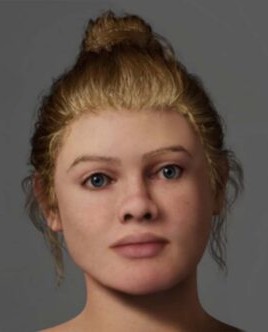
Beachy Head Woman facial reconstruction (Face Lab/Liverpool John Moores University)
1,857 words
In 2016, the BBC (Black Broadcasting Corporation) transmitted a “documentary” series called Black and British: A Forgotten History, presented by the black amateur historian and professional victim David Olusoga, which promised to explore “the enduring relationship between Britain and people whose origins lie in Africa,” like David himself. According to the online BBC description of the first episode:
The story begins in the Cumbrian village of Burgh-by-Sands near the western end of Hadrian’s Wall. During the 3rd century AD, a unit of North African Roman soldiers was garrisoned in a fort here, making this the first known African community in Britain.
So, the first black ‘British’ people were military agents of a colonial occupying force, then. Something truly worth celebrating. Where’s the follow-up program, White and Indian, in which soldiers of the British East India Company are celebrated likewise?
The black Roman legionaries apparently impregnated the locals like David Olusoga’s Nigerian dad did to his own white English mother in 1960s England, the series notes further explained:
Emerging evidence shows that the African Romans raised families here too. In Eastbourne, David comes face to face with ‘Beachy Head Woman’. The remains of an ancient, mysterious skeleton … are put under forensic and isotopic analysis in order to reconstruct her identity. This analysis reveals that she was of African descent yet raised in East Sussex.
But there seems to be a problem. During the show, it is said, “David considers why there’s no visible trace of these populations today” in terms of Britain quite clearly not being rammed full of blacks in the intervening 2,000 years since the Roman Conquest, up until around 1945. He finds the solution is that, through intermarriage of blacks with native whites, the black Roman soldiers’ visible genetic “heritage has all but vanished” with their skin tones becoming ever paler down the generations as the centuries passed by.
An alternative explanation, of course, might be that David is full of shit, and most of these black Roman families were never truly here at all, as an amusing new archaeological development appears to have partially demonstrated. In fact, most ancient North Africans weren’t even black to begin with.
Beach-Blonde Her

You can order Greg Johnson’s White Identity Politics here
I do not mean to imply there were absolutely zero non-white people living in what is now the UK pre-1945. Just prior to WWII, under 0.1 percent of the population were genetically alien, and no more than 20,000 by 1950. Britain today may now have a Black History Month, just like America, but, as I have shown elsewhere, the word “History” there should be in extremely inverted commas.
In 2003, a national poll was organized to see who the public would vote as history’s greatest black Britons. So insignificant had such people’s actual historical contribution to our island story been, however, it ended up including such colossal, towering figures as the former Manchester United midfielder Paul Ince. At number five on the list came Queen Philippa of Hainault, wife of Edward III, who was actually white. But, her son was known as Edward the Black Prince due to the color of his armor and shield, not his skin. It seems some voters misunderstood.
On this confused racial basis, another olden days “black” person who deserved to make the list too was Beachy Head Woman, the 2,000-year-old “African Roman” (what, like Mario Barwua Balotelli?) whom David Olusoga lionized in his 2016 BBC race-propaganda show to such an extent that he erected a plaque in the woman’s memory, acclaiming her as being “of African origin,” like Ebola and AIDS.
Embarrassingly in December, new DNA analysis of the woman’s remains using more advanced techniques than in 2016 demonstrated she was actually a white European. Worse, she even seems to have had blonde eyes and blue hair, and so was emblematically Nordic or Aryan, if you want to use those terms. The whole thing turned out to be a wishful thinking re-run of the old Edwardian-era Piltdown Man hoax, but in direct racial reverse.
Plaque to Black
Sometime following the original broadcast, scientific consensus about Beachy Head Woman being black had already collapsed, leading to her plaque being removed (white people don’t deserve any plaques), and David’s embarrassing eulogies about her were stealthily edited out of both his BBC show and its tie-in book. When The Times newspaper interviewed Olusgoa in 2024, he explained away this re-edit as follows:
When the science changes, history changes. That’s the scholarly approach. But Beachy Head Woman still became a culture wars battleground because a few people believe I have an agenda and see my work as a threat.
The title of that interview was “David Olusoga: Imperialism lasted centuries—we’re only a few years into righting injustices.” No, obviously no agenda at all there, then.
Olusoga is very eager to dismiss anyone who objects to his own blatant provocations as being “culture warriors,” while pretending he isn’t one himself. So, the one who launches the whole racial attack in the first place is innocent, but the person who attempts to defend himself from it is the true breacher of the peace. On the idea of white British people paying reparations for black slavery, for example, David says that:
This is straightforward … British slavery ended when approximately £17 billion in today’s money was paid to slave owners … for the loss of their human property. The Church of England derived a part of its vast wealth from the murder and exploitation of Africans and since religion is based on a structure of ethics and morals I’d say they are beholden more than most to come down on one side or another of that question … Imperialism lasted centuries and we are only a few years into righting historical injustices — this process might last as long as imperialism or slavery. Why not? Some culture warriors think that what the Church of England and countless other organizations are doing [by paying reparations] is simply fashionable. I think they’re smoking their own supply.
Did they buy it from one of those street-corner Jamaican Romans you’re always going on about, David?
To prove even further that he has zero ulterior motive in pretending Britain has always been full of weed-dealing Africans, Olusoga’s Times interview also contains the following passage:
He opens his laptop. I can see his screensaver: a photo of the Gateshead council flats where he lived with his family until 1984 when persistent racist attacks finally drove them into emergency accommodation. Olusoga was only 14 years old. The block of flats, now demolished, looks grim. ‘Oh yes, it was an awful place to live and, in the 1980s, to be black in Britain was to be told you were an aberration, you had no place. So that picture is there to remind me that when I’m swanning through Soho in London after a TV meeting I know life can be a lot tougher.’
I have a free screensaver from Nintendo of one of their characters being cute, not an image of a low-rent council flat intended to remind me perpetually of incidents of violent childhood trauma to fuel a perpetual sense of racial grievance within me every single time I flip open my laptop. But don’t forget, I’m the racist one here, not David.
“In the 1980s, to be black in Britain was to be told you were an aberration, you had no place” Olusoga says of his childhood. And then, in his adulthood, he grows up to make BBC TV documentaries and books lying that the place has always been swarming with darkies like Beachy Head Woman, who it turns out weren’t even dark at all, and seriously expects us to believe he has absolutely no agenda whatsoever in all this? He’s the one smoking his own supply here.
The Dark Ages
Contrary to Olusoga’s protestations, there is a risibly self-evident crusade by activist UK archaeologists, historians, and media organizations like the BBC to pretend Britain has always been black when it hasn’t. There was the similar debacle of ‘Cheddar Man,’ a 10,000-year-old ‘African’ caveman found in Somerset in 1903, and automatically presumed to be white at the time. Recently his ethnic interpretation changed, until in 2018 analysts admitted his DNA was so degraded there was no accurate way to determine his skin color.
But, even if he did have darker skin than modern day white Europeans, because true white skin in the sense we now know and love it had not necessarily evolved in the low-sunlight conditions of northern Europe yet, this hardly made him what a Schwarze-Ahnenerbe ideologue like Olusoga would today call an ‘African.’ Cheddar Man’s ancestors are presumed to have migrated to England from areas corresponding to Spain, Hungary, and Luxembourg, not Nigeria like David’s dad. Then again, there was some evidence suggestive of acts of ritualized cannibalism taking place in Cheddar Man’s cave, so you never know.
You also get lying children’s books like 2023’s Brilliant Black British History by a “Nigerian-born British author” (so a Nigerian) known only as ‘Atinuke’ aimed at misleading clueless kids aged seven and above that “every single British person comes from a migrant,” that Britain has been “mostly a white country for a lot less time than it has been mostly a black country,” and that Africans built Stonehenge.
In 2024, a state-funded exhibition based on this book was held in the London borough of Brixton, where the only genuine contribution black people have made to British history was to hold some very innovative race-riots in the 1980s. The illiterate promotional material promised to (mis)inform visitors of “an amazon discovery” rather than an amazing one: that the first white Britons had entered the country 4,500BC years ago but that Britain was Black for 7,000 years before that. At least you can tell blacks wrote the PR material, if not the nation’s actual history.
I Sing of Arms and of the Black Man
The BBC itself has a children’s history show called Horrible Histories, a BLM-friendly 2021 episode of which featured a rapping black Roman legionary guarding Hadrian’s Wall.
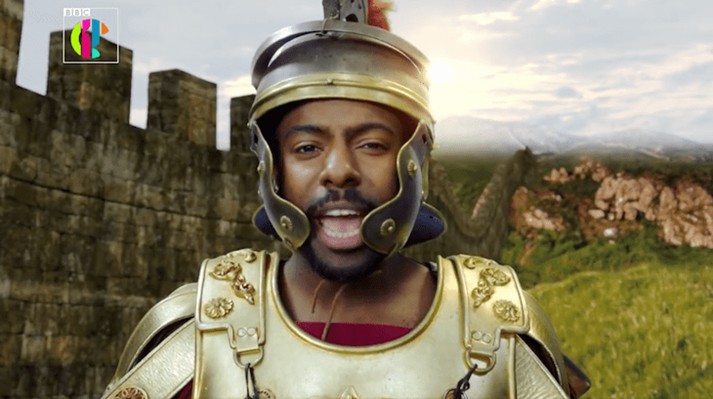
The above-pictured Nubian wannabe 50-Centurion sang lyrics like this:
These histories are just stories, there’s truths for us to see
That for 10,000 British years some Brits have looked like me.
And today the future’s hopeful; Rashford and Stormzy light the way
Evaristo, Blackman, Hamilton, Kaluuya and many more names to say.
I won’t bother explaining who any of those contemporary black ‘British’ people listed at the end are. That are so meaninglessly insignificant that history will not bother to record them. Except as colonizers.
Again, it is true there were a tiny number of black legionaries in Roman Britain, busily taxing and oppressing the populace. But there was a comparatively tiny number of British Redcoats in Raj-era Imperial India, too, and their genetic imprint was but a drop in the sea.
And what is the ultimate intended political purpose of this whole campaign of systematically yet falsely browning Britain’s past? To justify systematically browning Britain’s future for real instead. Non-UK readers may not know that Beachy Head, where that nice young blonde, blue-eyed skeleton-woman was found, is a popular jumping-off suicide-spot. Today, for entire depressed human civilizations, as well as for depressed individual humans.
26 comments
“In fact, most ancient North Africans weren’t even black to begin with.”
I looked at the genetic composition of Iron Age North Africa a while back (while researching Phoenician colonization (which turned out to have been a nothingburger)). There was basically no Sub-Saharan heritage, and even the “Northafrican” genetic cluster (which is distinct from Sub-Sahara) was only a third or so of their genetics.
Even today, after many centuries of Arab slave trade etc, Moroccans and Algerians are only ca. 8% Sub-Saharan.
I blame the popular image of the “Moor” in Medieval Spain as Negroid. Just like “Latinos” look different than ancient Latins, ancient “Moors” (= people from Mauretania) looked different than Medieval “Moors” (often Blacks working for Muslims in Spain).
Conclusion: The North Africans in the Roman Army were basically a Northafrican variant of Mediterranean.
Moors were and are Arabs and Berbers, both of them Mediterranean southern Europeoids, i.e. Whites. Shakespeare’s Othello was not a black African, either. He was a seaman, by the way. Where have you seen black African seamen, while Maghrebians, Arabs and Berbers, always were good seamen and pirates.
True, but there were some (part) Black people among them (note that Medieval i.e. Muslim Andalusia was genetically 7% Sub-Saharan) so the popular imagination took this anomaly and exaggerated it, sometimes depicting Moors as full Negros.
What stands out is usually overemphasized (this happened with both Negroid and Nordic features in various contexts).
Othello is definitely a negro. This is very clearly expressed in the text itself. Their union is consistently described as being against nature or as monstrous etc. Desdemona’s father would hardly react the way he does to the news of her elopement if it were not with a literal negro.
IAGO
Zounds, sir, you’re robbed. For shame, put on your
gown!
Your heart is burst. You have lost half your soul.
Even now, now, very now, an old black ram
Is tupping your white ewe. Arise, arise!
Awake the snorting citizens with the bell,
Or else the devil will make a grandsire of you.
Or.
IAGO
Zounds, sir, you are one of those that will not
serve God if the devil bid you. Because we come to
do you service and you think we are ruffians, you’ll
have your daughter covered with a Barbary horse,
you’ll have your nephews neigh to you, you’ll have
coursers for cousins and jennets for germans.
In fact, Othello’s insecurity (the reason he falls prey to Iago’s scheme) is predicated on the stark racial difference between Desdemona (a white Venetian) and Othello (a black Moor).
OTHELLO
And yet, how nature erring from itself—
IAGO
Ay, there’s the point. As, to be bold with you,
Not to affect many proposèd matches
Of her own clime, complexion, and degree,
Whereto we see in all things nature tends—
Foh! One may smell in such a will most rank,
Foul disproportion, thoughts unnatural—
But pardon me—I do not in position
Distinctly speak of her, though I may fear
Her will, recoiling to her better judgment,
May fall to match you with her country forms
And happily repent.
Or more explicitly.
RODERIGO
“What a full fortune does the thick-lips owe
If he can carry ’t thus!”
“thick-lips” here refers to Othello; and “thick-lips” are obviously a typical feature of negro faces.
As shown by your quotes from the play, there is no doubt that Shakespeare had a sub-Saharan black in mind when he created Othello. It is not apparent that Shakespeare’s geographic knowledge was such that we could conclude that he thought that Othello was a typical Moor. Maybe it was just a convenient assumption for the dramatic purpose of making him the extreme opposite of Desdemona in order to depict the penchant of some white women to glorify and cherish what white men despise.
But regarding the main point of the article, it is worth observing that the play takes place in Venice, not Britain.
The best performance of Othello I have ever seen was delivered by the very white Laurence Olivier, who was in all respects a superb actor, but also perhaps because he had to exert himself to imagine the dimensions of a heroic but reviled character. That is totally beyond the experience of most black British actors, who are worshipped, especially in the theatrical profession.
I think the reason Shakespeare made Othello a negro was to make the idea of Desdemona’s adultery credible to Othello and Othello’s jealousy (and his act of murdering his own wife) credible to the audience.
[1]:
OTHELLO No, not much moved.
I do not think but Desdemona’s honest.
IAGO
Long live she so! And long live you to think so!
OTHELLO
And yet, how nature erring from itself—
IAGO
Ay, there’s the point. || As, to be bold with you,
Not to affect many proposèd matches
Of her own clime, complexion, and degree,
Whereto we see in all things nature tends—
Foh! One may smell in such a will most rank,
Foul disproportion, thoughts unnatural— ||
But pardon me—I do not in position
Distinctly speak of her, though I may fear
Her will, recoiling to her better judgment,
May fall to match you with her country forms
And happily repent. ||
AND
[2]:
OTHELLO
This fellow’s of exceeding honesty,
And knows all qualities with a learnèd spirit
Of human dealings. || If I do prove her haggard,
Though that her jesses were my dear heartstrings,
I’d whistle her off and let her down the wind
To prey at fortune. || Haply, for I am black
And have not those soft parts of conversation
That chamberers have, or for I am declined
Into the vale of years—yet that’s not much— ||
She’s gone, I am abused, and my relief
Must be to loathe her. || O curse of marriage,
That we can call these delicate creatures ours
And not their appetites! || I had rather be a toad
And live upon the vapor of a dungeon
Than keep a corner in the thing I love
For others’ uses. || Yet ’tis the plague of great ones;
Prerogatived are they less than the base.
’Tis destiny unshunnable, like death.
Even then this forkèd plague is fated to us
When we do quicken. || Look where she comes.
I was about to mention Laurence Olivier’s performance of Othello since it was in the mid 60’s and he wore literal blackface. So it was always been pretty well understood that Othello was a black. Coleridge discusses the question in his Notes and Lectures on Shakespeare.
[3]:
Ib.—
“Rod. What a full fortune does the thick-lips owe,
If he can carry ‘t thus.”
Roderigo turns off to Othello; and here comes one, if not the only, seeming justification of our blackamoor or negro Othello. Even if we supposed this an uninterrupted tradition of the theatre, and that Shakespeare himself, from want of scenes, and the experience that nothing could be made too marked for the senses of his audience, had practically sanctioned it,—would this prove aught concerning his own intention as a poet for all ages? Can we imagine him so utterly ignorant as to make a barbarous negro plead royal birth,—at a time, too, when negroes were not known except as slaves? As for Iago’s language to Brabantio, it implies merely that Othello was a Moor,—that is, black. Though I think the rivalry of Roderigo sufficient to account for his wilful confusion of Moor and Negro,—yet, even if compelled to give this up, I should think it only adapted for the acting of the day, and should complain of an enormity built on a single word, in direct contradiction to Iago’s “Barbary horse.” Besides, if we could in good earnest believe Shakespeare ignorant of the distinction, still why should we adopt one disagreeable possibility instead of a ten times greater and more pleasing probability? It is a common error to mistake the epithets applied by the dramatis personæ to each other, as truly descriptive of what the audience ought to see or know. || No doubt Desdemona saw Othello’s visage in his mind; yet, as we are constituted, and most surely as an English audience was disposed in the beginning of the seventeenth century, it would be something monstrous to conceive this beautiful Venetian girl falling in love with a veritable negro. It would argue a disproportionateness, a want of balance, in Desdemona, which Shakespeare does not appear to have in the least contemplated. ||
I have read a good deal of Shakespeare’s works, but not much criticism. I didn’t know about Colderidge. His analysis suggests to me that time spent reading Shakespeare himself is more rewarding than reading criticism. It seems to me that Shakespeare’s penetrating vision could peer into the hearts and minds of any human and most domestic animals. He obviously understood the character of Africans in white society much better than Coleridge.
Coincidentally, I just received an email from Peter Brimelow detailing the month’s toll of white people murdered by blacks in the U.S. He lists various themes, including this:
White women killed by black Significant Others. This is a perhaps the single most consistent pattern that we see: the reverse very rarely occurs. Are young white girls warned about this?
Again, returning to the point of this article, the question arises as to where did Shakespeare encounter blacks? It seems like I read somewhere that he travelled abroad, to Italy at least, but I can’t find confirmation of that.
One interpretation of Othello is that Desdemona burned the coal and paid the toll, it’s a universal law.
In my experience, the most frequent use of “Briton” in the British media isn’t to refer to the people who were on the island when the Romans got there, and whose descendants (with Anglo-Saxon + Viking + Norman admixture) are probably still there nowadays. In BBC usage, at least when I had a television, when you heard “Briton” you expected to see somebody in a “Great Britain” sports shirt whose ancestral lines had arrived after 1945. And once the word “Briton” was used, the concept or the phrase “national treasure” was never far away – National treasure Briton javelin-thrower Fatima Whitbread – it was all very cosy and granny-friendly.
The news reports of the retraction are more cautious about using the word “Briton” which was bandied about triumphantly in the original reports. Now we have to be scientific and avoid inflammatory essentialism, so all we can say is that the boring bones have a boring statistical overlap with the statistical population of boring bones that we’ve dug up so far in this longitude and latitude.
Or to avoid nationalism, they call the bones a local Eastbourne girl, which is confusing because again when the national media goes cosy and granny-friendly – look, it’s a local girl who has a street and a neighbourhood and a bus and a corner store – most of the time it’s the language the media uses to insinuate an alien into your sympathies.
For me personally, much more interesting was a question about Phoenician/Carthagenian blood and influence on the British Islands. For example, if the “Celtic” druids were in reality Carthagenian priests, migrated to the North-West, if the Wicker Man is just a local version of human sacrifices to Moloch, etc. These Phoenician/Carthagenian roots of druids were suggested by Miguel Serrano many years ago.
Now that would be an interesting article, my understanding of the Carthaginians is that they were basically jewish. 🙃
Genetically, the Phoenicians were relatively close to the Hebrews, but more Mediterranean and less Arab/Egyptian than the latter (makes sense geographically). Culturally, however, the Phoenicians were basically normal Middle Easterners. They had a normal Pagan pantheon, didn’t think they were the chosen people, and mixed with other tribes over time (for example in Northafrica or in Greece).
The Carthagenians were the cultural descendants of the Phoenicians, but hardly their genetic descendants.
The gist is:
Phoenician trade was a multi-ethnic endevour from the start, whereby Levantine traders and ship captains would hire Cyprians and people from the wider Aegean region (Greece, Crete, Rhodes, West and Southwest Turkish coast) as workers, oarsmen, craftsmen and bodyguards (or use slaves from these regions for those purposes). Hence, the colony-founding population that arrived by ship in the western med was already mostly non-Levantine.
In Northern Africa, they would naturally use the local or regional labor pool i.e. hire Northafrican Natives (or people from Sicily).
So you kind of end up with a populatin that is, let’s say, 1% Phoenician, 9% Aegean and 90% Northafrican and Sicilian.
Yet despite all that, the language and script they used were Phoenician and Phoenician culture was associated with the upper classes i.e. emulated by the middle class. The result was that the Carthagenians prided themselves in Phoenician heritage (both genetic and cultural), while only having little of the former.
“For me personally, much more interesting was a question about Phoenician/Carthagenian blood and influence on the British Islands.”
I found that theory very interesting as well and researched this (and related questions) more extensively:
a) there’s basically zero Levantine genetic influence on the British Isles. Not autosomally, nor w.r.t Y-DNA haplogroups.
b) the trade link between Carthagenians and Iron-Age Britons was very limited (it’s doubtful whether there even was direct trade, rather than trade with Bretons as intermediaries).
c) the Carthagenians weren’t genetically Levantine to begin with [1]. They were mostly Northafrican Mediterraneans, but Northafrican heritage isn’t found in Britain, either.
The idea of a link between Britons and Phoenicians comes from a guy named Laurence Waddell (1854-1938) [2], who was a bit of an Indiana Jones figure. He believed that the Phoenicians renowned for sea-faring were Nordic-looking Aryans and that the sun crosses found in ancient Britain were a sign of Phoenician colonization.
Waddell wanted to combine ancient literature (Iliad, Greek writings about the Phoenicians etc) with racial history, but did so without common sense – why on earth would Levantines be needed to explain Nordics and sun crosses in Britain when Scandinavia and Northern Germany are so close nearby?
Waddell wanted to make an Aryan origins of civilization argument while being stuck in the “Ex Oriente Lux” (culture originates in the orient) paradigm, and so ended up arguing for Aryans spreading out from the Middle East and colonizing Britain.
[1] see https://www.eupedia.com/forum/threads/punic-people-were-genetically-diverse-with-almost-no-levantine-ancestors.45711/
[2] Waddell wrote a book called “Phoenician Origin of Britons, Scots, and Anglo-Saxons” (1924)
For Serrano, the Welsh especially were of Semitic origins.
Which is complete nonsense from an anthropological, genetic and cultural perspective.
Maybe he was talking about how he perceived their racial spirit on the astral or something of that sort (contrasting them with Anglo-Saxons). I’m generally open to heterox paradigms and weird perspectives, but I don’t think one of the European tribes most removed from anything Middle Eastern can be called “Semitic” in any meaningful way.
“Blood and Someone Else’s Soil” is an ingenius title. Well done.
This should be memed into the zeitgeist so that within 2-5 years time, we hear J.D. Vance or even a fully confident as yet undiscovered White man with political power say:
‘Today European man and his civilization faces ruin. Across Europe, North America and Oceana, he is being reduced to a despised minority, with no political power or legal rights in his own homelands. For nearly a century, he has lived under a regime where asserting his right to his home, his traditions, his culture, even his own history is a sign that he may grow a funny mustache. This false religion then infers that he must not be allowed to assert his right to his land in order that he not be a racist. Better that he is dispossessed and eradicated than be a racist.
Yet, the invaders brought in to replace him across three entire continents are encouraged and celebrated when asserting their racial and ethnic superiority and their moral superiority by virtue of their supposed oppression at the hands of European man. But do they not ride the boats and fly on the planes and enjoy the housing, entertainments and their transmission mechanisms and enjoy his climate control and energy systems to get to his homelands and reside in them in comfort? Do they not use his legal systems to subvert his right to his homeland. Are not their vast numbers only possible because of his agricultural, energy, satellite and transportation systems as well as his beneficence in vast sums of his money spent subsidizing their success in breeding?
Now on his shores and handed ever more political power they are permitted to be Blood and Soil Nationalists, but he is not. Well, let us be clear, what they are really practicing is Blood and Someone Else’s Soil Nationalism. We all know that their Someone Else’s soil is Our soil; the soil of Our people in our ancestral and diasporic homelands. Today I declare an end to the prohibition on Blood and Soil Nationalism for European man. In so doing, I declare war on Blood and Someone Else’s Soil Nationalism that is a stealth and malevolent evil meant to rob Us, the people of Europe, of Our birth rite and doom us to a slow and inevitable total genocide.
This is Our soil. It is fertilized with Our sweat and with Our blood in Europe back into the mists of time and in our other lands for well over 500 years of discovery and settlement that ended the Stone Ages and built up Our civilization that everyone wants. To all those who would hand it over and all those who would gladly take it, we declare war on you in response to your century long war on us.
Sons and Daughters of Europe, this is Our Blood and this is Our Soil! Let us rise and take it back!
Mars Exulti!
“
And they complain about us on the technology we invented. That’s cultural appropriation!
And when would that finally be?
Interesting news. This is a small win for us but you have to wonder how accurate DNA analysis and facial reconstructions really are.
Personally, I’ve always been skeptical about reconstructions, but even the DNA research seems less helpful than it used to. Not to mention the scientists themselves are not always honest.
We will probably hear something totally different about Beachy Head woman in a couple years.
“…. A Forgotten History, presented by the black amateur historian and professional victim David Olusoga, which promised to explore “the enduring relationship between Britain and people whose origins lie in Africa,” like David himself….” Blah, blah, blah. Whatever… This whole Black trend: Black people were here, Black people were there, Black people did this, Black people did that is a bunch of BS. Steven Tucker is right as he says: And what is the ultimate intended political purpose of this whole campaign of systematically yet falsely browning Britain’s past? To justify systematically browning Britain’s future for real instead. And to justify the browning of everywhere else for that matter. The whole thing is a crock. Watch MSM TV and you’d think Blacks were 70% of the U.S. population… A contrived reality being shoved down everyone’s throat.
Their entire narrative is based on the completely childish idea that “a person vaguely resembling a black person” = a person of Sub-Saharan origin related to today’s black people. By the same token, albinos in Nigeria would simply be Europeans. Even in today’s white population, there are a number of individuals who have seemingly Negroid or Asian facial features without having any genetic relationship to exotic ethnic groups outside Europe. It somehow reminds me of old German westerns filmed in Yugoslavia, where local Bosnians played Sioux and Apaches because they seemed “similar” to the director.
It somehow reminds me of old German westerns filmed in Yugoslavia, where local Bosnians played Sioux and Apaches because they seemed “similar” to the director.
Did they speak Yiddish?
Well, there was Blazing Saddles, but that was filmed in America 🙂
There were also films in East Germany, where American Indians were played by Mongols (Khalkha) somewhere in Mongolian Peoples Republic.
I lived in London in the 1980s, along with millions of other people. I wonder who on Earth Olusoga thinks he’s fooling?
More like suicidally stubborn Whites are just fooling themselves pledging outward allegiance to the cancerous death cult of inclusion while practicing inward nimbyism. WWJBD? Almost fourteen years. Rest in power.
Comments are closed.
If you have a Subscriber access,
simply login first to see your comment auto-approved.
Note on comments privacy & moderation
Your email is never published nor shared.
Comments are moderated. If you don't see your comment, please be patient. If approved, it will appear here soon. Do not post your comment a second time.