1,239 words 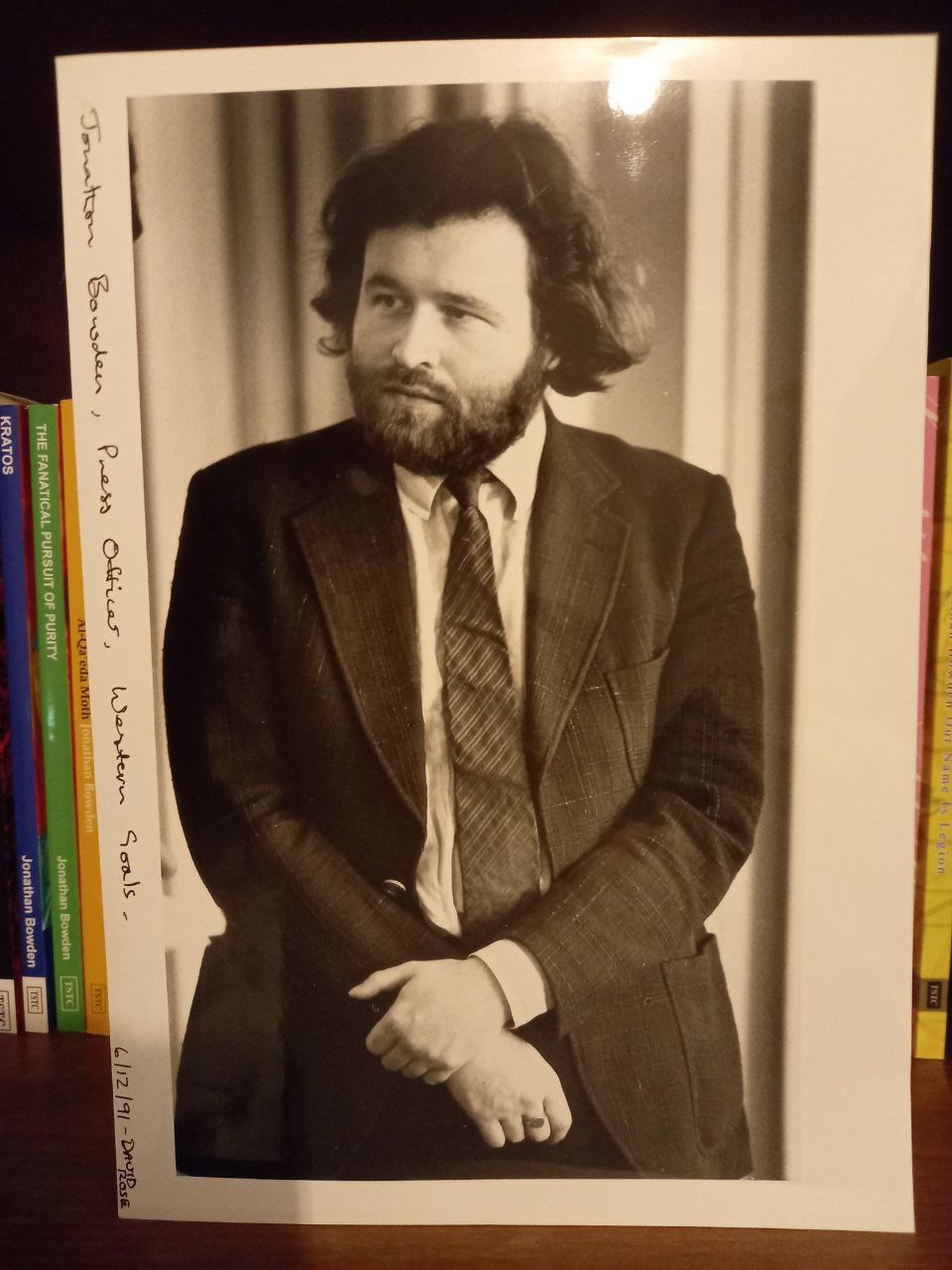
Part 1, Part 2, Part 3, Part 4, Part 5
What about film? Again, Bowden switches sides, and returns to align with Burroughs again, but not Neville. For some odd reason there’s no video of or by Neville; even the 26 episodes of his TV show went unrecorded. In Infinite Potential, Horowitz provides a transcript of the surviving audio of one episode; it’s interesting to “hear” Neville suavely moving in and out of commercials.[1]
Burroughs, however, was involved in several experiments in avant garde film making. Miriam Balanescu gives a quick summary:
From the 1960s onwards, Burroughs embarked on a series of collaborations with Anthony Balch, an exploitation movie director who Burroughs met at the famed Beat Hotel in Paris. Their films, in which both frequently starred, continued the projects started by Burroughs’ writings, probing questions of queerness, identity, life on the margins, oppression and the ominous world to come. Less ubiquitous than the cut-up technique, the author’s “playback technique”, whereby audio is recorded at a certain place before being played back there at a later date (apparently allowing Burroughs to lay curses on venues he disliked such as London’s Moka Coffee Bar), consolidated his standing as part in the “chaos magic” movement and variations on this process were woven into his films. In Balch and Burroughs’ first short Towers, Open Fire (1963), Burrough’s voiceover (reading from the “Where you belong” section of The Soft Machine (1961)) is spliced together with brisk snippets of shadowy, obscure footage. “You’re only human cattle,” Burroughs chants, as the camera glides over tribal masks, headlines announcing the stock market crash and finally an off-kilter smattering of apocalyptic imagery. In its heavy, quick-fire editing and phantasmagorical visuals, there is something trance-inducing.[2]
Although both Bowden and Burroughs were film makers, Bowden’s film work (which I haven’t seen) seems to have been more along the lines of conventional, if outsider, cinema, basically just filming his fiction verbatim, rather than inducing (a word we’ve seen Dutton play with) shamanic trances. Dutton quotes from “the one detailed attempt to analyze the different forms of Bowden’s art,” an essay by Ian Nol, that in Bowden’s films,
People play multiple roles (indicated, for example, by a change in tie), we see the same mostly female acquaintances again and again, there are limited props and sets, there are very few special effects, and the camera work is that of a “home movie.”
Dutton further cites Nol to the effect that:
There is far too much dialogue without the necessary imagery, he implies that the dialogue is didactic (directly stating points to the viewer), that there is obvious symbolism (such as … multiple women playing the same part to symbolize different aspects of her character) and that, in general, it is below the standard of a “student movie.”
Nol concludes that they “aren’t particularly good movies in a conventional sense” but allows that audiences might get a kick out of “watching Bowden ham it up.”
Student movie? Home movie? Well, all this may be true, but what we can recognize here are most of the signs of a really enjoyable “bad” movie, along the lines of a Coleman Francis, Ed Wood, or more recently, Neil Breen.[3] Indeed, the elements Nol lists could easily come from a description of any part of the “Coleman Francis Trilogy,” a landmark in “bad” yet metaphysically interesting film making. [4]
Oddly enough, it’s Bowden’s attempts at painting that perhaps bring him closest to Burroughs, since it links up with another shared interest: guns.
As noted above, Burroughs had derived the cut up method from Brion Gysin whose own paintings were inspired by Arabic calligraphy, but Burroughs, who called Gysin “the only man I ever respected,” was never inspired to imitate his style, perhaps knowing his own limitations. But after moving to Lawrence, Kansas in his last decade, Burroughs decided to take up painting. One of many reasons for moving was his love of guns, which had been stifled by New York City’s draconian laws (although even in Lawrence he was not allowed to shoot within city limits). Soon the two interests collided, with spectacular results:
Always receptive to chance, Burroughs’ “shotgun paintings” initially happened by accident. While trying out a new firearm, he aimed at a piece of plywood and noticed how his shot stripped away layers in an interesting pattern. He decided to add collage elements such as photos taken from magazines before pulling the trigger on the next piece of wood.[5]
These “chance” works – Burroughs was always the enemy of Control — are very unlike what Dutton calls Bowden’s “ugly… Jackson Pollack splatter” in a “’pseudo-Cubist’ style”; like his films, Bowden’s paintings are avant garde but still out of date, what Gysin would have called “fifty years behind.” They have also, unlike Bowden’s, achieved a level of critical appeal, with many sales and exhibitions. [6]
[6]
But it’s the shotgun method itself that brings us back to Bowden; just as Burroughs had to move West to freely exercise his gun lust, so it was when Bowden visited New York that he experienced the jouissance of firearms:
After dinner, we wound up at a friend’s house, who decided to show Jonathan his gun collection. Having been starved of any contact with guns in the U.K., Jonathan was delighted. After their owner made sure they were all unloaded, Jonathan began examining them, tentatively at first. But then the child in him took over. I got out my camera and began snapping pictures as Jonathan struck various poses with the pistols, taking goofy delight in playing James Bond and Dirty Harry. Those images are what come to mind now when I think of Jonathan.
Dutton qualifies his distaste for Bowden’s paintings by rightly praising Bowden’s willingness to take chances, and this emphasis on chance is exactly what Burroughs “aimed at” in his books as well as the shotgun paintings.[7] Dutton pulls out Beckett, of all people, and particularly Not I (1972) as an analogy to Bowden’s fiction, as I did as well in my review of Axe. Beckett and Burroughs at least share the same publishers, Grove Press (USA) and John Calder (UK). And after all, the ugly and unreadable are a substantial part of our culture, but the producers tend to be of or promoting the Left side of things; not that the Right hasn’t had its own share, but they tend to be ignored or left behind by the dominant culturati.
Notes
[1] Infinite Potential: The Greatest Works of Neville Goddard; introduced and edited by Mitch Horowitz (New York: St. Martin’s, 2019), reviewed here.
[2] “The Cinematic Vision of William S. Burroughs,” op. cit.
[3] Just as digital technology has made anyone an audio engineer or performer, so with film; what could Bowden have done with access to the infamous “BreenScreen”? Unlike Coleman Francis, I assume Bowden even had access to synchronized sound!
[4] See my own epic trilogy, “Coffee? I Like Coffee! The Metaphysical Cinema of Coleman Francis,” reprinted in my collection Passing the Buck: Coleman Francis & Other Cinematic Metaphysicians (Melbourne, Australia: Manticore Press, 2021).
[5] Rae, p.248.
[6] See Dutton, pp.244-5 and compare Rae, pp. 2, 248 (their accidental or “chance” origin), and 255 (sales and exhibitions).
[7] An anecdote from Dutton: After Greg Johnson had offered to put up Bowden for a while in California, he heard that Bowden had been picked up by police while carrying a Samurai sword; since Bowden had been carrying a box labeled “Samurai sword” when delivering some of his paintings to him awhile back, Johnson says he felt he had “dodged a bullet.”
1 comment
Rich bachelors should be heavily taxed. It is not fair that some men should be happier than others. Oscar Wilde
While not rich, Burroughs certainly had his fun as a bachelor. Bowden was fortunate that imagination could not be taxed.
Comments are closed.
If you have a Subscriber access,
simply login first to see your comment auto-approved.
Note on comments privacy & moderation
Your email is never published nor shared.
Comments are moderated. If you don't see your comment, please be patient. If approved, it will appear here soon. Do not post your comment a second time.