Counter-Currents
  • Advertise
  • Private Events
  • T&C
  • About
  • Contact
  • RSS
    • Main feed
    • Podcast feed
    • Videos feed
    • Comments feed
  • Welcome
  • Webzine
  • Books
  • Merch
  • Podcasts
  • Videos
  • Donate
  • Patrons
  • Subscribe
  • Crypto

LEVEL2

Donate Now Mailing list

Writers of May

(2 votes) Morris van de Camp David M. Zsutty Derek Stark Jayant Bhandari Greg Johnson

Articles of May

Heidegger on Nietzsche, Part One by Collin Cleary The Lunch Wars by David M. Zsutty 2 votes
  • Welcome
  • Webzine
  • Books
  • Merch
  • Podcasts
  • Videos
  • Donate
  • Patrons
  • Subscribe
  • Crypto
    • Counter-Currents Radio Podcast No. 691
      Rob Rundo Returns

      Counter-Currents Radio

    • The Fragile Polity that is Syria

      Morris van de Camp

    • Nigel Farage Calls Britain a Two-Tier State

      Mark Gullick

      3

    • Nationalism This Week
      Letter to J. D. Vance

      Greg Johnson

      26

    • Lost In Trans-Mission:
      How the Media Fails To Reveal the Inconvenient Truth About the Usual Suspects

      Steven Tucker

      10

    • Liar, Liar, Pants on Fire!

      Beau Albrecht

      7

    • Editor’s Update
      Rob Rundo on Counter-Currents Radio, Fundraiser Update, & a New $20,000 Matching Grant

      Greg Johnson

    • The Bitter End of Western Metaphysics:
      Heidegger on Nietzsche, Part Three

      Collin Cleary

      10

    • Uncivil War

      Mark Gullick

      49

    • Exclusive Interview with Karel Veliky:
      The Final Chapter in the Film Series! Part II

      Ondrej Mann

      2

    • Happy Birthday to Us!

      Greg Johnson

      6

    • Zsutty’s Maximum

      David M. Zsutty

      16

    • Exclusive Interview with Karel Veliky:
      The Final Chapter in the Film Series! Part I

      Ondrej Mann

      2

    • The Union Jackal, June 2026

      Mark Gullick

      23

    • The Inferiority Behind Immigrant Superiority

      Jayant Bhandari

      15

    • Counter-Currents Radio Podcast No. 690
      Greg Johnson & David Zsutty Discuss Current Things: AI, Henry Nowak, the Iran Crisis, & More

      Counter-Currents Radio

      7

    • Collin Cleary: What Rome Means to Me

      Collin Cleary

      4

    • Paul Krugman: Closet Bolshevik

      Spencer J. Quinn

      21

    • Fugue of Ideas:
      Ibram X. Kendi’s Chain of Ideas

      Greg Johnson

      19

    • Based Blacks

      Lipton Matthews

      24

    • Black Intellectual Fatigue

      Derek Stark

      41

    • Why White Advocates Should Avoid “Based Blacks”

      Dani Vypont

      32

    • Nietzsche & Race

      Mark Gullick

    • Editor’s Update
      Rob Rundo Rescheduled to Next Week on Counter-Currents Radio;
      Tonight Greg Johnson & David Zsutty Answer Your Questions;
      Fundraiser Update & a New $20,000 Matching Grant

      Greg Johnson

    • The Counter-Currents 2026 Fundraiser
      Lifetime Subscriber Welcome Packages Extended

      Greg Johnson

    • Nationalism This Week
      Who’s Looking Back?

      Greg Johnson

      29

    • China’s Threat to American Security:
      Food, Farmland, Foreign Control, & Energy Policy

      Lipton Matthews

      5

    • The Bitter End of Western Metaphysics:
      Heidegger on Nietzsche, Part Two

      Collin Cleary

      16

    • The Killing of Henry Nowak

      Mark Gullick

      38

    • The Crisis of Chinese Technology Thieves

      Morris van de Camp

      1

    • The Strange World of Gender Bender Fiction:
      & What This Genre Tells Us About Autosexuality

      Dani Vypont

      3

    • Watching the Watchers:
      The Dark Triad Question

      David M. Zsutty

      14

    • The Remigration Movement Solidifies

      F. Roger Devlin

      2

    • Casting Aspersions:
      The Fatal Consequences of Race-Swapped Casting, From Helen of Troy to Henry of Southampton

      Steven Tucker

      20

    • The Murder of Henry Nowak

      Millennial Woes

      23

    • Don’t Forget to Vote in Our Writer & Article of the Month Poll

      Greg Johnson

    • The Robot Hotdog Stand

      Greg Johnson

      37

    • Laughing Our Way to Victory

      Dave Chambers

      7

    • The Zodiac Killer

      Mark Gullick

      11

    • Jared Taylor: What Rome Means to Me

      Jared Taylor

      1

    • An Interview with Endeavour:
      My Way of Life Is an Adventure!

      Ondrej Mann

      6

    • José Pedro Zúquete’s The Identitarians

      Greg Johnson

      3

    • Editor’s Update
      Fundraiser Update & How to Watch the Remigration Summit

      Greg Johnson

      5

    • The Bitter End of Western Metaphysics:
      Heidegger on Nietzsche, Part One

      Collin Cleary

      12

    • Berlin: City of Stones

      Spencer J. Quinn

      6

    • True Folk-Horror Is Horror of Your Own Folk:
      Mark Gatiss vs the Brexit Blind Dead  

      Steven Tucker

      4

    • Counter-Currents Radio Podcast No. 689
      Thomas Massie, the America 2050 Bust, the Need for Whites to Divest from America, the AI Economic Apocalypse, & Pro-White Project Pitches to Billionaires

      Counter-Currents Radio

      7

    • Nationalism This Week
      Remigration is Inevitable, Part 3

      Greg Johnson

      27

    • Why Billionaires Should Fund White Identity Politics

      Lipton Matthews

      8

    • How Cold War Two Came About

      Morris van de Camp

      5

    • Will Williams

      Nigel Farage Calls Britain a Two-Tier State

      Farage may turn out to be the latest in a line of snake-oil salesmen posing as saviors…---He’s...

    • Joe Gould

      Letter to J. D. Vance

      "If Trump does not go quietly, Vance can withhold his pardon and let the dogs in Congress tear Trump...

    • Peter Quint

      Letter to J. D. Vance

      I can’t tell from this far off. I wouldn’t put it pass him; it is pretty common these days. 🙃

    • Adrian Roberts

      Letter to J. D. Vance

      Does he wear eye-liner?

    • Doug Harrison

      Letter to J. D. Vance

      So it's a good career move for the cabinet secretaries to save the country from a deranged chief...

    • Greg Johnson

      Letter to J. D. Vance

      I am pretty sure that everyone in the cabinet wants a political career or just to enjoy his life in...

    • Adrian Roberts

      Nigel Farage Calls Britain a Two-Tier State

      ‘Unelected PM’. This is a silly term, first used by David Cameron to taunt Gordon Brown after he...

    • Greg Johnson

      Letter to J. D. Vance

      He "stood up" to the neocons because Iran had the ability to completely wreck the Gulf and the...

    • Doug Harrison

      Letter to J. D. Vance

      Yes, the pardon would be Vance's defensive weapon. Who would Vance trust to confide in regarding the...

    • Lexi

      Letter to J. D. Vance

      Yes, I think a brief Democratic Congressional majority is now baked in.  There will not be a...

    • Judas

      Letter to J. D. Vance

      I'm not sure if Trump is a Svengali or more of a Pied Piper and I don't really know who may be...

    • Will Williams

      Uncivil War

      Paudi McCreevey: June 16, 2026  White Nationalism and Christianity are compatible.---No, they...

    • Peter Quint

      Nigel Farage Calls Britain a Two-Tier State

      This carefully crafted animus is reaching critical levels in the US after the conviction and...

    • Will Williams

      Uncivil War

      Peter Quint: June 12, 2026  There are many reports of Catholics and Protestants sitting down...

    • JaymunD

      Lost In Trans-Mission

      The same goes for the "race is a social construct" creed.  Pretty soon my Money Market Fund will be...

    • Paudi McCreevey

      Uncivil War

      I know. It's sad. They preach Woke and not the Scriptures. Dark times.

    • Greg Johnson

      Uncivil War

      Preach it in the churches.

    • Greg Johnson

      Letter to J. D. Vance

      It isn't like Leftism will start working magically. And it isn't like they will learn to moderate...

    • Paudi McCreevey

      Uncivil War

      White Nationalism and Christianity are compatible. You may be plrasantly surprisedto to read the...

    • Dr X

      Letter to J. D. Vance

      Yes, I think a brief Democratic Congressional majority is now baked in. But, just as Labour achieved...

    • Earth Day Special

      John Morgan

      12

    • A Robertson Roundup
      Remembering Wilmot Robertson
      (April 16, 1915 – July 8, 2005)

      Margot Metroland

      13

    • The Paranoid Style in White Nationalism

      Greg Johnson

      30

    • Join the Dance!

      Andrew Hamilton

      1

    • We Can’t Save the Earth Without Reducing African Birth Rates

      James Dunphy

      36

    • “I’m Not a Conspiracy Theorist, but . . .”:
      Jeffrey Epstein’s Death Gives New Life to “Conspiracy Theories”

      Greg Johnson

      22

    • Sylvia Plath: Stasis in Darkness

      Vic Olvir

      17

    • Vanguardism, Vantardism, & Mainstreaming

      Greg Johnson

      80

    • Aviation, Geography, & Race

      Charles Lindbergh

      3

    • Some Thoughts on Yule

      Collin Cleary

      4

    • Living in Truth:
      A Yuletide Homily

      Jef Costello

      7

    • John Kennedy Toole’s A Confederacy of Dunces

      Greg Johnson

      20

    • On Aleksandr Solzhenitsyn’s Warning to the West

      Spencer J. Quinn

      7

    • Elitism, British Modernism, & Wyndham Lewis

      Jonathan Bowden

      6

    • Philip K. Dick’s Do Androids Dream of Electric Sheep? as Anti-Semitic/Christian-Gnostic Allegory

      Greg Johnson

      20

    • “Conspiracy Theory” or Conspiracy?

      Andrew Hamilton

      21

    • Remembering H. P. Lovecraft
      (August 20, 1890–March 15, 1937)

      Greg Johnson

      3

    • Who Are We?
      Nordics, Aryans, & Whites

      Greg Johnson

      71

    • Remembering William Gayley Simpson
      (July 23, 1892–December 31, 1990)
      A Pleasant Afternoon with Harriet & Bill Simpson

      Margot Metroland

      18

    • Here are the Young Men
      Remembering Ian Curtis
      (July 15, 1956–May 18, 1980)

      Mark Gullick

      18

    • Percy Grainger
      Artist of the Right

      Alex Graham

      7

    • Remembering Revilo Oliver
      (July 7, 1908–August 20, 1994)

      Greg Johnson

      18

    • The Meaning of July 4th for the White Man

      Gregory Hood

      13

    • The Front National’s Evolution

      Bruno Mégret

    • Merwin K. Hart
      Forgotten American Hero & Man of the Right

      Morris van de Camp

      10

    • George Orwell’s Nineteen Eighty-Four

      Jonathan Bowden

      8

    • Carleton S. Coon
      Scientist & Reluctant White Advocate

      Morris van de Camp

      3

    • The Kwanzaa Absurdity Will Be Dwarfed by Juneteenth

      Robert Hampton

      10

    • Stravinsky

      Alex Graham

      7

    • Like the Roman:
      Remembering Enoch Powell (1912-1998)

      Mark Gullick

      23

    • The 1970s: The Golden Age of Hijacking

      Morris van de Camp

      21

    • Jonathan Bowden’s Deliverance
      Part 6

      Jonathan Bowden

    • Do You Want to Play a Game?

      Mark Gullick

      1

    • Sexually Incontinent on the Indian Subcontinent:
      Who Rapes More Animals, Indians or Pakistanis? The Battle Continues!

      Steven Tucker

      3

    • Neo-Fascism in Film
      Part 5

      Karel Veliky

      15

    • The Game of Tarot

      Mark Gullick

      2

    • Institutions Cannot Be Transplanted

      Jayant Bhandari

      5

    • Jonathan Bowden’s Deliverance
      Part 5

      Jonathan Bowden

    • Crosstown Traffic:
      Jimi Hendrix & The Post-War Rock ‘N’ Roll Revolution

      Mark Gullick

      1

    • Slaves from the North:
      Finns & Karelians in the East European Slave Trade, 900–1600

      Lipton Matthews

      14

    • Neo-Fascism in Film
      Part 4

      Karel Veliky

      2

    • David Lean’s A Passage to India

      Spencer J. Quinn

      1

    • Elites are Essential to Development

      Lipton Matthews

      7

    • Jonathan Bowden’s Deliverance
      Part 4

      Jonathan Bowden

    • Neo-Fascism in Film
      Part 3

      Karel Veliky

      6

    • E. M. Forster’s A Passage to India & the Indian Mentality

      Spencer J. Quinn

      25

    • Jonathan Bowden’s Deliverance
      Part 3

      Jonathan Bowden

    • The Rest Is Silence
      Heidegger’s Quietism

      Mark Gullick

      2

    • Dispelling the Historical Fallacy of Indian Nationalism

      Lipton Matthews

      8

    • Neo-Fascism in Film
      Part 2

      Karel Veliky

      8

    • Jonathan Bowden’s Deliverance
      Part 2

      Jonathan Bowden

    • Life of a Klansman

      Mark Gullick

      8

    • Jonathan Bowden’s Deliverance, Part 1

      Jonathan Bowden

    • Decolonial Ideas are Holding Back Developing Countries

      Lipton Matthews

      8

    • Neo-fascism in Film, Part 1

      Karel Veliky

      21

    • Jonathan Bowden’s Onslaught, Part 8
      Divigations on Decadence

      Jonathan Bowden

    • Jonathan Bowden’s Onslaught, Part 7
      Intrigues in the National Front

      Jonathan Bowden

      1

    • Rotten to the Core

      Mark Gullick

      8

    • Strauss on Husserl’s “Philosophy as Rigorous Science”

      Greg Johnson

    • Jonathan Bowden’s Onslaught, Part 6
      Francis Bacon & Right-Wing Nihilism

      Jonathan Bowden

    • András László
    • Derek Hawthorne
    • Beau Albrecht
    • Alain de Benoist
    • Kerry Bolton
    • Jonathan Bowden
    • Collin Cleary
    • Jef Costello
    • Savitri Devi
    • Julius Evola
    • Jim Goad
    • Gregory Hood
    • Juleigh Howard-Hobson
    • Greg Johnson
    • Charles Krafft
    • Anthony M. Ludovici
    • Trevor Lynch
    • H. L. Mencken
    • J. A. Nicholl
    • James J. O’Meara
    • Christopher Pankhurst
    • Tito Perdue
    • Michael Polignano
    • Spencer J. Quinn
    • Fenek Solère
    • Irmin Vinson
    • Leo Yankevich
    • Francis Parker Yockey
    • Multiple authors
  • Editor-in-Chief

    • Greg Johnson, Ph.D.

    Featured Writers

    • Beau Albrecht
    • Gunnar Alfredsson
    • Collin Cleary, Ph.D.
    • Jef Costello
    • Morris V. de Camp
    • F. Roger Devlin, Ph.D.
    • Stephen Paul Foster, Ph.D.
    • Jim Goad
    • Alex Graham
    • Mark Gullick, Ph.D.
    • Greg Johnson, Ph.D.
    • Travis LeBlanc
    • Trevor Lynch
    • Margot Metroland
    • James J. O’Meara
    • Angelo Plume
    • Spencer J. Quinn
    • Fred Reed
    • Clarissa Schnabel
    • Michael Walker
    • David M. Zsutty

    Frequent Writers

    • Asier Abadroa
    • Aquilonius
    • Alain de Benoist
    • Kerry Bolton, Ph.D.
    • Dave Chambers
    • Steven Clark
    • James Dunphy
    • Endeavour
    • Richard Houck
    • Jason Kessler
    • Titus Livius
    • Ondrej Mann
    • Lipton Matthews
    • Mark Mazari
    • John Morgan
    • Jaroslav Ostrogniew
    • Kathryn S.
    • Christian Secor
    • Anne Wilson Smith
    • Thomas Steuben
    • William De Vere
    • Kenneth Vinther
    • Max West

    Classic Authors

    • Maurice Bardèche
    • Jonathan Bowden
    • Julius Evola
    • Guillaume Faye
    • Ernst Jünger
    • Kevin MacDonald, Ph.D.
    • D. H. Lawrence
    • Charles Lindbergh
    • Jack London
    • H. P. Lovecraft
    • Anthony M. Ludovici
    • Sir Oswald Mosley
    • National Vanguard
    • Friedrich Nietzsche
    • Revilo Oliver
    • William Pierce
    • Ezra Pound
    • Saint-Loup
    • Savitri Devi
    • Carl Schmitt
    • Miguel Serrano
    • Oswald Spengler
    • P. R. Stephensen
    • Jean Thiriart
    • John Tyndall
    • Dominique Venner
    • Leo Yankevich
    • Francis Parker Yockey

    Other Authors

    • Howe Abbott-Hiss
    • Michael Bell
    • Giles Corey
    • Jack Donovan
    • Richardo Duchesne, Ph.D.
    • Emile Durand
    • Guillaume Durocher
    • Mark Dyal
    • Tom Goodroch
    • Andrew Hamilton
    • Robert Hampton
    • Huntley Haverstock
    • Derek Hawthorne
    • Gregory Hood
    • Juleigh Howard-Hobson
    • Alexander Jacob
    • Ruuben Kaalep
    • Tobias Langdon
    • Julian Langness
    • Patrick Le Brun
    • G A Malvicini
    • John Michael McCloughlin
    • Millennial Woes
    • Michael O’Meara
    • Christopher Pankhurst
    • Michael Polignano
    • J. J. Przybylski
    • Quintilian
    • Edouard Rix
    • C. B. Robertson
    • C. F. Robinson
    • Herve Ryssen
    • Alan Smithee
    • Fenek Solere
    • Ann Sterzinger
    • Robert Steuckers
    • Tomislav Sunic
    • Donald Thoresen
    • Marian Van Court
    • Irmin Vinson
    • Book Reviews
    • Movie Reviews
    • TV Reviews
    • Music Reviews
    • Art Criticism
    • Graphic Novels & Comics
    • Video Game Reviews
    • Fiction
    • Poems
    • Interviews
    • Videos
    • English Translations
    • Other Languages
      • Arabic
      • Bulgarian
      • Croatian
      • Czech
      • Danish
      • Dutch
      • Estonian
      • Finnish
      • French
      • German
      • Greek
      • Hungarian
      • Italian
      • Lithuanian
      • Norwegian
      • Polish
      • Portuguese
      • Romanian
      • Russian
      • Slovak
      • Spanish
      • Swedish
      • Ukrainian
    • Commemorations
    • Why We Write
  • Archives
  • Top 100 Commenters
  • The Looney Bin
  • Advertise
  • Private Events
  • T&C
  • About
  • Contact
  • RSS
    • Main feed
    • Podcast feed
    • Videos feed
    • Comments feed
Sponsored Links
Europa.com Above Time Coffee Antelope Hill Publishing Paul Waggener IHR-Store Spencer J. Quinn American Renaissance Jim Goad The Occidental Observer
Print June 6, 2025 7 comments

Hollow Solutions for a Hollow Generation

Francis Rockwell

3,517 words

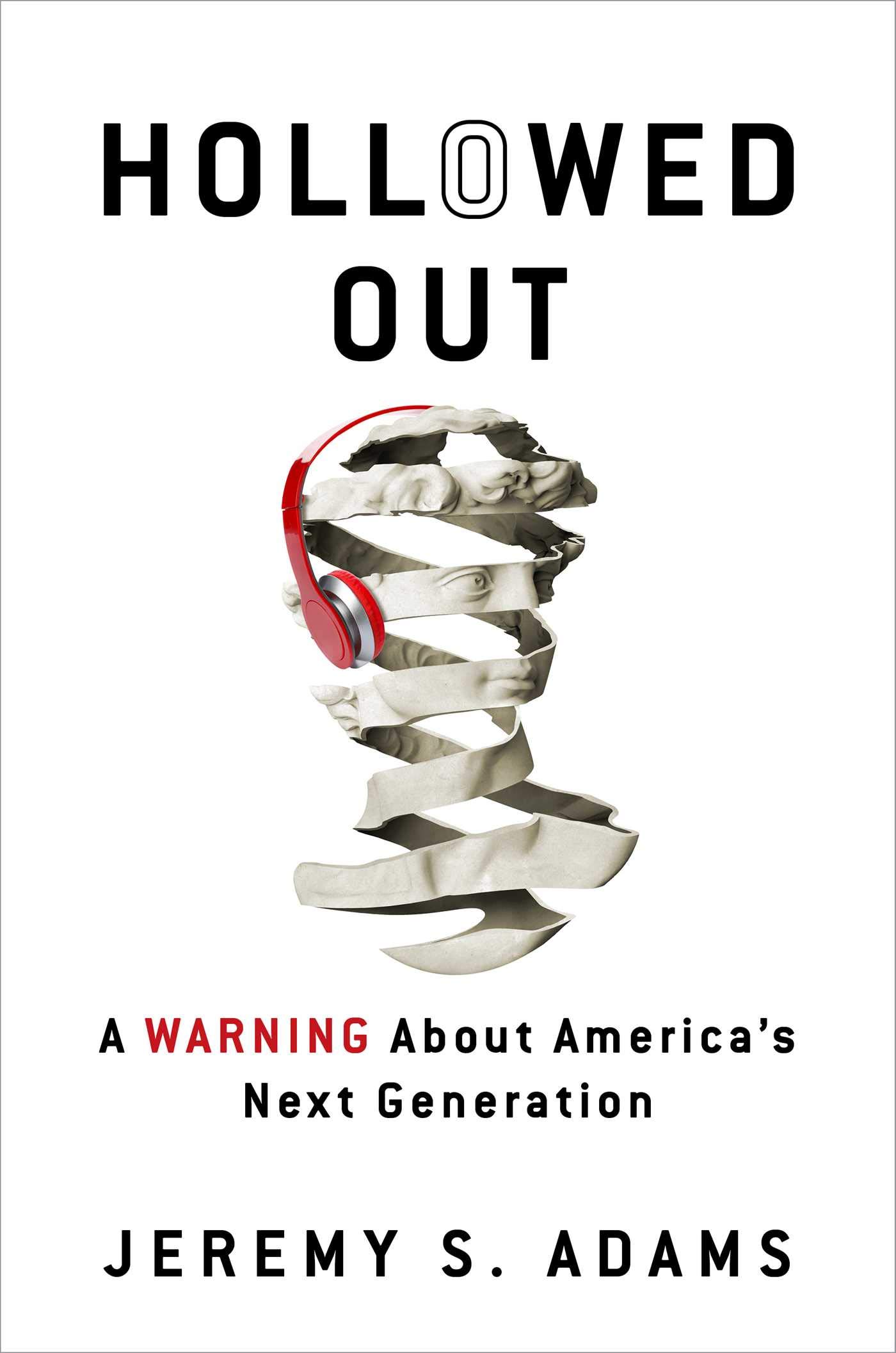
Jeremy S. Adams
Hollowed Out: A Warning About America’s Next Generation
Regnery Publishing, 2021

We are the hollow men
We are the stuffed men
Leaning together
Headpiece filled with straw. Alas!
Our dried voices, when
We whisper together


Are quiet and meaningless
As wind in dry grass
Or rats’ feet over broken glass
In our dry cellar
– T.S. Eliot

***

Teacher Jeremy S. Adams believes that the current generation of students have been “hollowed out”–they lack the understanding of what it means to be fully human; they are “mysteriously barren of the behaviors, values, and hopes from which humans have traditionally found higher meaning, grand purpose, or even simple contentment—and little that is worthwhile has filled this vacancy” (pg. 2).

I cannot help but recall the quote falsely attributed to Socrates about the youth of Athens:

The children now love luxury; they have bad manners, contempt for authority; they show disrespect for elders and love chatter in place of exercise. Children are now tyrants, not the servants of their households. They no longer rise when elders enter the room. They contradict their parents, chatter before company, gobble up dainties at the table, cross their legs, and tyrannize their teachers.

(That quote, rather than being from Socrates, is a paraphrase from Kenneth Freedman’s doctoral dissertation Schools of Hellas written in 1907.)[1]

Each generation feels subsequent generations never measure up; they are less moral, less intelligent, lazier, and more disrespectful and rebellious. Is Adams’ prognosis merely following the age-old tradition of shaking his fist at “those darn kids nowadays” or has there truly been a moral and intellectual degeneration?

Every teacher I’ve talked to agrees that the students now are worse than they were twenty years ago. “They don’t have any respect anymore,” opined the head of the math department. “They don’t care about school and have no work ethic. They’re so much lazier now than when I first started teaching.”

Mark Fisher, educator and writer, described the students he encountered as living in a state of

[…]depressive hedonia. Depression is usually characterized by a state of anhedonia, but the condition I’m referring to is constituted not by an inability to get pleasure so much as it by an inability to do anything else except pursue pleasure. There is a sense that ‘something is missing’ – but no appreciation that this mysterious missing enjoyment can only be accessed beyond the pleasure principle. …  To be bored simply means to be removed from the communicative sensation-stimulus matrix of texting, YouTube and fast food; to be denied, for a moment, the constant flow of sugary gratification on demand.[2]

 Adams groups the culprits hollowing out students into two broad categories: social media—serving as a vector for post-modern philosophy—and the dissolution of families and communities.

Through most of humanity’s past, technology changed slowly, but it has rapidly increased over the last two centuries. New technologies uprooted the majority of mankind from their agrarian lifestyles—dominated by the changing of the seasons, their neighbors, and local church—and thrust them into cities with numberless concourses of strangers to whom they owe no social responsibilities and hold no connections. Combine that with other technologies like advances in printing, radio, television, and eventually the internet and smartphones, and one can begin crafting the argument for a difference between the standard complaints about the younger generation and the current concerns about the youth of today.

Adams notes that young “people spend up to nine hours a day on their phones, most of it on social media platforms with a vapid parade of posts, comments, and pictures” (pg. 21). Social media serves as the vector by which most students are infected with post-modern ideas, and it inflames their narcissism. He argues that prior to social media, post-modern ideas—such as those of Derrida, Foucault, and Howard Zinn—were generally contained within niche university circles and had limited to almost non-existent impact on the general population and culture, but with the advent of social media, post-modern ideas saturated students’ minds without them realizing it, just as a fish doesn’t notice the water it swims in. They “accept, often without thinking about it, that the past is not only irrelevant but wrong; they accept the post-modern conceit that the self does not need instruction. The modern self needs only validation and is not ashamed of seeking satiation” (pg. 11).

In the early volumes of Will and Ariel Durant’s The Story of Civilization (covering Egypt, India, China, Greece, and Rome), they describe various strains of nihilism appearing in those cultures’ philosophy thousands of years ago. To some degree, there have always been post-modernists—people seeking to tear down their civilization and torch the roots—walking among mankind, though under different names. The great change is the ability of those ideas to propagate in mass because of the internet.

Martin Gurri, in his book Revolt of the Public, describes social media networks as propagators of nihilism. Networks allow amateurs to challenge the established authorities in a field when previously the elites controlled the methods of communication and dissemination of ideas. While this can be viewed as a positive—bypassing the gatekeepers of knowledge—it also serves to delegitimize the concept of authority (and truth) in general. People can “batter away at the established order, until every trace of history has been erased from social life.”[3] The internet allows people to organize as an anti- force, attacking any idea, platform, or research put forth, but they rarely put forth any positive programs of their own because doing so would open them up to attack.

This destructive energy released by the public’s sudden ability to communicate almost instantaneously regardless of distance, synthesized with post-modern philosophy to tear down Western culture. It becomes easy, and popular, to tear down the White men of the past, to simplify them into caricatures to be attacked, knowing “just enough negative information to know what is wrong with someone from the past” (pg. 110). Social media reduces everything to quick soundbites, fast-food for the mind, rather than providing depth or nuance about people and cultures.

This nihilism expands from the historical and political to the metaphysical and ethical. Rather than looking to any transcendent ideal—religious or philosophical—for how to live their lives and what to become, students look into the mirror for guidance. They have no interesting in becoming because they are content (or at least strive to be) with what they already are.

To validate their identity, students turn to social media for validation. They desire to be “famesque”—they want to be seen, liked, and have lots of followers. Without a greater worldview to organize around, they turn to social approval, measured in follows and likes, as their measure of what is good. “To many young people, a moment is only truly significant if it is observed and approved by others. Celebrity is the goal. It is not the by-product of doing something grand or noble” (pg. 22).

Adams contrasts this fame-for-the-sake-of-fame mentality with that established by Homer’s Iliad: “The desire to distinguish oneself in the world, to stand taller amongst the herd, is sewn into our very nature. The Greeks used the term thymos to describe the powerful human desire for recognition, the penetrating need to have one’s efforts, recognized as valuable, excellent, and praiseworthy” (pg. 25). The French historian H.I. Marrou places “the love of glory,” arete, as taught by the Homeric epics, at the heart of aristocratic education throughout the classical Greek and Roman civilization.[4] Modern students fail to see any connection between doing and being.

They don’t want to do the work necessary for a substantial achievement worthy of fame; they just want the fame.

On top of the post-modern, nihilistic, and egotistical streak of social media, a plethora of additional problems blossom in its shade: it creates a massive time sink (again, students spend nine hours a day on their phones), wasting precious time that could be turned toward more productive and edifying pursuits; students withdraw from social activities (dances, sporting events, clubs, etc.) in favor of their self-selected virtual communities, but those pseudo-relationships leave them feeling isolated and lonely.

The ability for people to choose what niche, virtual communities to engage with and which to ignore leads to a broader problem for society: the lack of common cultural knowledge. As E.D. Hirsch points out, “At both the local and national level, an economy, and a democracy can work effectively only if people understand one another. Language specialists use the term ‘speech community’ to describe a group of people who share a set of language norms that allow them to interact, share interest, and participate in a healthy community.”[5] However, due to the fracturing of physical communities and the increasing isolation of individuals as they filter into micro-communities, people now lack a shared set of cultural references and expectations for social behavior.

In his book The Devil’s Pleasure Palace, Michael Walsh describes the creative powers of eros, roughly described as the striving of male after female. Much art, literature, and music has been created with this end in mind—men, with passions burning but unsatiated, turning that energy toward cultural pursuits. But now, with access to pornography a click away, the creative energies of men are being sapped away and degraded—why work and craft to impress a woman, when a virtual girl demands nothing? And, with the ascendance of feminism, telling women that sleeping with men is “empowering,” the bar for male behavior has been lowered. Through pornography and feminism, one of the great driving forces of cultural development ground to a halt.

With the release of sexual urges from the bonds of matrimony comes the dissolution of the family. Adams spends little time discussing the various factors that combined to destroy families and instead focuses on a few symptoms that arise from it. One issue he focuses on is that fewer and fewer families eat dinner together—a decline of 33% over the last two decades. He notes that “Children who do not dine with their parents at least twice a week are more likely to be overweight, less likely to eat vegetables, and more likely to be truant at school.” Additionally, having dinner as a family boosts children’s vocabulary, lowers rates of depression and suicide, and reduces that chances of “smoking, binge drinking, marijuana usage, violence, school problems, eating disorders, and sexual activity” (pg. 93).

The dinner issue serves as a microcosm of the isolation of family members from each other. Parents do not act as parents and children are left to their own devices. As a result:

[…]digital life replaces family life … the role of parents is replaced by teachers you wouldn’t want teaching your kids. As Jason Whitlock has noted, technology has diminished ‘the influence of traditional authority figures’ and strengthened ‘the reach of celebrities.’ … the digital world inhabited by teens is not one that celebrates ‘family values’ or intellectual accomplishments or any form of piety, affection, dignity, or nobility of spirit. It is rough, raw, casually vulgar, endlessly sexual, insolently uncouth, sneeringly sarcastic—a place where all relationships are “transactional” and obscenity is a constant theme. Unsurprisingly, the neuroscience tells us that this digital world is harmful to the cognitive development of children and teens (pg. 95).

As parents abdicate their responsibilities, many expect schools to pick up the slack and create intelligent, well-adjusted, functional citizens from the detritus thrown at them each year. Across Western societies, people have adopted a “teacher-as-savior” model where teachers are expected to, “all day, every day, be the students’ stand-in parent, friend, therapist, and life coach” (pg. 51). Unfortunately for them, such a task is impossible for even the most motivated and skilled teachers.

A further difficulty occurs when students need to be disciplined. Because Western society has lost faith in itself, and its moral and behavioral standards, teachers lack the righteous indignation necessary to discipline unruly behavior. And adults, parents, and teachers, engulfed in the same self-obsessed, post-modern world, don’t want to take on the responsibility of acting as an adult. They fear making difficult choices, disciplining children rather than acting as a friend.

Through most of history, parents were not alone in instilling morals and duty onto the rising generation; families engaged with religious institutions as part of their community. What alarms Adams most about the students he works with is the “absolute indifference young people demonstrate to the mighty question of God or religion or faith or anything related to the realm of the spiritual. They aren’t defiant in the face of religion. They aren’t confused or fascinated by it. They are utterly indifferent. They shrug. They slouch. They yawn. And they are ignorant” (pg. 81).

There is a deep, spiritual void in their souls. Their parents didn’t take them to church, or in the rare case they did, it was often a church that parroted general feel-good platitudes that mimicked modern liberalism. Since the Evangelical Boom of the 70s, church attendance has been declining across the United States. While the stereotype is that educated people are less religious than the uneducated, church attendance has “fallen twice as fast among kids from the lower third of the socioeconomic hierarchy than among kids from the upper third.”[6] Most students are not zealously atheistic or agnostic—they believe in some sort of god or spiritual power—they simply lack an interest in pursuing knowledge of the divine.

This causes two sets of concerns for Adams: first, he fears that students are not asking the grand philosophical questions in life such as, What is true?, What is ennobling?, What do I want?, What do I need to do to achieve salvation? Instead they focus on material desires with little thought beyond. Second, he fears the lack of religious knowledge greatly inhibits students’ understanding of Western culture; the don’t know that Easter is about the resurrection of Jesus or they think Joan of Arc was married to Noah (if they even know the Biblical story of Noah). This ignorance of Christianity cuts students off from understanding vast swaths of European art and literature.

Culture and religion are highly intertwined. As T.S. Eliot wrote: “it must not be forgotten that without a religion there can be no culture.”[7] How can one read, and truly appreciate, the great works of Western literature—Dante, Shakespeare, Milton—without knowing the Bible from which they drew? One cannot appreciate the artwork of the Renaissance and beyond without understanding the religious stories and themes they portray. Separating (European) students from Christianity separates them from their roots; the artwork, literature, and music of the past lose their meaning.[8] One must teach Christianity, disconnected from a call to believe it, for a complete education. Writing over sixty years ago, Leo Strauss proclaimed, “a very large part of the people no longer receive any religious education.”[9] And the problem has only worsened since his time.

In addition to the cultural factor, there are socioeconomic outcomes affected by the decline of religious observance. According to sociologist Robert D. Putnam:

[R]eligious involvement among youth themselves is associated with a wide range of positive outcomes, both academic and nonacademic. Compared to their unchurched peers, youth who are involved in a religious organization take tougher courses, get higher grades and test scores, and are less likely to drop out of high school. [… They have] better relationships with their parents and other adults, have more friendships with high-performing peers, are more involved in sports and other extracurricular activities, are less prone to substance abuse (drugs, alcohol, and smoking), risky behavior (like not wearing seat belts), and delinquency (shoplifting, misbehaving in school, and being suspended or expelled).[10]

Church attendance creates more opportunities for “informal mentoring” and the creation of connections to broaden their social networks which helps the student find opportunities for jobs, schooling, and extracurriculars that they would otherwise have not had access to. Those who attend church regularly and consider religion an important part of their lives “have longer life expectancies, less disability in old age, and more stable marriages,” and they report more “happiness and satisfaction with life, self-esteem, less depression, and less substance abuse.”[11]

With all these problems converging upon the youth, one would expect a strong call to action, a rallying cry and list of changes to be demanded from those in power, but no such trumpet sounds. On the final pages of the book, Adams calls for the young

to know the boundless possibilities of a good life, a full life, a life of service to our country, our families, and our highest ideals.

We must show them these possibilities through love—a love that believes that every young person has a worthy future. We must educate them through instruction—instruction that helps them understand their privileged place, no matter how unprivileged they might feel, in the great pageant of human history, thought, and learning. We must enlighten them through compassion—a compassion that acknowledges that every person is a unique individual with a singular calling and inestimable value (pgs. 135-136).

As an example of what he wants to be taught in schools, and what he has attempted to instill in his students in his twenty years teaching history, Adams includes The 1776 Report as an appendix; the Report, created during Trump’s first presidency in response to the 1619 Project, endorses a patriotic telling of America’s past with an emphasis on the ideas of the Founders as embodied in the Declaration of Independence and the Constitution. He hopes students will, instead of focusing on the perceived wrongs of America (wrong from a left-wing perspective), view America as “an unfolding drama in which the United States struggles to reconcile its worst misdeeds with its most soaring ideals” (106).

He falls into the common blunder of modern conservatives: he accepts the majority of Leftist premises and goals, but disagrees on their methods of implementing and achieving them. This was revealed early in the book when, in the middle of bemoaning the plights of the current generation, he commends them for being a generation who are

powerfully on guard against racism and ethnic bias, care deeply about homophobia and the marginalizing of gay Americans, are less chauvinistic and uncompromising about gender equality … less likely to express of a love of America yet more likely to embrace its principles of pluralism, equality, and individual liberty. … there is great hope. I want to keep that hope alive (pg. 6).

It’s quite ironic that he calls for people to seek transcendent values, yet seems afraid to call for action for the values he upholds. He would like social media to hold less sway over people’s lives, for families to be strengthened, for religion to be renewed and form an important pillar of community life, but he doesn’t propose any changes, legislation, or programs to achieve those dreams. There is no call to pass laws to limit divorce and strengthen families, nor any attempt to impose regulations on social media, and any attempt to limit the speech of destructive parties would likely give Adams an aneurysm.

By implication, he wants readers to take action by avoiding divorce, spending time together as families, limiting time on social media, avoiding pornography, going to church, engaging in their communities, and studying the teachings of the Founding Fathers to develop a transcendent worldview rather than a nihilistic and self-absorbed one, but he lacks the moral confidence to openly tell the readers to follow such a course. How does he expect to inspire change when he lacks the conviction to call others to action?

This book serves as yet another example of the failures of modern conservatism. The young men and women of the West are in crisis, but, rather than doing anything to change the flow of culture, Adams demurely whimpers that individuals should try harder to swim upstream.

This is the way the world ends
Not with a bang but a whimper.

Notes

[1] Kenneth J. Freeman, Schools of Hellas (London: Macmillan, 1922), 74.

[2] Mark Fisher, Capitalist Realism: Is There No Alternative? (Winchester, UK: Zero Books, 2009), 21-22, 24.

[3] Martin Gurri, The Revolt of the Public: and the Crisis of Authority in the New Millenium (San Francisco, CA: Stripe Press, 2018), 114.

[4] H.I. Marrou, A History of Education in Antiquity, trans. George Lamb (Madison, Wisconsin: University of Wisconsin Press, 1956), 11.

[5] E.D. Hirsch, How to Educate a Citizen: The Power of Shared Knowledge to Unify a Nation (New York: HarperCollins, 2020), 6-7.

[6] Robert Putnam, Our Kids: The American Dream in Crisis (New York: Simon & Schuster, 2015), 225. See also: Amy Chua, Political Tribes: Group Instinct and the Fate of Nations (New York: Penguin Press, 2018), 143; Charles Murray, Coming Apart: The State of White America, 1960-2010 (New York: Crown, 2012), 204-211.

[7] T.S. Eliot, “Notes Towards a Definition of Culture,” in The Complete Prose of T. S. Eliot: The Critical Edition, Volume 6: The War Years, 1940-1946, ed. David E. Chinitz and Ronald Schuchard (Baltimore, London: The        Johns Hopkins University Press and Faber & Faber Ltd., 2017), 353.

[8] Michael Walsh, The Fiery Angel: Art, Culture, Sex, Politics, and the Struggle for the Soul of the West (New York: Encounter Books, 2018), 100.

[9] Leo Strauss, Liberalism Ancient and Modern (New York: Basic Books, 1968), 19.

[10] Putnam, Our Kids, 224.

[11] Murray, Coming Apart, 205.

Hollow Solutions for a Hollow Generation

Hollow%20Solutions%20for%20a%20Hollow%20Generation%0A

Share

  • Gab

Enjoyed this article?

Be the first to leave a tip in the jar!

Instant Echeck GreenPay™

Related

  • Nigel Farage Calls Britain a Two-Tier State

  • Heidegger on Nietzsche, Part One

  • Elites are Essential to Development

  • A Novel Approach: Roberto Bolaño’s 2666

  • Restoring American Deterrence through Innovation and Industry

  • Rome and Education

  • E. M. Forster’s A Passage to India & the Indian Mentality

  • The Theology Behind Ruby Ridge

Tags

apathybook reviewseducationFrancis Rockwellgenerational differencesmeaningT. S. Eliotteens

Previous

« Before the Storm

Next

» The Naked Island

7 comments

  1. AdamMil says:
    June 6, 2025 at 4:57 pm

    “We must enlighten them through compassion—a compassion that acknowledges that every person is a unique individual with a singular calling and inestimable value.”

    I appreciate him pointing out the problems we see around us, but this guy sounds like he’s unwittingly part of the problem. How is a kid supposed to seek things greater than himself, be subsumed by a common culture, revere its ancestors and traditions, and follow its norms and standards if we teach him that he’s “a unique individual with a singular calling and inestimable value”? The truth is that most people have easily estimable and rather limited value, a calling that is almost entirely commonplace, and very little that is unique in a notable and valuable way. And they should accept that wholeheartedly. There’s nothing wrong with being ordinary and having an ordinary calling – working, starting a family, raising children, growing old, and dying. Such people are the backbone of any society! Kids all believing they are special and unique, with inestimable value and a singular calling in life, seems more or less like the exact problem of today.

    Kids are “powerfully on guard against racism and ethnic bias, care deeply about homophobia and the marginalizing of gay Americans, are less chauvinistic, and uncompromising about gender equality … less likely to express of a love of America yet more likely to embrace its principles of pluralism, equality, and individual liberty. … there is great hope. I want to keep that hope alive”

    Are these the hopes and values he wants to keep alive? Leaving aside the woke stuff, which is cultural poison, pluralism, equality, and individualism are at the core of all the worst ideologies that are rotting Western societies. We need something closer to the opposite of all of those: ethnocentrism, hierarchy (i.e. a recognition of merit and natural inequality), and collectivism (i.e. putting the nation and society – the common good – above the individual).

    5
    5
    • Peter Quint
    • Niels Ebbesen
    • Scott
    • Kim
    • Todd Wayne
  2. Peter Quint says:
    June 6, 2025 at 6:58 pm

    ”…cross their legs,…”

    I don’t understand what Kenneth Freedman had against children crossing their legs, as far as girls are concerned, this would be an improvement in behavior, instead of sitting around with their legs gapped, giving any male a “see-through”—like slatterns! 🙃

    1
    1
    • Uncle Semantic
    1. Uncle Semantic says:
      June 7, 2025 at 5:54 pm

      I always hated that indian-style sitting in gym class. For guys, the obnoxiously open wide Al Bundy leg gap is very cringe, like someone who thinks it’s boss pissing in a urinal with fists on hips. Just sit normally or the alt position of right shoe horizontally on your left knee which you can slap while laughing. That’s a dude pose. No guy should cross his legs like a woman, wear sandals, or god forbid do both, under any circumstances whatsoever.

      1
      1
      • Peter Quint
    2. Kim says:
      June 7, 2025 at 11:45 pm

      poor posture

      1
      1
      • Todd Wayne
  3. Peter Quint says:
    June 6, 2025 at 7:38 pm

    Jeremy S. Adams does not address the true causes of white decline. The first being, that our people are forced to “herd” with non-whites, and their alien thought processes. The second being, we are ruled over by jews, and have been subjected to their subversive programs for over a hundred years. 🙃

    2
    2
    • Scott
    • Joe Gould
  4. Tower Of Stone says:
    June 6, 2025 at 8:49 pm

    Counter-Currents and Rockwell have provided some great food for thought with this article, as genetic/cultural decline is a foundational matter. Addressing the decline with concrete things that can be implemented is terribly important. It should be entirely clear by now that varying degrees of systemic paralysis are inevitable, due to the proliferation of ‘hollowed-out” zombies in both the private and public spheres, as well as sub-human migration into Western nations. We have our work cut out for us, but the work is an endlessly exciting opportunity to become more that we think we can be.

    3
    3
    • Peter Quint
    • Kim
    • Todd Wayne
  5. Kim says:
    June 8, 2025 at 12:06 am

    I am also guilty of having falsely attributed that Ken Freedman quote to Socrates!  This is another, even more frequent, misattribution:

    “To determine the true rulers of any society, all you must do is ask yourself this question: Who is it that I am not permitted to criticize?”

    ̶V̶o̶l̶t̶a̶i̶r̶e̶   Kevin Alfred Strom

    https://nationalvanguard.org/2017/01/voltaire-didnt-say-it/


    0
    0

Comments are closed.

If you have a Subscriber access,
simply login first to see your comment auto-approved.

Note on comments privacy & moderation

Your email is never published nor shared.

Comments are moderated. If you don't see your comment, please be patient. If approved, it will appear here soon. Do not post your comment a second time.

Writers of May

(2 votes) Morris van de Camp David M. Zsutty Derek Stark Jayant Bhandari Greg Johnson

Articles of May

Heidegger on Nietzsche, Part One by Collin Cleary The Lunch Wars by David M. Zsutty 2 votes
    • Counter-Currents Radio Podcast No. 691
      Rob Rundo Returns

      Counter-Currents Radio

    • The Fragile Polity that is Syria

      Morris van de Camp

    • Nigel Farage Calls Britain a Two-Tier State

      Mark Gullick

      3

    • Nationalism This Week
      Letter to J. D. Vance

      Greg Johnson

      26

    • Lost In Trans-Mission:
      How the Media Fails To Reveal the Inconvenient Truth About the Usual Suspects

      Steven Tucker

      10

    • Liar, Liar, Pants on Fire!

      Beau Albrecht

      7

    • Editor’s Update
      Rob Rundo on Counter-Currents Radio, Fundraiser Update, & a New $20,000 Matching Grant

      Greg Johnson

    • The Bitter End of Western Metaphysics:
      Heidegger on Nietzsche, Part Three

      Collin Cleary

      10

    • Uncivil War

      Mark Gullick

      49

    • Exclusive Interview with Karel Veliky:
      The Final Chapter in the Film Series! Part II

      Ondrej Mann

      2

    • Happy Birthday to Us!

      Greg Johnson

      6

    • Zsutty’s Maximum

      David M. Zsutty

      16

    • Exclusive Interview with Karel Veliky:
      The Final Chapter in the Film Series! Part I

      Ondrej Mann

      2

    • The Union Jackal, June 2026

      Mark Gullick

      23

    • The Inferiority Behind Immigrant Superiority

      Jayant Bhandari

      15

    • Counter-Currents Radio Podcast No. 690
      Greg Johnson & David Zsutty Discuss Current Things: AI, Henry Nowak, the Iran Crisis, & More

      Counter-Currents Radio

      7

    • Collin Cleary: What Rome Means to Me

      Collin Cleary

      4

    • Paul Krugman: Closet Bolshevik

      Spencer J. Quinn

      21

    • Fugue of Ideas:
      Ibram X. Kendi’s Chain of Ideas

      Greg Johnson

      19

    • Based Blacks

      Lipton Matthews

      24

    • Black Intellectual Fatigue

      Derek Stark

      41

    • Why White Advocates Should Avoid “Based Blacks”

      Dani Vypont

      32

    • Nietzsche & Race

      Mark Gullick

    • Editor’s Update
      Rob Rundo Rescheduled to Next Week on Counter-Currents Radio;
      Tonight Greg Johnson & David Zsutty Answer Your Questions;
      Fundraiser Update & a New $20,000 Matching Grant

      Greg Johnson

    • The Counter-Currents 2026 Fundraiser
      Lifetime Subscriber Welcome Packages Extended

      Greg Johnson

    • Nationalism This Week
      Who’s Looking Back?

      Greg Johnson

      29

    • China’s Threat to American Security:
      Food, Farmland, Foreign Control, & Energy Policy

      Lipton Matthews

      5

    • The Bitter End of Western Metaphysics:
      Heidegger on Nietzsche, Part Two

      Collin Cleary

      16

    • The Killing of Henry Nowak

      Mark Gullick

      38

    • The Crisis of Chinese Technology Thieves

      Morris van de Camp

      1

    • The Strange World of Gender Bender Fiction:
      & What This Genre Tells Us About Autosexuality

      Dani Vypont

      3

    • Watching the Watchers:
      The Dark Triad Question

      David M. Zsutty

      14

    • The Remigration Movement Solidifies

      F. Roger Devlin

      2

    • Casting Aspersions:
      The Fatal Consequences of Race-Swapped Casting, From Helen of Troy to Henry of Southampton

      Steven Tucker

      20

    • The Murder of Henry Nowak

      Millennial Woes

      23

    • Don’t Forget to Vote in Our Writer & Article of the Month Poll

      Greg Johnson

    • The Robot Hotdog Stand

      Greg Johnson

      37

    • Laughing Our Way to Victory

      Dave Chambers

      7

    • The Zodiac Killer

      Mark Gullick

      11

    • Jared Taylor: What Rome Means to Me

      Jared Taylor

      1

    • An Interview with Endeavour:
      My Way of Life Is an Adventure!

      Ondrej Mann

      6

    • José Pedro Zúquete’s The Identitarians

      Greg Johnson

      3

    • Editor’s Update
      Fundraiser Update & How to Watch the Remigration Summit

      Greg Johnson

      5

    • The Bitter End of Western Metaphysics:
      Heidegger on Nietzsche, Part One

      Collin Cleary

      12

    • Berlin: City of Stones

      Spencer J. Quinn

      6

    • True Folk-Horror Is Horror of Your Own Folk:
      Mark Gatiss vs the Brexit Blind Dead  

      Steven Tucker

      4

    • Counter-Currents Radio Podcast No. 689
      Thomas Massie, the America 2050 Bust, the Need for Whites to Divest from America, the AI Economic Apocalypse, & Pro-White Project Pitches to Billionaires

      Counter-Currents Radio

      7

    • Nationalism This Week
      Remigration is Inevitable, Part 3

      Greg Johnson

      27

    • Why Billionaires Should Fund White Identity Politics

      Lipton Matthews

      8

    • How Cold War Two Came About

      Morris van de Camp

      5

    • Will Williams

      Nigel Farage Calls Britain a Two-Tier State

      Farage may turn out to be the latest in a line of snake-oil salesmen posing as saviors…---He’s...

    • Joe Gould

      Letter to J. D. Vance

      "If Trump does not go quietly, Vance can withhold his pardon and let the dogs in Congress tear Trump...

    • Peter Quint

      Letter to J. D. Vance

      I can’t tell from this far off. I wouldn’t put it pass him; it is pretty common these days. 🙃

    • Adrian Roberts

      Letter to J. D. Vance

      Does he wear eye-liner?

    • Doug Harrison

      Letter to J. D. Vance

      So it's a good career move for the cabinet secretaries to save the country from a deranged chief...

    • Greg Johnson

      Letter to J. D. Vance

      I am pretty sure that everyone in the cabinet wants a political career or just to enjoy his life in...

    • Adrian Roberts

      Nigel Farage Calls Britain a Two-Tier State

      ‘Unelected PM’. This is a silly term, first used by David Cameron to taunt Gordon Brown after he...

    • Greg Johnson

      Letter to J. D. Vance

      He "stood up" to the neocons because Iran had the ability to completely wreck the Gulf and the...

    • Doug Harrison

      Letter to J. D. Vance

      Yes, the pardon would be Vance's defensive weapon. Who would Vance trust to confide in regarding the...

    • Lexi

      Letter to J. D. Vance

      Yes, I think a brief Democratic Congressional majority is now baked in.  There will not be a...

    • Judas

      Letter to J. D. Vance

      I'm not sure if Trump is a Svengali or more of a Pied Piper and I don't really know who may be...

    • Will Williams

      Uncivil War

      Paudi McCreevey: June 16, 2026  White Nationalism and Christianity are compatible.---No, they...

    • Peter Quint

      Nigel Farage Calls Britain a Two-Tier State

      This carefully crafted animus is reaching critical levels in the US after the conviction and...

    • Will Williams

      Uncivil War

      Peter Quint: June 12, 2026  There are many reports of Catholics and Protestants sitting down...

    • JaymunD

      Lost In Trans-Mission

      The same goes for the "race is a social construct" creed.  Pretty soon my Money Market Fund will be...

    • Paudi McCreevey

      Uncivil War

      I know. It's sad. They preach Woke and not the Scriptures. Dark times.

    • Greg Johnson

      Uncivil War

      Preach it in the churches.

    • Greg Johnson

      Letter to J. D. Vance

      It isn't like Leftism will start working magically. And it isn't like they will learn to moderate...

    • Paudi McCreevey

      Uncivil War

      White Nationalism and Christianity are compatible. You may be plrasantly surprisedto to read the...

    • Dr X

      Letter to J. D. Vance

      Yes, I think a brief Democratic Congressional majority is now baked in. But, just as Labour achieved...

    • Earth Day Special

      John Morgan

      12

    • A Robertson Roundup
      Remembering Wilmot Robertson
      (April 16, 1915 – July 8, 2005)

      Margot Metroland

      13

    • The Paranoid Style in White Nationalism

      Greg Johnson

      30

    • Join the Dance!

      Andrew Hamilton

      1

    • We Can’t Save the Earth Without Reducing African Birth Rates

      James Dunphy

      36

    • “I’m Not a Conspiracy Theorist, but . . .”:
      Jeffrey Epstein’s Death Gives New Life to “Conspiracy Theories”

      Greg Johnson

      22

    • Sylvia Plath: Stasis in Darkness

      Vic Olvir

      17

    • Vanguardism, Vantardism, & Mainstreaming

      Greg Johnson

      80

    • Aviation, Geography, & Race

      Charles Lindbergh

      3

    • Some Thoughts on Yule

      Collin Cleary

      4

    • Living in Truth:
      A Yuletide Homily

      Jef Costello

      7

    • John Kennedy Toole’s A Confederacy of Dunces

      Greg Johnson

      20

    • On Aleksandr Solzhenitsyn’s Warning to the West

      Spencer J. Quinn

      7

    • Elitism, British Modernism, & Wyndham Lewis

      Jonathan Bowden

      6

    • Philip K. Dick’s Do Androids Dream of Electric Sheep? as Anti-Semitic/Christian-Gnostic Allegory

      Greg Johnson

      20

    • “Conspiracy Theory” or Conspiracy?

      Andrew Hamilton

      21

    • Remembering H. P. Lovecraft
      (August 20, 1890–March 15, 1937)

      Greg Johnson

      3

    • Who Are We?
      Nordics, Aryans, & Whites

      Greg Johnson

      71

    • Remembering William Gayley Simpson
      (July 23, 1892–December 31, 1990)
      A Pleasant Afternoon with Harriet & Bill Simpson

      Margot Metroland

      18

    • Here are the Young Men
      Remembering Ian Curtis
      (July 15, 1956–May 18, 1980)

      Mark Gullick

      18

    • Percy Grainger
      Artist of the Right

      Alex Graham

      7

    • Remembering Revilo Oliver
      (July 7, 1908–August 20, 1994)

      Greg Johnson

      18

    • The Meaning of July 4th for the White Man

      Gregory Hood

      13

    • The Front National’s Evolution

      Bruno Mégret

    • Merwin K. Hart
      Forgotten American Hero & Man of the Right

      Morris van de Camp

      10

    • George Orwell’s Nineteen Eighty-Four

      Jonathan Bowden

      8

    • Carleton S. Coon
      Scientist & Reluctant White Advocate

      Morris van de Camp

      3

    • The Kwanzaa Absurdity Will Be Dwarfed by Juneteenth

      Robert Hampton

      10

    • Stravinsky

      Alex Graham

      7

    • Like the Roman:
      Remembering Enoch Powell (1912-1998)

      Mark Gullick

      23

    • The 1970s: The Golden Age of Hijacking

      Morris van de Camp

      21

    • Jonathan Bowden’s Deliverance
      Part 6

      Jonathan Bowden

    • Do You Want to Play a Game?

      Mark Gullick

      1

    • Sexually Incontinent on the Indian Subcontinent:
      Who Rapes More Animals, Indians or Pakistanis? The Battle Continues!

      Steven Tucker

      3

    • Neo-Fascism in Film
      Part 5

      Karel Veliky

      15

    • The Game of Tarot

      Mark Gullick

      2

    • Institutions Cannot Be Transplanted

      Jayant Bhandari

      5

    • Jonathan Bowden’s Deliverance
      Part 5

      Jonathan Bowden

    • Crosstown Traffic:
      Jimi Hendrix & The Post-War Rock ‘N’ Roll Revolution

      Mark Gullick

      1

    • Slaves from the North:
      Finns & Karelians in the East European Slave Trade, 900–1600

      Lipton Matthews

      14

    • Neo-Fascism in Film
      Part 4

      Karel Veliky

      2

    • David Lean’s A Passage to India

      Spencer J. Quinn

      1

    • Elites are Essential to Development

      Lipton Matthews

      7

    • Jonathan Bowden’s Deliverance
      Part 4

      Jonathan Bowden

    • Neo-Fascism in Film
      Part 3

      Karel Veliky

      6

    • E. M. Forster’s A Passage to India & the Indian Mentality

      Spencer J. Quinn

      25

    • Jonathan Bowden’s Deliverance
      Part 3

      Jonathan Bowden

    • The Rest Is Silence
      Heidegger’s Quietism

      Mark Gullick

      2

    • Dispelling the Historical Fallacy of Indian Nationalism

      Lipton Matthews

      8

    • Neo-Fascism in Film
      Part 2

      Karel Veliky

      8

    • Jonathan Bowden’s Deliverance
      Part 2

      Jonathan Bowden

    • Life of a Klansman

      Mark Gullick

      8

    • Jonathan Bowden’s Deliverance, Part 1

      Jonathan Bowden

    • Decolonial Ideas are Holding Back Developing Countries

      Lipton Matthews

      8

    • Neo-fascism in Film, Part 1

      Karel Veliky

      21

    • Jonathan Bowden’s Onslaught, Part 8
      Divigations on Decadence

      Jonathan Bowden

    • Jonathan Bowden’s Onslaught, Part 7
      Intrigues in the National Front

      Jonathan Bowden

      1

    • Rotten to the Core

      Mark Gullick

      8

    • Strauss on Husserl’s “Philosophy as Rigorous Science”

      Greg Johnson

    • Jonathan Bowden’s Onslaught, Part 6
      Francis Bacon & Right-Wing Nihilism

      Jonathan Bowden

    • András László
    • Derek Hawthorne
    • Beau Albrecht
    • Alain de Benoist
    • Kerry Bolton
    • Jonathan Bowden
    • Collin Cleary
    • Jef Costello
    • Savitri Devi
    • Julius Evola
    • Jim Goad
    • Gregory Hood
    • Juleigh Howard-Hobson
    • Greg Johnson
    • Charles Krafft
    • Anthony M. Ludovici
    • Trevor Lynch
    • H. L. Mencken
    • J. A. Nicholl
    • James J. O’Meara
    • Christopher Pankhurst
    • Tito Perdue
    • Michael Polignano
    • Spencer J. Quinn
    • Fenek Solère
    • Irmin Vinson
    • Leo Yankevich
    • Francis Parker Yockey
    • Multiple authors
  • Editor-in-Chief

    • Greg Johnson, Ph.D.

    Featured Writers

    • Beau Albrecht
    • Gunnar Alfredsson
    • Collin Cleary, Ph.D.
    • Jef Costello
    • Morris V. de Camp
    • F. Roger Devlin, Ph.D.
    • Stephen Paul Foster, Ph.D.
    • Jim Goad
    • Alex Graham
    • Mark Gullick, Ph.D.
    • Greg Johnson, Ph.D.
    • Travis LeBlanc
    • Trevor Lynch
    • Margot Metroland
    • James J. O’Meara
    • Angelo Plume
    • Spencer J. Quinn
    • Fred Reed
    • Clarissa Schnabel
    • Michael Walker
    • David M. Zsutty

    Frequent Writers

    • Asier Abadroa
    • Aquilonius
    • Alain de Benoist
    • Kerry Bolton, Ph.D.
    • Dave Chambers
    • Steven Clark
    • James Dunphy
    • Endeavour
    • Richard Houck
    • Jason Kessler
    • Titus Livius
    • Ondrej Mann
    • Lipton Matthews
    • Mark Mazari
    • John Morgan
    • Jaroslav Ostrogniew
    • Kathryn S.
    • Christian Secor
    • Anne Wilson Smith
    • Thomas Steuben
    • William De Vere
    • Kenneth Vinther
    • Max West

    Classic Authors

    • Maurice Bardèche
    • Jonathan Bowden
    • Julius Evola
    • Guillaume Faye
    • Ernst Jünger
    • Kevin MacDonald, Ph.D.
    • D. H. Lawrence
    • Charles Lindbergh
    • Jack London
    • H. P. Lovecraft
    • Anthony M. Ludovici
    • Sir Oswald Mosley
    • National Vanguard
    • Friedrich Nietzsche
    • Revilo Oliver
    • William Pierce
    • Ezra Pound
    • Saint-Loup
    • Savitri Devi
    • Carl Schmitt
    • Miguel Serrano
    • Oswald Spengler
    • P. R. Stephensen
    • Jean Thiriart
    • John Tyndall
    • Dominique Venner
    • Leo Yankevich
    • Francis Parker Yockey

    Other Authors

    • Howe Abbott-Hiss
    • Michael Bell
    • Giles Corey
    • Jack Donovan
    • Richardo Duchesne, Ph.D.
    • Emile Durand
    • Guillaume Durocher
    • Mark Dyal
    • Tom Goodroch
    • Andrew Hamilton
    • Robert Hampton
    • Huntley Haverstock
    • Derek Hawthorne
    • Gregory Hood
    • Juleigh Howard-Hobson
    • Alexander Jacob
    • Ruuben Kaalep
    • Tobias Langdon
    • Julian Langness
    • Patrick Le Brun
    • G A Malvicini
    • John Michael McCloughlin
    • Millennial Woes
    • Michael O’Meara
    • Christopher Pankhurst
    • Michael Polignano
    • J. J. Przybylski
    • Quintilian
    • Edouard Rix
    • C. B. Robertson
    • C. F. Robinson
    • Herve Ryssen
    • Alan Smithee
    • Fenek Solere
    • Ann Sterzinger
    • Robert Steuckers
    • Tomislav Sunic
    • Donald Thoresen
    • Marian Van Court
    • Irmin Vinson
    • Book Reviews
    • Movie Reviews
    • TV Reviews
    • Music Reviews
    • Art Criticism
    • Graphic Novels & Comics
    • Video Game Reviews
    • Fiction
    • Poems
    • Interviews
    • Videos
    • English Translations
    • Other Languages
      • Arabic
      • Bulgarian
      • Croatian
      • Czech
      • Danish
      • Dutch
      • Estonian
      • Finnish
      • French
      • German
      • Greek
      • Hungarian
      • Italian
      • Lithuanian
      • Norwegian
      • Polish
      • Portuguese
      • Romanian
      • Russian
      • Slovak
      • Spanish
      • Swedish
      • Ukrainian
    • Commemorations
    • Why We Write
  • Archives
  • Top 100 Commenters
  • The Looney Bin
Sponsored Links
Europa.com Above Time Coffee Antelope Hill Publishing Paul Waggener IHR-Store Spencer J. Quinn American Renaissance Jim Goad The Occidental Observer
Donate Now Mailing list
Books for sale
  • The Philosopher Is In
  • Sexual Utopia in Power (Expanded Edition)
  • In Defense of Prejudice
  • Loving Our Own
  • Tyranny & Wisdom
  • The Populist Moment
  • Is America Doomed?
  • To all books
Copyright © 2026 Counter-Currents Publishing, Ltd.

Paywall Access


Please enter your email address.

Lost your password?

Edit your comment

Writer & Article of the Month May 2026

Voting for this month has concluded. Here are the final results!

Top Writers

  • #1 Morris van de Camp 2 votes
  • #2 David M. Zsutty 2 votes
  • #3 Derek Stark 2 votes
  • #4 Jayant Bhandari 2 votes
  • #5 Greg Johnson 2 votes
  • #6 Jared Taylor 1 vote
  • #7 Collin Cleary 1 vote
  • #8 Spencer J. Quinn 1 vote
  • #9 Mark Gullick 1 vote
  • #10 Lipton Matthews 1 vote
  • #11 Keith Woods 1 vote
  • #12 Steven Tucker 1 vote

Top Articles

  • #1 Heidegger on Nietzsche, Part One 2 votes
  • #2 The Lunch Wars 2 votes
  • #3 The 1970s: The Golden Age of Hijacking 1 vote
  • #4 True Folk-Horror Is Horror of Your Own Folk 1 vote
  • #5 Finding Atlantis Part 4 1 vote
  • #6 Berlin: City of Stones 1 vote
  • #7 The Ghost of the Confederacy 1 vote
  • #8 Lothrop Stoddard’s The Revolt Against Civilization 1 vote
  • #9 Could Fascism Work? 1 vote
  • #10 Jared Taylor's Elevator Pitch to a Billionaire 1 vote
  • #11 Predation Wearing the Mask of Civilization 1 vote
  • #12 Peak Fatigue in Fort Wayne 1 vote
  • #13 Keith Wood's Elevator Pitch to a Billionaire 1 vote
  • #14 Do You Want to Play a Game? 1 vote
  • #15 Why Billionaires Should Fund White Identity Politics 1 vote

Total votes cast: 17