2,046 words 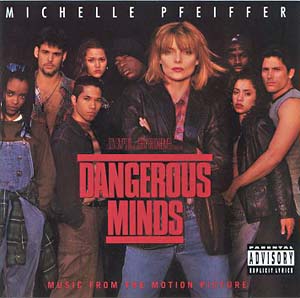
The 1995 film Dangerous Minds is a very bad movie, and I’m not just saying it because I disagree with its liberal-coded themes. Even movie critics, who generally lean left, deemed the movie a tad too corny despite its good intentions. Some liberals actually found the movie offensive, complaining that many of the characters were two-dimensional racial stereotypes. The Hispanic actors try a little too hard to sound Hispanic.
However, I don’t really do movie reviews where I talk about the camerawork, the direction, and the brilliant score by so-and-so. I do film analysis. I like to look at a movie and ask, “What does this movie say about the time during which it was made?” You can sometimes tell a lot about the state of the culture by seeing what movies were popular in different era. What did the people of that era consider scary? What was considered edgy, risqué, offensive, or cool by the standards of the time? Not all movies are worth analyzing in this way. Great movies are fun to review but not always fun to analyze because truly great movies are timeless and transcend their era.
A movie like Dangerous Minds is not worth anyone’s time to review but it is worth analyzing because while it was met with lukewarm responses from the critics, it was enormously popular upon release. It grossed $187 million at the box office and inspired a short-lived TV spin-off. When a movie is very popular despite not being very good, it is often because the movie taps into a certain zeitgeist, and that is the case with Dangerous Minds (granted, much of the success of the movie was due to the runaway success of its Grammy-winning theme song Gangsta’s Paradise by Coolio which featured Michelle Pfeiffer in the video).
Dangerous Minds is about a white, divorced, ex-marine LouAnne Johnson (played by Michelle Pfeiffer) who hopes to land an assistant teaching job. As luck would have it, something even better came up: a full-time teaching position opens and LouAnne, a teaching novice with minimal experience is offered the job. Ah, but there is a catch. She won’t be teaching regular kids but black and brown lumpenproles. These kids eat teachers for breakfast. We are informed that the last three substitute teachers left after experiencing nervous breakdowns. One administrator euphemistically describes them “Passionate, energetic, challenging. Special kids”. Another teacher only slightly more honestly describes them as “bright kids with little or no educational skills and what we politely call a lot of social problems.”
Worth noting is that the movie is based on an autobiographical book called My Posse Don’t Do Homework by LouAnne Johnson. The school the story is based off (Carlmont High School in Belmont, CA) was actually much whiter than it appears in the movie. It’s 43% white today, so 30 years ago it was well over half. The kids that the real LouAnne Johnson taught were victims of desegregation bussing.
I wrote about my experiences with desegregation bussing in 2020. In it, I said “those three years completely inoculated me to media propaganda about race. Even 90s hood movies like Boyz n the Hood or Menace II Society seemed overly-sanitized to me.” Dangerous Minds is one such movie that I found way too glossy. Having been in class with bussed-in blacks from the hood, I found the “bad kids” of Dangerous Minds only slightly more threatening than the Sweathogs from Welcome Back Kotter. Most of them sound more like middle class minorities. No kid strikes me as outright feral.
After an initial hazing period where she is given the nickname “white bread”, LouAnne manages to win over the class with all sorts of outside-the-box teaching methods and rewards systems, much to the annoyance of the school principal who wishes she would just go by the book. She goes above and beyond her normal teaching duties. She gets invested in her students’ personal lives and goes to their homes to talk to their parents. She takes one Hispanic kid out to a gourmet restaurant as a self-esteem building exercise. By the end of the school year, the students who were once rowdy hooligans have now turned into diligent students with a thirst for knowledge. There is some tragedy in that there are a few kids she is unable to save but for most of the kids, her teaching is a life-changing experience for them.
Before Dangerous Minds, there had already been two similar movies about teachers turning troubled teens into honor students through the power of love, both of which were far more critically acclaimed. There was the Hispanic-themed Stand and Deliver released in 1988 and Lean on Me starring Morgan Freeman. What separates Dangerous Minds from Stand and Deliver and Lean on Me is that in those two movies, the teacher is the same race as the students whereas in Dangerous Minds a white teacher has to tame a classroom that is majority POC.
Put that in the context of the 1990s. After the Los Angeles riots and the OJ Simpson trial, you can understand why there would be a demand for a movie like Dangerous Minds. The fact that the teacher is white and students POC adds an extra layer to the story. Not only does the teacher manage to find a way to connect to the brown kids despite being a lame, middle-age white lady, the brown kids have their own arc where they come to see their teacher as more than a lame, middle-age white lady, but rather as something of a mother figure. There is an undercurrent of racial reconciliation to the story and after the rather heated first half of the decade, an optimistic movie that says that we can somehow bridge the racial communication gap and see each other as family.
Another thing notable about Dangerous Minds is that it exudes a very 20th century style of liberals, a kind that was known as the “bleeding heart liberal”, which was a slightly different animal from 21st century “woke liberals.” The difference between bleeding heart liberalism and woke liberalism is a different set of excuses for why non-white students underperform. Bleeding heart liberals believe that blacks could succeed, but fail because nobody cares about them. Once Michelle Pfeiffer shows these undisciplined rapscallions that she cares about them as human beings, it completely changes their perspective on life and all their antisocial qualities melt away. Early in the movie, she gives a rousing speech on how success is a choice and it’s up to them to choose to succeed.
LouAnne Johnson: Well, if you all feel that strongly about it, leave the room.
Student: What?
LouAnne Johnson: Hey, listen. Nobody’s forcing you to be here. You have a choice. You can stay, or you can leave.
Student: Lady, why are you playin’ this game? We don’t have a choice.
LouAnne Johnson: You don’t have a choice? You don’t have a choice on whether or not you’re here?
Student: No. If we leave, we don’t get to graduate. If we stay, we gotta put up with you.
LouAnne Johnson: Well, that’s a choice, isn’t it? You have a choice. You either don’t graduate or you have to put up with me. lt may not be a choice you like, but it is a choice.
Student: Man, you don’t understand nothing. L mean, you don’t come from where we live. You-You’re not bussed here.
LouAnne Johnson: Do you have a choice to get on that bus?
Student: Man, you come and live in my neighbourhood for one week and then you tell me if you got a choice.
LouAnne Johnson: There are a lot of people who live in your neighbourhood who choose not to get on that bus. What do they choose to do? They choose to go out and sell drugs. They choose to go out and kill people. They choose to do a lot of other things. But they choose not to get on that bus. The people who choose to get on that bus, which are you, are the people who are saying, “l will not carry myself down to die When I go to my grave. My head will be high” That is a choice. There are no victims in this classroom!
Student: Why do you care anyway? You just here for the money.
LouAnne Johnson: Because I make a choice to care. And, honey, the money ain’t that good.
This scene is why Dangerous Minds has some value as a historical document. It gives you a feel for how far liberalism has moved in the last 30 years that this is the kind of liberalism which struck a chord with people in 1995. In 1995, it was progressive to say that ethnic minorities were capable of succeeding. However, you can see all sorts of ways that this inspirational speech might be deemed offensive in the post woke world. LouAnne’s declaration that “There are no victims in this classroom!” is denial of structural racism and her dismissal of the student’s objecting that “You don’t come from where we live” should have ended the discussion. Nowadays, LouAnne would be cancelled for implying that non-whites choose not to succeed.
There are some shades of woke like the fact that nothing is ever the kids’ fault. It’s the parents’ fault or it’s the school’s. One girl gets pregnant and her boyfriend makes her drop out of the class. A few of the kids get into a brawl and Michelle Pfeiffer is trying to figure out the cause of the fight. The kids explain that they had to fight in order to protect their reputation. This was a frequent cope for minority violence at the time: it was just the strong honor culture among brown youth, so even their violent tendencies were evidence that they were principled people deep down. This simply ignores how sadistic POC violence is and how frequently it is random.
There are many ways in which Dangerous Minds might be deemed beyond the pale by 21st century standards. It plays into the dreaded “white savior” trope and the her means of reaching the kids is poetry, a very white thing indeed. She has the students interpret Bob Dylan lyrics. In short, the students are redeemed be being indoctrinated into whiteness. While the multiracial classroom is all one big happy family, the white woman is the mom, the dominant who all the POC depend on and look up to guidance. That probably felt good to white audience at the time but I’m sure Shaun King would have a thing or two about it now. There is also nothing anti-white about the movie. The closest thing to a villain is the black principle whose rigid adherence to protocol undermines Michelle Pfieffer who has to resort to unorthodox means reach the kids.
There are other examples of 90s pop culture which were progressive for the time but would be un-PC now. In 1992, En Vogue released “Free Your Mind”. It is a song about not making judgements about people based on their appearance. The chorus went:
Free your mind
And the rest will follow
Be colorblind
Don’t be so shallow.
That song was ultra progressive for its time. It hit #8 on the charts and was nominated for a Grammy but these days it is now considered racist to be “colorblind” as the song recommends. Again, whatever you think of the song, it is noteworthy as a historical document.
In both the song and the movie, we see what the copes were at the time. It was still believed that the reason minorities don’t perform as well as whites is because white people treat them differently. If white people just treated them the same as other whites, they would start behaving more like whites. Nowadays, that’s not good enough. Now, whites have to check their privilege and do land acknowledgements and whatnot. I’m sure that if I had bothered to watch Dangerous Minds upon release, I would have raged at it, but in the post-George Floyd world, I found some quaint nostalgia in being immersed in a world that still had some naïve hope for a brighter racial future.
11 comments
The target audience here was white liberals. That’s why it did so well at the box office. I’m sure it inspired many a misinformed white person to to pursue a career in teaching only to find out that Hollywood and Luann lied to them.
You forgot to mention The Principal starring Jim Belushi.
In the article, he states that the principal is black? 🙃
Sorry about that, I just realized you were talking about another movie. 🙃
“I’m sure it inspired many a misinformed white person to to pursue a career in teaching only to find out that Hollywood and Luann lied to them.”
My mom was a public school teacher for many years. She has a very selective memory about teaching newly racially-mixed public school classes during bussing in the late 60s.
I’ve asked her, over the years, whether she recalled any challenges with junior high schools students being disrespectful toward her. Nope, not at all.*
And I asked her, what made her switch to teaching only at private religious (overwhelmingly White!) schools? She then recalled, a black male student who was making very credible death threats to her life, so much so, that she almost quit mid-year, but her husband convinced her if she didn’t get back into that classroom, & finish out the school year, nobody would ever hire her as a school teacher again.
*(This is cognitive dissonance.)
Great article, movies like this make my blood boil, because non-whites, be they parents, or children are never responsible for their own behavior, or circumstances. 🙃
Peter, you are exactly right about its general (anti-White) message. Troubled, black students can always be turned around, if just given enough resources, attention, the benefit of the doubt 100% of the time, etc.
LeBlanc says, “There is also nothing anti-white about the movie.” Anti-White propaganda was much more subtle in older movies. Heck, going way back, the original Jewish Al Jolson blackface musical(s) were “anti-White”, in this way– they portrayed blacks as silly, dim, song & dancey, as opposed to anything threatening in any way. Those in blackface were never shown as emotional, jealous, greedy, scary, violent. And later on, in the late 1930s & early 40s, black actors (usually very light skinned) were not just shown as having typical White Christian American characteristics, on-screen black domestic employees within White homes were even *more* patient, altruistic, & honorable than the White characters. Black characters were ones to befriend & mix things up with– all the way up to 1990s Fresh Prince of Bel Air, & The Huxtables/Cosby family show. This was meant to encourage mixed-race friendships, dating, & eventually misecegnation. Devon Stack has discussed this at length.
They were heroic. Like the maid in Whatever Happened to Baby Jane.
This is the kind of film they showed us in school. God, I found it unbearably sappy.
Adding to your list, what about the film To Sir, with Love?
“ what you have here as a bunch of high IQ kids with bad grades”
Lol, I read this as comedy.
another one like this, if you’ve ever seen higher education from about the same time, the whites are shooting up the place, date raping girls, and the blacks are the solemn scholars. One utters the unforgettably cringe line “we are plotting to steal the information.”
On my way to being all-pilled I started noticing just how hard POC had to be artificially propped up in all areas of life, especially movies. There was a time I didn’t care about race, then I realized I was being beat with a bat to get me to believe these folks were all altruistic geniuses who I was somehow holding back from unimaginable levels of success just by virtue of my being a dirty honkey. Well, that didn’t quite fit with any part of my “lived experience” or reality on planet Earth. So, fuck them and their movies.
I remember these kinds of movies as a kid. Joe Clark is the only authority blacks would even have a chance of listening to but I’ve long abandoned any hope of even considering uplifting them from their plight as a workable or good idea. Fuck that. Even at ten, I saw these negroes and mestizo spics as just a lowlife criminal class and the White-savior-to-the-rescue as a gullible sap. Dangerous Minds today would be categorized as another woke turd with all the blackwashing dreck and trannification by Disney. Whatever happened to Michelle Pfeiffer, anyway? She’s a fine enough actress, was okay but mostly forgettable in Scarface, and I enjoyed her as Catwoman in Batman Returns. She would’ve been my first choice for Clarice Starling as well. I did enjoy the bad Substitute movies as a teen with Tom Berenger and the late Treat Williams who showed some spine dealing with these criminal ingrates. Throwing a stolen boombox out a window and using a yo-yo to smash a bottle of orange drank in classroom are more effective methods than any liberal’s understanding of ‘inner city’ feelings.
Comments are closed.
If you have a Subscriber access,
simply login first to see your comment auto-approved.
Note on comments privacy & moderation
Your email is never published nor shared.
Comments are moderated. If you don't see your comment, please be patient. If approved, it will appear here soon. Do not post your comment a second time.