3,275 words 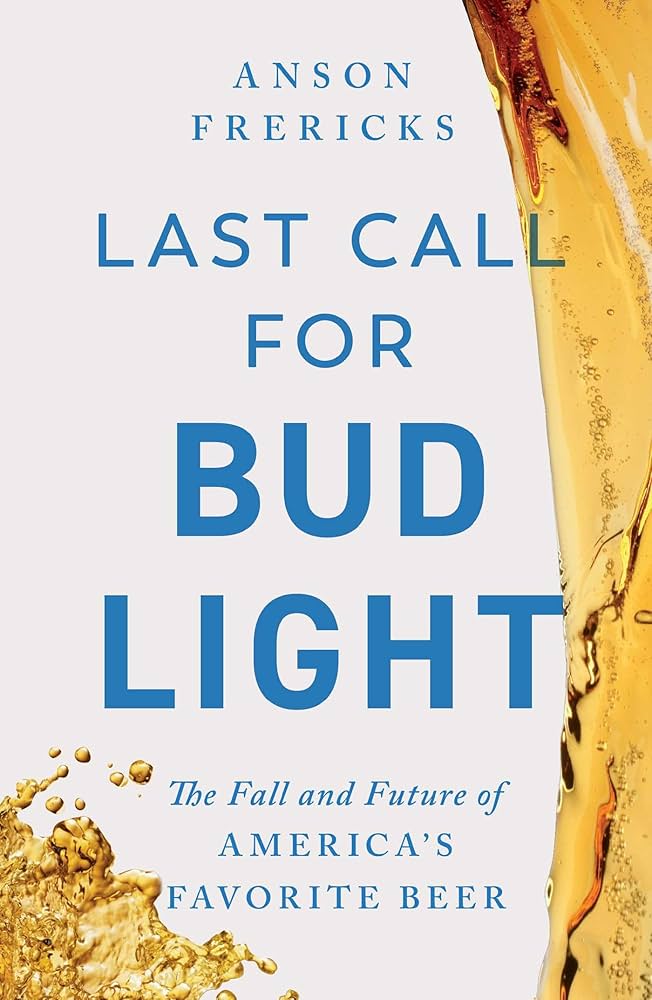
Anson Frericks
Last Call for Bud Light: The Fall and Future of America’s Favorite Beer
Threshold Editions, 2025
In the 1980s, the top selling beer in America was Budweiser and the second best-selling beer was Bud Light, both brewed by Anheuser-Busch, a Saint Louis based company. Budweiser and Bud Light were boosted by a marketing campaign which grew out of the company’s cultural ties to Midwestern Americanism. Anheuser-Busch’s marketing caused Americans to fall in love with Spuds MacKinzie, Budweiser’s “original party animal” dog in 1987. In 1989, Anheuser-Busch sponsored Bud Bowl, which was a fictional sporting event and a series of commercials filmed in stop-motion animation. Americans were encouraged to keep track of the Bud Bowl’s score as the fictional story played out during Superbowl XXIII. Bud Bowl became an interactive mega-success which went on for several years. In the late 1990s, Budweiser scored again with its “wazzup” marketing campaign.
In 2023, it all came crashing down. The implosion started when Bud Light’s marketing team created an advertisement campaign around an actor named Dylan Mulvany who documented his “transition” into being a “girl” on social media, where he had many followers. Mulvany’s portrayal of being a girl was over-the-top and offensive. Bud Light’s transsexual marketing campaign around Mulvany was a disaster. Bud Light faced a swift and effective boycott. Anson Frericks, who worked on the company at the time, wrote a book on Bud Light’s implosion, pointing out that the Mulvany debacle was made possible by many missteps taken in the years prior to the boycott.
From American to Globalist
Anheuser-Busch grew to be the top brewing company in the United States when its founder, Adolphus Busch, a Union veteran of the Civil War, took a local Saint Louis brewery and sought to distribute its product nationally. He used new brewing techniques, shipped beer by rail in refrigerated cars, and took out advertising at sporting events. Budweiser became the top brand in America.
Anheuser-Busch consistently brewed profitable beer but was “fiscally irresponsible” by Wall Street standards. August Busch IV, the last CEO from the Busch family before the company was bought out by a globalist firm, made a series of poor choices. The root of the problem stemmed from the fact that August IV liked to party. He also had a difficult time adjusting to the changing consumer tastes for craft beers – which was a trend in the early 2000s.
August IV’s biggest mistake was adjusting the internal workings of Anheuser-Busch to make it easier to carry out a hostile takeover, should a hungry firm wish to do so, to put it simply. Then he flew some Wall Street bankers to a meeting in Cancun to discuss how to “stay competitive.” The meeting was a signal that the company was not doing well. August IV’s father, now retired, was angry that the meeting was held at all. Anheuser-Busch was acquired through a hostile takeover in 2008. InBev, the new owner, was a globalist company, based in Belgium.
InBev was founded by a Brazilian and Brazilian executives dominated the company. The firm operated by leveraging borrowed money to buy a company that made a product, reducing the company’s costs of making that product to get more loans, and then moving on to acquire the next firm with the new loans. InBev was originally called AmBev and they used this method to lock up the drink market in Latin America before doing the same in Europe. Once InBev’s executives had control of Anheuser-Busch, they removed the office decorations in the company’s headquarters which had been added by the original founder. They sold off Sea World and Busch Gardens. The perks for retirees ended. Charitable giving to the local community stopped. Long term employees who were deemed “fat cats” or surplus were laid off.
InBev’s Corporate Culture
When InBev acquired Anheuser-Busch, the American economy had come to be based on shaky mortgages for single family homes. George H.W. Bush, Bill Clinton, and George W. Bush had followed neo-liberal economic theories to dismantle banking safeguards which were put in place after the Great Depression while foolishly following the logic of “civil rights” dogma to push banks to give mortgages to non-whites who had no ability to continuously make payments on such a mortgage. Just after InBev acquired Anheuser-Busch, the economy collapsed.
In the short term, the collapse caused sales of Anheuser-Busch to go down, but InBev controlled an enormous beer company with a steady group of consumers, so the situation was not that bad. Meanwhile, the executives at InBev sought to capitalize on the wealth generated from Budweiser. The company’s starting point was in its corporate philosophy which was:
Everyone pursues the same DREAM. Find the best PEOPLE, who recruit even better people to build quality teams. Do it in a CULTURE that is never satisfied and delivers a great customer experience.
The plan to generate wealth fell into three categories:
- Grow revenue ahead of inflation.
- Drive higher profitability and cash generation.
- Strengthen the financial foundation of the business through reductions in leverage (i.e., pay down debt, especially that which was incurred buying Anheuser-Busch.)
After the acquisition the main strategy for InBev to grow revenue ahead of inflation was to seek to gain the best price for the inputs into beer – hops, grain, and aluminum for the cans. Frericks did everything he could to get a lower price for the various inputs. The company also sought to delay payments to vendors, up to 120 days. This eased off on any cash flow issues and passed on any interest charge to other companies. In effect, InBev was short-paying smaller firms, which usually ends badly.
In 2011, Anheuser-Busch had a great year. Profits were up. The reason for the success was that the old marketing team was still around, but this was only clear in hindsight. Budweiser and Bud Light taste about the same as any other mass-produced American beer. The only advantage Budweiser has over any other beer is the image of the brand and that image is entirely derived from advertisements and marketing, and the marketing only works because the marketers understand the minds of the American consumers.
Friction Starts to Appear
After 2011, the problems started. The problems were noticeable in two different but fundamentally related areas. The first cropped up when InBev sought to acquire a Mexican beer called Modelo. InBev’s corporate headquarters continually had problems reaching the Mexicans due to the two-hour lunches commonly practiced there. Mexico’s siesta culture meant that meetings were missed, and things didn’t get done.
Then there were the problems between the English-speakers and the French or Flemish speakers in Belgium. One day, Frericks asked a Belgian co-worker to “swing by his office” to discuss some issue. When the Belgian failed to arrive, Frericks sought him out, asked a few questions, and then realized the Belgian hadn’t understood what he meant. When dealing with Chinese suppliers he discovered that nobody understood what ASAP meant when he used the acronym in a sentence. In Chinese culture one doesn’t ask for clarification from a superior, so nothing was done.
Language differences are important. The German philosopher Johann Gottfried von Herder was a scholar of languages, both ancient and modern. He came to realize that language shapes thought and perception. Those who speak different languages see different things due in part to the way things are phrased – “I broke my arm” verses “My arm broke.” Then there are words which are of enormous meaning in one tongue but untranslatable in other languages. In Korea, the concept of “kibun” is very important, but the word cannot truly be translated into English. The word means something like, “mood: based on the appearance of being right.”
The First Real Setback
Given so much internal friction it was natural that major problems would follow. InBev had its first setback prior to the Bud Light debacle around this time. The problem was that the Brazilian executives had no idea how America’s anti-trust legislation worked. When InBev acquired Modelo, it accidentally created a monopoly in several market areas which brought about trouble from the US Justice Department. Another failure followed – InBev’s Brazilian executives sought to increase revenues with gimmicky beers which didn’t sell in the quantities needed. This meant that wholesalers absorbed the cost of the unsold beers.
After facing angry wholesalers due to this problem, the executives sought to directly acquire the wholesalers’ respective warehouses and distribution networks rather than think about what worked and what didn’t work and adjust accordingly. This strategy was misguided. The various wholesalers/distributers worked on a business model based on a longstanding give-and-take relationship with Anheuser-Busch. The wholesalers agreed to store the beer in expensive, climate-controlled warehouses to avoid spoilage in exchange for exclusive rights to distribute Anheuser-Busch products in a particular territory. They were also expected to advertise Anheuser-Busch products ahead of any other company. A Budweiser sign was expected to be more prominent than a Coors sign even if the distributor moved both beers.
The attempt to seize control of the warehouses and the various wholesalers’ distribution networks created a swift backlash. Many of the warehouses were in rural areas and the owners and workers had extensive ties to the local community and political structure. The warehouses were also the best employers in the area. The various state legislatures became involved and passed legislation which blocked InBev from purchasing anything. It was another failure to understand the culture of America on the part of InBev’s globalist executives.
Abandoning the Heartland
In 2014, Saint Louis became the scene of black rioting encouraged by the mainstream media, the illicit second constitution that is the 1964 Civil Rights Act, and the black political machine within the Democratic Party. It was an election year and so these institutions sought to turn out Democratic voters by hyping the death of an African-American “aspiring rapper” at the hands of police.
The wives of the Belgian and Brazilian executives working at Anheuser-Busch were especially concerned about the situation and pushed for a move. Officially, the executives cited the fact that Saint Louis didn’t have Uber as a livability dealbreaker, so in 2016 InBev moved Anheuser-Busch’s corporate offices, including the marketing department, to New York City. The move was inevitable, InBev’s foreign, globalist owners always favored Manhattan over America’s Rust Belt “Gateway to the West” metropolis.
The move caused an uproar. Many of Anheuser-Busch’s executives had lived in Saint Louis their entire lives. Those with older children were especially distressed. Once in New York City, matters worsened. The commute was tougher, so Anheuser-Busch employees stopped socializing after work like they had in Saint Louis. Additionally, talented people could easily drop working for Anheuser-Busch and go to another firm in Manhattan.
This is when the marketing problems started. Manhattan-based advertising companies had a harder time reaching out to Middle America. Matters were made worse by Belgian advertising department executives who pushed for marketing to people at raves and techno clubs rather than people at sporting events and country music concerts. It was like exchanging ten-thousand loyal customers for several hundred because Europeans were more comfortable at techno clubs than at baseball games.
One Bud Light advertising campaign accidently promoted rape culture with an advertising catch phrase which said Bud Light was the “perfect beer for removing ‘No” from your vocabulary for the night.” The company swiftly apologized and moved on, but the mistake was an indicator of things to come.
Globalist Utopianism
While InBev stumbled about in North America, European business executives became fascinated with the utopian schemes. Klaus Schwab promoted one such scheme, the theory of “stakeholder capitalism.” Of this Frericks writes:
Under this theory, businesses exist not just to serve their owners, but society as a whole. In this system, society is run by elites from every sector – not just democratically elected politicians, but by churches and nonprofits and billionaires and business leaders. These experts come together to create policies that benefit the world as a whole and then implement them via the power they hold over the various organizations that they run. The purpose of a business is thus not very different from a nonprofit or government agency: making the world a better place. Central planning, but with a better PR department than the communists had. (p. 147)
Opposed to this theory is “shareholder primacy.” This philosophy was spearheaded by American economist Milton Friedman around the same time. It holds that the purpose of a for-profit company is to make money for its owners. Nothing more, nothing less. (p. 148)
Schwab’s ideas meant that the pet causes of leftist establishment figures, “structural racism,” “net-zero carbon emissions,” and “gender ideology” became InBev’s company policy.
It wasn’t just InBev’s Europe-leaning executives that drove this. Pension funds in places like California, New York, and Norway were controlled by leftist politicians who leaned on big Wall Street Firms like BlackRock, State Street, and Vanguard which owned large amounts of shares of InBev. These firms leaned on InBev to participate in stakeholder capitalism. Meanwhile, InBev had foolishly invested in African beer-makers and the continued collapse of that continent’s economy since the end of apartheid and colonization cut into profits. InBev was stuck with an underperforming asset which came with interest payments.
In 2018, Anheuser-Busch hired its first director of Diversity and Inclusion and signed on to a variety of “diversity” efforts. Then came training sessions. These weren’t agonizing sessions where whites were berated, instead the ideas were introduced in a friendly way – often in terms that appeared to be good business sense. Upon deeper reflection, however, none of the ideas showed how Anheuser-Busch could improve sales or improve the ongoing toxic relationship with the wholesalers.
And then came the COVID plague.
COVID-19 & the Summer of Floyd
The COVID-19 pandemic became a national crisis. In response, Anheuser-Busch shifted from brewing beer to making hand sanitizer. By mid-May 2020, things started to get better all around. InBev benefited at this time because alcohol sales exploded. People were home more and started to drink earlier in the day. Then a black career criminal named Geoge Floyd died while being arrested and,
Wall Street firms soon issued their commands, sometimes directly, sometimes by example. Citigroup’s approach was perhaps the boldest. Days after the murder [of Floyd], its Chief Financial Officer wrote a statement titled “I can’t breathe” on the company’s website. (p. 187)
The ideas of “stakeholder” capitalism and the Diversity and Inclusion executives hired earlier prompted Anheuser-Busch to dive headlong into liberal, “civil rights” inspired fads. Corporate America, including Anheuser-Busch, poured money into the Black Lives Matter organization where much of it was syphoned off into the private bank accounts of the BLM organizers. Corporate America didn’t comment on this noticeable fraud. Otherwise, the piles of money being moved towards “civil rights” issues created a financially motivated set of activists to put pressure on more companies to hire more Diversity, Equity, and Inclusion Officers. The mad stampede caused companies to hire non-whites over whites and focus on “diversity.” The term “diversity” did not mean diversity of thought, however. Anheuser-Busch and InBev executives had painted themselves into a corner.
It barely mattered that Americans were buying more alcoholic beverages during the COVID lockdown, InBev’s acquisition of unprofitable overseas brands continued to plague the company, so a new CEO came onboard. In 2021 the new CEO doubled down on “stakeholder” capitalism, which had come to be called the strategy of environmental, social, and governance (ESG). The ESG focus changed the company’s internal human resources policies. Merit ceased to be rewarded, and within a year fifty percent of the company’s employees planned to leave.
In 2021, the same group of Wall Street firms that pushed InBev to donate to Black Lives Matter and go “woke” spoke out against tightened voter identification laws in Georgia. The affair caused Major League Baseball to move its All-Star Game to Coors Field in Denver. This was a blow to Anheuser-Busch, since Coors was a rival. The blow also landed upon Atlanta. Frericks points to this event as the start of the backlash against “woke capital” and ESG. Many of Georgia’s voters supported tightening voter identification laws and they were furious at out-of-touch corporate executives pushing them around.
The Mulvaney Disaster
While this was going on, Frericks sought to improve revenue by leveraging Anheuser-Busch’s extensive distribution network. He recognized the same people who drank Bud Light in the evening drank Black Rifle Coffee in the morning. He proposed that Anheuser-Busch distribute the coffee to supermarkets and thereby capture part of the profits from sales of that brand of coffee. InBev’s executives passed on the proposal. Meanwhile, Alissa Heinerscheid was hired to lead the marketing effort for Bud Light. Instead of looking at the situation Bud Light was in objectively, Heinerscheid opted for the ideology of stakeholder capitalism. She decided to drop its proven marketing strategy of “fratty humor” and focus on an “inclusive” approach, which included “public commitments to the LGBTQ+ community.”
InBev’s structural problems had aligned to create a disaster. Brazilian executives had failed to understand American culture. Anheuser-Busch’s move from Saint Louis to New York City deepened the problem. Support for ESG and DEI over a focus on financial results meant executives were looking at the wrong things and spending money on sub-Saharan activists who were squandering the money as fast as it could be raised. Anheuser-Busch’s beers were not much different from any other beer, the only advantage Budweiser and Bud Light had over anything was a connection to the people of America’s heartland, and that connection was gone.
On March 27, 2023, a woman pretending to be a man shot students and staff members at a Christian school in Tennessee. On April 1, 2023, Bud Light promoted Dylan Mulvaney, the obviously male, over-the-top trans social media influencer. Men pretending to be women – transmen – are in insult in that they are obviously men, appear dangerous, and make people accept a lie. It’s a form of humiliation. This is a different situation to an earlier marketing campaign where men dressed like women to get in the club for free on “ladies’ night” to get more beer. There, the joke was obviously on the men. The public reacted with enormous hostility to the Mulvaney-based campaign. Kid Rock filmed himself shooting a case of Bud Light. Alissa Heinersheid’s comments about Bud Light being too “fratty” appeared callous and out-of-touch. Loyal customers felt insulted. The boycott gained traction.
The boycott was so effective that companies which had been pushing homosexual themes ceased doing so almost immediately. Frericks’s advice for companies going forward is to always have a policy of non-involvement in controversial topics. Anheuser-Busch, when still controlled by the Busch Family, showed how to address an event which is unavoidable. They only commented on 9-11 by showing Budweiser’s iconic Clydesdales bow with New York City in the background. The company acknowledge the horror, heroism, and sacrifice without commenting on the thorny issues of immigration, Zionism, or Islam that caused the terror attack in the first place.
It was only a matter of time before an anti-woke boycott worked. Customers wanted to boycott the National Football League during the “take a knee” anti-white, anti-cop, and pro-“civil rights” situation in 2020, but there is no way to boycott what is in effect a monopoly for a sport millions enjoy watching. The Bud Light boycott was successful because it was easy for customers to switch from Bud Light to another beer. Other boycotts followed. There was one against Target for trans clothing which was reasonably successful. Ironically, the transsexual activists probably did themselves more harm than good during this dust up when they counter-boycotted Bud Light for not standing fully for them. Bud Light has recovered somewhat since the boycott, but it probably will not return to the heights that it once occupied.
14 comments
Maybe some enterprising Americans can finance a new leveraged buyout or buyout and take the reins of the company, make a huge amount of money after restructuring it and bolster it as a truly American company.
We need to think and act along these lines. Whenever an opportunity exists to pounce on enemy mistakes we should be ready to act decisively with a bold and long term plan for success.
Thus it is always when jews take over a business—they are so weird! 🐍
That beer was always pisswater swill reminding me of concert floors. Boycott everything.
It’s interesting to read all the behind-the-scenes machination.
Earlier this year, I saw that for draft beer, Bud Lite is again #1.* I didn’t read the details, because I never drank Bud Light. (I had been drinking Amstel light for years until they went woke w/ advertising, then I switched to Yuengling, the oldest brewer in America, based in Pennsylvania, & they never advertise, thank goodness, because trying to keep on top of everything is exhausting! )
* I don’t see that article any more, but another recent one claims, “Michelob Ultra has gained ground and in November of this year took the top spot on tap from Bud Light…Both Bud Light and Michelob Ultra are owned by Anheuser-Busch InBev.”
https://www.scrippsnews.com/life/food-and-drink/bud-light-loses-its-spot-as-the-no-1-tap-beer-in-us-bars
”Yuengling” I can’t get over the spelling of that name; is that Chinese? I don’t drink myself, and I never saw the appeal in beer. It just tastes like crap to me. 🍺
No. It’s German. The German ‘J’ sounds like a ‘Y’ to English speakers. So it’s an attempt at Anglicising the name. Though I’ll admit that I had the same thought when first I saw it.
I don’t mean to come off as a snob here, but it’s an acquired taste. : )
I do remember the first time I was offered a taste of beer by my parents (at around 12 years old) I thought that exact same thing. And alcohol is addictive. Looking back now– did I begin liking the taste of it with pizza & with seafood, or the the way it made me feel when I was drinking it while eating pizza & seafood? I may never know for certain.
As for the name: Yuengling is an Anglicized version of Jüngling, its founder’s surname and the German term for a “young person” or “youngster”. It’s a weird word.
“It just tastes like crap to me. 🍺”
There’s so much hype in this world. Having kids sometimes makes you re-think things. I remember overhearing a little girl talking with some of her classmates on the playground.: “No, honeysuckle drops do not taste like honey. Honey does not taste like that.”
Very interesting and informative article, as always. I’ve been boycotting beer my whole life, so no special effort here…beer is much like wine in that it all tastes the same, and not good in the case of beer. It’s like a big mouth full of chemicals—yuck!
I’m encouraged by the reaction to trans activism in advertising and entertainment, but even better would be a backlash against race mixing in corporate media which is so pervasive, and ultimately more pernicious. There is frequently plenty of backlash against gay issues, but never against race. For example, about a decade ago in the game magic, the gathering, there was a card which showed two male heroes, and the text remarked that they had been lovers in life. People were outraged, –the fan base is much like gamer gate –comment threads were miles long and people quit the game. Notably, they had never had the need to say that a male and female couple were married or lovers before, and usually that topic was avoided to keep the game kid friendly obviously. But about that time they also introduced heavy blacks into European contexts, like making the ancient Greeks black, and the reaction was much more muted.
Everyone knows the greatest sin – racism – and fears even to give the appearance of it.
My Dad is a teetotaler who thought that his Dad was an alcoholic (though not a mean drunk). I somewhat doubt this, however, because I never ever saw my Granddad take a drink.
Anyway, I never grew up with alcohol and am not a huge fan of beer, especially from a can. I used to close my radio repair and parts shop up at a decent hour and then closed up the attached convenience store later. It was a little dicey sometimes because a serial killer who was later executed lived just around the corner and was kind of suspicious. He used to hold up stores where he was not known for a few cartons of smokes, murder the male clerk and rape and murder the females. He didn’t get caught until he abducted a schoolmarm and dumped her body. Then the Hue-and-Cry and pitchforks came out.
Anyway, my observation is that every White Trash who shuffled into the store like “the Dude” in a robe and flip-flops bought a case of Budweiser and a pack of Marlboro Reds. No thanks.
I have to let my date pick the wine because I can’t tell the difference between the (affordable) good stuff and the Soviet brake fluid. (Usually they pick very well, though.)
So I don’t care if Bud is “the King of Beers” or not. I forced myself to quit shopping at Target when they went corporate-woke, and I’m not the least bit sorry for Bud Light if they took a hit over the Dylan Mulvaney transgender promotion.
🙂
Good look behind the scenes at the Budweiser situation. Notice the intersection of the leveraged buyout mania, globalism, and “woke” ideology. Should be required reading for all people looking at boycotting corporations.
Interesting article but I do have one little nit to pick: “Men pretending to be women – transmen…” is actually backwards. Since so-called “trans” people are backwards anyway, it can be a little confusing. If you just keep in mind that “trans” flips their real gender it can be easier to remember that men pretending to be women are “transwomen” and women pretending to be men are “transmen.”
Anyway, I’d suppose that Alissa Heinerscheid wasn’t hired to devise advertising campaigns based on fratty humour.
Comments are closed.
If you have a Subscriber access,
simply login first to see your comment auto-approved.
Note on comments privacy & moderation
Your email is never published nor shared.
Comments are moderated. If you don't see your comment, please be patient. If approved, it will appear here soon. Do not post your comment a second time.