Counter-Currents
  • Advertise
  • Private Events
  • T&C
  • About
  • Contact
  • RSS
    • Main feed
    • Podcast feed
    • Videos feed
    • Comments feed
  • Welcome
  • Webzine
  • Books
  • Merch
  • Podcasts
  • Videos
  • Donate
  • Patrons
  • Subscribe
  • Crypto

LEVEL2

Donate Now Mailing list

Writers of May

(2 votes) Morris van de Camp David M. Zsutty Derek Stark Jayant Bhandari Greg Johnson

Articles of May

Heidegger on Nietzsche, Part One by Collin Cleary The Lunch Wars by David M. Zsutty 2 votes
  • Welcome
  • Webzine
  • Books
  • Merch
  • Podcasts
  • Videos
  • Donate
  • Patrons
  • Subscribe
  • Crypto
    • Nationalism This Week
      Letter to J. D. Vance

      Greg Johnson

      2

    • Lost In Trans-Mission:
      How the Media Fails To Reveal the Inconvenient Truth About the Usual Suspects

      Steven Tucker

      3

    • Liar, Liar, Pants on Fire!

      Beau Albrecht

      2

    • Editor’s Update
      Rob Rundo on Counter-Currents Radio, Fundraiser Update, & a New $20,000 Matching Grant

      Greg Johnson

    • The Bitter End of Western Metaphysics:
      Heidegger on Nietzsche, Part Three

      Collin Cleary

      10

    • Uncivil War

      Mark Gullick

      40

    • Exclusive Interview with Karel Veliky:
      The Final Chapter in the Film Series! Part II

      Ondrej Mann

      2

    • Happy Birthday to Us!

      Greg Johnson

      6

    • Zsutty’s Maximum

      David M. Zsutty

      15

    • Exclusive Interview with Karel Veliky:
      The Final Chapter in the Film Series! Part I

      Ondrej Mann

      2

    • The Union Jackal, June 2026

      Mark Gullick

      23

    • The Inferiority Behind Immigrant Superiority

      Jayant Bhandari

      15

    • Counter-Currents Radio Podcast No. 690
      Greg Johnson & David Zsutty Discuss Current Things: AI, Henry Nowak, the Iran Crisis, & More

      Counter-Currents Radio

      7

    • Collin Cleary: What Rome Means to Me

      Collin Cleary

      4

    • Paul Krugman: Closet Bolshevik

      Spencer J. Quinn

      21

    • Fugue of Ideas:
      Ibram X. Kendi’s Chain of Ideas

      Greg Johnson

      19

    • Based Blacks

      Lipton Matthews

      22

    • Black Intellectual Fatigue

      Derek Stark

      41

    • Why White Advocates Should Avoid “Based Blacks”

      Dani Vypont

      32

    • Nietzsche & Race

      Mark Gullick

    • Editor’s Update
      Rob Rundo Rescheduled to Next Week on Counter-Currents Radio;
      Tonight Greg Johnson & David Zsutty Answer Your Questions;
      Fundraiser Update & a New $20,000 Matching Grant

      Greg Johnson

    • The Counter-Currents 2026 Fundraiser
      Lifetime Subscriber Welcome Packages Extended

      Greg Johnson

    • Nationalism This Week
      Who’s Looking Back?

      Greg Johnson

      29

    • China’s Threat to American Security:
      Food, Farmland, Foreign Control, & Energy Policy

      Lipton Matthews

      5

    • The Bitter End of Western Metaphysics:
      Heidegger on Nietzsche, Part Two

      Collin Cleary

      16

    • The Killing of Henry Nowak

      Mark Gullick

      38

    • The Crisis of Chinese Technology Thieves

      Morris van de Camp

      1

    • The Strange World of Gender Bender Fiction:
      & What This Genre Tells Us About Autosexuality

      Dani Vypont

      3

    • Watching the Watchers:
      The Dark Triad Question

      David M. Zsutty

      14

    • The Remigration Movement Solidifies

      F. Roger Devlin

      1

    • Casting Aspersions:
      The Fatal Consequences of Race-Swapped Casting, From Helen of Troy to Henry of Southampton

      Steven Tucker

      20

    • The Murder of Henry Nowak

      Millennial Woes

      23

    • Don’t Forget to Vote in Our Writer & Article of the Month Poll

      Greg Johnson

    • The Robot Hotdog Stand

      Greg Johnson

      37

    • Laughing Our Way to Victory

      Dave Chambers

      7

    • The Zodiac Killer

      Mark Gullick

      11

    • Jared Taylor: What Rome Means to Me

      Jared Taylor

      1

    • An Interview with Endeavour:
      My Way of Life Is an Adventure!

      Ondrej Mann

      6

    • José Pedro Zúquete’s The Identitarians

      Greg Johnson

      3

    • Editor’s Update
      Fundraiser Update & How to Watch the Remigration Summit

      Greg Johnson

      5

    • The Bitter End of Western Metaphysics:
      Heidegger on Nietzsche, Part One

      Collin Cleary

      12

    • Berlin: City of Stones

      Spencer J. Quinn

      6

    • True Folk-Horror Is Horror of Your Own Folk:
      Mark Gatiss vs the Brexit Blind Dead  

      Steven Tucker

      4

    • Counter-Currents Radio Podcast No. 689
      Thomas Massie, the America 2050 Bust, the Need for Whites to Divest from America, the AI Economic Apocalypse, & Pro-White Project Pitches to Billionaires

      Counter-Currents Radio

      7

    • Nationalism This Week
      Remigration is Inevitable, Part 3

      Greg Johnson

      27

    • Why Billionaires Should Fund White Identity Politics

      Lipton Matthews

      8

    • How Cold War Two Came About

      Morris van de Camp

      5

    • Now Available for Pre-Order at a Special Price!
      Greg Johnson’s The Philosopher Is In

      Greg Johnson

    • David Zsutty’s Elevator Pitch to a Billionaire

      David M. Zsutty

      1

    • Headbanging Lite

      Mark Gullick

      5

    • Dominic Fox

      Letter to J. D. Vance

      "There was virtually no chance that this scenario would work. It was stewed up with bogus...

    • Zarathustra

      Letter to J. D. Vance

      A peace deal with Iran has finally been agreed. Let's see how Israel manages to sabotage it.

    • Will Williams

      Based Blacks

      Weave: June 15, 2026  Thank you for completely proving my point, which is that if we aren’t as...

    • Fred C. Dobbs

      Lost In Trans-Mission

      Great article. We’re all used to the media using lies of omission. The “teens” is most commonly used...

    • Fred C. Dobbs

      Liar, Liar, Pants on Fire!

      Father Merrin “he mixes lies with the truth to confuse us.” Excellent piece. We’ve all experienced...

    • Adrian Roberts

      Lost In Trans-Mission

      What about all the people who've been born in the wrong bodies and don't even know it?

    • Weave

      Based Blacks

      Thank you for completely proving my point, which is that if we aren’t as “pure” as you then we are...

    • Joe Gould

      Lost In Trans-Mission

      Philosophy matters. Bad philosophy backed by media, money, and state power is a disaster. The dogma...

    • Joe Gould

      Uncivil War

      I think that your phone (any brand, not just an iPhone) will give up all sorts of information on you...

    • YT

      Uncivil War

      So you’re advocating leaving your iPhone at home as it can be used for geographic location purposes...

    • Will Williams

      The SPLC Indictment

      I bump this comment because Christian conservative reporter Tyler O'Neil is on the SPLC  beat again...

    • Peter Quint

      Why White Advocates Should Avoid “Based Blacks”

      Why would you tell a little parable like that? Are you trying to tell us to judge blacks by the  “...

    • Will Williams

      Based Blacks

      Uncle Semantic: June 14, 2026  Will, I’m curious if your racial journey to where you stand now...

    • Angela Mercy

      Paul Krugman: Closet Bolshevik

      Things don't look bright for Republican party and it's voters but they can only blame Donald Trump...

    • S Dane

      Paul Krugman: Closet Bolshevik

      Krugman is the creep who was caught with kiddie porn a few years ago and was able to get off with a...

    • Will Williams

      Based Blacks

      Uncle Semantic: June 14, 2026  Do you think blacks would be more palatable to the proWhite...

    • ArminiusMaximus

      Based Blacks

      I may want them to get scared straight, but I doubt that message will sink in. Can they think in...

    • kerdasi amaq

      Uncivil War

      I never heard of the IRA knee-capping Protestants until now. They did it to their own juvenile...

    • Uncle Semantic

      Fugue of Ideas: Ibram X. Kendi’s Chain of Ideas

      The movie American Fiction with Jeffrey Wright is very good on this.

    • Will Williams

      Why White Advocates Should Avoid “Based Blacks”

      Scott: June 13, 2026 Will Williams wrote:“Scott, it’s interesting that you call George...

    • Earth Day Special

      John Morgan

      12

    • A Robertson Roundup
      Remembering Wilmot Robertson
      (April 16, 1915 – July 8, 2005)

      Margot Metroland

      13

    • The Paranoid Style in White Nationalism

      Greg Johnson

      30

    • Join the Dance!

      Andrew Hamilton

      1

    • We Can’t Save the Earth Without Reducing African Birth Rates

      James Dunphy

      36

    • “I’m Not a Conspiracy Theorist, but . . .”:
      Jeffrey Epstein’s Death Gives New Life to “Conspiracy Theories”

      Greg Johnson

      22

    • Sylvia Plath: Stasis in Darkness

      Vic Olvir

      17

    • Vanguardism, Vantardism, & Mainstreaming

      Greg Johnson

      80

    • Aviation, Geography, & Race

      Charles Lindbergh

      3

    • Some Thoughts on Yule

      Collin Cleary

      4

    • Living in Truth:
      A Yuletide Homily

      Jef Costello

      7

    • John Kennedy Toole’s A Confederacy of Dunces

      Greg Johnson

      20

    • On Aleksandr Solzhenitsyn’s Warning to the West

      Spencer J. Quinn

      7

    • Elitism, British Modernism, & Wyndham Lewis

      Jonathan Bowden

      6

    • Philip K. Dick’s Do Androids Dream of Electric Sheep? as Anti-Semitic/Christian-Gnostic Allegory

      Greg Johnson

      20

    • “Conspiracy Theory” or Conspiracy?

      Andrew Hamilton

      21

    • Remembering H. P. Lovecraft
      (August 20, 1890–March 15, 1937)

      Greg Johnson

      3

    • Who Are We?
      Nordics, Aryans, & Whites

      Greg Johnson

      71

    • Remembering William Gayley Simpson
      (July 23, 1892–December 31, 1990)
      A Pleasant Afternoon with Harriet & Bill Simpson

      Margot Metroland

      18

    • Here are the Young Men
      Remembering Ian Curtis
      (July 15, 1956–May 18, 1980)

      Mark Gullick

      18

    • Percy Grainger
      Artist of the Right

      Alex Graham

      7

    • Remembering Revilo Oliver
      (July 7, 1908–August 20, 1994)

      Greg Johnson

      18

    • The Meaning of July 4th for the White Man

      Gregory Hood

      13

    • The Front National’s Evolution

      Bruno Mégret

    • Merwin K. Hart
      Forgotten American Hero & Man of the Right

      Morris van de Camp

      10

    • George Orwell’s Nineteen Eighty-Four

      Jonathan Bowden

      8

    • Carleton S. Coon
      Scientist & Reluctant White Advocate

      Morris van de Camp

      3

    • The Kwanzaa Absurdity Will Be Dwarfed by Juneteenth

      Robert Hampton

      10

    • Stravinsky

      Alex Graham

      7

    • Like the Roman:
      Remembering Enoch Powell (1912-1998)

      Mark Gullick

      23

    • The 1970s: The Golden Age of Hijacking

      Morris van de Camp

      21

    • Jonathan Bowden’s Deliverance
      Part 6

      Jonathan Bowden

    • Do You Want to Play a Game?

      Mark Gullick

      1

    • Sexually Incontinent on the Indian Subcontinent:
      Who Rapes More Animals, Indians or Pakistanis? The Battle Continues!

      Steven Tucker

      3

    • Neo-Fascism in Film
      Part 5

      Karel Veliky

      15

    • The Game of Tarot

      Mark Gullick

      2

    • Institutions Cannot Be Transplanted

      Jayant Bhandari

      5

    • Jonathan Bowden’s Deliverance
      Part 5

      Jonathan Bowden

    • Crosstown Traffic:
      Jimi Hendrix & The Post-War Rock ‘N’ Roll Revolution

      Mark Gullick

      1

    • Slaves from the North:
      Finns & Karelians in the East European Slave Trade, 900–1600

      Lipton Matthews

      14

    • Neo-Fascism in Film
      Part 4

      Karel Veliky

      2

    • David Lean’s A Passage to India

      Spencer J. Quinn

      1

    • Elites are Essential to Development

      Lipton Matthews

      7

    • Jonathan Bowden’s Deliverance
      Part 4

      Jonathan Bowden

    • Neo-Fascism in Film
      Part 3

      Karel Veliky

      6

    • E. M. Forster’s A Passage to India & the Indian Mentality

      Spencer J. Quinn

      25

    • Jonathan Bowden’s Deliverance
      Part 3

      Jonathan Bowden

    • The Rest Is Silence
      Heidegger’s Quietism

      Mark Gullick

      2

    • Dispelling the Historical Fallacy of Indian Nationalism

      Lipton Matthews

      8

    • Neo-Fascism in Film
      Part 2

      Karel Veliky

      8

    • Jonathan Bowden’s Deliverance
      Part 2

      Jonathan Bowden

    • Life of a Klansman

      Mark Gullick

      8

    • Jonathan Bowden’s Deliverance, Part 1

      Jonathan Bowden

    • Decolonial Ideas are Holding Back Developing Countries

      Lipton Matthews

      8

    • Neo-fascism in Film, Part 1

      Karel Veliky

      21

    • Jonathan Bowden’s Onslaught, Part 8
      Divigations on Decadence

      Jonathan Bowden

    • Jonathan Bowden’s Onslaught, Part 7
      Intrigues in the National Front

      Jonathan Bowden

      1

    • Rotten to the Core

      Mark Gullick

      8

    • Strauss on Husserl’s “Philosophy as Rigorous Science”

      Greg Johnson

    • Jonathan Bowden’s Onslaught, Part 6
      Francis Bacon & Right-Wing Nihilism

      Jonathan Bowden

    • András László
    • Derek Hawthorne
    • Beau Albrecht
    • Alain de Benoist
    • Kerry Bolton
    • Jonathan Bowden
    • Collin Cleary
    • Jef Costello
    • Savitri Devi
    • Julius Evola
    • Jim Goad
    • Gregory Hood
    • Juleigh Howard-Hobson
    • Greg Johnson
    • Charles Krafft
    • Anthony M. Ludovici
    • Trevor Lynch
    • H. L. Mencken
    • J. A. Nicholl
    • James J. O’Meara
    • Christopher Pankhurst
    • Tito Perdue
    • Michael Polignano
    • Spencer J. Quinn
    • Fenek Solère
    • Irmin Vinson
    • Leo Yankevich
    • Francis Parker Yockey
    • Multiple authors
  • Editor-in-Chief

    • Greg Johnson, Ph.D.

    Featured Writers

    • Beau Albrecht
    • Gunnar Alfredsson
    • Collin Cleary, Ph.D.
    • Jef Costello
    • Morris V. de Camp
    • F. Roger Devlin, Ph.D.
    • Stephen Paul Foster, Ph.D.
    • Jim Goad
    • Alex Graham
    • Mark Gullick, Ph.D.
    • Greg Johnson, Ph.D.
    • Travis LeBlanc
    • Trevor Lynch
    • Margot Metroland
    • James J. O’Meara
    • Angelo Plume
    • Spencer J. Quinn
    • Fred Reed
    • Clarissa Schnabel
    • Michael Walker
    • David M. Zsutty

    Frequent Writers

    • Asier Abadroa
    • Aquilonius
    • Alain de Benoist
    • Kerry Bolton, Ph.D.
    • Dave Chambers
    • Steven Clark
    • James Dunphy
    • Endeavour
    • Richard Houck
    • Jason Kessler
    • Titus Livius
    • Ondrej Mann
    • Lipton Matthews
    • Mark Mazari
    • John Morgan
    • Jaroslav Ostrogniew
    • Kathryn S.
    • Christian Secor
    • Anne Wilson Smith
    • Thomas Steuben
    • William De Vere
    • Kenneth Vinther
    • Max West

    Classic Authors

    • Maurice Bardèche
    • Jonathan Bowden
    • Julius Evola
    • Guillaume Faye
    • Ernst Jünger
    • Kevin MacDonald, Ph.D.
    • D. H. Lawrence
    • Charles Lindbergh
    • Jack London
    • H. P. Lovecraft
    • Anthony M. Ludovici
    • Sir Oswald Mosley
    • National Vanguard
    • Friedrich Nietzsche
    • Revilo Oliver
    • William Pierce
    • Ezra Pound
    • Saint-Loup
    • Savitri Devi
    • Carl Schmitt
    • Miguel Serrano
    • Oswald Spengler
    • P. R. Stephensen
    • Jean Thiriart
    • John Tyndall
    • Dominique Venner
    • Leo Yankevich
    • Francis Parker Yockey

    Other Authors

    • Howe Abbott-Hiss
    • Michael Bell
    • Giles Corey
    • Jack Donovan
    • Richardo Duchesne, Ph.D.
    • Emile Durand
    • Guillaume Durocher
    • Mark Dyal
    • Tom Goodroch
    • Andrew Hamilton
    • Robert Hampton
    • Huntley Haverstock
    • Derek Hawthorne
    • Gregory Hood
    • Juleigh Howard-Hobson
    • Alexander Jacob
    • Ruuben Kaalep
    • Tobias Langdon
    • Julian Langness
    • Patrick Le Brun
    • G A Malvicini
    • John Michael McCloughlin
    • Millennial Woes
    • Michael O’Meara
    • Christopher Pankhurst
    • Michael Polignano
    • J. J. Przybylski
    • Quintilian
    • Edouard Rix
    • C. B. Robertson
    • C. F. Robinson
    • Herve Ryssen
    • Alan Smithee
    • Fenek Solere
    • Ann Sterzinger
    • Robert Steuckers
    • Tomislav Sunic
    • Donald Thoresen
    • Marian Van Court
    • Irmin Vinson
    • Book Reviews
    • Movie Reviews
    • TV Reviews
    • Music Reviews
    • Art Criticism
    • Graphic Novels & Comics
    • Video Game Reviews
    • Fiction
    • Poems
    • Interviews
    • Videos
    • English Translations
    • Other Languages
      • Arabic
      • Bulgarian
      • Croatian
      • Czech
      • Danish
      • Dutch
      • Estonian
      • Finnish
      • French
      • German
      • Greek
      • Hungarian
      • Italian
      • Lithuanian
      • Norwegian
      • Polish
      • Portuguese
      • Romanian
      • Russian
      • Slovak
      • Spanish
      • Swedish
      • Ukrainian
    • Commemorations
    • Why We Write
  • Archives
  • Top 100 Commenters
  • The Looney Bin
  • Advertise
  • Private Events
  • T&C
  • About
  • Contact
  • RSS
    • Main feed
    • Podcast feed
    • Videos feed
    • Comments feed
Sponsored Links
Europa.com Above Time Coffee Antelope Hill Publishing Paul Waggener IHR-Store Spencer J. Quinn American Renaissance Jim Goad The Occidental Observer
Print February 28, 2023 4 comments

By the Twisted Word, Slain;
By the Good Word, Saved . . .
& Other Stories
Part II

Kathryn S.

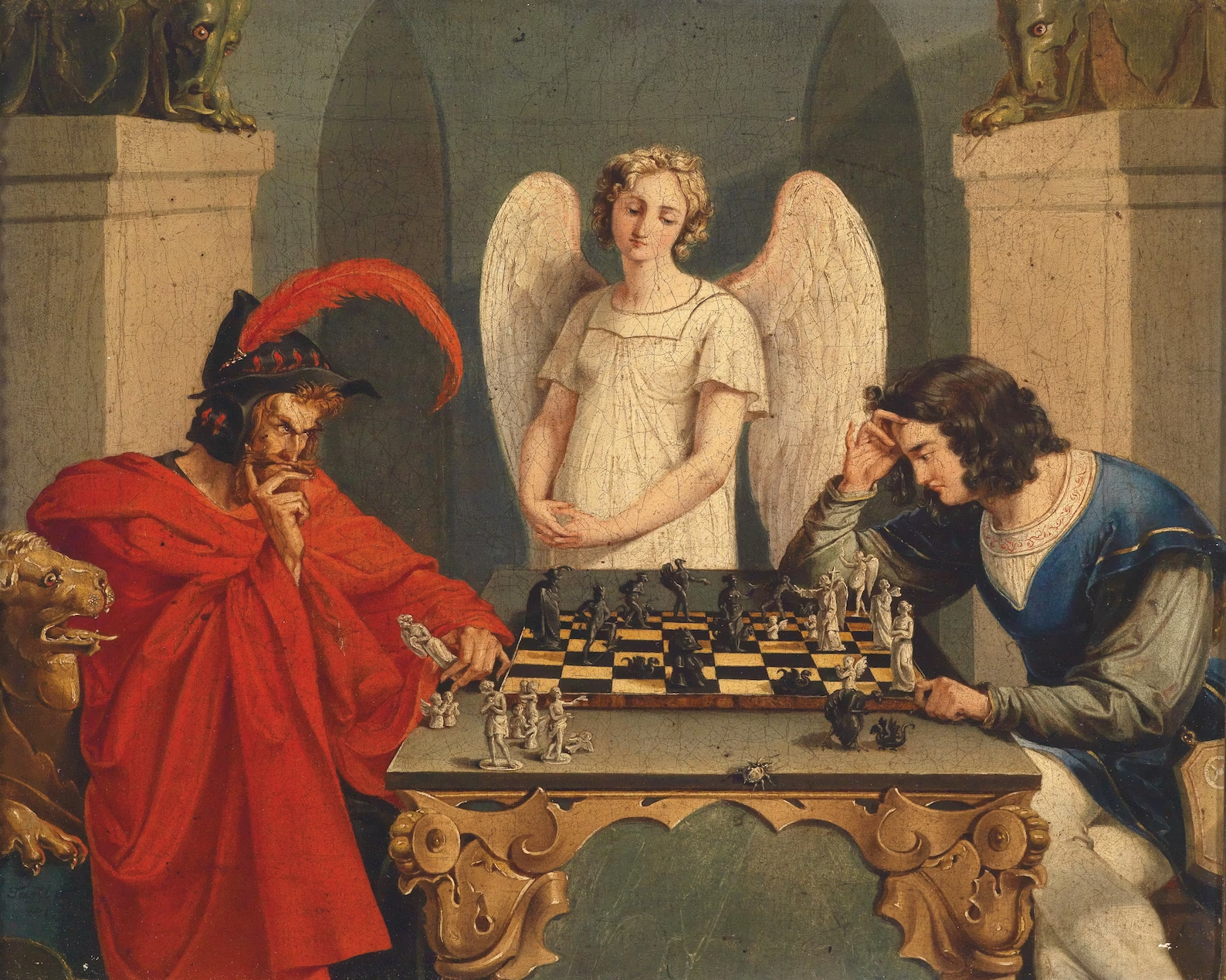
Friedrich August Moritz Retzsch, Faust and Mephisto Playing Chess, ca. 1825

5,747 words

Part 2 of 3 (Part 1 here, Part 2 here)

III. Eating His Words: Renaissance Tricksters

Renaissance dramas were also a rich fount for stories/speech gone awry and ironic. In many of these plays, the character of the “jester,” “fool,” “familiar,” or “parasite” drove the plot of their master, the latter’s arrogance making him fatally invested in the belief that he, as the patron, was in control. That would turn out to be nothing more than a pretty fiction he told himself. The main character became tangled in his own snarl of deceit, or hoisted on his word-petard by none other than his “loyal” servingman. It was the “fool” who was the cleverest, at times the most honest (*wink, wink* “I get away with telling cruel truths, snide remarks, and dirty stories, because I’m just the court jester speaking nonsense, you know — A ha! A ha a ha a ha a ha a HA!”). His role was also the one most likely to break the Fourth Wall, and listeners/audiences came to view him as an insert of themselves and perhaps of the playwright, because they were privy to this trickster’s inner thoughts and perspective. Othello’s Iago, for example — that maximally evil creation of Shakespeare — has sometimes come across as the most relatable character in the play. Many a true word, after all, has been spoken in “jest.”

We are familiar with dramas like these as dry texts we read in school, but like old legends and epic poems, their creators meant for them to be an oral performance — full of shouts, murmurs, dramatic pauses, and physical farces. The early-modern era in particular (1450-1750) was obsessed with court and church rot, degeneracy, and religious uncertainty, while powerful transformations swept the Western world and upended older understandings and institutions. We have since called these movements the Scientific Revolution, the Reformation, and the Age of Exploration. It was the end of ancient dynasties, and the beginning of the expansive age of nation-states and empires. To sort through some of these complex and upsetting changes, people told stories (as they always have).

The theatrical medium allowed Anglo playwrights to critique their own societies in a public manner — literally on-stage — while maintaining plausible deniability by setting them in other places: in Ben Jonson’s Volpone, it was Venice, Italy, a city known for its maritime wealth and supposed debauchery; in Christopher Marlowe’s Doctor Faustus, it was Wittenberg, Germany, a university area known for its innovative but perhaps dangerous currents of intellectualism. These particular suppositions almost went without saying. Both were cautionary morality tales that, while condemning man’s sins of excess, also indulged in fantasy-play, giving their audiences a vicarious taste of things people not-so-secretly crave: wealth, knowledge, the wherewithal to play tricks on those deserving a comeuppance, and the possession of a flunky who will do the dirty work while they did more important or enjoyable things. But while the “masters” scratched a passing itch, and while they celebrated their momentary triumphs, the “lackeys” played a longer game. It was an old, yet timeless story: Sometimes you got what you asked for — and never recovered from it.

Indeed, scholars of Christopher Marlowe usually place an emphasis on the blood-inked written word — that foul bargain that Faustus signed. It was certainly damning. Yet, it was the spoken word, those things said and unsaid, that ultimately doomed the Doctor.

The play began with the Classical Chorus singing the story of Doctor Faustus and his “swoln . . . self-deceit.” From humble beginnings, he’d risen to attend the best universities in Germany, the mastery of all his studies coming easily to him — perhaps too easily. A bored and brilliant mind all but guarantees a flirtation with dark, or forbidden, ideas. Indeed, Faustus was no ordinary “heretic” practicing the tarot, alchemy, or star-reading. He’d become something far more serious: a “Necromancer.” Not satisfied with his vast powers of intellect and learning, he lamented, “Yet art thou still but Faustus, and a man. Couldst thou make men to live eternally, Or, being dead, raise them to life again?”[1] For this he would ironically summon the servant of eternal death and damnation.

The smug Doctor then launched into one of the great bombastic soliloquies of the early-modern stage. When he solved the art of death and magic, he crowed, “All things that move between the quiet poles Shall be at my command.” While temporal “emperors and kings Are but obeyed in their several provinces, Nor can they raise the wind, or rend the clouds,” he whose “dominion . . . exceeds in this . . . [will be] a mighty god: Here, Faustus, tire thy brains to gain a deity.” Yes, once he’d discovered this cosmic knowledge he doubted not that he would win renown “[a]nd [become] more frequented for this mystery Than . . . the Delphian oracle.” But first he needed to “know the words of art; And then, all other ceremonies learn’d,” Faustus could stretch forth his hand and be “emperor of the world.”[2]

As he searched through a tome of black magic spells for the incantations necessary to summon a demon, there appeared two angels over each shoulder — one good, and the other wicked (perhaps the first time anyone had used this literary image). Such words are dangerous, the Good Angel warned: “O, Faustus, lay that damned book aside . . . lest it tempt thy soul, And heap God’s heavy wrath upon thy head! Read, read the Scriptures: – that is blasphemy.”[3] Before the drama ended, these two aspects of humanity would visit him thrice and repeat their messages. Nevertheless, Faustus would not be dissuaded from his course. Instead, he recited conjuring words in hopes that “devils [would] obey [his] hest,” seeing he “hast pray’d and sacrific’d to them.” To his delight a demon did appear, the one called “Mephistophilis,” for the surest cut for rousing a fiend “[was] stoutly to abjure the Trinity, And pray devoutly to the prince of hell.” Believing that he could control these dark forces that came running when he called for them, Faustus charged his new “familiar” with absolute servitude, to remain “by [his] side” for “four and twenty years”; and to reveal secrets of the universe with a snap of his fingers and a curling of smoke. For these privileges Faustus promised “to [Satan] . . . [he would] build an altar and a church, and offer the lukewarm blood of new-born babes” – an evil ritual reminiscent of the cruel demands of Ba’al and the alleged child-killings of some pockets of scattered Jewry. No matter, for “[that] word ‘damnation’ terrified not him.”[4]

But Mephistophilis had another payment in mind. In exchange for 24 years of unbounded power, Faustus would surrender his soul: Draw up the deed in thine own blood, Faustus, and pledge away your eternal peace. Take a knife and “stab thine arm courageously, And bind thy soul, that at some certain day Great Lucifer may claim it as his own; And then be thou as great as Lucifer,” the demon goaded. After writing the contract — at Mephistophilis’ request — Faustus read it aloud. Again, the demon asked for consent, “Speak, Faustus, do you deliver this as your deed?” And again, the foolhardy Doctor gave it: “Ay, take it, and the devil give thee good on’t!”[5]

Only after bartering away his soul did he think to ask Mephistopholis about the nature of Hell — perhaps a sign that he felt subconscious regret over what he’d done. The obliging demon was remarkably candid about what lay in store. Hell was a physical and spiritual state, its seat “Within the bowels of these elements, Where [the damned] are tortur’d and remain for ever.” But even as he stood before Faustus in the magician’s study, Mephistopholis confessed to suffering a thousand torments, for Hell “hath no limits, nor is circumscrib’d In one self place; for where we are is hell, And where hell is, there must we ever be.” Still, Faustus remained unconvinced and regarded the demon as a King would a minstrel who sought to entertain him with spooky tales and boogeymen: “Come sweet Mephistophilis,” for “I think Hell’s a fable” — a fiction used to frighten children and less intelligent men. How foolish “to imagine that, after this life, there is any pain? Tush, these are old wive’s tales.”[6] At least, that was the pretty story he told himself. He reclined and watched as a harem of dancers representing the Seven Sins twirled for his amusement.

Over the next two decades, and despite all his bold and empty words — for he knew nothing of Hell as his “dearest” Mephostopholis did — Faustus veered wildly from regret to impenitence at his choice. Like Macbeth, having gotten his fondest wish, he could not enjoy it. As the Good Angel implored him multiple times, all that was required of Faustus was to say the word, “Repent!” and he would save himself. The deed was only binding if he made it so — if he allowed Mephistopholis and his familiar’s real master in Hell to deceive him into believing this, and thus to despair of Grace. Lucifer, too, understood the power of words to reverse Faustus’ contract, for wherever the Doctor began to speak of God or Heaven, he threatened Faustus with pain. Be careful not to “[t]alk . . . of Paradise nor creation; but mark this show: talk of the devil, and nothing else — Come away!”[7]

But perhaps the play’s biggest lies were Faustus’ own self-deceptions about Mephistophilis, whom he came to trust like he would a close friend and confidant, one who would not hurt him in the end. The “romantic friendship” they’d developed would surely protect him. They’d spent 24 years together, after all, sharing adventures and stirring up mischief. Do not look for a happy ending in Marlowe’s story, readers; at the final hour of his final day on Earth, a crack opened beneath Faustus’ feet, and a crushing bevy of imps and goblins arrived to drag him to the black Inferno, his last words begging the God he’d spurned and the familiar he’d embraced, both without question, to “look not so fierce on me! Adders and serpents, let me breathe a while! Ugly hell, gape not! . . . I’ll burn my books! — Ah, Mephistophilis!”[8] For his part, Mephistopholis felt nothing and followed calmly behind. No more words from him were needed. The kindled glow of his eyes in the gathering dark singed and said enough: You think I answer to you, mortal? I only told you what you wanted to hear, they replied. I only obeyed every word of your whims for 24 years, they told. It was your own words, spoken and unspoken, that damned you, they answered.
You can buy Kerry Bolton’s Artists of the Right here.

While Faustus was a tragedy about a “familiar” who had helped his “master” fashion a pair of “waxen wings [that] did mount above his reach” — then as they melted, watched his “overthrow”[9] and plunge — Ben Jonson’s Volpone was about a “parasite,” whose agenda also conflicted with the lustful man he pretended to serve.

All of Jonson’s characters had names that implied their inner natures: Volpone, the Fox; Mosca, the Fly/Parasite; Corvino, the Carrion Crow; Corbaccio, the Raven; Voltore, the Vulture, etc. The rich and rapacious Venetian Volpone had recently recovered from an illness, and having no issue, let it be known to his three potential inheritors that they stood to gain his massive fortune should he die. Instead of revealing his return to health, Volpone decided to play an elaborate game of charades: He instructed his equally cunning servingman Mosca to tell each of his heirs that his master’s disease was so serious that he could die at any moment, thus feeding the greedy men a pack of lies and stories. if Corbaccio would disinherit his own son in favor of Volpone, Volpone would make him the beneficiary of his largesse; if Corvino would allow Volpone to rape his wife, then he stood to gain the lion’s share of the wealth; and if the lawyer Voltore would deceive the judges into believing that Volpone was innocent of this attempted assault, then the crooked solicitor would win the estate. Mosca performed these arts so well that Volpone exclaimed, “Excellent varlet!” and “Rare Mosca! how his villainy becomes him!” With endearments echoing the foolish Faustus, Volpone rubbed his hands together and heaped further praise on his “good rascal, let me kiss thee!” Practicing a modesty he did not feel, the parasite replied that he merely did “as [he was] taught; [to] Follow [Volpone’s] grave instructions; give them words; Pour oil into their ears, and send them hence.”[10]

After this rigamarole, Volpone capped it all with the pièce de résistance: his faked death and final will. Anticipating the delicious mischief that would ensue at the reading of the will, Volpone exhorted “Mosca . . . [to] Play the artificer now, torture them rarely.” As Corbaccio, Voltore, and Corvino eagerly listened for their own names at the reading, words none had expected were voiced: “Mosca [is] the heir!”[11] As Volpone chortled behind a curtain, the three fools erupted in rage at how they’d been duped. They threatened to dispute the parasite’s claim in court.

Well done, Mosca, Volpone crowed, “now leave off, they are gone.” With feigned astonishment, Mosca turned on his master and asked, “Why? Who are you? What!” for you, Volpone died in the night.

     Reverend sir! Good faith, I am grieved for you,
     That any chance of mine should thus defeat
     Your (I must needs say) most deserving travails:
     But I protest, sir, it was cast upon me,
     And I could almost wish to be without it,
     But that the will o’ the dead must be observ’d . . . (emphasis mine)

It seemed now that Volpone had “died” and apparently left everything to Mosca, the parasite had no intention of revealing the truth and relinquishing his new fortune. “My Fox Is out of his hole,” he whistled as an aside, and

. . . now I have the keys, and am [possessed].
     Since he will needs be dead afore his time,
     I’ll bury him, or gain by him: I am his heir,
     And so will keep me, till he share at least.
     To cozen him of all, were but a cheat
     Well placed; no man would construe it a sin:
     Let his sport pay for it, this is call’d the Fox-trap.

“Well placed” and well played, Volpone grudgingly admitted; by the made-up stories he’d concocted to humiliate his grasping heirs, so was he “caught In [his] own noose.”[12]

Volpone had no choice but to come clean and unmask himself as a fraud. But his “ruins [would] not come alone,” for his confession was sure to topple Mosca from his perch. Upon hearing the entire sordid story of these misdeeds, the judges of Venice sentenced both men to fates reminiscent of Dante’s Inferno or Marlowe’s flaming Pit: a hell on earth. Mosca, for his surpassing brand of treachery, would submit to a whipping and then to perpetual servitude in the galleys. Volpone’s wealth they confiscated in an ironic reversal of his will. “And, since the most was gotten by imposture, By feigning lame, gout, palsy, and such diseases,” the Avocatori damned Volpone to languishment “in prison, cramp’d with irons, Till [he] be’st sick, and lame indeed.”[13] In an unwelcome way, the lies of the Fox and the Fly had come true. Their tricks were so entertaining, I, for one, almost wish they’d gotten away with them.

IV. Fighting Words: Duels of Transformation and Power

Perhaps we sometimes place too much emphasis on the hard line that separates words from deeds, the pen from the sword — for where would wars be without speeches; without the “trash talk”; without the often completely made-up stories of villainy? The Duke of Wellington once remarked that Napoleon’s hat alone was worth 50,000 men in the field. An electrifying bromide, or propaganda campaign, can be worth just as many. And after achieving triumph in battle, to the victors go the story-spinning spoils of history, lest anyone forget what the fighting was really about. In the right mouths, words can be weapons (Leftists are absolutely correct: speech is dangerous — which is why we must never stop talking and writing about them).

Readers might recognize the ancient genre of the transformational duel, in which two men (often magicians) sought to overtake one another by turning themselves into various objects, or animals. The first magician might transform into a swallow that could fly away; the second would check his adversary by assuming the form of an eagle. The smaller bird then changed into a minnow, or other fish; the eagle would become a seagull, or sharp-toothed pike. The former made himself into tiny, scattered grains on the riverbank; then the latter outdid him as a rooster, pecking at the seed. At last, the first magician might seize his chance and become a fox that quickly strangled the rooster.
You can buy Kerry Bolton’s More Artists of the Right here.

This kind of story appeared throughout the Caucasian world.[14] Some persisted in their supernatural elements — a tale of spells and deities, but they could assume a more secular form. Regardless, all such stories imparted to words an invigorating and often dangerous magic in which the stakes were victory and death.

The anonymously authored Alexander Romance of the third century AD told the story of Alexander the Great’s conquest of the Persian Empire (334 BC). After the sacking of Tyre, a city on the outskirts of the Achaemenid/Persian Empire, the Achaemenid King Darius III sent several messengers bearing “gifts” for the young conqueror who threatened a full-scale invasion.

Our master, King of Kings and kinsman of the gods, he who “rise[s] to heaven with the Sun,” does give these tokens of his esteem. With a flourish the messengers produced “a strap, a ball, and a money box of gold.” With the first gift, Darius instructed Alexander to return to “the lap of [his] mother . . . [for] that [was] how old” the Macedonian ruler was — still in need of “discipline and correction.” The second gift of a ball Darius told him to use in the games he might “play with children [his] own age,” instead of misleading “so many young men . . . into disturbing the peace of cities.” And the final gift of gold the Persian King condescendingly sent “so that should [Alexander] run out of food to give [his] fellow brigands, [he might] give them each the wherewithal to go back to their own homeland” — an allowance an indulgent uncle or godfather might give to a wayward youth who had lost more than he was worth at the gaming table. But if Alexander should spurn these “well-meant” gifts, Darius promised to “send a force” innumerable after him, with the result that the wannabe conqueror playing dress-up “[would] be arrested by [Darius’] soldiers.” No more would the “King of Kings” educate Alexander as the son of a fellow-monarch, but would crucify him “as a rebel.”[15]

Unintimidated, Alexander understood that only a frightened man would send such things; if Darius was as confident as he suggested, then the Achaemenid ruler would simply have marched on Alexander’s invading army of callow “youths” and crushed him; no snide messages required. Darius’ words reeked of his fear. In reply, Alexander sent back a new interpretation of these symbols. When men assumed “[t]he titles of the gods” as Darius had, they “[did] not confer great power or sense upon them. For how [could] names of the immortal gods take up residence in destructible bodies?” Know that I, Alexander of Macedon, “am going to wage war on you in the view that you are mortal, and which way victory goes depends on Providence above.” Alexander returned the gifts in kind. Behold the strap I send, “so that I may flay [your] barbarians with my spears and weapons and reduce them by my hands to servitude.” As for the ball, you merely suggest to me “that I shall gain control over the whole world,” which is spherical and round. The chest of riches you sent me means this: “you will be defeated by me,” and in future “pay me tribute!”[16]

The same objects that were for Darius trinkets of “feebleness and childishness” became in Alexander’s mouth “the heralds of manly and warlike prowess.” The two interpretations acted as a scaffolding ascent that signaled loss to win, “underling to overlord,” weakness to dominance. Once this powerful reply made its way back to the Persian court, Darius was “disturbed.”[17] By refashioning the Achaemenid King’s original story with a few terse lines of dialogue, Alexander had managed to completely unnerve his older, more experienced opponent.
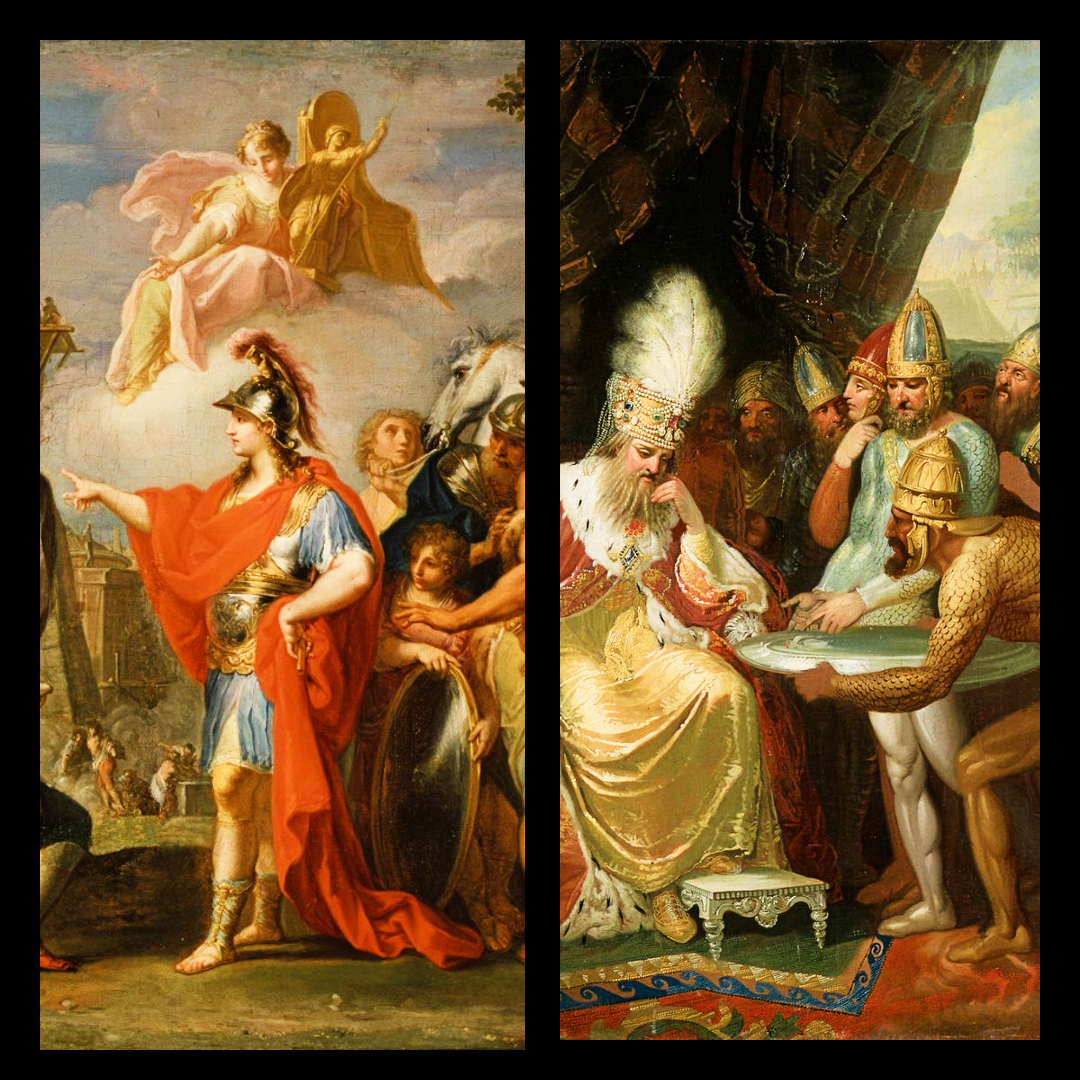
Placido Costanzi — a pair of images depicting the exchange of “gifts,” and their interpretations between Alexander, dictating his reply (left) and Darius receiving it (right), ca. 1740

J. R. R. Tolkien’s Silmarillion also used this basic plot device, but unlike the Alexander Romance, the English fantasist kept the supernatural and religious nature of the transformational duel intact. Written in the high epic style of Homer or Hesiod, the Silmarillion contextualized his Middle-Earth within a mythological framework. Just as figures in Norse and Homeric poems sang their wrath and joy, so did Tolkien’s characters duel with music. At the moment of creation, Eru Ilúvatar (God) unfolded to the Aínur (angels) a song “[of] things greater and more wonderful than He had yet revealed; and the glory of its beginning and the splendour of its end amazed the Aínur.” They, too, took up the song, each adding to the orchestra his own sound “like unto harps and lutes and pipes and trumpets, and viols and organs, and like unto countless choirs singing with words.” Thus, at His command they “began to fashion the theme of Ilúvatar to a great music; and a sound arose of endless interchanging melodies woven in harmony . . . and the music and the echo of the music went out into the Void, and it was not void.”[18]

But Melkor, whose gifts of understanding were greater than all the other Aínur, had begun to chafe at Ilúvatar’s dominion. Thus, some of these secret thoughts “he now wove into his music, and straightway discord arose about him.” Those who sang “nigh him grew despondent, and their thought was disturbed and their music faltered,” while a few others even “began to attune their music to [Melkor’s] rather than to the thought which they had at first.” After a while, “the discord of Melkor spread . . . and the melodies which had been heard before foundered in a sea of turbulent sound.” Ilúvatar continued to sit “and hearkened until it seemed that about his throne there was a raging storm, as of dark waters that made war one upon another in an endless wrath that would not be assuaged.”

At last, Ilúvatar ended the music and began again — and again, Melkor’s influence marred the original with clashing symbols. For a third time, Ilúvatar, now stern, wove a new theme amid the strife, “and it was unlike the others.” Its melody seemed at first “soft and sweet, a mere rippling of gentle sounds,” but for all its delicacy, it could not be quenched, “and it took to itself power and profundity.” Two musics progressed at once: “the one was deep and wide and beautiful, but slow and blended with an immeasurable sorrow, from which its beauty chiefly came.” The second had now “achieved a unity of its own; but it was loud, and vain, and endlessly repeated.” Though this latter theme “essayed to drown the other music by the violence of its voice . . . its most triumphant notes were taken by the other and woven into its own solemn pattern.”[19] In the duel of sound, Good had appropriated Evil, though Melkor had managed to include within the Song the darkness and envy of his own spirit.

This duel would repeat itself time and again in Tolkien’s Middle-Earth, the Children of Ilúvatar battling the poison of Melkor’s servants with beautiful song. A particularly memorable episode occurred between Finrod Felagund, a High Elf of the First Age, who confronted Sauron at the Dark Lord’s stronghold after his capture. Thus “befell the contest of Sauron and Felagund which is renowned. For Felagund strove with Sauron in songs of power.” The Dark Lord “chanted a song of wizardry, Of piercing, opening, of treachery, Revealing, uncovering, betraying.” In swift reply, Felagund lifted his voice in a chant

. . . of staying,
Resisting, battling against power,
Of secrets kept, strength like a tower,
And trust unbroken, freedom, escape;
Of changing and of shifting shape,
Of snares eluded, broken traps,
The prison opening, the chain that snaps.

Now one, now the other, both “swayed their song. Reeling and foundering, as ever more strong The chanting swelled.” Felagund mustered all the “magic and might” of “Elvenesse into his words,” so that softly in the gloom “they heard the birds Singing afar . . . The sighing of the Sea beyond, Beyond the western world, on sand, On sand of pearls in Elvenland.” In turn, Sauron conjured the sins of the Elves, the “darkness growing In Valinor, the red blood flowing Beside the Sea, where the “Elves once slew their sea-kin, “and stealing drew Their white ships” to flee. With these dark words, the black god bade the wind wail, the wolf howl, and “The ravens flee.” The grinding ice muttered “in the mouths of the Sea . . . Thunder rumble[d], the fires” consumed — And Finrod Felagund “fell before the throne.”[20] The High Elf lost his battle, because as the original Music had willed it in its third and tragic refrain, all existence is a litany of death, little wins and long defeats, before the Last Triumph.

V. <Insert Words Here>: Nordic Bargains and the “Blank Cheque”
You can buy Collin Cleary’s Summoning the Gods here.

Foolish oaths and rash promises have led to the downfall of many a storyteller’s protagonist — even if they were mighty gods. The Norse Edda was also based on oral traditions: an ancient vala woman wrapped in beaten bracelets and old furs and regaling groups of Northerners at dinner. According to myth, Odin often pledged more than he should have, and the Nine Realms suffered for it. The All-Father knew that Asgard required a strong wall to enclose its towers and to keep its glittering halls from the gods’ enemies. If only they had security, they might focus their energies on creation rather than constant fighting.

In answer to this prayer, a Stranger-Giant on a great horse with legs swift as Thor’s thunder-crack arrived and offered his unsurpassed craftsmanship for the job. “I know what is in the mind of the Gods,” the Stranger declared. “I can [raise] great walls that can never be overthrown. Let me build the wall round your City.” Odin, not as wise as he would later become, “thought that no payment the Stranger could ask would be too much for the building of that wall.” He praised the giant’s work; anything the Builder wanted was his, the god promised, so long as the wall was finished by the next summer solstice. Turning from his toil, the Stranger answered, “O Father of the Gods . . . the reward I shall ask for my work is the Sun and the Moon, and Freya, who watches over the flowers and grasses, for my wife.” When the gods heard this, they grew fearful and angry, for the “price the Stranger” wanted was “beyond all prices.”[21] Odin, it seemed, was trapped by his own foolhardy words. But among the gods in Asgard there was a cunning deity named Loki, a figure who bore more than a passing resemblance to the “jester,” or “parasite” in early-modern drama, and Loki told Odin that he could solve this seemingly hopeless problem.

Before the first day of summer arrived, Loki lured away the Giant’s horse with his artful schemes, so that the stranded Giant could not journey back to Asgard and finish the wall in the allotted year. The last stones remained unset above the gate; the terms set by word-of-mouth went unfulfilled. While the rest of Asgard rejoiced at this turn of events, Odin was troubled and sad of heart — sad that “the Gods had their wall built by a trick; that oaths had been broken, and that a blow had been struck in injustice in Asgard.”[22] Had they gotten their peace free of charge, or had they paid the dearest price of all?

Nor was this the last time Odin would offer up a blank cheque, then call on Loki to “save” him. As the two wandered Midgard in disguise, they came upon a lake where an otter was happily collecting his mud and sticks into piles. Then, Loki did “a senseless, evil thing,” and pitched a rock at the poor creature, killing it instantly. Odin was furious, but the damage had been done, and so Loki skinned the otter of its fur and packed it in his traveling case. At sundown, they lodged for the night at a dwarven-metalsmith’s home. But when Loki unpacked the fresh skin, their host cried out in agony, “you have killed my son!”[23] Indeed, the dwarf’s son had been a shapeshifter and could turn into an animal if he chose. Loki had directed his cruelty at the wrong swimmer.

“Peace,” said Odin. “We have slain thy son, it would seem, but it was unwittingly that we did the deed. We will give a recompense for [his] death.” The dwarf’s eyes became small and sharp as he asked, “What recompense will ye give?” Then did Odin, the “Eldest of the Gods, say a word that was unworthy of his wisdom and his power.” Of all the gifts the All-Father might have given in exchange — the water from Memir’s Well, for example — Odin only “thought of gold.” Decide a cost “on the life of thy son and we will pay that price in gold coin,” he said. Though filled with grief, the dwarf, like the rest of his kind, never lost the preoccupied lust after every jeweled fruit that came from the mountains. He named an outrageous sum: “Ye will have to find a gold coin [for every hair] upon the skin of him whom ye have killed.”[24]
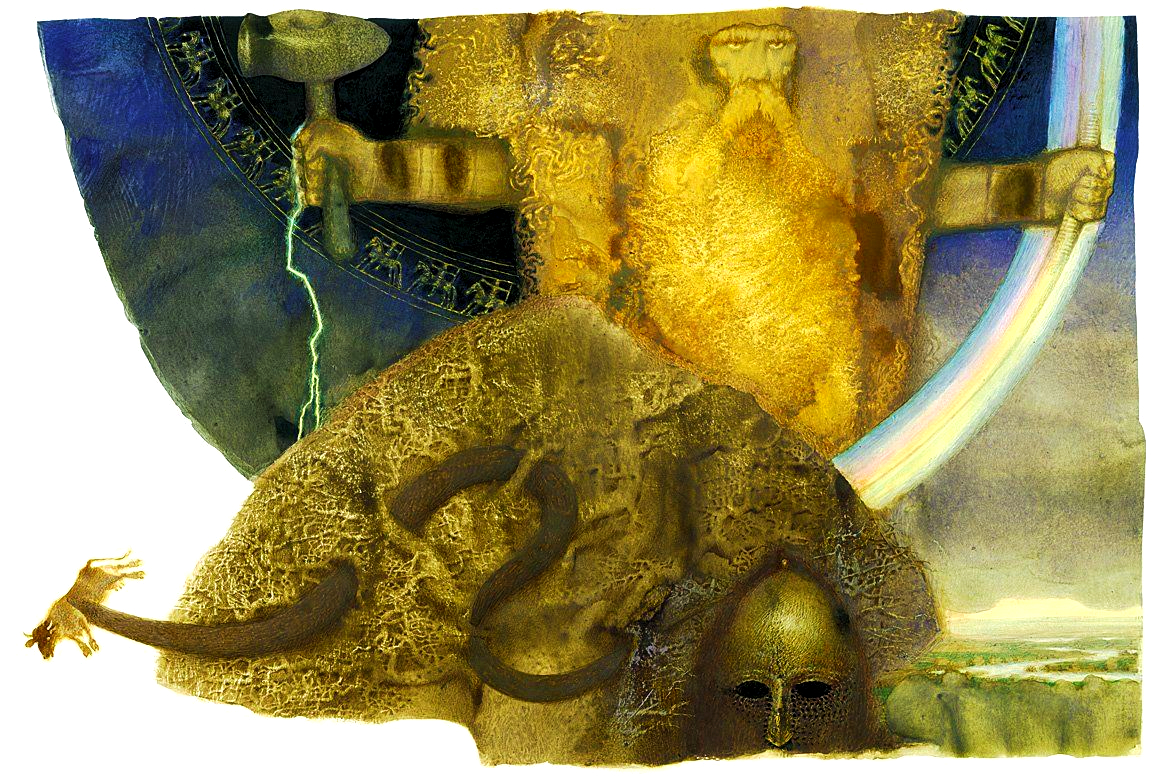
Pavel Tatarnikov, unknown title, 2008

Odin knew of only one such treasure that could fulfill the oath: Andvari’s Hoard, guarded by another, even more cantankerous dwarf. Turning to Loki, he told the trickster to retrieve the magnificent lode. Though everyone in Asgard knew of Andvari’s Hoard, “there was a thought amongst all that this hoard was not to be meddled with and that some evil was joined to it.” But what choice did Odin have, now that he’d given his word? When Loki arrived at the cave where the treasure lay, he saw that a lake encircled it, and in this moat, a large pike circled the waters incessantly. Loki knew that this was Andvari the dwarf, who had given up fellowship with his kinsmen and had taken on the “dumbness and deafness” of a fish, so that he might guard his treasure with a continuous vigil.[25] At first, Loki could not capture the fish, for it was too quick and strong; he perceived that he would need a net – a magical trap wielded by the likes of Ran, the cold Queen of the Sea. Because she hated dwarves, Ran lent Loki her net of silvered gossamer, its unbreakable strings threaded with pearls.

Returning to the lake, Loki caught Andvari up in the mesh, and brought him to land. When he demanded Andvari give up his hoard in exchange for freedom, the dwarf-pike appealed to Odin for justice. Ha! laughed the trickster, it was “Odin [that] sent me to fetch thy hoard to him,” said Loki. In dismay, Andvari remembered the Giant-Stranger who’d once built Asgard’s fine wall:

Can it be that all the Æsir [gods] are unjust? Ah, yes. In the beginning of things they cheated the [one] who built the wall round their City. The Æsir are unjust.[26]

Nevertheless, Andvari revealed his golden hoard, and Loki began to spirit the riches away in his Ran’s net — but not before the dwarf pronounced a dreadful curse on the treasure. At the same moment, Gulveig, a giant-woman who had once lived in Asgard but had been banished for her wickedness, emerged from the darkness of the cavern.

“Thou hast freed me, Loki,” Gulveig smiled, “I go to Odin to bring the message of your success.” When the All-Father saw the giantess appear, she “who had troubled the happiness of the gods” in long-ago days, he raised his spear as if to cast her back to her prison. Lay thy weapon down, Odin, she said. Though

I dwelt for long in the Dwarf’s cave . . . thy word unloosed me, and the curse said over Andvari’s [treasure] has sent me here . . . Thou didst [turn] me out of Asgard, but thy word has brought me to come back to thee. And if ye two, Odin and Loki, have bought yourselves free with gold and may enter Asgard, surely I, Gulveig, am free to enter Asgard also.

Odin acknowledged the justice of her statement. As Gulvieg approached the great city’s high (but incomplete) walls, Loki followed her, and behind them all lagged Odin, the Ruler of the Gods. He went “slowly with his head bent, for he knew that an unwelcome one had gained entry . . . and whose return now the Gods might not gainsay.”[27] The bill for incautious words could not be avoided forever, he knew. The cost of his Kingdom dangled in the balance of time, for the debt, it always comes due.

More is yet to come, readers, for you are also due the best: wrathful rajas, romance, and war — if only you would allow me to tell you about them the next night.

* * *

Like all journals of dissident ideas, Counter-Currents depends on the support of readers like you. Help us compete with the censors of the Left and the violent accelerationists of the Right with a donation today. (The easiest way to help is with an e-check donation. All you need is your checkbook.)

GreenPay™ by Green Payment

Select donation type

Select or enter an amount to give

Select or enter an amount to give monthly

For other ways to donate, click here.

Notes

[1] Christopher Marlowe, Doctor Faustus (Manchester: Manchester University Press, 1995), 107-108; 1604 A-text used.

[2] Faustus, I.i, 111-115.

[3] Ibid., 115.

[4] Ibid., I.iii, 124, 127.

[5] Ibid., II.i, 140-142.

[6] Ibid., II.i, 144.

[7] Ibid., II.iii, 156.

[8] Ibid., V.ii, 197.

[9] Ibid., 11-112.

[10] Ben Jonson, Volpone, provided in digital form by the Bench Company Theatre for their 2009 production, V.iv, 52; I.iv, 12.

[11] Volpone, V.iii, 51.

[12] Ibid., V.vii, 58-59.

[13] Ibid., V.xi, 66.

[14] I’m including here the Near East, Persia, and India, as well as Europe.

[15] The Alexander Romance, in B. P. Reardon, ed., Collected Ancient Greek Novels (Berkeley, Ca: University of California Press, 1989), 679-680.

[16] Alexander Romance, 681-683.

[17] Ioannis M. Konstantakos, “The Magical Transformation Contest in the Ancient Storytelling Tradition” in Estudios griegos e indoeuropeos, 26 (2016) pp. 207-234, 15.

[18] J. R. R. Tolkien, The Silmarillion (Boston: Houghton Mifflin Co., 2004), 3.

[19] Silmarillion, 4-5.

[20] Ibid., 168-169.

[21] Padraic Colum, Nordic Gods and Heroes (Garden City, NY: Dover, 1996), 7-12. Because there is a lot of conversation in these stories, I have italicized what I mean to be spoken dialogue between characters and have only put in quotes those lines that are direct quotations from the cited text.

[22] Nordic Gods, 12.

[23] Ibid., 140-142.

[24] Ibid., 144.

[25] Ibid., 145.

[26] Ibid., 148.

[27] Ibid., 149, 154.

By the Twisted Word, Slain; By the Good Word, Saved . . . & Other Stories Part II

By%20the%20Twisted%20Word%2C%20Slain%3B%0ABy%20the%20Good%20Word%2C%20Saved%20.%20.%20.%0Aandamp%3B%20Other%20Stories%0APart%20II%0A

Share

  • Gab

Enjoyed this article?

Be the first to leave a tip in the jar!

Instant Echeck GreenPay™

Related

  • An Esoteric Commentary on the Volsung Saga – Part XXII

  • Finding Atlantis Part 3: The Stories We Tell

  • An Esoteric Commentary on the Volsung Saga—Part XX:

  • Leveling up Agency

  • An Esoteric Commentary on the Volsung Saga—Part XIX:

  • An Esoteric Commentary on the Volsung Saga, Part XVIII

  • An Esoteric Commentary on the Volsung Saga, Part XVII

  • An Esoteric Commentary on the Volsung Saga – Part XV

Tags

Alexander the GreatBen JonsonChristopher MarloweDarius IIIDoctor FaustusJ. R. R. TolkienKathryn SlegendsLokiMiddle EarthmythsNorse mythologyOdinthe Alexander Romancethe EddasThe SilmarillionVolponewords

4 comments

  1. Lord Snooty says:
    February 28, 2023 at 6:55 pm

    Doctor Faustus, the 1967 film version, directed by and starring Richard Burton, was broadcast on British TV just a few days ago. It was godawful (the movie, not the play). Avoid.

    Burton even managed to kill stone dead Marlowe’s deathless lines:

    Was this the face that launched a thousand ships
    And burnt the topless towers of Ilium?
    Sweet Helen, make me immortal with a kiss.

    0
    0
    1. Kathryn S says:
      February 28, 2023 at 9:06 pm

      I have not seen that film before, so thank you for the heads-up! It surprises me that Burton botched it, since most of the work I’ve seen of his is pretty good: Becket, Anne of a Thousand Days, Antony & Cleopatra (well, that one is just OK). I’m trying to think of a golden-age Shakesperean actor who would have done the character more justice — Olivier would probably have been miscast in the role, too. Rex Harrison might have made a good Mephistopheles.  

      You’re right — Renaissance dramas have some of the best and most evocative lines. Highly quotable.

      Thanks for reading, M’lord Snooty!

      0
      0
      1. Lord Snooty says:
        March 1, 2023 at 3:35 pm

        “Antony & Cleopatra (well, that one’s just OK)”

        You’re thinking of Cleopatra (1963), with Burton and Liz Taylor, which is a modern re-telling of Cleo’s life. I found it pretty tedious, apart from Roddy McDowall’s performance as Octavian.

        Antony and Cleopatra (1972) is an adaptation of Shakespeare’s play, directed by and starring Charlton Heston; a labour of love for him. The critics were unkind, but I suspect that – given the buzz surrounding the emerging American New Wave – Heston was then seen as a stale relic of old Hollywood.

        0
        0
        1. Kathryn S says:
          March 2, 2023 at 12:08 am

          We have a lot of film aficionados here at CC who would know better than I would, but from what I understand, Heston was a serious man who never really considered himself one of them — one of the Hollywood crowd; there weren’t many of the big-budget historical epics that he specialized in being filmed  in the 70s, or at least not many that I can think of. That decade seems to have shifted to an updated noir.

          0
          0

Comments are closed.

If you have a Subscriber access,
simply login first to see your comment auto-approved.

Note on comments privacy & moderation

Your email is never published nor shared.

Comments are moderated. If you don't see your comment, please be patient. If approved, it will appear here soon. Do not post your comment a second time.

Writers of May

(2 votes) Morris van de Camp David M. Zsutty Derek Stark Jayant Bhandari Greg Johnson

Articles of May

Heidegger on Nietzsche, Part One by Collin Cleary The Lunch Wars by David M. Zsutty 2 votes
    • Nationalism This Week
      Letter to J. D. Vance

      Greg Johnson

      2

    • Lost In Trans-Mission:
      How the Media Fails To Reveal the Inconvenient Truth About the Usual Suspects

      Steven Tucker

      3

    • Liar, Liar, Pants on Fire!

      Beau Albrecht

      2

    • Editor’s Update
      Rob Rundo on Counter-Currents Radio, Fundraiser Update, & a New $20,000 Matching Grant

      Greg Johnson

    • The Bitter End of Western Metaphysics:
      Heidegger on Nietzsche, Part Three

      Collin Cleary

      10

    • Uncivil War

      Mark Gullick

      40

    • Exclusive Interview with Karel Veliky:
      The Final Chapter in the Film Series! Part II

      Ondrej Mann

      2

    • Happy Birthday to Us!

      Greg Johnson

      6

    • Zsutty’s Maximum

      David M. Zsutty

      15

    • Exclusive Interview with Karel Veliky:
      The Final Chapter in the Film Series! Part I

      Ondrej Mann

      2

    • The Union Jackal, June 2026

      Mark Gullick

      23

    • The Inferiority Behind Immigrant Superiority

      Jayant Bhandari

      15

    • Counter-Currents Radio Podcast No. 690
      Greg Johnson & David Zsutty Discuss Current Things: AI, Henry Nowak, the Iran Crisis, & More

      Counter-Currents Radio

      7

    • Collin Cleary: What Rome Means to Me

      Collin Cleary

      4

    • Paul Krugman: Closet Bolshevik

      Spencer J. Quinn

      21

    • Fugue of Ideas:
      Ibram X. Kendi’s Chain of Ideas

      Greg Johnson

      19

    • Based Blacks

      Lipton Matthews

      22

    • Black Intellectual Fatigue

      Derek Stark

      41

    • Why White Advocates Should Avoid “Based Blacks”

      Dani Vypont

      32

    • Nietzsche & Race

      Mark Gullick

    • Editor’s Update
      Rob Rundo Rescheduled to Next Week on Counter-Currents Radio;
      Tonight Greg Johnson & David Zsutty Answer Your Questions;
      Fundraiser Update & a New $20,000 Matching Grant

      Greg Johnson

    • The Counter-Currents 2026 Fundraiser
      Lifetime Subscriber Welcome Packages Extended

      Greg Johnson

    • Nationalism This Week
      Who’s Looking Back?

      Greg Johnson

      29

    • China’s Threat to American Security:
      Food, Farmland, Foreign Control, & Energy Policy

      Lipton Matthews

      5

    • The Bitter End of Western Metaphysics:
      Heidegger on Nietzsche, Part Two

      Collin Cleary

      16

    • The Killing of Henry Nowak

      Mark Gullick

      38

    • The Crisis of Chinese Technology Thieves

      Morris van de Camp

      1

    • The Strange World of Gender Bender Fiction:
      & What This Genre Tells Us About Autosexuality

      Dani Vypont

      3

    • Watching the Watchers:
      The Dark Triad Question

      David M. Zsutty

      14

    • The Remigration Movement Solidifies

      F. Roger Devlin

      1

    • Casting Aspersions:
      The Fatal Consequences of Race-Swapped Casting, From Helen of Troy to Henry of Southampton

      Steven Tucker

      20

    • The Murder of Henry Nowak

      Millennial Woes

      23

    • Don’t Forget to Vote in Our Writer & Article of the Month Poll

      Greg Johnson

    • The Robot Hotdog Stand

      Greg Johnson

      37

    • Laughing Our Way to Victory

      Dave Chambers

      7

    • The Zodiac Killer

      Mark Gullick

      11

    • Jared Taylor: What Rome Means to Me

      Jared Taylor

      1

    • An Interview with Endeavour:
      My Way of Life Is an Adventure!

      Ondrej Mann

      6

    • José Pedro Zúquete’s The Identitarians

      Greg Johnson

      3

    • Editor’s Update
      Fundraiser Update & How to Watch the Remigration Summit

      Greg Johnson

      5

    • The Bitter End of Western Metaphysics:
      Heidegger on Nietzsche, Part One

      Collin Cleary

      12

    • Berlin: City of Stones

      Spencer J. Quinn

      6

    • True Folk-Horror Is Horror of Your Own Folk:
      Mark Gatiss vs the Brexit Blind Dead  

      Steven Tucker

      4

    • Counter-Currents Radio Podcast No. 689
      Thomas Massie, the America 2050 Bust, the Need for Whites to Divest from America, the AI Economic Apocalypse, & Pro-White Project Pitches to Billionaires

      Counter-Currents Radio

      7

    • Nationalism This Week
      Remigration is Inevitable, Part 3

      Greg Johnson

      27

    • Why Billionaires Should Fund White Identity Politics

      Lipton Matthews

      8

    • How Cold War Two Came About

      Morris van de Camp

      5

    • Now Available for Pre-Order at a Special Price!
      Greg Johnson’s The Philosopher Is In

      Greg Johnson

    • David Zsutty’s Elevator Pitch to a Billionaire

      David M. Zsutty

      1

    • Headbanging Lite

      Mark Gullick

      5

    • Dominic Fox

      Letter to J. D. Vance

      "There was virtually no chance that this scenario would work. It was stewed up with bogus...

    • Zarathustra

      Letter to J. D. Vance

      A peace deal with Iran has finally been agreed. Let's see how Israel manages to sabotage it.

    • Will Williams

      Based Blacks

      Weave: June 15, 2026  Thank you for completely proving my point, which is that if we aren’t as...

    • Fred C. Dobbs

      Lost In Trans-Mission

      Great article. We’re all used to the media using lies of omission. The “teens” is most commonly used...

    • Fred C. Dobbs

      Liar, Liar, Pants on Fire!

      Father Merrin “he mixes lies with the truth to confuse us.” Excellent piece. We’ve all experienced...

    • Adrian Roberts

      Lost In Trans-Mission

      What about all the people who've been born in the wrong bodies and don't even know it?

    • Weave

      Based Blacks

      Thank you for completely proving my point, which is that if we aren’t as “pure” as you then we are...

    • Joe Gould

      Lost In Trans-Mission

      Philosophy matters. Bad philosophy backed by media, money, and state power is a disaster. The dogma...

    • Joe Gould

      Uncivil War

      I think that your phone (any brand, not just an iPhone) will give up all sorts of information on you...

    • YT

      Uncivil War

      So you’re advocating leaving your iPhone at home as it can be used for geographic location purposes...

    • Will Williams

      The SPLC Indictment

      I bump this comment because Christian conservative reporter Tyler O'Neil is on the SPLC  beat again...

    • Peter Quint

      Why White Advocates Should Avoid “Based Blacks”

      Why would you tell a little parable like that? Are you trying to tell us to judge blacks by the  “...

    • Will Williams

      Based Blacks

      Uncle Semantic: June 14, 2026  Will, I’m curious if your racial journey to where you stand now...

    • Angela Mercy

      Paul Krugman: Closet Bolshevik

      Things don't look bright for Republican party and it's voters but they can only blame Donald Trump...

    • S Dane

      Paul Krugman: Closet Bolshevik

      Krugman is the creep who was caught with kiddie porn a few years ago and was able to get off with a...

    • Will Williams

      Based Blacks

      Uncle Semantic: June 14, 2026  Do you think blacks would be more palatable to the proWhite...

    • ArminiusMaximus

      Based Blacks

      I may want them to get scared straight, but I doubt that message will sink in. Can they think in...

    • kerdasi amaq

      Uncivil War

      I never heard of the IRA knee-capping Protestants until now. They did it to their own juvenile...

    • Uncle Semantic

      Fugue of Ideas: Ibram X. Kendi’s Chain of Ideas

      The movie American Fiction with Jeffrey Wright is very good on this.

    • Will Williams

      Why White Advocates Should Avoid “Based Blacks”

      Scott: June 13, 2026 Will Williams wrote:“Scott, it’s interesting that you call George...

    • Earth Day Special

      John Morgan

      12

    • A Robertson Roundup
      Remembering Wilmot Robertson
      (April 16, 1915 – July 8, 2005)

      Margot Metroland

      13

    • The Paranoid Style in White Nationalism

      Greg Johnson

      30

    • Join the Dance!

      Andrew Hamilton

      1

    • We Can’t Save the Earth Without Reducing African Birth Rates

      James Dunphy

      36

    • “I’m Not a Conspiracy Theorist, but . . .”:
      Jeffrey Epstein’s Death Gives New Life to “Conspiracy Theories”

      Greg Johnson

      22

    • Sylvia Plath: Stasis in Darkness

      Vic Olvir

      17

    • Vanguardism, Vantardism, & Mainstreaming

      Greg Johnson

      80

    • Aviation, Geography, & Race

      Charles Lindbergh

      3

    • Some Thoughts on Yule

      Collin Cleary

      4

    • Living in Truth:
      A Yuletide Homily

      Jef Costello

      7

    • John Kennedy Toole’s A Confederacy of Dunces

      Greg Johnson

      20

    • On Aleksandr Solzhenitsyn’s Warning to the West

      Spencer J. Quinn

      7

    • Elitism, British Modernism, & Wyndham Lewis

      Jonathan Bowden

      6

    • Philip K. Dick’s Do Androids Dream of Electric Sheep? as Anti-Semitic/Christian-Gnostic Allegory

      Greg Johnson

      20

    • “Conspiracy Theory” or Conspiracy?

      Andrew Hamilton

      21

    • Remembering H. P. Lovecraft
      (August 20, 1890–March 15, 1937)

      Greg Johnson

      3

    • Who Are We?
      Nordics, Aryans, & Whites

      Greg Johnson

      71

    • Remembering William Gayley Simpson
      (July 23, 1892–December 31, 1990)
      A Pleasant Afternoon with Harriet & Bill Simpson

      Margot Metroland

      18

    • Here are the Young Men
      Remembering Ian Curtis
      (July 15, 1956–May 18, 1980)

      Mark Gullick

      18

    • Percy Grainger
      Artist of the Right

      Alex Graham

      7

    • Remembering Revilo Oliver
      (July 7, 1908–August 20, 1994)

      Greg Johnson

      18

    • The Meaning of July 4th for the White Man

      Gregory Hood

      13

    • The Front National’s Evolution

      Bruno Mégret

    • Merwin K. Hart
      Forgotten American Hero & Man of the Right

      Morris van de Camp

      10

    • George Orwell’s Nineteen Eighty-Four

      Jonathan Bowden

      8

    • Carleton S. Coon
      Scientist & Reluctant White Advocate

      Morris van de Camp

      3

    • The Kwanzaa Absurdity Will Be Dwarfed by Juneteenth

      Robert Hampton

      10

    • Stravinsky

      Alex Graham

      7

    • Like the Roman:
      Remembering Enoch Powell (1912-1998)

      Mark Gullick

      23

    • The 1970s: The Golden Age of Hijacking

      Morris van de Camp

      21

    • Jonathan Bowden’s Deliverance
      Part 6

      Jonathan Bowden

    • Do You Want to Play a Game?

      Mark Gullick

      1

    • Sexually Incontinent on the Indian Subcontinent:
      Who Rapes More Animals, Indians or Pakistanis? The Battle Continues!

      Steven Tucker

      3

    • Neo-Fascism in Film
      Part 5

      Karel Veliky

      15

    • The Game of Tarot

      Mark Gullick

      2

    • Institutions Cannot Be Transplanted

      Jayant Bhandari

      5

    • Jonathan Bowden’s Deliverance
      Part 5

      Jonathan Bowden

    • Crosstown Traffic:
      Jimi Hendrix & The Post-War Rock ‘N’ Roll Revolution

      Mark Gullick

      1

    • Slaves from the North:
      Finns & Karelians in the East European Slave Trade, 900–1600

      Lipton Matthews

      14

    • Neo-Fascism in Film
      Part 4

      Karel Veliky

      2

    • David Lean’s A Passage to India

      Spencer J. Quinn

      1

    • Elites are Essential to Development

      Lipton Matthews

      7

    • Jonathan Bowden’s Deliverance
      Part 4

      Jonathan Bowden

    • Neo-Fascism in Film
      Part 3

      Karel Veliky

      6

    • E. M. Forster’s A Passage to India & the Indian Mentality

      Spencer J. Quinn

      25

    • Jonathan Bowden’s Deliverance
      Part 3

      Jonathan Bowden

    • The Rest Is Silence
      Heidegger’s Quietism

      Mark Gullick

      2

    • Dispelling the Historical Fallacy of Indian Nationalism

      Lipton Matthews

      8

    • Neo-Fascism in Film
      Part 2

      Karel Veliky

      8

    • Jonathan Bowden’s Deliverance
      Part 2

      Jonathan Bowden

    • Life of a Klansman

      Mark Gullick

      8

    • Jonathan Bowden’s Deliverance, Part 1

      Jonathan Bowden

    • Decolonial Ideas are Holding Back Developing Countries

      Lipton Matthews

      8

    • Neo-fascism in Film, Part 1

      Karel Veliky

      21

    • Jonathan Bowden’s Onslaught, Part 8
      Divigations on Decadence

      Jonathan Bowden

    • Jonathan Bowden’s Onslaught, Part 7
      Intrigues in the National Front

      Jonathan Bowden

      1

    • Rotten to the Core

      Mark Gullick

      8

    • Strauss on Husserl’s “Philosophy as Rigorous Science”

      Greg Johnson

    • Jonathan Bowden’s Onslaught, Part 6
      Francis Bacon & Right-Wing Nihilism

      Jonathan Bowden

    • András László
    • Derek Hawthorne
    • Beau Albrecht
    • Alain de Benoist
    • Kerry Bolton
    • Jonathan Bowden
    • Collin Cleary
    • Jef Costello
    • Savitri Devi
    • Julius Evola
    • Jim Goad
    • Gregory Hood
    • Juleigh Howard-Hobson
    • Greg Johnson
    • Charles Krafft
    • Anthony M. Ludovici
    • Trevor Lynch
    • H. L. Mencken
    • J. A. Nicholl
    • James J. O’Meara
    • Christopher Pankhurst
    • Tito Perdue
    • Michael Polignano
    • Spencer J. Quinn
    • Fenek Solère
    • Irmin Vinson
    • Leo Yankevich
    • Francis Parker Yockey
    • Multiple authors
  • Editor-in-Chief

    • Greg Johnson, Ph.D.

    Featured Writers

    • Beau Albrecht
    • Gunnar Alfredsson
    • Collin Cleary, Ph.D.
    • Jef Costello
    • Morris V. de Camp
    • F. Roger Devlin, Ph.D.
    • Stephen Paul Foster, Ph.D.
    • Jim Goad
    • Alex Graham
    • Mark Gullick, Ph.D.
    • Greg Johnson, Ph.D.
    • Travis LeBlanc
    • Trevor Lynch
    • Margot Metroland
    • James J. O’Meara
    • Angelo Plume
    • Spencer J. Quinn
    • Fred Reed
    • Clarissa Schnabel
    • Michael Walker
    • David M. Zsutty

    Frequent Writers

    • Asier Abadroa
    • Aquilonius
    • Alain de Benoist
    • Kerry Bolton, Ph.D.
    • Dave Chambers
    • Steven Clark
    • James Dunphy
    • Endeavour
    • Richard Houck
    • Jason Kessler
    • Titus Livius
    • Ondrej Mann
    • Lipton Matthews
    • Mark Mazari
    • John Morgan
    • Jaroslav Ostrogniew
    • Kathryn S.
    • Christian Secor
    • Anne Wilson Smith
    • Thomas Steuben
    • William De Vere
    • Kenneth Vinther
    • Max West

    Classic Authors

    • Maurice Bardèche
    • Jonathan Bowden
    • Julius Evola
    • Guillaume Faye
    • Ernst Jünger
    • Kevin MacDonald, Ph.D.
    • D. H. Lawrence
    • Charles Lindbergh
    • Jack London
    • H. P. Lovecraft
    • Anthony M. Ludovici
    • Sir Oswald Mosley
    • National Vanguard
    • Friedrich Nietzsche
    • Revilo Oliver
    • William Pierce
    • Ezra Pound
    • Saint-Loup
    • Savitri Devi
    • Carl Schmitt
    • Miguel Serrano
    • Oswald Spengler
    • P. R. Stephensen
    • Jean Thiriart
    • John Tyndall
    • Dominique Venner
    • Leo Yankevich
    • Francis Parker Yockey

    Other Authors

    • Howe Abbott-Hiss
    • Michael Bell
    • Giles Corey
    • Jack Donovan
    • Richardo Duchesne, Ph.D.
    • Emile Durand
    • Guillaume Durocher
    • Mark Dyal
    • Tom Goodroch
    • Andrew Hamilton
    • Robert Hampton
    • Huntley Haverstock
    • Derek Hawthorne
    • Gregory Hood
    • Juleigh Howard-Hobson
    • Alexander Jacob
    • Ruuben Kaalep
    • Tobias Langdon
    • Julian Langness
    • Patrick Le Brun
    • G A Malvicini
    • John Michael McCloughlin
    • Millennial Woes
    • Michael O’Meara
    • Christopher Pankhurst
    • Michael Polignano
    • J. J. Przybylski
    • Quintilian
    • Edouard Rix
    • C. B. Robertson
    • C. F. Robinson
    • Herve Ryssen
    • Alan Smithee
    • Fenek Solere
    • Ann Sterzinger
    • Robert Steuckers
    • Tomislav Sunic
    • Donald Thoresen
    • Marian Van Court
    • Irmin Vinson
    • Book Reviews
    • Movie Reviews
    • TV Reviews
    • Music Reviews
    • Art Criticism
    • Graphic Novels & Comics
    • Video Game Reviews
    • Fiction
    • Poems
    • Interviews
    • Videos
    • English Translations
    • Other Languages
      • Arabic
      • Bulgarian
      • Croatian
      • Czech
      • Danish
      • Dutch
      • Estonian
      • Finnish
      • French
      • German
      • Greek
      • Hungarian
      • Italian
      • Lithuanian
      • Norwegian
      • Polish
      • Portuguese
      • Romanian
      • Russian
      • Slovak
      • Spanish
      • Swedish
      • Ukrainian
    • Commemorations
    • Why We Write
  • Archives
  • Top 100 Commenters
  • The Looney Bin
Sponsored Links
Europa.com Above Time Coffee Antelope Hill Publishing Paul Waggener IHR-Store Spencer J. Quinn American Renaissance Jim Goad The Occidental Observer
Donate Now Mailing list
Books for sale
  • The Philosopher Is In
  • Sexual Utopia in Power (Expanded Edition)
  • In Defense of Prejudice
  • Loving Our Own
  • Tyranny & Wisdom
  • The Populist Moment
  • Is America Doomed?
  • To all books
Copyright © 2026 Counter-Currents Publishing, Ltd.

Paywall Access


Please enter your email address.

Lost your password?

Edit your comment

Writer & Article of the Month May 2026

Voting for this month has concluded. Here are the final results!

Top Writers

  • #1 Morris van de Camp 2 votes
  • #2 David M. Zsutty 2 votes
  • #3 Derek Stark 2 votes
  • #4 Jayant Bhandari 2 votes
  • #5 Greg Johnson 2 votes
  • #6 Jared Taylor 1 vote
  • #7 Collin Cleary 1 vote
  • #8 Spencer J. Quinn 1 vote
  • #9 Mark Gullick 1 vote
  • #10 Lipton Matthews 1 vote
  • #11 Keith Woods 1 vote
  • #12 Steven Tucker 1 vote

Top Articles

  • #1 Heidegger on Nietzsche, Part One 2 votes
  • #2 The Lunch Wars 2 votes
  • #3 The 1970s: The Golden Age of Hijacking 1 vote
  • #4 True Folk-Horror Is Horror of Your Own Folk 1 vote
  • #5 Finding Atlantis Part 4 1 vote
  • #6 Berlin: City of Stones 1 vote
  • #7 The Ghost of the Confederacy 1 vote
  • #8 Lothrop Stoddard’s The Revolt Against Civilization 1 vote
  • #9 Could Fascism Work? 1 vote
  • #10 Jared Taylor's Elevator Pitch to a Billionaire 1 vote
  • #11 Predation Wearing the Mask of Civilization 1 vote
  • #12 Peak Fatigue in Fort Wayne 1 vote
  • #13 Keith Wood's Elevator Pitch to a Billionaire 1 vote
  • #14 Do You Want to Play a Game? 1 vote
  • #15 Why Billionaires Should Fund White Identity Politics 1 vote

Total votes cast: 17