Counter-Currents
  • Advertise
  • Private Events
  • T&C
  • About
  • Contact
  • RSS
    • Main feed
    • Podcast feed
    • Videos feed
    • Comments feed
  • Welcome
  • Webzine
  • Books
  • Merch
  • Podcasts
  • Videos
  • Donate
  • Patrons
  • Subscribe
  • Crypto

LEVEL2

Donate Now Mailing list
Upcoming podcasts
  • Rob Rundo on Counter-Currents Radio

    Rob Rundo on Counter-Currents Radio

    Counter-Currents Radio

    06/13/2026 — 3 pm EST / 9 pm CET
  • Daniel Tyrie on Counter-Currents Radio

    Daniel Tyrie on Counter-Currents Radio

    Counter-Currents Radio

    06/20/2026 — 3 pm EST / 9 pm CET

Writers of May

(2 votes) Morris van de Camp David M. Zsutty Derek Stark Jayant Bhandari Greg Johnson

Articles of May

The Lunch Wars by David M. Zsutty Heidegger on Nietzsche, Part One by Collin Cleary 2 votes
  • Welcome
  • Webzine
  • Books
  • Merch
  • Podcasts
  • Videos
  • Donate
  • Patrons
  • Subscribe
  • Crypto
    • Black Intellectual Fatigue

      Derek Stark

      12

    • Why White Advocates Should Avoid “Based Blacks”

      Dani Vypont

      10

    • Nietzsche & Race

      Mark Gullick

    • Editor’s Update
      Rob Rundo Rescheduled to Next Week on Counter-Currents Radio;
      Tonight Greg Johnson & David Zsutty Answer Your Questions;
      Fundraiser Update & a New $20,000 Matching Grant

      Greg Johnson

    • The Counter-Currents 2026 Fundraiser
      Lifetime Subscriber Welcome Packages Extended

      Greg Johnson

    • Nationalism This Week
      Who’s Looking Back?

      Greg Johnson

      25

    • China’s Threat to American Security:
      Food, Farmland, Foreign Control, & Energy Policy

      Lipton Matthews

      5

    • The Bitter End of Western Metaphysics:
      Heidegger on Nietzsche, Part Two

      Collin Cleary

      13

    • The Killing of Henry Nowak

      Mark Gullick

      31

    • The Crisis of Chinese Technology Thieves

      Morris van de Camp

      1

    • The Strange World of Gender Bender Fiction:
      & What This Genre Tells Us About Autosexuality

      Dani Vypont

      3

    • Watching the Watchers:
      The Dark Triad Question

      David M. Zsutty

      14

    • The Remigration Movement Solidifies

      F. Roger Devlin

      1

    • Casting Aspersions:
      The Fatal Consequences of Race-Swapped Casting, From Helen of Troy to Henry of Southampton

      Steven Tucker

      20

    • The Murder of Henry Nowak

      Millennial Woes

      23

    • Don’t Forget to Vote in Our Writer & Article of the Month Poll

      Greg Johnson

    • The Robot Hotdog Stand

      Greg Johnson

      35

    • Laughing Our Way to Victory

      Dave Chambers

      7

    • The Zodiac Killer

      Mark Gullick

      11

    • Jared Taylor: What Rome Means to Me

      Jared Taylor

      1

    • An Interview with Endeavour:
      My Way of Life Is an Adventure!

      Ondrej Mann

      6

    • José Pedro Zúquete’s The Identitarians

      Greg Johnson

      3

    • Editor’s Update
      Fundraiser Update & How to Watch the Remigration Summit

      Greg Johnson

      5

    • The Bitter End of Western Metaphysics:
      Heidegger on Nietzsche, Part One

      Collin Cleary

      11

    • Berlin: City of Stones

      Spencer J. Quinn

      6

    • True Folk-Horror Is Horror of Your Own Folk:
      Mark Gatiss vs the Brexit Blind Dead  

      Steven Tucker

      4

    • Counter-Currents Radio Podcast No. 689
      Thomas Massie, the America 2050 Bust, the Need for Whites to Divest from America, the AI Economic Apocalypse, & Pro-White Project Pitches to Billionaires

      Counter-Currents Radio

      7

    • Nationalism This Week
      Remigration is Inevitable, Part 3

      Greg Johnson

      27

    • Why Billionaires Should Fund White Identity Politics

      Lipton Matthews

      8

    • How Cold War Two Came About

      Morris van de Camp

      5

    • Now Available for Pre-Order at a Special Price!
      Greg Johnson’s The Philosopher Is In

      Greg Johnson

    • David Zsutty’s Elevator Pitch to a Billionaire

      David M. Zsutty

      1

    • Headbanging Lite

      Mark Gullick

      5

    • White Advocacy Past and Present

      Peter Bradley

      13

    • The Lunch Wars

      David M. Zsutty

      47

    • The Russians are Coming/The Russians are Coming

      Steven Clark

      1

    • Peak Fatigue in Fort Wayne

      Gabriel Anderson

      24

    • Keith Woods’ Elevator Pitch to a Billionaire

      Keith Woods

    • The Cruelty of Kindness

      Morris van de Camp

      9

    • Predation Wearing the Mask of Civilization

      Jayant Bhandari

      13

    • The Mandalorian & Grogu

      Trevor Lynch

      24

    • Editor’s Update
      Fundraiser Update & a New $20,000 Matching Grant
      Greg Johnson & David Zsutty Discuss Thomas Massie on Counter-Currents Radio

      Greg Johnson

      2

    • How the Jews Defeated Thomas Massie—& Themselves

      David M. Zsutty

      25

    • Jared Taylor’s Elevator Pitch to a Billionaire

      Jared Taylor

      15

    • Nationalism This Week
      Remigration Is Inevitable, Part 2

      Greg Johnson

      8

    • Could Fascism Work?

      Mark Gullick

      40

    • Jonathan Bowden’s Deliverance
      Part 7

      Jonathan Bowden

    • China’s Quiet Hand:
      Influence, Infiltration, & the Western Blind Spot

      Lipton Matthews

      9

    • Counter-Currents Radio Podcast No. 688
      Tyler Dykes on Running for US Congress in South Carolina

      Counter-Currents Radio

      4

    • Lothrop Stoddard’s The Revolt Against Civilization

      Spencer J. Quinn

      14

    • DarkPlato

      Black Intellectual Fatigue

      I think it’s cruel to put blacks in prison.  They can’t understand cause and consequence and are not...

    • Connor McDowell

      Black Intellectual Fatigue

      Yeah that’s why I said “that’s where we already are in many respects” as far as the lowering of...

    • Derek Stark

      Black Intellectual Fatigue

      You’re not totally wrong; our rules and institutions were created from a white perspective. But even...

    • Connor McDowell

      Black Intellectual Fatigue

      So I’m going to offer a comment that might ruffle some feathers, but I think it is true and needs to...

    • Joe Gould

      Black Intellectual Fatigue

      Anyway, Derek Stark is right. Even a a sign of increased Black fatigue of a purely academic and...

    • Joe Gould

      Black Intellectual Fatigue

      Cohabitation with other races is harm to Whites. Cohabitation with Blacks is harm to Whites....

    • Glide Ratio 0:1

      Why White Advocates Should Avoid “Based Blacks”

      I don't know anyone who considers Candice Owens "based". She's seen as a schizo who talks about...

    • Glide Ratio 0:1

      Why White Advocates Should Avoid “Based Blacks”

      We have a regular based black writer here on CC. Is it a good thing when nons know what is actually...

    • Lord Snooty

      The Game of Tarot

      "It had previously been simply the Rider-Waite deck, after its non-artistic creator, Arthur Rider-...

    • ArminiusMaximus

      Black Intellectual Fatigue

      We will know the tide has turned when scholars like Staddon begin writing papers and cultural ing...

    • Eric

      Black Intellectual Fatigue

      Greetings.  "Black intellectuals" are also known as, "professional negroes."

    • Collin Cleary

      Heidegger on Nietzsche, Part Two

      Perhaps the irony here is that he was mistaking appearance (what appears to a human subject) as...

    • Sam JP

      Why White Advocates Should Avoid “Based Blacks”

      There's nothing special about being based, it's just the baseline common sense and self-respecting...

    • Collin Cleary

      Heidegger on Nietzsche, Part Two

      No, Heidegger wasn't an influence on either.

    • Scott

      China’s Threat to American Security

      I don’t fear or hate the Chinese. But China is still a Communist nation and they will never be our...

    • Eric

      Black Intellectual Fatigue

      Thank you very much for this fine article.  One book opens another.  Mr. Stark has...

    • Scott

      Why White Advocates Should Avoid “Based Blacks”

      Agree with most of the article. Spot on about Negroes and the dusky grifter, Candace Owens.However,...

    • Hugo Raven

      China’s Threat to American Security

      Much ado about nothing. So China has acquired a strong position in some minor industry or in a...

    • White Lives Matter!

      The Killing of Henry Nowak

      Great coment. This pray, pray, pray nonsense makes me sick too. No, I won't pray for Nowak's...

    • Will Williams

      Black Intellectual Fatigue

      Am I the only White racial nationalist who is fatigued from Black “intellectual” Lip Man Matthews...

    • Earth Day Special

      John Morgan

      12

    • A Robertson Roundup
      Remembering Wilmot Robertson
      (April 16, 1915 – July 8, 2005)

      Margot Metroland

      13

    • The Paranoid Style in White Nationalism

      Greg Johnson

      30

    • Join the Dance!

      Andrew Hamilton

      1

    • We Can’t Save the Earth Without Reducing African Birth Rates

      James Dunphy

      36

    • “I’m Not a Conspiracy Theorist, but . . .”:
      Jeffrey Epstein’s Death Gives New Life to “Conspiracy Theories”

      Greg Johnson

      22

    • Sylvia Plath: Stasis in Darkness

      Vic Olvir

      17

    • Vanguardism, Vantardism, & Mainstreaming

      Greg Johnson

      80

    • Aviation, Geography, & Race

      Charles Lindbergh

      3

    • Some Thoughts on Yule

      Collin Cleary

      4

    • Living in Truth:
      A Yuletide Homily

      Jef Costello

      7

    • John Kennedy Toole’s A Confederacy of Dunces

      Greg Johnson

      20

    • On Aleksandr Solzhenitsyn’s Warning to the West

      Spencer J. Quinn

      7

    • Elitism, British Modernism, & Wyndham Lewis

      Jonathan Bowden

      6

    • Philip K. Dick’s Do Androids Dream of Electric Sheep? as Anti-Semitic/Christian-Gnostic Allegory

      Greg Johnson

      20

    • “Conspiracy Theory” or Conspiracy?

      Andrew Hamilton

      21

    • Remembering H. P. Lovecraft
      (August 20, 1890–March 15, 1937)

      Greg Johnson

      3

    • Who Are We?
      Nordics, Aryans, & Whites

      Greg Johnson

      71

    • Remembering William Gayley Simpson
      (July 23, 1892–December 31, 1990)
      A Pleasant Afternoon with Harriet & Bill Simpson

      Margot Metroland

      18

    • Here are the Young Men
      Remembering Ian Curtis
      (July 15, 1956–May 18, 1980)

      Mark Gullick

      18

    • Percy Grainger
      Artist of the Right

      Alex Graham

      7

    • Remembering Revilo Oliver
      (July 7, 1908–August 20, 1994)

      Greg Johnson

      18

    • The Meaning of July 4th for the White Man

      Gregory Hood

      13

    • The Front National’s Evolution

      Bruno Mégret

    • Merwin K. Hart
      Forgotten American Hero & Man of the Right

      Morris van de Camp

      10

    • George Orwell’s Nineteen Eighty-Four

      Jonathan Bowden

      8

    • Carleton S. Coon
      Scientist & Reluctant White Advocate

      Morris van de Camp

      3

    • The Kwanzaa Absurdity Will Be Dwarfed by Juneteenth

      Robert Hampton

      10

    • Stravinsky

      Alex Graham

      7

    • Like the Roman:
      Remembering Enoch Powell (1912-1998)

      Mark Gullick

      23

    • Neo-Fascism in Film
      Part 5

      Karel Veliky

      15

    • The Game of Tarot

      Mark Gullick

      2

    • Institutions Cannot Be Transplanted

      Jayant Bhandari

      5

    • Jonathan Bowden’s Deliverance
      Part 5

      Jonathan Bowden

    • Crosstown Traffic:
      Jimi Hendrix & The Post-War Rock ‘N’ Roll Revolution

      Mark Gullick

      1

    • Slaves from the North:
      Finns & Karelians in the East European Slave Trade, 900–1600

      Lipton Matthews

      14

    • Neo-Fascism in Film
      Part 4

      Karel Veliky

      2

    • David Lean’s A Passage to India

      Spencer J. Quinn

      1

    • Elites are Essential to Development

      Lipton Matthews

      7

    • Jonathan Bowden’s Deliverance
      Part 4

      Jonathan Bowden

    • Neo-Fascism in Film
      Part 3

      Karel Veliky

      6

    • E. M. Forster’s A Passage to India & the Indian Mentality

      Spencer J. Quinn

      25

    • Jonathan Bowden’s Deliverance
      Part 3

      Jonathan Bowden

    • The Rest Is Silence
      Heidegger’s Quietism

      Mark Gullick

      2

    • Dispelling the Historical Fallacy of Indian Nationalism

      Lipton Matthews

      8

    • Neo-Fascism in Film
      Part 2

      Karel Veliky

      8

    • Jonathan Bowden’s Deliverance
      Part 2

      Jonathan Bowden

    • Life of a Klansman

      Mark Gullick

      8

    • Jonathan Bowden’s Deliverance, Part 1

      Jonathan Bowden

    • Decolonial Ideas are Holding Back Developing Countries

      Lipton Matthews

      8

    • Neo-fascism in Film, Part 1

      Karel Veliky

      21

    • Jonathan Bowden’s Onslaught, Part 8
      Divigations on Decadence

      Jonathan Bowden

    • Jonathan Bowden’s Onslaught, Part 7
      Intrigues in the National Front

      Jonathan Bowden

      1

    • Rotten to the Core

      Mark Gullick

      8

    • Strauss on Husserl’s “Philosophy as Rigorous Science”

      Greg Johnson

    • Jonathan Bowden’s Onslaught, Part 6
      Francis Bacon & Right-Wing Nihilism

      Jonathan Bowden

    • London After (& Before) Midnight:
      Aleister Crowley, The Landlord’s Worst Nightmare

      James J. O'Meara

      2

    • Jonathan Bowden’s Onslaught, Part 5
      The Post-War British Far Right

      Jonathan Bowden

    • No Rules: Rollerball

      Mark Gullick

      4

    • Jonathan Bowden’s Onslaught, Part 3
      Brett Easton Ellis’ American Psycho

      Jonathan Bowden

    • András László
    • Derek Hawthorne
    • Beau Albrecht
    • Alain de Benoist
    • Kerry Bolton
    • Jonathan Bowden
    • Collin Cleary
    • Jef Costello
    • Savitri Devi
    • Julius Evola
    • Jim Goad
    • Gregory Hood
    • Juleigh Howard-Hobson
    • Greg Johnson
    • Charles Krafft
    • Anthony M. Ludovici
    • Trevor Lynch
    • H. L. Mencken
    • J. A. Nicholl
    • James J. O’Meara
    • Christopher Pankhurst
    • Tito Perdue
    • Michael Polignano
    • Spencer J. Quinn
    • Fenek Solère
    • Irmin Vinson
    • Leo Yankevich
    • Francis Parker Yockey
    • Multiple authors
  • Editor-in-Chief

    • Greg Johnson, Ph.D.

    Featured Writers

    • Beau Albrecht
    • Gunnar Alfredsson
    • Collin Cleary, Ph.D.
    • Jef Costello
    • Morris V. de Camp
    • F. Roger Devlin, Ph.D.
    • Stephen Paul Foster, Ph.D.
    • Jim Goad
    • Alex Graham
    • Mark Gullick, Ph.D.
    • Greg Johnson, Ph.D.
    • Travis LeBlanc
    • Trevor Lynch
    • Margot Metroland
    • James J. O’Meara
    • Angelo Plume
    • Spencer J. Quinn
    • Fred Reed
    • Clarissa Schnabel
    • Michael Walker
    • David M. Zsutty

    Frequent Writers

    • Asier Abadroa
    • Aquilonius
    • Alain de Benoist
    • Kerry Bolton, Ph.D.
    • Dave Chambers
    • Steven Clark
    • James Dunphy
    • Endeavour
    • Richard Houck
    • Jason Kessler
    • Titus Livius
    • Ondrej Mann
    • Lipton Matthews
    • Mark Mazari
    • John Morgan
    • Jaroslav Ostrogniew
    • Kathryn S.
    • Christian Secor
    • Anne Wilson Smith
    • Thomas Steuben
    • William De Vere
    • Kenneth Vinther
    • Max West

    Classic Authors

    • Maurice Bardèche
    • Jonathan Bowden
    • Julius Evola
    • Guillaume Faye
    • Ernst Jünger
    • Kevin MacDonald, Ph.D.
    • D. H. Lawrence
    • Charles Lindbergh
    • Jack London
    • H. P. Lovecraft
    • Anthony M. Ludovici
    • Sir Oswald Mosley
    • National Vanguard
    • Friedrich Nietzsche
    • Revilo Oliver
    • William Pierce
    • Ezra Pound
    • Saint-Loup
    • Savitri Devi
    • Carl Schmitt
    • Miguel Serrano
    • Oswald Spengler
    • P. R. Stephensen
    • Jean Thiriart
    • John Tyndall
    • Dominique Venner
    • Leo Yankevich
    • Francis Parker Yockey

    Other Authors

    • Howe Abbott-Hiss
    • Michael Bell
    • Giles Corey
    • Jack Donovan
    • Richardo Duchesne, Ph.D.
    • Emile Durand
    • Guillaume Durocher
    • Mark Dyal
    • Tom Goodroch
    • Andrew Hamilton
    • Robert Hampton
    • Huntley Haverstock
    • Derek Hawthorne
    • Gregory Hood
    • Juleigh Howard-Hobson
    • Alexander Jacob
    • Ruuben Kaalep
    • Tobias Langdon
    • Julian Langness
    • Patrick Le Brun
    • G A Malvicini
    • John Michael McCloughlin
    • Millennial Woes
    • Michael O’Meara
    • Christopher Pankhurst
    • Michael Polignano
    • J. J. Przybylski
    • Quintilian
    • Edouard Rix
    • C. B. Robertson
    • C. F. Robinson
    • Herve Ryssen
    • Alan Smithee
    • Fenek Solere
    • Ann Sterzinger
    • Robert Steuckers
    • Tomislav Sunic
    • Donald Thoresen
    • Marian Van Court
    • Irmin Vinson
    • Book Reviews
    • Movie Reviews
    • TV Reviews
    • Music Reviews
    • Art Criticism
    • Graphic Novels & Comics
    • Video Game Reviews
    • Fiction
    • Poems
    • Interviews
    • Videos
    • English Translations
    • Other Languages
      • Arabic
      • Bulgarian
      • Croatian
      • Czech
      • Danish
      • Dutch
      • Estonian
      • Finnish
      • French
      • German
      • Greek
      • Hungarian
      • Italian
      • Lithuanian
      • Norwegian
      • Polish
      • Portuguese
      • Romanian
      • Russian
      • Slovak
      • Spanish
      • Swedish
      • Ukrainian
    • Commemorations
    • Why We Write
  • Archives
  • Top 100 Commenters
  • The Looney Bin
  • Advertise
  • Private Events
  • T&C
  • About
  • Contact
  • RSS
    • Main feed
    • Podcast feed
    • Videos feed
    • Comments feed
Sponsored Links
Europa.com Above Time Coffee Antelope Hill Publishing Paul Waggener IHR-Store Spencer J. Quinn American Renaissance Jim Goad The Occidental Observer
Print February 27, 2023

By the Twisted Word, Slain;
By the Good Word, Saved . . .
& Other Stories
Part I

Kathryn S.

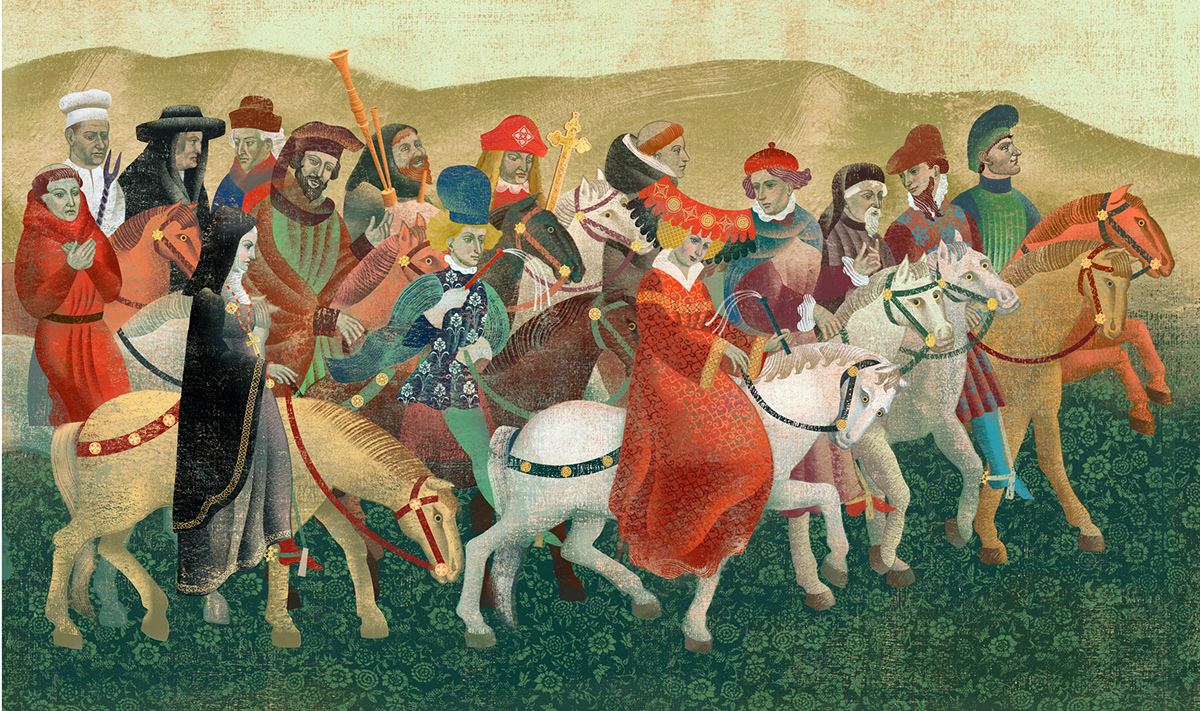
Unknown artist and date, The Pilgrimage to Canterbury

4,059 words

Part 1 of 3 (Part 2 here)

There’s an old story within a story told by a pilgrim knight about ancient Thebes and two Theban cousins named Arcite and Palamon.[1] According to everyone who knew them, no two warriors were more perfect. Arcite was “a stout man, by his face a prince . . . stern and yet noble . . . the circle of his eyes [showed] fire within him, and as a heated lion so he look[ed], his hair [hung] long behind him, black and shining like raven’s wings.” Palamon, meanwhile, was in appearance “a prince too . . . ha[d] all the ornament of honor in ‘t . . . but of a face far sweeter; his complexion [was] as a ripe grape, ruddy.”[2] The only problem with these two knights, who embodied “the glory of chivalry”?[3] They had fallen in love with the same woman, Emily. The words of praise they’d once lavished on one another had become a war of words.

Before long, a real duel was announced — to the loser, death; to the winner, the woman. Arcite, beloved of Mars, prayed for “help tomorrow in [his] battle . . . [to] grant that [he] have victory.” Palamon, beloved of Venus, did not ask for any “boast of arms, nor to have victory . . . [but] only to have [his] lady in [his] arms.” Emily, beloved of Diana to whose temple she belonged, asked to be spared marriage in favor of a chaste life as the goddess’ priestess — or if not, to “send [her] him that most desire[d] [her].”[4] The next day, the two men fought, and Mars granted Arcite victory in the fight, for he forced his cousin to yield. But as the young warrior rode forward to claim his prize, his horse threw him off, and he suffered a fatal injury. Thus, Venus upheld her promise to Palamon, and delivered his lady into “his arms.” And as the only one of the two men now available, it was Palamon who “most desire[d]” Emily, and Diana then “sent [her] him.”

It wasn’t simply the pilgrim’s words that mattered in this story; the words — the exact words — spoken by his characters mattered as much and allowed the tricky gods to keep their word to all three lovers involved in this mortal triangle. The following essay explores how words and language used in our most memorable stories have always mattered. Some were tales, others tales within tales where storytellers themselves were protagonists, but all were part of a tradition in which words — especially spoken ones — were magical things. Words have malleability, but also finality; their interpretations can vary, but their consequences may nevertheless spell irreversible doom. Whether listeners or speakers, characters in these adventures constantly admired their own cleverness and way with words — at times to their detriment; at others, to their salvation; and occasionally, to both.

NB: If you don’t like silly puns, this essay probably isn’t for you.

* * *

Throughout our history storytelling has been a ritual, or repeating game, that has aimed to enchant or ensnare its listeners. Audiences may know the raconteur manipulates them — is telling them tales — but they willingly submit to both author and story. For them, “losing” is a sweet defeat. The storytelling game’s central themes have always asked: What and how much can I get away with? Can I fool the gods/fate/more powerful people and take what I desire? Through my lovely voice, can I bring my wife back from Pluto; can I taunt a monster and live to tell the tale; what rules can I break; or, how long will my silver-tongued prevarications save me from the Sultan’s wrath? What is the limit of human intelligence, the invention of the narrative being one of the ways we have grappled with boredom, madness, plague, and all those other indignities that we, as mortal beings, must suffer to acknowledge that we are meat on bones, yet also something more? This, I believe, is the true allure of “the story”: the fusion of the ordinary with the marvelous, the desire to know what might happen next, and how all of our stories will end.

Though the legends that follow have been collated over the centuries and adapted to print, they retain the soul of orality, the lilt of verse, a song of sagas, and a celebration of the fireside circle, for they are the products of a communal voice. Reading is (in general) a solitary activity, while storytelling is an interactive, social one. It is little wonder that in each of these tales, formatted as though they entertain a spellbound audience, the spoken word has powers over life and death. A blasphemous oath dooms a dynasty; the fate of an empire hangs on the lips of a Pythia; the quivering harp of a lover swings on the cold heart of a god. So, dear readers, lie back on your settee, put on Mr. Rimsky-Korsakov’s Scheherazade, and imagine a fire-lit hall where maidens have scattered lily petals “ere the night slay light with her blue sword,” and words, like stars, hold dominion over all.

I. Hanging on Every Word: Kings and Oracles

When a king gives orders, his subjects must obey. Why? Because he said so. Therefore, “everyone” around him must say so, too — must profess his authority (in this, rule by divine right has much in common with rule by “will of the people”). As readers can imagine, this is an anxious way to live, and it might explain why in so many of our stories, kings continually sought the truth, but at the same time could not bear to hear it. They ran afoul of Fate not in spite of, but because they were warned. All of the following kings sought oracles as mouthpieces to affirm their desire for excessive power, to justify their extension of royal tenure beyond just measurement, simultaneously making them both insecure and arrogant; unable not to ask for, yet unable to handle, an answer. Even ominous prophecies only served to blandish their designs.
You can buy Tito Perdue’s Though We Be Dead Yet Our Day Will Come here.

In 59 AD, not long after he had arranged for his mother’s assassination, the Roman Emperor Nero (of Great Fire infamy) visited the oracle at Delphi, where he received no welcome. “Your presence here outrages the god you seek,” the priestess/Pythia declared. “Go back,” thou perpetrator of “matricide! The number 73 marks the hour of your downfall!” More than a little incensed at this treatment, Nero compounded his crimes against the gods by burning the Pythia alive. He then carried off over 500 bronze statues to enrich his own Roman palaces.[5] He chose to interpret the Pythia’s words to mean that he would reign until he reached the ripe old age of 73. Instead, his rule was short and overthrown by the elderly Livius Ocella Sulpicius Galba, who was 73 years old at the time of his successful coup.

Nero’s heart had always been treacherous, but sometimes it doesn’t take much to turn a loyal man into a faithless one. He simply needs to heed the words of the women around him and allow them to ruffle his masculine pride and flatter his vanity. Enter Shakespeare’s three witch-seeresses, who greeted Scottish laird Macbeth with the exclamation, “All hail, Macbeth! Hail to thee, Thane of Glamis! All hail, Macbeth! Hail to thee, Thane of Cawdor! All hail, Macbeth, that shalt be king hereafter” — a triple prophecy that promised him power above and beyond his role as a mere chieftain. Exultant at the battlefield victory he’d won against Norwegian-Irish foes whom the treasonous Thane of Cawdor had supported, and still pumping blood intoxicated with adrenaline, Macbeth’s eyes took on a wild light at the pronouncement. Of course, the real conflict began when the Three Witches turned to Macbeth’s more sensible friend Banquo and again repeated their acclamation:

Hail! Hail! Hail! Lesser than Macbeth and greater. Not so happy, yet much happier. Thou shalt get kings, though thou be none. So all hail, Macbeth and Banquo! Banquo and Macbeth, all hail![6]

While Banquo shrugged off the “Weird Sisters’ ”prophecy as drivel, their speech fired Macbeth’s anxiety and lust for power. “Stay, you imperfect speakers. Tell me more . . . I know I am Thane of Glamis. But how of Cawdor?” he asked in his pursuit, for “The Thane of Cawdor lives . . . Say why / Upon this blasted heath you stop our way / With such prophetic greeting. Speak, I charge you.”[7] But the Witch-Fates did not exist to satisfy men, and done with their work (for now), they disappeared into the drizzly Highland fog. At that moment a more quotidian messenger arrived, bearing news: Macbeth had become Thane of Cawdor, King Duncan having rewarded him with the defeated traitor’s title. It seemed that the Weird Sisters had spoken the truth. The final prophecy, that Macbeth would be king, must then also be his destiny, he reasoned. By what means, though? Unnerved and excited by the strange visit, he retired and sought out his wife, Lady Macbeth, for her advice. After a conversation by firelight, Macbeth determined to make the unreal prophecy a reality by murdering his liege-lord and thus assuming the throne himself . . . but what of Banquo? Had not the Sisters claimed that he would be “much happier” than Macbeth; that Banquo, not Macbeth, would be a “get[ter of] kings”? There was only one solution, Macbeth and his Lady agreed: Banquo must also die. Meanwhile, the dead king’s heir Malcolm, along with Macduff, the loyal Thane of Fife, fled the realm to escape both danger and accusations that they had slain the King in his bed.
You can buy J. A. Nicholl’s short story collection Venus and Her Thugs here.

Having gotten his wish to become ruler of Scotland, Macbeth could not enjoy it. Plagued by doubts and Banquo’s ghost, he called forth the Witches and asked them if his crown was safe. The crones took this opportunity to intone another seemingly paradoxical statement: “Macbeth! Macbeth! Macbeth! Beware Macduff! Beware the Thane of Fife!” How now? Would this exiled nobleman o’erthrow him? “Macbeth! Macbeth! Macbeth! . . . Be bloody, bold, and resolute. Laugh to scorn / The power of man, for none of woman born / Shall harm Macbeth.”[8] What a relief, the false king sighed, for since men have ever entered this world by a woman, none would be able to stand against him. Unfortunately, Macbeth had fallen for one of the oldest word tricks in the book, for Macduff was not literally born from a woman, but was “from his mother’s womb / Untimely ripped” during a cesarean section. On top of that, Macbeth had lost his wife and beloved partner in crime to a guilt-driven suicide. Oh, tyrant, “despair thy charms,” as thou had heard them from the fork-tongued mouths of storytellers.[9] With King Duncan’s son at his side, Macduff besieged Macbeth’s stronghold, then beheaded him. It was perhaps from this and similar stories that J. R. R. Tolkien took inspiration for the Witchking’s literal prophecy — that no man could destroy him, thus convincing the evil wraith of his false invincibility.

The Odyssey, one of the West’s oldest oral stories, might seem to fall outside the bounds of this particular theme, because as a king, Odysseus was so often the wily character who used his words to “hang” his nemeses, and not the reverse. But in the wooded Land of the Cyclopes, the ruler of Ithaca still managed to turn a prophecy into his own undoing. Part IX of the poem opened with Odysseus relating his recent exploits to Alkinoös, Prince of the Phaiakians, including how the Cloud-Lord Zeus had “roused the North Wind with a wondrous tempest” to hurl Odysseus and his pirates off course. His ships “were driven headlong, and [his] sails were torn to shreds by the violence of the” unrelenting gale. Naturally, Odysseus and his remaining crew then crashed into the worst island in the Mediterranean. Having lost most of their food, the sailors decided to explore the place for meat and to capture the wild goats that roamed “among the high peaks.”[10] And because it’s almost always been a good idea to forage in strange mines and rotten-smelling caverns carved ominously into a mountain’s bones, Odysseus led his men into a bone-filled cave.

Unfortunately for our heroes, a sadistic cyclops named Polyphemus lived there, and he rolled a great boulder across the mouth of his cozy, one-bedroom lair, trapping the men inside. Though Odysseus entreated the giant to spare their lives in the name of hospitality, Polyphemus had a “pitiless heart.” He jumped up “and put forth his hands upon [Odysseus’] comrades. Two of them . . . he seized and dashed to the earth like puppies,” and the brain flowed pulpy “upon the ground and wetted the earth.” Then this nightmarish creature “cut them limb from limb and made ready his supper, and ate them . . . leaving naught,” for he consumed “the entrails, and the flesh, and the marrowy bones” with a sickening crunch.[11] If ever the “wily fox” Odysseus needed the powers of his nimble mind, it was in the Cyclops’ hollow.

After his meal, Polyphemus asked Odysseus his name, to which the Kng told an impromptu story: “Noman is my famous name, Noman do they call me — my mother and my father, and all my comrades as well.”[12] This seemed to satisfy the Cyclops, who imagined that his prophesied doomsday that would supposedly come at the hands of a great and tall warrior-king named “Odysseus” had yet to arrive. Sated and lulled by “Noman’s” tales of woe, the monster fell into fits of snoring, loud as logs rolling down his side of the mountain. The sailors’ chance had arrived.

Odysseus and his surviving crew sharpened a “stake of olive wood” while their host slept. Then, with hearts beating madly, they heaved their weapon across the cave-floor and toward their cruel tormentor. Odysseus held for a brief moment to gather his courage and aim, then “thrust [the stake] into [Polyphemus’] eye . . . throwing [his] weight upon it from above, [and] whirl[ing] it round” with a spinning thong “as when a man bores a ship’s timber with a drill.” Around the heated thing, “the blood flowed as the eyeball burned, and its roots crackled in the fire.”[13] Shock and pain caused the now-blinded cyclops to grasp wildly around, while the sailors lashed themselves to the undersides of the sheep Polyphemus kept in his cave. Feeling only the wool and not the men, the giant allowed them to leave the blood-soaked cave at last. Meanwhile, he bellowed for his friends to help him find the man responsible for the loss of his eye.

“Who blinded you, Polyphemus?”

“Noman did this to me!” he wailed in answer. Per Odyssesus’ clever scheme, the other cyclopes quickly lost interest in their friend’s plight: If “no man” hurt you, Polyphemus, then why trouble us for aid? The freed sailors boarded their rafts and steered, hell-bent for the open water and away from the island. But if Polyphemus met his sorry fate because of Odysseus’ word trick, then the King of Ithaca doomed himself as well, for braggarts and tellers-of-tales must always take credit for their stories. Over his crew’s objections, Odysseus taunted Polyphemus as they rowed away from land, shouting “Cyclops, if any[one] shall ask thee about the shameful blinding of thine eye, say that Odysseus, the sacker of cities, blinded it, even the son of Laertes, whose home is in Ithaca,” all but providing the monster his mailing address. At the revelation of this trickery, Polyphemus appealed to his father Poseidon, O “earth-enfolder, thou dark-haired god, if indeed I am thy son and thou declarest thyself my father; grant that Odysseus, the sacker of cities, may never reach his home . . . but if it is his fate to see his friends and to reach his well-built house and his native land” once more, “late may he come and in evil case, after losing all his comrades . . . and may he find woes [unnumbered] in his house.” Hanging on his son’s every word, the “dark-haired” sea god agreed, and Odysseus soon realized that he’d fallen victim to a fatal phrasing of his own invention.[14]

II. Breaking His Word: Lovers Separated

Such declarations doomed not only kings, but husbands and wives; words could come between lovers that manifested as a lack of trust and subsequent inability to follow spoken directions. In the following tales, one Greek and the other Norwegian, warnings against the gaze — likewise a recurring motif in old stories — separated couples, sometimes for life.

Renowned musician Orpheus thought he’d died and gone to heaven on the day of his wedding to the beautiful Eurydice. But “while through the grass delighted Naiads wandered with the bride, a serpent struck its venomed tooth in her soft ankle — and she died.” It was Eurydice who had gone to Hades. Since his heart had gone with her, down the young lyre-player followed her to the Kingdom of the Dead — but how to convince the god and goddess of the Underworld to restore his bride to life? He began to strum his small harp and plaintively sing to the rulers of that shadowy realm his sorrow and desire.

“I have come,” Your Majesties, “because my darling wife stepped on a viper that sent through her veins death poison, cutting off her coming years.” I begrudge you not the ultimate mastery of all men’s souls, and so Eurydice, too, would “be yours to rule, when full of age she shall have lived the days of her allotted years. So I ask of you possession of her few days as a boon . . .

The stone-hearted Tantalus wept; even the infinite turning of Ixion’s Wheel stilled, “wonder-bound,” at Orpheus’ tragic tale. Persephone urged her husband to relent, reminding him of their own deathless love. Thus, “Pluto told [Orpheus] he might now ascend from these Avernian vales up to the light, with his Eurydice; but, if he turned his eyes to look at her” before leaving the Underworld, “the gift of her delivery would be lost.”[15]

And so Orpheus took Eurydice’s hand, and “[t]hey picked their way in silence up a steep and gloomy path of darkness. There remained but little more to climb till they would touch earth’s surface.” Wracked with a sudden anxiousness, Orpheus could not help believing she might not follow — could not stop himself from turning to gaze upon his lover who walked behind. To his horror, she instantly slipped away, though he “stretched out to her his despairing arms, eager to rescue her, or feel her form, but could hold nothing save the yielding air.” Eurydice thus died “a second time,” but “she could not say a word of censure of her husband’s fault.” Indeed, his only fault was “his great love.” As she fell into the maw of the Classical black hole, “her last” and barely audible word “spoken [to him] was, ‘Farewell!’”[16] Then, a dreadful silence. Orpheus had failed to follow Pluto’s directions to the letter, and so he lost the prize for which he’d traveled all the paths beneath heaven and earth.
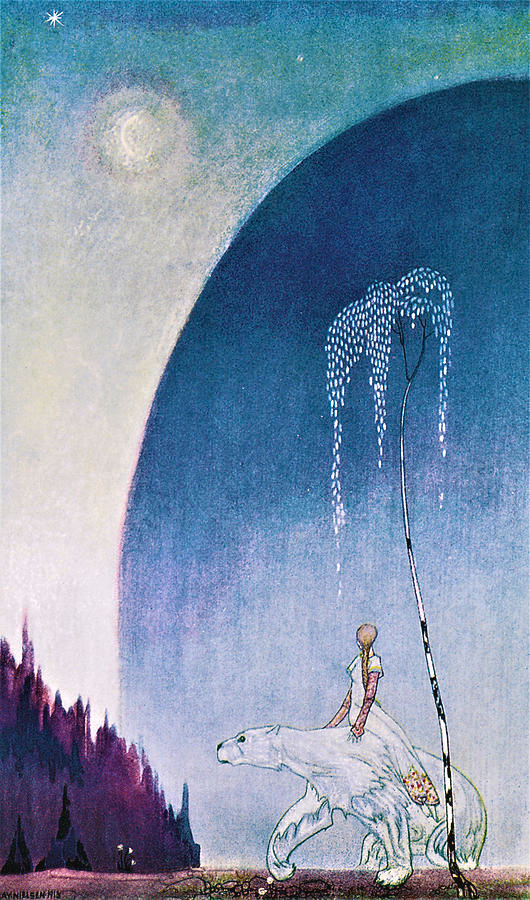
Kay Nielsen, East of the Sun and West of the Moon, ca. 1920

The ancient Greek writer Apuleius’ tale of Psyche and Cupid followed in the tradition of broken rules and forbidden gazes, inspiring other peoples to tell similar tales with a few culture-specific twists woven within them. One such story was the Scandinavian myth, “East of the Sun and West of the Moon.” Somewhere in the ancient North, a poor woman was compelled by her family to marry a White Bear in exchange for riches. In the spirit of fairy tales and their outlandish episodes that further their plots, but episodes that are nonetheless easy to accept, “East of the Sun’s” man-bear gave his new bride puzzling instructions. Never was she to look on his form after dark, but instead to keep their bedroom wrapped in a blackness deeper than night. His next admonition was stranger still: When visiting the family that she’d reluctantly left behind, she should never be alone in a room with her mother. Darling, beware that she will “take you by the hand and try to lead you into a room [by yourselves] to talk,” he warned. Be on your guard against this, “or else you’ll bring bad luck on both of us.” Few characters in this literary genre can resist temptation, and the young woman found herself confessing to her mother “the whole story” — how at the end of every day and “as soon as she had put out the light,” a man lay down beside her. Never could she catch a glimpse of him, for “he was always up and away before the morning dawned.”[17]
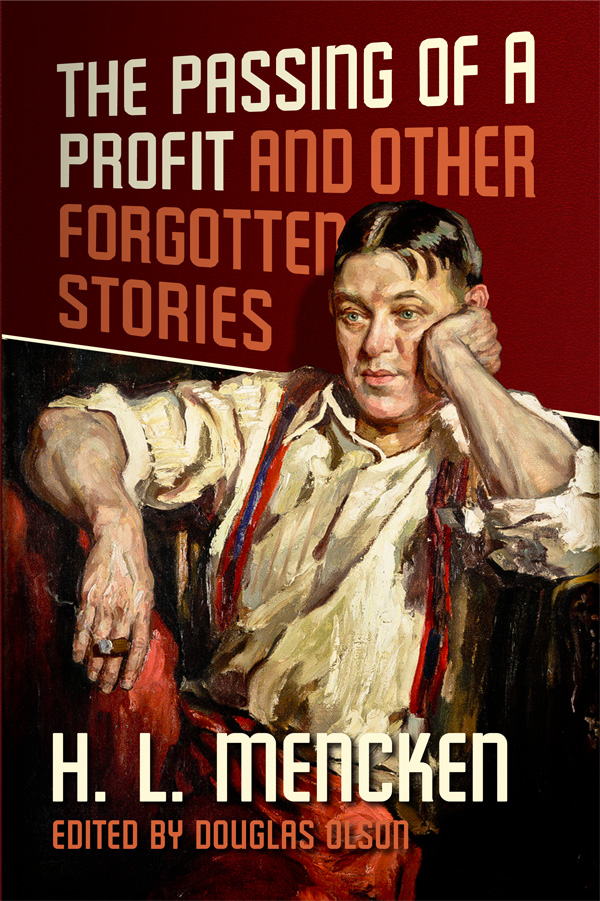
You can buy H. L. Mencken’s The Passing of a Profit and Other Forgotten Stories here.

How awful! her mother said. What if he was “a troll you slept with?” She gave her daughter a small piece of candle that she could light and thus “set eyes on him” — only “take care not to drop the tallow on him” as he lay in bed, her mother advised. When the daughter returned to the White Bear and her evening ritual, she waited for the “dead of night” to descend and for the sounds indicating that her mysterious midnight visitor lay sleeping. She got up, lit the candle, and “let the light shine on him.” To her amazement, she saw no bear or troll, but “the loveliest prince one ever set eyes on,” and so fell deeply in love. But while giving him a kiss, “she dropped three hot drops of tallow on his shirt,” causing him to wake from the sting.[18] If anyone is counting, that was the third rule she broke.

“What have you done?” the handsome man demanded. Had she only followed his directions and held out for a year, he would have been freed from his wicked stepmother’s curse that caused him to live as a bear by day and as a man by night. Since she had failed to curb her curious gaze’s desire, “all ties [were] snapped between” them. Now he had to set off from his bride to his stepmother, who lived in a castle that stood “East of the Sun and West of the Moon.” There, he would be forced to marry a princess with a “nose [of] three arm’s lengths.”[19]

In contrast to Orpheus’ ultimate failure to reunite with his wife after braving the unknown, this story ends happily. Even so, the young woman’s journey to find her beloved and thus to atone for ignoring his explicit rules was filled with sorrow and frustration, for she ironically had to rely on asking for directions while receiving little but vague replies. To everyone whom she met along the road, she repeated the question: “Did they know the way to the Prince who lived with his stepmother in the castle that lay East of the Sun and West of the Moon, and who was to marry the princess with a nose three arm’s lengths?” Perhaps the neighbor some leagues distant would know, they’d say. Perhaps she’d better “ride to the East Wind and ask him,” they suggested — words that nearly drove her to an everlasting despair.[20]

However wonderful were the legends I’ve just told you, readers, they cannot compare with the stories of demonic tricksters, world conquerors, and northern bargainers, which I shall resume tomorrow evening.

* * *

Like all journals of dissident ideas, Counter-Currents depends on the support of readers like you. Help us compete with the censors of the Left and the violent accelerationists of the Right with a donation today. (The easiest way to help is with an e-check donation. All you need is your checkbook.)

GreenPay™ by Green Payment

Select donation type

Select or enter an amount to give

Select or enter an amount to give monthly

For other ways to donate, click here.

Notes

[1] I refer to Geoffrey Chaucer’s “Knight’s Tale,” though others have since retold it, most notably in William Shakespeare and John Fletcher’s play, The Two Noble Kinsmen (1594). In Chaucer’s unfinished Canterbury Tales, written in verse, a large group of pilgrims (including a knight, a prioress, a miller, a remarried widow, a pardoner, and a merchant) set out from London to visit the shrine of Canterbury; they have a storytelling contest along the way, the winner of which will receive a free meal at an inn. The “Knight’s Tale” is the story of Arcite and Palamon and the longest of Chaucer’s narrations.

[2] William Shakespeare & John Fletcher, The Two Noble Kinsmen, IV.ii (New York: Folger Shakespeare Library, 2010), 183.

[3] Geoffrey Chaucer, The Canterbury Tales (New York: Bantam, 1981), 103; original Middle English phrase: “encrees of chivalrye.”

[4] Canterbury Tales, 113, 105, 109.

[5] “Panhellenic Sanctuary of Pythian Apollo,” Perseus Digital Library, 2023.

[6] William Shakespeare, Macbeth, I.iii (Folger Shakespeare Library, 2012), 18-19.

[7] Macbeth, I.iii, 19.

[8] Ibid., IV.i, 125.

[9] Ibid., V.viii, 185.

[10] Homer, The Odyssey, Richmond Lattimore, trans. (New York: Harper, 2007), 139-140.

[11] Odyssey, 145.

[12] Ibid., 146.

[13] Ibid., 147.

[14] Ibid., 147, 150, 151.

[15] Ovid, Metamorphoses, Brookes More, trans. (Boston: Cornhill Publishing Co., 1922), 125.

[16] Metamorphoses, 126.

[17] George Webbe Dasent, “East of the Sun and West of the Moon” in East of the Sun and West of the Moon: Old Tales from the North, Noel Daniel, ed. (Cologne: Taschen, 2021), 60.

[18] “East of the Sun,” 61-62.

[19] Ibid., 62.

[20] Ibid., 64.

By the Twisted Word, Slain; By the Good Word, Saved . . . & Other Stories Part I

By%20the%20Twisted%20Word%2C%20Slain%3B%0ABy%20the%20Good%20Word%2C%20Saved%20.%20.%20.%0Aandamp%3B%20Other%20Stories%0APart%20I%0A

Share

  • Gab

Enjoyed this article?

Be the first to leave a tip in the jar!

Instant Echeck GreenPay™

Related

  • Finding Atlantis Part 3: The Stories We Tell

  • The Union Jackal

  • To Yin or Not to Yang: Male and Female Spirituality in Hamnet

  • Finding Atlantis Part 1

  • A Life of Seneca

  • The Return

  • By Any Other Name: Was Shakespeare a Woman?

  • My literary ballet

Tags

ApuleiusArcitecyclopsEast of the Sun and West of the MoonEmperor NeroEurydiceHomerKathryn SlanguageMacbethmythNeroOdysseusoraclesOrpheusPalamonPsyche and Cupidthe OdysseyWilliam Shakespeare
Upcoming podcasts
  • Rob Rundo on Counter-Currents Radio

    Rob Rundo on Counter-Currents Radio

    Counter-Currents Radio

    Sat, Jun 13th — 3 pm EST / 9 pm CET
  • Daniel Tyrie on Counter-Currents Radio

    Daniel Tyrie on Counter-Currents Radio

    Counter-Currents Radio

    Sat, Jun 20th — 3 pm EST / 9 pm CET

Writers of May

(2 votes) Morris van de Camp David M. Zsutty Derek Stark Jayant Bhandari Greg Johnson

Articles of May

The Lunch Wars by David M. Zsutty Heidegger on Nietzsche, Part One by Collin Cleary 2 votes
    • Black Intellectual Fatigue

      Derek Stark

      12

    • Why White Advocates Should Avoid “Based Blacks”

      Dani Vypont

      10

    • Nietzsche & Race

      Mark Gullick

    • Editor’s Update
      Rob Rundo Rescheduled to Next Week on Counter-Currents Radio;
      Tonight Greg Johnson & David Zsutty Answer Your Questions;
      Fundraiser Update & a New $20,000 Matching Grant

      Greg Johnson

    • The Counter-Currents 2026 Fundraiser
      Lifetime Subscriber Welcome Packages Extended

      Greg Johnson

    • Nationalism This Week
      Who’s Looking Back?

      Greg Johnson

      25

    • China’s Threat to American Security:
      Food, Farmland, Foreign Control, & Energy Policy

      Lipton Matthews

      5

    • The Bitter End of Western Metaphysics:
      Heidegger on Nietzsche, Part Two

      Collin Cleary

      13

    • The Killing of Henry Nowak

      Mark Gullick

      31

    • The Crisis of Chinese Technology Thieves

      Morris van de Camp

      1

    • The Strange World of Gender Bender Fiction:
      & What This Genre Tells Us About Autosexuality

      Dani Vypont

      3

    • Watching the Watchers:
      The Dark Triad Question

      David M. Zsutty

      14

    • The Remigration Movement Solidifies

      F. Roger Devlin

      1

    • Casting Aspersions:
      The Fatal Consequences of Race-Swapped Casting, From Helen of Troy to Henry of Southampton

      Steven Tucker

      20

    • The Murder of Henry Nowak

      Millennial Woes

      23

    • Don’t Forget to Vote in Our Writer & Article of the Month Poll

      Greg Johnson

    • The Robot Hotdog Stand

      Greg Johnson

      35

    • Laughing Our Way to Victory

      Dave Chambers

      7

    • The Zodiac Killer

      Mark Gullick

      11

    • Jared Taylor: What Rome Means to Me

      Jared Taylor

      1

    • An Interview with Endeavour:
      My Way of Life Is an Adventure!

      Ondrej Mann

      6

    • José Pedro Zúquete’s The Identitarians

      Greg Johnson

      3

    • Editor’s Update
      Fundraiser Update & How to Watch the Remigration Summit

      Greg Johnson

      5

    • The Bitter End of Western Metaphysics:
      Heidegger on Nietzsche, Part One

      Collin Cleary

      11

    • Berlin: City of Stones

      Spencer J. Quinn

      6

    • True Folk-Horror Is Horror of Your Own Folk:
      Mark Gatiss vs the Brexit Blind Dead  

      Steven Tucker

      4

    • Counter-Currents Radio Podcast No. 689
      Thomas Massie, the America 2050 Bust, the Need for Whites to Divest from America, the AI Economic Apocalypse, & Pro-White Project Pitches to Billionaires

      Counter-Currents Radio

      7

    • Nationalism This Week
      Remigration is Inevitable, Part 3

      Greg Johnson

      27

    • Why Billionaires Should Fund White Identity Politics

      Lipton Matthews

      8

    • How Cold War Two Came About

      Morris van de Camp

      5

    • Now Available for Pre-Order at a Special Price!
      Greg Johnson’s The Philosopher Is In

      Greg Johnson

    • David Zsutty’s Elevator Pitch to a Billionaire

      David M. Zsutty

      1

    • Headbanging Lite

      Mark Gullick

      5

    • White Advocacy Past and Present

      Peter Bradley

      13

    • The Lunch Wars

      David M. Zsutty

      47

    • The Russians are Coming/The Russians are Coming

      Steven Clark

      1

    • Peak Fatigue in Fort Wayne

      Gabriel Anderson

      24

    • Keith Woods’ Elevator Pitch to a Billionaire

      Keith Woods

    • The Cruelty of Kindness

      Morris van de Camp

      9

    • Predation Wearing the Mask of Civilization

      Jayant Bhandari

      13

    • The Mandalorian & Grogu

      Trevor Lynch

      24

    • Editor’s Update
      Fundraiser Update & a New $20,000 Matching Grant
      Greg Johnson & David Zsutty Discuss Thomas Massie on Counter-Currents Radio

      Greg Johnson

      2

    • How the Jews Defeated Thomas Massie—& Themselves

      David M. Zsutty

      25

    • Jared Taylor’s Elevator Pitch to a Billionaire

      Jared Taylor

      15

    • Nationalism This Week
      Remigration Is Inevitable, Part 2

      Greg Johnson

      8

    • Could Fascism Work?

      Mark Gullick

      40

    • Jonathan Bowden’s Deliverance
      Part 7

      Jonathan Bowden

    • China’s Quiet Hand:
      Influence, Infiltration, & the Western Blind Spot

      Lipton Matthews

      9

    • Counter-Currents Radio Podcast No. 688
      Tyler Dykes on Running for US Congress in South Carolina

      Counter-Currents Radio

      4

    • Lothrop Stoddard’s The Revolt Against Civilization

      Spencer J. Quinn

      14

    • DarkPlato

      Black Intellectual Fatigue

      I think it’s cruel to put blacks in prison.  They can’t understand cause and consequence and are not...

    • Connor McDowell

      Black Intellectual Fatigue

      Yeah that’s why I said “that’s where we already are in many respects” as far as the lowering of...

    • Derek Stark

      Black Intellectual Fatigue

      You’re not totally wrong; our rules and institutions were created from a white perspective. But even...

    • Connor McDowell

      Black Intellectual Fatigue

      So I’m going to offer a comment that might ruffle some feathers, but I think it is true and needs to...

    • Joe Gould

      Black Intellectual Fatigue

      Anyway, Derek Stark is right. Even a a sign of increased Black fatigue of a purely academic and...

    • Joe Gould

      Black Intellectual Fatigue

      Cohabitation with other races is harm to Whites. Cohabitation with Blacks is harm to Whites....

    • Glide Ratio 0:1

      Why White Advocates Should Avoid “Based Blacks”

      I don't know anyone who considers Candice Owens "based". She's seen as a schizo who talks about...

    • Glide Ratio 0:1

      Why White Advocates Should Avoid “Based Blacks”

      We have a regular based black writer here on CC. Is it a good thing when nons know what is actually...

    • Lord Snooty

      The Game of Tarot

      "It had previously been simply the Rider-Waite deck, after its non-artistic creator, Arthur Rider-...

    • ArminiusMaximus

      Black Intellectual Fatigue

      We will know the tide has turned when scholars like Staddon begin writing papers and cultural ing...

    • Eric

      Black Intellectual Fatigue

      Greetings.  "Black intellectuals" are also known as, "professional negroes."

    • Collin Cleary

      Heidegger on Nietzsche, Part Two

      Perhaps the irony here is that he was mistaking appearance (what appears to a human subject) as...

    • Sam JP

      Why White Advocates Should Avoid “Based Blacks”

      There's nothing special about being based, it's just the baseline common sense and self-respecting...

    • Collin Cleary

      Heidegger on Nietzsche, Part Two

      No, Heidegger wasn't an influence on either.

    • Scott

      China’s Threat to American Security

      I don’t fear or hate the Chinese. But China is still a Communist nation and they will never be our...

    • Eric

      Black Intellectual Fatigue

      Thank you very much for this fine article.  One book opens another.  Mr. Stark has...

    • Scott

      Why White Advocates Should Avoid “Based Blacks”

      Agree with most of the article. Spot on about Negroes and the dusky grifter, Candace Owens.However,...

    • Hugo Raven

      China’s Threat to American Security

      Much ado about nothing. So China has acquired a strong position in some minor industry or in a...

    • White Lives Matter!

      The Killing of Henry Nowak

      Great coment. This pray, pray, pray nonsense makes me sick too. No, I won't pray for Nowak's...

    • Will Williams

      Black Intellectual Fatigue

      Am I the only White racial nationalist who is fatigued from Black “intellectual” Lip Man Matthews...

    • Earth Day Special

      John Morgan

      12

    • A Robertson Roundup
      Remembering Wilmot Robertson
      (April 16, 1915 – July 8, 2005)

      Margot Metroland

      13

    • The Paranoid Style in White Nationalism

      Greg Johnson

      30

    • Join the Dance!

      Andrew Hamilton

      1

    • We Can’t Save the Earth Without Reducing African Birth Rates

      James Dunphy

      36

    • “I’m Not a Conspiracy Theorist, but . . .”:
      Jeffrey Epstein’s Death Gives New Life to “Conspiracy Theories”

      Greg Johnson

      22

    • Sylvia Plath: Stasis in Darkness

      Vic Olvir

      17

    • Vanguardism, Vantardism, & Mainstreaming

      Greg Johnson

      80

    • Aviation, Geography, & Race

      Charles Lindbergh

      3

    • Some Thoughts on Yule

      Collin Cleary

      4

    • Living in Truth:
      A Yuletide Homily

      Jef Costello

      7

    • John Kennedy Toole’s A Confederacy of Dunces

      Greg Johnson

      20

    • On Aleksandr Solzhenitsyn’s Warning to the West

      Spencer J. Quinn

      7

    • Elitism, British Modernism, & Wyndham Lewis

      Jonathan Bowden

      6

    • Philip K. Dick’s Do Androids Dream of Electric Sheep? as Anti-Semitic/Christian-Gnostic Allegory

      Greg Johnson

      20

    • “Conspiracy Theory” or Conspiracy?

      Andrew Hamilton

      21

    • Remembering H. P. Lovecraft
      (August 20, 1890–March 15, 1937)

      Greg Johnson

      3

    • Who Are We?
      Nordics, Aryans, & Whites

      Greg Johnson

      71

    • Remembering William Gayley Simpson
      (July 23, 1892–December 31, 1990)
      A Pleasant Afternoon with Harriet & Bill Simpson

      Margot Metroland

      18

    • Here are the Young Men
      Remembering Ian Curtis
      (July 15, 1956–May 18, 1980)

      Mark Gullick

      18

    • Percy Grainger
      Artist of the Right

      Alex Graham

      7

    • Remembering Revilo Oliver
      (July 7, 1908–August 20, 1994)

      Greg Johnson

      18

    • The Meaning of July 4th for the White Man

      Gregory Hood

      13

    • The Front National’s Evolution

      Bruno Mégret

    • Merwin K. Hart
      Forgotten American Hero & Man of the Right

      Morris van de Camp

      10

    • George Orwell’s Nineteen Eighty-Four

      Jonathan Bowden

      8

    • Carleton S. Coon
      Scientist & Reluctant White Advocate

      Morris van de Camp

      3

    • The Kwanzaa Absurdity Will Be Dwarfed by Juneteenth

      Robert Hampton

      10

    • Stravinsky

      Alex Graham

      7

    • Like the Roman:
      Remembering Enoch Powell (1912-1998)

      Mark Gullick

      23

    • Neo-Fascism in Film
      Part 5

      Karel Veliky

      15

    • The Game of Tarot

      Mark Gullick

      2

    • Institutions Cannot Be Transplanted

      Jayant Bhandari

      5

    • Jonathan Bowden’s Deliverance
      Part 5

      Jonathan Bowden

    • Crosstown Traffic:
      Jimi Hendrix & The Post-War Rock ‘N’ Roll Revolution

      Mark Gullick

      1

    • Slaves from the North:
      Finns & Karelians in the East European Slave Trade, 900–1600

      Lipton Matthews

      14

    • Neo-Fascism in Film
      Part 4

      Karel Veliky

      2

    • David Lean’s A Passage to India

      Spencer J. Quinn

      1

    • Elites are Essential to Development

      Lipton Matthews

      7

    • Jonathan Bowden’s Deliverance
      Part 4

      Jonathan Bowden

    • Neo-Fascism in Film
      Part 3

      Karel Veliky

      6

    • E. M. Forster’s A Passage to India & the Indian Mentality

      Spencer J. Quinn

      25

    • Jonathan Bowden’s Deliverance
      Part 3

      Jonathan Bowden

    • The Rest Is Silence
      Heidegger’s Quietism

      Mark Gullick

      2

    • Dispelling the Historical Fallacy of Indian Nationalism

      Lipton Matthews

      8

    • Neo-Fascism in Film
      Part 2

      Karel Veliky

      8

    • Jonathan Bowden’s Deliverance
      Part 2

      Jonathan Bowden

    • Life of a Klansman

      Mark Gullick

      8

    • Jonathan Bowden’s Deliverance, Part 1

      Jonathan Bowden

    • Decolonial Ideas are Holding Back Developing Countries

      Lipton Matthews

      8

    • Neo-fascism in Film, Part 1

      Karel Veliky

      21

    • Jonathan Bowden’s Onslaught, Part 8
      Divigations on Decadence

      Jonathan Bowden

    • Jonathan Bowden’s Onslaught, Part 7
      Intrigues in the National Front

      Jonathan Bowden

      1

    • Rotten to the Core

      Mark Gullick

      8

    • Strauss on Husserl’s “Philosophy as Rigorous Science”

      Greg Johnson

    • Jonathan Bowden’s Onslaught, Part 6
      Francis Bacon & Right-Wing Nihilism

      Jonathan Bowden

    • London After (& Before) Midnight:
      Aleister Crowley, The Landlord’s Worst Nightmare

      James J. O'Meara

      2

    • Jonathan Bowden’s Onslaught, Part 5
      The Post-War British Far Right

      Jonathan Bowden

    • No Rules: Rollerball

      Mark Gullick

      4

    • Jonathan Bowden’s Onslaught, Part 3
      Brett Easton Ellis’ American Psycho

      Jonathan Bowden

    • András László
    • Derek Hawthorne
    • Beau Albrecht
    • Alain de Benoist
    • Kerry Bolton
    • Jonathan Bowden
    • Collin Cleary
    • Jef Costello
    • Savitri Devi
    • Julius Evola
    • Jim Goad
    • Gregory Hood
    • Juleigh Howard-Hobson
    • Greg Johnson
    • Charles Krafft
    • Anthony M. Ludovici
    • Trevor Lynch
    • H. L. Mencken
    • J. A. Nicholl
    • James J. O’Meara
    • Christopher Pankhurst
    • Tito Perdue
    • Michael Polignano
    • Spencer J. Quinn
    • Fenek Solère
    • Irmin Vinson
    • Leo Yankevich
    • Francis Parker Yockey
    • Multiple authors
  • Editor-in-Chief

    • Greg Johnson, Ph.D.

    Featured Writers

    • Beau Albrecht
    • Gunnar Alfredsson
    • Collin Cleary, Ph.D.
    • Jef Costello
    • Morris V. de Camp
    • F. Roger Devlin, Ph.D.
    • Stephen Paul Foster, Ph.D.
    • Jim Goad
    • Alex Graham
    • Mark Gullick, Ph.D.
    • Greg Johnson, Ph.D.
    • Travis LeBlanc
    • Trevor Lynch
    • Margot Metroland
    • James J. O’Meara
    • Angelo Plume
    • Spencer J. Quinn
    • Fred Reed
    • Clarissa Schnabel
    • Michael Walker
    • David M. Zsutty

    Frequent Writers

    • Asier Abadroa
    • Aquilonius
    • Alain de Benoist
    • Kerry Bolton, Ph.D.
    • Dave Chambers
    • Steven Clark
    • James Dunphy
    • Endeavour
    • Richard Houck
    • Jason Kessler
    • Titus Livius
    • Ondrej Mann
    • Lipton Matthews
    • Mark Mazari
    • John Morgan
    • Jaroslav Ostrogniew
    • Kathryn S.
    • Christian Secor
    • Anne Wilson Smith
    • Thomas Steuben
    • William De Vere
    • Kenneth Vinther
    • Max West

    Classic Authors

    • Maurice Bardèche
    • Jonathan Bowden
    • Julius Evola
    • Guillaume Faye
    • Ernst Jünger
    • Kevin MacDonald, Ph.D.
    • D. H. Lawrence
    • Charles Lindbergh
    • Jack London
    • H. P. Lovecraft
    • Anthony M. Ludovici
    • Sir Oswald Mosley
    • National Vanguard
    • Friedrich Nietzsche
    • Revilo Oliver
    • William Pierce
    • Ezra Pound
    • Saint-Loup
    • Savitri Devi
    • Carl Schmitt
    • Miguel Serrano
    • Oswald Spengler
    • P. R. Stephensen
    • Jean Thiriart
    • John Tyndall
    • Dominique Venner
    • Leo Yankevich
    • Francis Parker Yockey

    Other Authors

    • Howe Abbott-Hiss
    • Michael Bell
    • Giles Corey
    • Jack Donovan
    • Richardo Duchesne, Ph.D.
    • Emile Durand
    • Guillaume Durocher
    • Mark Dyal
    • Tom Goodroch
    • Andrew Hamilton
    • Robert Hampton
    • Huntley Haverstock
    • Derek Hawthorne
    • Gregory Hood
    • Juleigh Howard-Hobson
    • Alexander Jacob
    • Ruuben Kaalep
    • Tobias Langdon
    • Julian Langness
    • Patrick Le Brun
    • G A Malvicini
    • John Michael McCloughlin
    • Millennial Woes
    • Michael O’Meara
    • Christopher Pankhurst
    • Michael Polignano
    • J. J. Przybylski
    • Quintilian
    • Edouard Rix
    • C. B. Robertson
    • C. F. Robinson
    • Herve Ryssen
    • Alan Smithee
    • Fenek Solere
    • Ann Sterzinger
    • Robert Steuckers
    • Tomislav Sunic
    • Donald Thoresen
    • Marian Van Court
    • Irmin Vinson
    • Book Reviews
    • Movie Reviews
    • TV Reviews
    • Music Reviews
    • Art Criticism
    • Graphic Novels & Comics
    • Video Game Reviews
    • Fiction
    • Poems
    • Interviews
    • Videos
    • English Translations
    • Other Languages
      • Arabic
      • Bulgarian
      • Croatian
      • Czech
      • Danish
      • Dutch
      • Estonian
      • Finnish
      • French
      • German
      • Greek
      • Hungarian
      • Italian
      • Lithuanian
      • Norwegian
      • Polish
      • Portuguese
      • Romanian
      • Russian
      • Slovak
      • Spanish
      • Swedish
      • Ukrainian
    • Commemorations
    • Why We Write
  • Archives
  • Top 100 Commenters
  • The Looney Bin
Sponsored Links
Europa.com Above Time Coffee Antelope Hill Publishing Paul Waggener IHR-Store Spencer J. Quinn American Renaissance Jim Goad The Occidental Observer
Donate Now Mailing list
Books for sale
  • The Philosopher Is In
  • Sexual Utopia in Power (Expanded Edition)
  • In Defense of Prejudice
  • Loving Our Own
  • Tyranny & Wisdom
  • The Populist Moment
  • Is America Doomed?
  • To all books
Copyright © 2026 Counter-Currents Publishing, Ltd.

Paywall Access


Please enter your email address.

Lost your password?

Edit your comment

Writer & Article of the Month May 2026

Voting for this month has concluded. Here are the final results!

Top Writers

  • #1 Morris van de Camp 2 votes
  • #2 David M. Zsutty 2 votes
  • #3 Derek Stark 2 votes
  • #4 Jayant Bhandari 2 votes
  • #5 Greg Johnson 2 votes
  • #6 Jared Taylor 1 vote
  • #7 Collin Cleary 1 vote
  • #8 Spencer J. Quinn 1 vote
  • #9 Mark Gullick 1 vote
  • #10 Lipton Matthews 1 vote
  • #11 Keith Woods 1 vote
  • #12 Steven Tucker 1 vote

Top Articles

  • #1 The Lunch Wars 2 votes
  • #2 Heidegger on Nietzsche, Part One 2 votes
  • #3 Could Fascism Work? 1 vote
  • #4 Jared Taylor's Elevator Pitch to a Billionaire 1 vote
  • #5 Predation Wearing the Mask of Civilization 1 vote
  • #6 Peak Fatigue in Fort Wayne 1 vote
  • #7 Keith Wood's Elevator Pitch to a Billionaire 1 vote
  • #8 Do You Want to Play a Game? 1 vote
  • #9 Why Billionaires Should Fund White Identity Politics 1 vote
  • #10 The 1970s: The Golden Age of Hijacking 1 vote
  • #11 True Folk-Horror Is Horror of Your Own Folk 1 vote
  • #12 Finding Atlantis Part 4 1 vote
  • #13 Berlin: City of Stones 1 vote
  • #14 The Ghost of the Confederacy 1 vote
  • #15 Lothrop Stoddard’s The Revolt Against Civilization 1 vote

Total votes cast: 17