 5,983 words
Kent & Phoebe Courtney
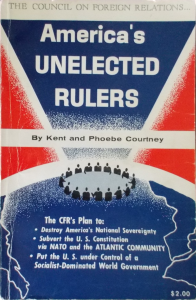
America’s Unelected Rulers
New Orleans: Conservative Society of America, 1962
America’s Unelected Rulers shines a spotlight on the Council on Foreign Relations of nearly six decades ago. All told, it’s an interesting blast from the past, and a reminder that some things never change.
Kent Courtney is fairly obscure these days, though he did have some impact in times past. As his biography indicates, he had a colorful career. Highlights from that include involvement in the John Birch Society and the States Rights Party, publishing the Independent American periodical (formerly Free Men Speak), writing a few books, and — prefiguring David Duke — running for Governor of Louisiana. All told, these activities weren’t too deplorable, as Cupcake termed it. However, that moderate level of deplorability still was enough to qualify for membership in the Boomer-era Dissident Right.
Phoebe was his wife and co-author. They later divorced, but she kept on writing. Her book catalog seems a little Boomerish by today’s standards, and also not very deplorable. Still, she did have her moments. Most notably, she tracked goings-on in the CFR up through 1993 during Slick Willie’s administration. The organization, although highly influential, remains obscure even now. Prior to the Internet, there would’ve been hardly any awareness among the public about what it did, or even that it existed, and no good way to research it or compare notes.
All told, America’s Unelected Rulers discusses many hidden agendas and much monkey business going on behind the scenes. If the authors are right about all that, then apparently the government doesn’t always work the way you learned it did during your civics class. Who knew, right?
Conspiracy theory or conspiracy fact?
Probably since the late Pleistocene Epoch, Leftists have been complaining about the extremely wealthy having far too much sway over the political system. Quite strangely, they snicker about “conspiracy theories” as soon as Rightists agree with their basic proposition but start naming names or otherwise getting specific. As I put it in Deplorable Diatribes about the sneakier types of globalists:
Looking at it another way, none of the following are unprecedented:
-
- People forming groups (legitimate or otherwise) to promote common interests;
- Dishonest characters keeping unsavory activities secret; and
- Influencing politicians and officials through large campaign contributions or outright bribery.
When blue-collar criminals do those things, it’s an organized crime syndicate. When that’s done by the wealthy and powerful, it’s a garden-variety cabal. This isn’t too hard to comprehend. Understandably, they’re not very forthcoming about these activities.
In public matters, arrangements with little transparency that are obscured from sight will create a blurry picture, one that easily can be written off as a mirage. Still, sometimes focusing in carefully can yield surprising results. The problem is that it’s difficult to call out institutions that have little to no recognition by most of the public; it may come across like alarmism, at best. Therefore, before delving into the text, let’s make an analogy in very simple terms and then discuss the implications.
First, a thought experiment
Suppose you discover that most of the Cabinet-level appointees under Democratic administrations are high-ranking Girl Scouts leaders. That’s an interesting data point. Then you find that it’s the same for Republican administrations. The CIA and the State Department are full of adorable little nature-appreciating cookie vendors, and they’re not too hard to find in other bureaus too. Moreover, even some Presidents were Girl Scouts. Candidates who weren’t members still had to get their approval to win a nomination, and each had a pantry packed to the ceiling with Thin Mints. In that case, conventional politics might be a lively contest, but it’s about as “real” as professional wrestling.
Even more surprisingly, that’s mostly how it’s been for the last century. The only recent exception was the last Presidential campaign, when a candidate got nominated and elected without being preapproved by the Girl Scouts. The entire establishment went berserk — even his own party. The brouhaha still wasn’t over after an impeachment attempt turned out to be a complete nothingburger.
If all that is so, then we’ve gone from interesting data points to a full-blown coinkydink. You might wonder — what’s the deal with those Girl Scouts? How did they accumulate such power, and why? What do they want, and what does it mean for the country? Does this mean they’re calling the shots behind the scenes, and if so, what gives them the right? In fact, one would have to be willfully ignorant to understand the facts but refuse to consider the possible implications.
Not quite the Girl Scouts
This odd thought experiment does have an approximate real-world parallel with the top three globalist clubs: the Council on Foreign Relations, the Bilderberg Group, and the Trilateral Commission. The former is the oldest and fairly exclusively American; the other two essentially are more internationally oriented spinoffs. They, in turn, sometimes create subordinate organizations for influencing foreign policy or promoting social agendas. If the globalist clubs were merely lobbying agencies for the wealthy, it wouldn’t be too remarkable, but it seems that they’re quite ambitious.
Nothing in this document is meant to say that they’re all bad people, or even that all members agree with the entire agenda. Still, the accumulation of great power in very exclusive private clubs, and largely outside of public view, is troubling. Neither does this mean that they rule the world, or even have absolute control over the USA. The establishment, of which the globalist clubs are an important part, is better described as the 800-pound gorilla in Washington that few among the public realize is there. All that said, I should add that they’re only part of the Deep State. Other organizations and informal circles exist, some with varying degrees of overlap.
From the outside, the three foremost globalist clubs may seem like think tanks for rich policy wonks, but effectively they might as well be unofficial staffing agencies for top government positions. A large part of the membership includes extremely wealthy businessmen. Among them are CEOs and directors of major multinational corporations, some having greater gross revenue than the GDP of some developing countries. There are also key politicians and media figures. According to some critics, their purpose is to be proxies of the billionaire businessmen. There are some celebrities whose role likely is for public relations. Some members are related to others, giving the organization a semi-dynastic character. All told, some members are famous, but for many others, hardly anyone has heard of them.
That much isn’t proof that they’re up to no good, but it’s understandable that this sort of thing might cause concern. Some critics consider these insiders to be a shadow government, in private hands and unaccountable to the public. (One needn’t be much of a cynic to wonder if the New World Order idea is appealing to those who expect to be in charge.) The members tend to be globalist in their political alignment. As a whole, opinions range from neoconservatives to neoliberals. The difference, of course, is as meaningful as the momentous choice between vanilla and French vanilla. Perhaps this is why it doesn’t matter who the public elects; we get the same thing.
Oligarchy 101
You can buy Greg Johnson’s Graduate School with Heidegger here
America’s Unelected Rulers makes several similar points to the above. With some striking quotes, it opens detailing the political establishment. (The counterculture soon would adopt this term, using it in a fuzzier and more expansive context. They also became notorious for thinking they were fighting The System while actually doing its bidding, not so different from today’s Leftists.) In more recent times, of course, this establishment is called the Deep State.
One of its more influential members was Arthur M, Schlesinger, Jr., a Harvard professor who became an advisor to President Kennedy. (In his later years, he got somewhat more sensible.) In 1947, he had written an article in the Partisan Review, regarded by the Courtneys as a transmission belt publication. Part of it included the following statement, a good summary of what they wanted and how they planned to implement it:
Socialism appears quite practicable . . . as a long-term proposition. Its gradual advance might well preserve order and law, keep enough internal checks and discontinuities to guarantee a measure of freedom, and evolve new and real forms for the expression of democracy. The active agents in effecting the transition will probably be, not the working class, but some combination of lawyers, business and labor managers, politicians, and intellectuals, in the manner of the first New Deal, or of the Labour Government in Britain.
Now how does that sound so familiar? This revolutionary vanguard is essentially identical to what Sam Francis called the managerial elite.
All told, the authors identified the Council on Foreign Relations as the flagship institution of the American establishment. As another characteristic policy statement, they quote from the Fulbright Memorandum, “which urged the muzzling of the military who warn of the Communist threat.”
In the long run it is quite possible that the principal problem of leadership will be, if it is not already, to restrain the desire of the (American) people to hit the Communists with everything we’ve got, particularly if there are more Cubas and Laoses. Pride in victory and frustration in restraint, during the Korean War, led to MacArthur’s revolt and McCarthyism.
So they were holding key positions in the American government, but with an attitude like that, the question arises: whose side were they on, anyway? At least we now know who shut up Major General Ted Walker and Lieutenant Colonel Archibald Roberts.
Then the authors list action items recommended by the CFR, which would have the effect of eroding the USA’s sovereignty and empowering the United Nations. More foreign aid and donations of military hardware were recommended too, which prior to that often had been misdirected and sent to Communist nations. (Since then, of course, an unfathomable pile of taxpayer money has gone to countries that hate us or routinely play us for chumps.) According to what the authors were documenting, the CFR seems to have been remarkably soft on Communism. It’s one of those age-old questions: is it bungling, or is it sabotage?
The Center for International Affairs at Harvard, ideologically aligned with the CFR, came up with the following:
Nationalism is the assertion by a people of its claim to a distinctive national identity, entitling it to live its own life in its own fashion. [. . .] Nationalism seldom yields positive doctrine, beyond the demand for a sovereign state, independent of alien overlords.
Precious, isn’t it? Then:
Nationalism does, however, have much to contribute to the development of new countries, by (a) providing a sense of social and political solidarity; and (b) injecting dynamism and political activism into the society.
Apparently they were getting postcolonial here. It’s not clear why nationalism is good for “new countries” but wrong for everyone else. Maybe it’s just one more of those endless Leftist double standards.
The authors quote a couple of other whoppers, one of which recently got implemented. “The Kennedy Administration’s Trade Expansion Act of 1962, which admits that a number of U.S. industries will be grievously hurt by wiping out tariffs, is an example of this anti-U.S. industry attitude on the part of the Internationalist experts.” That much was merely the beginning; long before the SHAFTA Treaty, GATT, and all the rest of it. Still, all those smart economists say “free trade” is the neatest thing since sliced bread, and what’s the worst thing that possibly could happen with all that?
Who they were
Chapter 2 recaps the findings in the 1954 Reece Committee report concerning tricky foundations. (Similar topics remain very relevant today.) Quoting from the report:
Substantial evidence indicates there is more than a mere close working-together among some foundations operating in the international field. There is here a close interlock. The Carnegie Endowment for International Peace, the Rockefeller Foundation, and recently the Ford Foundation, joined by some others, have commonly cross-financed to the tune of many millions various intermediate and agency organizations concerned with internationalism, among them
The Institute of Pacific Relations
The Foreign Policy Association
The Council on Foreign Relations and others
That it (the interlock) happened by sheer coincidence stretches credulity. That such unity of purpose, effort, and direction resulted from chance or happenstance seems unlikely.
So apparently a lot of people in high places were in bed together, and it’s probably not so different lately. All told, several deep-pockets foundations aggressively promoted one-world government. In some cases, this was as a gateway drug to world Communism. I’ll add that the Institute of Pacific Relations helped give China away to Chairman Mao. (Kerry Bolton has had more to say about this tricky outfit and the globalists behind it. Apparently, when Joseph McCarthy was getting too close to their trail, they pulled the rug out from under him.) In any event, some of the foundations providing monetary backing had been created by Gilded Age industrialists; one can imagine them turning over in their graves.
The next chapter indicates that major funding from these foundations allowed the CFR to grow from its beginnings in 1921. Afterward, quoting the Dan Smoot Report, “In 1939 the Council began to take over the American State Department.” The original design was that 700 members would be New Yorkers, along with another 700 “non-resident” members. It continues with a list of notables, some apparently recruited for public relations. Excerpting the more interesting CFR members of the time:
- Dean Acheson, globalist boy wonder
- Dwight Eisenhower, former President and war criminal
- Jacob Javits, Senator, who along with Ted Kennedy would soon promote the 1965 Immigration Act, which may turn out to be the USA’s death warrant
- Walter Lippman, critic of Senator McCarthy, also Soviet spy (Venona codename IMPERIALIST, among others)
- Edward R. Murrow, critic of Senator McCarthy, and much more could be said about Murrow’s early days
- William L. Shirer, one more of those tricky journalists, also famous for the hit piece The Rise and Fall of the Third Reich
Other than that, there certainly were a number of pinkos and comsymps, who apparently didn’t have much problem fitting in with all the champagne socialists. Quoting the Smoot Report again:
Some Council on Foreign Relations individuals were later identified as Soviet espionage agents: for example, Alger Hiss, Harry Dexter White, Lauchlin Currie. Other Council on Foreign Relations members — Owen Lattimore, for instance — with powerful influence in the Roosevelt and Truman Administrations, were subsequently identified, not as actual Communists, or Soviet espionage agents, but as “conscious, articulate instruments of the Soviet international conspiracy.”
Precious, isn’t it? Carroll Quigley once described some of that from an insider’s perspective. He did seem to be whitewashing matters, though that might be a subject for another discussion.
The CFR controls the media
At chapter 4, many contemporary Dissident Rightists might be tempted to snicker or roll their eyes. The media bosses often were CFR members and. . . anything else? Could they, well, be related somehow? It seems rather like describing the Mafia in detail but neglecting to mention that they’re Sicilians.
Again, remember that the Courtneys weren’t too deplorable. Perhaps they didn’t want to open that can of worms. (I’d prefer not to ruffle feathers unnecessarily, but this topic is entirely too glaring to overlook.) Despite omitting a fairly conspicuous detail, they do have some decent arguments on why it’s bad for any particular fraction of the public to have a media monopoly. Feel free to substitute any better term that comes to mind for “CFR” in the following quote:
It is a strange quirk of human nature that if something appears in print, is heard on the radio, or is seen on television, it becomes, ipso facto, not only authentic, but readily credible to unthinking citizens.
Capitalizing on this mental laziness — this failure to question or do one’s own thinking — the big guns of the CFR-manipulated communications media spout forth their propaganda barrage in support of the aims of the CFR.
Following that, nineteen CFR members in the media are named. (In more recent times, JournoList was a more industry-specific transmission belt. It included at least one CFR member — small world, isn’t it?) Only five of the nineteen names look — you know — other than WASP. One might draw the conclusion that the media was still mostly Anglo-Saxon in 1962, but this list predominantly includes notable reporters and talking heads; the “public face” side of things. However, the owners at the apex of the corporate pyramids obviously are the ones with the real power.
As for the top broadcasting figures, even more important than print media bosses, the picture looks a bit different. By the 1950s, the idiot box was America’s number one propaganda delivery device, and for decades, there were only three commercial networks. William S. Paley (CBS) and David Sarnoff (NBC) were listed in the book. In 1962, Leonard Goldenson was in his long career at ABC, though apparently not a CFR member. What did those three have in common again? Oh yeah, they were major corporate executives; that’s it! Damn 1%ers!
The chapter also describes the CFR-sponsored American Assembly at the luxury location Arden House. Some of that seemed like the American version of Yuri Bezmenov’s adventures at the Novosti Press Agency.
Arden House is the scene of carefully planned six-week seminars for businessmen. At these seminars, businessmen are “briefed” on the inner workings of government by so-called experts, particularly in the area of Foreign Policy. Impressed by the physical trappings at Arden House, the erudition of the lecturing experts, and flattered at having been selected to be a part of such august company, the businessmen are highly susceptible to the Internationalist theories propounded at these seminars.
For example, one lecturer, billed as “an authority on the real conditions inside Russia,” will give an unchallenged report on market conditions expected within the next five years, provided the U.S. will “wake up” and do business with the Soviet Union and Red China. Another lecturer will moralize on the inevitability of Red China’s admission to the U.N. and the necessity for U.S. cooperation to this end. Or, the subject may be the necessity for placing Foreign Aid on a permanent basis and under the control of the United Nations.
Generally, they ate it up like candy and got recruited as Agents of Influence.
Among those addressing CFR meetings in recent years have been Anastas I. Mikoyan, first deputy premier of the Soviet Union; Tom M’boya of Kenya, a follower of Jomo Kenyatta, leader of the murderous Mau Mau; and Fidel Castro, Communist dictator of Cuba.
Sweet! I bet that arranging the entry visas for these characters wasn’t too difficult, since the gentlemen inviting them as lecturers for benefit of American businessmen had a lot of pull in the State Department.
Globocop
Chapter 5 is called “World Government Via Tangled Alliances.” The USA was outnumbered by pro-Soviet interests in the UN. (It’s hard to imagine a time when the proverbial talking shop for Third World dictators wasn’t predominantly anti-American.) Moreover, NATO wasn’t exactly what it seemed to be, since at least theoretically it was hobbled by a technicality. Article 51 of the UN Charter says that countries may defend themselves. Then later verbiage effectively abrogates this, giving the Security Council the final say-so on this matter. NATO also was subordinate to the Security Council, even according to the treaty that created the organization.
What it means is that if the USSR had invaded a NATO member, an unfavorable Security Council ruling could’ve given stand-down orders to all the members, including the one under attack. Realistically, I have doubts about whether a panel of cookie pushers would’ve been taken seriously in a situation like that. Still, there were times, particularly in the early days, when it was expected that the UN would become a one-world government, or at least be put in charge of the world’s military forces. Apparently the CFR back in those days was enthusiastic about that sort of thing. Bush the Elder tried to revive the notion, but his “New World Order” speech went over pretty horribly with the public.
Rather absurdly, several NATO members had exported some of their defense production to Warsaw Pact countries. (That would be about as dumb as the USA sending factories for critical hardware to China, a potential rival.) There are other indications that some figures in NATO didn’t take their organization too seriously as a defensive force.
The big globaloney sandwich
Some commentators noted that the globalists weren’t out to defeat Communism; to them, the threat was useful for their dialectic strategies to erode America’s sovereignty. Some CFR members themselves stated that NATO would be a good stepping stone toward one-world government. Ultimately the plan fizzled, but if that had gone forward, NATO might have evolved into a transatlantic superstate territorially somewhat reminiscent of Oceania in Orwell’s 1984. Further discussion of that continues in the next two chapters.
Before that, it goes into proposals to give the UN’s bungling cookie pushers more power. Part of the deal includes gun-grabbing, an omnipotent World Court, UN taxes, etc., and “universal membership without right of secession.” Am I being a cynic, or did they have in mind taking over the entire planet? These proposals were by the United World Federalists, another globalist outfit which in some cases had interlocking CFR members.
Chapter 8 is about the European Common Market. The authors noted that unification of trade arrangements was a gradualist measure expected to lead to political unification. Was someone plotting to bring Europe under a single sclerotic nanny state, with all decisions handed down by Eurocrats largely unaccountable to the public? Why, golly jeepers, what a nutty conspiracy theory!
The next chapter discusses the Organization for Economic Cooperation and Development. It’s an umbrella group comprising mostly First World countries. Fortunately, it didn’t result in an enormous power grab like the European Union. However, the authors indicated that it could be implemented as a backup plan if the European Common Market became unpopular with the public, particularly if the rubes figured out what they were up to. Moreover, it would exert pressure on the USA to send foreign aid to wherever they wanted, perhaps even taking Congress out of the decision-making process. One recurrent theme is the CFR wanting the UN to control American budgetary outlays in foreign aid, without Congress having any say in how much and where it went.
Wrapping it all up
Naturally, the object of all these international superstructures was a gradualist approach to bring about one-world government. Some of the CFR characters basically admitted it, though typically in a warm and fuzzy “Let’s buy the world a Coke” kind of way. However, since the USSR was dominant in the UN, naturally the Soviets would be calling the shots in the long run. (The globalists surely imagined themselves in charge. Presumably, they would’ve had the surprise of their lives if the USSR had come out ahead.) The authors state that determined opposition to globalism must remain so, and they wrap up with this:
In addition, if a sufficiently large number of American voters become informed as to the real meaning of the plans of the Council on Foreign Relations and the One Worlders, the American people can again take into their hands the reins of government, and “America’s Unelected Rulers” will be deposed.
The final chapter in the book’s main text is “What You Can Do.” (For the short version, that involves dumping most of Congress and electing politicians who won’t be globalist lackeys.) Three appendices follow: a general CFR member list, Communist ties of some of them, and their interesting activities in education.
Why this is bad
The usual rebuttal to all this is that ruling classes, powerful cliques, and elite networks are hardly unprecedented in politics. That much is true, of course, and actually such a rebuttal ironically is more agreement than objection. The thing is that we don’t have to be OK with such an arrangement.
We want real political parties, accountable to the people and with substantial differences, not this kabuki theater stuff. We want decisions to arise from open Congressional debates, not smoke-filled rooms out of public view. Moreover, why should so much power be wielded by a gaggle of grabblers, tricky swamp creatures, and spirit cooking party attendees? There are some arguments in favor of aristocracy, but all that goes out the window if the political establishment repeatedly acts irresponsibly or exhibits hostility toward the public.
Moreover, there are some ways that modern globalist oligarchs operate differently from groups of potentates in times past. For one thing, the Medicis and Borgias were well-known by the public, warts and all. They didn’t present themselves as obscure debating clubs or the like, hiding the actual extent of their influence.
The Hapsburg Dynasty was another example. This family directly ruled as kings, in accordance with the terms of monarchist legitimacy. They did not hold power behind the scenes and then operate through proxies, breaking the rules of who was supposed to be in charge. Everyone knew that the King was running the show, having the final word above even the most influential of his advisors. Responsible monarchs weren’t hostile to the peasants, nor did they interfere with their culture, push them too far, or invite hordes of “refugees” to promote disunity and anarcho-tyranny. Actually, that’s pretty decent advice for rulers who know what’s good for them.
All that said, it’s antithetical to ostensibly democratic governments to have powerful factions unaccountable to the public which could act — or at least have the potential to act — as an oligarchy or a shadow government. Our countries weren’t set up to be governed by unelected philosopher-kings. They certainly weren’t meant to be run by money-grubbing multinational CEOs with a God complex. Therefore, that much power shouldn’t be concentrated into a few hands, not even the Girl Scouts.
Plato recognized this too. He did indeed write about philosopher-kings, but these weren’t supposed to be rich people lording it over everyone else. It wasn’t intended for philosopher-kings to think of their own countries as mere economic zones, try to erase their borders, and let in hordes of barbarians to live at public expense and perhaps eventually replace the citizens. The Republic makes it clear that the classes should stick to their roles. For one example, this means that merchants should practice their trades, and not try to usurp the rulers. That would be as bad as the military staging a coup. The aristocracy that Plato wrote about actually means “government of the best,” which is not the same as plutocracy. He also described oligarchy as a degenerated form of government which will eventually become ripe for a popular revolution.
Fast forward
You can buy The World in Flames: The Shorter Writings of Francis Parker Yockey here.
Phoebe Courtney wrote several follow-ups, including one from 1987, Why Not Call it Treason? Many of the particulars are about the Deep State’s swamp creatures being soft on Communism. Again, the age-old question comes to mind of why the extremely wealthy are so chummy with Marxists: are they really just that stupid, or are they playing for the other team? One might even wonder if globalism and communism essentially comprised a “good cop / bad cop” strategy.
Other than those items, one chapter is about “Bailing Out the Big Banks With Taxpayers’ Dollars.” (Now why does that one sound so familiar?) Another is about the one-world government agenda, something that hasn’t changed much. One more calls out Howard Baker for giving away the Panama Canal. The following chapter is about “C.F.R. Control Of the Media.” Once again, we deplorables can get a little more specific about that particular problem, now can’t we?
The book has a membership list at the end, just as America’s Unelected Rulers did. Both of them read like a “Who’s Who” list of interesting people in business, government, and top media positions. The newer list, of course, will be more familiar today. Not everyone is famous — again, most of these very influential people are corporate executives who have little name recognition outside of the business world — but some particularly notable members include:
- David Brinkley, major TV talking head
- William F. Buckley, Jr., National Review top dog who positioned himself as the non plus ultra of “respectable” conservatism. So the apostle of the status quo belonged to the number one globalist club; that figures!
- Midge Decter, prolific writer, married to Norman Podhoretz (see below)
- Irving Kristol, highly influential neocon, father of the famous Bill Kristol
- Paul Krugman, free trade evangelist, in more recent years quite displeased about The Donald’s election
- Cord Meyer, former leader of the United World Federalists, the globalist outfit briefly described earlier. Later, none other than Allen Dulles invited him to join the CIA. If E. Howard Hunt’s deathbed confession is true, then he was in on the JFK hit. Was Meyer a wetwork consultant?
- Norman Pearlstine, high-ranking media executive whose career includes the Wall Street Journal, Forbes, Bloomberg Businessweek, Time, and the Los Angeles Times
- Norman Podhoretz, prolific writer for Commentary, more admirable than the usual garden variety neocons
- Dan Rather, major TV talking head
- David, David Jr., John D. IV, and Rodman C. Rockefeller, people with too much money
Other than that, the 1987 list includes some high-profile “inside the Beltway” types familiar to Generation X. Some of the more prominent ones include Elliott Abrams (son-in-law of Midge Decter and Norman Podhoretz), Madeleine Albright, Howard Baker, Zbigniew Brzezinski, Ruth Bader Ginsburg (recently assuming room temperature), Alan Greenspan, Alexander Haig, Richard Holbrooke, Jeanne J. Kirkpatrick, Henry Kissinger, Robert McNamara, Colin Powell, Brent Scowcroft, George Shultz, Strobe Talbott, Cyrus Vance, and Caspar Weinberger.
Some Presidents and Vice Presidents appear on the list too. Gerald Ford was a CFR member, and so were the Dynamic Duo of Walter Mondale and his sidekick Jimmy Carter. Again, candidates who aren’t members need to get at least the tacit approval of the “mainstream political establishment.” Failure to do so is almost always a deal-breaker. This is one of the things that has worked against Bernie Sanders, but if it weren’t for the DNC email leaks, it wouldn’t have been nearly as obvious.
But wait! There’s more!
I’ll add further commentary to this discussion. Membership sometimes overlaps with the other major globalist clubs. Mondale and Carter were members of the Trilateral Commission too, as was its ideological father Zbiggy. David Rockefeller created that spinoff group in 1973, because he wanted to add East Asia to his collection. The loathsome toad Jeffrey Epstein, whose honeypot racket included his mansions, a private jet, and “Lolita Island,” also was a member of both globalist clubs — surprise! His frequent flier Bill Clinton has been with the CFR and the Bilderberg Group, and Cupcake likewise. David Rockefeller was involved with the Bilderberg Group too, as well as several lesser-known globalist clubs. Apparently “Mr. New World Order” had a finger in every pie, promoting globalism until his demise at 101.
On that note, Bush the Elder was a CFR member too, as well as a former Trilateral Commission member. Therefore, Ross Perot was the only major candidate in the 1992 election not directly involved with the Deep State. Is all this starting to seem pretty incestuous, or what?
Going a little further back, rumor has it that Bush the Elder wasn’t Reagan’s preferred pick for VP until he got a visitation, but make of that what you will. It doesn’t take too much imagination to see why this sort of thing might be a priority. (Perhaps they really want to make sure they have someone who can cast a tie-breaking vote in the Senate, right?) Some other Vice Presidents were members too — Joe Biden, Dick Cheney, and Nelson Rockefeller, as well as 2004 VP candidate John Edwards. You’ll be happy to know that Kamala Harris fluently speaks globaloney in case anything — you know — happens to her sidekick Biden.
The organization’s changing composition
If my interpretation of Carroll Quigley is correct, the first stirrings of the “Round Table” transatlantic establishment basically began as major British and American business interests teaming up with some of the bankster families we know and love. One could call it the Rhodes-Rockefeller-Rothschild Axis. Comparing the membership in the two Courtney books, things obviously were in the process of changing.
The 1962 list reflects the composition four decades after this transatlantic establishment became formalized on the American side of the pond as the CFR. At the time, most of the members were as Anglo-Saxon as Hengist and Horsa. This was the elite class, the very cream of the crop — at least according to their own opinions — and therefore they were responsible for guiding their people wisely. Instead, they became sneaky one-worlders and champagne socialists. (How did they get so bamboozled by all that globaloney? Who made it trendy among them?) Whatever the case may be, twenty-five years later, the number of Yiddish origin names noticeably had increased.
This development observable in the 1987 list suggests growing Zionist presence among the Deep State. Putting it more simply, the WASPs got punked. This detail isn’t remarked on; again, the Courtneys weren’t too deplorable. Whether this change was entryism underway or if it just sort of happened like that is open to interpretation. Either way, the organization started by people like John W. Davis, Solicitor General during the Wilson administration, and Stephen P. Duggan, the “apostle of internationalism,” is now chaired by David Rubenstein.
Zionists do have their own institutions, of course. Although these are distinct from the Deep State, there are overlapping circles and points of liaison, and they tend to act together. (Interlocking spheres of influence aren’t unusual in the upper levels of politics; neither are alliances for mutual benefit.) Disagreements between the two power blocs — if there are any — seem to get settled behind closed doors, exactly where most Deep State policy discussions occur. Therefore, it’s understandable why some regard them as one and the same. The Anglo-American establishment in its various incarnations has been aiding Zionism from the Balfour Declaration to the present spit-in-your-eye wars in the Middle East. Israel wouldn’t exist without this continued backing, though Britain and the USA don’t seem to be getting much benefit out of the arrangement yet.
Still, I’ll have to give the Zionists credit here. Although their elites certainly have made some remarkably counterproductive moves, at least they conduct long-term planning. Even if it’s far from perfect, it’s better than nothing. On the other hand, the WASP elites apparently seldom thought beyond the next quarterly earnings statement.
The CFR’s present membership list shows a growing degree of diversity, with an increasing number of Orientals, South Asians, Hispanics, Arabs, and so forth. The demographic change in the organization might mean less than one might expect in terms of practical results. The newcomers are globalists, but what’s the difference? The extremely wealthy WASPs who once were solidly in charge are a declining fraction, gradually being pushed out of the institution that their forefathers built and bequeathed to their posterity. (Now, how does that seem so familiar?) Although some of them might pay little attention to the well-being of the “feeders” — the au courant term for peasants — are they really too self-absorbed to notice what’s been happening gradually inside the halls of power?
For the rest of us, a little more inclusiveness in the Deep State might not be entirely a bad thing. Again, what’s the difference? It’s not like the WASP elites had much loyalty to their own kindred people in a very long time.
Actually, that was their greatest problem.
If you want to support Counter-Currents, please send us a donation by going to our Entropy page and selecting “send paid chat.” Entropy allows you to donate any amount from $3 and up. All comments will be read and discussed in the next episode of Counter-Currents Radio, which airs every Friday.
Don’t forget to sign up for the twice-monthly email Counter-Currents Newsletter for exclusive content, offers, and news.
11 comments
Excellant essay….I have many of these books, from 1950s & 60s….I joined John Birch Society, in 1966….age 11….
Excellent! It took me until I was 14 to see the light. I’m glad I overcame my liberal upbringing.
On the question of a future One-World government, a really essential text is a lengthy article entitled ‘The Solution of War’, written for the North American Review of 1895 by Rabbi H. Pereira Mendes, a close associate of Theodore Herzl. See his entry in Encyclopedia Judaica s.v. Mendes. The rabbi gave an outline of Zionism for the benefit of a gentile readership. Perhaps because he was writing for the most educated and ‘liberal’ of gentiles, he was just a little too candid about the long-term ambitions of the Zionists. After a long preamble on the destructiveness and costliness of war, the rabbi warms to his theme:
PALESTINE THE SOLUTION OF WAR
“It is true that arbitration is the only becoming solution of the problem how to abolish war. But there must be some established arbitrative power to which disputing nations can appeal.
1. It must be above suspicion.
2. It must be removed from any chance of being biased by any possible political considerations.
3. It must have a moral, and if need be, a physical force behind it to enforce its decisions.
There is but one arbitrative power which can fulfil all these requirements, and we offer it because it comes from that book which has already given mankind so many practical ideals – the Bible.
But it involves the restoration of Palestine to the Hebrew nation. The mere suggestion of this opens a vista of practical results of tremendous importance, if we will only pause to glance at them.”
He lists these alleged advantages, some of which are breath taking:
(c) The erection of the Hebrew nation by the powers into a neutral state, its boundaries prescribed by the Bible limitation (Gen. xv.18-21; Deut. xi.24), so that it could not possibly have any territorial ambition beyond them, nor could it ever be exposed to political intrigue for its own aggrandisement.
(d) The opening up of a vast commerce, for which the Hebrews are peculiarly qualified by commercial genius, and for which they are prepared by their commercial establishments in all countries, which would be maintained and continued. …..
What if a nation should refuse to abide by the law going forth from Zion? It is a very remote contingency. The very treaty erecting Palestine into a neutral state, and clothing its court of international arbitration with its functions, would provide for just such a contingency. The moral force of the educated public opinion would speedily bring a recalcitrant nation to its senses. How could it withstand a threatened ostracism, or a combination of physical force or other penalties? But the time will come, it must come, when nations “will not learn war any more” and when humanity’s watchwords at last will be Right and Reason instead of Might and Treason.
Before our eyes rises a picture of the nations restoring the Hebrews “as an offering,” as the prophet phrases it (Isa. lxvi.20): shall we say as “an amendment offering” for the injustice of lead-footed centuries? We dream of that martyr-nation of history, “despised and rejected,” as that very prophet foretold, “wounded through others’ transgressions, bruised through others’ iniquities,” at last rightly, justly, lovingly dealt with!”
The North American Review, CLXI. No. 465 (1895) 161-169.
I can’t understand why this revealing article seems to be unknown to nationalists.
Interesting; that sounds similar to the blather that Ben-Gurion was saying in 1962, the interview with Look! (IIRC). It’s too bad that people like that have such a case of hubris – if not for them, we could all get along. Anyway, if I can get a copy of the source, I might could write it up one of these days.
The rabbi returned to the same theme in The North American Review Vol. 183, No. 598 (Sep. 7, 1906), pp. 372-375, and yet again on the front page of the Columbus Jewish Chronicle 19 April 1918, under the headline ‘PEACE WITH HONOR FOR ALL THE NATIONS’.
All three texts are available online.
Phoebe was one terrific spitfire. When ordering steak at a restaurant, she’d asked for it “Communist blood read.”
Midge Decter on the other hand played the rightwing card fairly straight, at least for awhile. As early as the 1970s she was ripping into transsexuals, saying “So now we know what the definition of woman is: A mutilated man.”
Not bad for Lite Rite. But the tribe always came first, so Midge was not especially dependable.
Around the same time, Gloria Steinem (who interestingly enough also had some Deep State connections) was a skeptic about transsexuality, what we’d call a TERF these days. Times have changed, and feminists can’t get away with that any more, or they’ll face the wrath of Woko Haram. Even Steinem reversed course.
Good article.
Professor Richard Spence of Idaho University in his book “Wall Street and the Russian Revolution 1905 to 1925, ” uses the dichotomy “conspiracy theory and conspiracy fact” to question the rather banal denialism of most academics in regard to conspiracies.
It is odd that the mafia with its international proportions, network of families, initiation rites and oaths, and influences in politics and commerce, spanning centuries, can be identified as a “conspiracy,” but when something similar is suggested for Freemasons or bankers, et al it is regarded as impossible.
What the “conspiracy theorists” such as the Courtney’s were saying has been more than confirmed by the official history of the CFR written by Peter Grosse: “Continuing the Inquiry” (a reference to the name of the proto-CFR) online for everyone, including sceptics, to read:
https://cdn.cfr.org/sites/default/files/book_pdf/Continuing_The_Inquiry.pdf
Here one finds the CFR’s attitude towards Bolshevik Russia in its pre-Stalin phase, towards Maoist China and how the CFR maneuvered against Taiwan; its attitude towards Sen. McCarthy, etc.
Of significance , given that a great deal of humbug had been written about it, mostly deriving from Dr Quigley’s comments, Grosse shows that the intended alliance between the CFR and the British RIIA never got started, and that what Quigley and others called the ‘Anglo-American Establishment’ is a myth, as is a whole bunch of twaddle about Cecil Rhodes, Alfred Milner, Lord Rothschild and the Round Table Group, etc. The old European imperialism was a hindrance to the globalism of the CFR types. Nor did Quigley know about how the bankers funded bolshevism, and he communicated with Willis Carto in this regard, thanking Carto for directing him to Professor Sutton’s pioneering research (since superseded by far by Prof. Spence).
Conservatives such as the Courtney’s and Congressman Reece and Sen. McCarthy were too preoccupied with the Soviet menace to understand what was going on from within. Reece thought the wealth of industrialists such as Ford had been hijacked by socialists via the Foundations and used against the will of the oligarchs. Rubbish. Even if the Ford family et al lost control of their Foundations, those institutions were nonetheless run for Wall Street. When the Rockefeller Foundation funded Saul Alinsky and eulogized him on his death, they did so at the time when the RF was headed by Douglas Dillon and those of similar background.
Yet Reece’s investigations were ended as ignobly as McCarthy’s when it looked like they were coming too close to the Establishment rather than being preoccupied with Soviet agents. The CIA even contrived a plan to feed McCarthy false information to discredit him, according to declassified CIA archives.
As for the media being run by the CFR, there was a concerted plan with the CIA’s Project Mockingbird, whose principals at the Washington Post etc. were at the head of the assaults on McCarthy. The interrelationships between CFR, oligarchs, Foundations and CIA have been extensive.
The nature of the “scepticism’ regarding “conspiracy theory” is indicated by the attempt by “sceptics” to claim that the Nicholas Rockefeller cited in the Russo clip is non-existent. Even David Rockefeller was vague about the existence of his cousin and tried to give the impression that Nicholas is a Rockefeller without consequence . Yet a few minutes research will show that Nicholas is an eminent figure in the CFR, co-authored a major CFR policy document, and has significant business relations with China.
How many times might one recall that a comment is shut down instantly by it being called a “conspiracy theory?”
My thoughts are that Quigley is an interesting source, and a very unique one, but not infallible. I caught him in a couple of contradictions, and he does have his biases. As for Continuing The Inquiry, it does sound interesting and I’ll have to have a look, though it wouldn’t surprise me if it nonetheless is a bit rose-tinted.
Other than that, I heard that the CIA created the term “conspiracy theory” to discredit alternate narratives about JFK’s demise. Could be they had a reason they didn’t want people looking too closely into that.
As for Russo, he died a month after that interview from bladder cancer. That’s rather surprising; he certainly didn’t look terminally ill.
“It’s not like the WASP elites had much loyalty to their own kindred people in a very long time.” — that’s the sad, sad truth behind all that has happened
It’s certainly a large part of it. A ruler’s number one job is protecting his people. It’s not like they tried and failed; they didn’t even lift a finger.
Comments are closed.
If you have a Subscriber access,
simply login first to see your comment auto-approved.
Note on comments privacy & moderation
Your email is never published nor shared.
Comments are moderated. If you don't see your comment, please be patient. If approved, it will appear here soon. Do not post your comment a second time.