Counter-Currents
  • Advertise
  • Private Events
  • T&C
  • About
  • Contact
  • RSS
    • Main feed
    • Podcast feed
    • Videos feed
    • Comments feed
  • Welcome
  • Webzine
  • Books
  • Merch
  • Podcasts
  • Videos
  • Donate
  • Patrons
  • Subscribe
  • Crypto

LEVEL2

Donate Now Mailing list

Writers of May

(2 votes) Morris van de Camp David M. Zsutty Derek Stark Jayant Bhandari Greg Johnson

Articles of May

Heidegger on Nietzsche, Part One by Collin Cleary The Lunch Wars by David M. Zsutty 2 votes
  • Welcome
  • Webzine
  • Books
  • Merch
  • Podcasts
  • Videos
  • Donate
  • Patrons
  • Subscribe
  • Crypto
    • Lost In Trans-Mission:
      How the Media Fails To Reveal the Inconvenient Truth About the Usual Suspects

      Steven Tucker

      2

    • Liar, Liar, Pants on Fire!

      Beau Albrecht

      1

    • Editor’s Update
      Rob Rundo on Counter-Currents Radio, Fundraiser Update, & a New $20,000 Matching Grant

      Greg Johnson

    • The Bitter End of Western Metaphysics:
      Heidegger on Nietzsche, Part Three

      Collin Cleary

      10

    • Uncivil War

      Mark Gullick

      40

    • Exclusive Interview with Karel Veliky:
      The Final Chapter in the Film Series! Part II

      Ondrej Mann

      2

    • Happy Birthday to Us!

      Greg Johnson

      6

    • Zsutty’s Maximum

      David M. Zsutty

      15

    • Exclusive Interview with Karel Veliky:
      The Final Chapter in the Film Series! Part I

      Ondrej Mann

      2

    • The Union Jackal, June 2026

      Mark Gullick

      23

    • The Inferiority Behind Immigrant Superiority

      Jayant Bhandari

      15

    • Counter-Currents Radio Podcast No. 690
      Greg Johnson & David Zsutty Discuss Current Things: AI, Henry Nowak, the Iran Crisis, & More

      Counter-Currents Radio

      7

    • Collin Cleary: What Rome Means to Me

      Collin Cleary

      4

    • Paul Krugman: Closet Bolshevik

      Spencer J. Quinn

      21

    • Fugue of Ideas:
      Ibram X. Kendi’s Chain of Ideas

      Greg Johnson

      19

    • Based Blacks

      Lipton Matthews

      21

    • Black Intellectual Fatigue

      Derek Stark

      41

    • Why White Advocates Should Avoid “Based Blacks”

      Dani Vypont

      32

    • Nietzsche & Race

      Mark Gullick

    • Editor’s Update
      Rob Rundo Rescheduled to Next Week on Counter-Currents Radio;
      Tonight Greg Johnson & David Zsutty Answer Your Questions;
      Fundraiser Update & a New $20,000 Matching Grant

      Greg Johnson

    • The Counter-Currents 2026 Fundraiser
      Lifetime Subscriber Welcome Packages Extended

      Greg Johnson

    • Nationalism This Week
      Who’s Looking Back?

      Greg Johnson

      29

    • China’s Threat to American Security:
      Food, Farmland, Foreign Control, & Energy Policy

      Lipton Matthews

      5

    • The Bitter End of Western Metaphysics:
      Heidegger on Nietzsche, Part Two

      Collin Cleary

      16

    • The Killing of Henry Nowak

      Mark Gullick

      38

    • The Crisis of Chinese Technology Thieves

      Morris van de Camp

      1

    • The Strange World of Gender Bender Fiction:
      & What This Genre Tells Us About Autosexuality

      Dani Vypont

      3

    • Watching the Watchers:
      The Dark Triad Question

      David M. Zsutty

      14

    • The Remigration Movement Solidifies

      F. Roger Devlin

      1

    • Casting Aspersions:
      The Fatal Consequences of Race-Swapped Casting, From Helen of Troy to Henry of Southampton

      Steven Tucker

      20

    • The Murder of Henry Nowak

      Millennial Woes

      23

    • Don’t Forget to Vote in Our Writer & Article of the Month Poll

      Greg Johnson

    • The Robot Hotdog Stand

      Greg Johnson

      37

    • Laughing Our Way to Victory

      Dave Chambers

      7

    • The Zodiac Killer

      Mark Gullick

      11

    • Jared Taylor: What Rome Means to Me

      Jared Taylor

      1

    • An Interview with Endeavour:
      My Way of Life Is an Adventure!

      Ondrej Mann

      6

    • José Pedro Zúquete’s The Identitarians

      Greg Johnson

      3

    • Editor’s Update
      Fundraiser Update & How to Watch the Remigration Summit

      Greg Johnson

      5

    • The Bitter End of Western Metaphysics:
      Heidegger on Nietzsche, Part One

      Collin Cleary

      12

    • Berlin: City of Stones

      Spencer J. Quinn

      6

    • True Folk-Horror Is Horror of Your Own Folk:
      Mark Gatiss vs the Brexit Blind Dead  

      Steven Tucker

      4

    • Counter-Currents Radio Podcast No. 689
      Thomas Massie, the America 2050 Bust, the Need for Whites to Divest from America, the AI Economic Apocalypse, & Pro-White Project Pitches to Billionaires

      Counter-Currents Radio

      7

    • Nationalism This Week
      Remigration is Inevitable, Part 3

      Greg Johnson

      27

    • Why Billionaires Should Fund White Identity Politics

      Lipton Matthews

      8

    • How Cold War Two Came About

      Morris van de Camp

      5

    • Now Available for Pre-Order at a Special Price!
      Greg Johnson’s The Philosopher Is In

      Greg Johnson

    • David Zsutty’s Elevator Pitch to a Billionaire

      David M. Zsutty

      1

    • Headbanging Lite

      Mark Gullick

      5

    • White Advocacy Past and Present

      Peter Bradley

      13

    • Fred C. Dobbs

      Liar, Liar, Pants on Fire!

      Father Merrin “he mixes lies with the truth to confuse us.” Excellent piece. We’ve all experienced...

    • Adrian Roberts

      Lost In Trans-Mission

      What about all the people who've been born in the wrong bodies and don't even know it?

    • Weave

      Based Blacks

      Thank you for completely proving my point, which is that if we aren’t as “pure” as you then we are...

    • Joe Gould

      Lost In Trans-Mission

      Philosophy matters. Bad philosophy backed by media, money, and state power is a disaster. The dogma...

    • Joe Gould

      Uncivil War

      I think that your phone (any brand, not just an iPhone) will give up all sorts of information on you...

    • YT

      Uncivil War

      So you’re advocating leaving your iPhone at home as it can be used for geographic location purposes...

    • Will Williams

      The SPLC Indictment

      I bump this comment because Christian conservative reporter Tyler O'Neil is on the SPLC  beat again...

    • Peter Quint

      Why White Advocates Should Avoid “Based Blacks”

      Why would you tell a little parable like that? Are you trying to tell us to judge blacks by the  “...

    • Will Williams

      Based Blacks

      Uncle Semantic: June 14, 2026  Will, I’m curious if your racial journey to where you stand now...

    • Angela Mercy

      Paul Krugman: Closet Bolshevik

      Things don't look bright for Republican party and it's voters but they can only blame Donald Trump...

    • S Dane

      Paul Krugman: Closet Bolshevik

      Krugman is the creep who was caught with kiddie porn a few years ago and was able to get off with a...

    • Will Williams

      Based Blacks

      Uncle Semantic: June 14, 2026  Do you think blacks would be more palatable to the proWhite...

    • ArminiusMaximus

      Based Blacks

      I may want them to get scared straight, but I doubt that message will sink in. Can they think in...

    • kerdasi amaq

      Uncivil War

      I never heard of the IRA knee-capping Protestants until now. They did it to their own juvenile...

    • Uncle Semantic

      Fugue of Ideas: Ibram X. Kendi’s Chain of Ideas

      The movie American Fiction with Jeffrey Wright is very good on this.

    • Will Williams

      Why White Advocates Should Avoid “Based Blacks”

      Scott: June 13, 2026 Will Williams wrote:“Scott, it’s interesting that you call George...

    • Joe Gould

      Uncivil War

      Upvoted for this: "Actually, there’s another, special tier, above the rest, for the Epstein Class...

    • Fred C. Dobbs

      Why White Advocates Should Avoid “Based Blacks”

      Anomaly

    • Scott

      Based Blacks

      D'oh, my post was lost by the C-C software again and it was short so I did not save it elsewhere. I...

    • Joe Gould

      Uncivil War

      One of the reasons we are confused and act unwisely is that many things around us have false names....

    • Earth Day Special

      John Morgan

      12

    • A Robertson Roundup
      Remembering Wilmot Robertson
      (April 16, 1915 – July 8, 2005)

      Margot Metroland

      13

    • The Paranoid Style in White Nationalism

      Greg Johnson

      30

    • Join the Dance!

      Andrew Hamilton

      1

    • We Can’t Save the Earth Without Reducing African Birth Rates

      James Dunphy

      36

    • “I’m Not a Conspiracy Theorist, but . . .”:
      Jeffrey Epstein’s Death Gives New Life to “Conspiracy Theories”

      Greg Johnson

      22

    • Sylvia Plath: Stasis in Darkness

      Vic Olvir

      17

    • Vanguardism, Vantardism, & Mainstreaming

      Greg Johnson

      80

    • Aviation, Geography, & Race

      Charles Lindbergh

      3

    • Some Thoughts on Yule

      Collin Cleary

      4

    • Living in Truth:
      A Yuletide Homily

      Jef Costello

      7

    • John Kennedy Toole’s A Confederacy of Dunces

      Greg Johnson

      20

    • On Aleksandr Solzhenitsyn’s Warning to the West

      Spencer J. Quinn

      7

    • Elitism, British Modernism, & Wyndham Lewis

      Jonathan Bowden

      6

    • Philip K. Dick’s Do Androids Dream of Electric Sheep? as Anti-Semitic/Christian-Gnostic Allegory

      Greg Johnson

      20

    • “Conspiracy Theory” or Conspiracy?

      Andrew Hamilton

      21

    • Remembering H. P. Lovecraft
      (August 20, 1890–March 15, 1937)

      Greg Johnson

      3

    • Who Are We?
      Nordics, Aryans, & Whites

      Greg Johnson

      71

    • Remembering William Gayley Simpson
      (July 23, 1892–December 31, 1990)
      A Pleasant Afternoon with Harriet & Bill Simpson

      Margot Metroland

      18

    • Here are the Young Men
      Remembering Ian Curtis
      (July 15, 1956–May 18, 1980)

      Mark Gullick

      18

    • Percy Grainger
      Artist of the Right

      Alex Graham

      7

    • Remembering Revilo Oliver
      (July 7, 1908–August 20, 1994)

      Greg Johnson

      18

    • The Meaning of July 4th for the White Man

      Gregory Hood

      13

    • The Front National’s Evolution

      Bruno Mégret

    • Merwin K. Hart
      Forgotten American Hero & Man of the Right

      Morris van de Camp

      10

    • George Orwell’s Nineteen Eighty-Four

      Jonathan Bowden

      8

    • Carleton S. Coon
      Scientist & Reluctant White Advocate

      Morris van de Camp

      3

    • The Kwanzaa Absurdity Will Be Dwarfed by Juneteenth

      Robert Hampton

      10

    • Stravinsky

      Alex Graham

      7

    • Like the Roman:
      Remembering Enoch Powell (1912-1998)

      Mark Gullick

      23

    • The 1970s: The Golden Age of Hijacking

      Morris van de Camp

      21

    • Jonathan Bowden’s Deliverance
      Part 6

      Jonathan Bowden

    • Do You Want to Play a Game?

      Mark Gullick

      1

    • Sexually Incontinent on the Indian Subcontinent:
      Who Rapes More Animals, Indians or Pakistanis? The Battle Continues!

      Steven Tucker

      3

    • Neo-Fascism in Film
      Part 5

      Karel Veliky

      15

    • The Game of Tarot

      Mark Gullick

      2

    • Institutions Cannot Be Transplanted

      Jayant Bhandari

      5

    • Jonathan Bowden’s Deliverance
      Part 5

      Jonathan Bowden

    • Crosstown Traffic:
      Jimi Hendrix & The Post-War Rock ‘N’ Roll Revolution

      Mark Gullick

      1

    • Slaves from the North:
      Finns & Karelians in the East European Slave Trade, 900–1600

      Lipton Matthews

      14

    • Neo-Fascism in Film
      Part 4

      Karel Veliky

      2

    • David Lean’s A Passage to India

      Spencer J. Quinn

      1

    • Elites are Essential to Development

      Lipton Matthews

      7

    • Jonathan Bowden’s Deliverance
      Part 4

      Jonathan Bowden

    • Neo-Fascism in Film
      Part 3

      Karel Veliky

      6

    • E. M. Forster’s A Passage to India & the Indian Mentality

      Spencer J. Quinn

      25

    • Jonathan Bowden’s Deliverance
      Part 3

      Jonathan Bowden

    • The Rest Is Silence
      Heidegger’s Quietism

      Mark Gullick

      2

    • Dispelling the Historical Fallacy of Indian Nationalism

      Lipton Matthews

      8

    • Neo-Fascism in Film
      Part 2

      Karel Veliky

      8

    • Jonathan Bowden’s Deliverance
      Part 2

      Jonathan Bowden

    • Life of a Klansman

      Mark Gullick

      8

    • Jonathan Bowden’s Deliverance, Part 1

      Jonathan Bowden

    • Decolonial Ideas are Holding Back Developing Countries

      Lipton Matthews

      8

    • Neo-fascism in Film, Part 1

      Karel Veliky

      21

    • Jonathan Bowden’s Onslaught, Part 8
      Divigations on Decadence

      Jonathan Bowden

    • Jonathan Bowden’s Onslaught, Part 7
      Intrigues in the National Front

      Jonathan Bowden

      1

    • Rotten to the Core

      Mark Gullick

      8

    • Strauss on Husserl’s “Philosophy as Rigorous Science”

      Greg Johnson

    • Jonathan Bowden’s Onslaught, Part 6
      Francis Bacon & Right-Wing Nihilism

      Jonathan Bowden

    • András László
    • Derek Hawthorne
    • Beau Albrecht
    • Alain de Benoist
    • Kerry Bolton
    • Jonathan Bowden
    • Collin Cleary
    • Jef Costello
    • Savitri Devi
    • Julius Evola
    • Jim Goad
    • Gregory Hood
    • Juleigh Howard-Hobson
    • Greg Johnson
    • Charles Krafft
    • Anthony M. Ludovici
    • Trevor Lynch
    • H. L. Mencken
    • J. A. Nicholl
    • James J. O’Meara
    • Christopher Pankhurst
    • Tito Perdue
    • Michael Polignano
    • Spencer J. Quinn
    • Fenek Solère
    • Irmin Vinson
    • Leo Yankevich
    • Francis Parker Yockey
    • Multiple authors
  • Editor-in-Chief

    • Greg Johnson, Ph.D.

    Featured Writers

    • Beau Albrecht
    • Gunnar Alfredsson
    • Collin Cleary, Ph.D.
    • Jef Costello
    • Morris V. de Camp
    • F. Roger Devlin, Ph.D.
    • Stephen Paul Foster, Ph.D.
    • Jim Goad
    • Alex Graham
    • Mark Gullick, Ph.D.
    • Greg Johnson, Ph.D.
    • Travis LeBlanc
    • Trevor Lynch
    • Margot Metroland
    • James J. O’Meara
    • Angelo Plume
    • Spencer J. Quinn
    • Fred Reed
    • Clarissa Schnabel
    • Michael Walker
    • David M. Zsutty

    Frequent Writers

    • Asier Abadroa
    • Aquilonius
    • Alain de Benoist
    • Kerry Bolton, Ph.D.
    • Dave Chambers
    • Steven Clark
    • James Dunphy
    • Endeavour
    • Richard Houck
    • Jason Kessler
    • Titus Livius
    • Ondrej Mann
    • Lipton Matthews
    • Mark Mazari
    • John Morgan
    • Jaroslav Ostrogniew
    • Kathryn S.
    • Christian Secor
    • Anne Wilson Smith
    • Thomas Steuben
    • William De Vere
    • Kenneth Vinther
    • Max West

    Classic Authors

    • Maurice Bardèche
    • Jonathan Bowden
    • Julius Evola
    • Guillaume Faye
    • Ernst Jünger
    • Kevin MacDonald, Ph.D.
    • D. H. Lawrence
    • Charles Lindbergh
    • Jack London
    • H. P. Lovecraft
    • Anthony M. Ludovici
    • Sir Oswald Mosley
    • National Vanguard
    • Friedrich Nietzsche
    • Revilo Oliver
    • William Pierce
    • Ezra Pound
    • Saint-Loup
    • Savitri Devi
    • Carl Schmitt
    • Miguel Serrano
    • Oswald Spengler
    • P. R. Stephensen
    • Jean Thiriart
    • John Tyndall
    • Dominique Venner
    • Leo Yankevich
    • Francis Parker Yockey

    Other Authors

    • Howe Abbott-Hiss
    • Michael Bell
    • Giles Corey
    • Jack Donovan
    • Richardo Duchesne, Ph.D.
    • Emile Durand
    • Guillaume Durocher
    • Mark Dyal
    • Tom Goodroch
    • Andrew Hamilton
    • Robert Hampton
    • Huntley Haverstock
    • Derek Hawthorne
    • Gregory Hood
    • Juleigh Howard-Hobson
    • Alexander Jacob
    • Ruuben Kaalep
    • Tobias Langdon
    • Julian Langness
    • Patrick Le Brun
    • G A Malvicini
    • John Michael McCloughlin
    • Millennial Woes
    • Michael O’Meara
    • Christopher Pankhurst
    • Michael Polignano
    • J. J. Przybylski
    • Quintilian
    • Edouard Rix
    • C. B. Robertson
    • C. F. Robinson
    • Herve Ryssen
    • Alan Smithee
    • Fenek Solere
    • Ann Sterzinger
    • Robert Steuckers
    • Tomislav Sunic
    • Donald Thoresen
    • Marian Van Court
    • Irmin Vinson
    • Book Reviews
    • Movie Reviews
    • TV Reviews
    • Music Reviews
    • Art Criticism
    • Graphic Novels & Comics
    • Video Game Reviews
    • Fiction
    • Poems
    • Interviews
    • Videos
    • English Translations
    • Other Languages
      • Arabic
      • Bulgarian
      • Croatian
      • Czech
      • Danish
      • Dutch
      • Estonian
      • Finnish
      • French
      • German
      • Greek
      • Hungarian
      • Italian
      • Lithuanian
      • Norwegian
      • Polish
      • Portuguese
      • Romanian
      • Russian
      • Slovak
      • Spanish
      • Swedish
      • Ukrainian
    • Commemorations
    • Why We Write
  • Archives
  • Top 100 Commenters
  • The Looney Bin
  • Advertise
  • Private Events
  • T&C
  • About
  • Contact
  • RSS
    • Main feed
    • Podcast feed
    • Videos feed
    • Comments feed
Sponsored Links
Europa.com Above Time Coffee Antelope Hill Publishing Paul Waggener IHR-Store Spencer J. Quinn American Renaissance Jim Goad The Occidental Observer
Print June 3, 2020 8 comments

The Birds
Or: Everything You Always Wanted to Know About Coronavirus (But Were Afraid to Ask Hitchcock & Heidegger), Part Five

Derek Hawthorne

6,056 words

Part 1, Part 2, Part 3, Part 4

In the last installment, I began to explore the possibility that The Birds can be understood as an “existentialist” parable. I argued that the film depicts what Heidegger calls das Ereignis (the event): a sudden and fundamental transformation of the meaning of everything. This transformation is ultimately absurd, because it is inexplicable — but it upends life as we know it. In the film, it is specifically modernity and modern complacency that are upended by an encounter with a mystery that defies our modern pretensions to knowledge and mastery of nature. I also argued that the “existentialist” element in The Birds was conscious and deliberate, as evidenced by production designer Robert Boyle’s use of Munch’s The Scream as inspiration for the “look” of the film.

Let us now consider more closely some of Hitchcock’s explicit statements about the meaning of The Birds. In the same interview quoted in the last installment, film critic Peter Bogdanovich (who later became a director himself) asks “Isn’t the film also a vision of Judgment Day?” Hitchcock responds:

Yes, it is. And we don’t know how they are going to come out. Certainly, the mother was scared to the end. The girl was brave enough to face the birds and try to beat them off. But as a group they were the victims of Judgment Day. For the ordinary public — they got away to San Francisco — but I toyed with the idea of lap-dissolving on them in the car, looking, and there is the Golden Gate Bridge — covered in birds.

What exactly does Hitchcock mean here by “Judgment Day”? This is a common, loose way of referring to the events described in the apocalyptic passages in the Bible. A Google search for “‘Hitchcock’ ‘The Birds’ ‘apocalyptic’” returns more than fifty-two thousand results. The first is a 2012 article on The Birds from The Guardian, at the end of which a commentator quotes Fellini describing the film as “an apocalyptic tone poem.” (The commentator responds, “that gets it about right.”) Describing The Birds as “apocalyptic” is indeed very popular, and it is intuitively correct. A consideration of what exactly “the apocalypse” is will deepen our understanding of the film, and will dovetail with what has already been said about Heidegger and Munch.
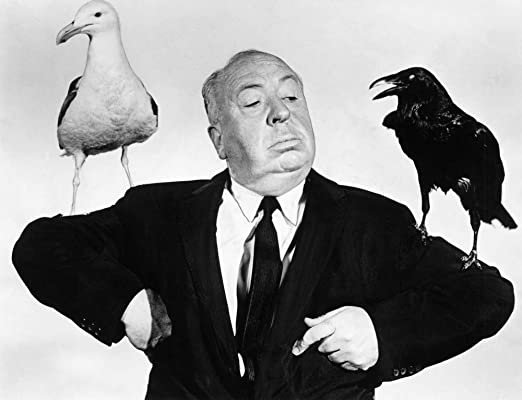
Let us approach the subject, in fact, as Heidegger himself would, by considering the etymology of “apocalypse.” The word is Greek, apocalypsis. Apo– is a versatile prefix in Classical Greek, but it can mean un- (as in undoing, unclean, unable), and linguists take it to mean this in apocalypsis. The rest of the word is derived from kalypto, “I cover” (the name of the Homeric Calypso comes from this, and basically means “she who conceals”). Thus, apocalypsis literally means “uncovering.” It is more often translated “revelation” (which, of course, literally means uncovering), hence “The Revelation of John” (“Book of Revelation”), the Greek title for which is Apocalypsis Ioannou, or simply Apocalypsis.

This is grist for Heidegger’s mill if ever there was, since it means that apocalypse has more or less the same meaning as the Greek alētheia, which is usually translated as “truth” but which Heidegger analyzes (correctly) as meaning “uncovering” or “unconcealment.” Alētheia is a crucially important word for Heidegger, but strangely, he did not seem to make the connection to apocalypsis (at least, so far as I know). An apocalypse is thus a revelation or unconcealment of some truth, which had hitherto been veiled from human sight. [1]

Heidegger’s own terminology is fraught with problems: peculiar choices of words (which often do not actually mean what they seem to mean), inconsistent usage, and, perhaps most troubling of all, the introduction of multiple terms that seem to all wind up meaning the same thing. In Heidegger’s philosophy, “unconcealment” is ultimately equivalent to what he calls “the clearing” (die Lichtung). This a metaphor. Heidegger is thinking of a clearing in a forest, which allows light to enter in. Thomas Sheehan describes the clearing as “the always already opened-up ‘space’ that makes the being of things (phenomenologically: the intelligibility of things) possible and necessary.” [2] The usually-lucid Sheehan fails us a bit here, since his definition repeats the spatial metaphor present in the language of clearing (and putting “space” in quotes is not a solution).

Nonetheless, the concept of the clearing is not that difficult to understand. Suppose I am walking through the hills of Sonoma County and on the horizon I see a tall, skinny object which I cannot immediately identify. I approach closer, and see that it is a scarecrow standing in someone’s field. The object has now become meaningful to me. We can also use the language of being and say that I have now registered what the object is. On one level, this seems like an active process. Perhaps, as I advance closer to the unidentified object, I am racking my brain, going over the different options for what this thing might be. But when I actually see that it is a scarecrow, it is as if the “scarecrowness” of this object just suddenly “appears” for me, “overlaying” the now-identified object.

I don’t experience this as an act of actively imposing some idea or schema of “scarecrowness” onto an object. Instead, the experience I have is that the being or meaning of the object, its “scarecrowness,” comes to meet me. In order for this to be possible, in order for the being or meaning of objects to display itself to me, I must possess a certain sort of “openness” in which this can happen. Again, I do not experience myself as slapping a meaning onto an object: I experience that meaning as something that, in a sense “comes forth” in my awareness, because I have made myself open to receive this. To use Sheehan’s language, my awareness, my openness, creates a kind of “space” in which the meaning of things can show up to me. Heidegger’s metaphorical language for this is straightforward: a clearing in the forest (= my subjective “openness”) allows light (= meaning/being) to enter in, revealing things to me in this light.

Here is another example: suppose I pick up an unfamiliar object from Annie Hayworth’s coffee table. I roll it around in my hand, baffled as to what it is. I am in a state of suspense: what it is will not reveal itself to me. It looks kind of like a rock, but it clearly isn’t. So I keep on exploring the object. I fumble open what turns out to be a hinged top — and then, all of a sudden, it hits me: this is a cigarette lighter.

Yes, I suppose it’s plausible to say that I have “fitted” the object within “mental categories,” based on prior knowledge. This may sound like a hardheaded description of the “mechanism” involved, but note that it is entirely metaphorical. Let’s dispense with attempts to describe what is happening behind the scenes and just describe my experience — which is what phenomenology does. If I do this, then, to be faithful to that experience I must note that the being or meaning of the object seems to just emerge at a certain point. It is almost irresistible to have recourse to more metaphors here — to speak of the being of the thing as suddenly “shining forth,” or some such. (This should cause us to feel some sympathy for Heidegger’s struggles with language.)

The real point is that if I were not, in some fundamental sense, “open” to the display of the being of things, then I would never be able to say “oh, that’s a scarecrow” or “that’s a cigarette lighter.” Nitpickers will charge that I have just substituted one metaphor for another: just as Sheehan replaced Heidegger’s “clearing” with “space,” so I have replaced Sheehan’s “space” with “openness.” In fact, I am not so sure that “openness” is metaphorical here, but to discuss that point would take us too far afield.

So far so good. Unconcealment (alētheia, “truth”) is equivalent to the clearing. In the clearing, we register what things are or what they mean. Perhaps, as I approached that object in the field, I thought it was a man, only to get closer and register that it is actually a scarecrow. So does that mean that what is “unconcealed” in the clearing is what things truly are? Their true being? Not so fast. We are tempted to say this, but remember what was discussed in the previous installment: things are always meaningful to us (i.e., they show up as beings of a certain sort) within a horizon of meaning that is historically conditioned. (What I loosely referred to in part four as a Zeitgeist.) This means that the being of things changes over time. What we take things to be or to mean changes over the course of history. [3]

But can a scarecrow ever cease to be a scarecrow? Yes and no. When I see the thing I say, “there’s a scarecrow,” but I take it quite differently from someone living a hundred years ago. Back then, a scarecrow was merely a utilitarian object. When I see it, I see a relic of a bygone age, the age of small farming. (Agribusiness doesn’t need scarecrows; its terrible machines keep the birds away.) “Isn’t that quaint?” I say. On further investigation, I might find the scarecrow is in that field precisely because the owner’s wife thinks it is quaint and decorative. I may also think of the scarecrow in The Wizard of Oz, or of any number of horror films.

It is the same with the tabletop cigarette lighter. No longer exclusively a utilitarian object, it is now a display of postmodern “hipster” irony, like Tiki mugs and vinyl and fabulous fifties furniture (take a closer look at Annie Hayworth’s living room for an unironic display of classic style). It also symbolizes, for me and many others, a world well lost: a world of rank odors and hacking coughs and lung surgeons with nicotine-stained hands. This is all now a part of what the object means, a part of its being — but that wasn’t true fifty or sixty years ago.

This means that there is a close connection between what Heidegger calls the clearing, in which the being of things shows up for us, and what he calls das Ereignis, the event. Recall that the event is a sudden and fundamental transformation of the meaning of everything. But what makes possible the meaningfulness of things is the clearing. Thus, the event is a transformation in the clearing, and this transformation is “historical,” in the sense that it is a change in cultural meaning undergone by a people. This makes it possible for Heidegger to speak of “epochs of being.” With the event, how things become meaningful to us within the clearing changes in truly fundamental ways. A new “age” is born, marked by a new way of understanding the being/meaning of beings.

I noted earlier that “apocalypse” has roughly the same literal meaning as alētheia — uncovering, or unconcealment — and that this is also equivalent to Heidegger’s Lichtung, clearing. That is correct insofar as the literal meaning of apocalypse goes, but the connotations of apocalypse and uncovering/unconcealment are nonetheless different. This is obvious if we consider the Latinate translation of apocalypse: revelation. A “revelation” is not just any old “uncovering of meaning.” The sense of “Revelation” has four “moments”: it is (1) the uncovering of some ultimate, world-shaking (or ego-shaking) meaning, that is (2) abrupt, sudden, and usually unanticipated, (3) not under our control, and (4) radically transformative: once it occurs, nothing will be the same again. Thus, apocalypse = the event.

In order to delve more deeply into this equivalency, and thus more deeply into the meaning of The Birds, let us now consider Heidegger’s peculiar etymology of Ereignis. Thomas Sheehan sums things up neatly:

Heidegger understands Ereignis in terms of its etymological roots, which go back to the German word for “eye.” The brothers Grimm had demonstrated that the original etymon of Ereignis is the Old High German ouga, “eye” (see the modern German Auge). Ouga underlies the Old High German verb ir-ougen and the Middle High German er-öugen and er-äugen, as well as the obsolete High German verb er-eigen, all of which mean “to place before the eyes, to show,” parallel to the Latin verbs monstrare and ostendere. Over the centuries, however, the etymology shifted significantly as the entirely unrelated adjective eigen (“one’s own”) and its cognate verb an-eigen (“to appropriate”) came to be associated with sich er-eigen. Eventually the two meanings — on the one hand, “to eye something,” and on the other, “to own it” — got commingled. Furthermore, by the early 1600s the letter n crept in (as in sich er-eignen). [4]

Heidegger plays on both of these etymological source meanings of Ereignis: “to see” and “to own/appropriate.” (It is for this reason that some Heidegger translators make life difficult for us by rendering Ereignis as “appropriation” or “the event of appropriation” or even, God help us, “enowning.”) In the second sense of “to own/appropriate,” the event is “our own” in that it constitutes our own human being. I do not create the event, I undergo it. But the undergoing of the event and the making meaningful of things within the historically-conditioned clearing is what it means to be human. The event is thus “mine” and yet “not mine”: my being stands over against me as something I must continually enact. To be human is to continually “open a space” in which the meaning of things comes to light. As Sheehan says, “Ereignis means that ex-sistence [Dasein, i.e., human nature] has always already been brought into its own as the thrown-open clearing, and ‘occurs’ precisely as that.” [5]

However, it is the other “root meaning” of Ereignis that interests me more: “to see.” Sheehan notes that Heidegger “hears in Ereignis echoes of ‘in den Augen fallen . . . erscheinen.’” [6] Sheehan correctly translates this quotation as “to come into view, to appear.” But a barbarously (but helpfully) literal translation would be “to fall into the eyes, to shine out.” [7] This neatly coincides with our suggestion that the event is the same thing as apocalypse, where the latter is a “revelation” or a “seeing.”
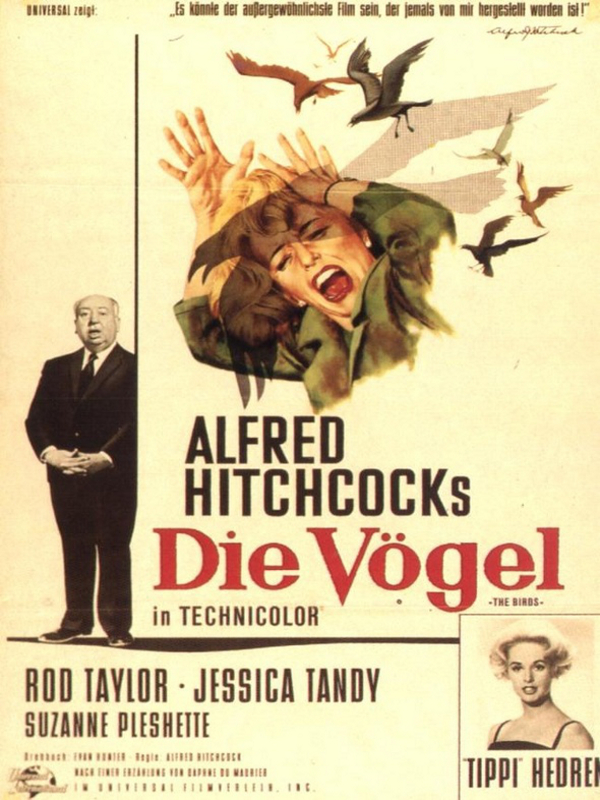
“Seeing “is frequently referred to in Evan Hunter’s screenplay. “See,” “seeing,” or “seen” occurs one hundred and forty-two times, sometimes in dialogue and sometimes in Hunter’s directions. Characters say “I see” eleven times. Characters say “you see” (sometimes “you’ll see”) fifteen times. “See,” and variations, occurs in more than twenty other occasions in dialogue. Often, “seeing” is used in the sense of “knowing.” For example, when Lydia first meets Melanie and learns that she has brought Mitch the lovebirds, she pointedly says “I see,” and the screenplay describes her as “understanding completely now.” Sebastian Sholes expresses skepticism about the “bird war,” saying to Mitch, “I can’t see any reason for it.” Characters say “You know” (and sometimes, but not often, “You don’t know”) thirty-six times. “I know” (and a fair number of times “I don’t know”) is said thirty-four times. One of the most significant of these occasions is when Melanie confesses to Mrs. Bundy that she does not have any scientific knowledge of birds, to which Mrs. Bundy responds, “Well, I do. I do know.”

As I’ve noted in previous installments, lack of vision, the inability to “see” or understand, and blindness are recurring themes in the film. The children at Cathy’s party are attacked while playing blind man’s bluff. Dan Fawcett’s eyes are pecked out. One of the schoolchildren being chased by the crows falls and Hitchcock shows us a closeup of her thick eyeglasses smashed on the pavement. In scenes to come, one major character will be blinded, and birds will attempt to blind another. Several characters are metaphorically blind to the peril posed by the birds – including the sheriff, Mrs. Bundy, and Sebastian Sholes. The characters who do recognize the crisis (Melanie, Mitch, Annie, and Lydia) are, at the same time, blind to the ways in which their own lives are stunted. However, as I shall argue, this blindness is cured when their eyes are opened to the enormity of the crisis that faces them, and, as a result, those characters grow.

In part one, I noted the “Oedipal” nature of Mitch’s relationship with his mother, which is even referred to in dialogue. As I noted, however, the breaking of the incest taboo is not the major point of Sophocles’s play. The events that lead to Oedipus’s discovery that he has killed his father and married his own mother involve him seeking to know why a plague is ravaging Thebes. The oracle at Delphi informs Creon, Oedipus’s brother-in-law, that the plague is the result of the defilement of the city, given that the murderer of King Laius was never caught (that murderer is actually Oedipus, who killed Laius on the road, not knowing he was his father). Oedipus curses the murderer and makes a vow to discover his identity. For advice, he calls in the prophet Tiresias, who happens to be blind. Tiresias has all the information Oedipus is seeking, but initially refuses to speak. This enrages Oedipus, who verbally assaults the prophet. In response, Tiresias reveals that Oedipus himself is the criminal he seeks. When the king mocks Tiresias’s blindness, the prophet retorts, “You have your eyesight, but you do not see.”
You can buy The World in Flames: The Shorter Writings of Francis Parker Yockey

What is Oedipus’s “tragic flaw”? It is actually not that obvious. On one level, it is clear that he is blind to the truth about his situation, and that he is the apparent cause of the plague. But what really causes the tragic events that follow — the suicide of his wife and mother, and Oedipus blinding himself and going into exile — is Oedipus’s desire to see. Tiresias actually advises him to give up his search, implying that some things are best not known. But Oedipus persists, with terrible results. His real blindness consists of not perceiving the limits of knowledge, or the unintended consequences of its relentless pursuit. To punish himself for this blindness, Oedipus blinds himself literally.

In The Birds, human beings are punished for this exact same blindness. Their unseeing eyes are attacked by the birds, and their lives turned upside down. At the same time, however, they are given a new vision: a revelation, an apocalypse, that ushers in a new “epoch of being” (though what that will be is not made clear in the film, which, as already noted, ends without any real resolution).

The “epoch of being” most fully discussed by Heidegger was post-war modernity, the essence of which he identifies as das Gestell. This is a common German word that is often translated as “rack” or “frame.” Of course, as always, Heidegger uses the word in an uncommon way, and translators have struggled to express what he means. Often, they have translated Gestell as “enframing.” Once again, Sheehan can serve as a reliable guide. He eschews a literal translation and interprets Gestell as “the world of exploitation.” Sheehan explains this as follows:

Heidegger reads the current dispensation [of being/the clearing] as one that provokes and even compels us to treat everything in terms of its exploitability-for-consumption: the being of things is now their ability to be turned into products for use and enjoyment. [. . .] Heidegger claims that in the modern world of calculative rationality, the instruments of technology and the mind-set of [Technik] dominate the way we understand and relate to everything. Earth is now seen as a vast storehouse of resources, both human and natural; and the value and realness of those resources, their being, is measured exclusively by their availability for consumption. Things are viewed, at least tacitly, as first and foremost producenda et consumenda, stuff to be exploited for commercialization and use. Their significance is measured by the degree to which they can be owned, stockpiled, marketed, sold, and consumed. And in a perverse phenomenological correlation, human beings are valued only for their ability to extract, work, shop, and consume. Exploitability for production and consumption has become the “truth” . . . of things, the dominant way they are now disclosed and will continue to be disclosed for the foreseeable future. [8]

It is not that difficult to see why Heidegger chooses Gestell to convey this modern mindset. It is as if we stretch the earth and everything on it on a rack, or “frame” everything in such a way that, so far as we are concerned, to be means to be raw material for human consumption and manipulation (what Heidegger calls Bestand, “stockpile,” or, as translators usually render it, “standing-reserve”). Think of Procrustes and his bed.

It is the epoch of being as “enframing” that is negated in The Birds. In a 1963 interview with a French journalist, [9] Hitchcock stated that the theme of The Birds “is that man must be responsible to nature. He cannot assume that nature is always beneficial.” (What Hitchcock probably meant here was “beneficent.”) He adds, “The beautiful scenery, the sea and the sky, the trees, everything he enjoys.” In other words, modern man has reduced nature to a pleasing backdrop, to “beautiful scenery” that exists to be consumed and enjoyed by human beings. “In the opening of the film,” Hitchcock continues, “we show how he treats birds, animals. He thinks they should be in nice cages, and very happy, and so forth.”

Hitchcock is inviting us to understand the cages in the film’s first scene as symbolic of modern man’s relationship to nature. In terms of the ideas introduced in this essay, they can be seen as representing the “enframing” Heidegger speaks of: nature is commodified, “turned into products for use and enjoyment.” In the bird shop, Mitch asks Melanie, “Doesn’t this make you feel awful? . . . All these innocent little creatures caged up like this?” Melanie speaks for modern man when she responds, cluelessly, “Well, we can’t just let them fly around the shop, you know.” It is as if she were unable to conceive of the birds as anything other than caged. When Mitch playfully asks Melanie if he can “see” one of the canaries, he holds out his hand, as if “seeing” the bird means grasping it. (Though I should acknowledge that he does this to trick Melanie into letting one of the canaries out of its cage.) Here I cannot resist mentioning that Alan Watts translated the Taoist term wu wei (a concept not unlike Heidegger’s Gelassenheit, to which I will turn in the next installment) as “don’t grasp the bird.”
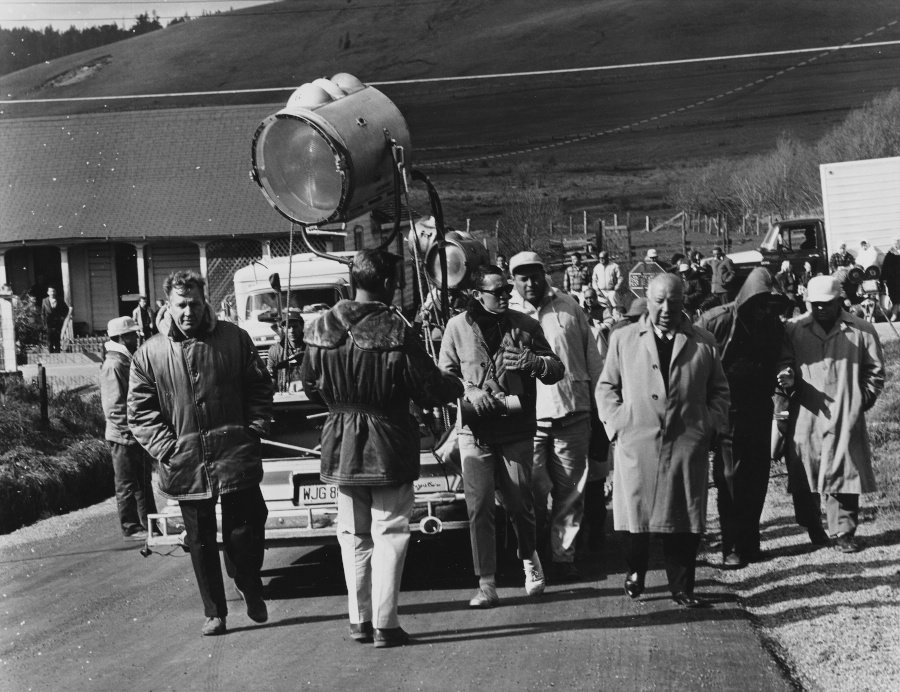
Hitchcock continues: “Now, the film shows that man takes nature for granted. But if it turns on him, then he’s in trouble.” This and Hitchcock’s earlier statement that “man must be responsible to nature” risk creating the impression that some kind of banal “environmentalist” or “conservationist” message is intended here. But there is something much deeper going on. He illustrates the point about nature “turning on” man with the following example: “he digs uranium out of the ground, and look at the trouble he’s in from that.”

In other words, it is not just a matter of “taking care” of nature; we must also recognize that nature is not merely a passively yielding commodity for our enjoyment and manipulation. Recall his comment that man “cannot assume that nature is always [beneficent].” Modern man deludes himself in thinking that he knows nature, and can control it. In fact, it contains mystery — a dark mystery which we delve into at our peril. Our insistence on trying to make nature fully transparent, our relentless, “Oedipal” pursuit of knowledge, can have terrible consequences (Hitchcock alludes to the atomic bomb) and nature can “turn on us.”

In the Bogdanovich interview, Hitchcock states that the theme of The Birds, “generally speaking,” is that “people are too complacent. [Melanie] represents complacency. But I believe that when people rise to the occasion, when catastrophe comes, they are all right.” This comment seems to restrict the theme of complacency to the private lives of the characters (e.g., Melanie’s aimless life of hobbies and practical jokes). But the interview I have been citing for the last several paragraphs confirms that the film deals with complacency on a deeper level.

Hitchcock states, “There’s a general theme [in The Birds] that in respect of man’s, shall we say, taking nature for granted, it makes him complacent. He thinks he’s the master of everything.” The deeper “complacency” treated here is thus the modern, human pretension to mastery and control of nature. To be sure, these two “complacencies” intersect in the film, and this is one of the elements that gives The Birds such great power: it is when the human complacency about nature is shattered that the characters in the film overcome the complacency that marks their own individual lives (more on that in the next installment).
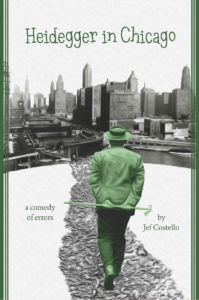
You can buy Jef Costello’s Heidegger in Chicago here

Hitchcock’s remarks continue as follows: “But if a man [is] in a thunderstorm, if he’s afraid at all, or you see a woman in a thunderstorm, she immediately goes under the table in fear. Nature is there in its most fiercest [sic]. I don’t think they’ve ever been able to make an atom bomb with anything like the power of a thunderstorm.” We may want quibble with this last point, but what Hitchcock is really saying is that, ultimately, nature’s power is greater than man’s; that all pretensions to be “master of everything” are shattered when we go under the table in fear, cowering from a storm.

Despite all our modern boasting, an instinctive fear of the power of nature is felt deep in our bones — and perhaps that is just why we boast. Essentially, it’s the same reason we whistle when we walk past a graveyard in the dead of night. We know — deep down, deeper than any of Mrs. Bundy’s knowledge — that nature can swat us whenever she wants to, and that she will never, ever give up all her secrets. It is certainly true, on one level, to say that The Birds is about our taking nature “for granted,” and then learning that it contains depths and powers that dwarf us. On a more fundamental level, however, I would suggest that this is a film about “the mystery of being.”

Heidegger points out that there is a huge difference between “nature” and the Greek phusis, which usually gets Latinized in translation as “nature.” The difference basically consists in the fact that “nature” has come to have the connotation of a collection of things that offer themselves to us to be gazed upon or made over in some fashion. In Hitchcock’s words, this is “nature” as “the beautiful scenery, the sea and the sky, the trees, everything [man] enjoys.” By contrast, the Greek phusis suggests a dynamic process. The word is derived from phuein, meaning “to generate or grow.” Heidegger writes:

Now what does the word phusis say? It says what emerges from itself (for example, the emergence, the blossoming, of a rose), the unfolding that opens itself up, the coming-into-appearance in such unfolding, and holding itself and persisting in appearance — in short, the emerging-abiding sway. [. . .] Phusis is the event of standing forth. Arising from the concealed and thus enabling the concealed to take its stand for the first time. [10]

Essentially, Heidegger identifies phusis with being. For the Greeks, “nature” is the very activity of the world around us continually emerging, unfolding, arising, unconcealing, appearing to us (to use Heidegger’s descriptors). Note, however, that there is a to us. Things only appear to a subject. They are only “unconcealed” to a subject from whom something can be hidden. They only “emerge” to a subject that stands outside them, experiencing their emergence from hiddenness. Thus, for phusis/being to “happen,” the clearing is necessary. In other words, we must possess the fundamental “openness” spoken of earlier.

For us, things emerge from hiddenness into the clearing. But the hiddenness of things is never completely overcome. For every disclosure of the being of things, there is a correlative hiddenness or closure. To take an extremely simple example, if I am looking at the top of the cigarette lighter, the bottom is concealed from me. If the front of the scarecrow is present to me, the back is absent. If I move around to the back, it is now present to me and the front is absent. It is the same way in all instances of “seeing” or “knowing” beings: something of things is revealed, while simultaneously something else is held back and concealed.

Heidegger made much of Heraclitus’s claim that “nature [phusis] loves to hide.” There is an intrinsic and ineliminable mystery to being. Whatever we dis-cover (if I may be forgiven a typical Heideggerean barbarism) there is always something that remains covered. What characterizes modernity, and is at the very root of das Gestell, is the hubristic idea that this mystery, this absence, can be (or eventually will be) completely overcome, and all will become transparent to us, all will be known. And if all is knowable, then all is, in principle, manipulable. This is modernity’s will to power.

Of course, this is disastrous foolishness, because the mystery, the concealing or “holding back” of being cannot be overcome. Further, not even our own being can be made fully transparent. In fact, it may be our own being that remains most mysterious of all. This is certainly what Heidegger thought. As I explained in the last installment, Heidegger held that human beings are fated to try to make sense out of things, to bring things into the clearing. As a species, this is what we do — it is our essential being. Yet exactly why this is and why we make sense out of things in the way we do, in any given epoch of being, remains a mystery to us.

The clearing is the ultimate condition that makes things knowable or intelligible to us. Given this, the clearing itself is not fully knowable or intelligible. The clearing hides as well. Indeed, Heidegger refers to the hiddenness of the clearing as das Geheimnis, the mystery. He speaks of das Geheimnis des Daseins (the mystery of ex-istence; i.e., of human being), and of das vergessene Geheimnis des Daseins (the forgotten mystery of ex-istence, especially forgotten by us moderns, who think all mystery has been canceled).

In The Birds, we are brought face-to-face with the unfathomable mystery of being: the being of nature, our own being, and the being of being itself. A new epoch of being, a new “event” emerges and cancels the old epoch of “enframing,” of taking nature as fully transparent and manipulable. Nature arises, emerges, reveals itself in a new and terrifying way. But this revealing is simultaneously a concealing: the “new” nature, the nature we had never known before, is mysterious and inexplicable. And why this event has occurred defies our reason. Echoing Mrs. Bundy, birds have indeed been on this planet since archaeopteryx, a hundred and twenty million years ago. Why did they wait all this time to start a “war against humanity”? Why now? What has changed?

The film, as everyone knows, provides no answers to these questions. In a chilling passage from the short story, du Maurier writes, “Nat listened to the tearing sound of splintering wood, and wondered how many million years of memory were stored in those little brains, behind the stabbing beaks, the piercing eyes, now giving them this instinct to destroy mankind with all the deft precision of machines.” Those piercing eyes are bottomless pits. We can peer into them all we like, but nothing remotely human peers back. Only the abyss of dark, merciless, pre-human eons stares back at us, like the empty, black eye sockets of Dan Fawcett. Given another million years, we will still not understand anything — anything at all about the abyss of nature and time. From where did it all come? Why this? Why now does it change? Where is it going? Where are we going? No answer.

In part two of this series, I discussed the importance of silence in The Birds. It is used to create suspense, and to suggest the presence of the uncanny. A heavy silence pervades the film, and it is out of this silence that the bird attacks come. The birds usually appear out of nowhere, attack, and then disappear again. This conveys, in a visual and auditory manner, the dynamic of the clearing. The clearing is an absence, a “space” in which things emerge from hiddenness and reveal something of what they are, before retreating again into hiddenness. Silence is an absence as well.

Hitchcock’s insistence on silence, and refusal to use a music score, even in the film’s earlier, lighter scenes, creates a sense of ominousness and expectance. We have the sense that something new and quite possibly terrible is about to emerge from this silence. We wait for it, in the suspense created by “the master,” and we are also thrown back on ourselves. Why does this silence affect me so? Why does it make me so uncomfortable? Why does it make me silent in response? Why does it make me wait? We are confronted, in other words, with the mystery of our own openness, and our own angst in the face of the ultimate unintelligibility of existence, which we normally suppress through such devices as laughter, idle chatter, gay music, busyness, and, indeed, going to the movies.

The silence of the film does indeed create a sense of the uncanny. In part two, I discussed the concept of the uncanny at length, and promised that we would come to see how The Birds concerns the encounter with the uncanny. We are now in a position to see how that is the case. I argued that the uncanny is the encounter with something hidden that now shows itself but nonetheless remains hidden. In other words, to be in the presence of the uncanny is to be confronted with a phenomenon that remains intransigently unintelligible. The uncanny is a form in which we encounter the mystery of being, and of our own openness to being.

Heidegger treats the idea of the uncanny in his famous discussion of “anxiety” (Angst) in Being and Time:

That about which one has anxiety is being-in-the-world. [. . .] In anxiety, the things at hand in the surrounding world sink away, and so do innerworldly beings in general. [. . .] Anxiety. . . fetches Dasein back out of its entangled absorption in “the world.” Everyday familiarity collapses. Dasein is individualized, but as being-in-the-world. Being-in enters the existential “mode” of not-being-at-home. The talk about “uncanniness” [Unheimlichkeit] means nothing other than this. [11]

In our next installment, we will rejoin our protagonists as they finally make it out of the Tides Restaurant.

If you want to support our work, please send us a donation by going to our Entropy page and selecting “send paid chat.” Entropy allows you to donate any amount from $3 and up. All comments will be read and discussed in the next episode of Counter-Currents Radio, which airs every Friday.

Don’t forget to sign up for the twice-monthly email Counter-Currents Newsletter for exclusive content, offers, and news.

Notes

[1] Though see Sheehan for a discussion of why alētheia should not be translated as “truth.” Thomas Sheehan, Making Sense of Heidegger: A Paradigm Shift (Lanham, Maryland: Rowman and Littlefield, 2015), 61-62.

[2] Sheehan, 20.

[3] Sheehan persuasively argues that Heidegger uses the terms “being” and “meaning” synonymously. If you object to this and insist that a thing’s being (what it is) is not reducible to what it means to us, then I would invite you to go in search of what “being” actually means. You’ll be on that journey for a long time.

[4] Sheehan, 232.

[5] Sheehan, 234.

[6] Sheehan, 233.

[7] Scheinen is obviously cognate with “shine.” The German prefix er– is hard to translate but it usually suggests a successful conclusion or outcome. Thus, erscheinen can be translated literally as “shining out,” with the connotation that the shining or appearing is successfully or completely expressed.

[8] Sheehan, 258-259.

[9] The interviewer is French, but the film I have linked to is subtitled in Dutch.

[10] Martin Heidegger, Introduction to Metaphysics, trans. Gregory Fried and Richard Polt (New Haven: Yale University Press, 2000), 15–16.

[11] Martin Heidegger, Being and Time, trans. Joan Stambaugh (Albany: State University of New York Press, 2010) 180-183.


The Birds Or: Everything You Always Wanted to Know About Coronavirus (But Were Afraid to Ask Hitchcock & Heidegger), Part Five

The%20Birds%20Or%3A%20Everything%20You%20Always%20Wanted%20to%20Know%20About%20Coronavirus%20%28But%20Were%20Afraid%20to%20Ask%20Hitchcock%20and%23038%3B%20Heidegger%29%2C%20Part%20Five

Share

  • Gab
  • Or: Everything You Always Wanted to Know About Coronavirus (But Were Afraid to Ask Hitchcock Heidegger), Part Five &body=%0D%0A%0D%0A%0D%0A%0D%0A%0D%0A%0D%0Ahttps://counter-currents.com/2020/06/the-birds-or-everything-you-always-wanted-to-know-about-coronavirus-but-were-afraid-to-ask-hitchcock-heidegger-part-five/%0D%0A%0D%0A%0D%0A%0D%0A">

Enjoyed this article?

Be the first to leave a tip in the jar!

Instant Echeck GreenPay™

Related

  • Heidegger on Nietzsche Part Three

  • Heidegger on Nietzsche, Part Two

  • Heidegger on Nietzsche, Part One

  • Finding Atlantis Part 4

  • Do You Want to Play a Game?

  • 500 Years of British Art, Part 2

  • The Rest Is Silence: Heidegger’s Quietism

  • Strauss on Husserl’s “Philosophy as Rigorous Science”

Tags

Alfred Hitchcockapocalypsebeingcomplacencydas EreignisDaseinDerek Hawthornedie LichtungenvironmentalismhubrisknowledgeMartin HeideggermodernismmortalitynaturephilosophyscientismThe Birdsthe uncanny

8 comments

  1. Robert Habel says:
    June 3, 2020 at 1:13 pm

    Wonderful work and analysis you did on a truly great piece of cinema. I not only enjoyed it but benefited from it immensely.

    0
    0
    1. Derek Hawthorne says:
      June 3, 2020 at 4:22 pm

      Thank you, sincerely. I am writing for readers like you.

      0
      0
  2. Robert Habel says:
    June 3, 2020 at 1:18 pm

    Is the German word “Ereignis”, similar to the concept of a paradigm shift?

    0
    0
    1. Derek Hawthorne says:
      June 3, 2020 at 4:25 pm

      It’s not quite the same. A “paradigm shift” is really under human control. For example, a scientist formulates a new theory that initiates a paradigm shift, because others sign onto the theory and are consciously influenced by it. For Heidegger, the Event is a shift in how we make things meaningful that does not seem to have been initiated by conscious human theories or efforts, and which we therefore do not control.

      0
      0
  3. Kolya Krassotkin says:
    June 4, 2020 at 1:06 pm

    Very enjoyable piece. Thank you.

    I saw “The Birds” for the first time two weeks ago (AMC, I think), after reading the first two parts of your essay, and so had a bit of fun comparing your analysis with my own. The movie’s ending puzzled me, and in light of the crazy rioting, looting and crescendoing social breakdown of the last two weeks, its overhanging uncertainty seems à-propos.

    0
    0
  4. do248 says:
    June 4, 2020 at 5:06 pm

    I enjoyed your analysis, but frankly I find it over intellectualized. Sometimes a cigar is just a cigar.

    0
    0
  5. Kolya Krassotkin says:
    June 5, 2020 at 8:02 am

    Incidentally, love the photoshopped graphics of Heidegger with Hedren.

    0
    0
  6. Randy says:
    June 5, 2020 at 7:40 pm

    I enjoyed your essay very much that is until it came to
    Heidegger then my eyes glazed over. I have never thought about it before but upon reading your essay my opinion is that the Birds is a parable of aging and is meant to be seen through the older lady’s eyes. Nature turns on you when you get older just like the birds, once your friends now your enemies, plus your family may not be there or is moving away and leaving you to face the Birds alone.

    0
    0

Comments are closed.

If you have a Subscriber access,
simply login first to see your comment auto-approved.

Note on comments privacy & moderation

Your email is never published nor shared.

Comments are moderated. If you don't see your comment, please be patient. If approved, it will appear here soon. Do not post your comment a second time.

Writers of May

(2 votes) Morris van de Camp David M. Zsutty Derek Stark Jayant Bhandari Greg Johnson

Articles of May

Heidegger on Nietzsche, Part One by Collin Cleary The Lunch Wars by David M. Zsutty 2 votes
    • Lost In Trans-Mission:
      How the Media Fails To Reveal the Inconvenient Truth About the Usual Suspects

      Steven Tucker

      2

    • Liar, Liar, Pants on Fire!

      Beau Albrecht

      1

    • Editor’s Update
      Rob Rundo on Counter-Currents Radio, Fundraiser Update, & a New $20,000 Matching Grant

      Greg Johnson

    • The Bitter End of Western Metaphysics:
      Heidegger on Nietzsche, Part Three

      Collin Cleary

      10

    • Uncivil War

      Mark Gullick

      40

    • Exclusive Interview with Karel Veliky:
      The Final Chapter in the Film Series! Part II

      Ondrej Mann

      2

    • Happy Birthday to Us!

      Greg Johnson

      6

    • Zsutty’s Maximum

      David M. Zsutty

      15

    • Exclusive Interview with Karel Veliky:
      The Final Chapter in the Film Series! Part I

      Ondrej Mann

      2

    • The Union Jackal, June 2026

      Mark Gullick

      23

    • The Inferiority Behind Immigrant Superiority

      Jayant Bhandari

      15

    • Counter-Currents Radio Podcast No. 690
      Greg Johnson & David Zsutty Discuss Current Things: AI, Henry Nowak, the Iran Crisis, & More

      Counter-Currents Radio

      7

    • Collin Cleary: What Rome Means to Me

      Collin Cleary

      4

    • Paul Krugman: Closet Bolshevik

      Spencer J. Quinn

      21

    • Fugue of Ideas:
      Ibram X. Kendi’s Chain of Ideas

      Greg Johnson

      19

    • Based Blacks

      Lipton Matthews

      21

    • Black Intellectual Fatigue

      Derek Stark

      41

    • Why White Advocates Should Avoid “Based Blacks”

      Dani Vypont

      32

    • Nietzsche & Race

      Mark Gullick

    • Editor’s Update
      Rob Rundo Rescheduled to Next Week on Counter-Currents Radio;
      Tonight Greg Johnson & David Zsutty Answer Your Questions;
      Fundraiser Update & a New $20,000 Matching Grant

      Greg Johnson

    • The Counter-Currents 2026 Fundraiser
      Lifetime Subscriber Welcome Packages Extended

      Greg Johnson

    • Nationalism This Week
      Who’s Looking Back?

      Greg Johnson

      29

    • China’s Threat to American Security:
      Food, Farmland, Foreign Control, & Energy Policy

      Lipton Matthews

      5

    • The Bitter End of Western Metaphysics:
      Heidegger on Nietzsche, Part Two

      Collin Cleary

      16

    • The Killing of Henry Nowak

      Mark Gullick

      38

    • The Crisis of Chinese Technology Thieves

      Morris van de Camp

      1

    • The Strange World of Gender Bender Fiction:
      & What This Genre Tells Us About Autosexuality

      Dani Vypont

      3

    • Watching the Watchers:
      The Dark Triad Question

      David M. Zsutty

      14

    • The Remigration Movement Solidifies

      F. Roger Devlin

      1

    • Casting Aspersions:
      The Fatal Consequences of Race-Swapped Casting, From Helen of Troy to Henry of Southampton

      Steven Tucker

      20

    • The Murder of Henry Nowak

      Millennial Woes

      23

    • Don’t Forget to Vote in Our Writer & Article of the Month Poll

      Greg Johnson

    • The Robot Hotdog Stand

      Greg Johnson

      37

    • Laughing Our Way to Victory

      Dave Chambers

      7

    • The Zodiac Killer

      Mark Gullick

      11

    • Jared Taylor: What Rome Means to Me

      Jared Taylor

      1

    • An Interview with Endeavour:
      My Way of Life Is an Adventure!

      Ondrej Mann

      6

    • José Pedro Zúquete’s The Identitarians

      Greg Johnson

      3

    • Editor’s Update
      Fundraiser Update & How to Watch the Remigration Summit

      Greg Johnson

      5

    • The Bitter End of Western Metaphysics:
      Heidegger on Nietzsche, Part One

      Collin Cleary

      12

    • Berlin: City of Stones

      Spencer J. Quinn

      6

    • True Folk-Horror Is Horror of Your Own Folk:
      Mark Gatiss vs the Brexit Blind Dead  

      Steven Tucker

      4

    • Counter-Currents Radio Podcast No. 689
      Thomas Massie, the America 2050 Bust, the Need for Whites to Divest from America, the AI Economic Apocalypse, & Pro-White Project Pitches to Billionaires

      Counter-Currents Radio

      7

    • Nationalism This Week
      Remigration is Inevitable, Part 3

      Greg Johnson

      27

    • Why Billionaires Should Fund White Identity Politics

      Lipton Matthews

      8

    • How Cold War Two Came About

      Morris van de Camp

      5

    • Now Available for Pre-Order at a Special Price!
      Greg Johnson’s The Philosopher Is In

      Greg Johnson

    • David Zsutty’s Elevator Pitch to a Billionaire

      David M. Zsutty

      1

    • Headbanging Lite

      Mark Gullick

      5

    • White Advocacy Past and Present

      Peter Bradley

      13

    • Fred C. Dobbs

      Liar, Liar, Pants on Fire!

      Father Merrin “he mixes lies with the truth to confuse us.” Excellent piece. We’ve all experienced...

    • Adrian Roberts

      Lost In Trans-Mission

      What about all the people who've been born in the wrong bodies and don't even know it?

    • Weave

      Based Blacks

      Thank you for completely proving my point, which is that if we aren’t as “pure” as you then we are...

    • Joe Gould

      Lost In Trans-Mission

      Philosophy matters. Bad philosophy backed by media, money, and state power is a disaster. The dogma...

    • Joe Gould

      Uncivil War

      I think that your phone (any brand, not just an iPhone) will give up all sorts of information on you...

    • YT

      Uncivil War

      So you’re advocating leaving your iPhone at home as it can be used for geographic location purposes...

    • Will Williams

      The SPLC Indictment

      I bump this comment because Christian conservative reporter Tyler O'Neil is on the SPLC  beat again...

    • Peter Quint

      Why White Advocates Should Avoid “Based Blacks”

      Why would you tell a little parable like that? Are you trying to tell us to judge blacks by the  “...

    • Will Williams

      Based Blacks

      Uncle Semantic: June 14, 2026  Will, I’m curious if your racial journey to where you stand now...

    • Angela Mercy

      Paul Krugman: Closet Bolshevik

      Things don't look bright for Republican party and it's voters but they can only blame Donald Trump...

    • S Dane

      Paul Krugman: Closet Bolshevik

      Krugman is the creep who was caught with kiddie porn a few years ago and was able to get off with a...

    • Will Williams

      Based Blacks

      Uncle Semantic: June 14, 2026  Do you think blacks would be more palatable to the proWhite...

    • ArminiusMaximus

      Based Blacks

      I may want them to get scared straight, but I doubt that message will sink in. Can they think in...

    • kerdasi amaq

      Uncivil War

      I never heard of the IRA knee-capping Protestants until now. They did it to their own juvenile...

    • Uncle Semantic

      Fugue of Ideas: Ibram X. Kendi’s Chain of Ideas

      The movie American Fiction with Jeffrey Wright is very good on this.

    • Will Williams

      Why White Advocates Should Avoid “Based Blacks”

      Scott: June 13, 2026 Will Williams wrote:“Scott, it’s interesting that you call George...

    • Joe Gould

      Uncivil War

      Upvoted for this: "Actually, there’s another, special tier, above the rest, for the Epstein Class...

    • Fred C. Dobbs

      Why White Advocates Should Avoid “Based Blacks”

      Anomaly

    • Scott

      Based Blacks

      D'oh, my post was lost by the C-C software again and it was short so I did not save it elsewhere. I...

    • Joe Gould

      Uncivil War

      One of the reasons we are confused and act unwisely is that many things around us have false names....

    • Earth Day Special

      John Morgan

      12

    • A Robertson Roundup
      Remembering Wilmot Robertson
      (April 16, 1915 – July 8, 2005)

      Margot Metroland

      13

    • The Paranoid Style in White Nationalism

      Greg Johnson

      30

    • Join the Dance!

      Andrew Hamilton

      1

    • We Can’t Save the Earth Without Reducing African Birth Rates

      James Dunphy

      36

    • “I’m Not a Conspiracy Theorist, but . . .”:
      Jeffrey Epstein’s Death Gives New Life to “Conspiracy Theories”

      Greg Johnson

      22

    • Sylvia Plath: Stasis in Darkness

      Vic Olvir

      17

    • Vanguardism, Vantardism, & Mainstreaming

      Greg Johnson

      80

    • Aviation, Geography, & Race

      Charles Lindbergh

      3

    • Some Thoughts on Yule

      Collin Cleary

      4

    • Living in Truth:
      A Yuletide Homily

      Jef Costello

      7

    • John Kennedy Toole’s A Confederacy of Dunces

      Greg Johnson

      20

    • On Aleksandr Solzhenitsyn’s Warning to the West

      Spencer J. Quinn

      7

    • Elitism, British Modernism, & Wyndham Lewis

      Jonathan Bowden

      6

    • Philip K. Dick’s Do Androids Dream of Electric Sheep? as Anti-Semitic/Christian-Gnostic Allegory

      Greg Johnson

      20

    • “Conspiracy Theory” or Conspiracy?

      Andrew Hamilton

      21

    • Remembering H. P. Lovecraft
      (August 20, 1890–March 15, 1937)

      Greg Johnson

      3

    • Who Are We?
      Nordics, Aryans, & Whites

      Greg Johnson

      71

    • Remembering William Gayley Simpson
      (July 23, 1892–December 31, 1990)
      A Pleasant Afternoon with Harriet & Bill Simpson

      Margot Metroland

      18

    • Here are the Young Men
      Remembering Ian Curtis
      (July 15, 1956–May 18, 1980)

      Mark Gullick

      18

    • Percy Grainger
      Artist of the Right

      Alex Graham

      7

    • Remembering Revilo Oliver
      (July 7, 1908–August 20, 1994)

      Greg Johnson

      18

    • The Meaning of July 4th for the White Man

      Gregory Hood

      13

    • The Front National’s Evolution

      Bruno Mégret

    • Merwin K. Hart
      Forgotten American Hero & Man of the Right

      Morris van de Camp

      10

    • George Orwell’s Nineteen Eighty-Four

      Jonathan Bowden

      8

    • Carleton S. Coon
      Scientist & Reluctant White Advocate

      Morris van de Camp

      3

    • The Kwanzaa Absurdity Will Be Dwarfed by Juneteenth

      Robert Hampton

      10

    • Stravinsky

      Alex Graham

      7

    • Like the Roman:
      Remembering Enoch Powell (1912-1998)

      Mark Gullick

      23

    • The 1970s: The Golden Age of Hijacking

      Morris van de Camp

      21

    • Jonathan Bowden’s Deliverance
      Part 6

      Jonathan Bowden

    • Do You Want to Play a Game?

      Mark Gullick

      1

    • Sexually Incontinent on the Indian Subcontinent:
      Who Rapes More Animals, Indians or Pakistanis? The Battle Continues!

      Steven Tucker

      3

    • Neo-Fascism in Film
      Part 5

      Karel Veliky

      15

    • The Game of Tarot

      Mark Gullick

      2

    • Institutions Cannot Be Transplanted

      Jayant Bhandari

      5

    • Jonathan Bowden’s Deliverance
      Part 5

      Jonathan Bowden

    • Crosstown Traffic:
      Jimi Hendrix & The Post-War Rock ‘N’ Roll Revolution

      Mark Gullick

      1

    • Slaves from the North:
      Finns & Karelians in the East European Slave Trade, 900–1600

      Lipton Matthews

      14

    • Neo-Fascism in Film
      Part 4

      Karel Veliky

      2

    • David Lean’s A Passage to India

      Spencer J. Quinn

      1

    • Elites are Essential to Development

      Lipton Matthews

      7

    • Jonathan Bowden’s Deliverance
      Part 4

      Jonathan Bowden

    • Neo-Fascism in Film
      Part 3

      Karel Veliky

      6

    • E. M. Forster’s A Passage to India & the Indian Mentality

      Spencer J. Quinn

      25

    • Jonathan Bowden’s Deliverance
      Part 3

      Jonathan Bowden

    • The Rest Is Silence
      Heidegger’s Quietism

      Mark Gullick

      2

    • Dispelling the Historical Fallacy of Indian Nationalism

      Lipton Matthews

      8

    • Neo-Fascism in Film
      Part 2

      Karel Veliky

      8

    • Jonathan Bowden’s Deliverance
      Part 2

      Jonathan Bowden

    • Life of a Klansman

      Mark Gullick

      8

    • Jonathan Bowden’s Deliverance, Part 1

      Jonathan Bowden

    • Decolonial Ideas are Holding Back Developing Countries

      Lipton Matthews

      8

    • Neo-fascism in Film, Part 1

      Karel Veliky

      21

    • Jonathan Bowden’s Onslaught, Part 8
      Divigations on Decadence

      Jonathan Bowden

    • Jonathan Bowden’s Onslaught, Part 7
      Intrigues in the National Front

      Jonathan Bowden

      1

    • Rotten to the Core

      Mark Gullick

      8

    • Strauss on Husserl’s “Philosophy as Rigorous Science”

      Greg Johnson

    • Jonathan Bowden’s Onslaught, Part 6
      Francis Bacon & Right-Wing Nihilism

      Jonathan Bowden

    • András László
    • Derek Hawthorne
    • Beau Albrecht
    • Alain de Benoist
    • Kerry Bolton
    • Jonathan Bowden
    • Collin Cleary
    • Jef Costello
    • Savitri Devi
    • Julius Evola
    • Jim Goad
    • Gregory Hood
    • Juleigh Howard-Hobson
    • Greg Johnson
    • Charles Krafft
    • Anthony M. Ludovici
    • Trevor Lynch
    • H. L. Mencken
    • J. A. Nicholl
    • James J. O’Meara
    • Christopher Pankhurst
    • Tito Perdue
    • Michael Polignano
    • Spencer J. Quinn
    • Fenek Solère
    • Irmin Vinson
    • Leo Yankevich
    • Francis Parker Yockey
    • Multiple authors
  • Editor-in-Chief

    • Greg Johnson, Ph.D.

    Featured Writers

    • Beau Albrecht
    • Gunnar Alfredsson
    • Collin Cleary, Ph.D.
    • Jef Costello
    • Morris V. de Camp
    • F. Roger Devlin, Ph.D.
    • Stephen Paul Foster, Ph.D.
    • Jim Goad
    • Alex Graham
    • Mark Gullick, Ph.D.
    • Greg Johnson, Ph.D.
    • Travis LeBlanc
    • Trevor Lynch
    • Margot Metroland
    • James J. O’Meara
    • Angelo Plume
    • Spencer J. Quinn
    • Fred Reed
    • Clarissa Schnabel
    • Michael Walker
    • David M. Zsutty

    Frequent Writers

    • Asier Abadroa
    • Aquilonius
    • Alain de Benoist
    • Kerry Bolton, Ph.D.
    • Dave Chambers
    • Steven Clark
    • James Dunphy
    • Endeavour
    • Richard Houck
    • Jason Kessler
    • Titus Livius
    • Ondrej Mann
    • Lipton Matthews
    • Mark Mazari
    • John Morgan
    • Jaroslav Ostrogniew
    • Kathryn S.
    • Christian Secor
    • Anne Wilson Smith
    • Thomas Steuben
    • William De Vere
    • Kenneth Vinther
    • Max West

    Classic Authors

    • Maurice Bardèche
    • Jonathan Bowden
    • Julius Evola
    • Guillaume Faye
    • Ernst Jünger
    • Kevin MacDonald, Ph.D.
    • D. H. Lawrence
    • Charles Lindbergh
    • Jack London
    • H. P. Lovecraft
    • Anthony M. Ludovici
    • Sir Oswald Mosley
    • National Vanguard
    • Friedrich Nietzsche
    • Revilo Oliver
    • William Pierce
    • Ezra Pound
    • Saint-Loup
    • Savitri Devi
    • Carl Schmitt
    • Miguel Serrano
    • Oswald Spengler
    • P. R. Stephensen
    • Jean Thiriart
    • John Tyndall
    • Dominique Venner
    • Leo Yankevich
    • Francis Parker Yockey

    Other Authors

    • Howe Abbott-Hiss
    • Michael Bell
    • Giles Corey
    • Jack Donovan
    • Richardo Duchesne, Ph.D.
    • Emile Durand
    • Guillaume Durocher
    • Mark Dyal
    • Tom Goodroch
    • Andrew Hamilton
    • Robert Hampton
    • Huntley Haverstock
    • Derek Hawthorne
    • Gregory Hood
    • Juleigh Howard-Hobson
    • Alexander Jacob
    • Ruuben Kaalep
    • Tobias Langdon
    • Julian Langness
    • Patrick Le Brun
    • G A Malvicini
    • John Michael McCloughlin
    • Millennial Woes
    • Michael O’Meara
    • Christopher Pankhurst
    • Michael Polignano
    • J. J. Przybylski
    • Quintilian
    • Edouard Rix
    • C. B. Robertson
    • C. F. Robinson
    • Herve Ryssen
    • Alan Smithee
    • Fenek Solere
    • Ann Sterzinger
    • Robert Steuckers
    • Tomislav Sunic
    • Donald Thoresen
    • Marian Van Court
    • Irmin Vinson
    • Book Reviews
    • Movie Reviews
    • TV Reviews
    • Music Reviews
    • Art Criticism
    • Graphic Novels & Comics
    • Video Game Reviews
    • Fiction
    • Poems
    • Interviews
    • Videos
    • English Translations
    • Other Languages
      • Arabic
      • Bulgarian
      • Croatian
      • Czech
      • Danish
      • Dutch
      • Estonian
      • Finnish
      • French
      • German
      • Greek
      • Hungarian
      • Italian
      • Lithuanian
      • Norwegian
      • Polish
      • Portuguese
      • Romanian
      • Russian
      • Slovak
      • Spanish
      • Swedish
      • Ukrainian
    • Commemorations
    • Why We Write
  • Archives
  • Top 100 Commenters
  • The Looney Bin
Sponsored Links
Europa.com Above Time Coffee Antelope Hill Publishing Paul Waggener IHR-Store Spencer J. Quinn American Renaissance Jim Goad The Occidental Observer
Donate Now Mailing list
Books for sale
  • The Philosopher Is In
  • Sexual Utopia in Power (Expanded Edition)
  • In Defense of Prejudice
  • Loving Our Own
  • Tyranny & Wisdom
  • The Populist Moment
  • Is America Doomed?
  • To all books
Copyright © 2026 Counter-Currents Publishing, Ltd.

Paywall Access


Please enter your email address.

Lost your password?

Edit your comment

Writer & Article of the Month May 2026

Voting for this month has concluded. Here are the final results!

Top Writers

  • #1 Morris van de Camp 2 votes
  • #2 David M. Zsutty 2 votes
  • #3 Derek Stark 2 votes
  • #4 Jayant Bhandari 2 votes
  • #5 Greg Johnson 2 votes
  • #6 Jared Taylor 1 vote
  • #7 Collin Cleary 1 vote
  • #8 Spencer J. Quinn 1 vote
  • #9 Mark Gullick 1 vote
  • #10 Lipton Matthews 1 vote
  • #11 Keith Woods 1 vote
  • #12 Steven Tucker 1 vote

Top Articles

  • #1 Heidegger on Nietzsche, Part One 2 votes
  • #2 The Lunch Wars 2 votes
  • #3 Why Billionaires Should Fund White Identity Politics 1 vote
  • #4 The 1970s: The Golden Age of Hijacking 1 vote
  • #5 True Folk-Horror Is Horror of Your Own Folk 1 vote
  • #6 Finding Atlantis Part 4 1 vote
  • #7 Berlin: City of Stones 1 vote
  • #8 The Ghost of the Confederacy 1 vote
  • #9 Lothrop Stoddard’s The Revolt Against Civilization 1 vote
  • #10 Could Fascism Work? 1 vote
  • #11 Jared Taylor's Elevator Pitch to a Billionaire 1 vote
  • #12 Predation Wearing the Mask of Civilization 1 vote
  • #13 Peak Fatigue in Fort Wayne 1 vote
  • #14 Keith Wood's Elevator Pitch to a Billionaire 1 vote
  • #15 Do You Want to Play a Game? 1 vote

Total votes cast: 17