
Counter-Currents
  • Advertise
  • Private Events
  • T&C
  • About
  • Contact
  • RSS
    • Main feed
    • Podcast feed
    • Videos feed
    • Comments feed
  • Welcome
  • Webzine
  • Books
  • Merch
  • Podcasts
  • Videos
  • Donate
  • Patrons
  • Subscribe
  • Crypto

LEVEL2

Donate Now Mailing list

Writers of May

(2 votes) Morris van de Camp David M. Zsutty Derek Stark Jayant Bhandari Greg Johnson

Articles of May

Heidegger on Nietzsche, Part One by Collin Cleary The Lunch Wars by David M. Zsutty 2 votes
  • Welcome
  • Webzine
  • Books
  • Merch
  • Podcasts
  • Videos
  • Donate
  • Patrons
  • Subscribe
  • Crypto
    • Nationalism This Week
      Letter to J. D. Vance

      Greg Johnson

      3

    • Lost In Trans-Mission:
      How the Media Fails To Reveal the Inconvenient Truth About the Usual Suspects

      Steven Tucker

      4

    • Liar, Liar, Pants on Fire!

      Beau Albrecht

      4

    • Editor’s Update
      Rob Rundo on Counter-Currents Radio, Fundraiser Update, & a New $20,000 Matching Grant

      Greg Johnson

    • The Bitter End of Western Metaphysics:
      Heidegger on Nietzsche, Part Three

      Collin Cleary

      10

    • Uncivil War

      Mark Gullick

      40

    • Exclusive Interview with Karel Veliky:
      The Final Chapter in the Film Series! Part II

      Ondrej Mann

      2

    • Happy Birthday to Us!

      Greg Johnson

      6

    • Zsutty’s Maximum

      David M. Zsutty

      15

    • Exclusive Interview with Karel Veliky:
      The Final Chapter in the Film Series! Part I

      Ondrej Mann

      2

    • The Union Jackal, June 2026

      Mark Gullick

      23

    • The Inferiority Behind Immigrant Superiority

      Jayant Bhandari

      15

    • Counter-Currents Radio Podcast No. 690
      Greg Johnson & David Zsutty Discuss Current Things: AI, Henry Nowak, the Iran Crisis, & More

      Counter-Currents Radio

      7

    • Collin Cleary: What Rome Means to Me

      Collin Cleary

      4

    • Paul Krugman: Closet Bolshevik

      Spencer J. Quinn

      21

    • Fugue of Ideas:
      Ibram X. Kendi’s Chain of Ideas

      Greg Johnson

      19

    • Based Blacks

      Lipton Matthews

      22

    • Black Intellectual Fatigue

      Derek Stark

      41

    • Why White Advocates Should Avoid “Based Blacks”

      Dani Vypont

      32

    • Nietzsche & Race

      Mark Gullick

    • Editor’s Update
      Rob Rundo Rescheduled to Next Week on Counter-Currents Radio;
      Tonight Greg Johnson & David Zsutty Answer Your Questions;
      Fundraiser Update & a New $20,000 Matching Grant

      Greg Johnson

    • The Counter-Currents 2026 Fundraiser
      Lifetime Subscriber Welcome Packages Extended

      Greg Johnson

    • Nationalism This Week
      Who’s Looking Back?

      Greg Johnson

      29

    • China’s Threat to American Security:
      Food, Farmland, Foreign Control, & Energy Policy

      Lipton Matthews

      5

    • The Bitter End of Western Metaphysics:
      Heidegger on Nietzsche, Part Two

      Collin Cleary

      16

    • The Killing of Henry Nowak

      Mark Gullick

      38

    • The Crisis of Chinese Technology Thieves

      Morris van de Camp

      1

    • The Strange World of Gender Bender Fiction:
      & What This Genre Tells Us About Autosexuality

      Dani Vypont

      3

    • Watching the Watchers:
      The Dark Triad Question

      David M. Zsutty

      14

    • The Remigration Movement Solidifies

      F. Roger Devlin

      1

    • Casting Aspersions:
      The Fatal Consequences of Race-Swapped Casting, From Helen of Troy to Henry of Southampton

      Steven Tucker

      20

    • The Murder of Henry Nowak

      Millennial Woes

      23

    • Don’t Forget to Vote in Our Writer & Article of the Month Poll

      Greg Johnson

    • The Robot Hotdog Stand

      Greg Johnson

      37

    • Laughing Our Way to Victory

      Dave Chambers

      7

    • The Zodiac Killer

      Mark Gullick

      11

    • Jared Taylor: What Rome Means to Me

      Jared Taylor

      1

    • An Interview with Endeavour:
      My Way of Life Is an Adventure!

      Ondrej Mann

      6

    • José Pedro Zúquete’s The Identitarians

      Greg Johnson

      3

    • Editor’s Update
      Fundraiser Update & How to Watch the Remigration Summit

      Greg Johnson

      5

    • The Bitter End of Western Metaphysics:
      Heidegger on Nietzsche, Part One

      Collin Cleary

      12

    • Berlin: City of Stones

      Spencer J. Quinn

      6

    • True Folk-Horror Is Horror of Your Own Folk:
      Mark Gatiss vs the Brexit Blind Dead  

      Steven Tucker

      4

    • Counter-Currents Radio Podcast No. 689
      Thomas Massie, the America 2050 Bust, the Need for Whites to Divest from America, the AI Economic Apocalypse, & Pro-White Project Pitches to Billionaires

      Counter-Currents Radio

      7

    • Nationalism This Week
      Remigration is Inevitable, Part 3

      Greg Johnson

      27

    • Why Billionaires Should Fund White Identity Politics

      Lipton Matthews

      8

    • How Cold War Two Came About

      Morris van de Camp

      5

    • Now Available for Pre-Order at a Special Price!
      Greg Johnson’s The Philosopher Is In

      Greg Johnson

    • David Zsutty’s Elevator Pitch to a Billionaire

      David M. Zsutty

      1

    • Headbanging Lite

      Mark Gullick

      5

    • Peter Quint

      Liar, Liar, Pants on Fire!

      Great article! Well, I know I am good; I will match my rectitude with anyone, and come away clean...

    • Peter Quint

      Lost In Trans-Mission:
      How the Media Fails To Reveal the Inconvenient Truth About the Usual Suspects

      Great article! All he got was 28 months; he should have been locked away in a psycho ward for the...

    • Peter Quint

      Nationalism This Week
      Letter to J. D. Vance

      Great article! I don’t want Vance to be president; he gives me the creeps; I don’t think he has our...

    • Dominic Fox

      Liar, Liar, Pants on Fire!

      I’m still flabbergasted how someone can lie that egregiously and shamelessly. Do words have no...

    • Dominic Fox

      Liar, Liar, Pants on Fire!

      The Christian ideas of repentance and “prodigial sons” give dysfunctional and anti-social...

    • Dominic Fox

      Nationalism This Week
      Letter to J. D. Vance

      "There was virtually no chance that this scenario would work. It was stewed up with bogus...

    • Zarathustra

      Nationalism This Week
      Letter to J. D. Vance

      A peace deal with Iran has finally been agreed. Let's see how Israel manages to sabotage it.

    • Will Williams

      Based Blacks

      Weave: June 15, 2026  Thank you for completely proving my point, which is that if we aren’t as...

    • Fred C. Dobbs

      Lost In Trans-Mission:
      How the Media Fails To Reveal the Inconvenient Truth About the Usual Suspects

      Great article. We’re all used to the media using lies of omission. The “teens” is most commonly used...

    • Fred C. Dobbs

      Liar, Liar, Pants on Fire!

      Father Merrin “he mixes lies with the truth to confuse us.” Excellent piece. We’ve all experienced...

    • Adrian Roberts

      Lost In Trans-Mission:
      How the Media Fails To Reveal the Inconvenient Truth About the Usual Suspects

      What about all the people who've been born in the wrong bodies and don't even know it?

    • Weave

      Based Blacks

      Thank you for completely proving my point, which is that if we aren’t as “pure” as you then we are...

    • Joe Gould

      Lost In Trans-Mission:
      How the Media Fails To Reveal the Inconvenient Truth About the Usual Suspects

      Philosophy matters. Bad philosophy backed by media, money, and state power is a disaster. The dogma...

    • Joe Gould

      Uncivil War

      I think that your phone (any brand, not just an iPhone) will give up all sorts of information on you...

    • YT

      Uncivil War

      So you’re advocating leaving your iPhone at home as it can be used for geographic location purposes...

    • Will Williams

      Nationalism This Week
      The SPLC Indictment

      I bump this comment because Christian conservative reporter Tyler O'Neil is on the SPLC  beat again...

    • Peter Quint

      Why White Advocates Should Avoid “Based Blacks”

      Why would you tell a little parable like that? Are you trying to tell us to judge blacks by the  “...

    • Will Williams

      Based Blacks

      Uncle Semantic: June 14, 2026  Will, I’m curious if your racial journey to where you stand now...

    • Angela Mercy

      Paul Krugman: Closet Bolshevik

      Things don't look bright for Republican party and it's voters but they can only blame Donald Trump...

    • S Dane

      Paul Krugman: Closet Bolshevik

      Krugman is the creep who was caught with kiddie porn a few years ago and was able to get off with a...

    • Earth Day Special

      John Morgan

      12

    • A Robertson Roundup
      Remembering Wilmot Robertson
      (April 16, 1915 – July 8, 2005)

      Margot Metroland

      13

    • The Paranoid Style in White Nationalism

      Greg Johnson

      30

    • Join the Dance!

      Andrew Hamilton

      1

    • We Can’t Save the Earth Without Reducing African Birth Rates

      James Dunphy

      36

    • “I’m Not a Conspiracy Theorist, but . . .”:
      Jeffrey Epstein’s Death Gives New Life to “Conspiracy Theories”

      Greg Johnson

      22

    • Sylvia Plath: Stasis in Darkness

      Vic Olvir

      17

    • Vanguardism, Vantardism, & Mainstreaming

      Greg Johnson

      80

    • Aviation, Geography, & Race

      Charles Lindbergh

      3

    • Some Thoughts on Yule

      Collin Cleary

      4

    • Living in Truth:
      A Yuletide Homily

      Jef Costello

      7

    • John Kennedy Toole’s A Confederacy of Dunces

      Greg Johnson

      20

    • On Aleksandr Solzhenitsyn’s Warning to the West

      Spencer J. Quinn

      7

    • Elitism, British Modernism, & Wyndham Lewis

      Jonathan Bowden

      6

    • Philip K. Dick’s Do Androids Dream of Electric Sheep? as Anti-Semitic/Christian-Gnostic Allegory

      Greg Johnson

      20

    • “Conspiracy Theory” or Conspiracy?

      Andrew Hamilton

      21

    • Remembering H. P. Lovecraft
      (August 20, 1890–March 15, 1937)

      Greg Johnson

      3

    • Who Are We?
      Nordics, Aryans, & Whites

      Greg Johnson

      71

    • Remembering William Gayley Simpson
      (July 23, 1892–December 31, 1990)
      A Pleasant Afternoon with Harriet & Bill Simpson

      Margot Metroland

      18

    • Here are the Young Men
      Remembering Ian Curtis
      (July 15, 1956–May 18, 1980)

      Mark Gullick

      18

    • Percy Grainger
      Artist of the Right

      Alex Graham

      7

    • Remembering Revilo Oliver
      (July 7, 1908–August 20, 1994)

      Greg Johnson

      18

    • The Meaning of July 4th for the White Man

      Gregory Hood

      13

    • The Front National’s Evolution

      Bruno Mégret

    • Merwin K. Hart
      Forgotten American Hero & Man of the Right

      Morris van de Camp

      10

    • George Orwell’s Nineteen Eighty-Four

      Jonathan Bowden

      8

    • Carleton S. Coon
      Scientist & Reluctant White Advocate

      Morris van de Camp

      3

    • The Kwanzaa Absurdity Will Be Dwarfed by Juneteenth

      Robert Hampton

      10

    • Stravinsky

      Alex Graham

      7

    • Like the Roman:
      Remembering Enoch Powell (1912-1998)

      Mark Gullick

      23

    • The 1970s: The Golden Age of Hijacking

      Morris van de Camp

      21

    • Jonathan Bowden’s Deliverance
      Part 6

      Jonathan Bowden

    • Do You Want to Play a Game?

      Mark Gullick

      1

    • Sexually Incontinent on the Indian Subcontinent:
      Who Rapes More Animals, Indians or Pakistanis? The Battle Continues!

      Steven Tucker

      3

    • Neo-Fascism in Film
      Part 5

      Karel Veliky

      15

    • The Game of Tarot

      Mark Gullick

      2

    • Institutions Cannot Be Transplanted

      Jayant Bhandari

      5

    • Jonathan Bowden’s Deliverance
      Part 5

      Jonathan Bowden

    • Crosstown Traffic:
      Jimi Hendrix & The Post-War Rock ‘N’ Roll Revolution

      Mark Gullick

      1

    • Slaves from the North:
      Finns & Karelians in the East European Slave Trade, 900–1600

      Lipton Matthews

      14

    • Neo-Fascism in Film
      Part 4

      Karel Veliky

      2

    • David Lean’s A Passage to India

      Spencer J. Quinn

      1

    • Elites are Essential to Development

      Lipton Matthews

      7

    • Jonathan Bowden’s Deliverance
      Part 4

      Jonathan Bowden

    • Neo-Fascism in Film
      Part 3

      Karel Veliky

      6

    • E. M. Forster’s A Passage to India & the Indian Mentality

      Spencer J. Quinn

      25

    • Jonathan Bowden’s Deliverance
      Part 3

      Jonathan Bowden

    • The Rest Is Silence
      Heidegger’s Quietism

      Mark Gullick

      2

    • Dispelling the Historical Fallacy of Indian Nationalism

      Lipton Matthews

      8

    • Neo-Fascism in Film
      Part 2

      Karel Veliky

      8

    • Jonathan Bowden’s Deliverance
      Part 2

      Jonathan Bowden

    • Life of a Klansman

      Mark Gullick

      8

    • Jonathan Bowden’s Deliverance, Part 1

      Jonathan Bowden

    • Decolonial Ideas are Holding Back Developing Countries

      Lipton Matthews

      8

    • Neo-fascism in Film, Part 1

      Karel Veliky

      21

    • Jonathan Bowden’s Onslaught, Part 8
      Divigations on Decadence

      Jonathan Bowden

    • Jonathan Bowden’s Onslaught, Part 7
      Intrigues in the National Front

      Jonathan Bowden

      1

    • Rotten to the Core

      Mark Gullick

      8

    • Strauss on Husserl’s “Philosophy as Rigorous Science”

      Greg Johnson

    • Jonathan Bowden’s Onslaught, Part 6
      Francis Bacon & Right-Wing Nihilism

      Jonathan Bowden

    • András László
    • Derek Hawthorne
    • Beau Albrecht
    • Alain de Benoist
    • Kerry Bolton
    • Jonathan Bowden
    • Collin Cleary
    • Jef Costello
    • Savitri Devi
    • Julius Evola
    • Jim Goad
    • Gregory Hood
    • Juleigh Howard-Hobson
    • Greg Johnson
    • Charles Krafft
    • Anthony M. Ludovici
    • Trevor Lynch
    • H. L. Mencken
    • J. A. Nicholl
    • James J. O’Meara
    • Christopher Pankhurst
    • Tito Perdue
    • Michael Polignano
    • Spencer J. Quinn
    • Fenek Solère
    • Irmin Vinson
    • Leo Yankevich
    • Francis Parker Yockey
    • Multiple authors
  • Editor-in-Chief

    • Greg Johnson, Ph.D.

    Featured Writers

    • Beau Albrecht
    • Gunnar Alfredsson
    • Collin Cleary, Ph.D.
    • Jef Costello
    • Morris V. de Camp
    • F. Roger Devlin, Ph.D.
    • Stephen Paul Foster, Ph.D.
    • Jim Goad
    • Alex Graham
    • Mark Gullick, Ph.D.
    • Greg Johnson, Ph.D.
    • Travis LeBlanc
    • Trevor Lynch
    • Margot Metroland
    • James J. O’Meara
    • Angelo Plume
    • Spencer J. Quinn
    • Fred Reed
    • Clarissa Schnabel
    • Michael Walker
    • David M. Zsutty

    Frequent Writers

    • Asier Abadroa
    • Aquilonius
    • Alain de Benoist
    • Kerry Bolton, Ph.D.
    • Dave Chambers
    • Steven Clark
    • James Dunphy
    • Endeavour
    • Richard Houck
    • Jason Kessler
    • Titus Livius
    • Ondrej Mann
    • Lipton Matthews
    • Mark Mazari
    • John Morgan
    • Jaroslav Ostrogniew
    • Kathryn S.
    • Christian Secor
    • Anne Wilson Smith
    • Thomas Steuben
    • William De Vere
    • Kenneth Vinther
    • Max West

    Classic Authors

    • Maurice Bardèche
    • Jonathan Bowden
    • Julius Evola
    • Guillaume Faye
    • Ernst Jünger
    • Kevin MacDonald, Ph.D.
    • D. H. Lawrence
    • Charles Lindbergh
    • Jack London
    • H. P. Lovecraft
    • Anthony M. Ludovici
    • Sir Oswald Mosley
    • National Vanguard
    • Friedrich Nietzsche
    • Revilo Oliver
    • William Pierce
    • Ezra Pound
    • Saint-Loup
    • Savitri Devi
    • Carl Schmitt
    • Miguel Serrano
    • Oswald Spengler
    • P. R. Stephensen
    • Jean Thiriart
    • John Tyndall
    • Dominique Venner
    • Leo Yankevich
    • Francis Parker Yockey

    Other Authors

    • Howe Abbott-Hiss
    • Michael Bell
    • Giles Corey
    • Jack Donovan
    • Richardo Duchesne, Ph.D.
    • Emile Durand
    • Guillaume Durocher
    • Mark Dyal
    • Tom Goodroch
    • Andrew Hamilton
    • Robert Hampton
    • Huntley Haverstock
    • Derek Hawthorne
    • Gregory Hood
    • Juleigh Howard-Hobson
    • Alexander Jacob
    • Ruuben Kaalep
    • Tobias Langdon
    • Julian Langness
    • Patrick Le Brun
    • G A Malvicini
    • John Michael McCloughlin
    • Millennial Woes
    • Michael O’Meara
    • Christopher Pankhurst
    • Michael Polignano
    • J. J. Przybylski
    • Quintilian
    • Edouard Rix
    • C. B. Robertson
    • C. F. Robinson
    • Herve Ryssen
    • Alan Smithee
    • Fenek Solere
    • Ann Sterzinger
    • Robert Steuckers
    • Tomislav Sunic
    • Donald Thoresen
    • Marian Van Court
    • Irmin Vinson
    • Book Reviews
    • Movie Reviews
    • TV Reviews
    • Music Reviews
    • Art Criticism
    • Graphic Novels & Comics
    • Video Game Reviews
    • Fiction
    • Poems
    • Interviews
    • Videos
    • English Translations
    • Other Languages
      • Arabic
      • Bulgarian
      • Croatian
      • Czech
      • Danish
      • Dutch
      • Estonian
      • Finnish
      • French
      • German
      • Greek
      • Hungarian
      • Italian
      • Lithuanian
      • Norwegian
      • Polish
      • Portuguese
      • Romanian
      • Russian
      • Slovak
      • Spanish
      • Swedish
      • Ukrainian
    • Commemorations
    • Why We Write
  • Archives
  • Top 100 Commenters
  • The Looney Bin
  • Advertise
  • Private Events
  • T&C
  • About
  • Contact
  • RSS
    • Main feed
    • Podcast feed
    • Videos feed
    • Comments feed
Sponsored Links
Europa.com Above Time Coffee Antelope Hill Publishing Paul Waggener IHR-Store Spencer J. Quinn American Renaissance Jim Goad The Occidental Observer
Print June 1, 2020 4 comments

The Birds
Or: Everything You Always Wanted to Know About Coronavirus (But Were Afraid to Ask Hitchcock & Heidegger), Part Four

Derek Hawthorne

4,672 words

Part 1, Part 2, Part 3

We ended our last installment in the midst of the pivotal scene in the Tides Restaurant. There, we met Mrs. Bundy, a droll parody of modern, Western, pig-headed scientism. With arch condescension, she refuses to believe Melanie’s stories about the bird attacks. “Impossible!” Mrs. Bundy declares. “Their brain pans aren’t large enough. . . Really, let’s be logical about this,” she says, while refusing to consider any evidence that would contradict her preconceived notions.

In Evan Hunter’s script, Melanie offers a suggestion as to why the birds have been attacking: “Maybe they’re all protecting the species. Maybe they’re tired of being shot at and roasted in ovens and. . .” This line was cut, however, in keeping with Hitchcock’s desire to eliminate any explanation for the attacks. Since Melanie has so far been the most reasonable person in the scene, her suggestion would have carried weight with the audience — despite the fact that a sign in the restaurant looms over her saying “Absolutely No Credit.” (At this point in the scene, there is actually a good bit of “flab” that was removed from Hunter’s script.)

In the midst of this discussion, in walks a traveling salesman: a grey man in a grey suit wearing a grey hat. A hard drinker and a world-weary cynic, he sits at the bar and orders a scotch and water (“light on the water”). The salesman listens in on the conversation about the birds then says with a snarl, “Get yourself guns and wipe them off the face of the earth.”

“That would hardly be possible,” says Mrs. Bundy with a smug tone. “Because there are eight thousand six hundred and fifty species of birds in the world today. It’s estimated that five billion, seven hundred and fifty million birds live in the United States alone. The five continents of the world probably contain more than a hundred billion birds!” To this, the drunk at the end of the bar responds once more, “It’s the end of the world!”

When Melanie mentions that different species of birds have been flocking together in some of these attacks (as in the one on the Brenner living room), Mrs. Bundy says emphatically, “I have never known birds of different species to flock together. The very concept is unimaginable! Why if that happened, we wouldn’t have a chance. How could we possibly hope to fight them?” Aside from once more illustrating Mrs. Bundy’s rigid “logic,” these lines are calculated to bring the tension in the scene to a boil. It does indeed now seem like the end of the world — for, unlike Mrs. Bundy, we know that the bird attacks are real, and that this is just the beginning.

It is at this point that the nervous mother with the two children just can’t take it anymore. “If that young lady saw an attack on the school, why won’t you believe her?” she asks, sensibly. “You’re all sitting around here debating! What do you want them to do next? Crash through that window?” She is on her way out of town, and gets the salesman to agree to show her how to get to the freeway. Mitch now enters, having come from the Fawcett farm. The Santa Rosa police think Fawcett was killed by a burglar — yet another howler from our highly logical species. “Were the Santa Rosa police at your school today?” says the nervous woman, again asking the right questions. Aside from Mrs. Bundy, it is actually the women in this film who are quickest to understand what they are all really facing.
You can buy Son of Trevor Lynch’s White Nationalist Guide to the Movies here

The salesman now mentions that he recalls something similar happening in Santa Cruz “last year.” Seagulls got lost in the fog and swept into the town, making a terrible mess. “The point is that no one seemed to get upset about it,” says Mrs. Bundy. “They were gone the next morning, just as if nothing at all had happened. Poor things.” Here Hunter’s script refers to an actual incident that took place in Santa Cruz in 1961. It was this incident, plus another like it in La Jolla in 1960, and Daphne du Maurier’s short story “The Birds” that jointly provided the inspiration for the film.

The salesman finally finishes his drink and departs, closely followed by the mother and her two children. Mitch now corners Sebastian Sholes. “I think we’re in trouble,” Mitch says, as Melanie and the others listen. “I don’t know how or why this started, but I know it’s here and I know we’d be crazy to ignore it.” “Ignore what? The bird war?” asks Mrs. Bundy, her voice dripping with sarcasm. At this point, Mitch explodes at her: “Yes, the bird war, the bird attack, the bird plague, you can call it what you want to, they’re out there massing someplace and they’ll be back, you can count on that!” “Ridiculous,” Mrs. Bundy snarls, and in the script (but not in the finished film) Mitch responds, “Mrs. Bundy, why don’t you go home and polish your binoculars?”

It soon becomes apparent, however, that Sholes cannot be counted on. Incredibly, he does not believe there’s a crisis either, even after hearing all the evidence, including’s Mitch’s report about what happened at the Fawcett farm. Sholes does not believe it because, as he says, “I can’t see any reason for it.” Mitch’s response is significant. He says: “It’s happening. Isn’t that a good enough reason?” Both Sholes and Mrs. Bundy reject the reality of the bird attacks not just because they “can’t see any reason” for them, but because the attacks conflict with what they already believe to be true. Not just about birds, but about human knowledge. Both characters exhibit the modern tendency to overestimate our ability to know and to control nature. Their worldview does not admit the possibility of mystery.

This now seems as good as any place to bring in Heidegger (who has been waiting in the wings for some time in this series) and to discuss what is, for me, the major point of this film.

The Birds is a film about what Heidegger calls das Ereignis. This common German word is usually translated as “the event.” Heidegger uses the term, however, in a very uncommon way, drawing on its etymology (which I will save for the next installment) and also insisting that it should not be understood as “event.” Against Heidegger’s wishes, however, we can understand Ereignis as an “event,” though of a very special kind. As Greg Johnson notes, Ereignis refers to “fundamental transformations of the meaning of everything, such as the emergence of modernity — or its replacement with something else.”

Ereignis is a change in how a culture understands the being of beings. Put more simply (too simply, I’m sure, for Heidegger scholars), Ereignis is a change in how we understand, in a fundamental sense, what things are. Needless to say, we have always known that such shifts take place. We know that our modern way of understanding what things are is markedly different from that of, say, Christendom in the High Middle Ages, or that of Homeric Greece. So is Heidegger saying anything new here? He is indeed, for at least in the modern period we believe that human beings themselves bring about these shifts in being, through “advances” in scientific and philosophical thinking, and through conscious choice. Such a position makes mankind master of its destiny, as the supreme author of the cultures it lives under. Heidegger calls this position “humanism,” and he rejects it utterly. Heidegger is an arch anti-humanist, and this is the foundation of his conservatism. In fact, I would argue that true conservatism is essentially identical with anti-humanism.

Heidegger notes that while we moderns theorize that historical change is due to conscious human thought and decision (as in the notion that philosophers are the “hidden legislators” of mankind), our actual experience of our relationship to history is markedly different. As Johnson notes:

When individuals reflect upon language, culture, and history, we experience them as things that existed before our consciousness emerged, as things that will continue to exist after our consciousness has ended, and as external forces that envelope and enthrall us. They do stand over against us as objects — and also behind us as conditions of our subjectivity.

Indeed, we are not, as individuals or as a group, the masters of these conditions. Rather, they master us. As a simple illustration of this, just think of all the people around us who are in thrall to the modern, liberal Zeitgeist — without, for the most part, being aware of it. Think of the countless NPCs who intone the slogan “diversity is our strength,” as if they think it was their own personal coinage. Then consider your own sense of detachment from that Zeitgeist. [1] “Surely,” you think to yourself, “I have transcended my historical situation; surely, I am in control.” Until, inevitably, you are brought face-to-face now and then with the ways in which you are very much a product of your time, and always will be.

“But surely,” one may persist, “some people really are the authors of major cultural change; change in how we understand what things are. Admittedly, it is not I. It is men like Descartes, who brought about a sea change in Western thought, and helped create the modern mind.” To this, Heidegger would respond that men like Descartes are merely articulating a change in the Zeitgeist that was underway before they ever set pen to paper. And we critics of modernity are doing the same thing: not bringing about the death of modernity, but heralding it, like Nietzsche’s Madman, or Hegel’s Owl of Minerva, who takes flight only at dusk. In every case, the great minds give expression to a change in the Zeitgeist they did not themselves initiate — something that was, as we say, “in the air.” But how did the change actually get underway? What is the something that was “in the air”? And what is the something that is metaphorically expressed as “the air”?

For Heidegger, these questions simply cannot be answered. The reason is that, at any given time, our way of making sense of things, of understanding what things are, is conditioned by whatever the Zeitgeist happens to be. That Zeitgeist, that “epoch of Being” serves as the “horizon” (to use Heideggerese) within which we make sense of things. We are all born within a “worldview,” and I can no more get out from under it than, as Hegel said, a man can jump over the Colossus of Rhodes. But if it is only within such a horizon that we can make sense out of things, then where that (or any) horizon has come from, or how it has come, is ultimately unintelligible.

This amounts to anti-humanism and anti-modernism, essentially because Heidegger is saying that we are not the masters of our own fate. As human beings, we are fated to try to make sense out of things (as Aristotle said, “all men by nature desire to know”). Yet exactly why this is and why we make sense out of things in the way we do, in any given epoch of being, remains a mystery to us. All that we can say is that human life is moved by factors that are never fully clear to us, and will remain so. We are not in control, though we have a built-in tendency to imagine that we are.

This tendency is not itself modern. The Greeks knew about it, and they had a word for it: hubris. Essentially, modernity is the age of hubris. An age in which men could build a ship, christen it “Titanic” (after the Titans, who challenged the gods), and declare it “unsinkable” — all apparently without anyone suggesting at some point that perhaps this wasn’t such a good idea. Our pre-modern ancestors were proto-Heideggereans: they understood that their minds illuminated only a small portion of what is, and that much else will always remain a mystery, including the conditions that make possible humanity knowing itself.

What we have in The Birds is a Heideggerean “event”: a sudden and fundamental transformation of the meaning of everything. It comes out of nowhere. It completely upends life as we know it. And why it comes is inexplicable. Before the bird attacks, we were all Mrs. Bundy: we thought we had this world figured out. Why, we knew the Greek and Latin scientific names for everything! We had established that nature behaves according to regularities, which we christened “laws.” This essentially involves thinking that nature cannot behave in any way other than how we expect it to. (For more information, consult Hume.)

Further, we imagined that our limited knowledge had put us in control of nature; that what our ancestors struggled against had now been tamed and would never bother us again. So we settled into a comfortable complacency, sleepwalking through trivial and aimless lives, like Melanie’s “jobs” and practical jokes. We became self-absorbed, never really committing or living for anything (Mitch’s womanizing; Annie’s dead-end spinsterhood in Bodega Bay; Lydia’s fear of abandonment). Death itself seemed unreal, something that happened to other people, or that could be kept at bay through pills or diets or hormones. So why the hurry? Why do anything?

But into the land of these lotus-eaters come the birds, who effect a change in Being. Our former way of understanding the being of things — what nature is and what it is capable of; what we are and what we are capable of — is completely invalidated the moment that gull strikes Melanie on the head. In an interview conducted at the time of the film’s release, Hitchcock was asked what the film is “about.” He answered as follows:

Generally speaking, that people are too complacent. The girl [i.e., Melanie] represents complacency. But I believe that when people rise to the occasion, when catastrophe comes, they are all right. The mother panics because she starts off being so strong, but she is not strong, it is a facade: she has been substituting her son for her husband. She is the weak character in the story. But the girl shows that people can be strong when they face up to the situation. It’s like the people in London, during the wartime air raids.

My own interpretation of the film is completely compatible with its author’s. I am simply digging down to a deeper complacency — the complacency of modernity itself. Hitchcock’s “catastrophe” is equivalent to my Heideggerean use of “event.” “Catastrophe” is a Greek noun, derived from katastrepho, “I overturn.” The prefix kata– can mean against, back, or downwards, while strepho means “to twist.” Together, they mean something like “twist against” or “twist back down.” The sense of a reversal is implied, so that “overturn” is a decent translation. Such an “overturning” is exactly what humanity, represented by our cast of very imperfect characters, undergoes in The Birds.

In his comments, Hitchcock puts the focus on what becomes of the characters as a result of this overturning. I shall argue in the final part of this series that, in fact, the only sense of “resolution” in the film comes in the form of definite indications that the characters develop and grow. But if we ask about the larger effects of the “event,” about what it will bring for humanity as a whole (if, indeed, the bird attacks are a global phenomenon), then there is simply no answer to this. When “the event” comes we cannot know exactly what it will issue in. We do not predict it and we do not control it, so we cannot know what its outcome will be for us; we cannot know how being will change. Hitchcock signifies this, notoriously, by ending the film (spoiler alert!) without any resolution to the story at all. We never learn why the birds attack, whether it remains a localized phenomenon (I will argue that it does not), and what happens to the main characters.

You can buy Jef Costello’s Heidegger in Chicago here

I should mention here that of course, I am not saying that Hitchcock was familiar with Heidegger, or even that he was consciously trying to make larger philosophical points in the film. I don’t even fundamentally care what Hitchcock himself thought of the film (though what he says is, as we have seen, helpful). Works of art mean more than their authors intend. This is the case for at least two reasons. First, as culture changes, as the horizon of meaningfulness changes, the meaning an artwork has for audiences changes as well. Second, an artwork is at least partly a projection of the artist’s subconscious mind. I believe this is especially true of Hitchcock’s films, which were the product of a highly intelligent but deeply-repressed personality.

At first blush, one might think this means that an artwork would only give us an indication of the artist’s own peculiar psychology. But this misses the obvious fact that the author is a member of the human species. In addition to whatever may be peculiarly his own, he also expresses preoccupations, desires, aspirations, and anxieties that may resonate with all men, or at least all men in the artist’s own cultural milieu. In general, when I interpret a film, I follow the advice of D.H. Lawrence:

The artist usually sets out — or used to — to point a moral and adorn a tale. The tale, however, points the other way, as a rule. Two blankly opposing morals, the artist’s and the tale’s. Never trust the artist. Trust the tale. The proper function of a critic is to save the tale from the artist who created it. [2]

Despite this, I do believe — setting Heideggerean lingo aside — that I am not actually “reading something into” The Birds that is not actually there. This is a film that demands repeated viewings and handsomely repays the effort one puts into it. Intelligent viewers who have never read Heidegger can see that this is a film about empty, modern, complacent lives overturned and transformed by an encounter with mystery. It is deeply anti-modern, and anti-humanist. And I do not believe for a moment that this was entirely something “subconscious” on the part of the filmmakers. Characters like Mrs. Bundy don’t just happen by accident.

We can come to a deeper understanding of the filmmakers’ intentions by examining the work of one contributor who has so far not been mentioned, production designer Robert Boyle. Boyle had previously worked with Hitchcock on Saboteur (1942) and North by Northwest (1959). On The Birds, Hitchcock sought Boyle’s input before Evan Hunter was ever engaged to write the screenplay. Hitchcock had Boyle read Daphne du Maurier’s short story and produce some sketches to establish a possible “look” for the film. Boyle’s initial sketches (which survive, and are reproduced below) depict a single episode in the story, in which the main character and his daughter are attacked by birds while on their way home. Boyle’s inspiration for these images, and throughout all his subsequent work on the film, was, surprisingly, Edvard Munch’s 1893 painting The Scream.
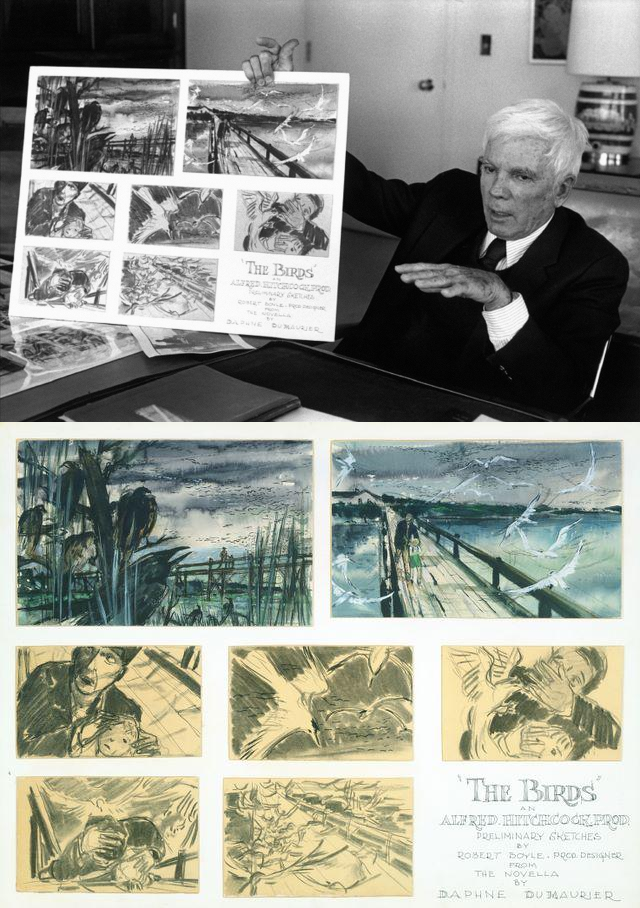
Boyle with preliminary sketches for The Birds

Munch’s most celebrated composition, The Scream, exists in several versions: two in paint, two in pastel, and several prints from a lithograph stone created by the artist. The image has a curious power to become the object of obsession, and over the years both of the paintings have been stolen, then recovered. In 2012, one of the pastels fetched a record $120 million when it was auctioned at Sotheby’s. Like Hitchcock, Munch poured his own darkest obsessions into his artwork, and The Scream is probably the finest example in art history of an attempt to express a psychological state in a single image. Madness ran in Munch’s family, and he grew up with the fear that it would one day take him over. Munch did indeed suffer a nervous breakdown in 1908, but after eight months of confinement to a psychiatric clinic, he seemed to make a full recovery.

At some point, Munch came under the influence of the Norwegian nihilist and anarchist Hans Jaeger who lived by the credo “a passion to destroy is also a creative passion.” Jaeger encouraged Munch to depict his own psychological states, from which emerged what Munch would call his “soul paintings,” the most celebrated of which is The Scream. Munch wrote the following about the origins of the painting, which was conceived in Oslo (then called Kristiania):

I was walking down the road with two friends when the sun set; suddenly, the sky turned as red as blood. I stopped and leaned against the fence, feeling unspeakably tired. Tongues of fire and blood stretched over the bluish-black fjord. My friends went on walking, while I lagged behind, shivering with fear. Then I heard the enormous, infinite scream of nature.

The painting has frequently been interpreted as an expression of modern “existential angst.” Munch later said, “for several years I was almost mad. . . You know my picture, The Scream? I was stretched to the limit — nature was screaming in my blood. . . After that I gave up hope ever of being able to love again.”

What motivated Boyle’s choice of The Scream as inspiration for The Birds? Since the screenplay was not yet written, we have to look to the content of the Du Maurier story for answers. Doing so also allows us to comment on the continuity between the story and the film — something which is seldom perceived, since the plots and characters of the two are markedly different.

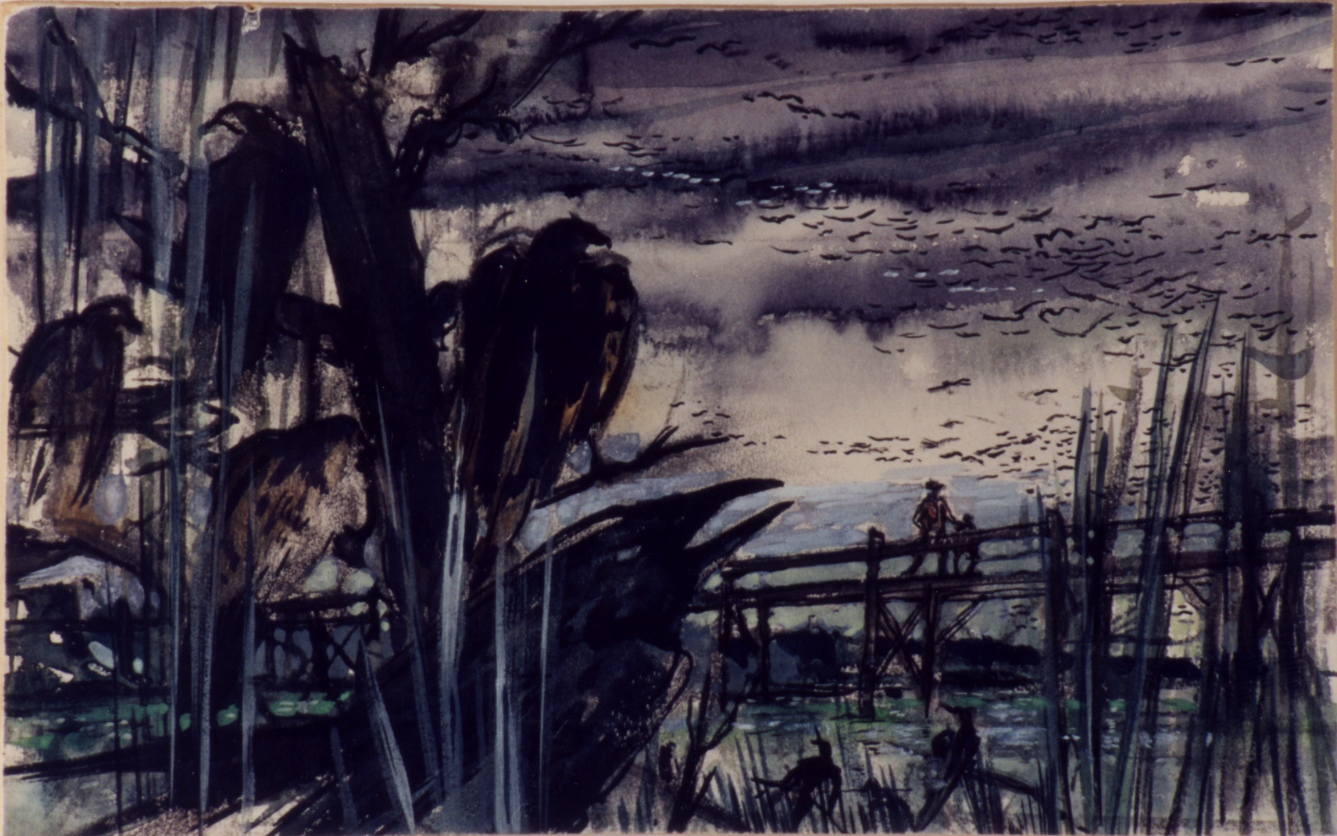
Boyle’s Munch-inspired watercolor for The Birds

The story focuses on one family, a farmer with his wife and two children, living in rural England. Suddenly one evening, birds begin attacking their house. This is dismissed as a fluke, until the attacks continue. At one point, a visit to a nearby farmhouse results in the discovery of the corpses of a man and his wife killed by birds (the inspiration for the Fawcett farm sequence in the film). The climax of the story involves the family waiting out the bird attacks in their boarded-up house, fending off attempts by the birds to breach their fortifications — including one episode in which the birds come down the chimney, just as in the film. Also like the film, the story ends without any resolution. We do not find out what becomes of the family, and the reason for the bird attacks is never explained.

There is a general feeling of despair and helplessness that hangs over the tale. The farmer, whose name is Nat, thinks at one point: “Someone should know of this. Someone should be told. Something was happening, because of the east wind and the weather, that he did not understand. He wondered if he should go to the callbox by the bus stop and ring up the police. Yet what could they do? What could anyone do?” Listening to “the wireless,” however, the family learns that the bird attacks have spread to the entire country. This convinces Nat that it is only a matter of time before the men he looks up to as authorities come riding to the rescue. He thinks to himself,

“There’s one thing, the best brains of the country will be onto it tonight.” Somehow the thought reassured him. He had a picture of scientists, naturalists, technicians, and all those chaps they called the backroom boys, summoned to a council; they’d be working on the problem now. This was not a job for the government, for the chiefs-of-staff — they would merely carry out the orders of the scientists.

(Sound familiar?) His wife has an even greater faith in authority figures (as most women do), and wonders why they fail to act: “Why don’t the authorities do something? Why don’t they get the army, get machine guns, anything?” She even says at one point, “Won’t America do something? . . . They’ve always been our allies, haven’t they? Surely America will do something?” But du Maurier instead shows that human beings, especially trusted authorities, prove completely incapable not just of understanding what is happening and doing something about it, but even of accepting that it is happening.

Eventually, the authorities do act, but the result is disastrous. The RAF is called into action, but their planes crash when they fly into the great flocks of birds that hang over the country like angry clouds. “What could aircraft do against birds that flung themselves to death against propeller and fuselage, but hurtle to the ground themselves?” Nat thinks to himself: “Someone high up had lost his head.” The authorities have completely failed — both the authority of government, and the authority of what had been “settled” knowledge of the universe. In the end, the characters are completely abandoned, left alone to face the very real possibility of death, unaided by comforting illusions. Arguably, this is as “existentialist” a story as anything by Camus.
And we can definitely discern a continuity of mood and themes between story and film. The bird attacks are “absurd” in the sense that they defy our attempts to make them intelligible. This brings us face-to-face with our own hubris in thinking that we have made the physical universe fully transparent to us, and manipulable. Our helplessness in the face of the terrifying power of the Unknown is exposed. And we might as well identify Nature with the Unknown, for what The Birds suggests is that the greater part of nature is unknown, the huge underside of the proverbial iceberg, the part that sinks our titanic pretensions.

It seems clear that Robert Boyle, who was a highly cultivated man, perceived the “existentialist” themes in du Maurier’s story, and made an intuitive connection to Munch’s The Scream, which, as already noted, is widely interpreted as a portrait of “existential angst.” Although the sketches Boyle initially produced, inspired by Munch, depict a scene that does not make it into the film, The Scream remained his inspiration throughout the design of the picture. This is especially the case with the depiction of the skyline around Bodega Bay. Grey, overcast skies were painted in by matte artist Albert Whitlock, to give the setting an ominous feeling of impending doom.

Grey painted-in skies over Bodega Bay

It was Boyle himself who found Bodega Bay when scouting locations, and proposed it to Hitchcock as a suitably “bleak” location for the film. It is thus clear that at least some of the personnel involved with the film were aware of the story’s philosophical depth even if it remained, for them, on the level of mood and atmosphere rather than some sort of articulated “message.” It is also fortuitous that Munch characterized the psychological state expressed in The Scream as the result of hearing “the enormous, infinite scream of nature.” This scream of nature is, of course, what the film depicts, though it would be a stretch to insist that Boyle was aware of this quote from Munch.

In our next installment, we will examine the question of what it means to call The Birds an “apocalyptic film” — a description many have endorsed. We will consider what Heidegger would have called the “originary meaning” of the Greek apocalypsis. And we will rejoin our protagonists, as they make a last stand against the birds.

If you want to support our work, please send us a donation by going to our Entropy page and selecting “send paid chat.” Entropy allows you to donate any amount from $3 and up. All comments will be read and discussed in the next episode of Counter-Currents Radio, which airs every Friday.

Don’t forget to sign up for the twice-monthly email Counter-Currents Newsletter for exclusive content, offers, and news.

Notes

[1] The term Zeitgeist, “spirit of the times,” is usually associated with Hegel, but we can still use this term in understanding Heidegger. Hegel’s own peculiar use of it is not intended here.

[2] D.H. Lawrence, Studies in Classic American Literature (London: Penguin, 1971), 8.


The Birds Or: Everything You Always Wanted to Know About Coronavirus (But Were Afraid to Ask Hitchcock & Heidegger), Part Four

The%20Birds%20Or%3A%20Everything%20You%20Always%20Wanted%20to%20Know%20About%20Coronavirus%20%28But%20Were%20Afraid%20to%20Ask%20Hitchcock%20and%23038%3B%20Heidegger%29%2C%20Part%20Four

Share

  • Gab
  • Or: Everything You Always Wanted to Know About Coronavirus (But Were Afraid to Ask Hitchcock Heidegger), Part Four &body=%0D%0A%0D%0A%0D%0A%0D%0A%0D%0A%0D%0Ahttps://counter-currents.com/2020/06/the-birds-or-everything-you-always-wanted-to-know-about-coronavirus-but-were-afraid-to-ask-hitchcock-heidegger-part-four/%0D%0A%0D%0A%0D%0A%0D%0A">

Enjoyed this article?

Be the first to leave a tip in the jar!

Instant Echeck GreenPay™

Related

  • Heidegger on Nietzsche Part Three

  • Heidegger on Nietzsche, Part Two

  • The Strange World of Gender Bender Fiction

  • Heidegger on Nietzsche, Part One

  • Finding Atlantis Part 4

  • Do You Want to Play a Game?

  • The Game of Tarot

  • Counter-Currents Radio Podcast No. 686

Tags

Alfred Hitchcockartbeingdas EreignisDerek HawthornedestinyhumanismMartin Heideggermodernitymovie reviewsnatureparadigm shiftsphilosophypsychologyscientismThe BirdsTranscendence

4 comments

  1. Paul says:
    June 1, 2020 at 2:57 pm

    https://de.wikipedia.org/wiki/Gegen%C3%B6ffentlichkeit
    https://en.wikipedia.org/wiki/Public_sphere

    0
    0
  2. margot metroland says:
    June 1, 2020 at 5:48 pm

    A pitch-perfect accompaniment to current events. And Mrs. Bundy is my favorite character in the film because she’s such an authentic example of real-life Science cranks.

    0
    0
    1. Derek Hawthorne says:
      June 2, 2020 at 12:15 pm

      Thank you, Margot! It’s good to hear somebody’s reading this.

      0
      0
    2. Don says:
      June 2, 2020 at 1:12 pm

      Mrs. Bundy is no crank. She’s right. The movie is science fiction. The world of the movie is not real. Her reaction is a real world reaction. It’s only out of place because she’s placed, as a character, in a fictional world.

      Science fiction is not science.

      0
      0

Comments are closed.

If you have a Subscriber access,
simply login first to see your comment auto-approved.

Note on comments privacy & moderation

Your email is never published nor shared.

Comments are moderated. If you don't see your comment, please be patient. If approved, it will appear here soon. Do not post your comment a second time.

Writers of May

(2 votes) Morris van de Camp David M. Zsutty Derek Stark Jayant Bhandari Greg Johnson

Articles of May

Heidegger on Nietzsche, Part One by Collin Cleary The Lunch Wars by David M. Zsutty 2 votes
    • Nationalism This Week
      Letter to J. D. Vance

      Greg Johnson

      3

    • Lost In Trans-Mission:
      How the Media Fails To Reveal the Inconvenient Truth About the Usual Suspects

      Steven Tucker

      4

    • Liar, Liar, Pants on Fire!

      Beau Albrecht

      4

    • Editor’s Update
      Rob Rundo on Counter-Currents Radio, Fundraiser Update, & a New $20,000 Matching Grant

      Greg Johnson

    • The Bitter End of Western Metaphysics:
      Heidegger on Nietzsche, Part Three

      Collin Cleary

      10

    • Uncivil War

      Mark Gullick

      40

    • Exclusive Interview with Karel Veliky:
      The Final Chapter in the Film Series! Part II

      Ondrej Mann

      2

    • Happy Birthday to Us!

      Greg Johnson

      6

    • Zsutty’s Maximum

      David M. Zsutty

      15

    • Exclusive Interview with Karel Veliky:
      The Final Chapter in the Film Series! Part I

      Ondrej Mann

      2

    • The Union Jackal, June 2026

      Mark Gullick

      23

    • The Inferiority Behind Immigrant Superiority

      Jayant Bhandari

      15

    • Counter-Currents Radio Podcast No. 690
      Greg Johnson & David Zsutty Discuss Current Things: AI, Henry Nowak, the Iran Crisis, & More

      Counter-Currents Radio

      7

    • Collin Cleary: What Rome Means to Me

      Collin Cleary

      4

    • Paul Krugman: Closet Bolshevik

      Spencer J. Quinn

      21

    • Fugue of Ideas:
      Ibram X. Kendi’s Chain of Ideas

      Greg Johnson

      19

    • Based Blacks

      Lipton Matthews

      22

    • Black Intellectual Fatigue

      Derek Stark

      41

    • Why White Advocates Should Avoid “Based Blacks”

      Dani Vypont

      32

    • Nietzsche & Race

      Mark Gullick

    • Editor’s Update
      Rob Rundo Rescheduled to Next Week on Counter-Currents Radio;
      Tonight Greg Johnson & David Zsutty Answer Your Questions;
      Fundraiser Update & a New $20,000 Matching Grant

      Greg Johnson

    • The Counter-Currents 2026 Fundraiser
      Lifetime Subscriber Welcome Packages Extended

      Greg Johnson

    • Nationalism This Week
      Who’s Looking Back?

      Greg Johnson

      29

    • China’s Threat to American Security:
      Food, Farmland, Foreign Control, & Energy Policy

      Lipton Matthews

      5

    • The Bitter End of Western Metaphysics:
      Heidegger on Nietzsche, Part Two

      Collin Cleary

      16

    • The Killing of Henry Nowak

      Mark Gullick

      38

    • The Crisis of Chinese Technology Thieves

      Morris van de Camp

      1

    • The Strange World of Gender Bender Fiction:
      & What This Genre Tells Us About Autosexuality

      Dani Vypont

      3

    • Watching the Watchers:
      The Dark Triad Question

      David M. Zsutty

      14

    • The Remigration Movement Solidifies

      F. Roger Devlin

      1

    • Casting Aspersions:
      The Fatal Consequences of Race-Swapped Casting, From Helen of Troy to Henry of Southampton

      Steven Tucker

      20

    • The Murder of Henry Nowak

      Millennial Woes

      23

    • Don’t Forget to Vote in Our Writer & Article of the Month Poll

      Greg Johnson

    • The Robot Hotdog Stand

      Greg Johnson

      37

    • Laughing Our Way to Victory

      Dave Chambers

      7

    • The Zodiac Killer

      Mark Gullick

      11

    • Jared Taylor: What Rome Means to Me

      Jared Taylor

      1

    • An Interview with Endeavour:
      My Way of Life Is an Adventure!

      Ondrej Mann

      6

    • José Pedro Zúquete’s The Identitarians

      Greg Johnson

      3

    • Editor’s Update
      Fundraiser Update & How to Watch the Remigration Summit

      Greg Johnson

      5

    • The Bitter End of Western Metaphysics:
      Heidegger on Nietzsche, Part One

      Collin Cleary

      12

    • Berlin: City of Stones

      Spencer J. Quinn

      6

    • True Folk-Horror Is Horror of Your Own Folk:
      Mark Gatiss vs the Brexit Blind Dead  

      Steven Tucker

      4

    • Counter-Currents Radio Podcast No. 689
      Thomas Massie, the America 2050 Bust, the Need for Whites to Divest from America, the AI Economic Apocalypse, & Pro-White Project Pitches to Billionaires

      Counter-Currents Radio

      7

    • Nationalism This Week
      Remigration is Inevitable, Part 3

      Greg Johnson

      27

    • Why Billionaires Should Fund White Identity Politics

      Lipton Matthews

      8

    • How Cold War Two Came About

      Morris van de Camp

      5

    • Now Available for Pre-Order at a Special Price!
      Greg Johnson’s The Philosopher Is In

      Greg Johnson

    • David Zsutty’s Elevator Pitch to a Billionaire

      David M. Zsutty

      1

    • Headbanging Lite

      Mark Gullick

      5

    • Peter Quint

      Liar, Liar, Pants on Fire!

      Great article! Well, I know I am good; I will match my rectitude with anyone, and come away clean...

    • Peter Quint

      Lost In Trans-Mission:
      How the Media Fails To Reveal the Inconvenient Truth About the Usual Suspects

      Great article! All he got was 28 months; he should have been locked away in a psycho ward for the...

    • Peter Quint

      Nationalism This Week
      Letter to J. D. Vance

      Great article! I don’t want Vance to be president; he gives me the creeps; I don’t think he has our...

    • Dominic Fox

      Liar, Liar, Pants on Fire!

      I’m still flabbergasted how someone can lie that egregiously and shamelessly. Do words have no...

    • Dominic Fox

      Liar, Liar, Pants on Fire!

      The Christian ideas of repentance and “prodigial sons” give dysfunctional and anti-social...

    • Dominic Fox

      Nationalism This Week
      Letter to J. D. Vance

      "There was virtually no chance that this scenario would work. It was stewed up with bogus...

    • Zarathustra

      Nationalism This Week
      Letter to J. D. Vance

      A peace deal with Iran has finally been agreed. Let's see how Israel manages to sabotage it.

    • Will Williams

      Based Blacks

      Weave: June 15, 2026  Thank you for completely proving my point, which is that if we aren’t as...

    • Fred C. Dobbs

      Lost In Trans-Mission:
      How the Media Fails To Reveal the Inconvenient Truth About the Usual Suspects

      Great article. We’re all used to the media using lies of omission. The “teens” is most commonly used...

    • Fred C. Dobbs

      Liar, Liar, Pants on Fire!

      Father Merrin “he mixes lies with the truth to confuse us.” Excellent piece. We’ve all experienced...

    • Adrian Roberts

      Lost In Trans-Mission:
      How the Media Fails To Reveal the Inconvenient Truth About the Usual Suspects

      What about all the people who've been born in the wrong bodies and don't even know it?

    • Weave

      Based Blacks

      Thank you for completely proving my point, which is that if we aren’t as “pure” as you then we are...

    • Joe Gould

      Lost In Trans-Mission:
      How the Media Fails To Reveal the Inconvenient Truth About the Usual Suspects

      Philosophy matters. Bad philosophy backed by media, money, and state power is a disaster. The dogma...

    • Joe Gould

      Uncivil War

      I think that your phone (any brand, not just an iPhone) will give up all sorts of information on you...

    • YT

      Uncivil War

      So you’re advocating leaving your iPhone at home as it can be used for geographic location purposes...

    • Will Williams

      Nationalism This Week
      The SPLC Indictment

      I bump this comment because Christian conservative reporter Tyler O'Neil is on the SPLC  beat again...

    • Peter Quint

      Why White Advocates Should Avoid “Based Blacks”

      Why would you tell a little parable like that? Are you trying to tell us to judge blacks by the  “...

    • Will Williams

      Based Blacks

      Uncle Semantic: June 14, 2026  Will, I’m curious if your racial journey to where you stand now...

    • Angela Mercy

      Paul Krugman: Closet Bolshevik

      Things don't look bright for Republican party and it's voters but they can only blame Donald Trump...

    • S Dane

      Paul Krugman: Closet Bolshevik

      Krugman is the creep who was caught with kiddie porn a few years ago and was able to get off with a...

    • Earth Day Special

      John Morgan

      12

    • A Robertson Roundup
      Remembering Wilmot Robertson
      (April 16, 1915 – July 8, 2005)

      Margot Metroland

      13

    • The Paranoid Style in White Nationalism

      Greg Johnson

      30

    • Join the Dance!

      Andrew Hamilton

      1

    • We Can’t Save the Earth Without Reducing African Birth Rates

      James Dunphy

      36

    • “I’m Not a Conspiracy Theorist, but . . .”:
      Jeffrey Epstein’s Death Gives New Life to “Conspiracy Theories”

      Greg Johnson

      22

    • Sylvia Plath: Stasis in Darkness

      Vic Olvir

      17

    • Vanguardism, Vantardism, & Mainstreaming

      Greg Johnson

      80

    • Aviation, Geography, & Race

      Charles Lindbergh

      3

    • Some Thoughts on Yule

      Collin Cleary

      4

    • Living in Truth:
      A Yuletide Homily

      Jef Costello

      7

    • John Kennedy Toole’s A Confederacy of Dunces

      Greg Johnson

      20

    • On Aleksandr Solzhenitsyn’s Warning to the West

      Spencer J. Quinn

      7

    • Elitism, British Modernism, & Wyndham Lewis

      Jonathan Bowden

      6

    • Philip K. Dick’s Do Androids Dream of Electric Sheep? as Anti-Semitic/Christian-Gnostic Allegory

      Greg Johnson

      20

    • “Conspiracy Theory” or Conspiracy?

      Andrew Hamilton

      21

    • Remembering H. P. Lovecraft
      (August 20, 1890–March 15, 1937)

      Greg Johnson

      3

    • Who Are We?
      Nordics, Aryans, & Whites

      Greg Johnson

      71

    • Remembering William Gayley Simpson
      (July 23, 1892–December 31, 1990)
      A Pleasant Afternoon with Harriet & Bill Simpson

      Margot Metroland

      18

    • Here are the Young Men
      Remembering Ian Curtis
      (July 15, 1956–May 18, 1980)

      Mark Gullick

      18

    • Percy Grainger
      Artist of the Right

      Alex Graham

      7

    • Remembering Revilo Oliver
      (July 7, 1908–August 20, 1994)

      Greg Johnson

      18

    • The Meaning of July 4th for the White Man

      Gregory Hood

      13

    • The Front National’s Evolution

      Bruno Mégret

    • Merwin K. Hart
      Forgotten American Hero & Man of the Right

      Morris van de Camp

      10

    • George Orwell’s Nineteen Eighty-Four

      Jonathan Bowden

      8

    • Carleton S. Coon
      Scientist & Reluctant White Advocate

      Morris van de Camp

      3

    • The Kwanzaa Absurdity Will Be Dwarfed by Juneteenth

      Robert Hampton

      10

    • Stravinsky

      Alex Graham

      7

    • Like the Roman:
      Remembering Enoch Powell (1912-1998)

      Mark Gullick

      23

    • The 1970s: The Golden Age of Hijacking

      Morris van de Camp

      21

    • Jonathan Bowden’s Deliverance
      Part 6

      Jonathan Bowden

    • Do You Want to Play a Game?

      Mark Gullick

      1

    • Sexually Incontinent on the Indian Subcontinent:
      Who Rapes More Animals, Indians or Pakistanis? The Battle Continues!

      Steven Tucker

      3

    • Neo-Fascism in Film
      Part 5

      Karel Veliky

      15

    • The Game of Tarot

      Mark Gullick

      2

    • Institutions Cannot Be Transplanted

      Jayant Bhandari

      5

    • Jonathan Bowden’s Deliverance
      Part 5

      Jonathan Bowden

    • Crosstown Traffic:
      Jimi Hendrix & The Post-War Rock ‘N’ Roll Revolution

      Mark Gullick

      1

    • Slaves from the North:
      Finns & Karelians in the East European Slave Trade, 900–1600

      Lipton Matthews

      14

    • Neo-Fascism in Film
      Part 4

      Karel Veliky

      2

    • David Lean’s A Passage to India

      Spencer J. Quinn

      1

    • Elites are Essential to Development

      Lipton Matthews

      7

    • Jonathan Bowden’s Deliverance
      Part 4

      Jonathan Bowden

    • Neo-Fascism in Film
      Part 3

      Karel Veliky

      6

    • E. M. Forster’s A Passage to India & the Indian Mentality

      Spencer J. Quinn

      25

    • Jonathan Bowden’s Deliverance
      Part 3

      Jonathan Bowden

    • The Rest Is Silence
      Heidegger’s Quietism

      Mark Gullick

      2

    • Dispelling the Historical Fallacy of Indian Nationalism

      Lipton Matthews

      8

    • Neo-Fascism in Film
      Part 2

      Karel Veliky

      8

    • Jonathan Bowden’s Deliverance
      Part 2

      Jonathan Bowden

    • Life of a Klansman

      Mark Gullick

      8

    • Jonathan Bowden’s Deliverance, Part 1

      Jonathan Bowden

    • Decolonial Ideas are Holding Back Developing Countries

      Lipton Matthews

      8

    • Neo-fascism in Film, Part 1

      Karel Veliky

      21

    • Jonathan Bowden’s Onslaught, Part 8
      Divigations on Decadence

      Jonathan Bowden

    • Jonathan Bowden’s Onslaught, Part 7
      Intrigues in the National Front

      Jonathan Bowden

      1

    • Rotten to the Core

      Mark Gullick

      8

    • Strauss on Husserl’s “Philosophy as Rigorous Science”

      Greg Johnson

    • Jonathan Bowden’s Onslaught, Part 6
      Francis Bacon & Right-Wing Nihilism

      Jonathan Bowden

    • András László
    • Derek Hawthorne
    • Beau Albrecht
    • Alain de Benoist
    • Kerry Bolton
    • Jonathan Bowden
    • Collin Cleary
    • Jef Costello
    • Savitri Devi
    • Julius Evola
    • Jim Goad
    • Gregory Hood
    • Juleigh Howard-Hobson
    • Greg Johnson
    • Charles Krafft
    • Anthony M. Ludovici
    • Trevor Lynch
    • H. L. Mencken
    • J. A. Nicholl
    • James J. O’Meara
    • Christopher Pankhurst
    • Tito Perdue
    • Michael Polignano
    • Spencer J. Quinn
    • Fenek Solère
    • Irmin Vinson
    • Leo Yankevich
    • Francis Parker Yockey
    • Multiple authors
  • Editor-in-Chief

    • Greg Johnson, Ph.D.

    Featured Writers

    • Beau Albrecht
    • Gunnar Alfredsson
    • Collin Cleary, Ph.D.
    • Jef Costello
    • Morris V. de Camp
    • F. Roger Devlin, Ph.D.
    • Stephen Paul Foster, Ph.D.
    • Jim Goad
    • Alex Graham
    • Mark Gullick, Ph.D.
    • Greg Johnson, Ph.D.
    • Travis LeBlanc
    • Trevor Lynch
    • Margot Metroland
    • James J. O’Meara
    • Angelo Plume
    • Spencer J. Quinn
    • Fred Reed
    • Clarissa Schnabel
    • Michael Walker
    • David M. Zsutty

    Frequent Writers

    • Asier Abadroa
    • Aquilonius
    • Alain de Benoist
    • Kerry Bolton, Ph.D.
    • Dave Chambers
    • Steven Clark
    • James Dunphy
    • Endeavour
    • Richard Houck
    • Jason Kessler
    • Titus Livius
    • Ondrej Mann
    • Lipton Matthews
    • Mark Mazari
    • John Morgan
    • Jaroslav Ostrogniew
    • Kathryn S.
    • Christian Secor
    • Anne Wilson Smith
    • Thomas Steuben
    • William De Vere
    • Kenneth Vinther
    • Max West

    Classic Authors

    • Maurice Bardèche
    • Jonathan Bowden
    • Julius Evola
    • Guillaume Faye
    • Ernst Jünger
    • Kevin MacDonald, Ph.D.
    • D. H. Lawrence
    • Charles Lindbergh
    • Jack London
    • H. P. Lovecraft
    • Anthony M. Ludovici
    • Sir Oswald Mosley
    • National Vanguard
    • Friedrich Nietzsche
    • Revilo Oliver
    • William Pierce
    • Ezra Pound
    • Saint-Loup
    • Savitri Devi
    • Carl Schmitt
    • Miguel Serrano
    • Oswald Spengler
    • P. R. Stephensen
    • Jean Thiriart
    • John Tyndall
    • Dominique Venner
    • Leo Yankevich
    • Francis Parker Yockey

    Other Authors

    • Howe Abbott-Hiss
    • Michael Bell
    • Giles Corey
    • Jack Donovan
    • Richardo Duchesne, Ph.D.
    • Emile Durand
    • Guillaume Durocher
    • Mark Dyal
    • Tom Goodroch
    • Andrew Hamilton
    • Robert Hampton
    • Huntley Haverstock
    • Derek Hawthorne
    • Gregory Hood
    • Juleigh Howard-Hobson
    • Alexander Jacob
    • Ruuben Kaalep
    • Tobias Langdon
    • Julian Langness
    • Patrick Le Brun
    • G A Malvicini
    • John Michael McCloughlin
    • Millennial Woes
    • Michael O’Meara
    • Christopher Pankhurst
    • Michael Polignano
    • J. J. Przybylski
    • Quintilian
    • Edouard Rix
    • C. B. Robertson
    • C. F. Robinson
    • Herve Ryssen
    • Alan Smithee
    • Fenek Solere
    • Ann Sterzinger
    • Robert Steuckers
    • Tomislav Sunic
    • Donald Thoresen
    • Marian Van Court
    • Irmin Vinson
    • Book Reviews
    • Movie Reviews
    • TV Reviews
    • Music Reviews
    • Art Criticism
    • Graphic Novels & Comics
    • Video Game Reviews
    • Fiction
    • Poems
    • Interviews
    • Videos
    • English Translations
    • Other Languages
      • Arabic
      • Bulgarian
      • Croatian
      • Czech
      • Danish
      • Dutch
      • Estonian
      • Finnish
      • French
      • German
      • Greek
      • Hungarian
      • Italian
      • Lithuanian
      • Norwegian
      • Polish
      • Portuguese
      • Romanian
      • Russian
      • Slovak
      • Spanish
      • Swedish
      • Ukrainian
    • Commemorations
    • Why We Write
  • Archives
  • Top 100 Commenters
  • The Looney Bin
Sponsored Links
Europa.com Above Time Coffee Antelope Hill Publishing Paul Waggener IHR-Store Spencer J. Quinn American Renaissance Jim Goad The Occidental Observer
Donate Now Mailing list
Books for sale
  • The Philosopher Is In
  • Sexual Utopia in Power (Expanded Edition)
  • In Defense of Prejudice
  • Loving Our Own
  • Tyranny & Wisdom
  • The Populist Moment
  • Is America Doomed?
  • To all books
Copyright © 2026 Counter-Currents Publishing, Ltd.

Paywall Access


Please enter your email address.

Lost your password?

Edit your comment

Writer & Article of the Month May 2026

Voting for this month has concluded. Here are the final results!

Top Writers

  • #1 Morris van de Camp 2 votes
  • #2 David M. Zsutty 2 votes
  • #3 Derek Stark 2 votes
  • #4 Jayant Bhandari 2 votes
  • #5 Greg Johnson 2 votes
  • #6 Jared Taylor 1 vote
  • #7 Collin Cleary 1 vote
  • #8 Spencer J. Quinn 1 vote
  • #9 Mark Gullick 1 vote
  • #10 Lipton Matthews 1 vote
  • #11 Keith Woods 1 vote
  • #12 Steven Tucker 1 vote

Top Articles

  • #1 Heidegger on Nietzsche, Part One 2 votes
  • #2 The Lunch Wars 2 votes
  • #3 The 1970s: The Golden Age of Hijacking 1 vote
  • #4 True Folk-Horror Is Horror of Your Own Folk 1 vote
  • #5 Finding Atlantis Part 4 1 vote
  • #6 Berlin: City of Stones 1 vote
  • #7 The Ghost of the Confederacy 1 vote
  • #8 Lothrop Stoddard’s The Revolt Against Civilization 1 vote
  • #9 Could Fascism Work? 1 vote
  • #10 Jared Taylor's Elevator Pitch to a Billionaire 1 vote
  • #11 Predation Wearing the Mask of Civilization 1 vote
  • #12 Peak Fatigue in Fort Wayne 1 vote
  • #13 Keith Wood's Elevator Pitch to a Billionaire 1 vote
  • #14 Do You Want to Play a Game? 1 vote
  • #15 Why Billionaires Should Fund White Identity Politics 1 vote

Total votes cast: 17