 2,405 words
Most academic publishers — and all of the most prestigious ones — are affiliated with universities. Routledge is one of the largest private academic publishers. Routledge is fair-to-middling in terms of prestige but above average in production and marketing. Nobody places their best work there, but Routledge provides plenty of opportunities for established scholars to pad their resumes and young scholars on the make to get started. Counter-Currents, my work, and the work of my colleagues here are mentioned in a growing number of Routledge volumes.
The default preference of the establishment — especially academia — is to censor White Nationalist ideas. Barring that, they prefer to ignore us. But since our ideas are breaking into the mainstream, they are forced to deal with us. Of course, given the biases of academia, we can’t expect such writers to defend us. The best we can hope for is fairness. But mentioning our ideas even to criticize them is dangerous, since at least some people will explore further and become converted. Mentioning White Nationalism also gives us a form of “social proof,” since it shows that we can no longer be ignored.
The purpose of the The Battle of the Books series is to document the impact of Counter-Currents‘ writers, and of course all of you who so generously support us. In this installment, I look at five volumes in the Routledge Studies in Fascism and the Far Right series, which began in 2014 and is now approaching 100 volumes.
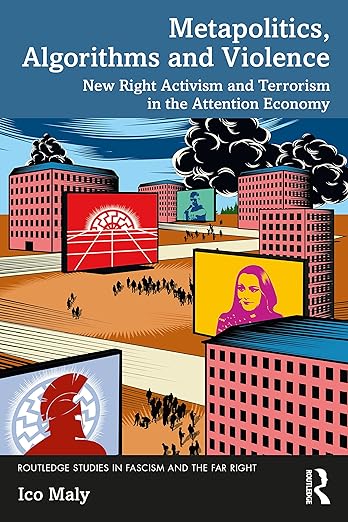
Ico Maly
Metapolitics, Algorithms and Violence:
New Right Activism and Terrorism in the Attention Economy
Routledge Studies in Fascism and the Far Right
New York: Routledge, 2024
One of the oldest smears in history is to discuss an idea you don’t like by linking it to the worst person associated with it, however tenuously. Thus Ico Maly’s book on the metapolitics of the European New Right begins with Brenton Tarrant, who murdered dozens of Muslims in New Zealand in 2019. Tarrant is mentioned 80 times by Maly. Fellow spree killer Dylann Roof receives 187 mentions. Maly is particularly triggered by all the “bowl patrol” memes generated by Roof’s fans. Maly does not mention if any of these merry pranksters were subsequently outed as federal or NGO provocateurs.
According to Maly, Tarrant’s manifesto reflected some of the “differentialist” and “ethnopluralist” ideas associated with Guillaume Faye and Alain de Benoist. The basic idea is that if you wish to preserve diversity, you need borders. If you wish to destroy diversity, encourage racial and cultural mixing. Benoist and Faye adopted a Gramscian “metapolitical” strategy for promoting their ideas. New Right metapolitics got a huge boost with the creation of the internet, which allows millions to form relationships and share ideas free of the old institutional choke points and gatekeepers that maintained an artificial consensus in the West since the Second World War. Maly finds this scary and hopes something can be done about it. Maly develops these ideas over more than 300 pages of dry academic prose, without reporting anything that I found new, useful, or interesting.
I was, however, flattered to note that Maly mentions or cites me 42 times. He mentions or cites Counter-Currents (with or without the hyphen and italics) 49 times. I don’t receive any extensive analysis, since this book deals primarily with Faye (309 mentions), Alain de Benoist (159 mentions), and their influence. Instead, Counter-Currents and I are mentioned as exponents and practitioners of New Right metapolitics in the digital age, as well as victims of politically-motivated deplatforming. Interestingly, Renaud Camus, who coined the term “the Great Replacement” and was widely smeared by association with Tarrant, receives only 39 mentions.
Maly repeatedly uses the phrase “old skool,” but it is unclear whether this is a whigger affectation or merely the sort of English-as-a-second language mistake that should have been caught by a proofreader.
 A. James McAdams and Samuel Piccolo, eds.
Far-Right Newspeak and the Future of Liberal Democracy
Routledge Studies in Fascism and the Far Right
New York: Routledge, 2024
This book deserves some sort of prize for its whiny, tendentious, and deeply ironic title. According to Routledge, “The book demonstrates that mainstream politicians and intellectuals are at risk of losing control over the definitions of the very concepts, including equal rights, racial and ethnic diversity, and political tolerance, that undergird their vision of liberal democracy.”
Of course, George Orwell’s famous concept of “Newspeak” in Nineteen Eighty-Four referred to the system’s control of thought by policing the use of language. Thus it is a breathtaking bit of projection for defenders of the liberal democratic consensus to accuse its critics of Newspeak when the entire book is an exercise in language policing. Apparently, we just aren’t allowed to use Liberal Democracy’s trademarked concepts to criticize it.
For instance, liberal democrats refuse to acknowledge that adding the “liberal” qualifier to “democracy” basically means that popular sovereignty can always be vetoed by minority interests. Thus, in practice, liberal democracy means minority rule. Thus liberal democrats do not applaud attempts to assert popular sovereignty and demand government accountability as democracy in action. Instead, they stigmatize it as “populism.”
We are also not allowed to point out that advocating censorship is inconsistent with liberal norms. Nor are we allowed to point out that systems of racial privilege are inconsistent with equal rights. Nor are we allowed to ask how supporting Islamic colonization and covering up the mass rape of whites by non-whites is consistent with feminism. In short, we are never allowed to condemn massive liberal hypocrisy.
Marine Le Pen, Tucker Carlson, Peter Thiel, Nick Griffin, Thierry Baudet, Jordan Peterson, Russell Brand, Viktor Orbán, and Raw Egg Nationalist receive extensive treatment in this volume. Although I have a lot to say on these subjects, I am discussed only briefly in only one of 12 essays.
In José Pedro Zúquete’s “Against the Global Prison-Society: The Far Right’s Language of the Opposition to the Great Reset,” I am quoted about the relationship between the Great Replacement and the Great Reset. My answer, basically, is that they have little connection aside from the word “great.” The Great Replacement is actually happening. The Great Reset is a way of branding a whole slate of pre-existing schemes to ram them through during the Covid panic. Most of it never happened. It is noteworthy that, unlike virtually every other mainstream scholar who writes about me, Zúquete actually had the courtesy to contact me and ask me for my opinion.
Counter-Currents is also mentioned in passing in another essay, Josh Vandiver’s “Hard Men, Hard Money, Hardening Right: Bitcoin, Peter Thiel, and Schmittian States of Exception,” where Vandiver notes that Counter-Currents publishes Bitcoin advocates.
 José Pedro Zúquete and Riccardo Marchi, eds.
Global Identitarianism
Routledge Studies in Fascism and the Far Right
New York: Routledge, 2023
This book’s title is quite accurate: it is a collection of studies of Identitarianism, a form of white identity politics that was founded in France in 2003 and soon spread around the world. The volume is co-edited by José Pedro Zúquete, who wrote the best book on the subject: The Identitarians: The Movement Against Globalism and Islam in Europe (Notre Dame: University of Notre Dame Press, 2018).
The book comprises 14 essays discussing Identitarianism in Europe, North America, South America, and Australia. I am mentioned in five essays.
In Riccardo Marchi and Gabriel Guimares, “The Identitarian Movement in Portugal at the Beginning of the 21st Century,” I am mentioned alongside Jared Taylor as the sort of North American racialist who influenced the Portuguese webzine O Bom Europeu [The Good European] (p. 66).
In D. J. Mulloy’s “Continuity and Disruption: American White Nationalism, the Alt-Right, and the Politics of Displacement at the Beginning of the Twenty-first Century,” I am mentioned frequently in pages 134–37 and again on 140. Mulloy dismisses the concept of Human Biodiversity as “pseudo-scientific.” He also claims that universal ethnonationalism is a “spurious rationalization” for white supremacism, rather than an alternative to it. Throughout the article, Mulloy simply pulls together other people’s research, with no evidence of original research and little evidence even of direct engagement with texts. It is a waste of time.
Alexandra Minna Stern’s essay “The Far Right, White Identity Politics, and the Failure of Organized Identitarianism in the United States” focuses on Identity Evropa and the American Identity Movement. Stern’s essay is fair-minded, not tendentious. It also contains some original thought and useful ideas. I am mentioned on page 145 as an interviewer of Nathan Damigo and on page 149 as someone who recognizes the importance of the European New Right.
Josh Vandiver’s “Masculinist Identitarians, Strategic Culture, and Eurocene Geopolitics” is quite a grab-bag. I am mentioned in passing for having published Jack Donovan at Counter-Currents (p. 179 and again on p. 192).
Imogen Richards and Callum Jones, in their article “Far-Right Identitarianism in Australia,” mention me in passing on page 211 as the publisher of Counter-Currents, which has been cited by Australian nationalist Jim Saleam. Saleam has actually commented at Counter-Currents.
 A. James McAdams and Alejandro Castrillon, eds.
Contemporary Far-Right Thinkers and the Future of Liberal Democracy
Routledge Studies in Fascism and the Far Right
New York: Routledge, 2022
Five of the fifteen essays in this volume mention me, but none of them deal with my work at length. Instead, the volume contains essays on the European New Right, Alain de Benoist, Identitarianism, Götz Kubitschek. Guillaume Faye, Frodi Midjord, Bronze Age Pervert, the Groyper movement, Quilette magazine, Jason Jorjani, nationalism in Slovakia and Russia, and other topics.
Jean-Yves Camus’ “Guillaume Faye, from New Right Intellectual to Prophet of the Racial Civil War,” mentions me as follows: “Faye is also a reference point for the quarterly magazine Réfléchir et Agir (1995) which is distributed at newsstands and also draws from the ideas of Jared Taylor and Greg Johnson” (p. 76), citing R&A no. 55, Winter 2017, which contains interviews with me and Jared Taylor.
Ronald Beiner’s “The Conservative Revolution of the Twenty-First Century: The Curious Case of Jason Jorjani” focuses on Jason Jorjani but mentions me in four places. Beiner refers to me as the “neo-Nazi philosopher Greg Johnson,” quoting the Southern Poverty Law Center as a reputable source (p. 189). Beiner also mentions my remarks on Jorjani’s doxing by a Hope Not Hate spy (pp. 190, 191, 200). Beiner is a college professor, but he writes like an antifa blogger.
José Pedro Zúquete’s “Beyond America: The Rise of the European Alt-Right” deals primarily with my friend Frodi Midjord and his various projects. I am mentioned as “Greg Johnson (the co-founder of the site Counter-Currents)” alongside Kevin MacDonald and Jared Taylor in a list of “White nationalist intellectual leaders” who spoke at Frodi Midjord’s Scandza Forum events (p. 213).
George Hawley’s “The ‘Groyper’ Movement in the US: Challenges for the Post-Alt-Right,” mentions my argument that White Nationalism in America should present itself as American nationalism (pp. 232-33). Hawley finds this puzzling, because I draw so much on the European New Right. There’s no contradiction, however. I define White Nationalism as advocating for homelands and self-determination for all white peoples. Thus White Nationalism in America is American nationalism, just as White Nationalism in Croatia is Croatian nationalism. Moreover, American White Nationalists have much to learn from American history, for America from the start was always a profoundly white-supremacist society. Finally, for White Nationalism in America to be genuinely populist, it must appeal to American symbols and traditions, not LARP as European interwar fascists.
Alejandro Castrillon’s “The Shifting Faces of Far-Right Identity and the Future of Liberal Democracy” mentions me several times in connection with metapolitics, quoting my essay “New Right vs. Old Right” on how our movement can harness its own intellectual diversity to appeal to a wide number of different white constituencies (p. 294), discussing my liberal arts education (p. 295), and pointing out my role in the transatlantic exchange of ideas (p. 296). I laughed out loud, however, when Castrillon claimed that “Counter-Currents and The Daily Stormer” give “a high-brow veneer to White nationalism” (p. 296). The Daily Stormer is not “high-brow.” Frankly, I think they would be insulted by the suggestion. Counter-Currents, moreover, is a genuinely intellectual publication. It does not put an intellectual “veneer” on something else.
Two Counter-Currents writers are also mentioned in this book.
Michael O’Meara is quoted on Guillaume Faye’s book La nouvelle question juive (pp. 68-69), which I commissioned him to review for The Occidental Quarterly.
James O’Meara is mentioned in connection with Peter Bredon’s article at Counter-Currents suggesting that O’Meara was the real author of Bronze Age Mindset (p. 246). I thought the thesis was preposterous, given that O’Meara was incapable of a miserable intellectual performance like Bronze Age Mindset, but I published the essay anyways because it was so damned funny.
 Sarah Bracke and Luis Manuel Hernández Aguilar, eds.
The Politics of Replacement: Demographic Fears, Conspiracy Theories, and Race Wars
Routledge Studies in Fascism and the Far Right
New York: Routledge, 2023
Since the Great Replacement is obviously happening, and it is obviously a conspiracy, I was eager to see what this crack team of professors would make of it. Basically, it is like reading young-earth creationists: our authors believe that facts that conflict with their feelings can be simply dismissed by putting them in “scare quotes” and blackening the motives and reputations of the people who defend them.
At core, this book is a polemic against Renaud Camus, who coined the term “the Great Replacement.” “The Great Replacement” is mentioned 151 times in the text, yet his central theses are never presented or refuted. Although Camus’ name is mentioned 42 times in the text, it does not appear once in the Index. The related concept of “white genocide” is mentioned 81 times yet does not appear in the Index. Bob Whitaker is mentioned once but does not appear in the Index. There are no mentions of Tim Murdock, Horus, or White Rabbit Radio.
Somehow, though, our authors manage to produce more than 300 pages of leaden academic sludge while studiously avoiding any real issues.
My name is mentioned twice. My alter ego Trevor Lynch is also mentioned twice, as is my colleague Gregory Hood. Counter-Currents is mentioned three times: as Counter-Current, Counter-Current Publications, and Counter-Currents. None of these mentions are indexed.
Am I cited for my essays “White Extinction” and “White Genocide” in The White Nationalist Manifesto? Is Counter-Currents mentioned for its pioneering role in popularizing the Great Replacement in the Anglosphere or for our early attempts to popularize the idea of white genocide? No, not at all. Instead, we are mentioned only by some lazy slob writing about movie reviews.
This book is a pathetic and contemptible performance. If this is the best the system can come up with, then the outcome is clear: without censorship, we win.
17 comments
Without censorship and with the deteriorating situation of white people and academics writing lies, we white nationalists will win!
Books such as these fall on the spectrum between pearl clutching and hand waving but what they really show is that the White Nationalist phenomenon is all too real. I like our chances because, as Richard Nixon said, if someone gets up on their soap box and goes on tirades against X—always bet on X. That is they do protest too much.
Kudos to James O’Meara! When people start ascribing books to you you’ve certainly hit the Big Time. It happened to Revilo Oliver with The John Franklin Letters and William Pierce with Serpent’s Walk. Good company all.
Far from engaging in Newspeak what White Nationalists do is plainly call a spade a spade and thus cut too close to the bone for their tastes—Camus’ The Great Replacement being Exhibit A. It is our critics who engage in euphemism, as in France they call Multiculturalism “Vivre Ensemble”—living together, which phrase always sounded to me like a rest home for aging hippies.
Reading Greg’s “Is America Doomed”? Loving it. We need more books published through Counter Currents Publishing!
Universities and public research institutions are the places with the highest degree of conformity in the whole established system. The basic feeling of the average academic today is FEAR. All the mechanisms on which your existence as a university teacher or researcher depends today reinforce maximum conformity to the ruling liberal ideology. You have to pander to grant agencies and impact journals, which are essentially the gatekeepers to ensure that your research or publications not only contain nothing “controversial” but downright require you to outdo yourself in reciting liberal and woke dogmas. Also, on the part of students, woke activists, and colleagues, you must constantly count on the thought police. Department heads and university administrators routinely respond to the rare anonymous complaint that a professor has said something inappropriate, perhaps in passing. I think this conformity has rather deteriorated after white nationalism and anti-status-quo populism became more visible. Opposition forces may be stronger in political preferences and in the media space, but in the academy it just means that liberals here are pushing the envelope even more.The only thing that gives me hope in my many years at the university is the obviously growing number of students who have been affected by our ideas. However, this is happening on the internet, not in the classroom.
In my opinion, the stark truth is that academia is far too big, and the vast majority of the population are not intelligent enough to be put into an academic setting. 50% [or more] of people go to university, and the ones worthy of that distinction are probably about 1-5%, who would also be overwhelmingly White and male.
The fact academia is so frightened and so rule-obeying is that it’s full of midwits, females and nonwhites. University should be an elite institution. I also, frankly think we should do away with school altogether – but I’d settle for just abolishing universities.
This is before we even get into the insane disaster that is 18-30 year old women putting off having children, which the university system massively encourages.
I’d go one further: University exists TO BE a leftist indoctrination camp. That IS it’s purpose. The worth of the degree has been so diluted by the number of people going. It’s basic supply and demand. Uni is also a giant ponzi scheme which exists to profiteer off itself; but more than that, it strongly embeds leftist and anti nation narratives into the heads of 50+% of the population.
Great article! The jews have found a new enemy to blame all the world’s problems on, after all you can’t drag the ghost of Hitler out of the closet forever—or can you. 🙃
“I thought the thesis was preposterous, given that O’Meara was incapable of a miserable intellectual performance like Bronze Age Mindset,”
You might very well think that; I couldn’t possibly comment.
Ah, the classic non-denial obfuscation. Very Clever.
Great to see Counter-Currents giving the lefties nightmares.
It’s remarkable how much screed these “academics” write, yet their research seems to consist of a skim read of Wikipedia and maybe an email to the ADL/SPLC/etc. What’s more amazing is these people are full time academics who are funded to research this material and yet a NEET shitposter could give you a better précis of the arguments – EVEN the leftists’ own arguments. Academia is dead on its feet. They are quite simply, clearly incapable of engaging these ideas. Maybe they’re not intelligent enough? Maybe they’re not open minded enough ?
I’m also continually awed by Leftists’ habit of simply pointing and gawking at ideas they don’t like, and then just refuse to elaborate. “They don’t believe in equality!”, they splutter, and simply present this as the final argument, which is presumably meant to make the reader shudder in fear at the thought. It’s so massively lazy, dishonest, blockheaded, and frankly an insult to the intelligence of all invovled. The likes of the Guardian and NYT are simply not worth reading, and what’s more, it is they who are the ones applying an “intellectual veneer” to their arguments. It’s all so terribly midwitted, normie-coded, and yes, it’s all so tiresome.
And you don’t even have to be an academic. Wiki and Gurgle: the sources of first and last resort. Back in 2022, my old friend Colin Flaherty died (you may recall he was author of White Girl Bleed a Lot; Don’t Make the Black Kids Angry; and many other titles, and even some insides). I happened to mention this to an old friend in Oregon, because she had known him 25-30 years back. Her response, after consulting not her own memory but what she found in Wikipedia, was that he was a racist, a huwyte supreemist, and what-have-you. As clueless and unappreciative as she could be. Some months later the penny dropped and the fog cleared. But I don’t think she, or most people, will ever be able to think critically and discerningly when offered information that spools so quickly off the interwebz feed.
There are basically three types of people among mainstream academics
1) aggressive conformists who feel fulfilled if they can berate others for not being sufficiently conformist with official dogma
2) “core” conformists who experience satisfaction from “being like everyone else/doing what they’re supposed to” (this is the case for many women in universities who have been selected for their conformity)
3) “Pragmatists” who enjoy the satisfaction of being able to put on a good front and not being “foolish” to say what they really think.
I hope the majority is 3 but I suspect 1 and 2. Counter-Current, Counter-Current Publications- these are the same goofs whose protestor signs spell Fascist as ‘facist’, or they’re proudly holding up the sign oblivious that it is upside-down.
What’s most noticeable (besides disdain) is how dated the material is. I think that pro-White politics is now moving at a speed that our opponents cannot match.
That was good. It’s also nice that C-C and you are getting at least some recognition. I know I’ve reviewed about three Routledge books here over the years.
If you have a Subscriber access,
simply login first to see your comment auto-approved.
Note on comments privacy & moderation
Your email is never published nor shared.
Comments are moderated. If you don't see your comment, please be patient. If approved, it will appear here soon. Do not post your comment a second time.