Counter-Currents
  • Advertise
  • Private Events
  • T&C
  • About
  • Contact
  • RSS
    • Main feed
    • Podcast feed
    • Videos feed
    • Comments feed
  • Welcome
  • Webzine
  • Books
  • Merch
  • Podcasts
  • Videos
  • Donate
  • Patrons
  • Subscribe
  • Crypto

LEVEL2

Donate Now Mailing list

Writers of May

(2 votes) Morris van de Camp David M. Zsutty Derek Stark Jayant Bhandari Greg Johnson

Articles of May

The Lunch Wars by David M. Zsutty Heidegger on Nietzsche, Part One by Collin Cleary 2 votes
  • Welcome
  • Webzine
  • Books
  • Merch
  • Podcasts
  • Videos
  • Donate
  • Patrons
  • Subscribe
  • Crypto
    • The Unwanted Report

      Mark Gullick

    • The Doxing of Austin Franco

      David M. Zsutty

      8

    • Interview with Gerhard Hallstatt of Allerseelen:
      The Gesamtkunstwerk of the Future!

      Ondrej Mann

    • Small Is Beautiful:
      The Napoleon of Notting Hill and G. K. Chesterton Upon Defending One’s Homeland from Others—and Itself

      Steven Tucker

      2

    • The Psychology Behind MrBeast’s Moronic Thought Experiment

      Endeavour

      9

    • On the Roots of Anti-Immigrant Sentiment in Contemporary Britain

      Lipton Matthews

      7

    • Remembering Enoch Powell:
      June 16, 1912–February 8, 1998

      Greg Johnson

      17

    • Counter-Currents Radio Podcast No. 691
      Rob Rundo Returns

      Counter-Currents Radio

    • The Fragile Polity that is Syria

      Morris van de Camp

      2

    • Nigel Farage Calls Britain a Two-Tier State

      Mark Gullick

      4

    • Nationalism This Week
      Letter to J. D. Vance

      Greg Johnson

      32

    • Lost In Trans-Mission:
      How the Media Fails To Reveal the Inconvenient Truth About the Usual Suspects

      Steven Tucker

      10

    • Liar, Liar, Pants on Fire!

      Beau Albrecht

      7

    • Editor’s Update
      Rob Rundo on Counter-Currents Radio, Fundraiser Update, & a New $20,000 Matching Grant

      Greg Johnson

    • The Bitter End of Western Metaphysics:
      Heidegger on Nietzsche, Part Three

      Collin Cleary

      10

    • Uncivil War

      Mark Gullick

      50

    • Exclusive Interview with Karel Veliky:
      The Final Chapter in the Film Series! Part II

      Ondrej Mann

      2

    • Happy Birthday to Us!

      Greg Johnson

      6

    • Zsutty’s Maximum

      David M. Zsutty

      16

    • Exclusive Interview with Karel Veliky:
      The Final Chapter in the Film Series! Part I

      Ondrej Mann

      2

    • The Union Jackal, June 2026

      Mark Gullick

      24

    • The Inferiority Behind Immigrant Superiority

      Jayant Bhandari

      15

    • Counter-Currents Radio Podcast No. 690
      Greg Johnson & David Zsutty Discuss Current Things: AI, Henry Nowak, the Iran Crisis, & More

      Counter-Currents Radio

      7

    • Collin Cleary: What Rome Means to Me

      Collin Cleary

      4

    • Paul Krugman: Closet Bolshevik

      Spencer J. Quinn

      21

    • Fugue of Ideas:
      Ibram X. Kendi’s Chain of Ideas

      Greg Johnson

      19

    • Based Blacks

      Lipton Matthews

      24

    • Black Intellectual Fatigue

      Derek Stark

      41

    • Why White Advocates Should Avoid “Based Blacks”

      Dani Vypont

      32

    • Nietzsche & Race

      Mark Gullick

    • Editor’s Update
      Rob Rundo Rescheduled to Next Week on Counter-Currents Radio;
      Tonight Greg Johnson & David Zsutty Answer Your Questions;
      Fundraiser Update & a New $20,000 Matching Grant

      Greg Johnson

    • The Counter-Currents 2026 Fundraiser
      Lifetime Subscriber Welcome Packages Extended

      Greg Johnson

    • Nationalism This Week
      Who’s Looking Back?

      Greg Johnson

      29

    • China’s Threat to American Security:
      Food, Farmland, Foreign Control, & Energy Policy

      Lipton Matthews

      5

    • The Bitter End of Western Metaphysics:
      Heidegger on Nietzsche, Part Two

      Collin Cleary

      16

    • The Killing of Henry Nowak

      Mark Gullick

      38

    • The Crisis of Chinese Technology Thieves

      Morris van de Camp

      1

    • The Strange World of Gender Bender Fiction:
      & What This Genre Tells Us About Autosexuality

      Dani Vypont

      3

    • Watching the Watchers:
      The Dark Triad Question

      David M. Zsutty

      14

    • The Remigration Movement Solidifies

      F. Roger Devlin

      2

    • Casting Aspersions:
      The Fatal Consequences of Race-Swapped Casting, From Helen of Troy to Henry of Southampton

      Steven Tucker

      20

    • The Murder of Henry Nowak

      Millennial Woes

      23

    • Don’t Forget to Vote in Our Writer & Article of the Month Poll

      Greg Johnson

    • The Robot Hotdog Stand

      Greg Johnson

      37

    • Laughing Our Way to Victory

      Dave Chambers

      7

    • The Zodiac Killer

      Mark Gullick

      11

    • Jared Taylor: What Rome Means to Me

      Jared Taylor

      1

    • An Interview with Endeavour:
      My Way of Life Is an Adventure!

      Ondrej Mann

      6

    • José Pedro Zúquete’s The Identitarians

      Greg Johnson

      3

    • Editor’s Update
      Fundraiser Update & How to Watch the Remigration Summit

      Greg Johnson

      5

    • David M. Zsutty

      The Doxing of Austin Franco

      The Jews are going to learn how the world works and that they can't go around genociding Gaza and...

    • Malaparte

      The Doxing of Austin Franco

      I don't think a Cornell student would be so naive; this seems like an intentional cause celebre.

    • Stronza

      The Union Jackal, June 2026

      Re Rupert Lowe. The Rape Gang Inquiry Report on twitter (X) https://x.com/RupertLowe10/status/...

    • Peter Quint

      The Doxing of Austin Franco

      Great article! White people need their own advocacy group to take cases like this to the Supreme...

    • Josephus Cato

      The Doxing of Austin Franco

      I feel things like this say more about Jews, especially the Einhorn brothers, than the people they...

    • Dominic Fox

      The Doxing of Austin Franco

      What I find astonishing about episodes like these is how irrationality can flourish within a...

    • Mark Gullick

      The Doxing of Austin Franco

      Jews. They are a problem. Up there with blacks, Muslims, and faggots, say I.

    • Stronza

      The Doxing of Austin Franco

      Nineteen-year-olds don't understand how the world works.  Too bad that Austin found out the hard way...

    • Will Williams

      Is the Anti-Defamation League a Hate Group?

      Bertrand russell: June 18, 2026  Read False Flags by the late Michael Collins Piper, available...

    • JBP

      The Doxing of Austin Franco

      Thanks. Let the (((doxxing))) begin.

    • Joe Gould

      On the Roots of Anti-Immigrant Sentiment in Contemporary Britain

      It's too late to discuss whether the antiwhitism, hypocrisy, and injustice of the ruling...

    • Bertrand russell

      Is the Anti-Defamation League a Hate Group?

      Read False Flags by the late Michael Collins Piper, available at Unz Review and Archive.org. Piper...

    • Beau Albrecht

      Remembering Enoch Powell

      At the time, Britain was still only experiencing the thin end of the wedge as far as migration goes...

    • Peter Quint

      Remembering Enoch Powell

      Okay, so he has two White Nationalist speeches to his credit. 🦈

    • CC Reader

      Remembering Enoch Powell

      The best Prime Minister England never had. Powell went on the Dick Cavett show and was treated...

    • Livla

      The Psychology Behind MrBeast’s Moronic Thought Experiment

      From a biological perspective, this thought experiment is the equivalent of a selection event that...

    • Adrian Roberts

      Remembering Enoch Powell

      In Mein Kampf, Hitler argued that the side which makes war inevitable is the side most responsible...

    • Adrian Roberts

      Remembering Enoch Powell

      So the English owe everybody reparations? Damn.

    • Wasili

      The Psychology Behind MrBeast’s Moronic Thought Experiment

      Great article!  Indeed, the following point can’t be emphasized enough: The [insert non-white...

    • Will Williams

      On the Roots of Anti-Immigrant Sentiment in Contemporary Britain

      Ecological experts call the replacement of one species by another as habitat succession. In my...

    • Earth Day Special

      John Morgan

      12

    • A Robertson Roundup
      Remembering Wilmot Robertson
      (April 16, 1915 – July 8, 2005)

      Margot Metroland

      13

    • The Paranoid Style in White Nationalism

      Greg Johnson

      30

    • Join the Dance!

      Andrew Hamilton

      1

    • We Can’t Save the Earth Without Reducing African Birth Rates

      James Dunphy

      36

    • “I’m Not a Conspiracy Theorist, but . . .”:
      Jeffrey Epstein’s Death Gives New Life to “Conspiracy Theories”

      Greg Johnson

      22

    • Sylvia Plath: Stasis in Darkness

      Vic Olvir

      17

    • Vanguardism, Vantardism, & Mainstreaming

      Greg Johnson

      80

    • Aviation, Geography, & Race

      Charles Lindbergh

      3

    • Some Thoughts on Yule

      Collin Cleary

      4

    • Living in Truth:
      A Yuletide Homily

      Jef Costello

      7

    • John Kennedy Toole’s A Confederacy of Dunces

      Greg Johnson

      20

    • On Aleksandr Solzhenitsyn’s Warning to the West

      Spencer J. Quinn

      7

    • Elitism, British Modernism, & Wyndham Lewis

      Jonathan Bowden

      6

    • Philip K. Dick’s Do Androids Dream of Electric Sheep? as Anti-Semitic/Christian-Gnostic Allegory

      Greg Johnson

      20

    • “Conspiracy Theory” or Conspiracy?

      Andrew Hamilton

      21

    • Remembering H. P. Lovecraft
      (August 20, 1890–March 15, 1937)

      Greg Johnson

      3

    • Who Are We?
      Nordics, Aryans, & Whites

      Greg Johnson

      71

    • Remembering William Gayley Simpson
      (July 23, 1892–December 31, 1990)
      A Pleasant Afternoon with Harriet & Bill Simpson

      Margot Metroland

      18

    • Here are the Young Men
      Remembering Ian Curtis
      (July 15, 1956–May 18, 1980)

      Mark Gullick

      18

    • Percy Grainger
      Artist of the Right

      Alex Graham

      7

    • Remembering Revilo Oliver
      (July 7, 1908–August 20, 1994)

      Greg Johnson

      18

    • The Meaning of July 4th for the White Man

      Gregory Hood

      13

    • The Front National’s Evolution

      Bruno Mégret

    • Merwin K. Hart
      Forgotten American Hero & Man of the Right

      Morris van de Camp

      10

    • George Orwell’s Nineteen Eighty-Four

      Jonathan Bowden

      8

    • Carleton S. Coon
      Scientist & Reluctant White Advocate

      Morris van de Camp

      3

    • The Kwanzaa Absurdity Will Be Dwarfed by Juneteenth

      Robert Hampton

      10

    • Stravinsky

      Alex Graham

      7

    • Like the Roman:
      Remembering Enoch Powell (1912-1998)

      Mark Gullick

      23

    • About Film “From the Right”

      Karel Veliky

    • The 1970s: The Golden Age of Hijacking

      Morris van de Camp

      21

    • Jonathan Bowden’s Deliverance
      Part 6

      Jonathan Bowden

    • Do You Want to Play a Game?

      Mark Gullick

      1

    • Sexually Incontinent on the Indian Subcontinent:
      Who Rapes More Animals, Indians or Pakistanis? The Battle Continues!

      Steven Tucker

      3

    • Neo-Fascism in Film
      Part 5

      Karel Veliky

      15

    • The Game of Tarot

      Mark Gullick

      2

    • Institutions Cannot Be Transplanted

      Jayant Bhandari

      5

    • Jonathan Bowden’s Deliverance
      Part 5

      Jonathan Bowden

    • Crosstown Traffic:
      Jimi Hendrix & The Post-War Rock ‘N’ Roll Revolution

      Mark Gullick

      1

    • Slaves from the North:
      Finns & Karelians in the East European Slave Trade, 900–1600

      Lipton Matthews

      14

    • Neo-Fascism in Film
      Part 4

      Karel Veliky

      2

    • David Lean’s A Passage to India

      Spencer J. Quinn

      1

    • Elites are Essential to Development

      Lipton Matthews

      7

    • Jonathan Bowden’s Deliverance
      Part 4

      Jonathan Bowden

    • Neo-Fascism in Film
      Part 3

      Karel Veliky

      6

    • E. M. Forster’s A Passage to India & the Indian Mentality

      Spencer J. Quinn

      25

    • Jonathan Bowden’s Deliverance
      Part 3

      Jonathan Bowden

    • The Rest Is Silence
      Heidegger’s Quietism

      Mark Gullick

      2

    • Dispelling the Historical Fallacy of Indian Nationalism

      Lipton Matthews

      8

    • Neo-Fascism in Film
      Part 2

      Karel Veliky

      8

    • Jonathan Bowden’s Deliverance
      Part 2

      Jonathan Bowden

    • Life of a Klansman

      Mark Gullick

      8

    • Jonathan Bowden’s Deliverance, Part 1

      Jonathan Bowden

    • Decolonial Ideas are Holding Back Developing Countries

      Lipton Matthews

      8

    • Neo-fascism in Film, Part 1

      Karel Veliky

      21

    • Jonathan Bowden’s Onslaught, Part 8
      Divigations on Decadence

      Jonathan Bowden

    • Jonathan Bowden’s Onslaught, Part 7
      Intrigues in the National Front

      Jonathan Bowden

      1

    • Rotten to the Core

      Mark Gullick

      8

    • Strauss on Husserl’s “Philosophy as Rigorous Science”

      Greg Johnson

    • András László
    • Derek Hawthorne
    • Beau Albrecht
    • Alain de Benoist
    • Kerry Bolton
    • Jonathan Bowden
    • Collin Cleary
    • Jef Costello
    • Savitri Devi
    • Julius Evola
    • Jim Goad
    • Gregory Hood
    • Juleigh Howard-Hobson
    • Greg Johnson
    • Charles Krafft
    • Anthony M. Ludovici
    • Trevor Lynch
    • H. L. Mencken
    • J. A. Nicholl
    • James J. O’Meara
    • Christopher Pankhurst
    • Tito Perdue
    • Michael Polignano
    • Spencer J. Quinn
    • Fenek Solère
    • Irmin Vinson
    • Leo Yankevich
    • Francis Parker Yockey
    • Multiple authors
  • Editor-in-Chief

    • Greg Johnson, Ph.D.

    Featured Writers

    • Beau Albrecht
    • Gunnar Alfredsson
    • Collin Cleary, Ph.D.
    • Jef Costello
    • Morris V. de Camp
    • F. Roger Devlin, Ph.D.
    • Stephen Paul Foster, Ph.D.
    • Jim Goad
    • Alex Graham
    • Mark Gullick, Ph.D.
    • Greg Johnson, Ph.D.
    • Travis LeBlanc
    • Trevor Lynch
    • Margot Metroland
    • James J. O’Meara
    • Angelo Plume
    • Spencer J. Quinn
    • Fred Reed
    • Clarissa Schnabel
    • Michael Walker
    • David M. Zsutty

    Frequent Writers

    • Asier Abadroa
    • Aquilonius
    • Alain de Benoist
    • Kerry Bolton, Ph.D.
    • Dave Chambers
    • Steven Clark
    • James Dunphy
    • Endeavour
    • Richard Houck
    • Jason Kessler
    • Titus Livius
    • Ondrej Mann
    • Lipton Matthews
    • Mark Mazari
    • John Morgan
    • Jaroslav Ostrogniew
    • Kathryn S.
    • Christian Secor
    • Anne Wilson Smith
    • Thomas Steuben
    • William De Vere
    • Kenneth Vinther
    • Max West

    Classic Authors

    • Maurice Bardèche
    • Jonathan Bowden
    • Julius Evola
    • Guillaume Faye
    • Ernst Jünger
    • Kevin MacDonald, Ph.D.
    • D. H. Lawrence
    • Charles Lindbergh
    • Jack London
    • H. P. Lovecraft
    • Anthony M. Ludovici
    • Sir Oswald Mosley
    • National Vanguard
    • Friedrich Nietzsche
    • Revilo Oliver
    • William Pierce
    • Ezra Pound
    • Saint-Loup
    • Savitri Devi
    • Carl Schmitt
    • Miguel Serrano
    • Oswald Spengler
    • P. R. Stephensen
    • Jean Thiriart
    • John Tyndall
    • Dominique Venner
    • Leo Yankevich
    • Francis Parker Yockey

    Other Authors

    • Howe Abbott-Hiss
    • Michael Bell
    • Giles Corey
    • Jack Donovan
    • Richardo Duchesne, Ph.D.
    • Emile Durand
    • Guillaume Durocher
    • Mark Dyal
    • Tom Goodroch
    • Andrew Hamilton
    • Robert Hampton
    • Huntley Haverstock
    • Derek Hawthorne
    • Gregory Hood
    • Juleigh Howard-Hobson
    • Alexander Jacob
    • Ruuben Kaalep
    • Tobias Langdon
    • Julian Langness
    • Patrick Le Brun
    • G A Malvicini
    • John Michael McCloughlin
    • Millennial Woes
    • Michael O’Meara
    • Christopher Pankhurst
    • Michael Polignano
    • J. J. Przybylski
    • Quintilian
    • Edouard Rix
    • C. B. Robertson
    • C. F. Robinson
    • Herve Ryssen
    • Alan Smithee
    • Fenek Solere
    • Ann Sterzinger
    • Robert Steuckers
    • Tomislav Sunic
    • Donald Thoresen
    • Marian Van Court
    • Irmin Vinson
    • Book Reviews
    • Movie Reviews
    • TV Reviews
    • Music Reviews
    • Art Criticism
    • Graphic Novels & Comics
    • Video Game Reviews
    • Fiction
    • Poems
    • Interviews
    • Videos
    • English Translations
    • Other Languages
      • Arabic
      • Bulgarian
      • Croatian
      • Czech
      • Danish
      • Dutch
      • Estonian
      • Finnish
      • French
      • German
      • Greek
      • Hungarian
      • Italian
      • Lithuanian
      • Norwegian
      • Polish
      • Portuguese
      • Romanian
      • Russian
      • Slovak
      • Spanish
      • Swedish
      • Ukrainian
    • Commemorations
    • Why We Write
  • Archives
  • Top 100 Commenters
  • The Looney Bin
  • Advertise
  • Private Events
  • T&C
  • About
  • Contact
  • RSS
    • Main feed
    • Podcast feed
    • Videos feed
    • Comments feed
Sponsored Links
Europa.com Above Time Coffee Antelope Hill Publishing Paul Waggener IHR-Store Spencer J. Quinn American Renaissance Jim Goad The Occidental Observer
Print June 20, 2024 4 comments

The Proclamation from Hell

Dave Chambers

3,204 words

Kirkpatrick Sale
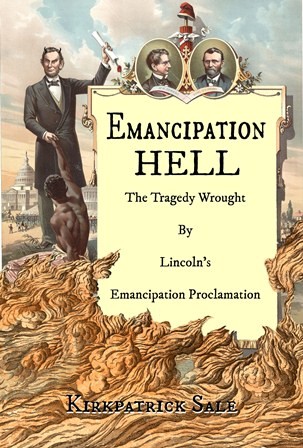
Emancipation Hell: The Tragedy Wrought by Lincoln’s Emancipation Proclamation
Columbia, S. C.: Shotwell Publishing, 2015

The emancipation of African slaves following the War Between the States is almost universally perceived as a great moral triumph, hence the enshrinement of Juneteenth as America’s newest federal holiday. While one will occasionally hear objections voiced to the way that then-President Abraham Lincoln conducted the war itself, the presumed righteousness of emancipation is rarely subjected to serious scrutiny.

The fact that slavery was abolished in all states following the war has been used as a post hoc justification for the Unionist cause, and many today believe that Lincoln waged the war for the express purpose of liberating the slaves, a notion utterly divorced from historical reality.[1] Lincoln’s reputation has benefited immensely from this misconception, and the man himself has been replaced in the public imagination with the legend of the “Great Emancipator.”

Emancipation Before the Proclamation

Slavery was seen by many prominent men of the founding generation as an unfortunate institution which the Republic would have been better off without. Take, for example, Thomas Jefferson, who included these lines in his original draft of the Declaration of Independence:

He [King George III] has waged cruel war against human nature itself, violating its most sacred rights of life & liberty in the persons of a distant people who never offended him, captivating & carrying them into slavery in another hemisphere, or to incur miserable death in their transportation thither.

Jefferson also accused Britain of inciting slave rebellions by promising freedom to those who would join with his loyalist forces against George Washington’s Continental Army. In so doing, wrote Jefferson, the King was “paying off former crimes committed against the liberties of one people, with crimes which he urges them to commit against the lives of another.”

This was ultimately left out of the Declaration, no doubt to appease some of the slaveholding contingent among the patriots, for slavery was never without its defenders. Yet, anti-slavery forces did achieve some notable victories in the antebellum years. The Northwest Ordinance of 1787 forbade slavery in what was then called the Northwest territory, consisting of land that would later become the states of Indiana, Illinois, Michigan, Ohio, and Wisconsin. The act of importing slaves from abroad was outlawed in 1807 by federal statute. At the state level, the “peculiar institution” was abolished in Pennsylvania (1780), New York (1827), New Jersey (1846), and Connecticut (1848). Additionally, in the early 1830s there was a serious effort to end the practice in Virginia.

Ethnonationalism and Emancipation

The Virginia proposals were motivated in large part by a desire for total racial separation, which was to be achieved through the process of “colonization” (i.e. resettling the emancipated slaves in Africa). The American Colonization Society (ACS), which could count among its members such men as Jefferson, James Madison, Henry Clay, and Francis Scott Key, was devoted to resettling freedmen in Liberia. The ACS made no secret of its desire to see blacks removed from the country, a goal shared by the influential abolitionist Hinton Rowan Helper.
You can buy Greg Johnson’s The White Nationalist Manifesto here

From an ethnonationalist perspective, African slavery was indefensible, but the appropriate thing to do would have been to give free blacks their own independent homeland, whether by securing territory for them in Africa or by setting aside some of the territory of the United States. Forcing the two races to live together was a terrible injustice to both. But since an alternative approach to emancipation that included racial separation and black independence would have made today’s multiracial America impossible (and diversity, as we are so often reminded, is supposed to be our greatest strength), to suggest that such an outcome might have been preferable to what we have now is to delve into the realm of heresy.

Like Thomas Jefferson, Abraham Lincoln was not a believer in integration, and would have much preferred that the freedmen be removed from America upon their emancipation. Still, the so-called “Great Emancipator” is now revered because he symbolizes a necessary step in the process that enabled America to become the multiracial state that it is today. Indeed, the true objects of contemporary Lincoln-worship are integration and multiracialism; Lincoln himself is a mere avatar of those ideas.

A Yankee Secessionist Takes on the Lincoln Myth

Those scholars who dare to question the Lincoln cult are likely to be bold, freethinking, and perhaps more than a little eccentric. Kirkpatrick Sale is just such a scholar. A native New Yorker with Leftist roots, Sale has previously contributed to such publications as The Nation and Mother Jones. He is also a radical environmentalist who is harshly critical of some forms of modern technology, to the extent that he once took a sledgehammer to a computer while giving a speech.[2] Back in 1985, Sale authored a book promoting the concept of bioregionalism, which supports the realignment of international borders so as to better reflect geographic features.[3] More recently he has been active in the Second Vermont Republic, an organization that promotes the idea of Vermont seceding from the Union, and another organization led by Sale co-sponsored a secessionist conference with the League of the South, an explicitly racialist Southern Nationalist group. In 2011, Sale was profiled in the American Conservative, which noted that

[h]is secessionist views stem from his rejection of the overarching “bigness” of political and social institutions. Sale’s landmark 1980 book Human Scale argues that virtually every institution — political, religious, social, economic — has grown too large and must be scaled down to better meet basic material and metaphysical needs. Needless to say, he shares conservatives’ opposition to big government, but he doesn’t think reforming it or scaling it down is possible. No, Kirk believes salvation from the modern state lies only in a full and final separation from it.[4]

Sale wrote a short volume in 2015 with the provocative title of Emancipation Hell: The Tragedy Wrought by Abraham Lincoln’s Emancipation Proclamation. This is a fascinating revisionist account of emancipation and its consequences. Though Sale is not himself a White Nationalist, many of the conclusions that he draws from his study of the war and the Reconstruction are entirely consistent with the ethnonationalist perspective.

Lincoln’s Emancipation Gamble

Sale begins his narrative with Lincoln’s decision to issue an executive order declaring all slaves in Confederate-held territory to be free. Lincoln decided to take this step in July of 1862, though he did not issue the order until that September, and it did not take effect until the following January. That the proclamation only applied to slaves in territory that the Union Army did not control was significant, for this meant that Lincoln did not actually free a single slave. He could, of course, have set free all of the enslaved people in the Union states of Delaware, Kentucky, Maryland, and Missouri, but this would not have made any progress toward his real goal. The Emancipation Proclamation, as Sale explains, “was not so much to create free people as to foster slave rebellions in the South (especially on plantations whose owners had gone to war) and to disrupt the food production on which the Confederate army depended.”

To give Lincoln his due, he did foresee the problems that would arise from setting 3.5 million blacks free, often penniless, into a society that did not want them. Thus, in December of 1862 he attempted to obtain Congressional support for a constitutional amendment that would establish a program of gradual rather than immediate emancipation, compensate slaveholders, and allocate funds to repatriate the freedmen. Sale compares this proposal favorably to the Emancipation Proclamation, deeming it “a far more realistic and solid appreciation of the complexities of true freedom.” He lays the blame for its failure at the feet of the more radical elements in Lincoln’s party “who in their ideological frenzy wanted a Proclamation whether or not it freed a single slave.”

Emancipation as Cover for Union War Crimes

In his discussion of the conduct of the Northern armies throughout the war, Sale describes the burning of cities such as Meridian, Mississippi, Atlanta, and Savannah in Georgia, and Barnwell and Columbia in South Carolina. He claims that the Proclamation, in addition to encouraging slave rebellions and the bloodshed that such insurrections would entail, also provided an excuse for Union troops to brutalize Southern civilians. His argument is that “when the new element to the war became the cause of eliminating slavery, a certain moral fervor was cast upon the troops, or a good many of them at least, that eventually added a kind of John Brown-like zealotry to the Union cause.”

I think Sale may be overstating his case here, however. As evidence that the Emancipation Proclamation was largely responsible for the adoption of “total war” tactics in 1863 by some Union commanders, Sale cites an exchange between Generals Hallek and Grant that took place that spring, wherein Hallek wrote that “the character of the war is very much changed.” Grant answered that “[r]ebellion has assumed the shape now that it can only terminate by the complete subjugation of the South . . .” It is not at all clear to me, however, that they are referring to Lincoln’s emancipation edict as the reason for this change in attitude. Conspicuously absent from Sale’s work is any quotation from a Union soldier that justifies atrocities committed on the grounds that they are fighting to “free the slaves.” This is not to say that such attitudes were not widespread, as Sale claims; only that he does not provide clear evidence that this was the case.

Another reason to doubt that it was Emancipation Proclamation and a hatred of slavery which motivated Union soldiers to rape and pillage the South from 1863 onward is the hostile reaction of these same soldiers at the time the Proclamation was announced. Sale confirms that the proclamation was “decidedly unpopular with the Union soldiers,” citing estimates that no fewer than 200,000 Union soldiers deserted in the winter of 1862-63, and he includes several quotes from Northern officers which show that the men they commanded were none too pleased by this sudden addition to Northern war aims.

Then there is the matter of the New York Draft riot, which Sale attributes to “men unwilling to be drafted to free black men who might then compete with them for laboring jobs.” All of this suggests that the Proclamation did more to harm morale among the fighting men of the North than it did to help it. Also, it should not be forgotten that there were four Northern slave states when the war began, and a fifth, West Virginia, was admitted to the Union after the issuance of the Emancipation Proclamation. It seems highly dubious that the “John Brown-like zealotry” described by Sale would have infected the Union soldiers of these states.

The so-called “Reconstruction”

Sale is scathing in his analysis of Reconstruction, and rightfully so. President Lincoln, despite all of his faults, was not willing to stoop so low in his treatment of the South as were the Radical Republicans. But Lincoln, brought down by an assassin’s bullet, was not there to temper the wrath of these vindictive legislators. That unenviable task fell to his Vice President, the Southern Unionist Andrew Johnson, whose presidency proved to be an utter failure. Lincoln, though, “had several ideas about the restoration of the Union that might have won the day.” As Sale writes:

At the core of his proposed Reconstruction was the idea of conciliation toward the South, easy paths to re-entry, a limited black franchise, and possible colonization of freedmen- all of which were espoused by Johnson once in office, but futilely, for he had no influence in Congress and no real personal following (except in his home state of Tennessee) to provide him with political clout.

Instead, it was the Radicals who got their way, and they inaugurated a program of suffrage for blacks, but disenfranchisement for much of Dixie’s white population. Sale tells the story of how a political alliance was formed between Northern “carpetbaggers” and newly-freed blacks, at the expense of Southern whites, in order to keep the Republican party in power. These occupation governments then proceeded to loot the states that they now ruled:

The fact that the governments were representative of only half or less of the population, were installed without any mandate, and had no constituencies to answer to (since they answered to the Union Army) meant that there were no barriers to open graft and corruption, which were practiced by both races with ingenuity and enthusiasm throughout their reign.

One blatant example of this took place in Mississippi, where taxes levied against white landowners were increased to the point that they were “fourteen times as high in 1874 as they were in 1869” by a black-dominated legislature. Whites were enraged across the South, and enmity between the races reached a fever pitch. Black militias were formed through organizations known as Union Leagues, which Sale calls “an arm of the Republican party.” This was made possible through the financial backing of Northern whites. White Southerners formed their own paramilitary groups, most notably the Ku Klux Klan. Sale approvingly quotes a report on Klan violence compiled by Northern Democrats in Congress, which deplored the Klan but also the oppressive Republican rule that precipitated it.

While those blacks fortunate enough to hold positions in the Reconstruction governments may have been living large at the expense of Southern whites, this was not the case for most of the freedmen. The Radical Republican program offered them no land of their own, but rather “a sure prescription for hostility between the races and penury for the large majority of free blacks after the war.” Slavery was finally abolished in all states by way of the ratification of the Thirteenth Amendment, but as Sale describes:

It did nothing, of course, to provide another social and economic role for the formerly enslaved, or to have any regard for the deprivation of the former slave owners, but its purpose was in fact more punitive than practical, as it enshrined the principles of the emancipation proclamation, limited as they were, in the Constitution.

The whole of the South was economically crippled by the war, and this hardship extended to former slaveholders who had once been responsible for housing, feeding, and clothing the slaves. The situation for most blacks in the South was therefore every bit as hellish as it was for whites, if not worse. For instance, the physical health of many blacks worsened after emancipation. Sale cites the work of James Downs, a Professor at Connecticut College, who estimates that “tens of thousands” of formerly enslaved blacks died of disease following emancipation. Sale observes that “[t]he failure of medical care was in essence the story with the rest of life for the freedmen” in that “no one had planned for their future after emancipation and no one in charge much cared about it, and as soon as their problems became intractable the north washed its hands of the whole morass.”

The Lessons of Emancipation
You can buy Greg Johnson’s Toward a New Nationalism here.

The post-emancipation South is one of countless examples of “diversity gone wrong.” When different peoples are forced to share the same territory, conflict and violence is to be expected. Yet, Reconstruction must surely rank as one of history’s most ill-conceived attempts at creating a harmonious multiracial society. The Republican tactic of using freed slaves as political pawns in the course of conducting a brutal military occupation was sure to end in disaster. Before the war, the non-slaveholding white population of the South saw black slaves not as fellow Southerners, but as a completely foreign people. Understandably, they were outraged when members of this alien race were placed in positions of authority over them. Just as understandably, many freedmen felt no love for the race of their former enslavers. Racial enmity between white Southerners and newly-freed blacks was exacerbated by the political violence and terrible poverty of the era. Suffice it to say, neither race made a favorable first impression on the other, a predictable outcome if ever there was one.

Sale is right to take Lincoln and the Radicals in Congress to task for their role in creating “emancipation hell,” but they do not deserve all of the blame. It must not be forgotten that the slaveholders were only too happy to benefit from the exploitation of unpaid labor, to the detriment of less prosperous whites. They must be assigned some responsibility for the disaster of Reconstruction. The same goes for the slave traders and the owners of the slave ships, as well as the African warlords who were willing to sell their own kinsmen to men of a foreign race. It is not uncommon for the upper classes of a society to sell out their own folk in order to make an extra buck. The elite planter class did not fulfill its duty to the rest of the white South. Racialist attorney and writer Sam Dickson made this very point in his essay “Race and the South”:

Had there existed a sufficient level of racial cohesion among whites, the emergence of a large, alien race in our midst would never have been tolerated. Part of this lack of racial cohesion may be found in class conflict within our own racial community, from antebellum times down to the present day. Slavery was of course to the material benefit of wealthy slave owners, but it was disadvantageous for middle class and working class whites, for the small, independent yeoman farmer.[5]

Unfortunately, this dereliction of noblesse oblige on the part of white elites did not end after the War Between the States. Dickson draws a parallel between the slave-owning class of the old South and the rootless capitalist class of today.

I see them in many respects as precursors of the corporate interests in our society that are colonizing our nation with Third World aliens: quite willing to burden America and its white posterity with rival, sullen, and hostile racial aliens so that these interests can obtain cheap labor at the expense of white Americans.

If whites are to overcome the perilous situation in which we now find ourselves, it will require a kind of racial solidarity that has been sorely lacking at the times when it was most needed. For that to occur, the myths on which the current regime justifies its power must be utterly discredited in the minds of our people, and replaced with a new worldview that affirms white racial consciousness and the necessity of racial preservation. When that day arrives, it will indeed be an occasion for rejoicing. Until then, we can take heart in knowing that there are scholars such as Sale who have the courage to provide readers with an honest assessment of our history. Emancipation Hell may be an unpleasant story, but it is one that white America needs to hear.

Notes

[1] If one examines the full text of the Emancipation Proclamation, they will see that individual Southern counties which were under Union occupation as of January 1, 1863 were exempted. These counties were to be “left precisely as if this proclamation were not issued.”

[2] Kevin Kelly, “Interview with the Luddite,” WIRED, June 1, 1995.

[3] Bioregionalism was praised by none other than Wilmot Robertson in his 1993 book The Ethnostate.

[4] Jack Hunter, “Radical Kirk,” The American Conservative, June 16, 2011.

[5] Sam Dickson, “Race and the South,” American Renaissance, 2006.

The Proclamation from Hell

The%20Proclamation%20from%20Hell

Share

  • Gab

Enjoyed this article?

Be the first to leave a tip in the jar!

Instant Echeck GreenPay™

*  *  *

Counter-Currents has extended special privileges to those who donate at least $10/month or $120/year.

  1. Donors will have immediate access to all Counter-Currents posts. Everyone else will find that one post a day, five posts a week will be behind a “paywall” and will be available to the general public after 30 days. Naturally, we do not grant permission to other websites to repost paywall content before 30 days have passed.
  2. Paywall member comments will appear immediately instead of waiting in a moderation queue. (People who abuse this privilege will lose it.)
  3. Paywall members have the option of editing their comments.
  4. Paywall members get an Badge badge on their comments.
  5. Paywall members can “like” comments.
  6. Paywall members can “commission” a yearly article from Counter-Currents. Just send a question that you’d like to have discussed to [email protected]. (Obviously, the topics must be suitable to Counter-Currents and its broader project, as well as the interests and expertise of our writers.)

To get full access to all content behind the paywall, please visit our redesigned Paywall page. 

Related

  • Laughing Our Way to Victory

  • The Ghost of the Confederacy

  • The Selective Memory of Empire:

  • Preparing for a Future After Trump

  • A Novel Approach: Roberto Bolaño’s 2666

  • Restoring American Deterrence through Innovation and Industry

  • E. M. Forster’s A Passage to India & the Indian Mentality

  • The Theology Behind Ruby Ridge

Tags

Abraham LincolnAmerican Civil Warbook reviewsDave ChambersEmancipation HellEmancipation ProclamationJuneteenthKirkpatrick SaleNegro slaveryShotwell Publishingslaverythe Thirteenth Amendment

4 comments

  1. Jeffrey A Freeman says:
    June 20, 2024 at 4:32 pm

    Nothing is more prohibited than white solidarity.

    2
    2
    • kolokol
    • Scott
  2. Scott says:
    June 22, 2024 at 12:32 am

    Great article.

    Ordinarily I would be quite dismissive of Luddites and strident critics of “human domination.”

    Nature simply isn’t the Garden of Eden that anthrophobes seem to think it is. Nature doesn’t play from any kind of benevolent teleology either.

    However, it looks like Kirkpatrick Sale might have some interesting perspectives on the Emancipation Proclamation.

    If I recall correctly, Sam Dixon made the case that the 13th Amendment which actually ended Slavery was passed with the acquiescence of the South, unlike the 14th, which was passed under the boot of Reconstruction, with most White men disfranchised for prior military service to their “insurrectionist states.”

    And while the 14th Amendment strengthened the Nation legally and administratively by denying the states their pretended (big-S) Sovereignty, it also incorporated an unfortunate focus on suppressing “rebellion.”

    My view is that thirteen “Switzerlands” were not going to settle a virtually-empty continent between two enormous oceans, and that the states were never truly Sovereign under the Constitution ─ but they were guaranteed certain legal and administrative rights.

    In any case, Hamilton’s tariff that spoke volumes in restoring the faith and integrity of the nation’s currency and its debts, and to promote its Manufactures, was never meant to be used as economic warfare against regions and factions ─ as the Northern Abolitionists were doing before the Secession of South Carolina.

    Furthermore, if these states had the authority to freely form a Union in the first place, then they had the authority to freely secede from it. Mr. Lincoln should have been pilloried instead of Sainted for this fratricide.

    I also doubt that Mr. Lincoln would have sent the Näggers back to Africa as he claimed. He was a slippery Illinois lawyer at heart who was used to speaking out of both sides of his mouth. And while his assassination was hardly helpful, I don’t think he would have ever bothered with his Negro Plan.

    Another point is that while the Redcoats often get credit for promoting manumission in the Caribbean and elsewhere ─ slavery ending in Jamaica far less problematically than in French Haiti, where the Negroes killed their French masters and have never recovered much in the way of civilization ─ this would have been farcical if the Americans by 1808 had not already pulled the plug on a crucial triad of the Atlantic slave trade, a legal policy reassessment that was specifically provided for in the Constitution when ratified.

    Furthermore, Muslims get far less mention today than is warranted about their extremely-crucial part in the Negro slave trade.

    🙂

    1
    1
    • Dave Chambers
  3. heymrguda says:
    June 23, 2024 at 3:41 pm

    Always overlooked is the fact all this could have been avoided if elite southern planters had not brought millions of slaves over here to begin with. But us northerners are always tagged with the blame for all the problems this has caused.

    0
    0
    1. Scott says:
      June 24, 2024 at 8:51 am

      New England was heavily involved in the Triangular Trade shipping circuit, where raw materials like timber and distilled rum from Caribbean molasses were acquired to be sold in Europe and then finished goods were acquired, to then sail to Africa and collect slaves from various local potentates to take them to the sugar cane fields in the Caribbean and to the cotton fields in the South.

      The United States ending the slave trade in 1808 essentially took the North out of operation and crippled it. The British then ended slavery in Jamaica in 1834, and this included compensating former slave owners for their losses. Salave in the cane fields were basically worked to death, whereas picking cotton in the South became slightly more productive due to improvments with the cotton gin. Whitney’s patent was validated in 1807.

      “A classic example is the colonial molasses trade. Merchants purchased raw sugar (often in its liquid form, molasses) from plantations in the Caribbean and shipped it to New England and Europe, where it was sold to distillery companies that produced rum. Merchant capitalists used cash from the sale of sugar to purchase rum, furs, and lumber in New England which their crews shipped to Europe.”

      🙂

      0
      0

Comments are closed.

If you have a Subscriber access,
simply login first to see your comment auto-approved.

Note on comments privacy & moderation

Your email is never published nor shared.

Comments are moderated. If you don't see your comment, please be patient. If approved, it will appear here soon. Do not post your comment a second time.

Writers of May

(2 votes) Morris van de Camp David M. Zsutty Derek Stark Jayant Bhandari Greg Johnson

Articles of May

The Lunch Wars by David M. Zsutty Heidegger on Nietzsche, Part One by Collin Cleary 2 votes
    • The Unwanted Report

      Mark Gullick

    • The Doxing of Austin Franco

      David M. Zsutty

      8

    • Interview with Gerhard Hallstatt of Allerseelen:
      The Gesamtkunstwerk of the Future!

      Ondrej Mann

    • Small Is Beautiful:
      The Napoleon of Notting Hill and G. K. Chesterton Upon Defending One’s Homeland from Others—and Itself

      Steven Tucker

      2

    • The Psychology Behind MrBeast’s Moronic Thought Experiment

      Endeavour

      9

    • On the Roots of Anti-Immigrant Sentiment in Contemporary Britain

      Lipton Matthews

      7

    • Remembering Enoch Powell:
      June 16, 1912–February 8, 1998

      Greg Johnson

      17

    • Counter-Currents Radio Podcast No. 691
      Rob Rundo Returns

      Counter-Currents Radio

    • The Fragile Polity that is Syria

      Morris van de Camp

      2

    • Nigel Farage Calls Britain a Two-Tier State

      Mark Gullick

      4

    • Nationalism This Week
      Letter to J. D. Vance

      Greg Johnson

      32

    • Lost In Trans-Mission:
      How the Media Fails To Reveal the Inconvenient Truth About the Usual Suspects

      Steven Tucker

      10

    • Liar, Liar, Pants on Fire!

      Beau Albrecht

      7

    • Editor’s Update
      Rob Rundo on Counter-Currents Radio, Fundraiser Update, & a New $20,000 Matching Grant

      Greg Johnson

    • The Bitter End of Western Metaphysics:
      Heidegger on Nietzsche, Part Three

      Collin Cleary

      10

    • Uncivil War

      Mark Gullick

      50

    • Exclusive Interview with Karel Veliky:
      The Final Chapter in the Film Series! Part II

      Ondrej Mann

      2

    • Happy Birthday to Us!

      Greg Johnson

      6

    • Zsutty’s Maximum

      David M. Zsutty

      16

    • Exclusive Interview with Karel Veliky:
      The Final Chapter in the Film Series! Part I

      Ondrej Mann

      2

    • The Union Jackal, June 2026

      Mark Gullick

      24

    • The Inferiority Behind Immigrant Superiority

      Jayant Bhandari

      15

    • Counter-Currents Radio Podcast No. 690
      Greg Johnson & David Zsutty Discuss Current Things: AI, Henry Nowak, the Iran Crisis, & More

      Counter-Currents Radio

      7

    • Collin Cleary: What Rome Means to Me

      Collin Cleary

      4

    • Paul Krugman: Closet Bolshevik

      Spencer J. Quinn

      21

    • Fugue of Ideas:
      Ibram X. Kendi’s Chain of Ideas

      Greg Johnson

      19

    • Based Blacks

      Lipton Matthews

      24

    • Black Intellectual Fatigue

      Derek Stark

      41

    • Why White Advocates Should Avoid “Based Blacks”

      Dani Vypont

      32

    • Nietzsche & Race

      Mark Gullick

    • Editor’s Update
      Rob Rundo Rescheduled to Next Week on Counter-Currents Radio;
      Tonight Greg Johnson & David Zsutty Answer Your Questions;
      Fundraiser Update & a New $20,000 Matching Grant

      Greg Johnson

    • The Counter-Currents 2026 Fundraiser
      Lifetime Subscriber Welcome Packages Extended

      Greg Johnson

    • Nationalism This Week
      Who’s Looking Back?

      Greg Johnson

      29

    • China’s Threat to American Security:
      Food, Farmland, Foreign Control, & Energy Policy

      Lipton Matthews

      5

    • The Bitter End of Western Metaphysics:
      Heidegger on Nietzsche, Part Two

      Collin Cleary

      16

    • The Killing of Henry Nowak

      Mark Gullick

      38

    • The Crisis of Chinese Technology Thieves

      Morris van de Camp

      1

    • The Strange World of Gender Bender Fiction:
      & What This Genre Tells Us About Autosexuality

      Dani Vypont

      3

    • Watching the Watchers:
      The Dark Triad Question

      David M. Zsutty

      14

    • The Remigration Movement Solidifies

      F. Roger Devlin

      2

    • Casting Aspersions:
      The Fatal Consequences of Race-Swapped Casting, From Helen of Troy to Henry of Southampton

      Steven Tucker

      20

    • The Murder of Henry Nowak

      Millennial Woes

      23

    • Don’t Forget to Vote in Our Writer & Article of the Month Poll

      Greg Johnson

    • The Robot Hotdog Stand

      Greg Johnson

      37

    • Laughing Our Way to Victory

      Dave Chambers

      7

    • The Zodiac Killer

      Mark Gullick

      11

    • Jared Taylor: What Rome Means to Me

      Jared Taylor

      1

    • An Interview with Endeavour:
      My Way of Life Is an Adventure!

      Ondrej Mann

      6

    • José Pedro Zúquete’s The Identitarians

      Greg Johnson

      3

    • Editor’s Update
      Fundraiser Update & How to Watch the Remigration Summit

      Greg Johnson

      5

    • David M. Zsutty

      The Doxing of Austin Franco

      The Jews are going to learn how the world works and that they can't go around genociding Gaza and...

    • Malaparte

      The Doxing of Austin Franco

      I don't think a Cornell student would be so naive; this seems like an intentional cause celebre.

    • Stronza

      The Union Jackal, June 2026

      Re Rupert Lowe. The Rape Gang Inquiry Report on twitter (X) https://x.com/RupertLowe10/status/...

    • Peter Quint

      The Doxing of Austin Franco

      Great article! White people need their own advocacy group to take cases like this to the Supreme...

    • Josephus Cato

      The Doxing of Austin Franco

      I feel things like this say more about Jews, especially the Einhorn brothers, than the people they...

    • Dominic Fox

      The Doxing of Austin Franco

      What I find astonishing about episodes like these is how irrationality can flourish within a...

    • Mark Gullick

      The Doxing of Austin Franco

      Jews. They are a problem. Up there with blacks, Muslims, and faggots, say I.

    • Stronza

      The Doxing of Austin Franco

      Nineteen-year-olds don't understand how the world works.  Too bad that Austin found out the hard way...

    • Will Williams

      Is the Anti-Defamation League a Hate Group?

      Bertrand russell: June 18, 2026  Read False Flags by the late Michael Collins Piper, available...

    • JBP

      The Doxing of Austin Franco

      Thanks. Let the (((doxxing))) begin.

    • Joe Gould

      On the Roots of Anti-Immigrant Sentiment in Contemporary Britain

      It's too late to discuss whether the antiwhitism, hypocrisy, and injustice of the ruling...

    • Bertrand russell

      Is the Anti-Defamation League a Hate Group?

      Read False Flags by the late Michael Collins Piper, available at Unz Review and Archive.org. Piper...

    • Beau Albrecht

      Remembering Enoch Powell

      At the time, Britain was still only experiencing the thin end of the wedge as far as migration goes...

    • Peter Quint

      Remembering Enoch Powell

      Okay, so he has two White Nationalist speeches to his credit. 🦈

    • CC Reader

      Remembering Enoch Powell

      The best Prime Minister England never had. Powell went on the Dick Cavett show and was treated...

    • Livla

      The Psychology Behind MrBeast’s Moronic Thought Experiment

      From a biological perspective, this thought experiment is the equivalent of a selection event that...

    • Adrian Roberts

      Remembering Enoch Powell

      In Mein Kampf, Hitler argued that the side which makes war inevitable is the side most responsible...

    • Adrian Roberts

      Remembering Enoch Powell

      So the English owe everybody reparations? Damn.

    • Wasili

      The Psychology Behind MrBeast’s Moronic Thought Experiment

      Great article!  Indeed, the following point can’t be emphasized enough: The [insert non-white...

    • Will Williams

      On the Roots of Anti-Immigrant Sentiment in Contemporary Britain

      Ecological experts call the replacement of one species by another as habitat succession. In my...

    • Earth Day Special

      John Morgan

      12

    • A Robertson Roundup
      Remembering Wilmot Robertson
      (April 16, 1915 – July 8, 2005)

      Margot Metroland

      13

    • The Paranoid Style in White Nationalism

      Greg Johnson

      30

    • Join the Dance!

      Andrew Hamilton

      1

    • We Can’t Save the Earth Without Reducing African Birth Rates

      James Dunphy

      36

    • “I’m Not a Conspiracy Theorist, but . . .”:
      Jeffrey Epstein’s Death Gives New Life to “Conspiracy Theories”

      Greg Johnson

      22

    • Sylvia Plath: Stasis in Darkness

      Vic Olvir

      17

    • Vanguardism, Vantardism, & Mainstreaming

      Greg Johnson

      80

    • Aviation, Geography, & Race

      Charles Lindbergh

      3

    • Some Thoughts on Yule

      Collin Cleary

      4

    • Living in Truth:
      A Yuletide Homily

      Jef Costello

      7

    • John Kennedy Toole’s A Confederacy of Dunces

      Greg Johnson

      20

    • On Aleksandr Solzhenitsyn’s Warning to the West

      Spencer J. Quinn

      7

    • Elitism, British Modernism, & Wyndham Lewis

      Jonathan Bowden

      6

    • Philip K. Dick’s Do Androids Dream of Electric Sheep? as Anti-Semitic/Christian-Gnostic Allegory

      Greg Johnson

      20

    • “Conspiracy Theory” or Conspiracy?

      Andrew Hamilton

      21

    • Remembering H. P. Lovecraft
      (August 20, 1890–March 15, 1937)

      Greg Johnson

      3

    • Who Are We?
      Nordics, Aryans, & Whites

      Greg Johnson

      71

    • Remembering William Gayley Simpson
      (July 23, 1892–December 31, 1990)
      A Pleasant Afternoon with Harriet & Bill Simpson

      Margot Metroland

      18

    • Here are the Young Men
      Remembering Ian Curtis
      (July 15, 1956–May 18, 1980)

      Mark Gullick

      18

    • Percy Grainger
      Artist of the Right

      Alex Graham

      7

    • Remembering Revilo Oliver
      (July 7, 1908–August 20, 1994)

      Greg Johnson

      18

    • The Meaning of July 4th for the White Man

      Gregory Hood

      13

    • The Front National’s Evolution

      Bruno Mégret

    • Merwin K. Hart
      Forgotten American Hero & Man of the Right

      Morris van de Camp

      10

    • George Orwell’s Nineteen Eighty-Four

      Jonathan Bowden

      8

    • Carleton S. Coon
      Scientist & Reluctant White Advocate

      Morris van de Camp

      3

    • The Kwanzaa Absurdity Will Be Dwarfed by Juneteenth

      Robert Hampton

      10

    • Stravinsky

      Alex Graham

      7

    • Like the Roman:
      Remembering Enoch Powell (1912-1998)

      Mark Gullick

      23

    • About Film “From the Right”

      Karel Veliky

    • The 1970s: The Golden Age of Hijacking

      Morris van de Camp

      21

    • Jonathan Bowden’s Deliverance
      Part 6

      Jonathan Bowden

    • Do You Want to Play a Game?

      Mark Gullick

      1

    • Sexually Incontinent on the Indian Subcontinent:
      Who Rapes More Animals, Indians or Pakistanis? The Battle Continues!

      Steven Tucker

      3

    • Neo-Fascism in Film
      Part 5

      Karel Veliky

      15

    • The Game of Tarot

      Mark Gullick

      2

    • Institutions Cannot Be Transplanted

      Jayant Bhandari

      5

    • Jonathan Bowden’s Deliverance
      Part 5

      Jonathan Bowden

    • Crosstown Traffic:
      Jimi Hendrix & The Post-War Rock ‘N’ Roll Revolution

      Mark Gullick

      1

    • Slaves from the North:
      Finns & Karelians in the East European Slave Trade, 900–1600

      Lipton Matthews

      14

    • Neo-Fascism in Film
      Part 4

      Karel Veliky

      2

    • David Lean’s A Passage to India

      Spencer J. Quinn

      1

    • Elites are Essential to Development

      Lipton Matthews

      7

    • Jonathan Bowden’s Deliverance
      Part 4

      Jonathan Bowden

    • Neo-Fascism in Film
      Part 3

      Karel Veliky

      6

    • E. M. Forster’s A Passage to India & the Indian Mentality

      Spencer J. Quinn

      25

    • Jonathan Bowden’s Deliverance
      Part 3

      Jonathan Bowden

    • The Rest Is Silence
      Heidegger’s Quietism

      Mark Gullick

      2

    • Dispelling the Historical Fallacy of Indian Nationalism

      Lipton Matthews

      8

    • Neo-Fascism in Film
      Part 2

      Karel Veliky

      8

    • Jonathan Bowden’s Deliverance
      Part 2

      Jonathan Bowden

    • Life of a Klansman

      Mark Gullick

      8

    • Jonathan Bowden’s Deliverance, Part 1

      Jonathan Bowden

    • Decolonial Ideas are Holding Back Developing Countries

      Lipton Matthews

      8

    • Neo-fascism in Film, Part 1

      Karel Veliky

      21

    • Jonathan Bowden’s Onslaught, Part 8
      Divigations on Decadence

      Jonathan Bowden

    • Jonathan Bowden’s Onslaught, Part 7
      Intrigues in the National Front

      Jonathan Bowden

      1

    • Rotten to the Core

      Mark Gullick

      8

    • Strauss on Husserl’s “Philosophy as Rigorous Science”

      Greg Johnson

    • András László
    • Derek Hawthorne
    • Beau Albrecht
    • Alain de Benoist
    • Kerry Bolton
    • Jonathan Bowden
    • Collin Cleary
    • Jef Costello
    • Savitri Devi
    • Julius Evola
    • Jim Goad
    • Gregory Hood
    • Juleigh Howard-Hobson
    • Greg Johnson
    • Charles Krafft
    • Anthony M. Ludovici
    • Trevor Lynch
    • H. L. Mencken
    • J. A. Nicholl
    • James J. O’Meara
    • Christopher Pankhurst
    • Tito Perdue
    • Michael Polignano
    • Spencer J. Quinn
    • Fenek Solère
    • Irmin Vinson
    • Leo Yankevich
    • Francis Parker Yockey
    • Multiple authors
  • Editor-in-Chief

    • Greg Johnson, Ph.D.

    Featured Writers

    • Beau Albrecht
    • Gunnar Alfredsson
    • Collin Cleary, Ph.D.
    • Jef Costello
    • Morris V. de Camp
    • F. Roger Devlin, Ph.D.
    • Stephen Paul Foster, Ph.D.
    • Jim Goad
    • Alex Graham
    • Mark Gullick, Ph.D.
    • Greg Johnson, Ph.D.
    • Travis LeBlanc
    • Trevor Lynch
    • Margot Metroland
    • James J. O’Meara
    • Angelo Plume
    • Spencer J. Quinn
    • Fred Reed
    • Clarissa Schnabel
    • Michael Walker
    • David M. Zsutty

    Frequent Writers

    • Asier Abadroa
    • Aquilonius
    • Alain de Benoist
    • Kerry Bolton, Ph.D.
    • Dave Chambers
    • Steven Clark
    • James Dunphy
    • Endeavour
    • Richard Houck
    • Jason Kessler
    • Titus Livius
    • Ondrej Mann
    • Lipton Matthews
    • Mark Mazari
    • John Morgan
    • Jaroslav Ostrogniew
    • Kathryn S.
    • Christian Secor
    • Anne Wilson Smith
    • Thomas Steuben
    • William De Vere
    • Kenneth Vinther
    • Max West

    Classic Authors

    • Maurice Bardèche
    • Jonathan Bowden
    • Julius Evola
    • Guillaume Faye
    • Ernst Jünger
    • Kevin MacDonald, Ph.D.
    • D. H. Lawrence
    • Charles Lindbergh
    • Jack London
    • H. P. Lovecraft
    • Anthony M. Ludovici
    • Sir Oswald Mosley
    • National Vanguard
    • Friedrich Nietzsche
    • Revilo Oliver
    • William Pierce
    • Ezra Pound
    • Saint-Loup
    • Savitri Devi
    • Carl Schmitt
    • Miguel Serrano
    • Oswald Spengler
    • P. R. Stephensen
    • Jean Thiriart
    • John Tyndall
    • Dominique Venner
    • Leo Yankevich
    • Francis Parker Yockey

    Other Authors

    • Howe Abbott-Hiss
    • Michael Bell
    • Giles Corey
    • Jack Donovan
    • Richardo Duchesne, Ph.D.
    • Emile Durand
    • Guillaume Durocher
    • Mark Dyal
    • Tom Goodroch
    • Andrew Hamilton
    • Robert Hampton
    • Huntley Haverstock
    • Derek Hawthorne
    • Gregory Hood
    • Juleigh Howard-Hobson
    • Alexander Jacob
    • Ruuben Kaalep
    • Tobias Langdon
    • Julian Langness
    • Patrick Le Brun
    • G A Malvicini
    • John Michael McCloughlin
    • Millennial Woes
    • Michael O’Meara
    • Christopher Pankhurst
    • Michael Polignano
    • J. J. Przybylski
    • Quintilian
    • Edouard Rix
    • C. B. Robertson
    • C. F. Robinson
    • Herve Ryssen
    • Alan Smithee
    • Fenek Solere
    • Ann Sterzinger
    • Robert Steuckers
    • Tomislav Sunic
    • Donald Thoresen
    • Marian Van Court
    • Irmin Vinson
    • Book Reviews
    • Movie Reviews
    • TV Reviews
    • Music Reviews
    • Art Criticism
    • Graphic Novels & Comics
    • Video Game Reviews
    • Fiction
    • Poems
    • Interviews
    • Videos
    • English Translations
    • Other Languages
      • Arabic
      • Bulgarian
      • Croatian
      • Czech
      • Danish
      • Dutch
      • Estonian
      • Finnish
      • French
      • German
      • Greek
      • Hungarian
      • Italian
      • Lithuanian
      • Norwegian
      • Polish
      • Portuguese
      • Romanian
      • Russian
      • Slovak
      • Spanish
      • Swedish
      • Ukrainian
    • Commemorations
    • Why We Write
  • Archives
  • Top 100 Commenters
  • The Looney Bin
Sponsored Links
Europa.com Above Time Coffee Antelope Hill Publishing Paul Waggener IHR-Store Spencer J. Quinn American Renaissance Jim Goad The Occidental Observer
Donate Now Mailing list
Books for sale
  • The Philosopher Is In
  • Sexual Utopia in Power (Expanded Edition)
  • In Defense of Prejudice
  • Loving Our Own
  • Tyranny & Wisdom
  • The Populist Moment
  • Is America Doomed?
  • To all books
Copyright © 2026 Counter-Currents Publishing, Ltd.

Paywall Access


Please enter your email address.

Lost your password?

Edit your comment

Writer & Article of the Month May 2026

Voting for this month has concluded. Here are the final results!

Top Writers

  • #1 Morris van de Camp 2 votes
  • #2 David M. Zsutty 2 votes
  • #3 Derek Stark 2 votes
  • #4 Jayant Bhandari 2 votes
  • #5 Greg Johnson 2 votes
  • #6 Jared Taylor 1 vote
  • #7 Collin Cleary 1 vote
  • #8 Spencer J. Quinn 1 vote
  • #9 Mark Gullick 1 vote
  • #10 Lipton Matthews 1 vote
  • #11 Keith Woods 1 vote
  • #12 Steven Tucker 1 vote

Top Articles

  • #1 The Lunch Wars 2 votes
  • #2 Heidegger on Nietzsche, Part One 2 votes
  • #3 Lothrop Stoddard’s The Revolt Against Civilization 1 vote
  • #4 Could Fascism Work? 1 vote
  • #5 Jared Taylor's Elevator Pitch to a Billionaire 1 vote
  • #6 Predation Wearing the Mask of Civilization 1 vote
  • #7 Peak Fatigue in Fort Wayne 1 vote
  • #8 Keith Wood's Elevator Pitch to a Billionaire 1 vote
  • #9 Do You Want to Play a Game? 1 vote
  • #10 Why Billionaires Should Fund White Identity Politics 1 vote
  • #11 The 1970s: The Golden Age of Hijacking 1 vote
  • #12 True Folk-Horror Is Horror of Your Own Folk 1 vote
  • #13 Finding Atlantis Part 4 1 vote
  • #14 Berlin: City of Stones 1 vote
  • #15 The Ghost of the Confederacy 1 vote

Total votes cast: 17