Counter-Currents
  • Advertise
  • Private Events
  • T&C
  • About
  • Contact
  • RSS
    • Main feed
    • Podcast feed
    • Videos feed
    • Comments feed
  • Welcome
  • Webzine
  • Books
  • Merch
  • Podcasts
  • Videos
  • Donate
  • Patrons
  • Subscribe
  • Crypto

LEVEL2

Donate Now Mailing list
Upcoming podcasts
  • Rob Rundo on Counter-Currents Radio

    Rob Rundo on Counter-Currents Radio

    Counter-Currents Radio

    06/13/2026 — 3 pm EST / 9 pm CET

Writers of May

(2 votes) Morris van de Camp David M. Zsutty Derek Stark Jayant Bhandari Greg Johnson

Articles of May

Heidegger on Nietzsche, Part One by Collin Cleary The Lunch Wars by David M. Zsutty 2 votes
  • Welcome
  • Webzine
  • Books
  • Merch
  • Podcasts
  • Videos
  • Donate
  • Patrons
  • Subscribe
  • Crypto
    • Editor’s Update
      Rob Rundo on Counter-Currents Radio, Fundraiser Update, & a New $20,000 Matching Grant

      Greg Johnson

    • The Bitter End of Western Metaphysics:
      Heidegger on Nietzsche, Part Three

      Collin Cleary

      10

    • Uncivil War

      Mark Gullick

      31

    • Exclusive Interview with Karel Veliky:
      The Final Chapter in the Film Series! Part II

      Ondrej Mann

      2

    • Happy Birthday to Us!

      Greg Johnson

      6

    • Zsutty’s Maximum

      David M. Zsutty

      15

    • Exclusive Interview with Karel Veliky:
      The Final Chapter in the Film Series! Part I

      Ondrej Mann

      2

    • The Union Jackal, June 2026

      Mark Gullick

      23

    • The Inferiority Behind Immigrant Superiority

      Jayant Bhandari

      15

    • Counter-Currents Radio Podcast No. 690
      Greg Johnson & David Zsutty Discuss Current Things: AI, Henry Nowak, the Iran Crisis, & More

      Counter-Currents Radio

      5

    • Collin Cleary: What Rome Means to Me

      Collin Cleary

      4

    • Paul Krugman: Closet Bolshevik

      Spencer J. Quinn

      19

    • Fugue of Ideas:
      Ibram X. Kendi’s Chain of Ideas

      Greg Johnson

      18

    • Based Blacks

      Lipton Matthews

      12

    • Black Intellectual Fatigue

      Derek Stark

      38

    • Why White Advocates Should Avoid “Based Blacks”

      Dani Vypont

      29

    • Nietzsche & Race

      Mark Gullick

    • Editor’s Update
      Rob Rundo Rescheduled to Next Week on Counter-Currents Radio;
      Tonight Greg Johnson & David Zsutty Answer Your Questions;
      Fundraiser Update & a New $20,000 Matching Grant

      Greg Johnson

    • The Counter-Currents 2026 Fundraiser
      Lifetime Subscriber Welcome Packages Extended

      Greg Johnson

    • Nationalism This Week
      Who’s Looking Back?

      Greg Johnson

      29

    • China’s Threat to American Security:
      Food, Farmland, Foreign Control, & Energy Policy

      Lipton Matthews

      5

    • The Bitter End of Western Metaphysics:
      Heidegger on Nietzsche, Part Two

      Collin Cleary

      16

    • The Killing of Henry Nowak

      Mark Gullick

      38

    • The Crisis of Chinese Technology Thieves

      Morris van de Camp

      1

    • The Strange World of Gender Bender Fiction:
      & What This Genre Tells Us About Autosexuality

      Dani Vypont

      3

    • Watching the Watchers:
      The Dark Triad Question

      David M. Zsutty

      14

    • The Remigration Movement Solidifies

      F. Roger Devlin

      1

    • Casting Aspersions:
      The Fatal Consequences of Race-Swapped Casting, From Helen of Troy to Henry of Southampton

      Steven Tucker

      20

    • The Murder of Henry Nowak

      Millennial Woes

      23

    • Don’t Forget to Vote in Our Writer & Article of the Month Poll

      Greg Johnson

    • The Robot Hotdog Stand

      Greg Johnson

      37

    • Laughing Our Way to Victory

      Dave Chambers

      7

    • The Zodiac Killer

      Mark Gullick

      11

    • Jared Taylor: What Rome Means to Me

      Jared Taylor

      1

    • An Interview with Endeavour:
      My Way of Life Is an Adventure!

      Ondrej Mann

      6

    • José Pedro Zúquete’s The Identitarians

      Greg Johnson

      3

    • Editor’s Update
      Fundraiser Update & How to Watch the Remigration Summit

      Greg Johnson

      5

    • The Bitter End of Western Metaphysics:
      Heidegger on Nietzsche, Part One

      Collin Cleary

      12

    • Berlin: City of Stones

      Spencer J. Quinn

      6

    • True Folk-Horror Is Horror of Your Own Folk:
      Mark Gatiss vs the Brexit Blind Dead  

      Steven Tucker

      4

    • Counter-Currents Radio Podcast No. 689
      Thomas Massie, the America 2050 Bust, the Need for Whites to Divest from America, the AI Economic Apocalypse, & Pro-White Project Pitches to Billionaires

      Counter-Currents Radio

      7

    • Nationalism This Week
      Remigration is Inevitable, Part 3

      Greg Johnson

      27

    • Why Billionaires Should Fund White Identity Politics

      Lipton Matthews

      8

    • How Cold War Two Came About

      Morris van de Camp

      5

    • Now Available for Pre-Order at a Special Price!
      Greg Johnson’s The Philosopher Is In

      Greg Johnson

    • David Zsutty’s Elevator Pitch to a Billionaire

      David M. Zsutty

      1

    • Headbanging Lite

      Mark Gullick

      5

    • White Advocacy Past and Present

      Peter Bradley

      13

    • The Lunch Wars

      David M. Zsutty

      47

    • The Russians are Coming/The Russians are Coming

      Steven Clark

      1

    • Collin Cleary

      Heidegger on Nietzsche Part Three

      I have not heard of the Beattie dissertation, or of any discussion of it. The Mansfield book is also...

    • Collin Cleary

      Heidegger on Nietzsche Part Three

      I believe in objective truth, just not the Christian claims about objective truth. Truth is what...

    • Collin Cleary

      Heidegger on Nietzsche Part Three

      Thank you very much!

    • tempus

      Why White Advocates Should Avoid “Based Blacks”

      As for lending money, that also goes for Whites. Never lend more than you are willing to make a gift...

    • tempus

      Why White Advocates Should Avoid “Based Blacks”

      The only person other than my brother to whom I have lent money who ever paid me back was a Black...

    • tempus

      Why White Advocates Should Avoid “Based Blacks”

      The Old South was nowhere near as anti-black as the Old North. Part of the Republican platform on...

    • tempus

      Black Intellectual Fatigue

      Hopefully, more Whites are ceasing to be racial nihilists and are abandoning the new morality (...

    • Jaego

      Uncivil War

      The Orthodox ideal - just like every other denomination - is people of all races worshiping together...

    • Jaego

      Uncivil War

      Isolate the police. Family or friends, no matter. Disown them. Maybe in time people will forgive...

    • Jaego

      Uncivil War

      Tikkun Olam. Repair of the World. Enabling mass immigration is a mitzvah or holy deed in the Repair...

    • I Do Not Surrender, My Hand Is Red.

      Uncivil War

      This is very good advice Joe. Very good.

    • NIdahoOrthodox

      Uncivil War

      How many tens of thousands of automatic weapons and tons of Semtex are in hidden caches in the North...

    • kolokol

      Uncivil War

      Stephen Ogilvie is the latest example of a decent, hard-working White person, killed by a useless...

    • Dr. X

      Uncivil War

      Great writeup. One error- I doubt the Republic of Ireland police (Garda) were responding on the...

    • kolokol

      Uncivil War

      This is a very good start. May it continue and accelerate, until all the invaders have been expelled...

    • Observer

      Heidegger on Nietzsche Part Three

      Ouch. Well, I had used the bullet formatting in the text box to break it up a bit... but it looks...

    • Gabe

      Uncivil War

      Scots-Irish is an American term. It's true that Presbyterians and others came from Scotland to...

    • Gabe

      Uncivil War

      I was just going to write that myself. The Garda Siochána, or guards, is a term they use in the...

    • Ondrej Mann

      Exclusive Interview with Karel Veliky Part 2

      Thanks for the cultural tip. I’m currently preparing an interview for CC with the Austrian band...

    • Observer

      Heidegger on Nietzsche Part Three

      Also, a semi-related topic, but have you read Darren Beattie's Heidegger PhD thesis? I know that it...

    • Earth Day Special

      John Morgan

      12

    • A Robertson Roundup
      Remembering Wilmot Robertson
      (April 16, 1915 – July 8, 2005)

      Margot Metroland

      13

    • The Paranoid Style in White Nationalism

      Greg Johnson

      30

    • Join the Dance!

      Andrew Hamilton

      1

    • We Can’t Save the Earth Without Reducing African Birth Rates

      James Dunphy

      36

    • “I’m Not a Conspiracy Theorist, but . . .”:
      Jeffrey Epstein’s Death Gives New Life to “Conspiracy Theories”

      Greg Johnson

      22

    • Sylvia Plath: Stasis in Darkness

      Vic Olvir

      17

    • Vanguardism, Vantardism, & Mainstreaming

      Greg Johnson

      80

    • Aviation, Geography, & Race

      Charles Lindbergh

      3

    • Some Thoughts on Yule

      Collin Cleary

      4

    • Living in Truth:
      A Yuletide Homily

      Jef Costello

      7

    • John Kennedy Toole’s A Confederacy of Dunces

      Greg Johnson

      20

    • On Aleksandr Solzhenitsyn’s Warning to the West

      Spencer J. Quinn

      7

    • Elitism, British Modernism, & Wyndham Lewis

      Jonathan Bowden

      6

    • Philip K. Dick’s Do Androids Dream of Electric Sheep? as Anti-Semitic/Christian-Gnostic Allegory

      Greg Johnson

      20

    • “Conspiracy Theory” or Conspiracy?

      Andrew Hamilton

      21

    • Remembering H. P. Lovecraft
      (August 20, 1890–March 15, 1937)

      Greg Johnson

      3

    • Who Are We?
      Nordics, Aryans, & Whites

      Greg Johnson

      71

    • Remembering William Gayley Simpson
      (July 23, 1892–December 31, 1990)
      A Pleasant Afternoon with Harriet & Bill Simpson

      Margot Metroland

      18

    • Here are the Young Men
      Remembering Ian Curtis
      (July 15, 1956–May 18, 1980)

      Mark Gullick

      18

    • Percy Grainger
      Artist of the Right

      Alex Graham

      7

    • Remembering Revilo Oliver
      (July 7, 1908–August 20, 1994)

      Greg Johnson

      18

    • The Meaning of July 4th for the White Man

      Gregory Hood

      13

    • The Front National’s Evolution

      Bruno Mégret

    • Merwin K. Hart
      Forgotten American Hero & Man of the Right

      Morris van de Camp

      10

    • George Orwell’s Nineteen Eighty-Four

      Jonathan Bowden

      8

    • Carleton S. Coon
      Scientist & Reluctant White Advocate

      Morris van de Camp

      3

    • The Kwanzaa Absurdity Will Be Dwarfed by Juneteenth

      Robert Hampton

      10

    • Stravinsky

      Alex Graham

      7

    • Like the Roman:
      Remembering Enoch Powell (1912-1998)

      Mark Gullick

      23

    • Jonathan Bowden’s Deliverance
      Part 6

      Jonathan Bowden

    • Do You Want to Play a Game?

      Mark Gullick

      1

    • Sexually Incontinent on the Indian Subcontinent:
      Who Rapes More Animals, Indians or Pakistanis? The Battle Continues!

      Steven Tucker

      3

    • Neo-Fascism in Film
      Part 5

      Karel Veliky

      15

    • The Game of Tarot

      Mark Gullick

      2

    • Institutions Cannot Be Transplanted

      Jayant Bhandari

      5

    • Jonathan Bowden’s Deliverance
      Part 5

      Jonathan Bowden

    • Crosstown Traffic:
      Jimi Hendrix & The Post-War Rock ‘N’ Roll Revolution

      Mark Gullick

      1

    • Slaves from the North:
      Finns & Karelians in the East European Slave Trade, 900–1600

      Lipton Matthews

      14

    • Neo-Fascism in Film
      Part 4

      Karel Veliky

      2

    • David Lean’s A Passage to India

      Spencer J. Quinn

      1

    • Elites are Essential to Development

      Lipton Matthews

      7

    • Jonathan Bowden’s Deliverance
      Part 4

      Jonathan Bowden

    • Neo-Fascism in Film
      Part 3

      Karel Veliky

      6

    • E. M. Forster’s A Passage to India & the Indian Mentality

      Spencer J. Quinn

      25

    • Jonathan Bowden’s Deliverance
      Part 3

      Jonathan Bowden

    • The Rest Is Silence
      Heidegger’s Quietism

      Mark Gullick

      2

    • Dispelling the Historical Fallacy of Indian Nationalism

      Lipton Matthews

      8

    • Neo-Fascism in Film
      Part 2

      Karel Veliky

      8

    • Jonathan Bowden’s Deliverance
      Part 2

      Jonathan Bowden

    • Life of a Klansman

      Mark Gullick

      8

    • Jonathan Bowden’s Deliverance, Part 1

      Jonathan Bowden

    • Decolonial Ideas are Holding Back Developing Countries

      Lipton Matthews

      8

    • Neo-fascism in Film, Part 1

      Karel Veliky

      21

    • Jonathan Bowden’s Onslaught, Part 8
      Divigations on Decadence

      Jonathan Bowden

    • Jonathan Bowden’s Onslaught, Part 7
      Intrigues in the National Front

      Jonathan Bowden

      1

    • Rotten to the Core

      Mark Gullick

      8

    • Strauss on Husserl’s “Philosophy as Rigorous Science”

      Greg Johnson

    • Jonathan Bowden’s Onslaught, Part 6
      Francis Bacon & Right-Wing Nihilism

      Jonathan Bowden

    • London After (& Before) Midnight:
      Aleister Crowley, The Landlord’s Worst Nightmare

      James J. O'Meara

      2

    • András László
    • Derek Hawthorne
    • Beau Albrecht
    • Alain de Benoist
    • Kerry Bolton
    • Jonathan Bowden
    • Collin Cleary
    • Jef Costello
    • Savitri Devi
    • Julius Evola
    • Jim Goad
    • Gregory Hood
    • Juleigh Howard-Hobson
    • Greg Johnson
    • Charles Krafft
    • Anthony M. Ludovici
    • Trevor Lynch
    • H. L. Mencken
    • J. A. Nicholl
    • James J. O’Meara
    • Christopher Pankhurst
    • Tito Perdue
    • Michael Polignano
    • Spencer J. Quinn
    • Fenek Solère
    • Irmin Vinson
    • Leo Yankevich
    • Francis Parker Yockey
    • Multiple authors
  • Editor-in-Chief

    • Greg Johnson, Ph.D.

    Featured Writers

    • Beau Albrecht
    • Gunnar Alfredsson
    • Collin Cleary, Ph.D.
    • Jef Costello
    • Morris V. de Camp
    • F. Roger Devlin, Ph.D.
    • Stephen Paul Foster, Ph.D.
    • Jim Goad
    • Alex Graham
    • Mark Gullick, Ph.D.
    • Greg Johnson, Ph.D.
    • Travis LeBlanc
    • Trevor Lynch
    • Margot Metroland
    • James J. O’Meara
    • Angelo Plume
    • Spencer J. Quinn
    • Fred Reed
    • Clarissa Schnabel
    • Michael Walker
    • David M. Zsutty

    Frequent Writers

    • Asier Abadroa
    • Aquilonius
    • Alain de Benoist
    • Kerry Bolton, Ph.D.
    • Dave Chambers
    • Steven Clark
    • James Dunphy
    • Endeavour
    • Richard Houck
    • Jason Kessler
    • Titus Livius
    • Ondrej Mann
    • Lipton Matthews
    • Mark Mazari
    • John Morgan
    • Jaroslav Ostrogniew
    • Kathryn S.
    • Christian Secor
    • Anne Wilson Smith
    • Thomas Steuben
    • William De Vere
    • Kenneth Vinther
    • Max West

    Classic Authors

    • Maurice Bardèche
    • Jonathan Bowden
    • Julius Evola
    • Guillaume Faye
    • Ernst Jünger
    • Kevin MacDonald, Ph.D.
    • D. H. Lawrence
    • Charles Lindbergh
    • Jack London
    • H. P. Lovecraft
    • Anthony M. Ludovici
    • Sir Oswald Mosley
    • National Vanguard
    • Friedrich Nietzsche
    • Revilo Oliver
    • William Pierce
    • Ezra Pound
    • Saint-Loup
    • Savitri Devi
    • Carl Schmitt
    • Miguel Serrano
    • Oswald Spengler
    • P. R. Stephensen
    • Jean Thiriart
    • John Tyndall
    • Dominique Venner
    • Leo Yankevich
    • Francis Parker Yockey

    Other Authors

    • Howe Abbott-Hiss
    • Michael Bell
    • Giles Corey
    • Jack Donovan
    • Richardo Duchesne, Ph.D.
    • Emile Durand
    • Guillaume Durocher
    • Mark Dyal
    • Tom Goodroch
    • Andrew Hamilton
    • Robert Hampton
    • Huntley Haverstock
    • Derek Hawthorne
    • Gregory Hood
    • Juleigh Howard-Hobson
    • Alexander Jacob
    • Ruuben Kaalep
    • Tobias Langdon
    • Julian Langness
    • Patrick Le Brun
    • G A Malvicini
    • John Michael McCloughlin
    • Millennial Woes
    • Michael O’Meara
    • Christopher Pankhurst
    • Michael Polignano
    • J. J. Przybylski
    • Quintilian
    • Edouard Rix
    • C. B. Robertson
    • C. F. Robinson
    • Herve Ryssen
    • Alan Smithee
    • Fenek Solere
    • Ann Sterzinger
    • Robert Steuckers
    • Tomislav Sunic
    • Donald Thoresen
    • Marian Van Court
    • Irmin Vinson
    • Book Reviews
    • Movie Reviews
    • TV Reviews
    • Music Reviews
    • Art Criticism
    • Graphic Novels & Comics
    • Video Game Reviews
    • Fiction
    • Poems
    • Interviews
    • Videos
    • English Translations
    • Other Languages
      • Arabic
      • Bulgarian
      • Croatian
      • Czech
      • Danish
      • Dutch
      • Estonian
      • Finnish
      • French
      • German
      • Greek
      • Hungarian
      • Italian
      • Lithuanian
      • Norwegian
      • Polish
      • Portuguese
      • Romanian
      • Russian
      • Slovak
      • Spanish
      • Swedish
      • Ukrainian
    • Commemorations
    • Why We Write
  • Archives
  • Top 100 Commenters
  • The Looney Bin
  • Advertise
  • Private Events
  • T&C
  • About
  • Contact
  • RSS
    • Main feed
    • Podcast feed
    • Videos feed
    • Comments feed
Sponsored Links
Europa.com Above Time Coffee Antelope Hill Publishing Paul Waggener IHR-Store Spencer J. Quinn American Renaissance Jim Goad The Occidental Observer
Print January 19, 2024 8 comments

Thoughts on Decadence & the American Ethos

Robert Wills

Joos van Craesbeeck, The Temptation of St. Anthony (1650)

3,082 words

The New York Times quoted French social critic Jacques Barzun when they defined decadence as the “economic stagnation, institutional decay and cultural and intellectual exhaustion at a high level of material prosperity and technological development,” in a 2020 article entitled “The Age of Decadence.” According to it, decadent societies are, by definition, a victim of their own success — the implication being that civilizations necessarily become decadent as a result of excessive wealth and material comfort, and thus what is currently taking place across the United States and Europe was an unavoidable consequence of unmatched prosperity in the post-Second World War era, thus denying that the American regime or its citizens could have stood against this encroachment of economic stagnation, institutional decay, and cultural exhaustion.

Its author, Ross Douthat, continues:

The decadent economy is not an impoverished one. The United States is an extraordinarily wealthy country, its middle class prosperous beyond the dreams of centuries past.

I deny this statement factually, and I believe there are polls to corroborate my point of view. However, for the sake of this essay I’ll grant his premise that America is a wealthy country, and that he believes decadence sprang from this wealth. He therefore believes that America’s descent into decadence was unavoidable. If I’m wrong, I’m sure I’ll hear about it.

The writer defended the current state of decadence:

With this stagnation comes social torpor. America is a more peaceable country than it was in 1970 or 1990, with lower crime rates and safer streets and better-behaved kids.

Yet again, I’ll deny that this statement is true, as I believe available polls and crime statistics suggest the opposite. But for the sake of my present argument, I’ll grant him the premise that modern America is socially lethargic.

Douthat then wraps up with his thesis: “complaining about decadence is a luxury good — a feature of societies where the mail is delivered, the crime rate is relatively low, and there is plenty of entertainment at your fingertips.” Again, I’ll deny that this statement is true in fact, yet it’s fair to infer that in his estimation of decadence is either a net-positive or a net-neutral. And since he’s writing for the paper of record, it’s only fair to assume that large swaths of America’s functionary elite have the same opinion.

The opioid crisis was a luxury good:

. . . and then there is the opioid epidemic, whose spread across the unhappiest parts of white America passed almost unnoticed in elite circles for a while because the drug itself quiets rather than inflames, supplying a gentle euphoria that lets its users simply slip away, day by day and bit by bit, without causing anyone any trouble. The best book on the epidemic, by the journalist Sam Quinones, is called Dreamland for a reason.

We could get into polls. We could get into the data suggesting that the writer’s own reader base is the “unhappiest part of white America.” We could get into the data suggesting that conservative Middle Americans are wealthier, more attractive, and more politically ascendant than most liberals. But that would be a paper in and of itself. So for now, according to the paper of record, the cure for unhappiness is euthanasia — or more cynically, if you’re not happy, kill yourself. This is the perfect articulation of the current American ethos or spirit behind its culture.

But of course, not everyone agreed with the American Regime’s theory that decadence is an unavoidable byproduct of wealth. Friedrich Nietzsche in particular had a drastically different idea about what it meant to decay, describing it instead as a failure of unity and of proper order in the self. Author Andrew Huddlestone wrote an outstanding essay, “Between Frustrated Wagnerians and Unsatisfied Schopenhauerians — What Does Nietzsche Reveal about Decadence?”, where he categorizes Nietzsche’s theory as suggesting that “décadence is an affliction characterized by a particular self-destructive pattern, bespeaking a failure of unity and of proper order in the self.” In this sense, both individuals and cultures as well as worldviews can develop serious flaws, and decay ensues as a result of these flaws. Huddlestone then gives a great Nietzschean analysis of Wagner’s music:

It is important to bear this in mind, since we often tend to think of things the other way around: to use our colloquial concept of decadence for a moment, we often think in the first instance of things (e.g., foie gras) or world-views (e.g., sexual hedonism) as decadent, and the people who are drawn to them as decadent derivatively. But according to Nietzsche, we cannot infer a person’s decadence from characteristically decadent predilections, since what is decadent for one person may not be so for another. Being drawn to Wagner’s music, for example, is typically a manifestation of decadence, but not for someone such as Nietzsche himself, who is able to turn this ‘questionable and dangerous’ music to his advantage.

You can buy Greg Johnson’s The Year America Died here.

Socrates serves to illustrate Nietzsche’s point. Rationality and logic in most instances are a good thing, just not for Socrates. This is because Socrates used his reason to totally subdue his instincts and impulses to the point that Socrates’ self was quite literally tyrannized by reason, a type of disease that Socrates infected others with through his teachings. This disease is really an obsession with logical dialectics and forces a disunity in the self which can be seen in rationalist thinkers such as Plato, who suggested that the state should have a monopoly on childrearing to such an extent that parents would forbidden even to live in the same residence as their own child. In a healthier context, the baser instincts of the parents — protection of one’s own child — should triumph over reason. Rationality by itself, however, is not simply a form of decay, as one may suffer from impulsivity as a defect as well. The cure is not to engage more with the defect, but to balance it. Thus, encouraging Socrates to glorify logical dialectics more is akin to encouraging a drug user to keep using drugs.

Another example of decadence is the modern obsession with civil war and revolution. In my opinion, Nietzsche would describe these people as Wagnerians. According to Huddlestone, a Wagnerian is to Nietzsche someone who cannot accept that most of life is mundane and normal, and thus uses the examples of walking the dog and having family dinners. The Wagnerian is so obsessed with the theatrical aspects of life that he basically lives in the opera house and has sealed himself away from reality. Huddlestone described the Wagnerian as experiencing life only in such moments as when “he cast off exhaustion and believes he is really alive [and] are those when he is immersed in Wagner’s music dramas and the exalted, heroic way of life they depict.” Thus, the Wagnerian cannot accept a mundane political struggle, but rather must envision it as a large-scale heroic war.

But what of the non-decadent man? Nietzsche describes such a man as someone who

. . . guesses what remedies avail against what is harmful; he exploits bad accidents to his advantage; what does not kill him makes him stronger. He collects instinctively [instinktiv] from everything he sees, hears, lives through, his sum: he is a principle of selection, he leaves much to fall through [lässt Viel durchfallen]. He is always in his own company, whether he associates with books, human beings, or landscapes: he honors by choosing, by admitting, by trusting.

Huddlestone explains this as follows:

. . . acting with instinct (in this sense) is not a matter of just letting impulses (instincts in the former sense) take their course; it is an ability one develops or achieves through painstaking work. The non-decadent person is thus not someone just happily living out his impulses with wild abandon. He is someone who has made a careful effort to cultivate these impulses in a particular way.

In other words, the non-decadent man is one who fights an internal struggle to sharpen himself — a man who sees the value in both cold, Socratic reason and hot, yet tempered instincts. And, of course, he must develop a fit self to adjudicate both.

This was the great revelation I had when I discovered race realism. I had suppressed my normative, healthy instincts for the autocratic tyranny of reason. With that said, the essence of the Nietzschean theory on decadence is that of the rightful ruler of the self. This rightful ruler is not set in stone — and thus the path out of decadence is not so much a destination as a journey. It is a journey in which one must not worry about the proper accumulation of wealth, as a poor man could be infinitely more decayed than a rich man, the poor society infinitely more decayed than the wealthy empire. And so on.

But is American society decadent? The short answer is yes, largely due to how it came to understand its own ethos, the essence of which is beautiful life. The American ethos, or the spirit behind the culture, has mutated a few times over its relatively brief existence. Its original articulation dates back to the Declaration of Independence, right at the founding of the country. This now-famous clause states that “we hold these truths to be self-evident, that all men are created equal, that they are endowed by their Creator with certain unalienable Rights, that among these are Life, Liberty and the pursuit of Happiness.” The key component in this clause is the pursuit of happiness. While it is hard to ascertain whether this clause and the worldview it espouses are decadent in the abstract, subsequent generations’ interpretations of it definitely are, establishing in utero beautiful life.

Beautiful life began to bloom in the 1960s, and its next metamorphosis is best encapsulated by the John Lennon song “Imagine.” This truly British recreation of the beautiful life doctrine had a soul of conquest, imperialism, and idealism. It was here that the American ethos began to declare war on eternal meaning itself. Happiness became equated with feeling good. Virtue became an impediment to happiness. It called for a true brotherhood of man with nothing to live or die for, and no higher ambitions outside of one’s own temporal pleasures. It was in this state of decay that happiness could only be expressed in materialistic terms. At this stage, the clause evolved into “among these are Life, Liberty, and the pursuit of Happiness through sex, drugs, and rock n’ roll.”
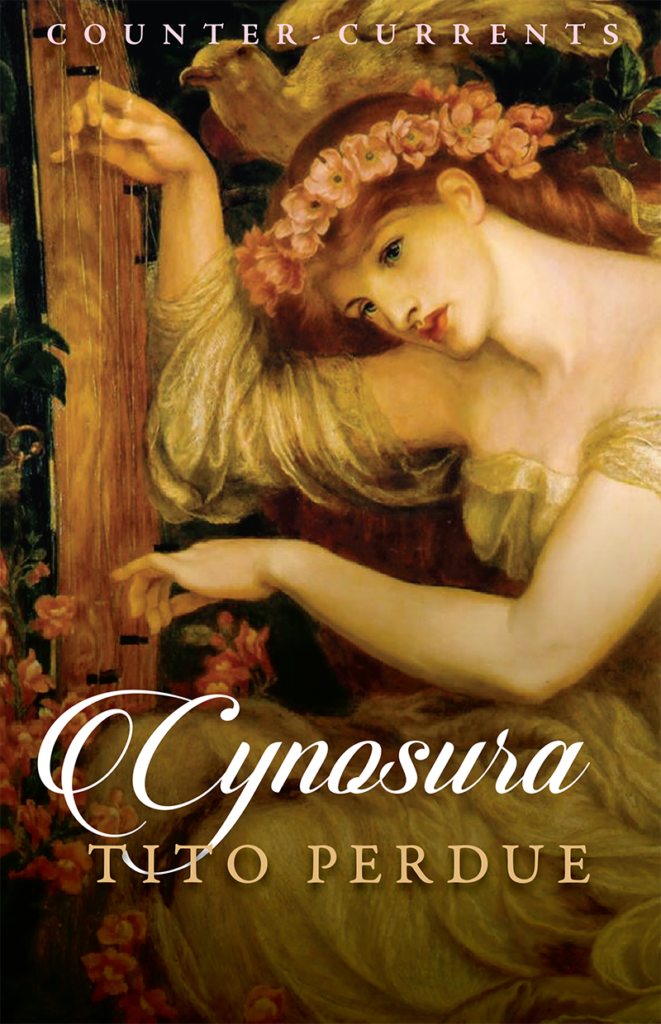
You can buy Tito Perdue’s novel Cynosura here.

The final evolution of the beautiful life doctrine, as expressed by Ross Douthat, abandons the idealism of the homogeneous American culture of the 1960s for the realpolitik of diverse America in 2020, suggesting that the unhappy parts of America should be euthanized, roughly bring about state-enforced happiness. Be happy or take the needle, just be quiet. To suggest otherwise is to question whether the fleeting feeling of temporal happiness is in itself ultimately meaningless. The current clause reads something like: “. . . among those are Life, Liberty, and the State Demand of Happiness, otherwise kill yourself.”

Beautiful life is neither completely hedonistic in nature nor completely moralistic in nature, as both of these when taken to their logical extreme bring unhappiness. It’s a kind of relativism. It has neither a consistent form nor a substance. More experiences. More newness. More safety. More drugs. If it feels good, do it. If it stops feeling good, stop doing it. More comfortable living. Lengthen your own life at any cost. More petty tyranny. Beautiful life as a concept is selfish, nihilistic, small-minded, and in the Nietzschean sense disaffirms the value of life. The ethos of beautiful life, at its most extreme, creates a dynamic where man becomes a slave to his own self-complacency. It is a kind of Siren’s call, if you will. His own creature comforts. His own decayed sense of self. No insult is bothered about, and every dream is smaller than the last. It is a beautiful kind of slavery, defended as freedom. As a result of this, man’s existence has become cheap, expendable, and ignoble. Western man has not yet drowned, but there may come a time when he is unable to free himself from his own self-complacency, his own beautiful slavery.

On the opposite side of the spectrum from Americanism are the Spartans and their beautiful death: the understanding that an honorable death is preferential to a dishonorable life. The Spartans also understood this idea in practical terms as well, believing that escape from premature death was much more often a sign of bravery and resourcefulness than an act of cowardice. Happiness, then, became a consequence of this type bravery and virtue. In fact, the common Greek word for happiness, eudaemon, had overtones that were different from the English word. It implied not a transitory “good-feeling,” but a permanent condition of life[1] –something that could only be achieved through virtue. This Greek definition of happiness can be seen in the Spartan Constitution, which says that “[virtue] ensures that the brave will have happiness and the coward misery.” In this sense, virtue created happiness: “Why, there is not even a need of money to spend on [fancy] cloaks; for their [value] is due not to the price of their clothes, but to the excellent condition of their bodies.” This means that the virtuous life — in this case, physical conditioning – is preferential to the wealthy and decayed life.

As much as the Spartans are remembered for their love of martial training, their highest virtues were actually humility and obedience. The consequence of this was that the goal of a beautiful life became a never-ending pursuit of hedonistic happiness, whereas the goal of the beautiful death was virtue itself. Americans — at least according to the law — don’t dictate social behavior, as everyone’s pursuit of happiness is unique and individualistic. Virtue is all too often an impediment to this happiness. While it took a long time to manifest, this planted the seeds of the current crop of hedonistic and temporal pleasure-seeking obsession. Americans sought winning because it brought them happiness, while the Spartans were prepared to lose — i.e., die — for the sake of eternal fame and virtue.

While Americans, both then and now, took a rather superficial view of decadence, attributing it to mere wealth, the Spartans adopted a proto-Nietzschean stance. It began with their educational system, the goal of which was not merely martial in nature. It sought to create men who were obedient, respectful, and temperate in nature. Manual labor was introduced at puberty, because the Spartans realized that puberty was the time in life when a man had the deepest sexual and hedonistic urges. They also realized that this was the ideal time to teach a child what they called self-will. As a child progressed into young adulthood, the Spartans began to moderate how much a child had to eat. This encouraged the child to steal, but they punished him severely if he was caught. Yet, that in itself was not the main reason for the exercise. The real lesson was to teach the child that “by enduring pain for a short time, one may win lasting fame and felicity.” In this sense, the Spartans had a fixation on the eternal, while Americans have a lust for the temporal and fleeting. The goal of this Spartan training was to create a man capable of good reason, great instincts, controlled but not dominated appetites, a strong self-will and an equally strong respect for authority, as well as a good sense of moral (virtuous) good to offset his intense military training. And, of course, they instilled a governing sense of self that was capable of calling upon all these skill sets.

Nietzsche had the right idea. Decadence is not merely a matter of wealth, but a matter of the decayed man, society, worldview, and so on. In other words, America is not decadent merely because of its wealth. Rather, decadence in the American context is a kind of zeitgeist and a result of the society’s obsession with the pursuit of its own happiness. This has encouraged those predisposed toward loving eating to become fat. It has encouraged people predisposed toward loving sex to chase ever more dangerous sexual experiences and drugs. It has encouraged those, such as Socrates, who love reason to abandon any sense of the baser instincts and thus reason themselves into insanity. It’s encouraged some men to completely abandon any sense of their will to dominate and become cucks, for lack of a better word. At the same time, it’s also encouraged others to go so far with their will to dominate that they became mass shooters. It’s led many to become so narcissistic and self-aggrandizing that they become basically unteachable, and oftentimes bound for prison, while it leads others to become so shy and hermit-like that they never leave their own homes.

Americans have pursued happiness and found misery. This is largely due to its citizenry’s adoption of the American ethos of the beautiful life. As a result of this, America has become a society of decayed people. A truly corrective solution will not be found in the realm of materialistic political science, but rather in a change in the American ethos itself by bringing about an understanding that happiness is not a fleeting pursuit, but a reward for the virtuous. Only after this can societal changes be enacted that go beyond mere individualism and contribute toward building a different type of man and woman — an indestructible, yet virtuous type. This will not happen by accident, but rather requires a concerted effort. In other words, the cure to a bad ethos is a good, life-affirming one.

But if America’s decadence goes back to its founding ethos, why has America only recently fallen into such a decayed state? That’s a question that one could write a book on, but for now I’ll use Nietzsche’s own example of Wagner’s music. Wagner’s music encouraged a type of decadence in many people, but Nietzsche wasn’t one of them. The American founding ethos of the individualistic pursuit of happiness is a decadent one, but it wasn’t necessarily decadent for Americans. At the time of America’s founding and up until recently, America was an incredibly religious society — one that was willing to addresses excesses of decadence, as in the prohibition on alcohol. Eventually, America lost this indirect method of governance, and the decadent beautiful-life ethos became the master and the religious impulse the servant.

Note

[1] D. Lee (ed.), The Republic, 2nd ed. (New York: Penguin Classics, 2007), p. 40.


Thoughts on Decadence & the American Ethos

Thoughts%20on%20Decadence%20andamp%3B%20the%20American%20Ethos%0A

Share

  • Gab

Enjoyed this article?

Be the first to leave a tip in the jar!

Instant Echeck GreenPay™

*  *  *

Counter-Currents has extended special privileges to those who donate at least $10/month or $120/year.

  1. Donors will have immediate access to all Counter-Currents posts. Everyone else will find that one post a day, five posts a week will be behind a “paywall” and will be available to the general public after 30 days. Naturally, we do not grant permission to other websites to repost paywall content before 30 days have passed.
  2. Paywall member comments will appear immediately instead of waiting in a moderation queue. (People who abuse this privilege will lose it.)
  3. Paywall members have the option of editing their comments.
  4. Paywall members get an Badge badge on their comments.
  5. Paywall members can “like” comments.
  6. Paywall members can “commission” a yearly article from Counter-Currents. Just send a question that you’d like to have discussed to [email protected]. (Obviously, the topics must be suitable to Counter-Currents and its broader project, as well as the interests and expertise of our writers.)

To get full access to all content behind the paywall, please visit our redesigned Paywall page. 

Related

  • Heidegger on Nietzsche Part Three

  • Nietzsche & Race

  • Heidegger on Nietzsche, Part Two

  • Jared Taylor: What Rome Means to Me

  • Heidegger on Nietzsche, Part One

  • How Cold War Two Came About

  • The Russians are Coming/The Russians are Coming

  • Finding Atlantis Part 4

Tags

America in the 1960sAndrew HuddlestonedecadenceDeclaration of Independencedecline of AmericaeudaemonFriedrich NietzschehappinessindividualisminstinctirrationalismJacques Barzunlogicopioid crisisrationalityreasonreligionRichard WagnerRobert WillsRoss DouthatSocratesSpartathe 1960sThe Age of Decadencethe beautiful deaththe beautiful lifeThe New York TimesThe Pursuit of Happinessthe Spartansthe United StatesvirtueWagnerianswealth

8 comments

  1. Third Place says:
    January 20, 2024 at 7:05 am

    Before we can address our spiritual problems, we need to fix our biological issues. The majority of Americans are abominations, to say nothing of the 5’2″ flat faced square bodied squatemalans we import by the millions. The issue is even more pronounced in the younger generations, the vast majority of whom are frankly genetic dead weight

    3
    3
    • Scott
    • Weave
    • DarkPlato
    1. Self-Hating Genetic Deadweight says:
      January 22, 2024 at 9:49 am

      With the feeling of refreshment this article brings, should one such as myself conclude that the best course of action is simply to present for summary culling? Despite being a verifiable member of the ethno/racial group lobbying for power through this movement, and having a foolish idealism for a world living in relative peace due to the cooperation of similar forces, AND agreeing with eugenics in principle, I cannot help but harbor discomfort. A fleeting confidant once phrased it roughly thus: “I see no reason to devote myself to a part of my identity that doesn’t consider me an asset.” Perhaps the proper Poppa Bear response would be, “well maybe you should *want* to be an asset to ’em!” Perhaps it is simply naif to keep wishing for such disparate parties to ever feel even a sliver of workable common ground, or perhaps one could impugn the kindness of Fred Rogers and Bob Ross, characterizing their mindset and those raised on it as life unfit for life, progenitors of an insidious strain of our race. Would Ross Douthat laugh, then, seeing himself in his declared foe? I would be disheartened if forced to conclude that the willingness to violently purge those they declare unfit for the world-to-be-created is what critically makes them worthy adversaries in a battle for ideological apotheosis. Then again, my hopelessly gamer side pogs in the sofa of my heart, saying “Dood this is like Dark Souls but if it real!!” #ShoutoutstoButtercupDew

      P.S. Keep up the good work. 🙂

      0
      0
      1. Third Place says:
        January 22, 2024 at 12:11 pm

        It might just be the Monday mental haze (only made worse by the torrential rain) but I honestly don’t know what you are saying, friend

        0
        0
  2. ArminiusMaximus says:
    January 20, 2024 at 9:16 am

    Beautiful articles, like this are why Counter Currents is a must read for serious men thinking about serious things. Well done.

    2
    2
    • kolokol
    • Weave
  3. james Smith says:
    January 20, 2024 at 1:12 pm

    The fall of the American Empire like Rome, implodes from within. All trends from family to christian or humane values and honor have been spiraling downward. Healing the spiritual problems are the root to healing all the other problems. This system of government with its financial authorities which have profited on our growing dysfunction is the system that needs to be replaced.

    1
    1
    • kolokol
  4. Sesto says:
    January 21, 2024 at 1:30 am

    America was lost when Germany lost World War II. The positive European racial identity which served to grow the American nation into an empire was snuffed out after going against and sabotaging itself during the war. It was all downhill after that.

    1
    1
    • Scott
  5. inq says:
    January 22, 2024 at 12:47 am

    As long as the US has people like Mr Roberts from Heritage Foundation in public centers of power, we are not decandent or lost.

    Heritage president torches ‘self-appointed global elites’ at Davos: ‘Your time is up.’
    https://www.bizpacreview.com/2024/01/19/heritage-president-torches-self- appointed-global-elites-at-davos-your-time-is-up-1429198/

    Let’s hope that Trump wins (DeSantis just conceded to him in primaries) and does not blink like he did during his presidency.

    Spread the word and mobilize. This is probably the last chance to defeat the monsters before they bring down the entire world.


    0
    0
  6. Weave says:
    January 22, 2024 at 4:47 am

    Perfect choice of artwork to accompany this excellent essay. Saint Anthony and Dorian Gray juxtaposed in my mind after reading this. The thing about Dorian Gray is how many people he ruined or killed along his way, a thing that would not be the case with Saint Anthony.

    1
    1
    • DarkPlato

Comments are closed.

If you have a Subscriber access,
simply login first to see your comment auto-approved.

Note on comments privacy & moderation

Your email is never published nor shared.

Comments are moderated. If you don't see your comment, please be patient. If approved, it will appear here soon. Do not post your comment a second time.

Upcoming podcasts
  • Rob Rundo on Counter-Currents Radio

    Rob Rundo on Counter-Currents Radio

    Counter-Currents Radio

    Sat, Jun 13th — 3 pm EST / 9 pm CET

Writers of May

(2 votes) Morris van de Camp David M. Zsutty Derek Stark Jayant Bhandari Greg Johnson

Articles of May

Heidegger on Nietzsche, Part One by Collin Cleary The Lunch Wars by David M. Zsutty 2 votes
    • Editor’s Update
      Rob Rundo on Counter-Currents Radio, Fundraiser Update, & a New $20,000 Matching Grant

      Greg Johnson

    • The Bitter End of Western Metaphysics:
      Heidegger on Nietzsche, Part Three

      Collin Cleary

      10

    • Uncivil War

      Mark Gullick

      31

    • Exclusive Interview with Karel Veliky:
      The Final Chapter in the Film Series! Part II

      Ondrej Mann

      2

    • Happy Birthday to Us!

      Greg Johnson

      6

    • Zsutty’s Maximum

      David M. Zsutty

      15

    • Exclusive Interview with Karel Veliky:
      The Final Chapter in the Film Series! Part I

      Ondrej Mann

      2

    • The Union Jackal, June 2026

      Mark Gullick

      23

    • The Inferiority Behind Immigrant Superiority

      Jayant Bhandari

      15

    • Counter-Currents Radio Podcast No. 690
      Greg Johnson & David Zsutty Discuss Current Things: AI, Henry Nowak, the Iran Crisis, & More

      Counter-Currents Radio

      5

    • Collin Cleary: What Rome Means to Me

      Collin Cleary

      4

    • Paul Krugman: Closet Bolshevik

      Spencer J. Quinn

      19

    • Fugue of Ideas:
      Ibram X. Kendi’s Chain of Ideas

      Greg Johnson

      18

    • Based Blacks

      Lipton Matthews

      12

    • Black Intellectual Fatigue

      Derek Stark

      38

    • Why White Advocates Should Avoid “Based Blacks”

      Dani Vypont

      29

    • Nietzsche & Race

      Mark Gullick

    • Editor’s Update
      Rob Rundo Rescheduled to Next Week on Counter-Currents Radio;
      Tonight Greg Johnson & David Zsutty Answer Your Questions;
      Fundraiser Update & a New $20,000 Matching Grant

      Greg Johnson

    • The Counter-Currents 2026 Fundraiser
      Lifetime Subscriber Welcome Packages Extended

      Greg Johnson

    • Nationalism This Week
      Who’s Looking Back?

      Greg Johnson

      29

    • China’s Threat to American Security:
      Food, Farmland, Foreign Control, & Energy Policy

      Lipton Matthews

      5

    • The Bitter End of Western Metaphysics:
      Heidegger on Nietzsche, Part Two

      Collin Cleary

      16

    • The Killing of Henry Nowak

      Mark Gullick

      38

    • The Crisis of Chinese Technology Thieves

      Morris van de Camp

      1

    • The Strange World of Gender Bender Fiction:
      & What This Genre Tells Us About Autosexuality

      Dani Vypont

      3

    • Watching the Watchers:
      The Dark Triad Question

      David M. Zsutty

      14

    • The Remigration Movement Solidifies

      F. Roger Devlin

      1

    • Casting Aspersions:
      The Fatal Consequences of Race-Swapped Casting, From Helen of Troy to Henry of Southampton

      Steven Tucker

      20

    • The Murder of Henry Nowak

      Millennial Woes

      23

    • Don’t Forget to Vote in Our Writer & Article of the Month Poll

      Greg Johnson

    • The Robot Hotdog Stand

      Greg Johnson

      37

    • Laughing Our Way to Victory

      Dave Chambers

      7

    • The Zodiac Killer

      Mark Gullick

      11

    • Jared Taylor: What Rome Means to Me

      Jared Taylor

      1

    • An Interview with Endeavour:
      My Way of Life Is an Adventure!

      Ondrej Mann

      6

    • José Pedro Zúquete’s The Identitarians

      Greg Johnson

      3

    • Editor’s Update
      Fundraiser Update & How to Watch the Remigration Summit

      Greg Johnson

      5

    • The Bitter End of Western Metaphysics:
      Heidegger on Nietzsche, Part One

      Collin Cleary

      12

    • Berlin: City of Stones

      Spencer J. Quinn

      6

    • True Folk-Horror Is Horror of Your Own Folk:
      Mark Gatiss vs the Brexit Blind Dead  

      Steven Tucker

      4

    • Counter-Currents Radio Podcast No. 689
      Thomas Massie, the America 2050 Bust, the Need for Whites to Divest from America, the AI Economic Apocalypse, & Pro-White Project Pitches to Billionaires

      Counter-Currents Radio

      7

    • Nationalism This Week
      Remigration is Inevitable, Part 3

      Greg Johnson

      27

    • Why Billionaires Should Fund White Identity Politics

      Lipton Matthews

      8

    • How Cold War Two Came About

      Morris van de Camp

      5

    • Now Available for Pre-Order at a Special Price!
      Greg Johnson’s The Philosopher Is In

      Greg Johnson

    • David Zsutty’s Elevator Pitch to a Billionaire

      David M. Zsutty

      1

    • Headbanging Lite

      Mark Gullick

      5

    • White Advocacy Past and Present

      Peter Bradley

      13

    • The Lunch Wars

      David M. Zsutty

      47

    • The Russians are Coming/The Russians are Coming

      Steven Clark

      1

    • Collin Cleary

      Heidegger on Nietzsche Part Three

      I have not heard of the Beattie dissertation, or of any discussion of it. The Mansfield book is also...

    • Collin Cleary

      Heidegger on Nietzsche Part Three

      I believe in objective truth, just not the Christian claims about objective truth. Truth is what...

    • Collin Cleary

      Heidegger on Nietzsche Part Three

      Thank you very much!

    • tempus

      Why White Advocates Should Avoid “Based Blacks”

      As for lending money, that also goes for Whites. Never lend more than you are willing to make a gift...

    • tempus

      Why White Advocates Should Avoid “Based Blacks”

      The only person other than my brother to whom I have lent money who ever paid me back was a Black...

    • tempus

      Why White Advocates Should Avoid “Based Blacks”

      The Old South was nowhere near as anti-black as the Old North. Part of the Republican platform on...

    • tempus

      Black Intellectual Fatigue

      Hopefully, more Whites are ceasing to be racial nihilists and are abandoning the new morality (...

    • Jaego

      Uncivil War

      The Orthodox ideal - just like every other denomination - is people of all races worshiping together...

    • Jaego

      Uncivil War

      Isolate the police. Family or friends, no matter. Disown them. Maybe in time people will forgive...

    • Jaego

      Uncivil War

      Tikkun Olam. Repair of the World. Enabling mass immigration is a mitzvah or holy deed in the Repair...

    • I Do Not Surrender, My Hand Is Red.

      Uncivil War

      This is very good advice Joe. Very good.

    • NIdahoOrthodox

      Uncivil War

      How many tens of thousands of automatic weapons and tons of Semtex are in hidden caches in the North...

    • kolokol

      Uncivil War

      Stephen Ogilvie is the latest example of a decent, hard-working White person, killed by a useless...

    • Dr. X

      Uncivil War

      Great writeup. One error- I doubt the Republic of Ireland police (Garda) were responding on the...

    • kolokol

      Uncivil War

      This is a very good start. May it continue and accelerate, until all the invaders have been expelled...

    • Observer

      Heidegger on Nietzsche Part Three

      Ouch. Well, I had used the bullet formatting in the text box to break it up a bit... but it looks...

    • Gabe

      Uncivil War

      Scots-Irish is an American term. It's true that Presbyterians and others came from Scotland to...

    • Gabe

      Uncivil War

      I was just going to write that myself. The Garda Siochána, or guards, is a term they use in the...

    • Ondrej Mann

      Exclusive Interview with Karel Veliky Part 2

      Thanks for the cultural tip. I’m currently preparing an interview for CC with the Austrian band...

    • Observer

      Heidegger on Nietzsche Part Three

      Also, a semi-related topic, but have you read Darren Beattie's Heidegger PhD thesis? I know that it...

    • Earth Day Special

      John Morgan

      12

    • A Robertson Roundup
      Remembering Wilmot Robertson
      (April 16, 1915 – July 8, 2005)

      Margot Metroland

      13

    • The Paranoid Style in White Nationalism

      Greg Johnson

      30

    • Join the Dance!

      Andrew Hamilton

      1

    • We Can’t Save the Earth Without Reducing African Birth Rates

      James Dunphy

      36

    • “I’m Not a Conspiracy Theorist, but . . .”:
      Jeffrey Epstein’s Death Gives New Life to “Conspiracy Theories”

      Greg Johnson

      22

    • Sylvia Plath: Stasis in Darkness

      Vic Olvir

      17

    • Vanguardism, Vantardism, & Mainstreaming

      Greg Johnson

      80

    • Aviation, Geography, & Race

      Charles Lindbergh

      3

    • Some Thoughts on Yule

      Collin Cleary

      4

    • Living in Truth:
      A Yuletide Homily

      Jef Costello

      7

    • John Kennedy Toole’s A Confederacy of Dunces

      Greg Johnson

      20

    • On Aleksandr Solzhenitsyn’s Warning to the West

      Spencer J. Quinn

      7

    • Elitism, British Modernism, & Wyndham Lewis

      Jonathan Bowden

      6

    • Philip K. Dick’s Do Androids Dream of Electric Sheep? as Anti-Semitic/Christian-Gnostic Allegory

      Greg Johnson

      20

    • “Conspiracy Theory” or Conspiracy?

      Andrew Hamilton

      21

    • Remembering H. P. Lovecraft
      (August 20, 1890–March 15, 1937)

      Greg Johnson

      3

    • Who Are We?
      Nordics, Aryans, & Whites

      Greg Johnson

      71

    • Remembering William Gayley Simpson
      (July 23, 1892–December 31, 1990)
      A Pleasant Afternoon with Harriet & Bill Simpson

      Margot Metroland

      18

    • Here are the Young Men
      Remembering Ian Curtis
      (July 15, 1956–May 18, 1980)

      Mark Gullick

      18

    • Percy Grainger
      Artist of the Right

      Alex Graham

      7

    • Remembering Revilo Oliver
      (July 7, 1908–August 20, 1994)

      Greg Johnson

      18

    • The Meaning of July 4th for the White Man

      Gregory Hood

      13

    • The Front National’s Evolution

      Bruno Mégret

    • Merwin K. Hart
      Forgotten American Hero & Man of the Right

      Morris van de Camp

      10

    • George Orwell’s Nineteen Eighty-Four

      Jonathan Bowden

      8

    • Carleton S. Coon
      Scientist & Reluctant White Advocate

      Morris van de Camp

      3

    • The Kwanzaa Absurdity Will Be Dwarfed by Juneteenth

      Robert Hampton

      10

    • Stravinsky

      Alex Graham

      7

    • Like the Roman:
      Remembering Enoch Powell (1912-1998)

      Mark Gullick

      23

    • Jonathan Bowden’s Deliverance
      Part 6

      Jonathan Bowden

    • Do You Want to Play a Game?

      Mark Gullick

      1

    • Sexually Incontinent on the Indian Subcontinent:
      Who Rapes More Animals, Indians or Pakistanis? The Battle Continues!

      Steven Tucker

      3

    • Neo-Fascism in Film
      Part 5

      Karel Veliky

      15

    • The Game of Tarot

      Mark Gullick

      2

    • Institutions Cannot Be Transplanted

      Jayant Bhandari

      5

    • Jonathan Bowden’s Deliverance
      Part 5

      Jonathan Bowden

    • Crosstown Traffic:
      Jimi Hendrix & The Post-War Rock ‘N’ Roll Revolution

      Mark Gullick

      1

    • Slaves from the North:
      Finns & Karelians in the East European Slave Trade, 900–1600

      Lipton Matthews

      14

    • Neo-Fascism in Film
      Part 4

      Karel Veliky

      2

    • David Lean’s A Passage to India

      Spencer J. Quinn

      1

    • Elites are Essential to Development

      Lipton Matthews

      7

    • Jonathan Bowden’s Deliverance
      Part 4

      Jonathan Bowden

    • Neo-Fascism in Film
      Part 3

      Karel Veliky

      6

    • E. M. Forster’s A Passage to India & the Indian Mentality

      Spencer J. Quinn

      25

    • Jonathan Bowden’s Deliverance
      Part 3

      Jonathan Bowden

    • The Rest Is Silence
      Heidegger’s Quietism

      Mark Gullick

      2

    • Dispelling the Historical Fallacy of Indian Nationalism

      Lipton Matthews

      8

    • Neo-Fascism in Film
      Part 2

      Karel Veliky

      8

    • Jonathan Bowden’s Deliverance
      Part 2

      Jonathan Bowden

    • Life of a Klansman

      Mark Gullick

      8

    • Jonathan Bowden’s Deliverance, Part 1

      Jonathan Bowden

    • Decolonial Ideas are Holding Back Developing Countries

      Lipton Matthews

      8

    • Neo-fascism in Film, Part 1

      Karel Veliky

      21

    • Jonathan Bowden’s Onslaught, Part 8
      Divigations on Decadence

      Jonathan Bowden

    • Jonathan Bowden’s Onslaught, Part 7
      Intrigues in the National Front

      Jonathan Bowden

      1

    • Rotten to the Core

      Mark Gullick

      8

    • Strauss on Husserl’s “Philosophy as Rigorous Science”

      Greg Johnson

    • Jonathan Bowden’s Onslaught, Part 6
      Francis Bacon & Right-Wing Nihilism

      Jonathan Bowden

    • London After (& Before) Midnight:
      Aleister Crowley, The Landlord’s Worst Nightmare

      James J. O'Meara

      2

    • András László
    • Derek Hawthorne
    • Beau Albrecht
    • Alain de Benoist
    • Kerry Bolton
    • Jonathan Bowden
    • Collin Cleary
    • Jef Costello
    • Savitri Devi
    • Julius Evola
    • Jim Goad
    • Gregory Hood
    • Juleigh Howard-Hobson
    • Greg Johnson
    • Charles Krafft
    • Anthony M. Ludovici
    • Trevor Lynch
    • H. L. Mencken
    • J. A. Nicholl
    • James J. O’Meara
    • Christopher Pankhurst
    • Tito Perdue
    • Michael Polignano
    • Spencer J. Quinn
    • Fenek Solère
    • Irmin Vinson
    • Leo Yankevich
    • Francis Parker Yockey
    • Multiple authors
  • Editor-in-Chief

    • Greg Johnson, Ph.D.

    Featured Writers

    • Beau Albrecht
    • Gunnar Alfredsson
    • Collin Cleary, Ph.D.
    • Jef Costello
    • Morris V. de Camp
    • F. Roger Devlin, Ph.D.
    • Stephen Paul Foster, Ph.D.
    • Jim Goad
    • Alex Graham
    • Mark Gullick, Ph.D.
    • Greg Johnson, Ph.D.
    • Travis LeBlanc
    • Trevor Lynch
    • Margot Metroland
    • James J. O’Meara
    • Angelo Plume
    • Spencer J. Quinn
    • Fred Reed
    • Clarissa Schnabel
    • Michael Walker
    • David M. Zsutty

    Frequent Writers

    • Asier Abadroa
    • Aquilonius
    • Alain de Benoist
    • Kerry Bolton, Ph.D.
    • Dave Chambers
    • Steven Clark
    • James Dunphy
    • Endeavour
    • Richard Houck
    • Jason Kessler
    • Titus Livius
    • Ondrej Mann
    • Lipton Matthews
    • Mark Mazari
    • John Morgan
    • Jaroslav Ostrogniew
    • Kathryn S.
    • Christian Secor
    • Anne Wilson Smith
    • Thomas Steuben
    • William De Vere
    • Kenneth Vinther
    • Max West

    Classic Authors

    • Maurice Bardèche
    • Jonathan Bowden
    • Julius Evola
    • Guillaume Faye
    • Ernst Jünger
    • Kevin MacDonald, Ph.D.
    • D. H. Lawrence
    • Charles Lindbergh
    • Jack London
    • H. P. Lovecraft
    • Anthony M. Ludovici
    • Sir Oswald Mosley
    • National Vanguard
    • Friedrich Nietzsche
    • Revilo Oliver
    • William Pierce
    • Ezra Pound
    • Saint-Loup
    • Savitri Devi
    • Carl Schmitt
    • Miguel Serrano
    • Oswald Spengler
    • P. R. Stephensen
    • Jean Thiriart
    • John Tyndall
    • Dominique Venner
    • Leo Yankevich
    • Francis Parker Yockey

    Other Authors

    • Howe Abbott-Hiss
    • Michael Bell
    • Giles Corey
    • Jack Donovan
    • Richardo Duchesne, Ph.D.
    • Emile Durand
    • Guillaume Durocher
    • Mark Dyal
    • Tom Goodroch
    • Andrew Hamilton
    • Robert Hampton
    • Huntley Haverstock
    • Derek Hawthorne
    • Gregory Hood
    • Juleigh Howard-Hobson
    • Alexander Jacob
    • Ruuben Kaalep
    • Tobias Langdon
    • Julian Langness
    • Patrick Le Brun
    • G A Malvicini
    • John Michael McCloughlin
    • Millennial Woes
    • Michael O’Meara
    • Christopher Pankhurst
    • Michael Polignano
    • J. J. Przybylski
    • Quintilian
    • Edouard Rix
    • C. B. Robertson
    • C. F. Robinson
    • Herve Ryssen
    • Alan Smithee
    • Fenek Solere
    • Ann Sterzinger
    • Robert Steuckers
    • Tomislav Sunic
    • Donald Thoresen
    • Marian Van Court
    • Irmin Vinson
    • Book Reviews
    • Movie Reviews
    • TV Reviews
    • Music Reviews
    • Art Criticism
    • Graphic Novels & Comics
    • Video Game Reviews
    • Fiction
    • Poems
    • Interviews
    • Videos
    • English Translations
    • Other Languages
      • Arabic
      • Bulgarian
      • Croatian
      • Czech
      • Danish
      • Dutch
      • Estonian
      • Finnish
      • French
      • German
      • Greek
      • Hungarian
      • Italian
      • Lithuanian
      • Norwegian
      • Polish
      • Portuguese
      • Romanian
      • Russian
      • Slovak
      • Spanish
      • Swedish
      • Ukrainian
    • Commemorations
    • Why We Write
  • Archives
  • Top 100 Commenters
  • The Looney Bin
Sponsored Links
Europa.com Above Time Coffee Antelope Hill Publishing Paul Waggener IHR-Store Spencer J. Quinn American Renaissance Jim Goad The Occidental Observer
Donate Now Mailing list
Books for sale
  • The Philosopher Is In
  • Sexual Utopia in Power (Expanded Edition)
  • In Defense of Prejudice
  • Loving Our Own
  • Tyranny & Wisdom
  • The Populist Moment
  • Is America Doomed?
  • To all books
Copyright © 2026 Counter-Currents Publishing, Ltd.

Paywall Access


Please enter your email address.

Lost your password?

Edit your comment

Writer & Article of the Month May 2026

Voting for this month has concluded. Here are the final results!

Top Writers

  • #1 Morris van de Camp 2 votes
  • #2 David M. Zsutty 2 votes
  • #3 Derek Stark 2 votes
  • #4 Jayant Bhandari 2 votes
  • #5 Greg Johnson 2 votes
  • #6 Jared Taylor 1 vote
  • #7 Collin Cleary 1 vote
  • #8 Spencer J. Quinn 1 vote
  • #9 Mark Gullick 1 vote
  • #10 Lipton Matthews 1 vote
  • #11 Keith Woods 1 vote
  • #12 Steven Tucker 1 vote

Top Articles

  • #1 Heidegger on Nietzsche, Part One 2 votes
  • #2 The Lunch Wars 2 votes
  • #3 The Ghost of the Confederacy 1 vote
  • #4 Lothrop Stoddard’s The Revolt Against Civilization 1 vote
  • #5 Could Fascism Work? 1 vote
  • #6 Jared Taylor's Elevator Pitch to a Billionaire 1 vote
  • #7 Predation Wearing the Mask of Civilization 1 vote
  • #8 Peak Fatigue in Fort Wayne 1 vote
  • #9 Keith Wood's Elevator Pitch to a Billionaire 1 vote
  • #10 Do You Want to Play a Game? 1 vote
  • #11 Why Billionaires Should Fund White Identity Politics 1 vote
  • #12 The 1970s: The Golden Age of Hijacking 1 vote
  • #13 True Folk-Horror Is Horror of Your Own Folk 1 vote
  • #14 Finding Atlantis Part 4 1 vote
  • #15 Berlin: City of Stones 1 vote

Total votes cast: 17