Counter-Currents
  • Advertise
  • Private Events
  • T&C
  • About
  • Contact
  • RSS
    • Main feed
    • Podcast feed
    • Videos feed
    • Comments feed
  • Welcome
  • Webzine
  • Books
  • Merch
  • Podcasts
  • Videos
  • Donate
  • Patrons
  • Subscribe
  • Crypto

LEVEL2

Donate Now Mailing list
Upcoming podcasts
  • Rob Rundo on Counter-Currents Radio

    Rob Rundo on Counter-Currents Radio

    Counter-Currents Radio

    06/13/2026 — 3 pm EST / 9 pm CET
  • Daniel Tyrie on Counter-Currents Radio

    Daniel Tyrie on Counter-Currents Radio

    Counter-Currents Radio

    06/20/2026 — 3 pm EST / 9 pm CET

Writers of May

(2 votes) Morris van de Camp David M. Zsutty Derek Stark Jayant Bhandari Greg Johnson

Articles of May

Heidegger on Nietzsche, Part One by Collin Cleary The Lunch Wars by David M. Zsutty 2 votes
  • Welcome
  • Webzine
  • Books
  • Merch
  • Podcasts
  • Videos
  • Donate
  • Patrons
  • Subscribe
  • Crypto
    • Happy Birthday to Us!

      Greg Johnson

    • Zsutty’s Maximum

      David M. Zsutty

      6

    • Exclusive Interview with Karel Veliky:
      The Final Chapter in the Film Series! Part I

      Ondrej Mann

    • The Union Jackal, June 2026

      Mark Gullick

      20

    • The Inferiority Behind Immigrant Superiority

      Jayant Bhandari

      15

    • Counter-Currents Radio Podcast No. 690
      Greg Johnson & David Zsutty Discuss Current Things: AI, Henry Nowak, the Iran Crisis, & More

      Counter-Currents Radio

      4

    • Collin Cleary: What Rome Means to Me

      Collin Cleary

      4

    • Paul Krugman: Closet Bolshevik

      Spencer J. Quinn

      14

    • Fugue of Ideas:
      Ibram X. Kendi’s Chain of Ideas

      Greg Johnson

      18

    • Based Blacks

      Lipton Matthews

      11

    • Black Intellectual Fatigue

      Derek Stark

      36

    • Why White Advocates Should Avoid “Based Blacks”

      Dani Vypont

      23

    • Nietzsche & Race

      Mark Gullick

    • Editor’s Update
      Rob Rundo Rescheduled to Next Week on Counter-Currents Radio;
      Tonight Greg Johnson & David Zsutty Answer Your Questions;
      Fundraiser Update & a New $20,000 Matching Grant

      Greg Johnson

    • The Counter-Currents 2026 Fundraiser
      Lifetime Subscriber Welcome Packages Extended

      Greg Johnson

    • Nationalism This Week
      Who’s Looking Back?

      Greg Johnson

      29

    • China’s Threat to American Security:
      Food, Farmland, Foreign Control, & Energy Policy

      Lipton Matthews

      5

    • The Bitter End of Western Metaphysics:
      Heidegger on Nietzsche, Part Two

      Collin Cleary

      16

    • The Killing of Henry Nowak

      Mark Gullick

      38

    • The Crisis of Chinese Technology Thieves

      Morris van de Camp

      1

    • The Strange World of Gender Bender Fiction:
      & What This Genre Tells Us About Autosexuality

      Dani Vypont

      3

    • Watching the Watchers:
      The Dark Triad Question

      David M. Zsutty

      14

    • The Remigration Movement Solidifies

      F. Roger Devlin

      1

    • Casting Aspersions:
      The Fatal Consequences of Race-Swapped Casting, From Helen of Troy to Henry of Southampton

      Steven Tucker

      20

    • The Murder of Henry Nowak

      Millennial Woes

      23

    • Don’t Forget to Vote in Our Writer & Article of the Month Poll

      Greg Johnson

    • The Robot Hotdog Stand

      Greg Johnson

      37

    • Laughing Our Way to Victory

      Dave Chambers

      7

    • The Zodiac Killer

      Mark Gullick

      11

    • Jared Taylor: What Rome Means to Me

      Jared Taylor

      1

    • An Interview with Endeavour:
      My Way of Life Is an Adventure!

      Ondrej Mann

      6

    • José Pedro Zúquete’s The Identitarians

      Greg Johnson

      3

    • Editor’s Update
      Fundraiser Update & How to Watch the Remigration Summit

      Greg Johnson

      5

    • The Bitter End of Western Metaphysics:
      Heidegger on Nietzsche, Part One

      Collin Cleary

      12

    • Berlin: City of Stones

      Spencer J. Quinn

      6

    • True Folk-Horror Is Horror of Your Own Folk:
      Mark Gatiss vs the Brexit Blind Dead  

      Steven Tucker

      4

    • Counter-Currents Radio Podcast No. 689
      Thomas Massie, the America 2050 Bust, the Need for Whites to Divest from America, the AI Economic Apocalypse, & Pro-White Project Pitches to Billionaires

      Counter-Currents Radio

      7

    • Nationalism This Week
      Remigration is Inevitable, Part 3

      Greg Johnson

      27

    • Why Billionaires Should Fund White Identity Politics

      Lipton Matthews

      8

    • How Cold War Two Came About

      Morris van de Camp

      5

    • Now Available for Pre-Order at a Special Price!
      Greg Johnson’s The Philosopher Is In

      Greg Johnson

    • David Zsutty’s Elevator Pitch to a Billionaire

      David M. Zsutty

      1

    • Headbanging Lite

      Mark Gullick

      5

    • White Advocacy Past and Present

      Peter Bradley

      13

    • The Lunch Wars

      David M. Zsutty

      47

    • The Russians are Coming/The Russians are Coming

      Steven Clark

      1

    • Peak Fatigue in Fort Wayne

      Gabriel Anderson

      24

    • Keith Woods’ Elevator Pitch to a Billionaire

      Keith Woods

    • The Cruelty of Kindness

      Morris van de Camp

      9

    • Predation Wearing the Mask of Civilization

      Jayant Bhandari

      13

    • Will Williams

      Zsutty’s Maximum

      C.E. Whiteoak: June 11, 2026  Fantastic article. I have never seen a better explanation of...

    • Flel

      The Union Jackal, June 2026

      Weren’t all of these incidents somewhat predictable when you openly invite masses of low...

    • WayDown

      Zsutty’s Maximum

      "Likewise, Indians were obsequious to whites when they felt we had power over them" It is an...

    • Will Williams

      Zsutty’s Maximum

      Mr. Zsutty: [M]any actual white [sic] liberals and many white [sic] conservatives for that matter...

    • Uliet Bravo

      Zsutty’s Maximum

      https://en.wikipedia.org/wiki/Liebig%27s_law_of_the_minimum#Liebig's_barrel Kinda sorta analogous...

    • Asier Abadroa

      Zsutty’s Maximum

      This reminds me of how Black South Africans burn illegal Black immigrants alive when they enter...

    • Elear

      The Inferiority Behind Immigrant Superiority

      Mr Bhandari describes a certain way of identity expression characteristic to ethnic diasporas: loud...

    • Beau Albrecht

      The Union Jackal, June 2026

      If he was all but dead on the scene, then the pigs wasted their effort arresting him for "racism". ...

    • Moss

      The Inferiority Behind Immigrant Superiority

      Interesting insights into a foreign culture, even though I find it quite disturbing.

    • Beau Albrecht

      The Union Jackal, June 2026

      As for the "elites", they should be housed in the middle of one of the no-go zones that their...

    • Will Williams

      Based Blacks

      Weave: June 9, 2026 ...I used to listen to preachers who claimed Jews were chosen and it was our...

    • Moss

      The Union Jackal, June 2026

      Ha, yes, better and more quaint times for our people Mark. In Fr Ted I remember the over 75's...

    • C.E. Whiteoak

      Zsutty’s Maximum

      Fantastic article. I have never seen a better explanation of group behavior.

    • Stronza

      The Union Jackal, June 2026

      Then the pigs arrest the White man, who dies because he got arrested instead getting first aid....

    • Vauquelin

      The Inferiority Behind Immigrant Superiority

      In the game of multiculturalism, everyone loses except those who have no culture and no roots.

    • Stronza

      The Union Jackal, June 2026

      What did that cute little opossum Pogo say?

    • Collin Cleary

      Heidegger on Nietzsche, Part One

      This is a joke, right?

    • Vauquelin

      Why White Advocates Should Avoid “Based Blacks”

      Blacks and whites are two nations inhabiting one territory. This is the source of all problems...

    • New Flyer

      The Union Jackal, June 2026

      Was listening to a Collett stream where he went over a police policy that dictates the 'racism" must...

    • Glide Ratio 0:1

      The Union Jackal, June 2026

      As to the World Cup, lets not forget the Czechs and the Croats did not kneel for the degenerate...

    • Earth Day Special

      John Morgan

      12

    • A Robertson Roundup
      Remembering Wilmot Robertson
      (April 16, 1915 – July 8, 2005)

      Margot Metroland

      13

    • The Paranoid Style in White Nationalism

      Greg Johnson

      30

    • Join the Dance!

      Andrew Hamilton

      1

    • We Can’t Save the Earth Without Reducing African Birth Rates

      James Dunphy

      36

    • “I’m Not a Conspiracy Theorist, but . . .”:
      Jeffrey Epstein’s Death Gives New Life to “Conspiracy Theories”

      Greg Johnson

      22

    • Sylvia Plath: Stasis in Darkness

      Vic Olvir

      17

    • Vanguardism, Vantardism, & Mainstreaming

      Greg Johnson

      80

    • Aviation, Geography, & Race

      Charles Lindbergh

      3

    • Some Thoughts on Yule

      Collin Cleary

      4

    • Living in Truth:
      A Yuletide Homily

      Jef Costello

      7

    • John Kennedy Toole’s A Confederacy of Dunces

      Greg Johnson

      20

    • On Aleksandr Solzhenitsyn’s Warning to the West

      Spencer J. Quinn

      7

    • Elitism, British Modernism, & Wyndham Lewis

      Jonathan Bowden

      6

    • Philip K. Dick’s Do Androids Dream of Electric Sheep? as Anti-Semitic/Christian-Gnostic Allegory

      Greg Johnson

      20

    • “Conspiracy Theory” or Conspiracy?

      Andrew Hamilton

      21

    • Remembering H. P. Lovecraft
      (August 20, 1890–March 15, 1937)

      Greg Johnson

      3

    • Who Are We?
      Nordics, Aryans, & Whites

      Greg Johnson

      71

    • Remembering William Gayley Simpson
      (July 23, 1892–December 31, 1990)
      A Pleasant Afternoon with Harriet & Bill Simpson

      Margot Metroland

      18

    • Here are the Young Men
      Remembering Ian Curtis
      (July 15, 1956–May 18, 1980)

      Mark Gullick

      18

    • Percy Grainger
      Artist of the Right

      Alex Graham

      7

    • Remembering Revilo Oliver
      (July 7, 1908–August 20, 1994)

      Greg Johnson

      18

    • The Meaning of July 4th for the White Man

      Gregory Hood

      13

    • The Front National’s Evolution

      Bruno Mégret

    • Merwin K. Hart
      Forgotten American Hero & Man of the Right

      Morris van de Camp

      10

    • George Orwell’s Nineteen Eighty-Four

      Jonathan Bowden

      8

    • Carleton S. Coon
      Scientist & Reluctant White Advocate

      Morris van de Camp

      3

    • The Kwanzaa Absurdity Will Be Dwarfed by Juneteenth

      Robert Hampton

      10

    • Stravinsky

      Alex Graham

      7

    • Like the Roman:
      Remembering Enoch Powell (1912-1998)

      Mark Gullick

      23

    • Sexually Incontinent on the Indian Subcontinent:
      Who Rapes More Animals, Indians or Pakistanis? The Battle Continues!

      Steven Tucker

      3

    • Neo-Fascism in Film
      Part 5

      Karel Veliky

      15

    • The Game of Tarot

      Mark Gullick

      2

    • Institutions Cannot Be Transplanted

      Jayant Bhandari

      5

    • Jonathan Bowden’s Deliverance
      Part 5

      Jonathan Bowden

    • Crosstown Traffic:
      Jimi Hendrix & The Post-War Rock ‘N’ Roll Revolution

      Mark Gullick

      1

    • Slaves from the North:
      Finns & Karelians in the East European Slave Trade, 900–1600

      Lipton Matthews

      14

    • Neo-Fascism in Film
      Part 4

      Karel Veliky

      2

    • David Lean’s A Passage to India

      Spencer J. Quinn

      1

    • Elites are Essential to Development

      Lipton Matthews

      7

    • Jonathan Bowden’s Deliverance
      Part 4

      Jonathan Bowden

    • Neo-Fascism in Film
      Part 3

      Karel Veliky

      6

    • E. M. Forster’s A Passage to India & the Indian Mentality

      Spencer J. Quinn

      25

    • Jonathan Bowden’s Deliverance
      Part 3

      Jonathan Bowden

    • The Rest Is Silence
      Heidegger’s Quietism

      Mark Gullick

      2

    • Dispelling the Historical Fallacy of Indian Nationalism

      Lipton Matthews

      8

    • Neo-Fascism in Film
      Part 2

      Karel Veliky

      8

    • Jonathan Bowden’s Deliverance
      Part 2

      Jonathan Bowden

    • Life of a Klansman

      Mark Gullick

      8

    • Jonathan Bowden’s Deliverance, Part 1

      Jonathan Bowden

    • Decolonial Ideas are Holding Back Developing Countries

      Lipton Matthews

      8

    • Neo-fascism in Film, Part 1

      Karel Veliky

      21

    • Jonathan Bowden’s Onslaught, Part 8
      Divigations on Decadence

      Jonathan Bowden

    • Jonathan Bowden’s Onslaught, Part 7
      Intrigues in the National Front

      Jonathan Bowden

      1

    • Rotten to the Core

      Mark Gullick

      8

    • Strauss on Husserl’s “Philosophy as Rigorous Science”

      Greg Johnson

    • Jonathan Bowden’s Onslaught, Part 6
      Francis Bacon & Right-Wing Nihilism

      Jonathan Bowden

    • London After (& Before) Midnight:
      Aleister Crowley, The Landlord’s Worst Nightmare

      James J. O'Meara

      2

    • Jonathan Bowden’s Onslaught, Part 5
      The Post-War British Far Right

      Jonathan Bowden

    • No Rules: Rollerball

      Mark Gullick

      4

    • András László
    • Derek Hawthorne
    • Beau Albrecht
    • Alain de Benoist
    • Kerry Bolton
    • Jonathan Bowden
    • Collin Cleary
    • Jef Costello
    • Savitri Devi
    • Julius Evola
    • Jim Goad
    • Gregory Hood
    • Juleigh Howard-Hobson
    • Greg Johnson
    • Charles Krafft
    • Anthony M. Ludovici
    • Trevor Lynch
    • H. L. Mencken
    • J. A. Nicholl
    • James J. O’Meara
    • Christopher Pankhurst
    • Tito Perdue
    • Michael Polignano
    • Spencer J. Quinn
    • Fenek Solère
    • Irmin Vinson
    • Leo Yankevich
    • Francis Parker Yockey
    • Multiple authors
  • Editor-in-Chief

    • Greg Johnson, Ph.D.

    Featured Writers

    • Beau Albrecht
    • Gunnar Alfredsson
    • Collin Cleary, Ph.D.
    • Jef Costello
    • Morris V. de Camp
    • F. Roger Devlin, Ph.D.
    • Stephen Paul Foster, Ph.D.
    • Jim Goad
    • Alex Graham
    • Mark Gullick, Ph.D.
    • Greg Johnson, Ph.D.
    • Travis LeBlanc
    • Trevor Lynch
    • Margot Metroland
    • James J. O’Meara
    • Angelo Plume
    • Spencer J. Quinn
    • Fred Reed
    • Clarissa Schnabel
    • Michael Walker
    • David M. Zsutty

    Frequent Writers

    • Asier Abadroa
    • Aquilonius
    • Alain de Benoist
    • Kerry Bolton, Ph.D.
    • Dave Chambers
    • Steven Clark
    • James Dunphy
    • Endeavour
    • Richard Houck
    • Jason Kessler
    • Titus Livius
    • Ondrej Mann
    • Lipton Matthews
    • Mark Mazari
    • John Morgan
    • Jaroslav Ostrogniew
    • Kathryn S.
    • Christian Secor
    • Anne Wilson Smith
    • Thomas Steuben
    • William De Vere
    • Kenneth Vinther
    • Max West

    Classic Authors

    • Maurice Bardèche
    • Jonathan Bowden
    • Julius Evola
    • Guillaume Faye
    • Ernst Jünger
    • Kevin MacDonald, Ph.D.
    • D. H. Lawrence
    • Charles Lindbergh
    • Jack London
    • H. P. Lovecraft
    • Anthony M. Ludovici
    • Sir Oswald Mosley
    • National Vanguard
    • Friedrich Nietzsche
    • Revilo Oliver
    • William Pierce
    • Ezra Pound
    • Saint-Loup
    • Savitri Devi
    • Carl Schmitt
    • Miguel Serrano
    • Oswald Spengler
    • P. R. Stephensen
    • Jean Thiriart
    • John Tyndall
    • Dominique Venner
    • Leo Yankevich
    • Francis Parker Yockey

    Other Authors

    • Howe Abbott-Hiss
    • Michael Bell
    • Giles Corey
    • Jack Donovan
    • Richardo Duchesne, Ph.D.
    • Emile Durand
    • Guillaume Durocher
    • Mark Dyal
    • Tom Goodroch
    • Andrew Hamilton
    • Robert Hampton
    • Huntley Haverstock
    • Derek Hawthorne
    • Gregory Hood
    • Juleigh Howard-Hobson
    • Alexander Jacob
    • Ruuben Kaalep
    • Tobias Langdon
    • Julian Langness
    • Patrick Le Brun
    • G A Malvicini
    • John Michael McCloughlin
    • Millennial Woes
    • Michael O’Meara
    • Christopher Pankhurst
    • Michael Polignano
    • J. J. Przybylski
    • Quintilian
    • Edouard Rix
    • C. B. Robertson
    • C. F. Robinson
    • Herve Ryssen
    • Alan Smithee
    • Fenek Solere
    • Ann Sterzinger
    • Robert Steuckers
    • Tomislav Sunic
    • Donald Thoresen
    • Marian Van Court
    • Irmin Vinson
    • Book Reviews
    • Movie Reviews
    • TV Reviews
    • Music Reviews
    • Art Criticism
    • Graphic Novels & Comics
    • Video Game Reviews
    • Fiction
    • Poems
    • Interviews
    • Videos
    • English Translations
    • Other Languages
      • Arabic
      • Bulgarian
      • Croatian
      • Czech
      • Danish
      • Dutch
      • Estonian
      • Finnish
      • French
      • German
      • Greek
      • Hungarian
      • Italian
      • Lithuanian
      • Norwegian
      • Polish
      • Portuguese
      • Romanian
      • Russian
      • Slovak
      • Spanish
      • Swedish
      • Ukrainian
    • Commemorations
    • Why We Write
  • Archives
  • Top 100 Commenters
  • The Looney Bin
  • Advertise
  • Private Events
  • T&C
  • About
  • Contact
  • RSS
    • Main feed
    • Podcast feed
    • Videos feed
    • Comments feed
Sponsored Links
Europa.com Above Time Coffee Antelope Hill Publishing Paul Waggener IHR-Store Spencer J. Quinn American Renaissance Jim Goad The Occidental Observer
Print November 6, 2023 8 comments

Wartime:
Paul Fussell Declares War on Optimism, Chickenshit, & Glory

Steven Clark

3,447 words

Paul Fussell
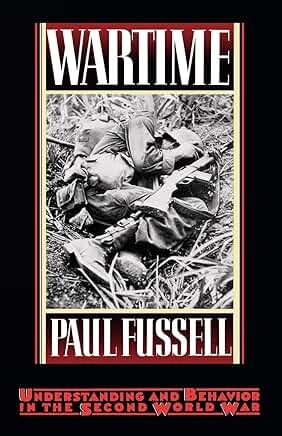
Wartime: Understanding and Behavior in the Second World War
New York: Oxford University Press, 1989

Most readers know Paul Fussell from his satiric Class: A Guide Through the American Status System, which, intended as a humorous study of American mores, has been accepted as a legitimate guideline to what H. L. Mencken called Boobis americanus. Fussell, however, produced many serious books, among them a remarkable memoir, Doing Battle: The Making of a Skeptic, recalling his service in the Second World War as an infantry officer, where he was seriously wounded and received a Bronze Star.

A lingering bitterness was apparent in Doing Battle, no doubt a residual effect of his wound he carried throughout his life, making him not exactly bitter but rather one who offered a superb, acidic analysis of life. “I find nothing more depressing than optimism,” Fussell observed.

This mindset came to splendid fruition in his 1989 Wartime: Understanding and Behavior in the Second World War. Wartime is especially pertinent now as we seem ready to step into a major war or two — or perhaps three. His book is a valuable aid in understanding the attitudes and psychological suggestions — both subliminal and overt — in modern war. As Fussell wrote: “For the past fifty years the Allied war has been sanitized and romanticized almost beyond recognition by the sentimental, the looney patriotic, the ignorant, and the bloodthirsty. I have tried to balance the scales.”

His book presents a kaleidoscope of wartime consequences, from errors and misconceptions on how easy victory and actual combat will be, to  the consequences of prolonged, industrial war on society, to the baleful effects of propaganda, to a comparison between what the “home front” saw of war and its gruesome realities. This was a consequence of the fact that many had assumed that the war would be, as with many other modern things, efficient and “clean,” and would avoid the meat grinder that was the First World War.

Fussell opens his book describing photos of a jeep speeding over any obstacle “looking as cute as Bambi” with quickness, dexterity, and style. (With the Lord’s help, of course; the Allied cause was righteous. Didn’t Eisenhower title his wartime memoir Crusade in Europe?) It was suggested that older men could easily fight in the war, since marching was a thing of the past. Everything now would be motorized, streamlined, or airborne. What was not anticipated was the grinding attritional war to come: jungle campaigns, the muck and slog of Italy and northwest Europe, and the incredible brutality and lethal efficiency of modern weapons. It was hard for a soldier to write home and describe how he was smacked in the chest by his buddy’s decapitated head. The beaches of Normandy on D-Day were littered with body parts — everything from legs to penises. The remains of bomber tail gunners had to be cleaned out with a steam hose.

This led to a massive propaganda campaign to tone down the horrors of the war. Gruesome photos were obviously omitted, and Fussell notes that a great number of military errors were fudged over. Bombers weren’t as accurate as they were made out to be, for example, often missing their targets by dozens of yards. Fussell explains that although a lot of things could be destroyed using bombs, they weren’t necessarily the things that were being aimed at. Allied anti-aircraft gun crews likewise had a dismal habit of shooting down their own planes. There were mishaps such as Operation Cobra, a 1944 bombing raid that was carried out near Saint-Lo as part of the Normandy campaign. Instead of the Germans being on the receiving end, the Allied lines were plastered, and 747 GIs were killed or wounded. Even years later, photos of American bodies being recovered after the bombing were said to be the result of German shelling.

A device used on D-Day consisted of inflatable tubes attached to tanks equipped with dual drive propellers that was supposed to buoy them so they could be dropped from ships offshore, speed to the beach, and immediately go into combat. 32 were launched, and 27 promptly sank like a stone, taking their crews with them. The Time-Life series of books published decades after the war nevertheless shows a photo of a tank equipped with this device, calling it “a tank that could swim.” Nothing is said about what actually happened. Military inefficiency and blunders were widespread on both sides. Hitler ironically said  that “the loser of this war will be the side that makes the greatest blunders.” It makes him an astute observer of reality, even if he himself was not immune.

The Second World War, even more so than the previous one, was a thoroughly propagandized affair. Newspapers were already in existence during the First World War, but the Second also saw 24-hour radio, film, and widely-circulated weekly magazines. Propaganda agencies in all the combatant nations thus saw the need to create “good news.” Radio was a primary purveyor of information; the average listener at the time of the war heard 4.5 hours of programming a day. But what he heard thoroughly censored, sanitized, and resolutely optimistic.

Reporters such as Edward R. Murrow, Eric Sevareid, and others did what they could to present an accurate picture of the war. One who became a national institution was Ernie Pyle, whose reporting on GIs at the front was well received. He embellished his reports with glowing descriptions of individual soldiers, however, which were commonly called Joe Blow stories. While remaining folksy, it also softened the dehumanizing aspects of modern war. Even the acronym “GI,” or “government issue,” itself that was used to describe American soldiers was a form of depersonalization.

Fussell notes that there was an attempt to enlist high culture in war propaganda. He thought the BBC had done a better job of this than American radio. Churchill’s oratory was certainly widely praised, and it was Churchill whose legacy was to define the war. He had his detractors, though: Hesketh Parsons found him “very amateurish,” sounding like “a gangster clergyman who has gone on the stage.” The novelist Evelyn Waugh likewise considered Churchill “a radio personality who has outlived his prime.”

You can buy Fenek Solère’s novel Rising here.

Yet, the staple of the great majority of listeners was not political oratory, but popular music which was intended to be heard “while you work.” Much of this was instrumental. In Britain it was felt that music with lyrics might cause workers to slow down in order to hear the words, and thereby set back production.

Inspirational war stories were always hard to come by, but the propagandists were more than happy to embellish. A B-17 bomber pilot, Captain Colin Kelly, became a hero in 1942 when it was said that he had rammed his crashing bomber into a Japanese battleship, destroying it. In reality, the bomber had merely damaged a troopship during an ordinary attack and survived the battle. Kelly and one other crewman were in fact killed later, when their plane was shot down by Japanese Zeros during its return to base. Kelly was in fact trying to bail out when his parachute became caught on the escape hatch. His alleged heroics were conveniently forgotten late in the war after Japanese kamikaze pilots began making suicide attacks on American ships;  the media began propagating the view that such suicide attacks were not acts of bravery, but rather those of madmen.

Frank Loesser, later known for writing the song lyrics for the musical Guys and Dolls, penned “The Ballad of Roger Young,” about a posthumous Medal of Honor winner who had rushed a Japanese machine gun nest:

Oh, they’ve got no time for glory in the Infantry,
Oh, they’ve got no use for praises loudly sung,
But in every soldier’s heart in all the Infantry,
Shines the name, shines the name of Roger Young.

Fussell reports that the song was too embarrassing for either soldiers or those on the home front to take into their hearts. But I mention this song because the starship that Johnny Rico, the protagonist of Robert Heinlein’s  novel Starship Troopers, serves aboard is named the Roger Young. At the end of the novel, after a huge victory over the alien bugs, Rico wants to hear the ballad to cheer him up. It’s a nice example of Heinlein’s satire of a fascist society, which is often wrongly seen by critics as Heinlein endorsing such a world. As Loesser later wrote, “You give hope without facts; glory without blood. You give them a legend with the rough edges neatly trimmed.”

Some wartime music also dealt with soldiers’ sexual deprivation: “I’ve Got a Girl in Kalamazoo,” and later, when worries about infidelity at home grew, “Don’t Sit Under the Apple Tree With Anyone Else But Me” and “Somebody Else is Taking My Place.” Even in Nazi Germany, the supposed den of legions of fanatical warriors, the Wehrmacht’s Wunschkonzert (request concert) included the usual hit music, the schlagers. “Lili Marleen” remained a staple.

The creation of propaganda was a full-time business. Fussell notes that vast numbers of officers were assigned as propaganda aides. Even Dwight Eisenhower — who disdained fellow officers who chased after publicity such as Douglas MacArthur, George S. Patton, and Bernard Montgomery — demanded that 12 more public relations officers be added to his staff. And on a visit to France after D-Day, he was met by no fewer than 50 newsmen. These officers served no other function; Eisenhower’s media chief, Navy Captain Harry Butcher, admitted that he didn’t even know the difference between latitude and longitude.

A major problem faced by the Allied governments was that the public had to be constantly reminded about why they were fighting the war. Anger in response to Pearl Harbor and Hitler’s aggression served that purpose early on, but as the years wore on, by and large there was a great deal of indifference among the public regarding war aims. In the end, the messaging simply became “let’s get the job done so we can go home.” Home was defined as a place where there was good food and plentiful consumer goods. That hazy conception of the good life laid the foundations for what came to be regarded as the American way of life in the post-war era.

The myth of the war as being absolutely necessary lives on in post-war legend. For example, Bart Simpson has dutifully opined that there was never a war that was necessary in all of history — apart from the American Revolution and the Second World War.

It’s noteworthy that when Churchill ran again for Prime Minister in 1945 on a program of keeping Europe safe from Communism, he lost to Attlee. The British were tired of war. The US had its own war weariness, and in the heavily censored American film industry, two comedies by Preston Sturges, The Miracle of Morgan’s Creek and Hail the Conquering Hero, poked fun at the earlier wartime rallying , implying that two of the sacred cows of the war effort, the decency and purity of the GIs and their women as well as  military heroism itself, were suspect. It recalls the propaganda in relation to our recent “war” on COVID (“A Mask is the New Smile”), where, after about a year and a half, public obedience declined and enthusiasm for countermeasures simply died out.

In contrast to the idea of American GIs going off to war with enthusiasm and idealism, desertion rates during the war were in fact heavy. Thousands of GIs who were AWOL (away without leave) were on the loose in Britain. The situation was no better on the continent. Anthony Burgess later said that his novel A Clockwork Orange, depicting violent gangs in a dreary socialist Britain, was largely influenced by the gangs of GIs that were on the loose, one of which sexually assaulted his wife.

Fussell likewise describes the excessive drinking that went on in the rank. Many soldiers were drunk most of the time, partly to cope with the stress of combat. Smoking was also heavy, and actively encouraged by the military. Even when I enlisted in the US Army in 1973, a pack of cigarettes was always included in our C rations alongside the food. Both of these habits carried over into post-war society. As Jim Kunstler noted, much of post-war suburban life involved the alcoholism and smoking that had been inherited from wartime.

The main enemy that all soldiers had to deal with was the facelessness and dehumanization of military life. Fussell cites the poetry of James Dickey as well as Randall Jarrell’s observation that servicemen were regarded merely as “killable puppets,” or as “something there are millions of.” Being a soldier involves social brutality, which Fussell defines as chickenshit: petty harassment, inane inspections, and sadism disguised as essential discipline that in fact has nothing to do with winning the war. Writers such as Norman Mailer chronicled this in The Naked and the Dead, as did Kingsley Amis in My Enemy’s Enemy. “Chickenshit” is the strong against the weak, where a phony class system of officers versus the enlisted prevails. A cartoon inYank, the US Army’s weekly news magazine for soldiers, showed two officers standing on a ledge, admiring a mountain vista. One says to the other, “It’s a splendid view. Is there one for the enlisted men?”

In the chapter entitled “Typecasting,” Fussell examines the corporate and advertising world’s efforts to convince both the home front and the GIs accept the suggestions propagated by the mass media. The Germans were shown as clever, but ruthless; the Italians clumsy, yet sweet. The Japanese, of course, were savage beasts who were incapable of civilized behavior. Wartime propaganda always openly called for bitter revenge on Japan. As Norman Mailer wrote in The Naked and the Dead, the Japanese were seen as cute little pets who had dared to bite their master, and had to be dealt with.

Americans in general were puffed up and exalted in sedate, subtle ways by the media. Fussell notes that there was relentless advertising in which

[o]ne would immediately understand the wartime thrill Americans achieved by imagining themselves good-looking Aryans, blond and tall, beloved by slim blonde women and surrounded by much-desired consumer goods. If the illustrations are to be believed, all young men are in the Air Corps, where they are officers almost by definition . . . The  people on whose behalf the war is being fought are Anglo-Saxons, “nice people” — that is, upper middle class . . . If the Jews, like those in New York, liked to think the war was in some way about them, it’s clear that most people didn’t want to be like them in any way or even reminded of them.
You can buy Tito Perdue’s Though We Be Dead Yet Our Day Will Come here.

It must be added that during the war years, many Americans fit that description; the post-war push to displace whites didn’t begin until the 1960s.

Len Deighton, in his insightful Blood, Tears, and Folly, noted that the sort of clear-cut issues that defined the war may never be seen again, and the racial unity that characterized both America and Europe at the time has since forever been altered. Writing in 1993, Deighton argued that the future may well be determined by either the success of a multi-racial world such as America’s or a racially united society such as Japan’s. Substitute China for Japan today, and our current dilemma is defined.

Another fanciful view of the Allied public was My Sister and I: The Diary of a Dutch Boy Refugee by Dirk van Der Heide. Dirk was said to have fled Rotterdam during the German bombing as a boy and then made it to England. While ostensibly celebrating the bravery of the Dutch, My Sister and I was in fact about something else entirely. Fussell observes:

The book is really a shrewd attempt to depict the British, presumably Hitler’s next victims, as especially fine and noble — selfless, sympathetic, faultless in every way . . . No one in the whole of the United Kingdom is impatient, not to mention snotty, snobbish, inept, or in any way unadmirable.

It turned out after the war that Dirk was a fabrication and that the book had in fact been commissioned by the publisher Harcourt and Brace, the “eye-witness account” intended to help motivate the American public to go to the aid of those brave and selfless British. The diary has interesting similarities to The Diary of Anne Frank, and supports Fussell’s contention that the war was the epitome of advertising. Fussell cites the infamous quotation usually attributed to either Joseph Goebbels or Adolf Hitler about the big lie: “The bigger the lie, the easier people will swallow it.” This quote has in fact never been found in either of the men’s writings or speeches, but is usually presented to to make it seem as if the Nazi leadership was gloating about their own propaganda techniques. Hitler did say something similar in Mein Kampf, but he was describing Jewish methods, and Goebbels made a similar statement as well, but he was referring to British propaganda. Fussell, apparently unaware of this,  goes on to say that “to have a Goebbels, you have to have something like we now recognize as the media world, where things are conventionally asserted to be true which smart people know are false.”

 The civilian population was so shielded from the actual reality of the war for those fighting it that a gulf developed between the boundless optimism of the war aims and the reality such that the Allies’ war aims themselves became clouded. In wartime recollections and memoirs of Allied veterans, there is a constant theme of their being unable to describe “what it was really like.” The conditions they underwent were bad enough, but there was also a sense of inner despair over the pointlessness of grinding, wrenching combat in industrialized warfare. British officer Neil McCallum said that his men largely ceased to think at all, and that there was an annihilation of the spirit. The war aims meant nothing to the soldiers at the front; it was simply about people killing other people.

An equally dreary recollection comes from Eugene B. Sledge, a US Marine whose book With the Old Breed at Peleliu and Okinawa is one of the finest memoirs of the war. Sledge recalls no glory or purpose in what he did apart from survival and the endurance to deal with trenches and jungles filled with excrement, maggots, and rotting corpses. He recalled, “It is too preposterous to think that men could actually live and fight for days and nights on end under such terrible conditions and not be driven insane . . . To me the war was insanity.”

Fussell writes with clarity rather than sourness about the war. He is especially piqued about the sense of hope that the war had been supposed to bring. He recounts that the literature of the period tried to instill optimism and a sense of community through writers such as Thornton Wilder. Acidic observers such as H. L. Mencken were forced to tone down their standard copy in favor of reminiscences and material that would not upset the wartime readers, or perhaps cause him to think. When John Steinbeck wrote The Moon Is Down and tried to offer a balanced view of both the Norwegians under German occupation and the Germans themselves, he was chided for it; Germans were only supposed to be depicted as evil.

Great efforts were made to get books to the troops. The paperback took off during the war as an easy way to carry a book. The British battledress uniform’s large pockets were nicknamed Penguin Pockets, since they were good places to store the new Penguin paperbacks. Yet, Fussell records that the overwhelming books of choice for soldiers were comic books. As one GI asked another, “Hey, buddy, fiction or non-fiction, which is real?”

Wartime also offers a guide to post-war America and the 1950s, with its relentless good faith and societal sense of material satiation. It was a afterglow from the war years that didn’t really end until Vietnam. Fussell concludes:

The same tricks of publicity and advertising might have succeeded in sweetening the actualities of Vietnam if television and a vigorous uncensored moral journalism hadn’t been brought to bear. America has not yet understood what the Second World War was like and has been unable to use such understanding to re-interpret and re-define the national reality and to arrive at something like public maturity.

 Wartime is a mature, thoughtful, and comprehensive volume about the era which has obvious parallels to today and recent attempts to propagandize the wars in Ukraine, and now Gaza, in favor of the American government’s view of their causes and conditions. Fussell’s wound, both physical and spiritual, led to a realistic portrayal of the “good war.”

Wartime: Paul Fussell Declares War on Optimism, Chickenshit, & Glory

Wartime%3A%0APaul%20Fussell%20Declares%20War%20on%20Optimism%2C%20Chickenshit%2C%20andamp%3B%20Glory%0A

Share

  • Gab

Enjoyed this article?

Be the first to leave a tip in the jar!

Instant Echeck GreenPay™

*  *  *

Counter-Currents has extended special privileges to those who donate at least $10/month or $120/year.

  1. Donors will have immediate access to all Counter-Currents posts. Everyone else will find that one post a day, five posts a week will be behind a “paywall” and will be available to the general public after 30 days. Naturally, we do not grant permission to other websites to repost paywall content before 30 days have passed.
  2. Paywall member comments will appear immediately instead of waiting in a moderation queue. (People who abuse this privilege will lose it.)
  3. Paywall members have the option of editing their comments.
  4. Paywall members get an Badge badge on their comments.
  5. Paywall members can “like” comments.
  6. Paywall members can “commission” a yearly article from Counter-Currents. Just send a question that you’d like to have discussed to [email protected]. (Obviously, the topics must be suitable to Counter-Currents and its broader project, as well as the interests and expertise of our writers.)

To get full access to all content behind the paywall, please visit our redesigned Paywall page. 

Related

  • The Russians are Coming/The Russians are Coming

  • Barbara Will’s Unlikely Collaboration

  • Le Debacle: Historical Echoes of Zola’s France

  • A Novel Approach: Roberto Bolaño’s 2666

  • Neo-Fascism in Film, Part 3

  • Restoring American Deterrence through Innovation and Industry

  • E. M. Forster’s A Passage to India & the Indian Mentality

  • The Theology Behind Ruby Ridge

Tags

America in the Second World Warbook reviewsD-DayDirk van Der HeideFrank LoesserJohn SteinbeckjournalismjournalistsLen Deightonmass mediaMy Sister and INorman MailerpaperbacksPaul Fussellpaywallpopular musicPreston Sturgespropagandapublic relationsradiosoldiersStarship TroopersSteven ClarktanksThe Ballad of Roger Youngthe mass mediathe Second World WarwarWartimewartime propagandaWinston ChurchillWorld War II

8 comments

  1. Al Dante says:
    November 6, 2023 at 3:19 pm

    One of the mysteries of the Second War was the discovery that most men were reluctant to fire their weapons. Those that did shoot were estimated to be only 15-25%.

    This may be mentioned in “Wartime” or in Fussell’s other book on the war. It’s been a while since I read them.

    Hollywood and video games seem to have done a good job in desensitizing people to become trigger-happy as evidenced by the proliferation of run amok spree killers.

    Amerikan culture has become truly toxic.

    0
    0
    1. John Morgan says:
      November 7, 2023 at 7:11 am

      The idea that only 15-25% of US soldiers fired their weapons in combat during World War II has been debunked by a number of other scholars, such as this one: https://www.americanheritage.com/secret-soldiers-who-didnt-shoot

      0
      0
      1. Al Dante says:
        November 7, 2023 at 10:34 am

        Thanks for the link, but I still want to believe it’s true.

        There were very few incidents of returning soldiers running amok after WWII considering the number who experienced combat.

        Do you think the shoot-em-up games and movies can account in some way for the current crop of spree killers?

        0
        0
        1. K. says:
          November 7, 2023 at 2:11 pm

          It seems you greatly underestimate the violent nature that resides in the heart of man. Video games, like first person shooters, give one a release outlet for this proclivity toward violence. They do not cause one to go postal, however. Same with violent movies, although movies are a purely passive experience, and less engaging than games. The decline of religion since the turn of the century probably has something to do with an increase of mass murders, murder-suicides, terrorist attacks etc. For many people throughout history, religion, Christianity specifically, served as a check on the primal and violent impulses. It wasn’t the only thing, but I think it was a big one. When that dies, it shouldn’t be surprising what sometimes happens. I’m not religious by the way.

          0
          0
          1. Al Dante says:
            November 7, 2023 at 3:28 pm

            Violent movies and video games desensitize and glorify violence. Some ‘human natures’ are more prone to being influenced. I don’t believe there is one human nature.

            Then again violent movies and games may be preventing more berserkers by providing a release. Maybe returning WWII vets were more peaceful because they got it out of their system and were tired and revulsed at what they had to do to survive.

            As you say, loss of moral values and a fear of God through religion along with a coarsening of the culture and breakdown of the social structure are also contributing factors in the murder sprees.

            0
            0
  2. Richard Chance says:
    November 6, 2023 at 6:31 pm

    We were assigned this book in my entry level American History course in undergrad five million years ago.  I remember devouring it in just a couple days–it was my first introduction to the enormous contrast between the WWII propaganda I’d been fed my entire life and the reality of it.  It’s become a cliche to ask this type of question but I’m going to ask it anyway: is this book still assigned in colleges today?  Given its celebration of critical thinking, I’d be surprised if it were.

    “the starship that Johnny Rico, the protagonist of Robert Heinlein’s novel Starship Troopers, serves aboard is named the Roger Young. At the end of the novel, after a huge victory over the alien bugs, Rico wants to hear the ballad to cheer him up. It’s a nice example of Heinlein’s satire of a fascist society, which is often wrongly seen by critics as Heinlein endorsing such a world.”

    It’s been a while since I’ve done a deep-dive into Heinlein, but where do you get that assertion from?  If I recall correctly, his writings are chock full of militarism and glorification of all things war-related (of course, Heinlein himself never saw combat).  Is there any indication from Heinlein that ST was intended to be satirical?

    0
    0
    1. K. says:
      November 6, 2023 at 7:07 pm

      I think a good amount of Starship Troopers is meant to be taken tongue in cheek. Heinlein was very much a libertarian. The Moon is a harsh mistress shows this influence as well. The film adaptation of ST just turns the goofy meter up to 11 and therefore makes it an obvious satire of fascism/militarism. I think people misunderstand Heinlein the same way they do Frank Herbert and Dune.

      0
      0
  3. Margot Metroland says:
    November 17, 2023 at 7:26 pm

    I’m the one who reviewed Class here, and I would have reviewed Wartime as well, had my first edition not vanished in my many moves over the past 35 years. I read it when it first came out, and I rate it as Fussell’s best. It led me to E.B. Sledge’s book, and that was excellent and powerful but sometimes a little dreary, as Fussell had already told me the hot parts.

    0
    0

Comments are closed.

If you have a Subscriber access,
simply login first to see your comment auto-approved.

Note on comments privacy & moderation

Your email is never published nor shared.

Comments are moderated. If you don't see your comment, please be patient. If approved, it will appear here soon. Do not post your comment a second time.

Upcoming podcasts
  • Rob Rundo on Counter-Currents Radio

    Rob Rundo on Counter-Currents Radio

    Counter-Currents Radio

    Sat, Jun 13th — 3 pm EST / 9 pm CET
  • Daniel Tyrie on Counter-Currents Radio

    Daniel Tyrie on Counter-Currents Radio

    Counter-Currents Radio

    Sat, Jun 20th — 3 pm EST / 9 pm CET

Writers of May

(2 votes) Morris van de Camp David M. Zsutty Derek Stark Jayant Bhandari Greg Johnson

Articles of May

Heidegger on Nietzsche, Part One by Collin Cleary The Lunch Wars by David M. Zsutty 2 votes
    • Happy Birthday to Us!

      Greg Johnson

    • Zsutty’s Maximum

      David M. Zsutty

      6

    • Exclusive Interview with Karel Veliky:
      The Final Chapter in the Film Series! Part I

      Ondrej Mann

    • The Union Jackal, June 2026

      Mark Gullick

      20

    • The Inferiority Behind Immigrant Superiority

      Jayant Bhandari

      15

    • Counter-Currents Radio Podcast No. 690
      Greg Johnson & David Zsutty Discuss Current Things: AI, Henry Nowak, the Iran Crisis, & More

      Counter-Currents Radio

      4

    • Collin Cleary: What Rome Means to Me

      Collin Cleary

      4

    • Paul Krugman: Closet Bolshevik

      Spencer J. Quinn

      14

    • Fugue of Ideas:
      Ibram X. Kendi’s Chain of Ideas

      Greg Johnson

      18

    • Based Blacks

      Lipton Matthews

      11

    • Black Intellectual Fatigue

      Derek Stark

      36

    • Why White Advocates Should Avoid “Based Blacks”

      Dani Vypont

      23

    • Nietzsche & Race

      Mark Gullick

    • Editor’s Update
      Rob Rundo Rescheduled to Next Week on Counter-Currents Radio;
      Tonight Greg Johnson & David Zsutty Answer Your Questions;
      Fundraiser Update & a New $20,000 Matching Grant

      Greg Johnson

    • The Counter-Currents 2026 Fundraiser
      Lifetime Subscriber Welcome Packages Extended

      Greg Johnson

    • Nationalism This Week
      Who’s Looking Back?

      Greg Johnson

      29

    • China’s Threat to American Security:
      Food, Farmland, Foreign Control, & Energy Policy

      Lipton Matthews

      5

    • The Bitter End of Western Metaphysics:
      Heidegger on Nietzsche, Part Two

      Collin Cleary

      16

    • The Killing of Henry Nowak

      Mark Gullick

      38

    • The Crisis of Chinese Technology Thieves

      Morris van de Camp

      1

    • The Strange World of Gender Bender Fiction:
      & What This Genre Tells Us About Autosexuality

      Dani Vypont

      3

    • Watching the Watchers:
      The Dark Triad Question

      David M. Zsutty

      14

    • The Remigration Movement Solidifies

      F. Roger Devlin

      1

    • Casting Aspersions:
      The Fatal Consequences of Race-Swapped Casting, From Helen of Troy to Henry of Southampton

      Steven Tucker

      20

    • The Murder of Henry Nowak

      Millennial Woes

      23

    • Don’t Forget to Vote in Our Writer & Article of the Month Poll

      Greg Johnson

    • The Robot Hotdog Stand

      Greg Johnson

      37

    • Laughing Our Way to Victory

      Dave Chambers

      7

    • The Zodiac Killer

      Mark Gullick

      11

    • Jared Taylor: What Rome Means to Me

      Jared Taylor

      1

    • An Interview with Endeavour:
      My Way of Life Is an Adventure!

      Ondrej Mann

      6

    • José Pedro Zúquete’s The Identitarians

      Greg Johnson

      3

    • Editor’s Update
      Fundraiser Update & How to Watch the Remigration Summit

      Greg Johnson

      5

    • The Bitter End of Western Metaphysics:
      Heidegger on Nietzsche, Part One

      Collin Cleary

      12

    • Berlin: City of Stones

      Spencer J. Quinn

      6

    • True Folk-Horror Is Horror of Your Own Folk:
      Mark Gatiss vs the Brexit Blind Dead  

      Steven Tucker

      4

    • Counter-Currents Radio Podcast No. 689
      Thomas Massie, the America 2050 Bust, the Need for Whites to Divest from America, the AI Economic Apocalypse, & Pro-White Project Pitches to Billionaires

      Counter-Currents Radio

      7

    • Nationalism This Week
      Remigration is Inevitable, Part 3

      Greg Johnson

      27

    • Why Billionaires Should Fund White Identity Politics

      Lipton Matthews

      8

    • How Cold War Two Came About

      Morris van de Camp

      5

    • Now Available for Pre-Order at a Special Price!
      Greg Johnson’s The Philosopher Is In

      Greg Johnson

    • David Zsutty’s Elevator Pitch to a Billionaire

      David M. Zsutty

      1

    • Headbanging Lite

      Mark Gullick

      5

    • White Advocacy Past and Present

      Peter Bradley

      13

    • The Lunch Wars

      David M. Zsutty

      47

    • The Russians are Coming/The Russians are Coming

      Steven Clark

      1

    • Peak Fatigue in Fort Wayne

      Gabriel Anderson

      24

    • Keith Woods’ Elevator Pitch to a Billionaire

      Keith Woods

    • The Cruelty of Kindness

      Morris van de Camp

      9

    • Predation Wearing the Mask of Civilization

      Jayant Bhandari

      13

    • Will Williams

      Zsutty’s Maximum

      C.E. Whiteoak: June 11, 2026  Fantastic article. I have never seen a better explanation of...

    • Flel

      The Union Jackal, June 2026

      Weren’t all of these incidents somewhat predictable when you openly invite masses of low...

    • WayDown

      Zsutty’s Maximum

      "Likewise, Indians were obsequious to whites when they felt we had power over them" It is an...

    • Will Williams

      Zsutty’s Maximum

      Mr. Zsutty: [M]any actual white [sic] liberals and many white [sic] conservatives for that matter...

    • Uliet Bravo

      Zsutty’s Maximum

      https://en.wikipedia.org/wiki/Liebig%27s_law_of_the_minimum#Liebig's_barrel Kinda sorta analogous...

    • Asier Abadroa

      Zsutty’s Maximum

      This reminds me of how Black South Africans burn illegal Black immigrants alive when they enter...

    • Elear

      The Inferiority Behind Immigrant Superiority

      Mr Bhandari describes a certain way of identity expression characteristic to ethnic diasporas: loud...

    • Beau Albrecht

      The Union Jackal, June 2026

      If he was all but dead on the scene, then the pigs wasted their effort arresting him for "racism". ...

    • Moss

      The Inferiority Behind Immigrant Superiority

      Interesting insights into a foreign culture, even though I find it quite disturbing.

    • Beau Albrecht

      The Union Jackal, June 2026

      As for the "elites", they should be housed in the middle of one of the no-go zones that their...

    • Will Williams

      Based Blacks

      Weave: June 9, 2026 ...I used to listen to preachers who claimed Jews were chosen and it was our...

    • Moss

      The Union Jackal, June 2026

      Ha, yes, better and more quaint times for our people Mark. In Fr Ted I remember the over 75's...

    • C.E. Whiteoak

      Zsutty’s Maximum

      Fantastic article. I have never seen a better explanation of group behavior.

    • Stronza

      The Union Jackal, June 2026

      Then the pigs arrest the White man, who dies because he got arrested instead getting first aid....

    • Vauquelin

      The Inferiority Behind Immigrant Superiority

      In the game of multiculturalism, everyone loses except those who have no culture and no roots.

    • Stronza

      The Union Jackal, June 2026

      What did that cute little opossum Pogo say?

    • Collin Cleary

      Heidegger on Nietzsche, Part One

      This is a joke, right?

    • Vauquelin

      Why White Advocates Should Avoid “Based Blacks”

      Blacks and whites are two nations inhabiting one territory. This is the source of all problems...

    • New Flyer

      The Union Jackal, June 2026

      Was listening to a Collett stream where he went over a police policy that dictates the 'racism" must...

    • Glide Ratio 0:1

      The Union Jackal, June 2026

      As to the World Cup, lets not forget the Czechs and the Croats did not kneel for the degenerate...

    • Earth Day Special

      John Morgan

      12

    • A Robertson Roundup
      Remembering Wilmot Robertson
      (April 16, 1915 – July 8, 2005)

      Margot Metroland

      13

    • The Paranoid Style in White Nationalism

      Greg Johnson

      30

    • Join the Dance!

      Andrew Hamilton

      1

    • We Can’t Save the Earth Without Reducing African Birth Rates

      James Dunphy

      36

    • “I’m Not a Conspiracy Theorist, but . . .”:
      Jeffrey Epstein’s Death Gives New Life to “Conspiracy Theories”

      Greg Johnson

      22

    • Sylvia Plath: Stasis in Darkness

      Vic Olvir

      17

    • Vanguardism, Vantardism, & Mainstreaming

      Greg Johnson

      80

    • Aviation, Geography, & Race

      Charles Lindbergh

      3

    • Some Thoughts on Yule

      Collin Cleary

      4

    • Living in Truth:
      A Yuletide Homily

      Jef Costello

      7

    • John Kennedy Toole’s A Confederacy of Dunces

      Greg Johnson

      20

    • On Aleksandr Solzhenitsyn’s Warning to the West

      Spencer J. Quinn

      7

    • Elitism, British Modernism, & Wyndham Lewis

      Jonathan Bowden

      6

    • Philip K. Dick’s Do Androids Dream of Electric Sheep? as Anti-Semitic/Christian-Gnostic Allegory

      Greg Johnson

      20

    • “Conspiracy Theory” or Conspiracy?

      Andrew Hamilton

      21

    • Remembering H. P. Lovecraft
      (August 20, 1890–March 15, 1937)

      Greg Johnson

      3

    • Who Are We?
      Nordics, Aryans, & Whites

      Greg Johnson

      71

    • Remembering William Gayley Simpson
      (July 23, 1892–December 31, 1990)
      A Pleasant Afternoon with Harriet & Bill Simpson

      Margot Metroland

      18

    • Here are the Young Men
      Remembering Ian Curtis
      (July 15, 1956–May 18, 1980)

      Mark Gullick

      18

    • Percy Grainger
      Artist of the Right

      Alex Graham

      7

    • Remembering Revilo Oliver
      (July 7, 1908–August 20, 1994)

      Greg Johnson

      18

    • The Meaning of July 4th for the White Man

      Gregory Hood

      13

    • The Front National’s Evolution

      Bruno Mégret

    • Merwin K. Hart
      Forgotten American Hero & Man of the Right

      Morris van de Camp

      10

    • George Orwell’s Nineteen Eighty-Four

      Jonathan Bowden

      8

    • Carleton S. Coon
      Scientist & Reluctant White Advocate

      Morris van de Camp

      3

    • The Kwanzaa Absurdity Will Be Dwarfed by Juneteenth

      Robert Hampton

      10

    • Stravinsky

      Alex Graham

      7

    • Like the Roman:
      Remembering Enoch Powell (1912-1998)

      Mark Gullick

      23

    • Sexually Incontinent on the Indian Subcontinent:
      Who Rapes More Animals, Indians or Pakistanis? The Battle Continues!

      Steven Tucker

      3

    • Neo-Fascism in Film
      Part 5

      Karel Veliky

      15

    • The Game of Tarot

      Mark Gullick

      2

    • Institutions Cannot Be Transplanted

      Jayant Bhandari

      5

    • Jonathan Bowden’s Deliverance
      Part 5

      Jonathan Bowden

    • Crosstown Traffic:
      Jimi Hendrix & The Post-War Rock ‘N’ Roll Revolution

      Mark Gullick

      1

    • Slaves from the North:
      Finns & Karelians in the East European Slave Trade, 900–1600

      Lipton Matthews

      14

    • Neo-Fascism in Film
      Part 4

      Karel Veliky

      2

    • David Lean’s A Passage to India

      Spencer J. Quinn

      1

    • Elites are Essential to Development

      Lipton Matthews

      7

    • Jonathan Bowden’s Deliverance
      Part 4

      Jonathan Bowden

    • Neo-Fascism in Film
      Part 3

      Karel Veliky

      6

    • E. M. Forster’s A Passage to India & the Indian Mentality

      Spencer J. Quinn

      25

    • Jonathan Bowden’s Deliverance
      Part 3

      Jonathan Bowden

    • The Rest Is Silence
      Heidegger’s Quietism

      Mark Gullick

      2

    • Dispelling the Historical Fallacy of Indian Nationalism

      Lipton Matthews

      8

    • Neo-Fascism in Film
      Part 2

      Karel Veliky

      8

    • Jonathan Bowden’s Deliverance
      Part 2

      Jonathan Bowden

    • Life of a Klansman

      Mark Gullick

      8

    • Jonathan Bowden’s Deliverance, Part 1

      Jonathan Bowden

    • Decolonial Ideas are Holding Back Developing Countries

      Lipton Matthews

      8

    • Neo-fascism in Film, Part 1

      Karel Veliky

      21

    • Jonathan Bowden’s Onslaught, Part 8
      Divigations on Decadence

      Jonathan Bowden

    • Jonathan Bowden’s Onslaught, Part 7
      Intrigues in the National Front

      Jonathan Bowden

      1

    • Rotten to the Core

      Mark Gullick

      8

    • Strauss on Husserl’s “Philosophy as Rigorous Science”

      Greg Johnson

    • Jonathan Bowden’s Onslaught, Part 6
      Francis Bacon & Right-Wing Nihilism

      Jonathan Bowden

    • London After (& Before) Midnight:
      Aleister Crowley, The Landlord’s Worst Nightmare

      James J. O'Meara

      2

    • Jonathan Bowden’s Onslaught, Part 5
      The Post-War British Far Right

      Jonathan Bowden

    • No Rules: Rollerball

      Mark Gullick

      4

    • András László
    • Derek Hawthorne
    • Beau Albrecht
    • Alain de Benoist
    • Kerry Bolton
    • Jonathan Bowden
    • Collin Cleary
    • Jef Costello
    • Savitri Devi
    • Julius Evola
    • Jim Goad
    • Gregory Hood
    • Juleigh Howard-Hobson
    • Greg Johnson
    • Charles Krafft
    • Anthony M. Ludovici
    • Trevor Lynch
    • H. L. Mencken
    • J. A. Nicholl
    • James J. O’Meara
    • Christopher Pankhurst
    • Tito Perdue
    • Michael Polignano
    • Spencer J. Quinn
    • Fenek Solère
    • Irmin Vinson
    • Leo Yankevich
    • Francis Parker Yockey
    • Multiple authors
  • Editor-in-Chief

    • Greg Johnson, Ph.D.

    Featured Writers

    • Beau Albrecht
    • Gunnar Alfredsson
    • Collin Cleary, Ph.D.
    • Jef Costello
    • Morris V. de Camp
    • F. Roger Devlin, Ph.D.
    • Stephen Paul Foster, Ph.D.
    • Jim Goad
    • Alex Graham
    • Mark Gullick, Ph.D.
    • Greg Johnson, Ph.D.
    • Travis LeBlanc
    • Trevor Lynch
    • Margot Metroland
    • James J. O’Meara
    • Angelo Plume
    • Spencer J. Quinn
    • Fred Reed
    • Clarissa Schnabel
    • Michael Walker
    • David M. Zsutty

    Frequent Writers

    • Asier Abadroa
    • Aquilonius
    • Alain de Benoist
    • Kerry Bolton, Ph.D.
    • Dave Chambers
    • Steven Clark
    • James Dunphy
    • Endeavour
    • Richard Houck
    • Jason Kessler
    • Titus Livius
    • Ondrej Mann
    • Lipton Matthews
    • Mark Mazari
    • John Morgan
    • Jaroslav Ostrogniew
    • Kathryn S.
    • Christian Secor
    • Anne Wilson Smith
    • Thomas Steuben
    • William De Vere
    • Kenneth Vinther
    • Max West

    Classic Authors

    • Maurice Bardèche
    • Jonathan Bowden
    • Julius Evola
    • Guillaume Faye
    • Ernst Jünger
    • Kevin MacDonald, Ph.D.
    • D. H. Lawrence
    • Charles Lindbergh
    • Jack London
    • H. P. Lovecraft
    • Anthony M. Ludovici
    • Sir Oswald Mosley
    • National Vanguard
    • Friedrich Nietzsche
    • Revilo Oliver
    • William Pierce
    • Ezra Pound
    • Saint-Loup
    • Savitri Devi
    • Carl Schmitt
    • Miguel Serrano
    • Oswald Spengler
    • P. R. Stephensen
    • Jean Thiriart
    • John Tyndall
    • Dominique Venner
    • Leo Yankevich
    • Francis Parker Yockey

    Other Authors

    • Howe Abbott-Hiss
    • Michael Bell
    • Giles Corey
    • Jack Donovan
    • Richardo Duchesne, Ph.D.
    • Emile Durand
    • Guillaume Durocher
    • Mark Dyal
    • Tom Goodroch
    • Andrew Hamilton
    • Robert Hampton
    • Huntley Haverstock
    • Derek Hawthorne
    • Gregory Hood
    • Juleigh Howard-Hobson
    • Alexander Jacob
    • Ruuben Kaalep
    • Tobias Langdon
    • Julian Langness
    • Patrick Le Brun
    • G A Malvicini
    • John Michael McCloughlin
    • Millennial Woes
    • Michael O’Meara
    • Christopher Pankhurst
    • Michael Polignano
    • J. J. Przybylski
    • Quintilian
    • Edouard Rix
    • C. B. Robertson
    • C. F. Robinson
    • Herve Ryssen
    • Alan Smithee
    • Fenek Solere
    • Ann Sterzinger
    • Robert Steuckers
    • Tomislav Sunic
    • Donald Thoresen
    • Marian Van Court
    • Irmin Vinson
    • Book Reviews
    • Movie Reviews
    • TV Reviews
    • Music Reviews
    • Art Criticism
    • Graphic Novels & Comics
    • Video Game Reviews
    • Fiction
    • Poems
    • Interviews
    • Videos
    • English Translations
    • Other Languages
      • Arabic
      • Bulgarian
      • Croatian
      • Czech
      • Danish
      • Dutch
      • Estonian
      • Finnish
      • French
      • German
      • Greek
      • Hungarian
      • Italian
      • Lithuanian
      • Norwegian
      • Polish
      • Portuguese
      • Romanian
      • Russian
      • Slovak
      • Spanish
      • Swedish
      • Ukrainian
    • Commemorations
    • Why We Write
  • Archives
  • Top 100 Commenters
  • The Looney Bin
Sponsored Links
Europa.com Above Time Coffee Antelope Hill Publishing Paul Waggener IHR-Store Spencer J. Quinn American Renaissance Jim Goad The Occidental Observer
Donate Now Mailing list
Books for sale
  • The Philosopher Is In
  • Sexual Utopia in Power (Expanded Edition)
  • In Defense of Prejudice
  • Loving Our Own
  • Tyranny & Wisdom
  • The Populist Moment
  • Is America Doomed?
  • To all books
Copyright © 2026 Counter-Currents Publishing, Ltd.

Paywall Access


Please enter your email address.

Lost your password?

Edit your comment

Writer & Article of the Month May 2026

Voting for this month has concluded. Here are the final results!

Top Writers

  • #1 Morris van de Camp 2 votes
  • #2 David M. Zsutty 2 votes
  • #3 Derek Stark 2 votes
  • #4 Jayant Bhandari 2 votes
  • #5 Greg Johnson 2 votes
  • #6 Jared Taylor 1 vote
  • #7 Collin Cleary 1 vote
  • #8 Spencer J. Quinn 1 vote
  • #9 Mark Gullick 1 vote
  • #10 Lipton Matthews 1 vote
  • #11 Keith Woods 1 vote
  • #12 Steven Tucker 1 vote

Top Articles

  • #1 Heidegger on Nietzsche, Part One 2 votes
  • #2 The Lunch Wars 2 votes
  • #3 The Ghost of the Confederacy 1 vote
  • #4 Lothrop Stoddard’s The Revolt Against Civilization 1 vote
  • #5 Could Fascism Work? 1 vote
  • #6 Jared Taylor's Elevator Pitch to a Billionaire 1 vote
  • #7 Predation Wearing the Mask of Civilization 1 vote
  • #8 Peak Fatigue in Fort Wayne 1 vote
  • #9 Keith Wood's Elevator Pitch to a Billionaire 1 vote
  • #10 Do You Want to Play a Game? 1 vote
  • #11 Why Billionaires Should Fund White Identity Politics 1 vote
  • #12 The 1970s: The Golden Age of Hijacking 1 vote
  • #13 True Folk-Horror Is Horror of Your Own Folk 1 vote
  • #14 Finding Atlantis Part 4 1 vote
  • #15 Berlin: City of Stones 1 vote

Total votes cast: 17