Counter-Currents
  • Advertise
  • Private Events
  • T&C
  • About
  • Contact
  • RSS
    • Main feed
    • Podcast feed
    • Videos feed
    • Comments feed
  • Welcome
  • Webzine
  • Books
  • Merch
  • Podcasts
  • Videos
  • Donate
  • Patrons
  • Subscribe
  • Crypto

LEVEL2

Donate Now Mailing list

Writers of May

(2 votes) Morris van de Camp David M. Zsutty Derek Stark Jayant Bhandari Greg Johnson

Articles of May

Heidegger on Nietzsche, Part One by Collin Cleary The Lunch Wars by David M. Zsutty 2 votes
  • Welcome
  • Webzine
  • Books
  • Merch
  • Podcasts
  • Videos
  • Donate
  • Patrons
  • Subscribe
  • Crypto
    • Nationalism This Week
      Letter to J. D. Vance

      Greg Johnson

      2

    • Lost In Trans-Mission:
      How the Media Fails To Reveal the Inconvenient Truth About the Usual Suspects

      Steven Tucker

      3

    • Liar, Liar, Pants on Fire!

      Beau Albrecht

      2

    • Editor’s Update
      Rob Rundo on Counter-Currents Radio, Fundraiser Update, & a New $20,000 Matching Grant

      Greg Johnson

    • The Bitter End of Western Metaphysics:
      Heidegger on Nietzsche, Part Three

      Collin Cleary

      10

    • Uncivil War

      Mark Gullick

      40

    • Exclusive Interview with Karel Veliky:
      The Final Chapter in the Film Series! Part II

      Ondrej Mann

      2

    • Happy Birthday to Us!

      Greg Johnson

      6

    • Zsutty’s Maximum

      David M. Zsutty

      15

    • Exclusive Interview with Karel Veliky:
      The Final Chapter in the Film Series! Part I

      Ondrej Mann

      2

    • The Union Jackal, June 2026

      Mark Gullick

      23

    • The Inferiority Behind Immigrant Superiority

      Jayant Bhandari

      15

    • Counter-Currents Radio Podcast No. 690
      Greg Johnson & David Zsutty Discuss Current Things: AI, Henry Nowak, the Iran Crisis, & More

      Counter-Currents Radio

      7

    • Collin Cleary: What Rome Means to Me

      Collin Cleary

      4

    • Paul Krugman: Closet Bolshevik

      Spencer J. Quinn

      21

    • Fugue of Ideas:
      Ibram X. Kendi’s Chain of Ideas

      Greg Johnson

      19

    • Based Blacks

      Lipton Matthews

      22

    • Black Intellectual Fatigue

      Derek Stark

      41

    • Why White Advocates Should Avoid “Based Blacks”

      Dani Vypont

      32

    • Nietzsche & Race

      Mark Gullick

    • Editor’s Update
      Rob Rundo Rescheduled to Next Week on Counter-Currents Radio;
      Tonight Greg Johnson & David Zsutty Answer Your Questions;
      Fundraiser Update & a New $20,000 Matching Grant

      Greg Johnson

    • The Counter-Currents 2026 Fundraiser
      Lifetime Subscriber Welcome Packages Extended

      Greg Johnson

    • Nationalism This Week
      Who’s Looking Back?

      Greg Johnson

      29

    • China’s Threat to American Security:
      Food, Farmland, Foreign Control, & Energy Policy

      Lipton Matthews

      5

    • The Bitter End of Western Metaphysics:
      Heidegger on Nietzsche, Part Two

      Collin Cleary

      16

    • The Killing of Henry Nowak

      Mark Gullick

      38

    • The Crisis of Chinese Technology Thieves

      Morris van de Camp

      1

    • The Strange World of Gender Bender Fiction:
      & What This Genre Tells Us About Autosexuality

      Dani Vypont

      3

    • Watching the Watchers:
      The Dark Triad Question

      David M. Zsutty

      14

    • The Remigration Movement Solidifies

      F. Roger Devlin

      1

    • Casting Aspersions:
      The Fatal Consequences of Race-Swapped Casting, From Helen of Troy to Henry of Southampton

      Steven Tucker

      20

    • The Murder of Henry Nowak

      Millennial Woes

      23

    • Don’t Forget to Vote in Our Writer & Article of the Month Poll

      Greg Johnson

    • The Robot Hotdog Stand

      Greg Johnson

      37

    • Laughing Our Way to Victory

      Dave Chambers

      7

    • The Zodiac Killer

      Mark Gullick

      11

    • Jared Taylor: What Rome Means to Me

      Jared Taylor

      1

    • An Interview with Endeavour:
      My Way of Life Is an Adventure!

      Ondrej Mann

      6

    • José Pedro Zúquete’s The Identitarians

      Greg Johnson

      3

    • Editor’s Update
      Fundraiser Update & How to Watch the Remigration Summit

      Greg Johnson

      5

    • The Bitter End of Western Metaphysics:
      Heidegger on Nietzsche, Part One

      Collin Cleary

      12

    • Berlin: City of Stones

      Spencer J. Quinn

      6

    • True Folk-Horror Is Horror of Your Own Folk:
      Mark Gatiss vs the Brexit Blind Dead  

      Steven Tucker

      4

    • Counter-Currents Radio Podcast No. 689
      Thomas Massie, the America 2050 Bust, the Need for Whites to Divest from America, the AI Economic Apocalypse, & Pro-White Project Pitches to Billionaires

      Counter-Currents Radio

      7

    • Nationalism This Week
      Remigration is Inevitable, Part 3

      Greg Johnson

      27

    • Why Billionaires Should Fund White Identity Politics

      Lipton Matthews

      8

    • How Cold War Two Came About

      Morris van de Camp

      5

    • Now Available for Pre-Order at a Special Price!
      Greg Johnson’s The Philosopher Is In

      Greg Johnson

    • David Zsutty’s Elevator Pitch to a Billionaire

      David M. Zsutty

      1

    • Headbanging Lite

      Mark Gullick

      5

    • Peter Quint

      Nationalism This Week
      Letter to J. D. Vance

      Great article! I don’t want Vance to be president; he gives me the creeps; I don’t think he has our...

    • Dominic Fox

      Liar, Liar, Pants on Fire!

      I’m still flabbergasted how someone can lie that egregiously and shamelessly. Do words have no...

    • Dominic Fox

      Liar, Liar, Pants on Fire!

      The Christian ideas of repentance and "prodigial sons" give dysfunctional and anti-social...

    • Dominic Fox

      Nationalism This Week
      Letter to J. D. Vance

      "There was virtually no chance that this scenario would work. It was stewed up with bogus...

    • Zarathustra

      Nationalism This Week
      Letter to J. D. Vance

      A peace deal with Iran has finally been agreed. Let's see how Israel manages to sabotage it.

    • Will Williams

      Based Blacks

      Weave: June 15, 2026  Thank you for completely proving my point, which is that if we aren’t as...

    • Fred C. Dobbs

      Lost In Trans-Mission:
      How the Media Fails To Reveal the Inconvenient Truth About the Usual Suspects

      Great article. We’re all used to the media using lies of omission. The “teens” is most commonly used...

    • Fred C. Dobbs

      Liar, Liar, Pants on Fire!

      Father Merrin “he mixes lies with the truth to confuse us.” Excellent piece. We’ve all experienced...

    • Adrian Roberts

      Lost In Trans-Mission:
      How the Media Fails To Reveal the Inconvenient Truth About the Usual Suspects

      What about all the people who've been born in the wrong bodies and don't even know it?

    • Weave

      Based Blacks

      Thank you for completely proving my point, which is that if we aren’t as “pure” as you then we are...

    • Joe Gould

      Lost In Trans-Mission:
      How the Media Fails To Reveal the Inconvenient Truth About the Usual Suspects

      Philosophy matters. Bad philosophy backed by media, money, and state power is a disaster. The dogma...

    • Joe Gould

      Uncivil War

      I think that your phone (any brand, not just an iPhone) will give up all sorts of information on you...

    • YT

      Uncivil War

      So you’re advocating leaving your iPhone at home as it can be used for geographic location purposes...

    • Will Williams

      Nationalism This Week
      The SPLC Indictment

      I bump this comment because Christian conservative reporter Tyler O'Neil is on the SPLC  beat again...

    • Peter Quint

      Why White Advocates Should Avoid “Based Blacks”

      Why would you tell a little parable like that? Are you trying to tell us to judge blacks by the  “...

    • Will Williams

      Based Blacks

      Uncle Semantic: June 14, 2026  Will, I’m curious if your racial journey to where you stand now...

    • Angela Mercy

      Paul Krugman: Closet Bolshevik

      Things don't look bright for Republican party and it's voters but they can only blame Donald Trump...

    • S Dane

      Paul Krugman: Closet Bolshevik

      Krugman is the creep who was caught with kiddie porn a few years ago and was able to get off with a...

    • Will Williams

      Based Blacks

      Uncle Semantic: June 14, 2026  Do you think blacks would be more palatable to the proWhite...

    • ArminiusMaximus

      Based Blacks

      I may want them to get scared straight, but I doubt that message will sink in. Can they think in...

    • Earth Day Special

      John Morgan

      12

    • A Robertson Roundup
      Remembering Wilmot Robertson
      (April 16, 1915 – July 8, 2005)

      Margot Metroland

      13

    • The Paranoid Style in White Nationalism

      Greg Johnson

      30

    • Join the Dance!

      Andrew Hamilton

      1

    • We Can’t Save the Earth Without Reducing African Birth Rates

      James Dunphy

      36

    • “I’m Not a Conspiracy Theorist, but . . .”:
      Jeffrey Epstein’s Death Gives New Life to “Conspiracy Theories”

      Greg Johnson

      22

    • Sylvia Plath: Stasis in Darkness

      Vic Olvir

      17

    • Vanguardism, Vantardism, & Mainstreaming

      Greg Johnson

      80

    • Aviation, Geography, & Race

      Charles Lindbergh

      3

    • Some Thoughts on Yule

      Collin Cleary

      4

    • Living in Truth:
      A Yuletide Homily

      Jef Costello

      7

    • John Kennedy Toole’s A Confederacy of Dunces

      Greg Johnson

      20

    • On Aleksandr Solzhenitsyn’s Warning to the West

      Spencer J. Quinn

      7

    • Elitism, British Modernism, & Wyndham Lewis

      Jonathan Bowden

      6

    • Philip K. Dick’s Do Androids Dream of Electric Sheep? as Anti-Semitic/Christian-Gnostic Allegory

      Greg Johnson

      20

    • “Conspiracy Theory” or Conspiracy?

      Andrew Hamilton

      21

    • Remembering H. P. Lovecraft
      (August 20, 1890–March 15, 1937)

      Greg Johnson

      3

    • Who Are We?
      Nordics, Aryans, & Whites

      Greg Johnson

      71

    • Remembering William Gayley Simpson
      (July 23, 1892–December 31, 1990)
      A Pleasant Afternoon with Harriet & Bill Simpson

      Margot Metroland

      18

    • Here are the Young Men
      Remembering Ian Curtis
      (July 15, 1956–May 18, 1980)

      Mark Gullick

      18

    • Percy Grainger
      Artist of the Right

      Alex Graham

      7

    • Remembering Revilo Oliver
      (July 7, 1908–August 20, 1994)

      Greg Johnson

      18

    • The Meaning of July 4th for the White Man

      Gregory Hood

      13

    • The Front National’s Evolution

      Bruno Mégret

    • Merwin K. Hart
      Forgotten American Hero & Man of the Right

      Morris van de Camp

      10

    • George Orwell’s Nineteen Eighty-Four

      Jonathan Bowden

      8

    • Carleton S. Coon
      Scientist & Reluctant White Advocate

      Morris van de Camp

      3

    • The Kwanzaa Absurdity Will Be Dwarfed by Juneteenth

      Robert Hampton

      10

    • Stravinsky

      Alex Graham

      7

    • Like the Roman:
      Remembering Enoch Powell (1912-1998)

      Mark Gullick

      23

    • The 1970s: The Golden Age of Hijacking

      Morris van de Camp

      21

    • Jonathan Bowden’s Deliverance
      Part 6

      Jonathan Bowden

    • Do You Want to Play a Game?

      Mark Gullick

      1

    • Sexually Incontinent on the Indian Subcontinent:
      Who Rapes More Animals, Indians or Pakistanis? The Battle Continues!

      Steven Tucker

      3

    • Neo-Fascism in Film
      Part 5

      Karel Veliky

      15

    • The Game of Tarot

      Mark Gullick

      2

    • Institutions Cannot Be Transplanted

      Jayant Bhandari

      5

    • Jonathan Bowden’s Deliverance
      Part 5

      Jonathan Bowden

    • Crosstown Traffic:
      Jimi Hendrix & The Post-War Rock ‘N’ Roll Revolution

      Mark Gullick

      1

    • Slaves from the North:
      Finns & Karelians in the East European Slave Trade, 900–1600

      Lipton Matthews

      14

    • Neo-Fascism in Film
      Part 4

      Karel Veliky

      2

    • David Lean’s A Passage to India

      Spencer J. Quinn

      1

    • Elites are Essential to Development

      Lipton Matthews

      7

    • Jonathan Bowden’s Deliverance
      Part 4

      Jonathan Bowden

    • Neo-Fascism in Film
      Part 3

      Karel Veliky

      6

    • E. M. Forster’s A Passage to India & the Indian Mentality

      Spencer J. Quinn

      25

    • Jonathan Bowden’s Deliverance
      Part 3

      Jonathan Bowden

    • The Rest Is Silence
      Heidegger’s Quietism

      Mark Gullick

      2

    • Dispelling the Historical Fallacy of Indian Nationalism

      Lipton Matthews

      8

    • Neo-Fascism in Film
      Part 2

      Karel Veliky

      8

    • Jonathan Bowden’s Deliverance
      Part 2

      Jonathan Bowden

    • Life of a Klansman

      Mark Gullick

      8

    • Jonathan Bowden’s Deliverance, Part 1

      Jonathan Bowden

    • Decolonial Ideas are Holding Back Developing Countries

      Lipton Matthews

      8

    • Neo-fascism in Film, Part 1

      Karel Veliky

      21

    • Jonathan Bowden’s Onslaught, Part 8
      Divigations on Decadence

      Jonathan Bowden

    • Jonathan Bowden’s Onslaught, Part 7
      Intrigues in the National Front

      Jonathan Bowden

      1

    • Rotten to the Core

      Mark Gullick

      8

    • Strauss on Husserl’s “Philosophy as Rigorous Science”

      Greg Johnson

    • Jonathan Bowden’s Onslaught, Part 6
      Francis Bacon & Right-Wing Nihilism

      Jonathan Bowden

    • András László
    • Derek Hawthorne
    • Beau Albrecht
    • Alain de Benoist
    • Kerry Bolton
    • Jonathan Bowden
    • Collin Cleary
    • Jef Costello
    • Savitri Devi
    • Julius Evola
    • Jim Goad
    • Gregory Hood
    • Juleigh Howard-Hobson
    • Greg Johnson
    • Charles Krafft
    • Anthony M. Ludovici
    • Trevor Lynch
    • H. L. Mencken
    • J. A. Nicholl
    • James J. O’Meara
    • Christopher Pankhurst
    • Tito Perdue
    • Michael Polignano
    • Spencer J. Quinn
    • Fenek Solère
    • Irmin Vinson
    • Leo Yankevich
    • Francis Parker Yockey
    • Multiple authors
  • Editor-in-Chief

    • Greg Johnson, Ph.D.

    Featured Writers

    • Beau Albrecht
    • Gunnar Alfredsson
    • Collin Cleary, Ph.D.
    • Jef Costello
    • Morris V. de Camp
    • F. Roger Devlin, Ph.D.
    • Stephen Paul Foster, Ph.D.
    • Jim Goad
    • Alex Graham
    • Mark Gullick, Ph.D.
    • Greg Johnson, Ph.D.
    • Travis LeBlanc
    • Trevor Lynch
    • Margot Metroland
    • James J. O’Meara
    • Angelo Plume
    • Spencer J. Quinn
    • Fred Reed
    • Clarissa Schnabel
    • Michael Walker
    • David M. Zsutty

    Frequent Writers

    • Asier Abadroa
    • Aquilonius
    • Alain de Benoist
    • Kerry Bolton, Ph.D.
    • Dave Chambers
    • Steven Clark
    • James Dunphy
    • Endeavour
    • Richard Houck
    • Jason Kessler
    • Titus Livius
    • Ondrej Mann
    • Lipton Matthews
    • Mark Mazari
    • John Morgan
    • Jaroslav Ostrogniew
    • Kathryn S.
    • Christian Secor
    • Anne Wilson Smith
    • Thomas Steuben
    • William De Vere
    • Kenneth Vinther
    • Max West

    Classic Authors

    • Maurice Bardèche
    • Jonathan Bowden
    • Julius Evola
    • Guillaume Faye
    • Ernst Jünger
    • Kevin MacDonald, Ph.D.
    • D. H. Lawrence
    • Charles Lindbergh
    • Jack London
    • H. P. Lovecraft
    • Anthony M. Ludovici
    • Sir Oswald Mosley
    • National Vanguard
    • Friedrich Nietzsche
    • Revilo Oliver
    • William Pierce
    • Ezra Pound
    • Saint-Loup
    • Savitri Devi
    • Carl Schmitt
    • Miguel Serrano
    • Oswald Spengler
    • P. R. Stephensen
    • Jean Thiriart
    • John Tyndall
    • Dominique Venner
    • Leo Yankevich
    • Francis Parker Yockey

    Other Authors

    • Howe Abbott-Hiss
    • Michael Bell
    • Giles Corey
    • Jack Donovan
    • Richardo Duchesne, Ph.D.
    • Emile Durand
    • Guillaume Durocher
    • Mark Dyal
    • Tom Goodroch
    • Andrew Hamilton
    • Robert Hampton
    • Huntley Haverstock
    • Derek Hawthorne
    • Gregory Hood
    • Juleigh Howard-Hobson
    • Alexander Jacob
    • Ruuben Kaalep
    • Tobias Langdon
    • Julian Langness
    • Patrick Le Brun
    • G A Malvicini
    • John Michael McCloughlin
    • Millennial Woes
    • Michael O’Meara
    • Christopher Pankhurst
    • Michael Polignano
    • J. J. Przybylski
    • Quintilian
    • Edouard Rix
    • C. B. Robertson
    • C. F. Robinson
    • Herve Ryssen
    • Alan Smithee
    • Fenek Solere
    • Ann Sterzinger
    • Robert Steuckers
    • Tomislav Sunic
    • Donald Thoresen
    • Marian Van Court
    • Irmin Vinson
    • Book Reviews
    • Movie Reviews
    • TV Reviews
    • Music Reviews
    • Art Criticism
    • Graphic Novels & Comics
    • Video Game Reviews
    • Fiction
    • Poems
    • Interviews
    • Videos
    • English Translations
    • Other Languages
      • Arabic
      • Bulgarian
      • Croatian
      • Czech
      • Danish
      • Dutch
      • Estonian
      • Finnish
      • French
      • German
      • Greek
      • Hungarian
      • Italian
      • Lithuanian
      • Norwegian
      • Polish
      • Portuguese
      • Romanian
      • Russian
      • Slovak
      • Spanish
      • Swedish
      • Ukrainian
    • Commemorations
    • Why We Write
  • Archives
  • Top 100 Commenters
  • The Looney Bin
  • Advertise
  • Private Events
  • T&C
  • About
  • Contact
  • RSS
    • Main feed
    • Podcast feed
    • Videos feed
    • Comments feed
Sponsored Links
Europa.com Above Time Coffee Antelope Hill Publishing Paul Waggener IHR-Store Spencer J. Quinn American Renaissance Jim Goad The Occidental Observer
Print June 12, 2020 3 comments

The Birds
Or: Everything You Always Wanted to Know About Coronavirus (But Were Afraid to Ask Hitchcock & Heidegger), Part Six

Derek Hawthorne

4,963 words

Part 1, Part 2, Part 3, Part 4, Part 5

(Editor’s Note: Mr. Hawthorne apologizes for repeatedly announcing the conclusion of this series. He is making it up as he goes along.)

For the last two installments, I have been principally occupied with an exposition of the ideas of the later Heidegger, and with a Heideggerean interpretation of The Birds. There is much more to be said, but to advance in our understanding of this great film, we must now return to the events of the story. So much lies ahead that sheds light on the film, and on our own lives.

We are still in the Tides Restaurant. Mitch has turned to local fisherman Sebastian Sholes for help. “I think we’re in trouble,” Mitch says, as Melanie and the others listen. “I don’t know how or why this started, but I know it’s here and I know we’d be crazy to ignore it.” It soon becomes apparent, however, that Sholes cannot be counted on. Incredibly, he does not believe there is a crisis either, even after hearing all the evidence. Sholes does not believe it because, he says, “I can’t see any reason for it.” Both Sholes and Mrs. Bundy reject the reality of the bird attacks not just because they “can’t see any reason” for them, but because the attacks conflict with what they already believe to be true. Mitch persists in trying to win the fisherman over. Then, pathetically, Sholes murmurs, “I like Bodega Bay as well as any man. If I thought. . .” but then shakes his head in disbelief.

Thinking out loud, Mitch begins to lay out an idea that would involve blanketing the town in smoke to drive away the birds. But just then, Melanie interrupts him. “Look!” she cries, pointing out the window. Whereas the skies had been free of birds a moment before, several gulls have swooped in and are flying low, shrieking angrily. Across the street, a gas station attendant is in the process of filling up a parked car. A gull dive bombs the man, striking him in the head. He spins backward, hitting the pavement and is knocked unconscious. The gasoline hose drops from the man’s hand, fuel gushing from the nozzle and over the concrete.

“They’re attacking again!” Mitch cries and, after ordering Melanie to stay in the restaurant, he rushes outside to help. Just as Mitch leaves, the frightened mother we met earlier comes running back into the restaurant, pulling her two children along with her. Melanie and several of the others watch at the window as Mitch examines the unconscious gas station attendant. But no one is paying any attention to the river of gasoline rushing across the pavement! Melanie watches as the gas flows under several parked cars. Then we see the salesmen we met earlier, about to climb into his car. He has an unlit cigar in his mouth and is fumbling for a match, oblivious to the fact that the gasoline is now pooling at his feet.

“Look at the gas! That man’s lighting a cigar,” Melanie says, her voice muffled, as Hitchcock shoots the group from behind the glass. They manage to get the window open and begin yelling at the salesman. “Get out of there! Don’t drop that match! Mister, run!” they scream frantically. But it is no use. Just as he seems to hear them, the lit match begins burning his hand. Instinctively, he tosses it to the ground, shaking his singed fingers. The gas immediately ignites and the man is consumed in flames. This, of course, sparks a chain reaction, as the long stream of gasoline covering the parking lot ignites. Hitchcock intercuts the ignition of this gas, as it reaches the filling station and explodes, with four reaction shots from Tippi Hedren as she follows the progress of the flames. These are filmed in closeup. In these shots (taken, as usual, in soft focus) Hedren is absolutely motionless, her face frozen in horror, as the actors behind her continue to move normally. The effect is highly stylized, and, once more, Hedren exudes a kind of unearthly loveliness. This sequence is yet another illustration of Hitchcock prioritizing beauty and arresting images over realism.

At this point, the director unexpectedly removes us from the midst of this chaos and places us in the air, high above Bodega Bay. We see the town from above, but from no particular point of view. The shot is clearly not taken from a high building, as there are no tall buildings in Bodega Bay, nor is it taken from an aircraft, as the camera is motionless. In fact, like so much else in The Birds, this is a trick composite shot. Albert Whitlock created a matte painting showing a fictionalized representation of Bodega Bay. Back at Universal Studios, a fire was started in a parking lot with men running around it, representing what see from ground level in the film, and this was photographed through the glass matte painting, from a hillside. None of this footage, in short, is actually of Bodega Bay.

Hitchcock holds this shot, and all we hear is the low rushing of wind, and the very faint cries of the men below. After seven seconds, a gull appears on the righthand side of the screen — then another and another, until the screen is filled with angry, cawing gulls, all headed for the town below. These gulls were shot separately and then rotoscoped one-by-one into the footage utilizing Whitlock’s matte work (a process that took technicians three months). Once again, the sounds made by the birds here, which are genuinely frightening, were produced electronically by the team of Remi Gassmann and Oskar Sala. While we completely accept these as sounds made by the birds here, it is interesting to note that they do not sound like actual seagulls!

It would be interesting to make a careful comparison of the actual sounds of the birds depicted in the film with the effects contributed by Gassmann and Sala. My suspicion is that there would be significant disparities. Subliminally, we register them as what they are: false and artificial. This helps to negate the familiarity of the birds in the film, and to portray them as strange and uncanny. Over the course of the film, these effects become increasingly unrealistic, until by the time we reach the climactic siege on the Brenner house, they sound like an avant-garde electronic music score.

The shot of Bodega Bay seen from the air, with gulls massing for an attack, lasts a little more than twenty seconds. Critics have usually taken it to be a “birds-eye view.” In other words, Hitchcock seems here to remove us from the human perspective and to show the action from the point of view of the birds — from the inhuman point of view. Production designer Robert Boyle has disputed this, however:

Hitchcock likes to put actors into situations he identifies with. He himself suffers from acrophobia, so he takes the audience high above the town in a “balloon” shot, which he called “God’s point of view.” Many people thought that it was supposed to represent a bird’s eye view, but it was not intended to be from any particular point of view. It was supposed to take you away from all the confusion below and re-establish the audience.

Albert Whitlock’s matte painting of Bodega Bay for “God’s point of view”

“God’s point of view” — the composite shot

“God’s point of view” — conceptual painting by Harold Michelson

One factor that supports Boyle’s position is that the camera is not in motion: if it were the perspective of birds (or a bird) would it not be in motion? I would argue, however, that things are somewhat more complicated than this.

First of all, it is perfectly natural for audiences to take this shot as the “birds’ eye view,” and Hitchcock is pretty much inviting us to do this. More importantly, however, whether this is a “birds’ eye view” or a “God’s eye view” it actually comes to the same thing, because the point of view is inhuman. The reason the shot is so disturbing is that it is threatening: the human becomes small and vulnerable, seen from the perspective of something that looms over it, ready to engulf it. The shot reinforces the “apocalyptic” tone that has already been established by the dialogue in the Tides. Something is emerging from the heavens (= the great unknown) to threaten humanity. The “something” is seagulls — but then again it is not. It is the familiar now made frighteningly unfamiliar; it is the uncanny.

There is now general panic in Bodega Bay as hundreds of seagulls begin targeting every exposed human being in the vicinity of the pier. Cast and crew have reported that of all the birds, the seagulls were the most unpredictable and vicious, and would deliberately try and attack their eyes. Melanie and some of the Tides’ patrons and employees make for the door, but quickly flee back into the restaurant when they see the carnage unfolding around them — all except Melanie, that is. She should have joined the others, but instead she foolishly seeks refuge inside a nearby telephone booth. This is, of course, an opportunity to set up some new frights for the audience, via a series of brilliant camera angles. It is one of the most famous sequences in the film, and in any of Hitchcock’s work. Above all, it is a triumph of editing.

Melanie shuts herself in the glass phone booth, which affords her (and us) a panoramic view of the chaos that ensues. Hitchcock shoots Hedren from multiple angles, including from directly above. Recall Mitch’s line early on in the film: “Back in your gilded cage, Melanie Daniels.” The phone booth is not exactly gilded, but the symbolism is obvious: it is Melanie, and man, that are now caged. Gulls seem to deliberately target her, and it proves impossible for her to leave the phone booth. She tries to open the door, but immediately a gull tries to enter, and Melanie has to push it away. At one point a horse-drawn wagon comes careening into view and overturns, its driver nowhere to be seen. The horses have been panicked by the gulls. A man stumbles by the booth being attacked by gulls, his face streaked with blood. Though he says nothing, he seems to be pleading for help, but Melanie simply stares at him with horror. (This part of the sequence, unfortunately, comes across as somewhat hokey, largely due to the uncredited actor’s melodramatic expression.)

As with many scenes in the film, the footage is enhanced by special effects. Some of the birds are rotoscoped into images of the town, and fake prop birds are used in several shots (the bird that attempts to enter the booth is very obviously fake). Just as in the scene where the schoolchildren are attacked by crows, the editing ensures that our eye never lingers on anything long enough to fully register the fakery. (At least this was the idea; the result is less successful with today’s audiences, who are much more accustomed to processing rapidly changing images.) In previous installments, I have already noted that personnel from several film studios collaborated on the special effects for The Birds, notably Ub Iwerks of Disney. For this scene, Hitchcock utilized the services of MGM’s Bob Hoag, who needed a team of 30 technicians to complete work on just this one sequence, which lasts less than a minute and a half. When it came time to edit the scene, Hitchcock requested that any footage of Hedren standing still be eliminated: he wanted her to be seen as constantly in motion.

The climax of the sequence is thrilling: in rapid succession, two gulls hurl themselves, kamikaze-like, against the booth, shattering the glass. The effect is completely convincing, and Hedren looks like she is in real danger from the flying glass (she may well have been!). Indeed, despite my minor quibbling, the entire sequence is very effective, and contains some of best special effects work in the film.

Finally, Mitch comes to rescue Melanie, pulling her out of the phone booth and back into the restaurant. The interior of the Tides is eerily quiet, and at first, the restaurant seems deserted. We can hear the screeching of the gulls outside, but after a while, that noise fades as well. Once more, the birds mysteriously end their attack and disappear. Mitch and Melanie scan the restaurant for signs of life, and then discover that the women are huddled in the short hallway leading to the restrooms. Fourteen or fifteen women are gathered there, plus the two children seen earlier, their terrified mother clutching them. The women’s faces convey fear, but also defeat. One of them, an older woman with a green scarf tied around her head, has a face like an abused Basset Hound. Curiously, however, some of them bear another expression: some seem to be glaring at Mitch and Melanie. Or is it just Melanie?
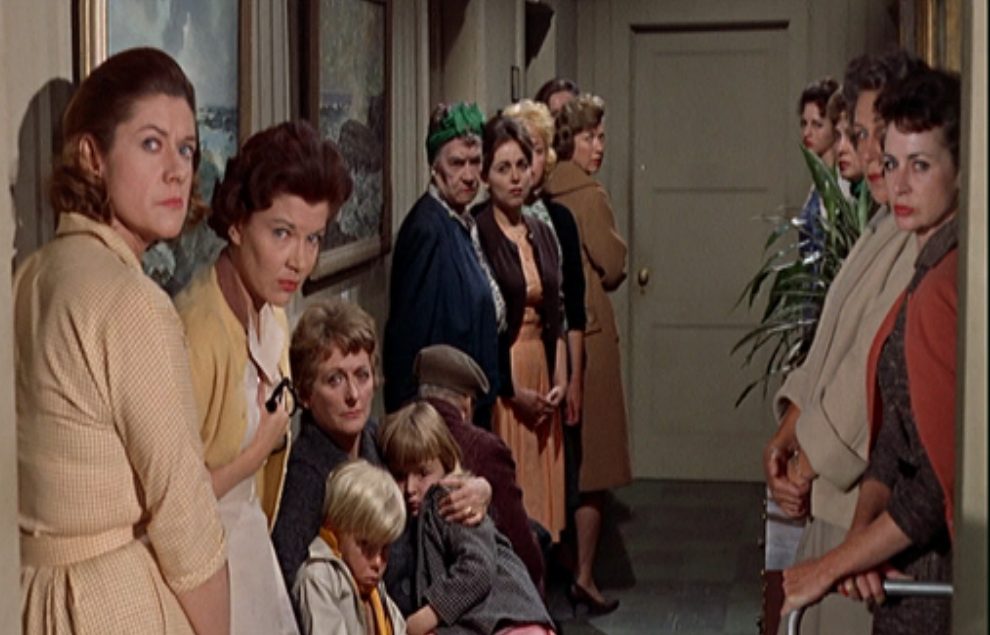
This scene contains one of the most significant moments in the entire film — but if you blink, you will miss it. Seated in the hallway is Mrs. Bundy. Hitchcock has all the other women face the camera — except Ethel Griffies, who has her back to us. She is also the only woman (initially) who is shown alone in a close-up. And she is trembling. The shot lasts barely two seconds. Hitchcock does not hit us over the head with it, but the point is crystal clear. I have argued in previous installments that Mrs. Bundy represents the hubris of modern man, who thinks he has laid bare nature’s secrets and made her predictable and manipulable. Well, the hubris has now been knocked out of this old bag. She knows now that she knows nothing, so she sits trembling before the Unknown God.

Evan Hunter’s “final draft” of the screenplay — dated March 2, 1962, just days before photography began — contains some surprises for those who remember this scene in the restaurant. To begin with, Mrs. Bundy is not described as trembling — far from it. In the script, the terrified mother says “Why are they doing it?! Why are they doing it. . . ?!” This is then followed by an indication that Mrs. Bundy will respond. However, instead of an actual line from Mrs. Bundy, Hunter inserts a notation in parentheses and square brackets that reads as follows: “([Mrs. Bundy offers a weak explanation of why the birds could have gone berserk like this. This information should be obtained from Dr. Stager.])” “Dr. Stager” refers to Kenneth Stager, an ornithologist at the Natural History Museum of Los Angeles County, who advised Hitchcock and Hunter on the film.

So, as originally planned, Mrs. Bundy was not to be seen as chastened at all. Instead, she would still have been prating. But Hitchcock clearly wanted to say something different here, and so the idea of Mrs. Bundy making another speech was dropped. Instead of a speech, she is rendered speechless. (Just as Lydia, instead of screaming when she finds Dan Fawcett’s body, which Hunter’s script had specified, instead is unable to scream.) In the finished film, this moment with Mrs. Bundy is followed by important (and very memorable) dialogue that also does not figure in Hunter’s late draft of the screenplay. The terrified mother (whose name is never revealed) asks “Why are they doing this?! Why are they doing this?!” — just as in Hunter’s script (though it has been changed to this). She then rises from her seat and starts directly toward the camera, which represents Melanie’s point of view.

“They said when you got here the whole thing started,” she says. So now we know why Melanie has been getting these looks: they have been talking about her in her absence. In the space of about five minutes of screen time, these “modern” women have completely abandoned reason and have reverted to superstition. Burn the witch! Hitchcock intercuts the crazed woman with reaction shots from Melanie, who just looks baffled. “Who are you?” demands the woman, becoming increasingly hysterical. “What are you? Where did you come from?” As she approaches closer and closer to the camera, we see that Hitchcock has lit the woman’s eyes to make her seem mad.

“I think you’re the cause of all this,” she says, now in tight closeup. “I think you’re evil! Evil!!” she shrieks — and Melanie slaps her. Or, rather, the slap is suggested by a shot of Hedren swinging her arm, plus a reaction shot of the woman clasping her hands to her face (looking uncannily like the figure in Munch’s The Scream), plus a sound effect. Surprised by her own reaction, Melanie collapses into Mitch’s arms. The woman immediately seems to come to her senses, as if the slap has broken some kind of spell. The actress who plays her, Doreen Lang, is convincingly unhinged in this scene. For these few seconds of hysteria, her name in the opening credits appears set off and in larger type on the card that features the minor players.

It is quite interesting that this dialogue was inserted into the script so late in the process of planning the film. It certainly provides a dramatic climax to the entire sequence involving the restaurant, and the attack on the town. But is that the reason it is there? First, let us note that the woman succeeds in planting an idea in the audience’s mind. The bird attacks do indeed begin with Melanie’s arrival in Bodega Bay. In fact, the first attack is on Melanie (the gull hitting her while she is in the motorboat). The second “attack” is the gull hitting Annie’s door, while Melanie is staying with Annie, and just after Melanie has promised Mitch that she will attend Cathy’s party. It seems we are being invited to ask if all of this might somehow be about Melanie.

However, this could simply be a red herring. After all, Melanie was nowhere near the Fawcett farm when Dan’s eyes were getting pecked out. Hunter’s original ending to the film was completely abandoned by Hitchcock and never shot. It involved Melanie and the Brenners driving through Bodega Bay and out of the town. Along the way, they see the devastation wrought by the birds, including dead bodies. Years later, Hunter (who was generally dissatisfied with Hitchcock’s treatment of his script) said that “the Hitchcock ending conveyed the impression . . . that what happened . . . may have been an isolated experience brought on by God knows what — Melanie’s flighty earlier days? Lydia’s rejection of her? Who knows? By extending the screenplay to show havoc wreaked in town, we dismiss any possibility of this having been a personal bird vendetta against a small group of people.”

In short, Hunter wanted to deliberately exclude the possibility that Melanie (or anyone else) is the focus of the attacks. However, by eliminating Hunter’s ending, and insisting on the addition of the crazed woman’s accusations against Melanie, Hitchcock has signaled that he wants the audience to consider this as a possibility. In general, Hunter’s criticisms of the film indicate that he favored a more literal approach: he wanted a clearer indication of why the birds are attacking — hence the many hints in his original screenplay — and he objected to the “indefinite” ending Hitchcock imposed on the film. Hunter has also been extremely dismissive of the idea that there is any psychological or philosophical depth to the film. He later said, “I think Hitch is putting the world on when he pretends there is anything meaningful about The Birds. We were trying to scare the hell out of people. Period.”

Well, that may have been what he was trying to do, but the changes Hitchcock makes to the script indicate that he had his own agenda (though he definitely wanted to frighten the audience as well!). Summing up, let’s consider some of Hitchcock’s changes to the script:

  1. The elimination of all explanations, no matter how flimsy, for why the birds attack. This includes Melanie’s tongue-in-cheek “Marxist” theory of the bird revolution (in the deleted scene), and a hypothetical speech by Mrs. Bundy explaining the bird attacks (see above).
  2. The insertion of the crazed woman’s accusations against Melanie.
  3. The insertion of a shot showing Mrs. Bundy trembling — her self-satisfied scientism having been refuted.
  4. The insertion of dialogue concerning Melanie’s relationship to her mother, who abandoned her when she was small. (This creates a psychological sub-plot or sub-theme, which achieves resolution in the final scene.)
  5. The elimination of Hunter’s original ending, showing the escape of Melanie and the Brenners, and the insistence on an ambiguous ending.

All of this points to the obvious conclusion that Hitchcock was not just trying to scare the audience, but also trying to make them think. Hunter’s script is quite literate (and I believe it contains more depth than he was aware of), but he was primarily a crime writer. Under the pen name “Ed McBain,” Hunter (whose real name was Salvatore Albert Lombino) wrote fifty-five novels in the 87th Precinct series between 1956 and his death in 2005. These were police procedural thrillers that aimed purely at telling a good mystery story. Hunter was a fine writer, but he was uninterested in “depth.” It is clear from Hitchcock’s changes to Hunter’s work that he had larger ambitions.

In any case, while it is possible that Hitchcock may be creating a red herring by planting the idea in our minds that somehow the attacks are about Melanie, it is nonetheless an idea that we should seriously entertain. I will return to it in the next installment. For now, let us take a closer look at the crazed woman’s speech. As I have mentioned, she delivers her lines directly to the camera, which represents Melanie’s point of view. Of course, it is also our point of view: she looks directly at us, and speaks to us. With this idea in mind — that she is speaking to us — let us consider her lines once more.

“They said when you got here the whole thing started.” Indeed. It all started with Pandora, when she arrived with that damned box. Pandora was intended by Zeus as a bride for Prometheus (“fore thinker”), who stole fire from the gods and gave it to man. Smelling a trap, Prometheus handed her off to his brother Epimetheus (“after thinker”), and the rest is prehistory. Women are trouble. Has Melanie brought a box of tricks to Bodega Bay? Again, I’ll return to the issue of whether Melanie is really the “focus” later on.

“Who are you? What are you? Where did you come from?” We’ve been asking ourselves these questions for thousands of years, haven’t we? And still, we don’t really know. Heidegger, and the “Existentialism” he inspired (which, in some ways, distorted his ideas), speaks of how human beings are “thrown” into this world and condemned to try to figure themselves out. Let’s return for a moment to the story of Prometheus, specifically the “prequel” to his theft of fire. This part of the story is eloquently told by Bernard Stiegler in the 2004 documentary The Ister, which concerns Heidegger’s ideas on technology:

One day Zeus said to Prometheus, “the time has come for you, for us gods, to bring into the day the non-immortals.” The non-immortals being animals and men. Prometheus, who is put in charge of this task, has a twin brother named Epimetheus. Epimetheus resembles Prometheus; he is his double. But in fact, Epimetheus is his brother’s opposite. Epimetheus is the god of the fault of forgetting. Prometheus is a figure of knowledge, of absolute mastery, total memory. Prometheus forgets nothing, Epimetheus forgets everything. Epimetheus says to his brother: “Zeus has given you this task — I want to do it! Me, me, me! I’ll take care of it.” Epimetheus is a rather simple-minded brother, and Prometheus is fond of him. He dares not refuse and says, “Okay, you take care of it.” So Epimetheus distributes the qualities. He will give the gazelle its speed, for example [and so on]. . . . Now, as Epimetheus is distributing the qualities, he suddenly notices something. . . . “There are no qualities left! I forgot to save a quality for man! . . . I still have to bring mankind, mortals, into the day.” . . . But there are no qualities left to give him a form. So Prometheus goes to the workshop of the god Hephaestus, to steal fire.

Stiegler takes fire to represent “technics” (i.e, that which issues from technē, including technology). This interpretation (which is not original with Stiegler) is not unreasonable, since fire is used in cooking and making. But fire also is a means to dispel the natural darkness imposed on man by night or enclosed places; it is a tool man uses to bring things into the light. Thus, it also represents intellect. (Indeed, there is no reason to suppose that fire cannot represent both intellect and “technics,” since, of course, they are intimately related.) For Heidegger, man is “thrown” into this baffling world and “condemned” to try and make it intelligible. His most fundamental intellectual task is to answer the crazed woman’s questions: Who are you? What are you? Where did you come from? These are the fundamental questions of philosophy.

Hitchcock is inviting us to ask ourselves these questions, and inviting us to see that we do not know the answers to them. The Birds shatters our self-confidence, our hubris, as I have argued already. It invites us to see that we have been asleep, dreaming in a world of “buildings and concrete” (to use Melanie’s words in the deleted scene); a human-built world surrounded by a nature we thought we understood and had tamed. The crazed woman’s questions awaken us from our slumbers, and we are reminded, momentarily, that not only is nature a mystery to us, we do not even know ourselves.

“I think you’re the cause of all this,” she says, and then shrieks, “I think you’re evil! Evil!” To address this particular point, we have to look beyond the Greek mythological tradition to the Biblical — something I usually avoid. Melanie may be Pandora, or she may be Eve. It was the woman who tempted the man to eat from “the tree of the knowledge of good and evil,” and who thus brought about the fall, and stained man with original sin. Some Hebrew scholars believe that the “good and evil” referred to in the name of the tree is a literary device implying “everything.” So that “knowledge of good and evil” implies a synoptic or complete knowledge of all things. When we say that we “searched high and low” we don’t mean that we searched only two points; we mean that we searched everywhere. Similarly, knowledge of what is good and knowledge of what is evil would be knowledge of all, since these appear to exhaust the possibilities. If this interpretation is correct, then eating of the tree represents the acquisition of the power to make all things intelligible. This “opens the eyes” of Adam and Eve. They now see that they are naked — in other words, they behold things as they really are.

But this all comes at a price: expulsion from the garden, pain, and toil. To top it off, the serpent lied when he said that they would become “as gods” — just as God lied when he said that they would die if they ate of the tree. The fruit didn’t go down well. Our eyes were opened, but a new blindness beset us: the inability to see the limits of our knowledge, and of our power to change nature. Does this make man evil? For Hitchcock, a Catholic to the end, a believer in original sin, it certainly did. (Priests performed Mass in Hitchcock’s home on the night he lay dying, in April 1980, and heard his confession.) Heidegger too was a Catholic, and we see the influence of the doctrine of original sin reflected in the Heideggerean-Sartrean language of man as “condemned” to make things meaningful, and to be free (it comes to the same thing).

Each of the characters we meet in this pivotal scene in the Tides Restaurant is really a human “type.” Mrs. Bundy represents the hubris of man the “rational animal” who thinks he has laid bare the secrets of nature (“I do know,” she says). Then there is the Cassandra, the soothsaying Celt at the end of the bar, drunk on beer and religion. There is the hysterical mother, who transforms into a torch-wielding, angry villager before our very eyes. There is the hardheaded and hard-drinking “practical” businessman who thinks nature is there to be bulldozed (“get yourselves guns and wipe [the birds] off the face of the earth. . . . Get rid of them. Messy animals.”). There is the cowardly and dithering Sebastian Sholes, who’d rather somebody else dealt with this problem. We may not be “evil,” but we certainly are a motley crew.

With the gulls now retreating, Mitch and Melanie leave the restaurant and make their way up the hill to Annie’s house to retrieve Cathy. All is deathly quiet. As they approach the schoolhouse, they see that the crows are back and perched all over the building and on the playground. “Look, the crows again!” Melanie says breathlessly. But as they approach the little house with its picket fence, a still more horrifying sight awaits them.

If you want to support our work, please send us a donation by going to our Entropy page and selecting “send paid chat.” Entropy allows you to donate any amount from $3 and up. All comments will be read and discussed in the next episode of Counter-Currents Radio, which airs every Friday.

Don’t forget to sign up for the twice-monthly email Counter-Currents Newsletter for exclusive content, offers, and news.


The Birds Or: Everything You Always Wanted to Know About Coronavirus (But Were Afraid to Ask Hitchcock & Heidegger), Part Six

The%20Birds%20Or%3A%20Everything%20You%20Always%20Wanted%20to%20Know%20About%20Coronavirus%20%28But%20Were%20Afraid%20to%20Ask%20Hitchcock%20and%23038%3B%20Heidegger%29%2C%20Part%20Six

Share

  • Gab
  • Or: Everything You Always Wanted to Know About Coronavirus (But Were Afraid to Ask Hitchcock Heidegger), Part Six &body=%0D%0A%0D%0A%0D%0A%0D%0A%0D%0A%0D%0Ahttps://counter-currents.com/2020/06/the-birds-or-everything-you-always-wanted-to-know-about-coronavirus-but-were-afraid-to-ask-hitchcock-heidegger-part-six/%0D%0A%0D%0A%0D%0A%0D%0A">

Enjoyed this article?

Be the first to leave a tip in the jar!

Instant Echeck GreenPay™

Related

  • Heidegger on Nietzsche Part Three

  • Heidegger on Nietzsche, Part Two

  • Jared Taylor: What Rome Means to Me

  • Heidegger on Nietzsche, Part One

  • Finding Atlantis Part 4

  • Do You Want to Play a Game?

  • David Lean’s A Passage to India

  • The Rest Is Silence: Heidegger’s Quietism

Tags

Alfred Hitchcockdas EreignisDerek HawthornehorrorhubrisknowledgeMartin Heideggermovie reviewsphilosophyreligionThe Birdsthe uncanny

3 comments

  1. Franz says:
    June 12, 2020 at 3:22 pm

    “He is making it up as he goes along.”

    Yes! And whatever happens, don’t stop.

    This is the finest analysis of a movie I’ve ever seen. And can art be prophetic or even just a bit predictive? I a fine case of subverting ordinary consciousness, Mr. Hawthorne has made some of us wonder about things we’d rather leave alone but should not. For that alone this series is classic.

    0
    0
    1. Derek Hawthorne says:
      June 13, 2020 at 5:59 pm

      Thank you so much. I do believe the next installment will be the last. I have enjoyed writing these tremendously. “The Birds” is a very rich cinematic text. As Camille Paglia said of it, “Because of Hitchcock’s personal engagement with [its] unsettling themes, the film is worked out in almost fanatical detail, to a degree perhaps unparalleled in his oeuvre. The more microscopically this film is studied, the more it reveals.”

      0
      0
  2. Kolya Krassotkin says:
    June 14, 2020 at 6:00 pm

    I felt a twinge of unhappiness as I read part 5, thinking it was the end. So imagine my pleasure to see we got Part 6.

    0
    0

Comments are closed.

If you have a Subscriber access,
simply login first to see your comment auto-approved.

Note on comments privacy & moderation

Your email is never published nor shared.

Comments are moderated. If you don't see your comment, please be patient. If approved, it will appear here soon. Do not post your comment a second time.

Writers of May

(2 votes) Morris van de Camp David M. Zsutty Derek Stark Jayant Bhandari Greg Johnson

Articles of May

Heidegger on Nietzsche, Part One by Collin Cleary The Lunch Wars by David M. Zsutty 2 votes
    • Nationalism This Week
      Letter to J. D. Vance

      Greg Johnson

      2

    • Lost In Trans-Mission:
      How the Media Fails To Reveal the Inconvenient Truth About the Usual Suspects

      Steven Tucker

      3

    • Liar, Liar, Pants on Fire!

      Beau Albrecht

      2

    • Editor’s Update
      Rob Rundo on Counter-Currents Radio, Fundraiser Update, & a New $20,000 Matching Grant

      Greg Johnson

    • The Bitter End of Western Metaphysics:
      Heidegger on Nietzsche, Part Three

      Collin Cleary

      10

    • Uncivil War

      Mark Gullick

      40

    • Exclusive Interview with Karel Veliky:
      The Final Chapter in the Film Series! Part II

      Ondrej Mann

      2

    • Happy Birthday to Us!

      Greg Johnson

      6

    • Zsutty’s Maximum

      David M. Zsutty

      15

    • Exclusive Interview with Karel Veliky:
      The Final Chapter in the Film Series! Part I

      Ondrej Mann

      2

    • The Union Jackal, June 2026

      Mark Gullick

      23

    • The Inferiority Behind Immigrant Superiority

      Jayant Bhandari

      15

    • Counter-Currents Radio Podcast No. 690
      Greg Johnson & David Zsutty Discuss Current Things: AI, Henry Nowak, the Iran Crisis, & More

      Counter-Currents Radio

      7

    • Collin Cleary: What Rome Means to Me

      Collin Cleary

      4

    • Paul Krugman: Closet Bolshevik

      Spencer J. Quinn

      21

    • Fugue of Ideas:
      Ibram X. Kendi’s Chain of Ideas

      Greg Johnson

      19

    • Based Blacks

      Lipton Matthews

      22

    • Black Intellectual Fatigue

      Derek Stark

      41

    • Why White Advocates Should Avoid “Based Blacks”

      Dani Vypont

      32

    • Nietzsche & Race

      Mark Gullick

    • Editor’s Update
      Rob Rundo Rescheduled to Next Week on Counter-Currents Radio;
      Tonight Greg Johnson & David Zsutty Answer Your Questions;
      Fundraiser Update & a New $20,000 Matching Grant

      Greg Johnson

    • The Counter-Currents 2026 Fundraiser
      Lifetime Subscriber Welcome Packages Extended

      Greg Johnson

    • Nationalism This Week
      Who’s Looking Back?

      Greg Johnson

      29

    • China’s Threat to American Security:
      Food, Farmland, Foreign Control, & Energy Policy

      Lipton Matthews

      5

    • The Bitter End of Western Metaphysics:
      Heidegger on Nietzsche, Part Two

      Collin Cleary

      16

    • The Killing of Henry Nowak

      Mark Gullick

      38

    • The Crisis of Chinese Technology Thieves

      Morris van de Camp

      1

    • The Strange World of Gender Bender Fiction:
      & What This Genre Tells Us About Autosexuality

      Dani Vypont

      3

    • Watching the Watchers:
      The Dark Triad Question

      David M. Zsutty

      14

    • The Remigration Movement Solidifies

      F. Roger Devlin

      1

    • Casting Aspersions:
      The Fatal Consequences of Race-Swapped Casting, From Helen of Troy to Henry of Southampton

      Steven Tucker

      20

    • The Murder of Henry Nowak

      Millennial Woes

      23

    • Don’t Forget to Vote in Our Writer & Article of the Month Poll

      Greg Johnson

    • The Robot Hotdog Stand

      Greg Johnson

      37

    • Laughing Our Way to Victory

      Dave Chambers

      7

    • The Zodiac Killer

      Mark Gullick

      11

    • Jared Taylor: What Rome Means to Me

      Jared Taylor

      1

    • An Interview with Endeavour:
      My Way of Life Is an Adventure!

      Ondrej Mann

      6

    • José Pedro Zúquete’s The Identitarians

      Greg Johnson

      3

    • Editor’s Update
      Fundraiser Update & How to Watch the Remigration Summit

      Greg Johnson

      5

    • The Bitter End of Western Metaphysics:
      Heidegger on Nietzsche, Part One

      Collin Cleary

      12

    • Berlin: City of Stones

      Spencer J. Quinn

      6

    • True Folk-Horror Is Horror of Your Own Folk:
      Mark Gatiss vs the Brexit Blind Dead  

      Steven Tucker

      4

    • Counter-Currents Radio Podcast No. 689
      Thomas Massie, the America 2050 Bust, the Need for Whites to Divest from America, the AI Economic Apocalypse, & Pro-White Project Pitches to Billionaires

      Counter-Currents Radio

      7

    • Nationalism This Week
      Remigration is Inevitable, Part 3

      Greg Johnson

      27

    • Why Billionaires Should Fund White Identity Politics

      Lipton Matthews

      8

    • How Cold War Two Came About

      Morris van de Camp

      5

    • Now Available for Pre-Order at a Special Price!
      Greg Johnson’s The Philosopher Is In

      Greg Johnson

    • David Zsutty’s Elevator Pitch to a Billionaire

      David M. Zsutty

      1

    • Headbanging Lite

      Mark Gullick

      5

    • Peter Quint

      Nationalism This Week
      Letter to J. D. Vance

      Great article! I don’t want Vance to be president; he gives me the creeps; I don’t think he has our...

    • Dominic Fox

      Liar, Liar, Pants on Fire!

      I’m still flabbergasted how someone can lie that egregiously and shamelessly. Do words have no...

    • Dominic Fox

      Liar, Liar, Pants on Fire!

      The Christian ideas of repentance and "prodigial sons" give dysfunctional and anti-social...

    • Dominic Fox

      Nationalism This Week
      Letter to J. D. Vance

      "There was virtually no chance that this scenario would work. It was stewed up with bogus...

    • Zarathustra

      Nationalism This Week
      Letter to J. D. Vance

      A peace deal with Iran has finally been agreed. Let's see how Israel manages to sabotage it.

    • Will Williams

      Based Blacks

      Weave: June 15, 2026  Thank you for completely proving my point, which is that if we aren’t as...

    • Fred C. Dobbs

      Lost In Trans-Mission:
      How the Media Fails To Reveal the Inconvenient Truth About the Usual Suspects

      Great article. We’re all used to the media using lies of omission. The “teens” is most commonly used...

    • Fred C. Dobbs

      Liar, Liar, Pants on Fire!

      Father Merrin “he mixes lies with the truth to confuse us.” Excellent piece. We’ve all experienced...

    • Adrian Roberts

      Lost In Trans-Mission:
      How the Media Fails To Reveal the Inconvenient Truth About the Usual Suspects

      What about all the people who've been born in the wrong bodies and don't even know it?

    • Weave

      Based Blacks

      Thank you for completely proving my point, which is that if we aren’t as “pure” as you then we are...

    • Joe Gould

      Lost In Trans-Mission:
      How the Media Fails To Reveal the Inconvenient Truth About the Usual Suspects

      Philosophy matters. Bad philosophy backed by media, money, and state power is a disaster. The dogma...

    • Joe Gould

      Uncivil War

      I think that your phone (any brand, not just an iPhone) will give up all sorts of information on you...

    • YT

      Uncivil War

      So you’re advocating leaving your iPhone at home as it can be used for geographic location purposes...

    • Will Williams

      Nationalism This Week
      The SPLC Indictment

      I bump this comment because Christian conservative reporter Tyler O'Neil is on the SPLC  beat again...

    • Peter Quint

      Why White Advocates Should Avoid “Based Blacks”

      Why would you tell a little parable like that? Are you trying to tell us to judge blacks by the  “...

    • Will Williams

      Based Blacks

      Uncle Semantic: June 14, 2026  Will, I’m curious if your racial journey to where you stand now...

    • Angela Mercy

      Paul Krugman: Closet Bolshevik

      Things don't look bright for Republican party and it's voters but they can only blame Donald Trump...

    • S Dane

      Paul Krugman: Closet Bolshevik

      Krugman is the creep who was caught with kiddie porn a few years ago and was able to get off with a...

    • Will Williams

      Based Blacks

      Uncle Semantic: June 14, 2026  Do you think blacks would be more palatable to the proWhite...

    • ArminiusMaximus

      Based Blacks

      I may want them to get scared straight, but I doubt that message will sink in. Can they think in...

    • Earth Day Special

      John Morgan

      12

    • A Robertson Roundup
      Remembering Wilmot Robertson
      (April 16, 1915 – July 8, 2005)

      Margot Metroland

      13

    • The Paranoid Style in White Nationalism

      Greg Johnson

      30

    • Join the Dance!

      Andrew Hamilton

      1

    • We Can’t Save the Earth Without Reducing African Birth Rates

      James Dunphy

      36

    • “I’m Not a Conspiracy Theorist, but . . .”:
      Jeffrey Epstein’s Death Gives New Life to “Conspiracy Theories”

      Greg Johnson

      22

    • Sylvia Plath: Stasis in Darkness

      Vic Olvir

      17

    • Vanguardism, Vantardism, & Mainstreaming

      Greg Johnson

      80

    • Aviation, Geography, & Race

      Charles Lindbergh

      3

    • Some Thoughts on Yule

      Collin Cleary

      4

    • Living in Truth:
      A Yuletide Homily

      Jef Costello

      7

    • John Kennedy Toole’s A Confederacy of Dunces

      Greg Johnson

      20

    • On Aleksandr Solzhenitsyn’s Warning to the West

      Spencer J. Quinn

      7

    • Elitism, British Modernism, & Wyndham Lewis

      Jonathan Bowden

      6

    • Philip K. Dick’s Do Androids Dream of Electric Sheep? as Anti-Semitic/Christian-Gnostic Allegory

      Greg Johnson

      20

    • “Conspiracy Theory” or Conspiracy?

      Andrew Hamilton

      21

    • Remembering H. P. Lovecraft
      (August 20, 1890–March 15, 1937)

      Greg Johnson

      3

    • Who Are We?
      Nordics, Aryans, & Whites

      Greg Johnson

      71

    • Remembering William Gayley Simpson
      (July 23, 1892–December 31, 1990)
      A Pleasant Afternoon with Harriet & Bill Simpson

      Margot Metroland

      18

    • Here are the Young Men
      Remembering Ian Curtis
      (July 15, 1956–May 18, 1980)

      Mark Gullick

      18

    • Percy Grainger
      Artist of the Right

      Alex Graham

      7

    • Remembering Revilo Oliver
      (July 7, 1908–August 20, 1994)

      Greg Johnson

      18

    • The Meaning of July 4th for the White Man

      Gregory Hood

      13

    • The Front National’s Evolution

      Bruno Mégret

    • Merwin K. Hart
      Forgotten American Hero & Man of the Right

      Morris van de Camp

      10

    • George Orwell’s Nineteen Eighty-Four

      Jonathan Bowden

      8

    • Carleton S. Coon
      Scientist & Reluctant White Advocate

      Morris van de Camp

      3

    • The Kwanzaa Absurdity Will Be Dwarfed by Juneteenth

      Robert Hampton

      10

    • Stravinsky

      Alex Graham

      7

    • Like the Roman:
      Remembering Enoch Powell (1912-1998)

      Mark Gullick

      23

    • The 1970s: The Golden Age of Hijacking

      Morris van de Camp

      21

    • Jonathan Bowden’s Deliverance
      Part 6

      Jonathan Bowden

    • Do You Want to Play a Game?

      Mark Gullick

      1

    • Sexually Incontinent on the Indian Subcontinent:
      Who Rapes More Animals, Indians or Pakistanis? The Battle Continues!

      Steven Tucker

      3

    • Neo-Fascism in Film
      Part 5

      Karel Veliky

      15

    • The Game of Tarot

      Mark Gullick

      2

    • Institutions Cannot Be Transplanted

      Jayant Bhandari

      5

    • Jonathan Bowden’s Deliverance
      Part 5

      Jonathan Bowden

    • Crosstown Traffic:
      Jimi Hendrix & The Post-War Rock ‘N’ Roll Revolution

      Mark Gullick

      1

    • Slaves from the North:
      Finns & Karelians in the East European Slave Trade, 900–1600

      Lipton Matthews

      14

    • Neo-Fascism in Film
      Part 4

      Karel Veliky

      2

    • David Lean’s A Passage to India

      Spencer J. Quinn

      1

    • Elites are Essential to Development

      Lipton Matthews

      7

    • Jonathan Bowden’s Deliverance
      Part 4

      Jonathan Bowden

    • Neo-Fascism in Film
      Part 3

      Karel Veliky

      6

    • E. M. Forster’s A Passage to India & the Indian Mentality

      Spencer J. Quinn

      25

    • Jonathan Bowden’s Deliverance
      Part 3

      Jonathan Bowden

    • The Rest Is Silence
      Heidegger’s Quietism

      Mark Gullick

      2

    • Dispelling the Historical Fallacy of Indian Nationalism

      Lipton Matthews

      8

    • Neo-Fascism in Film
      Part 2

      Karel Veliky

      8

    • Jonathan Bowden’s Deliverance
      Part 2

      Jonathan Bowden

    • Life of a Klansman

      Mark Gullick

      8

    • Jonathan Bowden’s Deliverance, Part 1

      Jonathan Bowden

    • Decolonial Ideas are Holding Back Developing Countries

      Lipton Matthews

      8

    • Neo-fascism in Film, Part 1

      Karel Veliky

      21

    • Jonathan Bowden’s Onslaught, Part 8
      Divigations on Decadence

      Jonathan Bowden

    • Jonathan Bowden’s Onslaught, Part 7
      Intrigues in the National Front

      Jonathan Bowden

      1

    • Rotten to the Core

      Mark Gullick

      8

    • Strauss on Husserl’s “Philosophy as Rigorous Science”

      Greg Johnson

    • Jonathan Bowden’s Onslaught, Part 6
      Francis Bacon & Right-Wing Nihilism

      Jonathan Bowden

    • András László
    • Derek Hawthorne
    • Beau Albrecht
    • Alain de Benoist
    • Kerry Bolton
    • Jonathan Bowden
    • Collin Cleary
    • Jef Costello
    • Savitri Devi
    • Julius Evola
    • Jim Goad
    • Gregory Hood
    • Juleigh Howard-Hobson
    • Greg Johnson
    • Charles Krafft
    • Anthony M. Ludovici
    • Trevor Lynch
    • H. L. Mencken
    • J. A. Nicholl
    • James J. O’Meara
    • Christopher Pankhurst
    • Tito Perdue
    • Michael Polignano
    • Spencer J. Quinn
    • Fenek Solère
    • Irmin Vinson
    • Leo Yankevich
    • Francis Parker Yockey
    • Multiple authors
  • Editor-in-Chief

    • Greg Johnson, Ph.D.

    Featured Writers

    • Beau Albrecht
    • Gunnar Alfredsson
    • Collin Cleary, Ph.D.
    • Jef Costello
    • Morris V. de Camp
    • F. Roger Devlin, Ph.D.
    • Stephen Paul Foster, Ph.D.
    • Jim Goad
    • Alex Graham
    • Mark Gullick, Ph.D.
    • Greg Johnson, Ph.D.
    • Travis LeBlanc
    • Trevor Lynch
    • Margot Metroland
    • James J. O’Meara
    • Angelo Plume
    • Spencer J. Quinn
    • Fred Reed
    • Clarissa Schnabel
    • Michael Walker
    • David M. Zsutty

    Frequent Writers

    • Asier Abadroa
    • Aquilonius
    • Alain de Benoist
    • Kerry Bolton, Ph.D.
    • Dave Chambers
    • Steven Clark
    • James Dunphy
    • Endeavour
    • Richard Houck
    • Jason Kessler
    • Titus Livius
    • Ondrej Mann
    • Lipton Matthews
    • Mark Mazari
    • John Morgan
    • Jaroslav Ostrogniew
    • Kathryn S.
    • Christian Secor
    • Anne Wilson Smith
    • Thomas Steuben
    • William De Vere
    • Kenneth Vinther
    • Max West

    Classic Authors

    • Maurice Bardèche
    • Jonathan Bowden
    • Julius Evola
    • Guillaume Faye
    • Ernst Jünger
    • Kevin MacDonald, Ph.D.
    • D. H. Lawrence
    • Charles Lindbergh
    • Jack London
    • H. P. Lovecraft
    • Anthony M. Ludovici
    • Sir Oswald Mosley
    • National Vanguard
    • Friedrich Nietzsche
    • Revilo Oliver
    • William Pierce
    • Ezra Pound
    • Saint-Loup
    • Savitri Devi
    • Carl Schmitt
    • Miguel Serrano
    • Oswald Spengler
    • P. R. Stephensen
    • Jean Thiriart
    • John Tyndall
    • Dominique Venner
    • Leo Yankevich
    • Francis Parker Yockey

    Other Authors

    • Howe Abbott-Hiss
    • Michael Bell
    • Giles Corey
    • Jack Donovan
    • Richardo Duchesne, Ph.D.
    • Emile Durand
    • Guillaume Durocher
    • Mark Dyal
    • Tom Goodroch
    • Andrew Hamilton
    • Robert Hampton
    • Huntley Haverstock
    • Derek Hawthorne
    • Gregory Hood
    • Juleigh Howard-Hobson
    • Alexander Jacob
    • Ruuben Kaalep
    • Tobias Langdon
    • Julian Langness
    • Patrick Le Brun
    • G A Malvicini
    • John Michael McCloughlin
    • Millennial Woes
    • Michael O’Meara
    • Christopher Pankhurst
    • Michael Polignano
    • J. J. Przybylski
    • Quintilian
    • Edouard Rix
    • C. B. Robertson
    • C. F. Robinson
    • Herve Ryssen
    • Alan Smithee
    • Fenek Solere
    • Ann Sterzinger
    • Robert Steuckers
    • Tomislav Sunic
    • Donald Thoresen
    • Marian Van Court
    • Irmin Vinson
    • Book Reviews
    • Movie Reviews
    • TV Reviews
    • Music Reviews
    • Art Criticism
    • Graphic Novels & Comics
    • Video Game Reviews
    • Fiction
    • Poems
    • Interviews
    • Videos
    • English Translations
    • Other Languages
      • Arabic
      • Bulgarian
      • Croatian
      • Czech
      • Danish
      • Dutch
      • Estonian
      • Finnish
      • French
      • German
      • Greek
      • Hungarian
      • Italian
      • Lithuanian
      • Norwegian
      • Polish
      • Portuguese
      • Romanian
      • Russian
      • Slovak
      • Spanish
      • Swedish
      • Ukrainian
    • Commemorations
    • Why We Write
  • Archives
  • Top 100 Commenters
  • The Looney Bin
Sponsored Links
Europa.com Above Time Coffee Antelope Hill Publishing Paul Waggener IHR-Store Spencer J. Quinn American Renaissance Jim Goad The Occidental Observer
Donate Now Mailing list
Books for sale
  • The Philosopher Is In
  • Sexual Utopia in Power (Expanded Edition)
  • In Defense of Prejudice
  • Loving Our Own
  • Tyranny & Wisdom
  • The Populist Moment
  • Is America Doomed?
  • To all books
Copyright © 2026 Counter-Currents Publishing, Ltd.

Paywall Access


Please enter your email address.

Lost your password?

Edit your comment

Writer & Article of the Month May 2026

Voting for this month has concluded. Here are the final results!

Top Writers

  • #1 Morris van de Camp 2 votes
  • #2 David M. Zsutty 2 votes
  • #3 Derek Stark 2 votes
  • #4 Jayant Bhandari 2 votes
  • #5 Greg Johnson 2 votes
  • #6 Jared Taylor 1 vote
  • #7 Collin Cleary 1 vote
  • #8 Spencer J. Quinn 1 vote
  • #9 Mark Gullick 1 vote
  • #10 Lipton Matthews 1 vote
  • #11 Keith Woods 1 vote
  • #12 Steven Tucker 1 vote

Top Articles

  • #1 Heidegger on Nietzsche, Part One 2 votes
  • #2 The Lunch Wars 2 votes
  • #3 The 1970s: The Golden Age of Hijacking 1 vote
  • #4 True Folk-Horror Is Horror of Your Own Folk 1 vote
  • #5 Finding Atlantis Part 4 1 vote
  • #6 Berlin: City of Stones 1 vote
  • #7 The Ghost of the Confederacy 1 vote
  • #8 Lothrop Stoddard’s The Revolt Against Civilization 1 vote
  • #9 Could Fascism Work? 1 vote
  • #10 Jared Taylor's Elevator Pitch to a Billionaire 1 vote
  • #11 Predation Wearing the Mask of Civilization 1 vote
  • #12 Peak Fatigue in Fort Wayne 1 vote
  • #13 Keith Wood's Elevator Pitch to a Billionaire 1 vote
  • #14 Do You Want to Play a Game? 1 vote
  • #15 Why Billionaires Should Fund White Identity Politics 1 vote

Total votes cast: 17