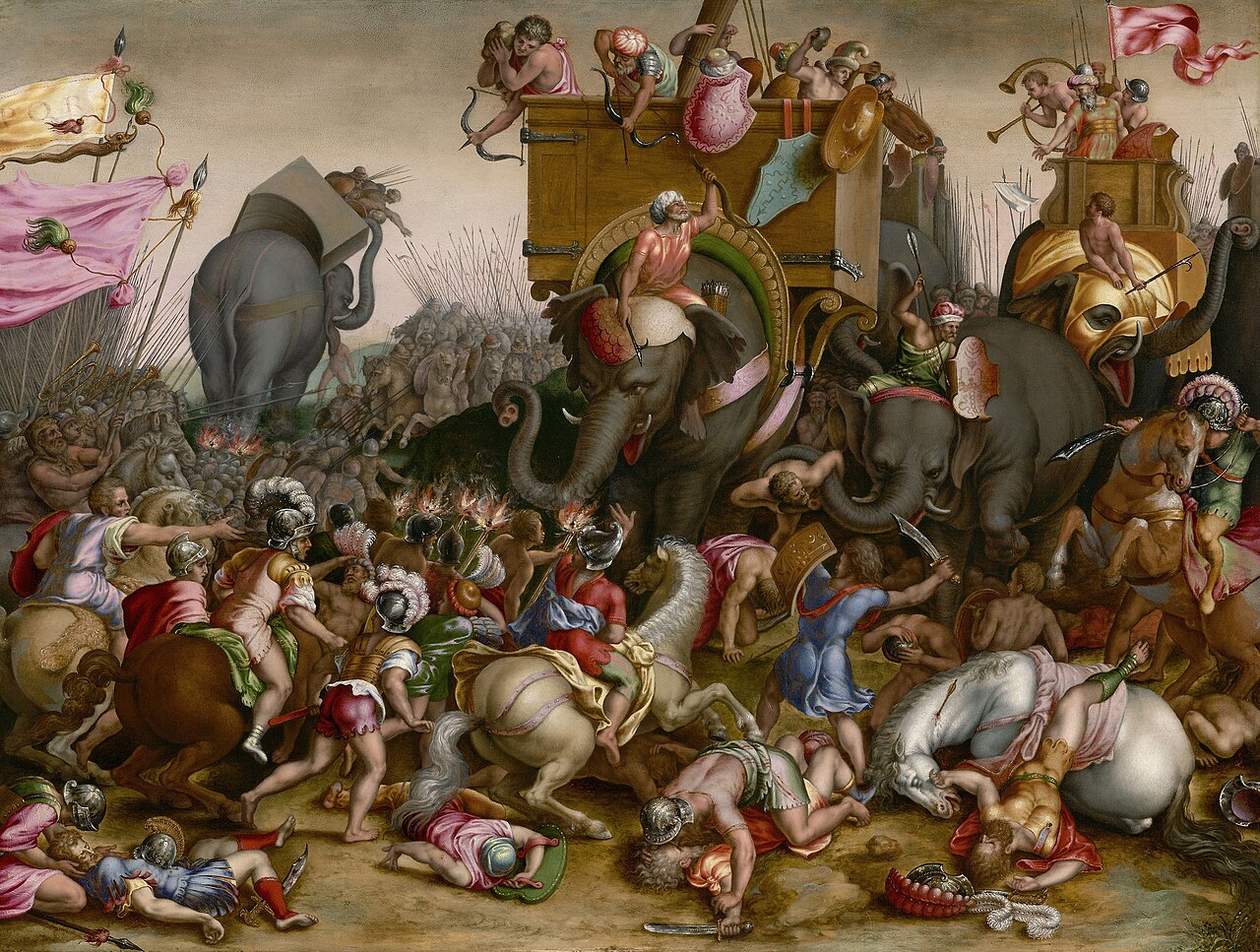
Cornelis Cort-The Battle of Zama. Courtesy of Wikimedia Commons.
1,356 words
In Part 1, I presented a close reading of Critias and Timaeus. I argued that Atlantis did exist and was probably an upper paleolithic settlement in North Africa. In fact, the upper paleolithic was probably busier than commonly thought but is only dimly remembered in myth and legend due to a lack of writing. While fascinating, that’s not the main point. Plato’s discussion of Atlantis is a means to a philosophical end. Plato’s message, moreover, is even more relevant to us today than to the ancient Athenians.
The strongest theme is the cyclical nature of time. Civilization periodically has to restart due to natural disasters and/or human decadence. In Plato’s view these oftentimes go hand in hand, due to the Traditionalist doctrine of as above, so below; as within, so without.
Plato’s Atlantis narrative that ideal states are founded by divine inspiration or providence, eventually become greedy, then imperialistic, and finally overreach and destroy themselves foreshadowed Oswald Spengler’s cycles of world cultures. Athena’s owl flies at dusk, and Plato wrote during the autumn of the Apollonian culture, while Spengler wrote in the early winter of the Faustian culture. Both Plato’s Athens and Spengler’s Germany had recently lost a major war and fallen into political instability, mass democracy, and decadence.
I of course prefer Spengler to Plato for several reasons. His theory of world cultures that live and die like plants has greater detail, breadth, and accuracy. It is not good laws that make good men, but men that make laws. While Plato sees his intellectualism and dislike of myth as an attack on decadence, they are as much a product of it as democracy. Spengler’s preference for what is natural, instinctual, archaic, and close to the earth is superior to urban intellect. Most importantly, he was a realist rather than an idealist. But Plato’s influence on Spengler is almost as strong as Herodotus’s influence on Plato. They translated an ambiguous sense of historical déjà vu into a proper system with practical uses.
That history is marked by cycles within cycles does not mean that we are predestined. We cannot change these cycles. But we can manage how we experience them, at least within certain parameters.
When Critias realized that his description of Atlantis’s doom foretold the same for Athens, he broke off his narrative mid-sentence. But modern Anglos should be even more shocked at the parallels to their rotting empires.
Like Athens after defeating the Persians, Britain and America got a taste of victory in WWI and went mad. They were already mercantile sea peoples possessed by a piratical will to plunder rather than the knightly Prussian will to serve, and their imperial designs became even more emboldened.[1] WWII was primarily a battle of nationalism and socialism against Judeo-capitalism and Judeo-bolshevism. But it was also a battle between imperialistic sea powers and traditionalist land powers, just as Atlantis and Athens were imperialistic sea powers that destroyed themselves by attacking traditionalist land powers.

You can buy Greg Johnson’s Is America Doomed? here.
There’s a sad irony to the fact that Athenian aggression against Sparta led to both cities becoming Roman tourist sites, just as British aggression against continental Europe damned both to becoming museums and satellites of the USA and USSR. Like Atlantis and Athens, Britain became a thalassocracy on a power trip, lost its empire from hubris, and has been declining ever since. They apparently learned nothing from reading the classics in their boarding schools. The reward of the Anglo elites for betraying their own people and Europe is to play second fiddle to the Jews. Now, their power doesn’t extend past the gates of their country clubs.
America followed a similar trajectory as Britain. America was hollowed out, humiliated, impoverished, and genocidally replaced with internal and external migration not despite, but because it “won” WWII and the Cold War. If you recoil from this, perhaps it is because the most accurate criticisms sting the most.
The end of that trajectory is finally being reached with the 2026 Iran War. America is destroying itself by slamming headfirst into a traditionalist land power, Iran, which is the modern-day iteration of various Persian Empires. As I explained here and here, anyone could have seen that the war would be a disaster. But Trump and MAGA are as blinded by arrogance as Atlantis was. Now, they will almost certainly lose the petrodollar, which is essential to keeping the Global American Empire with its wasteful deficit spending afloat.
World history is an endless cycle of cycles, great and small. The same cycles which began in the upper paleolithic with Atlantis and stone tipped arrows hold true in the era of hypersonic missiles. The same fundamental stories are repeated with only the details being different, like casting Siegfried in space.
The ancient Persian invasion of Greece was frustrated by the rugged terrain and the fact that, even though Persia was wealthier than Greece, their military science was inferior to hoplite infantry. Similarly, any boots on the ground invasion of modern Iran will likely be frustrated by rugged terrain and how US military science has stagnated while other powers have advanced in drones and missiles, despite America’s vastly greater wealth.
A similar pattern played out in the Punic Wars. Carthage was a rich thalassocracy, but when Rome decided to assert itself as a regional power much as Iran is now asserting itself, the Carthaginians couldn’t conquer it. This was despite inflicting devastating losses on the Romans, similar to Trump and Hegseth “decimating” Iran in the conventional sense. The Carthaginians were frustrated by Italy’s rugged terrain and superior legionary tactics. And the Romans, like modern Iranians, were fanatically virtuous. There was even a hint of asymmetric warfare when the Romans used squealing pigs to frighten Carthaginian elephants and the corvus to anchor enemy ships, thus turning sea battles which they struggled with into land battles which they excelled at. Eventually Scipio Africanus defeated Carthage by targeting their center of gravity in North Africa. Now Iran is targeting ZOG’s centers of gravity like refineries, data centers, and desalination plants.
Most strikingly, despite having charismatic leaders, Carthage’s multicultural mercenary armies were vanquished by the ethnically cohesive Romans and their Italian auxiliaries. The Iranians are willing to die for their country and faith, but no American will be willing to die for a degenerate, multicultural strip mall that hates them or an orange buffoon who systematically broke every campaign promise.
The Roman Empire shows that we do have at least some freedom to make good choices within the context of cyclical time. Per Spengler, Rome couldn’t escape the hardening of the Apollonian world culture in its civilizational winter. But Rome successfully decided not to follow Atlantis, Carthage, etc. in being arrogant, over expansive, and picking pointless fights. Augustus left instructions not to further expand the Empire, and his successors mostly followed it to their benefit. Acquiring and maintaining defensible borders explains much of Roman strategy. And while the Western Rome did eventually fall, it was only after a stubborn fight because unlike America, they kept up with military innovations like stirrups, cataphracts, and the compound bow. This is why the late Roman army looked so different.
Unlike Rome, it’s probably too late for America to learn from the past. In contrast to how “Men did not love Rome because she was great. She was great because they had loved her” America is only loved (or tolerated) due to its wealth and power—which within a matter of months may be exhausted.
America, like Atlantis, will be remembered more as an example of what not to do, rather than as an example to follow like Rome. Technological superiority is passing, but lessons of virtue (or lack thereof) are eternal. Regardless, America, or whatever succeeds it, will be rendered “self-controlled and more harmonious” one way or another.
There are other things to extract from the Atlantis story, but they will have to wait for another day.
Notes
[1] See Spengler’s Prussianism and Socialism for an in-depth description of how the Faustian will to power bifurcated into the knightly and piratical strains.
2 comments
Heres the link to part 1: https://counter-currents.com/2026/01/finding-atlantis-part-1/
Thanks Flin Flon, I had been looking for a link. Fantastic article and insights, learned a lot. Civilizational cycles. I am perplexed though at how most of humanity does not seem to learn. Not from the past, not from each other, not from experience either. Still, a small comfort to realize there is nothing new under the sun; surely cooler heads were also aghast at the stupidity of their day.
If you have a Subscriber access,
simply login first to see your comment auto-approved.
Note on comments privacy & moderation
Your email is never published nor shared.
Comments are moderated. If you don't see your comment, please be patient. If approved, it will appear here soon. Do not post your comment a second time.