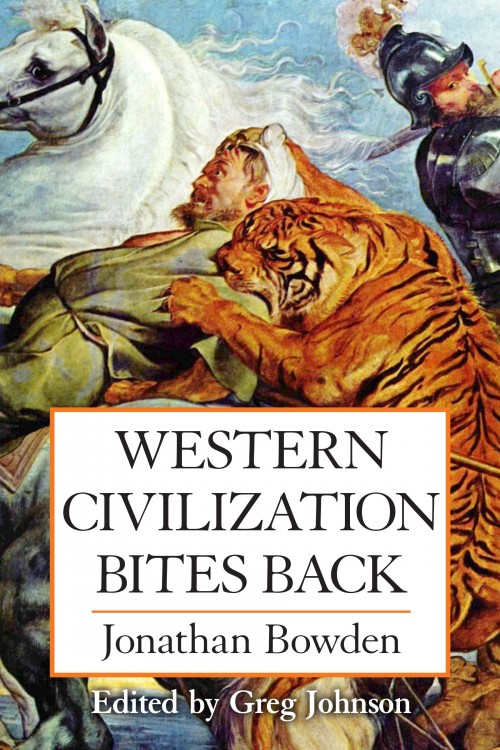
You can buy Jonathan Bowden’s Western Civilization Bites Back here.
3,056 words
Part 6 of 7
Edited by Greg Johnson and Peter Jacobi
In 1995, Jonathan Bowden self-published his Collected Works in 6 volumes (London: Avant-Garde, 1995), edited by Jürgen Schwartz, one of Bowden’s pen names. The six volumes comprise 27 distinct books, 12 of which had been previously published. Altogether, the Collected Works contain more than 2,600 pages of rare early Bowden.
Suck is the second book in volume 2. It was first published as a distinct book under Bowden’s pen name John Michael McCloughlin (London: Avant-Garde, 1994). We will publish it online in 7 installments. The titles are editorial.
Suck covers a wide range of political and cultural topics, interspersed with fictional narratives that may be loosely based on real people and events.
Eventually, a fully annotated version of Suck will appear at the Jonathan Bowden Archive. It will then be followed by similar editions of the rest of the Collected Works, plus a couple more early volumes that were not included. — Greg Johnson
All of which brings us quite comfortably to the Monday Club, and in particular, the Young Monday Club conference which I attended last weekend at the Adelphi Hotel in central London, in Villiers Street to be precise. Where a group of people such as Timorous Vole, the ex-Chairman, and A. J. Cronin-in-a-bread-basket, the Chairman to-be, all attended a relatively lacklustre affair. The other people at the conference included Wilfull Romantic/Priapic Miscegenator, the co-ordinator of the Western Goals Institute, Paedophilic Ant-eater, a law unto himself, a relatively right-wing councillor, a female, whom A. J. had dragged up from his constituency on the south coast, and a little known individual called Youthful Male Lesbian, who was active in the students wing of the Club at Hull University. Where he had fallen foul of the Conservative Collegiate Forum (left to centre right in Tory terms) and the student authorities. All of which was par for the course, but Young Male Lesbian’s real victims were not the ones for which he was being pilloried by various ‘wets.’ Indeed, his real views were close to Lady Jane Birdwood, Joyce Page, and other ‘lunatics,’ luminaries of what Sir Osbert Sitwell described, in his autobiography Great Morning, as Ultra-Right-wing Catholic Socialism. Although Sitwell was referring to a journal in which he had been attacked by Scott Moncrieff, the translator of Proust and a secret paederast, as Evelyn Waugh discovered when he applied to be his secretary.
These ideas are descended from A. K. Chesterton, from the Chesterton family in general, and they represent a native or integral Catholic stance. This is an English Catholic orientation within the far right, as is presently exemplified by Candour, a continuation of A. K. Chesterton’s journal of that name, Birdwood’s Choice, and a concatenation of extremist Tory leaflets and newsletters which are distributed by private citizens. All of which are loyal to various conspiracy theories, the most common one being that the world is in the grip of the Jewish world conspiracy, that even if The Protocols of the Learned Elders of Zion were a forgery, they were substantially true. They were true as documents in and of themselves, much in the same way that David Irving pronounced the Hitler diaries as fakes in a literary sense, but true in a political one. All of these ideas, if we can describe them as such, were typical of A. K. Chesterton’s organization, the League of Empire Loyalists (the LEL). This was an organization which was expelled with some bloodshed, a few cracked ribs and bloody noses at any rate, from the Conservative Party in the 1950s, and which put forward these ideas, these notions of conspiracy and betrayal on a regular basis. All of which he carried into the National Front at the end of the 1960s—and the League of Empire Loyalists, a sort of crankish and conspiratorial Monday club, was a mixture of socialism from the left, albeit in the form of a racialist or antisemitic socialism that drew on Blatchford, not Keir Hardie—and which was essentially a rightist version of nativist socialism (à la Commonwealth) after the war—and the conspiratorial strand in Old Right thought, which looked back to elements in Joseph Chamberlain’s Tory imperialist and liberal unionist ideas of the Edwardian era. All of which was seen to merge effortlessly with the Diehards, the Kiplingesque extremists of the first two decades of the twentieth century, together with the conspiratorial strand represented by the Britons publishing house, Nesta H. Webster, its most famous progeny (also a doyen of British-Israel), and the fact that these ideas essentially lingered around the defensive British Fascists of the twenties. (Incidentally, the journalist who revealed the violent treatment to which LEL delegates, including several dowagers and elderly women, were subjected at the Conservative Party conference when they were expelled was Bernard Levin, a Jew, who was then writing under a pseudonymous column in The Spectator called ‘Taper.’ All of which somewhat upsets the conspiratorial highjinks of the League.)
But one major question has to be asked: why are right-wingers (or at least some right wingers) so prone to conspiracy theories, so prone to the doctrine of the “hidden hand” (as Nesta H. Webster would put it) and which John Buchan immortalized in fiction, to be honest the place where it belonged. The reasons for this are many and complicated, to be frank, they have to do with the fact that most Right-wingers are rebels and romantics. In a sense they are rebels against the nature of the order which they wish to impose, and as a consequence, most Right-wingers are rebels in the direction of a New Order. They rebel in order to achieve Order rather than chaos. As a result, we might say that many people on the Right suffer from a Byronic impulse, an ultimately pagan and healthy spirit. This is the view that life is worth living against the Fates; either the nature of Destiny or the humdrum of daily life. In short, most Right-wingers are rebels against authority, except when they are exercising it—they are men and women who cannot sit still under anyone else’s authority. In short, it is they who must exercise ukase, discipline and regimentation—no one else. They are the aristocrats, in turn, of a new dispensation, a new challenge to the nature of rule—an understanding of the fact that authority has an anarchic streak, a desire to tear itself down, and rebuild itself in the twinkling of an eye. It is as if the Right always takes on a heroic role; a form of heroic muster. It is transparently vainglorious—proud, arrogant, and nihilistic by turns, flashy and cynical, and yet deeply ideologically committed. It is, in short, a type of authority for those who must exercise it; a rebellion against authority in the name of authority; an endless search for new men and new measures which are loyal to the past; a type of radical traditionalism. In many respects the Right-winger always looks to the cut of the cloth; to its heroic mien and demeanour. In actual fact there is a residual sympathy for socialism, particularly when it is authoritarian, elitist, and aristocratic in form. Such a thing, in short, is a romanticization of the Gracchi, a concealed regard for Lassalle and other leaders of the Left. If we have to find a perfect metaphor it is in the career of Julius Caesar, as outlined in Theodore Mommsen’s History of Rome—a man who begins as a tribune of the people, an archetype of the “Left,” and who ends up introducing a clean-limbed aristocratic dictatorship, in accordance with the will of the people, against an effete democracy. When this existed in the form of the Senate and the Republic, the aristocratic demos—in comparison to Caesar, who stood for the crowd and a resuscitation of Tarquin monarchy without the crown, a form of imperialism. All of which were examples that moved the young Oswald Mosley, as he attempted a synthesis of the old and the new, the social and the heroic. This is best seen in the manoeuvrings which led to the creation of the New Party, after the Labour Party leaders had rejected his memorandum, and the New Party was a vehicle for authoritarian social reform, a mixture of the socially-concerned Left and the anti-Bourgeois Right, which led directly to Fascism.
When fascism was a radical synthesis of Left and Right, socially-minded and yet inegalitarian, international in its scope, and yet national in its purpose, racialist admittedly, but in Mosley’s hands more concerned with culture than race. Ultimately it was a neo-aristocratic reaction in the machine age—something which preached a complete transformation of all values (like Nietzsche), but that also stood for things remaining as they were. In short, it was a heroic politics, vital and amoral, a type of idealism which was peculiar to the middle class who had rejected bourgeois values. In a sense fascism resembled conservatism in its pessimism, but it is an active pessimism. It is not a quietist one—(one of the reasons why Christians like T. S. Eliot, a modernist and a classicist, were uneasy in relation to the demands it made)—and the index of its pessimism is seen in its concern with hierarchy; its understanding of differentiation and meaning; its divine insight, if you will. Whether you imagine it to come from God or the Devil; from the penitent and crucified Christ or the sin of Lucifer, particularly in Milton’s depiction, his sin of pride, unholy and inhuman pride, hubris as the Greeks defined it, without which human life is not possible. In that human beings are dedicated to a tragic fate; a divine blunder; an error of form and proportion. All of which does not invalidate the striving, the urgency of the will. It merely perpetuates it; it gives it renewed force. It allows into itself the crystallization of a divine moment; a moment which approaches the possibility of what we call existence; being-in-being as Heidegger called it—at once a phenomenological exactitude and a meaningless absurdity. In a sense, therefore, human beings must strive with immense resolve against nothingness; against futility, against the prospect of absence, the contingent purposelessness of fate. (What in philosophy is called nihilism). Whilst recognizing that nothing exists which cannot be redefined; and that everything which exists can be reduced in the twinkling of an eye. In short, man is free to succeed in relation to the possibility of his own failure. He will succeed, he will fail by the nature of that success. We might say, therefore, that all positive striving is necessary. It leads to new, higher, and more complex forms. Evolution as such is certainly possible, but it will always be subsumed in the probable, the fleshy, the human, and the damned; in other words, the inadequate in relation to death. None of which is to condemn the flesh, incidentally, in that the flesh is vital to the spirit; its projects and outer lineaments. All we really mean to say is that human striving is necessary, positive, and wholesome. It points towards the limitless extension of higher forms—but it is also futile and destined to fail, and in its failure lies its grandeur, its attempt to be wholer, more complete, more firm and resolute in the capacity for leadership. All of which has led this particular author, over time and with reluctance, to admit, with Bardèche, that he is allegedly what the Left would call a “Fascist author,” an author of the terror and impermanency of the spirit.
When fascism is understood, as Mosley envisaged it, as a process of conquering external reality. It is a process which was indisputably male—in that it dealt with exteriorisation, with the commingling of desire and emotion; the desire to create out of nothingness which is, in turn, emblematic of that nothingness, that sense of doom, nullity and chaos—whilst being respectful of its purposes. If, however, there is a sense in which Mosley errs, it is in his positivism, not the scientific positivism—the logic-chopping, as we might call it, of Comte and other scientific materialists—but his positive, healthy, and ultimately pagan vision of humanity. This was certainly true in his own life, and that is why Mommsen’s History of Caesar is so important, in that it presents the rise to power, to complete power, of a wastrel, a true aristocrat, at one time a flaneur and at another a statesman; a vision of the warrior, polite, contemptible, and gay, as Beatrice Webb tartly remarked in Mosley’s case.
Much of which relates to what we said about Odinism before, namely that it was too healthy, too luxuriant in relation to its own passions—at once bathetic and contemptible in relation to its absence of an inner life. In that it looked upon human beings as untroubled, phlegmatic creatures, creatures that were naturally good, and yet lacking in insight when it came to their own lives. When my own personal bias, I freely confess it, is a more tragic and futile vision of humanity. Ultimately it is a more depressed side—a pessimistic element, an understanding of the nearness of death, and the ever-present nature of mortality. All of which does not deny the prospect of joy, the necessity of righteous emotion. It merely places it in a paradigm of despair, an understanding of ultimate futility, the degree to which all ecstasy is a form of strength through joy. It is a form of laughter which flies in the face of the Gods’ indifference.
As a consequence Fascism is a Janus-faced doctrine. It is a doctrine which faces in two directions at once, and although contemporary writers and historians can approach it without what Eric Bentley called ‘ritual exorcism’, fascism still needs to be understood as a movement of its time. It was a reaction to a particular era, broadly speaking, part of the reaction to industrialization during the nineteenth century. In a sense it was predicated on modernist influences—at once machine-oriented and futurist—but it was also backward looking, romantic, and restorative, replete with visions of the pastoral and an idealised past, a past which no longer existed, but that they wished to capture in the realm of the spirit. In relation to my own politics, however, the journey towards a position on the radical right has been tortuous in the extreme. It has involved a process of differentiation, amelioration, absorption, and general cantankerousness. In other words, it was a gradual process of recognition and response, as the nature of one’s thought redefines itself in relation to its own absence. To begin with I was a Stirnerite, a believer in a current of thought which mingles left and right in unusual ways—in a manner which is somewhat perverse and contagious, in relation to a type of idealism, a spectre of the spirit. This is something which affirms the fact that life is lived discontinuously for the intellectual, in relation to his own mind, defined by his own circumstances, pummelled by the nature of his own will, perturbed and exhausted by his “ego and its own.” In such circumstances, the mind floats free from the moorings of reality. It floats like a disembodied spectre, a triumph over the nature of the material—a protean and dynamic world—where the intellectual can shape his relationship with his own consciousness. In turn, he can determine the nature of the outside world, in relation to how much of it he allows into his mind. In such a landscape real and unreal merge and mingle with each other. They confound one another and turn back upon one another. In short, ideas, such as they are, are spent pieces of self—thirty pieces of silver, the degree to which the intelligence recognises the existence of an external world, a terrain outside itself—something which is necessarily a betrayal, a hindrance, a lack of communication, the hindrance of wonder. All in a manner which is reminiscent of Judas, who destroyed Christ to feel the nature of his own inadequacy, to test himself against the prospect of inexistence. This was an existence which he only felt in a firm or real sense when the rope was around his neck, and the leather of his boots had not left their support, prior to his suicide, his self-immolation. Indeed a man like Judas had to test himself, to go further than the others, to remonstrate with the nature of his own fate—to flirt with the idea that his name—‘Judas’—would be used forever to signify betrayal, the abandonment of principle, and the use of sordid motives. When in fact he merely went up to Christ and kissed him, as a signal to the officers, in order to test himself, to prick himself into consciousness, to see if he was truly alive. In other words, he wished to make philosophy, in a phenomenological sense, out of the movement of his body and the syllables on his lips. He wished to confront external existence and feel the carapace of matter. In some senses he even wished to punch through it and leave some hole or dent, some signification of his own passing. In short, he wished to see if there was an outside as well an inside. He had become so preoccupied with the workings of his own mind, his own savage intelligence, that he wondered whether external reality actually existed, or more accurately, whether he could have an impact upon it, in lieu of his deliberations. We might say, therefore, that Judas’ dilemma had taken on the proportions of a personal madness; a sickness of the spirit, an aporia in consciousness, at least in relation to the question of the real (not to mention the nature of ethics itself.) In that his vision—the vision of the modern intellectual, if you will—had become too complete, too all-encompassing, too reliant on its internal dynamic alone. In short, it had become a process which was akin to its own indifference. It had adopted, to use one of Adorno’s favourite maxims, a totalizing scheme of reference. It had become solipsistic, as if reality, a form of unreality in actual fact, was congruent, could be reduced, to the mind which gazed upon it.
If you have a Subscriber access,
simply login first to see your comment auto-approved.
Note on comments privacy & moderation
Your email is never published nor shared.
Comments are moderated. If you don't see your comment, please be patient. If approved, it will appear here soon. Do not post your comment a second time.