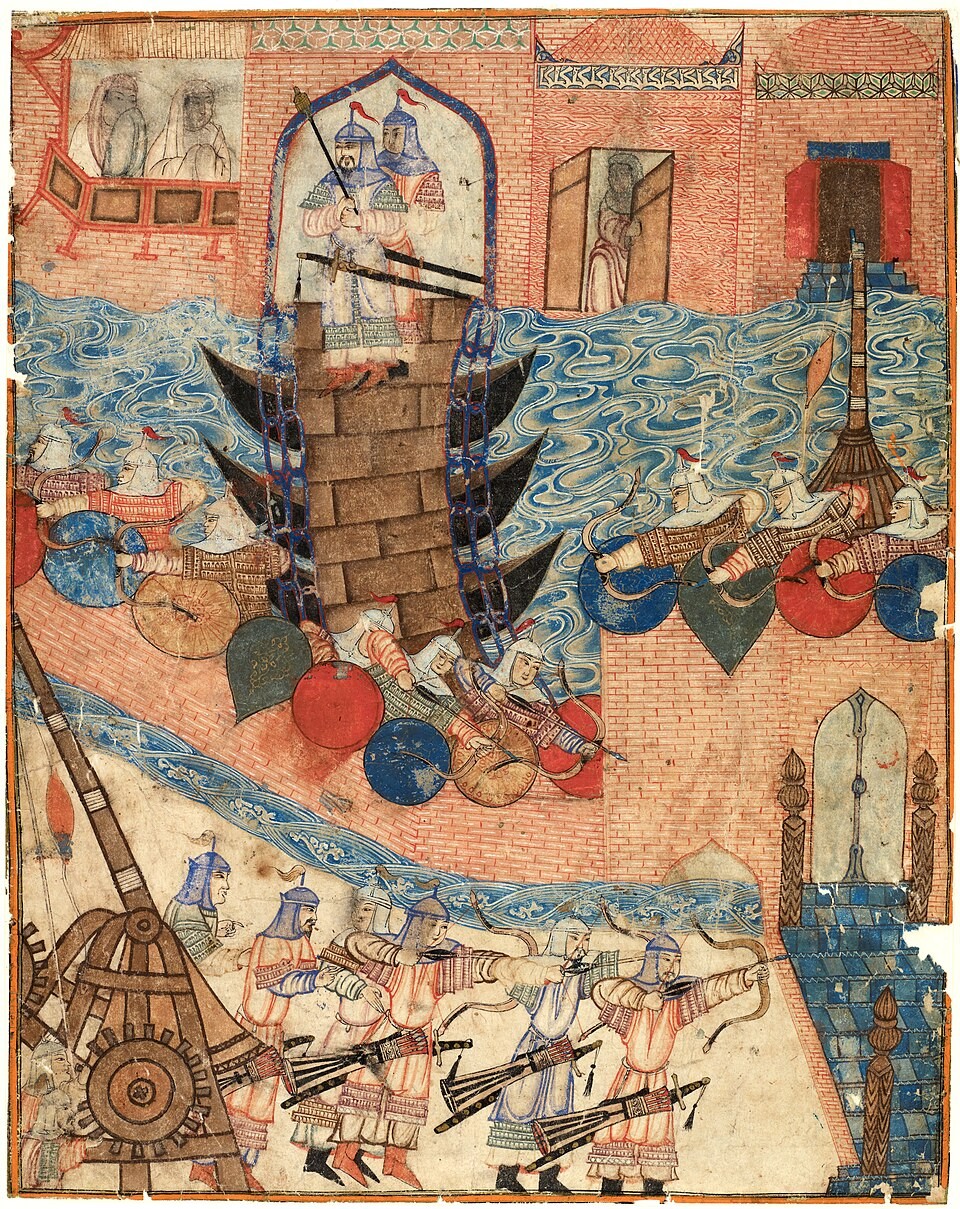
The Fall of Baghdad, courtesy of Wikimedia Commons.
1,138 words
Iran today is widely recognized as one of the most important scientific centers in the Middle East. In fields such as advanced materials and medicine it has developed a significant research base. The country ranks sixth in the world in nanotechnology output and its biopharmaceutical sector stands among the most advanced in Asia, currently placed fifth on the continent. These achievements are not simply the result of natural resources or temporary policy decisions. Rather, they reflect sustained investment in education, technical expertise, and research institutions. Iran’s contemporary scientific position therefore provides an opportunity to reflect on a broader historical question. Long term development is shaped less by momentary political shocks than by the accumulation of human capital and the institutional capacity of a society.
This historical perspective is important because intellectual debates in many developing regions frequently emphasize colonialism as the principal explanation for present day underdevelopment. Iran’s experience suggests a more complex picture. Long before the colonial era, Iran suffered repeated conquests that devastated its economy and population. Among these, the Mongol invasions of the thirteenth century rank among the most destructive episodes in Eurasian history. The scale of the devastation was such that entire cities vanished and flourishing agricultural regions collapsed. Contemporary observers recorded the catastrophe with a sense of disbelief at the sudden destruction of prosperous urban life. The geographer Yaqut al Hamawi described the great city of Merv before its fall in remarkable terms, writing that it had been “in a word, and without exaggeration, a copy of paradise” before it was destroyed by the invading armies.
The devastation produced consequences that extended far beyond the immediate violence of conquest. Agricultural systems were severely disrupted when irrigation networks, fields, and farming settlements were destroyed. As a result, famine and displacement spread across large areas of Iran and Central Asia. Some historical accounts of the aftermath convey the severity of this social collapse. One report concerning the destruction of Herat describes how the devastation of the countryside left a small number of survivors struggling to remain alive, forcing them “to feed for years afterwards on human flesh, dog and cat meat.” Such testimony from contemporaries conveys the depth of the crisis that followed the invasions. Cities that had once been vibrant centers of commerce and scholarship became ruins, while the population decline reduced the labor force required to rebuild agricultural and economic life.
At the same time, the destruction had profound intellectual consequences. Iran had previously been one of the great centers of scientific and philosophical activity within the wider Islamic world. Cities across the region hosted libraries, schools, and communities of scholars that participated in a vast network of intellectual exchange. The Mongol invasions shattered many of these networks. Numerous centers of learning were destroyed and many scholars were killed or forced to flee. Historical evidence indicates that the invasions resulted in the destruction of “cities, libraries, schools and academies,” thereby disrupting the institutional foundations that had sustained scientific inquiry and scholarship for centuries. The disappearance of these institutions meant that the transmission of knowledge was interrupted across large parts of the region.
Furthermore, the consequences of these invasions were not confined to Iran alone. The Mongol conquests affected a wide arc of Eurasia and produced long term economic transformations that contributed to the historical process known as the Great Divergence. This term refers to the gradual separation in economic performance between Western Europe and many Asian regions during the early modern period. The Mongol invasions played a significant role in this development because they inflicted severe demographic and economic shocks on large portions of Asia and the Middle East. Accounts of the conquests describe the “destruction of cities, salting of croplands, burning of libraries and hospitals, mass slaughter of population,” all of which undermined the economic foundations of several major civilizations.

You can order Greg Johnson’s White Identity Politics here
As a result of these shocks, many cities in the regions most affected by Mongol conquest experienced prolonged economic decline. Urban populations fell dramatically and trade networks were disrupted. Over time, these effects created an economic divergence across Eurasia. Regions less affected by the invasions gradually recovered and expanded, while heavily devastated areas struggled to regain their earlier levels of prosperity. Historical analysis indicates that the devastation created conditions in which Western Europe was able to catch up with and eventually surpass several Asian regions in economic development. In fact, the evidence suggests that the invasions “allowed Western Europe to catch up and surpass the levels of income and technical capacity of the great Asian civilizations”. Thus the consequences of these events extended far beyond the initial violence of conquest and shaped the trajectory of global economic history for centuries.
Iran’s long historical experience therefore demonstrates that even societies exposed to repeated invasions and catastrophic destruction can recover if they rebuild their institutions and cultivate human capital. At various points in history Iran stood among the leading powers of the world in culture, science, and political organization. The intellectual traditions of Persian civilization influenced vast regions stretching from the Middle East to Central Asia. Although invasions temporarily destroyed many of these institutions, the capacity for institutional reconstruction allowed the society to regenerate its intellectual and economic life.
This perspective also helps clarify contemporary debates about development in other parts of the world. In many discussions about global inequality, colonialism is often treated as the sole explanation for underdevelopment. Yet different regions entered the modern era with very different political and institutional structures. In much of pre-colonial Africa, political organization was frequently decentralized and formal states were often limited in scale compared with the large bureaucratic empires that existed in regions such as the Middle East, China, or South Asia. Consequently, administrative institutions capable of coordinating taxation, law, and long-term educational systems were less widespread.
During the colonial period, European powers introduced new administrative structures and built schools and universities in several African territories. Nevertheless, the region’s extraordinary diversity of languages, ethnic groups, and ecological environments posed major challenges for the development of unified states after independence. As a result, the consolidation of stable institutions and the expansion of human capital became central issues in the post-colonial period.
The comparison underscores the importance of institutional development and education in shaping long term prosperity. Iran’s history shows that even the most devastating invasions, which destroyed cities, annihilated scholarly communities, and disrupted entire agricultural systems, did not permanently prevent recovery. Once educational institutions, administrative structures, and intellectual networks were gradually rebuilt, scientific and cultural life revived. The modern scientific achievements of Iran, from its advanced nanotechnology research to its growing pharmaceutical sector, represent the continuation of this long historical process of institutional reconstruction and intellectual renewal following some of the most destructive invasions recorded in world history.
2 comments
The so-called “Islamic Golden Age” couldn’t have happened without the Rashidun conquest of Persia. Persian bureaucrats, philosophers and scholars were instrumental in proliferation of knowledge centers across the Caliphate.
For both of them it would be better, if they have kept their pre-Islamic beliefs, Zoroastrism for Persians, and Tengrism for Tatars.
If you have a Subscriber access,
simply login first to see your comment auto-approved.
Note on comments privacy & moderation
Your email is never published nor shared.
Comments are moderated. If you don't see your comment, please be patient. If approved, it will appear here soon. Do not post your comment a second time.