Institutions reveal their true character in two places: in the gray zones where rules are incomplete, ambiguous, or unenforceable, and even more nakedly in broad daylight when those in authority openly violate the clearest rules without shame. In a living civilization, power is restrained by the office it occupies. In a hollowed-out order, the office becomes a license to violate. Authority exists not to uphold rules but to prove exemption from them. That is why law, bureaucracy, and policing expose the moral substrate of a society with merciless clarity. (more…)

Tag: institutions
-
Modern development theory rests on a simple assumption: institutions can be transferred from one society to another. If a country adopts the right legal codes, builds courts, trains bureaucrats, and establishes regulatory agencies, it is expected to converge toward the stability and prosperity of developed nations.
This assumption persists not because it is true, but because it appears plausible to those who encounter societies primarily in abstraction. (more…)
-
A society can become technologically modern while remaining intellectually pre-modern. Satellites may be launched into space while superstition governs everyday decisions. The result is not progress but instability—a condition that can be described as second-hand modernity.
How can a society produce seemingly world-class engineers and nuclear scientists while remaining deeply irrational? (more…)
-
1,138 words
Iran today is widely recognized as one of the most important scientific centers in the Middle East. In fields such as advanced materials and medicine it has developed a significant research base. The country ranks sixth in the world in nanotechnology output and its biopharmaceutical sector stands among the most advanced in Asia, currently placed fifth on the continent. These achievements are not simply the result of natural resources or temporary policy decisions. (more…)
-
Modern people—particularly the university-educated, raised in predictable urban environments in relative comfort—live inside a powerful illusion: the belief that societies can change quickly.
We are surrounded by examples that condition us to think this way. Within a few decades, countries have gone from wretched poverty and primitive existence to rapid economic growth, and from illiteracy to seeming technical sophistication. (more…)
-
Henry Martin
Lawfare: A Practical Guide
Imperium Press, 2025Perhaps the most important political website in recent American domestic politics was vdare.com. Vdare focused on patriotic immigration reform. Because immigration and racial and ethnic politics cannot be fully separated, the website occasionally published white advocates. (more…)
-
1,587 words
Dr. Oasis Kodila-Tedika is an economics lecturer at the University of Kinshasa in the Democratic Republic of the Congo (DRC). As a trailblazing researcher he has authored several landmark papers on intelligence, economic development, and institutions. This Congolese economist is also a multitalented professional whose expertise has benefited institutions such as the World Bank, the United Nations, and PriceWaterhouse Coopers. (more…)
-
1,938 words
Don’t use the rules.
They’re not for you,
They’re for the fools.
And you’re a fool
If you don’t know that.So, here’s the rules
You stupid fool.
— The Clash, “Cheat” (more…)
-
2,289 words
2,289 wordsAnyone who remembers the 1980s can recall exactly what they were doing when the space shuttle Challenger exploded just 73 seconds after lifting off on January 28, 1986. People at the Florida launch site openly wept, pounded their fists on the hoods of their cars, and held each other. Schoolchildren looked at the televised images of the disaster with horror. The news media went into a frenzy, and President Reagan delivered a televised eulogy that evening that was probably his best speech ever. (more…)
-
8,516 words
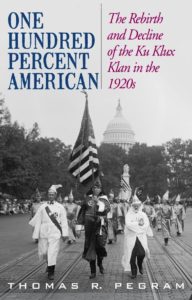
8,516 wordsThomas R. Pegram
One Hundred Percent American: The Rebirth and Decline of the Ku Klux Klan in the 1920s
Chicago: Ivan R. Dee, 2011The Ku Klux Klan suffers from a positively radioactive reputation, even among fellow Rightists. During the infamous family dinner scene in American History X, at which Edward Norton’s Derek Vinyard assaults his sister and displays his swastika tattoo to the Jewish teacher dating his widowed mother, (more…)