Counter-Currents
  • Advertise
  • Private Events
  • T&C
  • About
  • Contact
  • RSS
    • Main feed
    • Podcast feed
    • Videos feed
    • Comments feed
  • Welcome
  • Webzine
  • Books
  • Merch
  • Podcasts
  • Videos
  • Donate
  • Patrons
  • Subscribe
  • Crypto

LEVEL2

Donate Now Mailing list

Writers of May

(2 votes) Morris van de Camp David M. Zsutty Derek Stark Jayant Bhandari Greg Johnson

Articles of May

Heidegger on Nietzsche, Part One by Collin Cleary The Lunch Wars by David M. Zsutty 2 votes
  • Welcome
  • Webzine
  • Books
  • Merch
  • Podcasts
  • Videos
  • Donate
  • Patrons
  • Subscribe
  • Crypto
    • Nationalism This Week
      Letter to J. D. Vance

      Greg Johnson

      3

    • Lost In Trans-Mission:
      How the Media Fails To Reveal the Inconvenient Truth About the Usual Suspects

      Steven Tucker

      6

    • Liar, Liar, Pants on Fire!

      Beau Albrecht

      4

    • Editor’s Update
      Rob Rundo on Counter-Currents Radio, Fundraiser Update, & a New $20,000 Matching Grant

      Greg Johnson

    • The Bitter End of Western Metaphysics:
      Heidegger on Nietzsche, Part Three

      Collin Cleary

      10

    • Uncivil War

      Mark Gullick

      40

    • Exclusive Interview with Karel Veliky:
      The Final Chapter in the Film Series! Part II

      Ondrej Mann

      2

    • Happy Birthday to Us!

      Greg Johnson

      6

    • Zsutty’s Maximum

      David M. Zsutty

      16

    • Exclusive Interview with Karel Veliky:
      The Final Chapter in the Film Series! Part I

      Ondrej Mann

      2

    • The Union Jackal, June 2026

      Mark Gullick

      23

    • The Inferiority Behind Immigrant Superiority

      Jayant Bhandari

      15

    • Counter-Currents Radio Podcast No. 690
      Greg Johnson & David Zsutty Discuss Current Things: AI, Henry Nowak, the Iran Crisis, & More

      Counter-Currents Radio

      7

    • Collin Cleary: What Rome Means to Me

      Collin Cleary

      4

    • Paul Krugman: Closet Bolshevik

      Spencer J. Quinn

      21

    • Fugue of Ideas:
      Ibram X. Kendi’s Chain of Ideas

      Greg Johnson

      19

    • Based Blacks

      Lipton Matthews

      23

    • Black Intellectual Fatigue

      Derek Stark

      41

    • Why White Advocates Should Avoid “Based Blacks”

      Dani Vypont

      32

    • Nietzsche & Race

      Mark Gullick

    • Editor’s Update
      Rob Rundo Rescheduled to Next Week on Counter-Currents Radio;
      Tonight Greg Johnson & David Zsutty Answer Your Questions;
      Fundraiser Update & a New $20,000 Matching Grant

      Greg Johnson

    • The Counter-Currents 2026 Fundraiser
      Lifetime Subscriber Welcome Packages Extended

      Greg Johnson

    • Nationalism This Week
      Who’s Looking Back?

      Greg Johnson

      29

    • China’s Threat to American Security:
      Food, Farmland, Foreign Control, & Energy Policy

      Lipton Matthews

      5

    • The Bitter End of Western Metaphysics:
      Heidegger on Nietzsche, Part Two

      Collin Cleary

      16

    • The Killing of Henry Nowak

      Mark Gullick

      38

    • The Crisis of Chinese Technology Thieves

      Morris van de Camp

      1

    • The Strange World of Gender Bender Fiction:
      & What This Genre Tells Us About Autosexuality

      Dani Vypont

      3

    • Watching the Watchers:
      The Dark Triad Question

      David M. Zsutty

      14

    • The Remigration Movement Solidifies

      F. Roger Devlin

      1

    • Casting Aspersions:
      The Fatal Consequences of Race-Swapped Casting, From Helen of Troy to Henry of Southampton

      Steven Tucker

      20

    • The Murder of Henry Nowak

      Millennial Woes

      23

    • Don’t Forget to Vote in Our Writer & Article of the Month Poll

      Greg Johnson

    • The Robot Hotdog Stand

      Greg Johnson

      37

    • Laughing Our Way to Victory

      Dave Chambers

      7

    • The Zodiac Killer

      Mark Gullick

      11

    • Jared Taylor: What Rome Means to Me

      Jared Taylor

      1

    • An Interview with Endeavour:
      My Way of Life Is an Adventure!

      Ondrej Mann

      6

    • José Pedro Zúquete’s The Identitarians

      Greg Johnson

      3

    • Editor’s Update
      Fundraiser Update & How to Watch the Remigration Summit

      Greg Johnson

      5

    • The Bitter End of Western Metaphysics:
      Heidegger on Nietzsche, Part One

      Collin Cleary

      12

    • Berlin: City of Stones

      Spencer J. Quinn

      6

    • True Folk-Horror Is Horror of Your Own Folk:
      Mark Gatiss vs the Brexit Blind Dead  

      Steven Tucker

      4

    • Counter-Currents Radio Podcast No. 689
      Thomas Massie, the America 2050 Bust, the Need for Whites to Divest from America, the AI Economic Apocalypse, & Pro-White Project Pitches to Billionaires

      Counter-Currents Radio

      7

    • Nationalism This Week
      Remigration is Inevitable, Part 3

      Greg Johnson

      27

    • Why Billionaires Should Fund White Identity Politics

      Lipton Matthews

      8

    • How Cold War Two Came About

      Morris van de Camp

      5

    • Now Available for Pre-Order at a Special Price!
      Greg Johnson’s The Philosopher Is In

      Greg Johnson

    • David Zsutty’s Elevator Pitch to a Billionaire

      David M. Zsutty

      1

    • Headbanging Lite

      Mark Gullick

      5

    • Derek Stark

      Lost In Trans-Mission

      However, he would make a fascinating experiment. Give him five years in a highly controlled...

    • Peter Quint

      Lost In Trans-Mission

      Yes, when are those people going to get reparations? The horror, the horror! 🙃

    • Uncle Semantic

      Zsutty’s Maximum

      A warped secularization of christianity is how I’ve heard many writers on our side describe the...

    • Greg Johnson

      Based Blacks

      I would prefer you stay but just not read peoplr who annoy you. Thanks for being part of CC.

    • Peter Quint

      Liar, Liar, Pants on Fire!

      Great article! Well, I know I am good; I will match my rectitude with anyone, and come away clean...

    • Peter Quint

      Lost In Trans-Mission

      Great article! All he got was 28 months; he should have been locked away in a psycho ward for the...

    • Peter Quint

      Letter to J. D. Vance

      Great article! I don’t want Vance to be president; he gives me the creeps; I don’t think he has our...

    • Dominic Fox

      Liar, Liar, Pants on Fire!

      I’m still flabbergasted how someone can lie that egregiously and shamelessly. Do words have no...

    • Dominic Fox

      Liar, Liar, Pants on Fire!

      The Christian ideas of repentance and “prodigial sons” give dysfunctional and anti-social...

    • Dominic Fox

      Letter to J. D. Vance

      "There was virtually no chance that this scenario would work. It was stewed up with bogus...

    • Zarathustra

      Letter to J. D. Vance

      A peace deal with Iran has finally been agreed. Let's see how Israel manages to sabotage it.

    • Will Williams

      Based Blacks

      Weave: June 15, 2026  Thank you for completely proving my point, which is that if we aren’t as...

    • Fred C. Dobbs

      Lost In Trans-Mission

      Great article. We’re all used to the media using lies of omission. The “teens” is most commonly used...

    • Fred C. Dobbs

      Liar, Liar, Pants on Fire!

      Father Merrin “he mixes lies with the truth to confuse us.” Excellent piece. We’ve all experienced...

    • Adrian Roberts

      Lost In Trans-Mission

      What about all the people who've been born in the wrong bodies and don't even know it?

    • Weave

      Based Blacks

      Thank you for completely proving my point, which is that if we aren’t as “pure” as you then we are...

    • Joe Gould

      Lost In Trans-Mission

      Philosophy matters. Bad philosophy backed by media, money, and state power is a disaster. The dogma...

    • Joe Gould

      Uncivil War

      I think that your phone (any brand, not just an iPhone) will give up all sorts of information on you...

    • YT

      Uncivil War

      So you’re advocating leaving your iPhone at home as it can be used for geographic location purposes...

    • Will Williams

      The SPLC Indictment

      I bump this comment because Christian conservative reporter Tyler O'Neil is on the SPLC  beat again...

    • Earth Day Special

      John Morgan

      12

    • A Robertson Roundup
      Remembering Wilmot Robertson
      (April 16, 1915 – July 8, 2005)

      Margot Metroland

      13

    • The Paranoid Style in White Nationalism

      Greg Johnson

      30

    • Join the Dance!

      Andrew Hamilton

      1

    • We Can’t Save the Earth Without Reducing African Birth Rates

      James Dunphy

      36

    • “I’m Not a Conspiracy Theorist, but . . .”:
      Jeffrey Epstein’s Death Gives New Life to “Conspiracy Theories”

      Greg Johnson

      22

    • Sylvia Plath: Stasis in Darkness

      Vic Olvir

      17

    • Vanguardism, Vantardism, & Mainstreaming

      Greg Johnson

      80

    • Aviation, Geography, & Race

      Charles Lindbergh

      3

    • Some Thoughts on Yule

      Collin Cleary

      4

    • Living in Truth:
      A Yuletide Homily

      Jef Costello

      7

    • John Kennedy Toole’s A Confederacy of Dunces

      Greg Johnson

      20

    • On Aleksandr Solzhenitsyn’s Warning to the West

      Spencer J. Quinn

      7

    • Elitism, British Modernism, & Wyndham Lewis

      Jonathan Bowden

      6

    • Philip K. Dick’s Do Androids Dream of Electric Sheep? as Anti-Semitic/Christian-Gnostic Allegory

      Greg Johnson

      20

    • “Conspiracy Theory” or Conspiracy?

      Andrew Hamilton

      21

    • Remembering H. P. Lovecraft
      (August 20, 1890–March 15, 1937)

      Greg Johnson

      3

    • Who Are We?
      Nordics, Aryans, & Whites

      Greg Johnson

      71

    • Remembering William Gayley Simpson
      (July 23, 1892–December 31, 1990)
      A Pleasant Afternoon with Harriet & Bill Simpson

      Margot Metroland

      18

    • Here are the Young Men
      Remembering Ian Curtis
      (July 15, 1956–May 18, 1980)

      Mark Gullick

      18

    • Percy Grainger
      Artist of the Right

      Alex Graham

      7

    • Remembering Revilo Oliver
      (July 7, 1908–August 20, 1994)

      Greg Johnson

      18

    • The Meaning of July 4th for the White Man

      Gregory Hood

      13

    • The Front National’s Evolution

      Bruno Mégret

    • Merwin K. Hart
      Forgotten American Hero & Man of the Right

      Morris van de Camp

      10

    • George Orwell’s Nineteen Eighty-Four

      Jonathan Bowden

      8

    • Carleton S. Coon
      Scientist & Reluctant White Advocate

      Morris van de Camp

      3

    • The Kwanzaa Absurdity Will Be Dwarfed by Juneteenth

      Robert Hampton

      10

    • Stravinsky

      Alex Graham

      7

    • Like the Roman:
      Remembering Enoch Powell (1912-1998)

      Mark Gullick

      23

    • The 1970s: The Golden Age of Hijacking

      Morris van de Camp

      21

    • Jonathan Bowden’s Deliverance
      Part 6

      Jonathan Bowden

    • Do You Want to Play a Game?

      Mark Gullick

      1

    • Sexually Incontinent on the Indian Subcontinent:
      Who Rapes More Animals, Indians or Pakistanis? The Battle Continues!

      Steven Tucker

      3

    • Neo-Fascism in Film
      Part 5

      Karel Veliky

      15

    • The Game of Tarot

      Mark Gullick

      2

    • Institutions Cannot Be Transplanted

      Jayant Bhandari

      5

    • Jonathan Bowden’s Deliverance
      Part 5

      Jonathan Bowden

    • Crosstown Traffic:
      Jimi Hendrix & The Post-War Rock ‘N’ Roll Revolution

      Mark Gullick

      1

    • Slaves from the North:
      Finns & Karelians in the East European Slave Trade, 900–1600

      Lipton Matthews

      14

    • Neo-Fascism in Film
      Part 4

      Karel Veliky

      2

    • David Lean’s A Passage to India

      Spencer J. Quinn

      1

    • Elites are Essential to Development

      Lipton Matthews

      7

    • Jonathan Bowden’s Deliverance
      Part 4

      Jonathan Bowden

    • Neo-Fascism in Film
      Part 3

      Karel Veliky

      6

    • E. M. Forster’s A Passage to India & the Indian Mentality

      Spencer J. Quinn

      25

    • Jonathan Bowden’s Deliverance
      Part 3

      Jonathan Bowden

    • The Rest Is Silence
      Heidegger’s Quietism

      Mark Gullick

      2

    • Dispelling the Historical Fallacy of Indian Nationalism

      Lipton Matthews

      8

    • Neo-Fascism in Film
      Part 2

      Karel Veliky

      8

    • Jonathan Bowden’s Deliverance
      Part 2

      Jonathan Bowden

    • Life of a Klansman

      Mark Gullick

      8

    • Jonathan Bowden’s Deliverance, Part 1

      Jonathan Bowden

    • Decolonial Ideas are Holding Back Developing Countries

      Lipton Matthews

      8

    • Neo-fascism in Film, Part 1

      Karel Veliky

      21

    • Jonathan Bowden’s Onslaught, Part 8
      Divigations on Decadence

      Jonathan Bowden

    • Jonathan Bowden’s Onslaught, Part 7
      Intrigues in the National Front

      Jonathan Bowden

      1

    • Rotten to the Core

      Mark Gullick

      8

    • Strauss on Husserl’s “Philosophy as Rigorous Science”

      Greg Johnson

    • Jonathan Bowden’s Onslaught, Part 6
      Francis Bacon & Right-Wing Nihilism

      Jonathan Bowden

    • András László
    • Derek Hawthorne
    • Beau Albrecht
    • Alain de Benoist
    • Kerry Bolton
    • Jonathan Bowden
    • Collin Cleary
    • Jef Costello
    • Savitri Devi
    • Julius Evola
    • Jim Goad
    • Gregory Hood
    • Juleigh Howard-Hobson
    • Greg Johnson
    • Charles Krafft
    • Anthony M. Ludovici
    • Trevor Lynch
    • H. L. Mencken
    • J. A. Nicholl
    • James J. O’Meara
    • Christopher Pankhurst
    • Tito Perdue
    • Michael Polignano
    • Spencer J. Quinn
    • Fenek Solère
    • Irmin Vinson
    • Leo Yankevich
    • Francis Parker Yockey
    • Multiple authors
  • Editor-in-Chief

    • Greg Johnson, Ph.D.

    Featured Writers

    • Beau Albrecht
    • Gunnar Alfredsson
    • Collin Cleary, Ph.D.
    • Jef Costello
    • Morris V. de Camp
    • F. Roger Devlin, Ph.D.
    • Stephen Paul Foster, Ph.D.
    • Jim Goad
    • Alex Graham
    • Mark Gullick, Ph.D.
    • Greg Johnson, Ph.D.
    • Travis LeBlanc
    • Trevor Lynch
    • Margot Metroland
    • James J. O’Meara
    • Angelo Plume
    • Spencer J. Quinn
    • Fred Reed
    • Clarissa Schnabel
    • Michael Walker
    • David M. Zsutty

    Frequent Writers

    • Asier Abadroa
    • Aquilonius
    • Alain de Benoist
    • Kerry Bolton, Ph.D.
    • Dave Chambers
    • Steven Clark
    • James Dunphy
    • Endeavour
    • Richard Houck
    • Jason Kessler
    • Titus Livius
    • Ondrej Mann
    • Lipton Matthews
    • Mark Mazari
    • John Morgan
    • Jaroslav Ostrogniew
    • Kathryn S.
    • Christian Secor
    • Anne Wilson Smith
    • Thomas Steuben
    • William De Vere
    • Kenneth Vinther
    • Max West

    Classic Authors

    • Maurice Bardèche
    • Jonathan Bowden
    • Julius Evola
    • Guillaume Faye
    • Ernst Jünger
    • Kevin MacDonald, Ph.D.
    • D. H. Lawrence
    • Charles Lindbergh
    • Jack London
    • H. P. Lovecraft
    • Anthony M. Ludovici
    • Sir Oswald Mosley
    • National Vanguard
    • Friedrich Nietzsche
    • Revilo Oliver
    • William Pierce
    • Ezra Pound
    • Saint-Loup
    • Savitri Devi
    • Carl Schmitt
    • Miguel Serrano
    • Oswald Spengler
    • P. R. Stephensen
    • Jean Thiriart
    • John Tyndall
    • Dominique Venner
    • Leo Yankevich
    • Francis Parker Yockey

    Other Authors

    • Howe Abbott-Hiss
    • Michael Bell
    • Giles Corey
    • Jack Donovan
    • Richardo Duchesne, Ph.D.
    • Emile Durand
    • Guillaume Durocher
    • Mark Dyal
    • Tom Goodroch
    • Andrew Hamilton
    • Robert Hampton
    • Huntley Haverstock
    • Derek Hawthorne
    • Gregory Hood
    • Juleigh Howard-Hobson
    • Alexander Jacob
    • Ruuben Kaalep
    • Tobias Langdon
    • Julian Langness
    • Patrick Le Brun
    • G A Malvicini
    • John Michael McCloughlin
    • Millennial Woes
    • Michael O’Meara
    • Christopher Pankhurst
    • Michael Polignano
    • J. J. Przybylski
    • Quintilian
    • Edouard Rix
    • C. B. Robertson
    • C. F. Robinson
    • Herve Ryssen
    • Alan Smithee
    • Fenek Solere
    • Ann Sterzinger
    • Robert Steuckers
    • Tomislav Sunic
    • Donald Thoresen
    • Marian Van Court
    • Irmin Vinson
    • Book Reviews
    • Movie Reviews
    • TV Reviews
    • Music Reviews
    • Art Criticism
    • Graphic Novels & Comics
    • Video Game Reviews
    • Fiction
    • Poems
    • Interviews
    • Videos
    • English Translations
    • Other Languages
      • Arabic
      • Bulgarian
      • Croatian
      • Czech
      • Danish
      • Dutch
      • Estonian
      • Finnish
      • French
      • German
      • Greek
      • Hungarian
      • Italian
      • Lithuanian
      • Norwegian
      • Polish
      • Portuguese
      • Romanian
      • Russian
      • Slovak
      • Spanish
      • Swedish
      • Ukrainian
    • Commemorations
    • Why We Write
  • Archives
  • Top 100 Commenters
  • The Looney Bin
  • Advertise
  • Private Events
  • T&C
  • About
  • Contact
  • RSS
    • Main feed
    • Podcast feed
    • Videos feed
    • Comments feed
Sponsored Links
Europa.com Above Time Coffee Antelope Hill Publishing Paul Waggener IHR-Store Spencer J. Quinn American Renaissance Jim Goad The Occidental Observer
Print March 11, 2026 8 comments

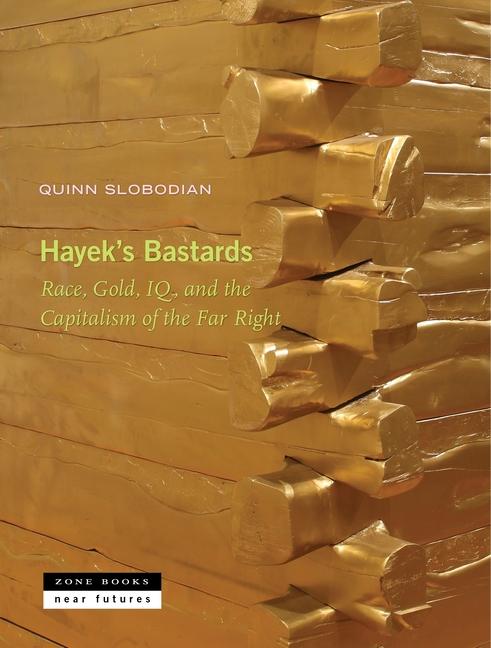
Quinn Slobodian’s Hayek’s Bastards

Greg Johnson

3,014 words

Quinn Slobodian
Hayek’s Bastards: The Neoliberal Roots of the Populist Right
London: Allen Lane, 2025

Quinn Slobodian’s Hayek’s Bastards is a pre-history of what in 2015 was called the “libertarian to Alt Right pipeline.” Just as Donald Trump’s populist presidential run in 2015 was heralded by changes in the Zeitgeist, Patrick Buchanan’s populist presidential runs in the 1990s followed upon metapolitical conversations beginning in the late 1980s. According to Slobodian:

Changing demographics—an aging white population matched by an expanding nonwhite population—made some right-wing neoliberals and libertarians rethink the conditions necessary for capitalism. Perhaps some cultures, and even some races, might be predisposed to market success while others were not? Perhaps cultural homogeneity was a precondition for social stability, and thus the peaceful conduct of market exchange and enjoyment of private property? (p. 10)

These intellectuals offered a new case for nationalism and populism by fusing free market economics (principally the Austrian School, hence the title) and “arguments borrowed from cognitive, behavioral, and evolutionary psychology and in some cases genetics, genomics, and biological anthropology” (p. 10). Slobodian focuses on such figures as Murray Rothbard, Hans-Hermann Hoppe, and Peter Brimelow. They drew upon the biological research of Charles Murray and Richard Herrnstein, the authors of The Bell Curve (1994), Richard Lynn, and J. Philippe Rushton (who is hardly mentioned).

Their allies and fellow travelers included the “paleo-conservatives” Sam Francis, Paul Gottfried, and Thomas Fleming. Of course, a whole book could be devoted to the paleocons, but they are marginal in Slobodian’s narrative because he is primarily a historian of Austrian School economics and libertarianism.

You can order Greg Johnson’s Loving Our Own here

Oddly, Slobodian refers to libertarianism and the broader free-market movement as “neoliberalism,” which to me means the embrace of market economics by center-Left politicians like Bill Clinton and Tony Blair in the 1990s. Instead of speaking of the Alt Right, Slobodian speaks of the broader populist Right. His timeframe is also much wider: most of the changes he discusses happened in the 1990s, but he traces the roots back much further. Still, the transformation he describes is essentially the same.

Classical liberalism and/or free market economics are individualistic in their basic morals and methods. Yet somehow people who once embraced those ideas came to embrace racialism and/or nationalism, which are morally and methodologically collectivist. Since you can’t derive collectivist conclusions from individualist premises, these thinkers abandoned key individualist premises.

In other words, we are talking about a fundamental transformation of worldviews, a “conversion” or a “paradigm shift.” Thus it is a very interesting question for intellectual historians to explain why so many libertarians and other free market supporters made that jump.

But Slobodian seems ill-equipped to understand the transformation he discusses. He is a Leftist historian of libertarianism and the Austrian School of economics. He is professor of international history at Boston University. His previous books include Globalists: The End of Empire and the Birth of Neoliberalism (Cambridge: Harvard University Press, 2018) and Crack-Up Capitalism: Market Radicals and the Dream of a World Without Democracy (London: Allen Lane, 2023).

Slobodian doesn’t really put his convictions or analytical tools on the table. But his basic premises appear to be Marxist. Thus he doesn’t explore the truth or coherence or contradictions of the ideas he discusses. Instead, he seems to think that they all hang together because they are ideological expressions of capitalism.

Thus Slobodian simply offers a narrative of how these ideas emerged: who said what, who influenced whom, and the publications, think tanks, organizations, and meetings where these discussions took place.

The result is a very useful study of one of the most successful Right-wing metapolitical projects of all time: the triumph of markets over socialist central planning, for today the market economy is every bit as hegemonic as globalism and multiculturalism.

But on Slobodian’s account, this metapolitical project had unintended consequences, or as he would have it: “bastard” offspring. For many of the pro-market thinkers and organizations he discusses contributed to the rise of Right-wing populism.

Basically, there are two ways one can go down “the pipeline.”

First, if one is a wholly consistent classical liberal, one needs to make a fundamental paradigm shift from individualism to collectivism.

Second, if one never had been a consistent individualist, meaning that one also held some collectivist premises, then the process of conversion is not so much the replacement of one coherent worldview with another as it is the rejection of an inconsistent worldview for a more consistent one.

Of course, that change can go in both directions: towards individualism or collectivism. But the tendency was toward collectivism.

A paradigm shift also involves a search for greater coherence when one confronts facts that cannot be explained within one’s current framework, thus forcing one to adopt a new framework.

Both sorts of changes are evident in Slobodian’s narrative, but as we will see, many of the people you thought were doctrinaire classical liberals were never all that doctrinaire or classical liberal.

Slobodian’s main narrative begins at the end of the Cold War. The economic argument against socialist central planning had been won. But the Left simply morphed into different guises, chiefly radical environmentalism, feminism, and anti-white identity politics. Those who only cared about economics could declare victory. But those who had a wider slate of concerns—basically, the desire to preserve our civilization and even our race—simply recalibrated.

The deep root of Leftism is egalitarianism. The Left had abandoned socialism but not egalitarianism. Thus Rightists took new aim at the idea of human equality.

As individualists, they were always willing to countenance individual inequality. But the most plausible accounts of inequality make reference to biological and cultural forms of evolution, which are group phenomena, which means looking at history in terms of collectives, not just individuals.

You can buy Greg Johnson’s Is America Doomed? here.

Nobel laureate Friedrich Hayek (1899–1992), the Austrian economist and political thinker, was very interested in both biological and social evolution. He is the main focus of chapter 1, “Of Savannahs and Satellites.” He argued that socialism is “atavistic” because it arises from solidaristic moral sentiments that evolved in hunter-gatherer societies. These sentiments must simply be suppressed to sustain the global market order. Thus Hayek wished to suppress the results of biological evolution to sustain the effects of social evolution. It is very much a conservative position, with interesting parallels to the argument of Freud’s late conservative work Civilization and Its Discontents.

When I was an undergraduate libertarian, Hayek was my introduction to both social and sociobiological evolutionary theories, which led me to Hume and Burke on the one hand and E. O. Wilson on the other. Both lines of thought eventually contributed to my discovery and embrace of the populist Right. It turns out that I was one among many.

Egalitarians, of course, embrace cultural explanations for inequality, since culture is mutable over time. Whenever an egalitarian declares something a “social construct,” that is equivalent to slapping a “Condemned” sign on a building. It is slated for destruction, to be replaced by something boxy and boring. Egalitarians reject biological explanations for inequality, because only eugenics and, eventually, genetic engineering can alter biological inequality. Thus the critics of egalitarianism were naturally drawn to biology.

Interestingly, it was the followers of the other great Austrian economist, Ludwig von Mises (1881–1973), who embraced biological evolution, led by Murray N. Rothbard (1926–1995). This is the main topic of chapter 2, “The Rock of Biology.” According to Rothbard, “Biology stands like a rock in the face of egalitarian fantasies” (p. 42). These fantasies include not just the equality of individuals, but the equality of the sexes and races.

In 1989, Rothbard declared himself a “paleo-libertarian,” basically rejecting libertarian cultural Leftism. Rothbard’s principal collaborators were Lew Rockwell and Hans-Hermann Hoppe. Rothbard also sought allies among the “paleo-conservative” movement, a term coined by Paul Gottfried for a rejection of neoconservatism for actual conservatism.

These allies included Gottfried himself plus Sam Francis and Thomas Fleming of Chronicles magazine. Together they formed a united front against the neoconservatives. In 1989, the “paleo alliance” formed the John Randolph Club, named for a former planation owner and advocate of shipping blacks back to Africa.

The paleo-libertarians openly championed the right to discriminate on racial and sexual grounds.

The breakup of Yugoslavia and the subsequent wars led to discussions of the virtues of small, ethnically homogeneous states.

David Duke’s election to the Louisiana state house in 1989 and his run for Senate in 1990 led to a serious consideration of populism, or, as Rothbard put it in an essay recommending “Right-Wing Populism”: “a strategy of Outreach to the Rednecks” (p. 59).

Rothbard also courted neo-Confederates. It was even rumored that he tried to lead a chorus of the “Horst-Wessel-Lied” at one of his conferences.

Sadly, Rothbard died in 1995 at the age of 68. Deprived of its charismatic, bizarre, and highly energetic impresario, the paleo alliance dissolved. But Rothbard’s synthesis of Austrian Economics, race realism, nationalism, and populism continues to be championed by Hans-Hermann Hoppe, who was widely read and cited in the Alt Right.

One of Slobodian’s most interesting discoveries is that Ludwig von Mises himself was something of a race realist (pp. 48–50), much more so than Hayek. Moreover, in the late 1980s, Rothbard’s paleo-libertarian turn coincided with a schism between the followers of Mises and the followers of Hayek, most of them at George Mason University. Thus this book might better be titled Mises’ Bastards. Although a case could be made that the paleolibertarians were entirely legitimate offspring.

Slobodian’s chapter 3, “Ethno-Economy,” focuses largely on Peter Brimelow. Brimelow is not an Austrian school economist or a libertarian. He is a conservative journalist with a focus on business and immigration. From early on, Brimelow had an interest in multiculturalism and the “national question.” In 1987, he published The Patriot Game on Canada, which has always had identity issues because of the Quebec Question. In 1995, Brimelow published Alien Nation, a critique of free market arguments for open borders. His central thesis is that “a belief in free markets does not commit you to free immigration” (p. 65).

Brimelow’s arguments made headway despite William F. Buckley’s attempts to purge immigration restrictionists from polite conservatism. In 1999, Brimelow founded VDARE.com, which led the fight for patriotic immigration reform until it ceased publication in 2024 due to blatantly partisan legal persecution by the State of New York.

Over the years, VDARE platformed White Nationalists, Alt Right figures, and defenders of Brexit and Donald Trump, thus serving as another pipeline from libertarian and conservative thought to national populism.

Classical liberals and market economists operate on the assumption that their ideas are universally valid and can be exported globally. Brimelow, however, seems never to have believed that the market system could pop up anywhere on the planet. He believed that it had cultural and even racial prerequisites. These conditions that make the market possible are called the “metamarket.” Brimelow is quite masterful at getting economists and classical liberals to confront questions about the cultural and racial specificity of what they advocate.

Another of Slobodian’s fascinating discoveries is one of Brimelow’s interviews with Milton Friedman, in which Friedman makes some surprisingly candid and non-doctrinaire remarks: “It’s a curious fact that capitalism has developed and really only come to fruition in the English-speaking world. . . . I don’t know why this is so, but the fact has to be admitted. . . . Beyond a certain point [capitalism] may not be [exportable]” (p. 84).

Given Brimelow’s discussion of the non-economic conditions of the market economy, it strikes me as odd that Slobodian accuses Brimelow of trying to “reduce” these to economic factors. In truth, Brimelow is trying to get people who think only in economic terms to acknowledge the existence of non-economic conditions for the market.

Slobodian’s chapter 4, “Neurocastes,” focuses on race realists like Charles Murray and Richard Lynn. There were a few surprises. For instance, although I knew that Charles Murray’s first book Losing Ground (1984) was solidly in the classical liberal tradition, with all its universalist assumptions about human nature and motivations, I did not know that Richard Lynn had similar classical liberal priors. I also learned of the importance of two Jewish economists, Stefan Possony (1913–1995) and Nathaniel Weyl (1910–2005) in bridging the gap between economics and race science.

The final chapter, “Goldbugs,” deals with various advocates of “hard money,” which I regard as libertarian baggage that the populist Right should leave behind.

My initial reaction to Hayek’s Bastards was quite negative. The Introduction is called “Volk Capital,” which calls to mind the Marxist critique of fascism as the refuge of the petite bourgeoisie. But Slobodian generally allows the facts to speak for themselves, and the result for me was a renewed appreciation for a milieu that I had bidden good riddance to by 1999. In my last few moves, I haven’t even bothered to unpack my Mises and Hayek books.

I still have a visceral reaction when I think back to a particular conference I attended in the late 1990s when I raised the question of tariffs to protect strategically important industries and was told flatly that such arguments were tantamount to “racism.”

There are plenty such people in classical liberal circles to this day. Back in the 1990s, I felt quite alone among them. But Slobodian corrected me on this. There were many dissident voices, all moving in pretty much the same direction. Indeed, I was watching and reading along carefully as paleo-libertarianism was born and the paleo alliance was formed, although I gravitated more toward the paleocon camp, especially Sam Francis. I don’t recall where I heard of them first, but I read The Bell Curve and Michael Levin’s masterpiece Why Race Matters shortly after they were published. (I read Levin’s Feminism and Freedom when it was first published as well.) All of this was well before I heard of American Renaissance or White Nationalism. But the ground was well-prepared.

I stepped out of the racial nationalist end of the pipeline around 1999, about a decade before the term “Alt Right” was even coined. I played some small role in helping others make the journey when I was editor of The Occidental Quarterly. I set up prize competition and a special issue on Libertarianism and White Racial Nationalism.[1]

Only a few years later, a trickle turned to a flood in the aftermath of the Ron Paul 2012 campaign. One of the catalysts was a rejection of the Leftist lies and hysteria surrounding the death of Trayvon Martin being parroted within the libertarian camp.

So what explains “the pipeline”? I can offer some thoughts by reflecting on my own journey.

I read Milton Friedman’s Free to Choose and Ayn Rand’s Anthem in high school, followed by Atlas Shrugged and Capitalism: The Unknown Ideal my freshman year of college. In my sophomore year, I read Ludwig von Mises’ mammoth treatises Human Action and Socialism. By the end of that year, I switched my major to economics.

The following summer is when I got into Hayek. I began with The Road to Serfdom. I never got into Hayek’s purely economic writings. Instead, I focused on his political and legal philosophy, essays in the history of ideas, and writings on the philosophy of the human sciences. Soon, I switched my major to philosophy.

Rand got me interested in Aristotle. Hayek got me interested in early 20th-century German-language debates about the differences between the natural sciences and the human sciences, through which I discovered phenomenology and hermeneutics. He also interested me in anti-rationalist/social evolutionist thinkers like Hume and Burke.

While I was still an undergraduate, two texts decisively nudged me away from doctrinaire rights-based classical liberalism toward a more conservative approach.

One was Thomas Sowell’s A Conflict of Visions. Sowell showed me that classical liberalism is part of the rationalist “unconstrained vision” of man and society, which I rejected in favor of the “constrained vision” to which Hayek introduced me.

The other text was an editorial by Edith Efron from Reason.[2] I have carried a photocopy around for decades. Efron argued that if libertarianism would cause civilization to collapse back to the Stone Age, doctrinaire libertarians would not flinch from that prospect, whereas she would. The point she conveyed is that she had a prior commitment to the high civilization of the West. She embraced libertarianism only insofar as she thought that it preserved and augmented Western civilization. I realized that I shared the same bedrock commitment. Basically, I stopped being a libertarian when I realized that it really would take mankind back to the Stone Age.

Liberal individualism helps create peaceful, prosperous, high-trust white societies. But liberal individualism is pretty much a white Western thing. It doesn’t export well to the rest of the world, because the other races and cultures are far more collectivist. Moreover, liberal individualism is very bad at assimilating collectivist groups.

In fact, liberal individualism goes from a strength to a weakness when we import collectivist communities. When a member of such a group wants something from us, he will appeal to our individualism and fairness, and if he is the best, he will win. However, when he has a favor to dispense, he will not reciprocate our fairness. Instead, he will seek to bestow his benefits to members of his community. Such behavior will eventually lead to individualist societies being hollowed out and destroyed by parasitic collectivist tribes.

The only way to stop this is to recognize that liberal individualism is itself a collective thing: it arises only in specific racial and cultural collectives, and it can be preserved only by preserving those collectives from rival collectives by erecting political barriers. Thus the libertarian idea that we can extend liberal individualism to the whole world is a civilizational suicide pact.

But within the borders of white societies, I still think private property, private enterprise, and private life are good things. I still believe in individual rights. I still believe we owe a great deal to individual creative geniuses. But all these good things must be made consistent with the common good of the societies that make them possible. To that extent, I believe I am a legitimate heir of Hayek.

Notes

[1] Libertarianism and White Racial Nationalism, The Occidental Quarterly, vol. 11, no. 1 (2011).

[2] Edith Efron, “The Petr Principle,” Reason, vol. 10, no 1, May 1978: pp. 62, 71.


Quinn Slobodian’s Hayek’s Bastards

Quinn%20Slobodian%E2%80%99s%20Hayek%E2%80%99s%20Bastards%0A

Share

  • Gab

Enjoyed this article?

Be the first to leave a tip in the jar!

Instant Echeck GreenPay™

Related

  • Letter to J. D. Vance

  • Zsutty’s Maximum

  • Counter-Currents Radio Podcast No. 690

  • Fugue of Ideas: Ibram X. Kendi’s Chain of Ideas

  • Who’s Looking Back?

  • The Robot Hotdog Stand

  • José Pedro Zúquete’s The Identitarians

  • Counter-Currents Radio Podcast No. 689

Tags

book reviewsCharles MurrayFriedrich HayekGreg JohnsonHans-Hermann HoppeHayek's BastardsLudwig von MisesMurray RothbardNational Populismpaleo-libertarianismPeter BrimelowQuinn Slobodianrace realismThe Battle of the Books

Previous

« Iran’s Recovery from the Mongol Invasions

Next

» Michael Caine in Kidnapped: Another Culloden Movie

8 comments

  1. Douglas Mercer says:
    March 11, 2026 at 6:14 pm

    Great article on a fascinating topic.

    The cliche is that racial differences due to genetics is the best-known secret in the Social Sciences.  The question is never if it’s true but how much one is willing to let on.

    5
    5
    • DarkPlato
    • kolokol
    • Greg Johnson
    • Scott
    • Todd Wayne
    Reply
  2. DarkPlato says:
    March 11, 2026 at 7:19 pm

    Most interesting!  I read Rothbard‘s essay on the Rwandan genocide. Basically, he says that the Hutus and tutsies were very distinct ethnically, tutsies being fair and higher in iq since they were mixed with Semitic blood from the east whereas the Hutus are more subsaharan. He said that the tutsies, even though smaller in numbers, held sway, and that what started the hostilities is when the tutsies shot down the plane of the democratically elected Hutu president.(~Kennedy?)  I could never get anyone else to confirm that version of events, for example, the movie says that the two groups were an artificially constructed races, and even people from Rwanda I spoke with tended not to confirm Rothbard‘s version of events.  I started to think maybe Rothbard was sort of changing the narrative to fit his racial preoccupations, but later a friend of mine from college, who is very smart, even though he was a leftist and not anything close to a racialist,  went to Rwanda and his version of the events confirmed everything that Rothbard wrote to a T.  That greatly increased my respect for Rothbard’s intellect.  my friend said they were obviously racially different, and that they asked a tutsy guide on Safari, if he would ever marry a Hutu, and the guy went “No!”, before they even could finish the sentence.

    Even though if I find this book interesting, I don’t really see any point in reading about politics. Nothing matters but power. All that matters is whatever Jews want or happen to be saying.  All of that writing is pointless blather.

    I was curious, what was Greg’s major before economics? What are the best essays of Hayek on the history of ideas and philosophy?

    3
    3
    • kolokol
    • Greg Johnson
    • Todd Wayne
    Reply
    1. Chud says:
      March 11, 2026 at 9:40 pm

      I have an Indian friend sympathetic to white nationalism who says that the caste system there, in northern India at least, is clearly racially delineated. If you go around and see a fair skinned person, you can be almost entirely sure he’s upper caste. And although a few dark skinned individuals make it to the top, the bottom is entirely dark. It’s less true for Southern India, but it’s certainly true for the north where they’ve had several waves of replacement migration.  There’s clearly massive IQ disparities there too.

      The left is very sensitive about people knowing the reality of racial admixture hierarchies in third world countries and will do their best to counter it at every possibility. The film “Hotel Rwanda” has African characters in the embassy explicitly say the differences between Tutsis and Hutus are trivial and only due to colonial meddling. Just another thing they can blame on us. Indians themselves peddle the same lies about their endogamic caste system and blame the British for it.

      He said that the tutsies, even though smaller in numbers, held sway, and that what started the hostilities is when the tutsies shot down the plane of the democratically elected Hutu president.(~Kennedy?) 

      Yeah I’ve never really believed that the Tutsis were wholly innocent. They organized in Uganda and invaded Rwanda from across the border during their civil war. If they were organized enough to do that, then they must’ve been planning such an invasion for years, and the Hutus were correct in thinking there was a legitimate threat to their wellbeing. And in order to maintain control today, the Tutsi ruled Rwanda have repetitively invaded the Congo to install Tutsi loyalists in border towns. It’s actually weird how much they’re involved in invading the Congo. That way if the Hutus try anything in Rwanda, the Tutsis can once again cross the border and depose of the Rwandan government.


      Tutsis are also expert at PR, they polished up their capitol a little to roleplay as the Singapore of Africa and fleece western investors. Yet when you look at the country objectively it seems to be just another generic poor African country, on the lower end if anything. Better than Burundi and the Congo I guess, but much worse than Kenya or Botswana. I haven’t read too much into it, but I get the vibes that the government banning racial agitation is just a means of Tutsis making their rule unquestionable.

      Because it was so long ago, without smartphones, and there’s a lot of “He said, she said”, the history is bound to be messy. But cynically looking at it, it looks like the Tutsis clocked exactly what westerners wanted to hear and crafted a decent victim narrative that justifies their legitimacy in ruling Rwanda as a minority population.

      2
      2
      • DarkPlato
      • Todd Wayne
      Reply
      1. DarkPlato says:
        March 11, 2026 at 11:00 pm

        Yeah, definitely, the word caste literally means color in ancient Sanskrit. The higher castes, Brahmin and kasatrya, were the remnant of the Aryan invaders and overlords.  There is a higher concentration of Brahmins as you go to the north.

        my friend also confirmed that it was definitely when the Tootsie shot down the Hutu elected president that the hostility started.

        1
        1
        • Todd Wayne
        Reply
    2. Greg Johnson says:
      March 12, 2026 at 1:55 am

      I had not declared major yet, but I was very interested in genetics.

      There are three Hayek essay collections that I got a lot from: Studies in Philosophy, Politics, Economics, and the History of Ideas, New Studies, and The Counter-Revolution of Science.

      3
      3
      • DarkPlato
      • Scott
      • Todd Wayne
      Reply
      1. DarkPlato says:
        March 12, 2026 at 2:37 am

        Oh thankee sir!

        1
        1
        • Todd Wayne
        Reply
  3. Chud says:
    March 11, 2026 at 10:40 pm

    There’s a concept that comes to mind here Greg, and that’s gullibility.

    Gullibility is a failure of social intelligence in which a person is easily tricked or manipulated into an ill-advised course of action.

    Some writers on gullibility have focused on the relationship between the negative trait of gullibility and positive trait of trust. They are related, as gullibility requires an act of trust. Greenspan (2009) writes that exploiters of the gullible “are people who understand the reluctance of others to appear untrusting and are willing to take advantage of that reluctance.”[7] In 1980, Julian Rotter wrote that the two are not equivalent: rather, gullibility is a foolish application of trust despite warning signs that another is untrustworthy

    Even on an individual level, being pro-social, agreeable and trusting is considered good if one has the discernment to perceive another is untrustworthy. Without that, the person becomes an easily exploited fool,  and ends up financially or socially exploited. Someone completely antagonistic and selfish towards everyone often fairs better in life than someone trusting but gullible. This is true for individuals, but it’s also true for civilizations.

    What is known as racial bigotry is often just people being discerning, knowing the reality of group differences, and not being gullible. If one is liable to know how nepotistic Indians are, one is less likely to hire one, knowing that eventually such an Indian could be in a position to hire people and fill the company up with other Indians. There’s a short term cost of not hiring the best, but one avoids the risk of ending up shafted for trusting someone he shouldn’t. The impetus falls on the discriminated against Indian to prove he’s one of the “good ones” and will uphold his end of the bargain. But many libertarians countersignal this and just tell the white person to ignore the cultural, racial and historical baggage people of another race drag in with them.

    Racial consciousness, group identity and discriminatory politics are just racial, cultural and civilizational means of not being gullible. Whites are so naturally trusting, so naturally open, that whites need the most explicit and harsh expressions of racialism to counteract our trusting tendency, more than other races do. In a sense we have to be the most explicitly racist culturally because we are the most open psychologically, which explains the excesses of National Socialism. Libertarianism exacerbates our worst trusting impulses to the point of gullibility and makes them harmful.

    4
    4
    • DarkPlato
    • Greg Johnson
    • Doug Harrison
    • Todd Wayne
    Reply
    1. Greg Johnson says:
      March 12, 2026 at 1:58 am

      This is an excellent comment. Yes, whites are very gullible, and libertarian individualism makes a cult of white gullibility. The fact that highly tribal Jews preach such ideas should come as no surprise.

      3
      3
      • DarkPlato
      • Scott
      • Todd Wayne
      Reply

If you have a Subscriber access,
simply login first to see your comment auto-approved.

Post a comment Cancel reply

Note on comments privacy & moderation

Your email is never published nor shared.

Comments are moderated. If you don't see your comment, please be patient. If approved, it will appear here soon. Do not post your comment a second time.

Writers of May

(2 votes) Morris van de Camp David M. Zsutty Derek Stark Jayant Bhandari Greg Johnson

Articles of May

Heidegger on Nietzsche, Part One by Collin Cleary The Lunch Wars by David M. Zsutty 2 votes
    • Nationalism This Week
      Letter to J. D. Vance

      Greg Johnson

      3

    • Lost In Trans-Mission:
      How the Media Fails To Reveal the Inconvenient Truth About the Usual Suspects

      Steven Tucker

      6

    • Liar, Liar, Pants on Fire!

      Beau Albrecht

      4

    • Editor’s Update
      Rob Rundo on Counter-Currents Radio, Fundraiser Update, & a New $20,000 Matching Grant

      Greg Johnson

    • The Bitter End of Western Metaphysics:
      Heidegger on Nietzsche, Part Three

      Collin Cleary

      10

    • Uncivil War

      Mark Gullick

      40

    • Exclusive Interview with Karel Veliky:
      The Final Chapter in the Film Series! Part II

      Ondrej Mann

      2

    • Happy Birthday to Us!

      Greg Johnson

      6

    • Zsutty’s Maximum

      David M. Zsutty

      16

    • Exclusive Interview with Karel Veliky:
      The Final Chapter in the Film Series! Part I

      Ondrej Mann

      2

    • The Union Jackal, June 2026

      Mark Gullick

      23

    • The Inferiority Behind Immigrant Superiority

      Jayant Bhandari

      15

    • Counter-Currents Radio Podcast No. 690
      Greg Johnson & David Zsutty Discuss Current Things: AI, Henry Nowak, the Iran Crisis, & More

      Counter-Currents Radio

      7

    • Collin Cleary: What Rome Means to Me

      Collin Cleary

      4

    • Paul Krugman: Closet Bolshevik

      Spencer J. Quinn

      21

    • Fugue of Ideas:
      Ibram X. Kendi’s Chain of Ideas

      Greg Johnson

      19

    • Based Blacks

      Lipton Matthews

      23

    • Black Intellectual Fatigue

      Derek Stark

      41

    • Why White Advocates Should Avoid “Based Blacks”

      Dani Vypont

      32

    • Nietzsche & Race

      Mark Gullick

    • Editor’s Update
      Rob Rundo Rescheduled to Next Week on Counter-Currents Radio;
      Tonight Greg Johnson & David Zsutty Answer Your Questions;
      Fundraiser Update & a New $20,000 Matching Grant

      Greg Johnson

    • The Counter-Currents 2026 Fundraiser
      Lifetime Subscriber Welcome Packages Extended

      Greg Johnson

    • Nationalism This Week
      Who’s Looking Back?

      Greg Johnson

      29

    • China’s Threat to American Security:
      Food, Farmland, Foreign Control, & Energy Policy

      Lipton Matthews

      5

    • The Bitter End of Western Metaphysics:
      Heidegger on Nietzsche, Part Two

      Collin Cleary

      16

    • The Killing of Henry Nowak

      Mark Gullick

      38

    • The Crisis of Chinese Technology Thieves

      Morris van de Camp

      1

    • The Strange World of Gender Bender Fiction:
      & What This Genre Tells Us About Autosexuality

      Dani Vypont

      3

    • Watching the Watchers:
      The Dark Triad Question

      David M. Zsutty

      14

    • The Remigration Movement Solidifies

      F. Roger Devlin

      1

    • Casting Aspersions:
      The Fatal Consequences of Race-Swapped Casting, From Helen of Troy to Henry of Southampton

      Steven Tucker

      20

    • The Murder of Henry Nowak

      Millennial Woes

      23

    • Don’t Forget to Vote in Our Writer & Article of the Month Poll

      Greg Johnson

    • The Robot Hotdog Stand

      Greg Johnson

      37

    • Laughing Our Way to Victory

      Dave Chambers

      7

    • The Zodiac Killer

      Mark Gullick

      11

    • Jared Taylor: What Rome Means to Me

      Jared Taylor

      1

    • An Interview with Endeavour:
      My Way of Life Is an Adventure!

      Ondrej Mann

      6

    • José Pedro Zúquete’s The Identitarians

      Greg Johnson

      3

    • Editor’s Update
      Fundraiser Update & How to Watch the Remigration Summit

      Greg Johnson

      5

    • The Bitter End of Western Metaphysics:
      Heidegger on Nietzsche, Part One

      Collin Cleary

      12

    • Berlin: City of Stones

      Spencer J. Quinn

      6

    • True Folk-Horror Is Horror of Your Own Folk:
      Mark Gatiss vs the Brexit Blind Dead  

      Steven Tucker

      4

    • Counter-Currents Radio Podcast No. 689
      Thomas Massie, the America 2050 Bust, the Need for Whites to Divest from America, the AI Economic Apocalypse, & Pro-White Project Pitches to Billionaires

      Counter-Currents Radio

      7

    • Nationalism This Week
      Remigration is Inevitable, Part 3

      Greg Johnson

      27

    • Why Billionaires Should Fund White Identity Politics

      Lipton Matthews

      8

    • How Cold War Two Came About

      Morris van de Camp

      5

    • Now Available for Pre-Order at a Special Price!
      Greg Johnson’s The Philosopher Is In

      Greg Johnson

    • David Zsutty’s Elevator Pitch to a Billionaire

      David M. Zsutty

      1

    • Headbanging Lite

      Mark Gullick

      5

    • Derek Stark

      Lost In Trans-Mission

      However, he would make a fascinating experiment. Give him five years in a highly controlled...

    • Peter Quint

      Lost In Trans-Mission

      Yes, when are those people going to get reparations? The horror, the horror! 🙃

    • Uncle Semantic

      Zsutty’s Maximum

      A warped secularization of christianity is how I’ve heard many writers on our side describe the...

    • Greg Johnson

      Based Blacks

      I would prefer you stay but just not read peoplr who annoy you. Thanks for being part of CC.

    • Peter Quint

      Liar, Liar, Pants on Fire!

      Great article! Well, I know I am good; I will match my rectitude with anyone, and come away clean...

    • Peter Quint

      Lost In Trans-Mission

      Great article! All he got was 28 months; he should have been locked away in a psycho ward for the...

    • Peter Quint

      Letter to J. D. Vance

      Great article! I don’t want Vance to be president; he gives me the creeps; I don’t think he has our...

    • Dominic Fox

      Liar, Liar, Pants on Fire!

      I’m still flabbergasted how someone can lie that egregiously and shamelessly. Do words have no...

    • Dominic Fox

      Liar, Liar, Pants on Fire!

      The Christian ideas of repentance and “prodigial sons” give dysfunctional and anti-social...

    • Dominic Fox

      Letter to J. D. Vance

      "There was virtually no chance that this scenario would work. It was stewed up with bogus...

    • Zarathustra

      Letter to J. D. Vance

      A peace deal with Iran has finally been agreed. Let's see how Israel manages to sabotage it.

    • Will Williams

      Based Blacks

      Weave: June 15, 2026  Thank you for completely proving my point, which is that if we aren’t as...

    • Fred C. Dobbs

      Lost In Trans-Mission

      Great article. We’re all used to the media using lies of omission. The “teens” is most commonly used...

    • Fred C. Dobbs

      Liar, Liar, Pants on Fire!

      Father Merrin “he mixes lies with the truth to confuse us.” Excellent piece. We’ve all experienced...

    • Adrian Roberts

      Lost In Trans-Mission

      What about all the people who've been born in the wrong bodies and don't even know it?

    • Weave

      Based Blacks

      Thank you for completely proving my point, which is that if we aren’t as “pure” as you then we are...

    • Joe Gould

      Lost In Trans-Mission

      Philosophy matters. Bad philosophy backed by media, money, and state power is a disaster. The dogma...

    • Joe Gould

      Uncivil War

      I think that your phone (any brand, not just an iPhone) will give up all sorts of information on you...

    • YT

      Uncivil War

      So you’re advocating leaving your iPhone at home as it can be used for geographic location purposes...

    • Will Williams

      The SPLC Indictment

      I bump this comment because Christian conservative reporter Tyler O'Neil is on the SPLC  beat again...

    • Earth Day Special

      John Morgan

      12

    • A Robertson Roundup
      Remembering Wilmot Robertson
      (April 16, 1915 – July 8, 2005)

      Margot Metroland

      13

    • The Paranoid Style in White Nationalism

      Greg Johnson

      30

    • Join the Dance!

      Andrew Hamilton

      1

    • We Can’t Save the Earth Without Reducing African Birth Rates

      James Dunphy

      36

    • “I’m Not a Conspiracy Theorist, but . . .”:
      Jeffrey Epstein’s Death Gives New Life to “Conspiracy Theories”

      Greg Johnson

      22

    • Sylvia Plath: Stasis in Darkness

      Vic Olvir

      17

    • Vanguardism, Vantardism, & Mainstreaming

      Greg Johnson

      80

    • Aviation, Geography, & Race

      Charles Lindbergh

      3

    • Some Thoughts on Yule

      Collin Cleary

      4

    • Living in Truth:
      A Yuletide Homily

      Jef Costello

      7

    • John Kennedy Toole’s A Confederacy of Dunces

      Greg Johnson

      20

    • On Aleksandr Solzhenitsyn’s Warning to the West

      Spencer J. Quinn

      7

    • Elitism, British Modernism, & Wyndham Lewis

      Jonathan Bowden

      6

    • Philip K. Dick’s Do Androids Dream of Electric Sheep? as Anti-Semitic/Christian-Gnostic Allegory

      Greg Johnson

      20

    • “Conspiracy Theory” or Conspiracy?

      Andrew Hamilton

      21

    • Remembering H. P. Lovecraft
      (August 20, 1890–March 15, 1937)

      Greg Johnson

      3

    • Who Are We?
      Nordics, Aryans, & Whites

      Greg Johnson

      71

    • Remembering William Gayley Simpson
      (July 23, 1892–December 31, 1990)
      A Pleasant Afternoon with Harriet & Bill Simpson

      Margot Metroland

      18

    • Here are the Young Men
      Remembering Ian Curtis
      (July 15, 1956–May 18, 1980)

      Mark Gullick

      18

    • Percy Grainger
      Artist of the Right

      Alex Graham

      7

    • Remembering Revilo Oliver
      (July 7, 1908–August 20, 1994)

      Greg Johnson

      18

    • The Meaning of July 4th for the White Man

      Gregory Hood

      13

    • The Front National’s Evolution

      Bruno Mégret

    • Merwin K. Hart
      Forgotten American Hero & Man of the Right

      Morris van de Camp

      10

    • George Orwell’s Nineteen Eighty-Four

      Jonathan Bowden

      8

    • Carleton S. Coon
      Scientist & Reluctant White Advocate

      Morris van de Camp

      3

    • The Kwanzaa Absurdity Will Be Dwarfed by Juneteenth

      Robert Hampton

      10

    • Stravinsky

      Alex Graham

      7

    • Like the Roman:
      Remembering Enoch Powell (1912-1998)

      Mark Gullick

      23

    • The 1970s: The Golden Age of Hijacking

      Morris van de Camp

      21

    • Jonathan Bowden’s Deliverance
      Part 6

      Jonathan Bowden

    • Do You Want to Play a Game?

      Mark Gullick

      1

    • Sexually Incontinent on the Indian Subcontinent:
      Who Rapes More Animals, Indians or Pakistanis? The Battle Continues!

      Steven Tucker

      3

    • Neo-Fascism in Film
      Part 5

      Karel Veliky

      15

    • The Game of Tarot

      Mark Gullick

      2

    • Institutions Cannot Be Transplanted

      Jayant Bhandari

      5

    • Jonathan Bowden’s Deliverance
      Part 5

      Jonathan Bowden

    • Crosstown Traffic:
      Jimi Hendrix & The Post-War Rock ‘N’ Roll Revolution

      Mark Gullick

      1

    • Slaves from the North:
      Finns & Karelians in the East European Slave Trade, 900–1600

      Lipton Matthews

      14

    • Neo-Fascism in Film
      Part 4

      Karel Veliky

      2

    • David Lean’s A Passage to India

      Spencer J. Quinn

      1

    • Elites are Essential to Development

      Lipton Matthews

      7

    • Jonathan Bowden’s Deliverance
      Part 4

      Jonathan Bowden

    • Neo-Fascism in Film
      Part 3

      Karel Veliky

      6

    • E. M. Forster’s A Passage to India & the Indian Mentality

      Spencer J. Quinn

      25

    • Jonathan Bowden’s Deliverance
      Part 3

      Jonathan Bowden

    • The Rest Is Silence
      Heidegger’s Quietism

      Mark Gullick

      2

    • Dispelling the Historical Fallacy of Indian Nationalism

      Lipton Matthews

      8

    • Neo-Fascism in Film
      Part 2

      Karel Veliky

      8

    • Jonathan Bowden’s Deliverance
      Part 2

      Jonathan Bowden

    • Life of a Klansman

      Mark Gullick

      8

    • Jonathan Bowden’s Deliverance, Part 1

      Jonathan Bowden

    • Decolonial Ideas are Holding Back Developing Countries

      Lipton Matthews

      8

    • Neo-fascism in Film, Part 1

      Karel Veliky

      21

    • Jonathan Bowden’s Onslaught, Part 8
      Divigations on Decadence

      Jonathan Bowden

    • Jonathan Bowden’s Onslaught, Part 7
      Intrigues in the National Front

      Jonathan Bowden

      1

    • Rotten to the Core

      Mark Gullick

      8

    • Strauss on Husserl’s “Philosophy as Rigorous Science”

      Greg Johnson

    • Jonathan Bowden’s Onslaught, Part 6
      Francis Bacon & Right-Wing Nihilism

      Jonathan Bowden

    • András László
    • Derek Hawthorne
    • Beau Albrecht
    • Alain de Benoist
    • Kerry Bolton
    • Jonathan Bowden
    • Collin Cleary
    • Jef Costello
    • Savitri Devi
    • Julius Evola
    • Jim Goad
    • Gregory Hood
    • Juleigh Howard-Hobson
    • Greg Johnson
    • Charles Krafft
    • Anthony M. Ludovici
    • Trevor Lynch
    • H. L. Mencken
    • J. A. Nicholl
    • James J. O’Meara
    • Christopher Pankhurst
    • Tito Perdue
    • Michael Polignano
    • Spencer J. Quinn
    • Fenek Solère
    • Irmin Vinson
    • Leo Yankevich
    • Francis Parker Yockey
    • Multiple authors
  • Editor-in-Chief

    • Greg Johnson, Ph.D.

    Featured Writers

    • Beau Albrecht
    • Gunnar Alfredsson
    • Collin Cleary, Ph.D.
    • Jef Costello
    • Morris V. de Camp
    • F. Roger Devlin, Ph.D.
    • Stephen Paul Foster, Ph.D.
    • Jim Goad
    • Alex Graham
    • Mark Gullick, Ph.D.
    • Greg Johnson, Ph.D.
    • Travis LeBlanc
    • Trevor Lynch
    • Margot Metroland
    • James J. O’Meara
    • Angelo Plume
    • Spencer J. Quinn
    • Fred Reed
    • Clarissa Schnabel
    • Michael Walker
    • David M. Zsutty

    Frequent Writers

    • Asier Abadroa
    • Aquilonius
    • Alain de Benoist
    • Kerry Bolton, Ph.D.
    • Dave Chambers
    • Steven Clark
    • James Dunphy
    • Endeavour
    • Richard Houck
    • Jason Kessler
    • Titus Livius
    • Ondrej Mann
    • Lipton Matthews
    • Mark Mazari
    • John Morgan
    • Jaroslav Ostrogniew
    • Kathryn S.
    • Christian Secor
    • Anne Wilson Smith
    • Thomas Steuben
    • William De Vere
    • Kenneth Vinther
    • Max West

    Classic Authors

    • Maurice Bardèche
    • Jonathan Bowden
    • Julius Evola
    • Guillaume Faye
    • Ernst Jünger
    • Kevin MacDonald, Ph.D.
    • D. H. Lawrence
    • Charles Lindbergh
    • Jack London
    • H. P. Lovecraft
    • Anthony M. Ludovici
    • Sir Oswald Mosley
    • National Vanguard
    • Friedrich Nietzsche
    • Revilo Oliver
    • William Pierce
    • Ezra Pound
    • Saint-Loup
    • Savitri Devi
    • Carl Schmitt
    • Miguel Serrano
    • Oswald Spengler
    • P. R. Stephensen
    • Jean Thiriart
    • John Tyndall
    • Dominique Venner
    • Leo Yankevich
    • Francis Parker Yockey

    Other Authors

    • Howe Abbott-Hiss
    • Michael Bell
    • Giles Corey
    • Jack Donovan
    • Richardo Duchesne, Ph.D.
    • Emile Durand
    • Guillaume Durocher
    • Mark Dyal
    • Tom Goodroch
    • Andrew Hamilton
    • Robert Hampton
    • Huntley Haverstock
    • Derek Hawthorne
    • Gregory Hood
    • Juleigh Howard-Hobson
    • Alexander Jacob
    • Ruuben Kaalep
    • Tobias Langdon
    • Julian Langness
    • Patrick Le Brun
    • G A Malvicini
    • John Michael McCloughlin
    • Millennial Woes
    • Michael O’Meara
    • Christopher Pankhurst
    • Michael Polignano
    • J. J. Przybylski
    • Quintilian
    • Edouard Rix
    • C. B. Robertson
    • C. F. Robinson
    • Herve Ryssen
    • Alan Smithee
    • Fenek Solere
    • Ann Sterzinger
    • Robert Steuckers
    • Tomislav Sunic
    • Donald Thoresen
    • Marian Van Court
    • Irmin Vinson
    • Book Reviews
    • Movie Reviews
    • TV Reviews
    • Music Reviews
    • Art Criticism
    • Graphic Novels & Comics
    • Video Game Reviews
    • Fiction
    • Poems
    • Interviews
    • Videos
    • English Translations
    • Other Languages
      • Arabic
      • Bulgarian
      • Croatian
      • Czech
      • Danish
      • Dutch
      • Estonian
      • Finnish
      • French
      • German
      • Greek
      • Hungarian
      • Italian
      • Lithuanian
      • Norwegian
      • Polish
      • Portuguese
      • Romanian
      • Russian
      • Slovak
      • Spanish
      • Swedish
      • Ukrainian
    • Commemorations
    • Why We Write
  • Archives
  • Top 100 Commenters
  • The Looney Bin
Sponsored Links
Europa.com Above Time Coffee Antelope Hill Publishing Paul Waggener IHR-Store Spencer J. Quinn American Renaissance Jim Goad The Occidental Observer
Donate Now Mailing list
Books for sale
  • The Philosopher Is In
  • Sexual Utopia in Power (Expanded Edition)
  • In Defense of Prejudice
  • Loving Our Own
  • Tyranny & Wisdom
  • The Populist Moment
  • Is America Doomed?
  • To all books
Copyright © 2026 Counter-Currents Publishing, Ltd.

Paywall Access


Please enter your email address.

Lost your password?

Edit your comment

Writer & Article of the Month May 2026

Voting for this month has concluded. Here are the final results!

Top Writers

  • #1 Morris van de Camp 2 votes
  • #2 David M. Zsutty 2 votes
  • #3 Derek Stark 2 votes
  • #4 Jayant Bhandari 2 votes
  • #5 Greg Johnson 2 votes
  • #6 Jared Taylor 1 vote
  • #7 Collin Cleary 1 vote
  • #8 Spencer J. Quinn 1 vote
  • #9 Mark Gullick 1 vote
  • #10 Lipton Matthews 1 vote
  • #11 Keith Woods 1 vote
  • #12 Steven Tucker 1 vote

Top Articles

  • #1 Heidegger on Nietzsche, Part One 2 votes
  • #2 The Lunch Wars 2 votes
  • #3 The 1970s: The Golden Age of Hijacking 1 vote
  • #4 True Folk-Horror Is Horror of Your Own Folk 1 vote
  • #5 Finding Atlantis Part 4 1 vote
  • #6 Berlin: City of Stones 1 vote
  • #7 The Ghost of the Confederacy 1 vote
  • #8 Lothrop Stoddard’s The Revolt Against Civilization 1 vote
  • #9 Could Fascism Work? 1 vote
  • #10 Jared Taylor's Elevator Pitch to a Billionaire 1 vote
  • #11 Predation Wearing the Mask of Civilization 1 vote
  • #12 Peak Fatigue in Fort Wayne 1 vote
  • #13 Keith Wood's Elevator Pitch to a Billionaire 1 vote
  • #14 Do You Want to Play a Game? 1 vote
  • #15 Why Billionaires Should Fund White Identity Politics 1 vote

Total votes cast: 17

Insert/edit link

Enter the destination URL

Or link to existing content

    No search term specified. Showing recent items. Search or use up and down arrow keys to select an item.