Counter-Currents
  • Advertise
  • Private Events
  • T&C
  • About
  • Contact
  • RSS
    • Main feed
    • Podcast feed
    • Videos feed
    • Comments feed
  • Welcome
  • Webzine
  • Books
  • Merch
  • Podcasts
  • Videos
  • Donate
  • Patrons
  • Subscribe
  • Crypto

LEVEL2

Donate Now Mailing list
Upcoming podcasts
  • Rob Rundo on Counter-Currents Radio

    Rob Rundo on Counter-Currents Radio

    Counter-Currents Radio

    06/13/2026 — 3 pm EST / 9 pm CET
  • Daniel Tyrie on Counter-Currents Radio

    Daniel Tyrie on Counter-Currents Radio

    Counter-Currents Radio

    06/20/2026 — 3 pm EST / 9 pm CET

Writers of May

(2 votes) Morris van de Camp David M. Zsutty Derek Stark Jayant Bhandari Greg Johnson

Articles of May

The Lunch Wars by David M. Zsutty Heidegger on Nietzsche, Part One by Collin Cleary 2 votes
  • Welcome
  • Webzine
  • Books
  • Merch
  • Podcasts
  • Videos
  • Donate
  • Patrons
  • Subscribe
  • Crypto
    • Black Intellectual Fatigue

      Derek Stark

      5

    • Why White Advocates Should Avoid “Based Blacks”

      Dani Vypont

      7

    • Nietzsche & Race

      Mark Gullick

    • Editor’s Update
      Rob Rundo Rescheduled to Next Week on Counter-Currents Radio;
      Tonight Greg Johnson & David Zsutty Answer Your Questions;
      Fundraiser Update & a New $20,000 Matching Grant

      Greg Johnson

    • The Counter-Currents 2026 Fundraiser
      Lifetime Subscriber Welcome Packages Extended

      Greg Johnson

    • Nationalism This Week
      Who’s Looking Back?

      Greg Johnson

      25

    • China’s Threat to American Security:
      Food, Farmland, Foreign Control, & Energy Policy

      Lipton Matthews

      4

    • The Bitter End of Western Metaphysics:
      Heidegger on Nietzsche, Part Two

      Collin Cleary

      13

    • The Killing of Henry Nowak

      Mark Gullick

      29

    • The Crisis of Chinese Technology Thieves

      Morris van de Camp

      1

    • The Strange World of Gender Bender Fiction:
      & What This Genre Tells Us About Autosexuality

      Dani Vypont

      3

    • Watching the Watchers:
      The Dark Triad Question

      David M. Zsutty

      14

    • The Remigration Movement Solidifies

      F. Roger Devlin

      1

    • Casting Aspersions:
      The Fatal Consequences of Race-Swapped Casting, From Helen of Troy to Henry of Southampton

      Steven Tucker

      20

    • The Murder of Henry Nowak

      Millennial Woes

      23

    • Don’t Forget to Vote in Our Writer & Article of the Month Poll

      Greg Johnson

    • The Robot Hotdog Stand

      Greg Johnson

      35

    • Laughing Our Way to Victory

      Dave Chambers

      7

    • The Zodiac Killer

      Mark Gullick

      11

    • Jared Taylor: What Rome Means to Me

      Jared Taylor

      1

    • An Interview with Endeavour:
      My Way of Life Is an Adventure!

      Ondrej Mann

      6

    • José Pedro Zúquete’s The Identitarians

      Greg Johnson

      3

    • Editor’s Update
      Fundraiser Update & How to Watch the Remigration Summit

      Greg Johnson

      5

    • The Bitter End of Western Metaphysics:
      Heidegger on Nietzsche, Part One

      Collin Cleary

      11

    • Berlin: City of Stones

      Spencer J. Quinn

      6

    • True Folk-Horror Is Horror of Your Own Folk:
      Mark Gatiss vs the Brexit Blind Dead  

      Steven Tucker

      4

    • Counter-Currents Radio Podcast No. 689
      Thomas Massie, the America 2050 Bust, the Need for Whites to Divest from America, the AI Economic Apocalypse, & Pro-White Project Pitches to Billionaires

      Counter-Currents Radio

      7

    • Nationalism This Week
      Remigration is Inevitable, Part 3

      Greg Johnson

      27

    • Why Billionaires Should Fund White Identity Politics

      Lipton Matthews

      8

    • How Cold War Two Came About

      Morris van de Camp

      5

    • Now Available for Pre-Order at a Special Price!
      Greg Johnson’s The Philosopher Is In

      Greg Johnson

    • David Zsutty’s Elevator Pitch to a Billionaire

      David M. Zsutty

      1

    • Headbanging Lite

      Mark Gullick

      5

    • White Advocacy Past and Present

      Peter Bradley

      13

    • The Lunch Wars

      David M. Zsutty

      47

    • The Russians are Coming/The Russians are Coming

      Steven Clark

      1

    • Peak Fatigue in Fort Wayne

      Gabriel Anderson

      24

    • Keith Woods’ Elevator Pitch to a Billionaire

      Keith Woods

    • The Cruelty of Kindness

      Morris van de Camp

      9

    • Predation Wearing the Mask of Civilization

      Jayant Bhandari

      13

    • The Mandalorian & Grogu

      Trevor Lynch

      24

    • Editor’s Update
      Fundraiser Update & a New $20,000 Matching Grant
      Greg Johnson & David Zsutty Discuss Thomas Massie on Counter-Currents Radio

      Greg Johnson

      2

    • How the Jews Defeated Thomas Massie—& Themselves

      David M. Zsutty

      25

    • Jared Taylor’s Elevator Pitch to a Billionaire

      Jared Taylor

      15

    • Nationalism This Week
      Remigration Is Inevitable, Part 2

      Greg Johnson

      8

    • Could Fascism Work?

      Mark Gullick

      40

    • Jonathan Bowden’s Deliverance
      Part 7

      Jonathan Bowden

    • China’s Quiet Hand:
      Influence, Infiltration, & the Western Blind Spot

      Lipton Matthews

      9

    • Counter-Currents Radio Podcast No. 688
      Tyler Dykes on Running for US Congress in South Carolina

      Counter-Currents Radio

      4

    • Lothrop Stoddard’s The Revolt Against Civilization

      Spencer J. Quinn

      14

    • Eric

      Black Intellectual Fatigue

      Greetings.  "Black intellectuals" are also known as, "professional negroes."

    • Collin Cleary

      The Bitter End of Western Metaphysics:
      Heidegger on Nietzsche, Part Two

      Perhaps the irony here is that he was mistaking appearance (what appears to a human subject) as...

    • Collin Cleary

      The Bitter End of Western Metaphysics:
      Heidegger on Nietzsche, Part Two

      No, Heidegger wasn't an influence on either.

    • Scott

      China’s Threat to American Security:
      Food, Farmland, Foreign Control, & Energy Policy

      I don’t fear or hate the Chinese. But China is still a Communist nation and they will never be our...

    • Eric

      Black Intellectual Fatigue

      Thank you very much for this fine article.  One book opens another.  Mr. Stark has...

    • Scott

      Why White Advocates Should Avoid “Based Blacks”

      Agree with most of the article. Spot on about Negroes and the dusky grifter, Candace Owens.However,...

    • Will Williams

      Black Intellectual Fatigue

      Am I the only White racial nationalist who is fatigued from Black “intellectual” Lip Man Matthews...

    • Will Williams

      Why White Advocates Should Avoid “Based Blacks”

      Dani, your understanding of GLR is wanting. You and others would do well to read the eight-part...

    • Peter Quint

      Black Intellectual Fatigue

      Great article! “Black intellectuals,” if that’s not an oxymoron, I don’t know what is. 🙃

    • Peter Quint

      Why White Advocates Should Avoid “Based Blacks”

      Great article! It is “past-time” that each White person developed a “siege mentality.” Each White...

    • Fred C. Dobbs

      Black Intellectual Fatigue

      It’s great to see increasing movement in the right direction. Excellent review. I often wonder if...

    • Derek Stark

      China’s Threat to American Security:
      Food, Farmland, Foreign Control, & Energy Policy

      Very good article. I remember back in the 1980s and 1990s how all the genius economists were saying...

    • Will Williams

      Counter-Currents Radio Podcast No. 688
      Tyler Dykes on Running for US Congress in South Carolina

      I rarely listen to long podcasts, but was interested in this one with Mr. Dykes, the American...

    • Tye

      Why White Advocates Should Avoid “Based Blacks”

      Exactly, enough of the precious exceptions.

    • Joe Gould

      Why White Advocates Should Avoid “Based Blacks”

      Amen to this whole article.

    • Peter Quint

      Why White Advocates Should Avoid “Based Blacks”

      That goes for all non-whites! 🙃

    • Moss

      The Killing of Henry Nowak

      Well said Joe. That bears repeating.

    • Fred C. Dobbs

      Why White Advocates Should Avoid “Based Blacks”

      I would advise all white people to never even befriend a black person. You will always get burned....

    • Hi-ya!

      Nationalism This Week
      Who’s Looking Back?

      the attraction of owning a radio is so much greater than the fear of propaganda Jacque ellul

    • Hi-ya!

      Nationalism This Week
      Who’s Looking Back?

      The Death of an Era My room was a block away I opened the bar at 5AM and closed it at 2AM Often...

    • Earth Day Special

      John Morgan

      12

    • A Robertson Roundup
      Remembering Wilmot Robertson
      (April 16, 1915 – July 8, 2005)

      Margot Metroland

      13

    • The Paranoid Style in White Nationalism

      Greg Johnson

      30

    • Join the Dance!

      Andrew Hamilton

      1

    • We Can’t Save the Earth Without Reducing African Birth Rates

      James Dunphy

      36

    • “I’m Not a Conspiracy Theorist, but . . .”:
      Jeffrey Epstein’s Death Gives New Life to “Conspiracy Theories”

      Greg Johnson

      22

    • Sylvia Plath: Stasis in Darkness

      Vic Olvir

      17

    • Vanguardism, Vantardism, & Mainstreaming

      Greg Johnson

      80

    • Aviation, Geography, & Race

      Charles Lindbergh

      3

    • Some Thoughts on Yule

      Collin Cleary

      4

    • Living in Truth:
      A Yuletide Homily

      Jef Costello

      7

    • John Kennedy Toole’s A Confederacy of Dunces

      Greg Johnson

      20

    • On Aleksandr Solzhenitsyn’s Warning to the West

      Spencer J. Quinn

      7

    • Elitism, British Modernism, & Wyndham Lewis

      Jonathan Bowden

      6

    • Philip K. Dick’s Do Androids Dream of Electric Sheep? as Anti-Semitic/Christian-Gnostic Allegory

      Greg Johnson

      20

    • “Conspiracy Theory” or Conspiracy?

      Andrew Hamilton

      21

    • Remembering H. P. Lovecraft
      (August 20, 1890–March 15, 1937)

      Greg Johnson

      3

    • Who Are We?
      Nordics, Aryans, & Whites

      Greg Johnson

      71

    • Remembering William Gayley Simpson
      (July 23, 1892–December 31, 1990)
      A Pleasant Afternoon with Harriet & Bill Simpson

      Margot Metroland

      18

    • Here are the Young Men
      Remembering Ian Curtis
      (July 15, 1956–May 18, 1980)

      Mark Gullick

      18

    • Percy Grainger
      Artist of the Right

      Alex Graham

      7

    • Remembering Revilo Oliver
      (July 7, 1908–August 20, 1994)

      Greg Johnson

      18

    • The Meaning of July 4th for the White Man

      Gregory Hood

      13

    • The Front National’s Evolution

      Bruno Mégret

    • Merwin K. Hart
      Forgotten American Hero & Man of the Right

      Morris van de Camp

      10

    • George Orwell’s Nineteen Eighty-Four

      Jonathan Bowden

      8

    • Carleton S. Coon
      Scientist & Reluctant White Advocate

      Morris van de Camp

      3

    • The Kwanzaa Absurdity Will Be Dwarfed by Juneteenth

      Robert Hampton

      10

    • Stravinsky

      Alex Graham

      7

    • Like the Roman:
      Remembering Enoch Powell (1912-1998)

      Mark Gullick

      23

    • Neo-Fascism in Film
      Part 5

      Karel Veliky

      15

    • The Game of Tarot

      Mark Gullick

      1

    • Institutions Cannot Be Transplanted

      Jayant Bhandari

      5

    • Jonathan Bowden’s Deliverance
      Part 5

      Jonathan Bowden

    • Crosstown Traffic:
      Jimi Hendrix & The Post-War Rock ‘N’ Roll Revolution

      Mark Gullick

      1

    • Slaves from the North:
      Finns & Karelians in the East European Slave Trade, 900–1600

      Lipton Matthews

      14

    • Neo-Fascism in Film
      Part 4

      Karel Veliky

      2

    • David Lean’s A Passage to India

      Spencer J. Quinn

      1

    • Elites are Essential to Development

      Lipton Matthews

      7

    • Jonathan Bowden’s Deliverance
      Part 4

      Jonathan Bowden

    • Neo-Fascism in Film
      Part 3

      Karel Veliky

      6

    • E. M. Forster’s A Passage to India & the Indian Mentality

      Spencer J. Quinn

      25

    • Jonathan Bowden’s Deliverance
      Part 3

      Jonathan Bowden

    • The Rest Is Silence
      Heidegger’s Quietism

      Mark Gullick

      2

    • Dispelling the Historical Fallacy of Indian Nationalism

      Lipton Matthews

      8

    • Neo-Fascism in Film
      Part 2

      Karel Veliky

      8

    • Jonathan Bowden’s Deliverance
      Part 2

      Jonathan Bowden

    • Life of a Klansman

      Mark Gullick

      8

    • Jonathan Bowden’s Deliverance, Part 1

      Jonathan Bowden

    • Decolonial Ideas are Holding Back Developing Countries

      Lipton Matthews

      8

    • Neo-fascism in Film, Part 1

      Karel Veliky

      21

    • Jonathan Bowden’s Onslaught, Part 8
      Divigations on Decadence

      Jonathan Bowden

    • Jonathan Bowden’s Onslaught, Part 7
      Intrigues in the National Front

      Jonathan Bowden

      1

    • Rotten to the Core

      Mark Gullick

      8

    • Strauss on Husserl’s “Philosophy as Rigorous Science”

      Greg Johnson

    • Jonathan Bowden’s Onslaught, Part 6
      Francis Bacon & Right-Wing Nihilism

      Jonathan Bowden

    • London After (& Before) Midnight:
      Aleister Crowley, The Landlord’s Worst Nightmare

      James J. O'Meara

      2

    • Jonathan Bowden’s Onslaught, Part 5
      The Post-War British Far Right

      Jonathan Bowden

    • No Rules: Rollerball

      Mark Gullick

      4

    • Jonathan Bowden’s Onslaught, Part 3
      Brett Easton Ellis’ American Psycho

      Jonathan Bowden

    • András László
    • Derek Hawthorne
    • Beau Albrecht
    • Alain de Benoist
    • Kerry Bolton
    • Jonathan Bowden
    • Collin Cleary
    • Jef Costello
    • Savitri Devi
    • Julius Evola
    • Jim Goad
    • Gregory Hood
    • Juleigh Howard-Hobson
    • Greg Johnson
    • Charles Krafft
    • Anthony M. Ludovici
    • Trevor Lynch
    • H. L. Mencken
    • J. A. Nicholl
    • James J. O’Meara
    • Christopher Pankhurst
    • Tito Perdue
    • Michael Polignano
    • Spencer J. Quinn
    • Fenek Solère
    • Irmin Vinson
    • Leo Yankevich
    • Francis Parker Yockey
    • Multiple authors
  • Editor-in-Chief

    • Greg Johnson, Ph.D.

    Featured Writers

    • Beau Albrecht
    • Gunnar Alfredsson
    • Collin Cleary, Ph.D.
    • Jef Costello
    • Morris V. de Camp
    • F. Roger Devlin, Ph.D.
    • Stephen Paul Foster, Ph.D.
    • Jim Goad
    • Alex Graham
    • Mark Gullick, Ph.D.
    • Greg Johnson, Ph.D.
    • Travis LeBlanc
    • Trevor Lynch
    • Margot Metroland
    • James J. O’Meara
    • Angelo Plume
    • Spencer J. Quinn
    • Fred Reed
    • Clarissa Schnabel
    • Michael Walker
    • David M. Zsutty

    Frequent Writers

    • Asier Abadroa
    • Aquilonius
    • Alain de Benoist
    • Kerry Bolton, Ph.D.
    • Dave Chambers
    • Steven Clark
    • James Dunphy
    • Endeavour
    • Richard Houck
    • Jason Kessler
    • Titus Livius
    • Ondrej Mann
    • Lipton Matthews
    • Mark Mazari
    • John Morgan
    • Jaroslav Ostrogniew
    • Kathryn S.
    • Christian Secor
    • Anne Wilson Smith
    • Thomas Steuben
    • William De Vere
    • Kenneth Vinther
    • Max West

    Classic Authors

    • Maurice Bardèche
    • Jonathan Bowden
    • Julius Evola
    • Guillaume Faye
    • Ernst Jünger
    • Kevin MacDonald, Ph.D.
    • D. H. Lawrence
    • Charles Lindbergh
    • Jack London
    • H. P. Lovecraft
    • Anthony M. Ludovici
    • Sir Oswald Mosley
    • National Vanguard
    • Friedrich Nietzsche
    • Revilo Oliver
    • William Pierce
    • Ezra Pound
    • Saint-Loup
    • Savitri Devi
    • Carl Schmitt
    • Miguel Serrano
    • Oswald Spengler
    • P. R. Stephensen
    • Jean Thiriart
    • John Tyndall
    • Dominique Venner
    • Leo Yankevich
    • Francis Parker Yockey

    Other Authors

    • Howe Abbott-Hiss
    • Michael Bell
    • Giles Corey
    • Jack Donovan
    • Richardo Duchesne, Ph.D.
    • Emile Durand
    • Guillaume Durocher
    • Mark Dyal
    • Tom Goodroch
    • Andrew Hamilton
    • Robert Hampton
    • Huntley Haverstock
    • Derek Hawthorne
    • Gregory Hood
    • Juleigh Howard-Hobson
    • Alexander Jacob
    • Ruuben Kaalep
    • Tobias Langdon
    • Julian Langness
    • Patrick Le Brun
    • G A Malvicini
    • John Michael McCloughlin
    • Millennial Woes
    • Michael O’Meara
    • Christopher Pankhurst
    • Michael Polignano
    • J. J. Przybylski
    • Quintilian
    • Edouard Rix
    • C. B. Robertson
    • C. F. Robinson
    • Herve Ryssen
    • Alan Smithee
    • Fenek Solere
    • Ann Sterzinger
    • Robert Steuckers
    • Tomislav Sunic
    • Donald Thoresen
    • Marian Van Court
    • Irmin Vinson
    • Book Reviews
    • Movie Reviews
    • TV Reviews
    • Music Reviews
    • Art Criticism
    • Graphic Novels & Comics
    • Video Game Reviews
    • Fiction
    • Poems
    • Interviews
    • Videos
    • English Translations
    • Other Languages
      • Arabic
      • Bulgarian
      • Croatian
      • Czech
      • Danish
      • Dutch
      • Estonian
      • Finnish
      • French
      • German
      • Greek
      • Hungarian
      • Italian
      • Lithuanian
      • Norwegian
      • Polish
      • Portuguese
      • Romanian
      • Russian
      • Slovak
      • Spanish
      • Swedish
      • Ukrainian
    • Commemorations
    • Why We Write
  • Archives
  • Top 100 Commenters
  • The Looney Bin
  • Advertise
  • Private Events
  • T&C
  • About
  • Contact
  • RSS
    • Main feed
    • Podcast feed
    • Videos feed
    • Comments feed
Sponsored Links
Europa.com Above Time Coffee Antelope Hill Publishing Paul Waggener IHR-Store Spencer J. Quinn American Renaissance Jim Goad The Occidental Observer
Print February 19, 2026 8 comments

Sadonazism in Film, Part 4

Karel Veliky

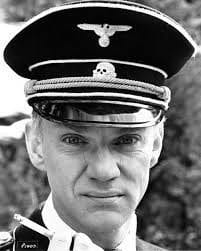
Malcolm McDowell as captain von Berkow

3,749 words

Karel Veliky

Original in Czech: https://deliandiver.org/sadonacismus-ve-filmu-cast-4/ 

Translated by Ondrej Mann

“We must categorically reject the attempt, made primarily by W. Reich, to derive the instinct for destruction from the repression of the instinct for pleasure.”

—Julius Evola, Eros and the Mysteries of Love: The Metaphysics of Sex.

Visconti’s authority and the international success of his The Damned (see Part II) were reflected in the fact that in the early 1970s there was perhaps no film about “fascism” or “Nazis” that did not take into account their “sick sexuality.” The Conformist (1970, dir. B. Bertolucci), based on the novel by Alberto Moravia, depicts the behavior of a man (played by J. P. Trintignant), a weak-willed intellectual for whom the only acceptable way out of his own insecurities is to “merge with the totalitarian crowd.” His lack of self-confidence stems from childhood trauma: as a boy, he was raped by an older man and is convinced that he killed his rapist when he shot at him. His efforts to overcome these complexes, feelings of humiliation and guilt, combined with states of exclusion, [1] then compel him—according to the Freudian scheme—to maximum adaptability: to a determination to fit into the course of social events at any cost, including “political murder.” This interpretation of “submission to fascism” is thus another illustration of Sartre’s equation “passive pederasty–active collaboration”. However, this is by no means a curiosity projected in obscure theaters somewhere on the periphery—The Conformist appealed to a wide audience and, thanks mainly to its artistic qualities, is still considered one of the best works of Italian cinema!

While in The Conformist Bertolucci—making no secret of his Freudian-Marxist inspiration—showed why even “intelligent people” joined fascism, in the second half of film 1900 (1976), an almost six-hour epic of “class struggle,” he portrayed a “born fascist” in the form of a demonically sadistic administrator named Attila (another nomen omen). The opening scene (“Struggles, Loves and Hopes”) is telling, with Attila demonstrating his fascist determination by killing an innocent animal. He continues by shooting defenseless villagers and sexually murdering a little boy. The interpretation of fascists as rapists of society undoubtedly reaches one of its dubious peaks here. Let us recall that Bertolucci began his career as Pasolini’s assistant. . .

Sexual undertones are more or less evident throughout the entire series of films depicting the frenetically decadent 1920s and 1930s as the “breeding ground” or “fruit” of fascism. This is the case in the film Cabaret (1972, dir. Bob Fosse) with its famous scene in which a young blond “Nazi” sings the song “Tomorrow Belongs to Me” so convincingly that it was cut from the film for screenings in Germany and became the anthem of the nationalist youth in Italy for a long time after the band La Compagnia dell’Anello included it in their repertoire, without anyone minding that it was supposedly composed by two Jews. [2]

Divina creatura (1975, dir. Giuseppe Patroni Griffi) captivates with Laura Antonelli’s charms, an abundance of literary references, the youthful exuberance of Michele Placido, and the acting of Brit Terence Stamp (among others, the Messiah in Pasolini’s Theorem!) in the role of the main “hero,” Prince de Bagnasca, whose bedroom is decorated with paintings by Klimt and Moreau, but who otherwise spends his fortune on drugs and love affairs. In the latter, his rival in passion is Marcello Mastroianni as Michelle Barra, a fascist marquis: the final scene from a wild party that ends with Giovinezza (the official hymn of the Italian National Fascist Party) sung by drunken “reactionaries” and their prostitutes to the accompaniment of a piano, is significant.

Seven Beauties (1975, dir. L. Wertmüllerová) remains undeservedly much better known, a kind of “negative” of The Night Porter (and one of many films reducing the German vocabulary to “los,” “schneller,” “Achtung,” and “Schweinehunde”). This was probably also due to the personality of the director, who had long rivaled Cavani in salon scandalism and, with this film, became the only female director nominated for an Oscar for a long time! G. Giannini’s entertaining film problematizes the glorified “Latin lover” type in Italy.

The surreal, Kafkaesque Mr. Klein (1976, dir. J. Losey) sets the romantic motif of the double in German-occupied Paris and a nearby castle. Alain Delon plays a greedy antique dealer who unscrupulously profits from Jews who suddenly find themselves in dire straits by buying up their property at bargain prices (the beautiful “Gnostic-Kabbalistic” painting at the beginning!), until he “becomes a Jew” and ends up being transported instead of his mysterious alter ego (according to Freud, the unconscious part of the psyche). Shots from medical examinations of those to be evacuated, or from a cabaret, clearly show where Losey drew some of his inspiration. However, the film aroused displeasure for other reasons. On the one hand, it showed that there were Jews who had enough money to simply pay for their departure from France without having to make any significant changes to their lifestyle, and on the other hand, it emphasized the cold indifference of the French (unless they were directly relieved) to the fate of their Jewish neighbors. Before boarding the trains, these Jews were “concentrated” in the city stadium. Everyday life goes on as normal.

The Serpent’s Egg (1976, dir. I. Bergman) shows Berlin in the 1920s as a “hopeless world from a nightmarish dream, in which all the horrors of approaching fascism are already looming—like a fully developed snake visible through the thin shell of an egg.” The snake takes the form of a doctor who conducts various experiments in his clinic, where several murders have taken place. The good is represented by Abel, an American Jew. And of course, cabaret is a must. [3]

Nest of Vipers (1977, dir. T. Cervi), the “snakes” are already mating—this time in Venice. Despair (1978, dir. R. W. Fassbinder), based on Nabokov and with screenplay contributions from Moravian native Tom Stoppard, is, like Mr. Klein, based on the motif of the double, but also on the desire for death and the concept of “murder as a fine art” (Thomas de Quincey). The film, overflowing with “art deco decor,” reflects the “uncertain times” of the Weimar Republic with its Sturmabteilung in the streets through the eyes of a deranged factory owner of Jewish origin, an emigrant from Soviet Russia, in a disturbing performance by Dirk Bogarde (see “The Damned” and “The Night Porter”).

All these films of the seventh decade seem to be summed up in Just a Gigolo (1979, dir. D. Hemmings): a garish sex cabaret, gay Nazis, sadly comical weirdos, communist shadows, capitalists enjoying themselves, impoverished junkers. In short, the whole panorama of “decadent Weimar”—the decline of the West, perfect bittersweet kitsch. The cast is extremely exclusive: Marlene Dietrich in her last role, Baroness von Semmering, sings the melancholic chanson Just a Gigolo as the owner of a dubious dance hall, singer David Bowie, a few years after his “cocaine-fascist” period, [4] plays the fearless former Prussian officer Paul von Przygodsky, who, in the permanent crisis of the so-called “Weimar democracy,” ultimately becomes, fittingly, “just a gigolo.” David Hemmings, the most famous of Antonioni’s “Blow-Up,” then tries, as “Captain Kraft,” to permanently and unsuccessfully win Paul von Przygodsky over to National Socialist ideas, while singer Curd Jürgens lends his appearance to the obese “prince,” etc. The strangely peculiar tone of the film is undoubtedly influenced by the fact that a significant portion of the footage was destroyed by fire, so the final version is the result of an emergency edit. Best scenes: when Kraft, who lives in a disused Berlin subway wagon, plays Wagner on a gramophone to Przygodsky over the sound of passing trains and shows him Nietzsche’s writings; when Przygodsky, hit by a stray bullet in a street shootout between militants, ultimately becomes—unintentionally and unknowingly—”a martyr of the movement.”

Our list cannot be exhaustive, as Freudo-Marxist and Sadian influences have permeated even the most disparate genres. The Diary of Chambermaid (1964, dir. L. Buñuel), members of the Catholic “French Action” are pedophiles who rape and kill a minor, while the “Gothic” Horror Castle (1963, dir. A. Margheriti), with a disfigured Christopher Lee, refers to “Nazi torture chambers,” Shock Waves (1977, K. Wiederhorn) with Peter Cushing as Frankenstein, who, as a former SS officer on a Caribbean island, commands a unit of Nazi zombies called the “Totenkorps”—previews the recent Dead Snow (2009, T. Wirkola), in the thriller Marathon Man (1976, dir. J. Schlesinger), Dustin Hoffman plays a Jew interrogated by the sadistic “SS dentist” Szell (Laurence Olivier); the comedy Sturmtruppen (1977, dir. L. Samperi), the detective film The Night of the Generals (1967, dir. A. Litvak) and the drama The Old Gun (1975, dir. R. Enrico) all deal with the “excesses of military power,” while The Skin (1981, dir. L. Cavani), based on Malaparte’s novel of the same name (the title itself evokes the idea of “getting under the skin,” “skinning,” its cutting, sex, even cannibalism) boldly manifests the idea of replacing one “evil” with another: When the Americans, with substantial logistical support from the mafia, occupied the area around Naples in 1943 without resistance from the enemy, their presence led to the prostitution of the entire society. [5]—everything is now governed solely by what can be sold to the “allies” (poor mothers from the lowest classes sell their children, daughters and sons, to the “goat fuckers” of the Moroccan legions); The only ones who really profit from all this (e.g., from extortion money for German prisoners of war, who are fattened up for meat in local restaurants) are the “patriotic” mafiosi, who always manage to cheat the gullible Americans. [6]

The adventurous The Passage (1979, dir. J. Lee Thompson) deserves a separate mention, in which the family of Jewish professor Bergson (!) flees from the Nazis across the Pyrenees with the help of a tough Basque shepherd (Anthony Quinn). Malcolm McDowell (Alex from A Clockwork Orange, later Caligula) as the “fanatical SS captain von Berkow” who pursues them surpasses similar performances by Helmut Berger (The Damned, Salon Kitty, Code Name: Emerald), Dirk Bogarde (The Night Porter), Helmut Griem (The Damned) and Klaus Kinski (Five Into Hell, Heroes in Hell). Particularly memorable are the interrogation scene in the kitchen (“cut, cut”), the burning of a gypsy (“I’ll send him exactly where he sent me—to hell”), and the giant swastika on the captain’s underpants as he prepares to abuse the professor’s daughter. The clownery culminates when, in one shot, he puts a black comb under his nose to look like “you know who,” or when, bloodied and with a gun in his hand, he emerges from under tons of snow from an avalanche that Bask wanted to bury him under. [7]

Perversion as a “consequence of the liberated energy of social events” also penetrated behind the Iron Curtain, most clearly—unsurprisingly—in Yugoslavia, where the barrier was more permeable: The Fall of Italy (1981, dir. L. Zafranovič) thus situates, alongside the groundedness, naturalness, and vibrant beauty of the “domestic” landscape (sun, sea, wine, brandy), the vigorous people, and the nakedness of women, “foreign” fascism as a nightmarish D’Annunzio-esque theater (note the absurd performance of the Italian “colonel” associated with burning at the stake, or the “SS angel of death” who approaches the “scene” of a mock ritual execution on a sidecar! This is presented as something highly artificial and artistic. Add to this the “gags” and caricatures of Croatian Ustasha, Serbian Chetniks, and savagely “innocent” Circassians. The hammering of nails into the heads of those arrested in an Ustasha bus from Zafranovič’s Occupation in 26 Pictures (1978), in the special effects quality of Romero’s early productions, may have remained the most brutal thing that could be seen in the regular distribution network of cinemas in socialist Czechoslovakia. And the filming of a Nazi party at the town hall with a cavalcade of bare breasts is clearly inspired by both The Damned and Salon Kitty. The Hungarian-German film Mefisto (1980, dir. I. Szabó), based on Klaus Mann’s novel about a “pact with the devil” (read: with “Nazism”) concluded by Klaus Maria Brandauer in the role of actor Hendrik Höfgen—a variation on the “conformist” who lost his identity (symbolized by a mask) and “helped bring fascism into the world.” [8]

The Czech film Pramen života (Spring of Life, 2000, dir. M. Cieslar), based on a screenplay by Vladimír Körner (Údolí včel—The Valley of the Bees 1967), can be considered a late response to these films. Although the subtitle “A story about how even the greatest cruelties happen without cruelty” is more indicative of an elaboration and application of Arendt’s “banalization of evil.” The story of a poor Silesian girl, Gréta Weiserová, who is sent to the Isolde forest sanatorium to be raised in the spirit of a new order, is, in the director’s words, an attempt to “portray the entire system of the birth of a new generation of Germans as faithfully and impressively as possible for the period.” “Emphasis was placed on the authenticity of the details, the choice of locations for filming, the props, and the overall visual style (…) we conceived the film in the gray, lifeless colors of winter, which are illuminated by SS rituals dominated by the red color of blood,” explained Milan Cieslar. But what good is that? When it comes to the “dramatic relationship” between Grétka and the Jewish boy (the “cuckoo’s egg” motif)? even the evil Odillo—well cast by Karel Dobrý in the role of a cultivated SS officer—is powerless against such “screenwriting banality.” [9]

Sadonazism today

During the 1980s, the genre naturally fell out of fashion: The Berlin Affair (1985, dir. L. Cavani) is more of an elegant melodrama about lesbian love between the wife of a German diplomat and the daughter of the Japanese ambassador to Germany in the 1930s. Helmut Berger starred in the trash horror film Faceless (1987, dir. J. Franco)—an adaptation of Franju’s Eyes Without a Face—”played” a plastic surgeon who uses “experimental experience” from a “concentration camp,” but he did not surpass the perversion displayed in Behind the Glass (1986, dir. A. Villaronga).

The association of “fascism” with sexual deviance also began to offend. A construct whose foundations date back to the interwar period and deeper [10], could not be viable at a time when its essential elements (based on Foucault’s theses) had been transformed into cherished components of the “new proletariat” of oppressed minorities (instead of the bourgeoisified working class disappearing in favor of “services”). Perversion was therefore promptly removed from the list of the “roots of fascism” proclaimed by Leftists and liberals, which included fear, anger, envy, and frustration. Nevertheless, “sadonazism” fulfilled its “historical role”: it undoubtedly contributed to the viewer learning to perceive monstrosities and oddities almost as normality. S/M stylization thus moved from “hidden” cardboard dungeons, padded cells, and soundproof “laboratories” into the mainstream, from the sick minds of eccentrics of all kinds to television and from there into the imaginations of the middle class and the masses.

The 1990s, alongside the obvious pornography of Le bambole del Führer (1995, dir. J. d’Amato), also saw the birth of the rather exceptional  The Ogre (1996, dir. V. Schlöndorff). The protagonist is Abel, a Parisian car mechanic, a mentally retarded foundling, a “simpleton with the face of a murderer” (John Malkovich—who else?), who is sent to the front after being accused of raping a schoolgirl, where he is captured by the Germans. From the prison camp, he accidentally ends up serving in a hunting lodge, where Marshal Göring himself takes a liking to him for his humiliating simplicity. However, he only becomes a servant of true “Evil” when, in the nearby ancient castle of Count Kaltenborn, now home to a military academy for boys, Professor Blättchen, a professor of racial genetics, entrusts him with the task of finding Nordic-looking boys from the surrounding villages for the school. Abel, on horseback, in a long black cloak and with two Dobermans, becomes a local ghost. . . Although the film is overburdened with clichés (Abel’s “epiphany,” hiding a Jewish refugee, biblical metaphors, etc.), the “narrative” is at times impressive (boys living with the vision of an invincible Germany, refusing to surrender to Russian tanks), interesting (insights into the workings of the institution) and long controversial (Abel, as a “monster” devoted to something more knowledgeable and powerful, feels truly content for the first time, convinced that he is perfectly fulfilling his destiny).  11]

In the new millennium, Tinto Brass attempted to revive the genre with Black Angel (2002, dir. T. Brass), which he once again set in the Republic of Salò. [12] The film faithfully reproduces many of the images and motifs from the 1970s, which are also enthusiastically paid tribute to in the “Tarantinoesque” (=> Inglourious Basterds, 2008) trailer for the fictional Grindhouse: Werewolf Women of SS (2007, dir. R. Zombie). And even Pasolini might have turned pale before The Human Centipede (2009, dir. T. Six)! [13]

Film “sadonazism” can certainly be interpreted to a large extent as a self-projection of its creators, Jews, wheeler-dealers, Leftists, and other deviants (cf. e.g. “Viennese Actionism”). On the other hand, it is undeniable that many so-called “neo-Nazis” identify with this demonic, negative image, which explains why their “scene,” not only in the US, continues to attract so many weirdos (hence its impotence and numerous ridiculous features!). The influence on Scandinavian black metal, or performers such as Nachtmahr or Shadow Reichenstein, is obvious, as is the influence on various “collectors” (Pierluigi Concutelli, a militant of the New Order, calls them “armchair fascists”), “cosplayers” (as in “dress-up artists”), who adorn themselves and surround themselves with bizarre props and other junk. [14] After all, an SS uniform with a skull, daggers, and rings has about as much symbolic value after the post-Nazi film orgy as a headless Templar costume, a manga image, an evil character somewhere between Hellboy and Darth Vader, see the children’s “bogeyman” Beyond (2000, dir. A. Sandgren) or the sci-fi film Iron Sky (2011, dir. T. Vuorensola)—it has simply long been part of pop folklore.

Notes:

  1. These stem not only from the fact that Trintignant’s Marcello Clerici (a clearly suggestive name, a cleric-intellectual) achieved the status of a respected philosopher, but—in the “spirit” of Freudianism—also from the “phallus” of a firearm, whose absolute power he “savored” at the age of thirteen by simply pulling the trigger.
  2. John Kander and Fred Ebb. Note also Helmut Griem (alias SS Captain Aschenbach from “Twilight“), this time as the bisexual Baron Max.
  3. See Stefano Vaj’s comments on the film The Serpent’s Egg in his note no. 24 on p. 21 of Locchi’s “The Essence of Fascism.” The best book on “Weimar decadence” remains Erich Kästner’s Fabian, a novella that was made into a film by Wolf Gremm in 1980.
  4. On Bowie, see here.
  5. The similarity to post-November developments in Czechoslovakia is striking! However, a performance in which a transvestite simulates childbirth so that, to the cheers of the crowd, a plastic baby boy with an enormous penis is “born” would today most likely be funded by EU funds for cultural development and equal opportunities. See the recent victory of the “bearded singer” in Eurovision. . .
  6. Thanks to US military aid during the war (the use of Italian emigrants and smuggling routes for espionage, etc.) and its above-standard relations with US intelligence services, the mafia established its post-war influence, which extended to the highest echelons of the demoliberal regime.
  7. McDowell’s counterpart is the “pure Nordic” Rutger Hauer as the “decent” SS-Sturmbannführer Xavier March in Fatherland (1994, dir. Ch. Menaul). The film is set in 1964, when the new Greater German Reich of Germania rules Europe and seeks to establish friendly relations with the US to help end the protracted guerrilla warfare behind the Urals (the expected arrival of President Kennedy coincides with the Führer’s 75th birthday celebrations). We mention this mainly because it was largely filmed in Prague: for example, the building of the former Federal Assembly of the Czech and Slovak Federal Republic next to the National Museum, a structure standing on four double pylons, is used as an “SS office” and is truly heart-wrenching. . .
  8. Further variations on these “conformists” can be seen in Ettore Scola’s films: the homosexual radio editor Gabriel in A Special Day (1977) and the collaborator figures-masks in Le Bal (1982). In terms of atmosphere, “Mephisto” is also very close to The Last Metro (1980, F. Truffaut).
  9. Luděk Munzar still holds the top spot for Czech portrayals of SS officers. Watch him closely in “Vyznavači ohně” (Fire Worshippers), the second episode of the first series of the TV series about Major Zeman, as Dr. Wolf (!), an SS weapons doctor, who says with growing passion: “We are not defeated. The flame has not been extinguished, it is only smoldering. Every Act that sanctifies our idea is as pure as the fire we profess. The fire will break out again, the whole world will go up in flames. And on its ruins we will build a new, eternal Reich.” Jiří Štěpnička is also excellent as Rudolf Höller, a former “camp commander,” in Thomas Bernhard’s play Před penzí—”Before the Pension” (“The Jews will destroy all of nature!”), which was recorded by Czech Television.
  10. Two random dates: in 1895, Oscar Wilde was sentenced to two years in prison and hard labor for homosexuality; in 1962, a new constitution legalized sodomy in Czechoslovakia.
  11. Volker Schlöndorff dedicated the film to Louis Malle, for whom he worked as an assistant, probably also in memory of his Lacombe Lucien (1974). One interpretation claims that this occupation drama also “examines the phenomenon of collaboration as a consequence of mental disability.” However, Lucien is more of a simple, rural simpleton. We would like to remind you that Schlöndorff had already sketched out his vision of totalitarianism in The Handmaid’s Tale (1990).
  12. The film features numerous flags with swastikas hanging around in a nonsensical manner, but there are also brief glimpses of young men dressed in uniforms of various armed forces of the Italian Social Republic Salo. For a more realistic take, see Blood of the Losers (2008, dir. M. Soavi) or even the old The Fascist (1961, dir. L. Salce). Also worth mentioning is Everybody Go Home! (1960, dir. L. Comencini).
  13. Or the creators of such “blockbusters” as Awakening of the Beast (1970, J. M. Marins), Cannibal Holocaust (1980, R. Deodato), or Guinea Pig: Devils Experiment (1985, dir. Satoru Ogura) and Tokyo Gore Police (2008). Long live the free market!
  14. See the film Zlopověstné dítě (The Ill-Fated Child, 2003, dir. L. Králová–M. Novák) about a young man who is fascinated by the evil of concentration camps and investigates how they function: he searches archives, interviews survivors, collects “souvenirs,” etc.

Special tips: Christopher Lee as Mr. Midnight in The Return of Captain Invincible (1982); Yukoku (1966, dir. J. Mishima) and Žižek’s Pervert’s Guide to Cinema (2006, dir. S. Phiennes).

Sadonazism in Film, Part 4

Sadonazism%20in%20Film%2C%20Part%204%0A

Share

  • Gab

Enjoyed this article?

Be the first to leave a tip in the jar!

Instant Echeck GreenPay™

Related

  • An Interview with Endeavour:

  • About film “From the Right”

  • Neo-Fascism in Film Part 6

  • Neo-fascism in Film Part 5

  • Neo-fascism in film part 4

  • Neo-Fascism in Film, Part 3

  • Neo-Fascism in Film, Part 2

  • Neo-fascism in Film, Part 1

Tags

A. MargheritiA. VillarongaBernardo BertolucciBob FosseDavid HemmingsEttore ScolafilmFrançois Roland TruffautGiuseppe Patroni GriffiIngmar BergmanJ. d'AmatoJ. Lee ThompsonJ. LoseyJ.M. MarinsKarel VelikyL. BuñuelL. KrálováL. WertmüllerováL. ZafranovičLiliana CavaniLuchino ViscontiM. CieslarM. NovákM. SoaviOndrej MannPier Paolo PasoliniS. PhiennesT. CerviThomas BernhardTinto BrassV. Schlöndorff

Previous

« Counter-Currents Radio Podcast No. 676

Next

» Manchester Benighted:

8 comments

  1. Fred C. Dobbs says:
    February 19, 2026 at 3:21 pm

    What???? No mention of Ilsa. She Wolf of the SS??

    1
    1
    • Uncle Semantic
    1. Ondrej Mann says:
      February 19, 2026 at 3:47 pm

      Try reading part 3 of the series. It describes this film and the entire genre of films that this film influenced.

      0
      0
      1. Fred C. Dobbs says:
        February 19, 2026 at 3:49 pm

        Will do. I must’ve missed it

        1
        1
        • Ondrej Mann
  2. Uncle Semantic says:
    February 21, 2026 at 4:20 pm

    ‘Cocaine Fascism’. I like the sound of that. Did the girls start to dig Bowie during this and the Ziggy Stardust days for those old enough to remember?

    0
    0
  3. Viktor Schmidt says:
    March 23, 2026 at 8:20 pm

    “fanatical SS captain von Berkow”


    Ha-ha-ha, Berkow is a Jewish name.

    0
    0
    1. Ondrej Mann says:
      March 25, 2026 at 6:09 am

      The entire world of Judaism and Nazi-themed cinema is deeply intertwined. Jews both hate Nazism and admire it, projecting their own sexual fantasies and notions of power onto it. It is a very strange world. At the time, it had a profound impact on many viewers.

      0
      0
      1. Viktor Schmidt says:
        March 26, 2026 at 4:53 am

        The interest of (some) Jews to Nazis in the modern America was shown in the film THE BELIEVER with Ryan Gosling, for example.

        0
        0
        1. Ondrej Mann says:
          March 26, 2026 at 2:04 pm

          Get ready for a wild ride. A new film series called “Neofascism in Film” is now launching on CC. It will take an in-depth look at film The Believer and other similar films. It’s an incredibly detailed film series.

          0
          0

Comments are closed.

If you have a Subscriber access,
simply login first to see your comment auto-approved.

Note on comments privacy & moderation

Your email is never published nor shared.

Comments are moderated. If you don't see your comment, please be patient. If approved, it will appear here soon. Do not post your comment a second time.

Upcoming podcasts
  • Rob Rundo on Counter-Currents Radio

    Rob Rundo on Counter-Currents Radio

    Counter-Currents Radio

    Sat, Jun 13th — 3 pm EST / 9 pm CET
  • Daniel Tyrie on Counter-Currents Radio

    Daniel Tyrie on Counter-Currents Radio

    Counter-Currents Radio

    Sat, Jun 20th — 3 pm EST / 9 pm CET

Writers of May

(2 votes) Morris van de Camp David M. Zsutty Derek Stark Jayant Bhandari Greg Johnson

Articles of May

The Lunch Wars by David M. Zsutty Heidegger on Nietzsche, Part One by Collin Cleary 2 votes
    • Black Intellectual Fatigue

      Derek Stark

      5

    • Why White Advocates Should Avoid “Based Blacks”

      Dani Vypont

      7

    • Nietzsche & Race

      Mark Gullick

    • Editor’s Update
      Rob Rundo Rescheduled to Next Week on Counter-Currents Radio;
      Tonight Greg Johnson & David Zsutty Answer Your Questions;
      Fundraiser Update & a New $20,000 Matching Grant

      Greg Johnson

    • The Counter-Currents 2026 Fundraiser
      Lifetime Subscriber Welcome Packages Extended

      Greg Johnson

    • Nationalism This Week
      Who’s Looking Back?

      Greg Johnson

      25

    • China’s Threat to American Security:
      Food, Farmland, Foreign Control, & Energy Policy

      Lipton Matthews

      4

    • The Bitter End of Western Metaphysics:
      Heidegger on Nietzsche, Part Two

      Collin Cleary

      13

    • The Killing of Henry Nowak

      Mark Gullick

      29

    • The Crisis of Chinese Technology Thieves

      Morris van de Camp

      1

    • The Strange World of Gender Bender Fiction:
      & What This Genre Tells Us About Autosexuality

      Dani Vypont

      3

    • Watching the Watchers:
      The Dark Triad Question

      David M. Zsutty

      14

    • The Remigration Movement Solidifies

      F. Roger Devlin

      1

    • Casting Aspersions:
      The Fatal Consequences of Race-Swapped Casting, From Helen of Troy to Henry of Southampton

      Steven Tucker

      20

    • The Murder of Henry Nowak

      Millennial Woes

      23

    • Don’t Forget to Vote in Our Writer & Article of the Month Poll

      Greg Johnson

    • The Robot Hotdog Stand

      Greg Johnson

      35

    • Laughing Our Way to Victory

      Dave Chambers

      7

    • The Zodiac Killer

      Mark Gullick

      11

    • Jared Taylor: What Rome Means to Me

      Jared Taylor

      1

    • An Interview with Endeavour:
      My Way of Life Is an Adventure!

      Ondrej Mann

      6

    • José Pedro Zúquete’s The Identitarians

      Greg Johnson

      3

    • Editor’s Update
      Fundraiser Update & How to Watch the Remigration Summit

      Greg Johnson

      5

    • The Bitter End of Western Metaphysics:
      Heidegger on Nietzsche, Part One

      Collin Cleary

      11

    • Berlin: City of Stones

      Spencer J. Quinn

      6

    • True Folk-Horror Is Horror of Your Own Folk:
      Mark Gatiss vs the Brexit Blind Dead  

      Steven Tucker

      4

    • Counter-Currents Radio Podcast No. 689
      Thomas Massie, the America 2050 Bust, the Need for Whites to Divest from America, the AI Economic Apocalypse, & Pro-White Project Pitches to Billionaires

      Counter-Currents Radio

      7

    • Nationalism This Week
      Remigration is Inevitable, Part 3

      Greg Johnson

      27

    • Why Billionaires Should Fund White Identity Politics

      Lipton Matthews

      8

    • How Cold War Two Came About

      Morris van de Camp

      5

    • Now Available for Pre-Order at a Special Price!
      Greg Johnson’s The Philosopher Is In

      Greg Johnson

    • David Zsutty’s Elevator Pitch to a Billionaire

      David M. Zsutty

      1

    • Headbanging Lite

      Mark Gullick

      5

    • White Advocacy Past and Present

      Peter Bradley

      13

    • The Lunch Wars

      David M. Zsutty

      47

    • The Russians are Coming/The Russians are Coming

      Steven Clark

      1

    • Peak Fatigue in Fort Wayne

      Gabriel Anderson

      24

    • Keith Woods’ Elevator Pitch to a Billionaire

      Keith Woods

    • The Cruelty of Kindness

      Morris van de Camp

      9

    • Predation Wearing the Mask of Civilization

      Jayant Bhandari

      13

    • The Mandalorian & Grogu

      Trevor Lynch

      24

    • Editor’s Update
      Fundraiser Update & a New $20,000 Matching Grant
      Greg Johnson & David Zsutty Discuss Thomas Massie on Counter-Currents Radio

      Greg Johnson

      2

    • How the Jews Defeated Thomas Massie—& Themselves

      David M. Zsutty

      25

    • Jared Taylor’s Elevator Pitch to a Billionaire

      Jared Taylor

      15

    • Nationalism This Week
      Remigration Is Inevitable, Part 2

      Greg Johnson

      8

    • Could Fascism Work?

      Mark Gullick

      40

    • Jonathan Bowden’s Deliverance
      Part 7

      Jonathan Bowden

    • China’s Quiet Hand:
      Influence, Infiltration, & the Western Blind Spot

      Lipton Matthews

      9

    • Counter-Currents Radio Podcast No. 688
      Tyler Dykes on Running for US Congress in South Carolina

      Counter-Currents Radio

      4

    • Lothrop Stoddard’s The Revolt Against Civilization

      Spencer J. Quinn

      14

    • Eric

      Black Intellectual Fatigue

      Greetings.  "Black intellectuals" are also known as, "professional negroes."

    • Collin Cleary

      The Bitter End of Western Metaphysics:
      Heidegger on Nietzsche, Part Two

      Perhaps the irony here is that he was mistaking appearance (what appears to a human subject) as...

    • Collin Cleary

      The Bitter End of Western Metaphysics:
      Heidegger on Nietzsche, Part Two

      No, Heidegger wasn't an influence on either.

    • Scott

      China’s Threat to American Security:
      Food, Farmland, Foreign Control, & Energy Policy

      I don’t fear or hate the Chinese. But China is still a Communist nation and they will never be our...

    • Eric

      Black Intellectual Fatigue

      Thank you very much for this fine article.  One book opens another.  Mr. Stark has...

    • Scott

      Why White Advocates Should Avoid “Based Blacks”

      Agree with most of the article. Spot on about Negroes and the dusky grifter, Candace Owens.However,...

    • Will Williams

      Black Intellectual Fatigue

      Am I the only White racial nationalist who is fatigued from Black “intellectual” Lip Man Matthews...

    • Will Williams

      Why White Advocates Should Avoid “Based Blacks”

      Dani, your understanding of GLR is wanting. You and others would do well to read the eight-part...

    • Peter Quint

      Black Intellectual Fatigue

      Great article! “Black intellectuals,” if that’s not an oxymoron, I don’t know what is. 🙃

    • Peter Quint

      Why White Advocates Should Avoid “Based Blacks”

      Great article! It is “past-time” that each White person developed a “siege mentality.” Each White...

    • Fred C. Dobbs

      Black Intellectual Fatigue

      It’s great to see increasing movement in the right direction. Excellent review. I often wonder if...

    • Derek Stark

      China’s Threat to American Security:
      Food, Farmland, Foreign Control, & Energy Policy

      Very good article. I remember back in the 1980s and 1990s how all the genius economists were saying...

    • Will Williams

      Counter-Currents Radio Podcast No. 688
      Tyler Dykes on Running for US Congress in South Carolina

      I rarely listen to long podcasts, but was interested in this one with Mr. Dykes, the American...

    • Tye

      Why White Advocates Should Avoid “Based Blacks”

      Exactly, enough of the precious exceptions.

    • Joe Gould

      Why White Advocates Should Avoid “Based Blacks”

      Amen to this whole article.

    • Peter Quint

      Why White Advocates Should Avoid “Based Blacks”

      That goes for all non-whites! 🙃

    • Moss

      The Killing of Henry Nowak

      Well said Joe. That bears repeating.

    • Fred C. Dobbs

      Why White Advocates Should Avoid “Based Blacks”

      I would advise all white people to never even befriend a black person. You will always get burned....

    • Hi-ya!

      Nationalism This Week
      Who’s Looking Back?

      the attraction of owning a radio is so much greater than the fear of propaganda Jacque ellul

    • Hi-ya!

      Nationalism This Week
      Who’s Looking Back?

      The Death of an Era My room was a block away I opened the bar at 5AM and closed it at 2AM Often...

    • Earth Day Special

      John Morgan

      12

    • A Robertson Roundup
      Remembering Wilmot Robertson
      (April 16, 1915 – July 8, 2005)

      Margot Metroland

      13

    • The Paranoid Style in White Nationalism

      Greg Johnson

      30

    • Join the Dance!

      Andrew Hamilton

      1

    • We Can’t Save the Earth Without Reducing African Birth Rates

      James Dunphy

      36

    • “I’m Not a Conspiracy Theorist, but . . .”:
      Jeffrey Epstein’s Death Gives New Life to “Conspiracy Theories”

      Greg Johnson

      22

    • Sylvia Plath: Stasis in Darkness

      Vic Olvir

      17

    • Vanguardism, Vantardism, & Mainstreaming

      Greg Johnson

      80

    • Aviation, Geography, & Race

      Charles Lindbergh

      3

    • Some Thoughts on Yule

      Collin Cleary

      4

    • Living in Truth:
      A Yuletide Homily

      Jef Costello

      7

    • John Kennedy Toole’s A Confederacy of Dunces

      Greg Johnson

      20

    • On Aleksandr Solzhenitsyn’s Warning to the West

      Spencer J. Quinn

      7

    • Elitism, British Modernism, & Wyndham Lewis

      Jonathan Bowden

      6

    • Philip K. Dick’s Do Androids Dream of Electric Sheep? as Anti-Semitic/Christian-Gnostic Allegory

      Greg Johnson

      20

    • “Conspiracy Theory” or Conspiracy?

      Andrew Hamilton

      21

    • Remembering H. P. Lovecraft
      (August 20, 1890–March 15, 1937)

      Greg Johnson

      3

    • Who Are We?
      Nordics, Aryans, & Whites

      Greg Johnson

      71

    • Remembering William Gayley Simpson
      (July 23, 1892–December 31, 1990)
      A Pleasant Afternoon with Harriet & Bill Simpson

      Margot Metroland

      18

    • Here are the Young Men
      Remembering Ian Curtis
      (July 15, 1956–May 18, 1980)

      Mark Gullick

      18

    • Percy Grainger
      Artist of the Right

      Alex Graham

      7

    • Remembering Revilo Oliver
      (July 7, 1908–August 20, 1994)

      Greg Johnson

      18

    • The Meaning of July 4th for the White Man

      Gregory Hood

      13

    • The Front National’s Evolution

      Bruno Mégret

    • Merwin K. Hart
      Forgotten American Hero & Man of the Right

      Morris van de Camp

      10

    • George Orwell’s Nineteen Eighty-Four

      Jonathan Bowden

      8

    • Carleton S. Coon
      Scientist & Reluctant White Advocate

      Morris van de Camp

      3

    • The Kwanzaa Absurdity Will Be Dwarfed by Juneteenth

      Robert Hampton

      10

    • Stravinsky

      Alex Graham

      7

    • Like the Roman:
      Remembering Enoch Powell (1912-1998)

      Mark Gullick

      23

    • Neo-Fascism in Film
      Part 5

      Karel Veliky

      15

    • The Game of Tarot

      Mark Gullick

      1

    • Institutions Cannot Be Transplanted

      Jayant Bhandari

      5

    • Jonathan Bowden’s Deliverance
      Part 5

      Jonathan Bowden

    • Crosstown Traffic:
      Jimi Hendrix & The Post-War Rock ‘N’ Roll Revolution

      Mark Gullick

      1

    • Slaves from the North:
      Finns & Karelians in the East European Slave Trade, 900–1600

      Lipton Matthews

      14

    • Neo-Fascism in Film
      Part 4

      Karel Veliky

      2

    • David Lean’s A Passage to India

      Spencer J. Quinn

      1

    • Elites are Essential to Development

      Lipton Matthews

      7

    • Jonathan Bowden’s Deliverance
      Part 4

      Jonathan Bowden

    • Neo-Fascism in Film
      Part 3

      Karel Veliky

      6

    • E. M. Forster’s A Passage to India & the Indian Mentality

      Spencer J. Quinn

      25

    • Jonathan Bowden’s Deliverance
      Part 3

      Jonathan Bowden

    • The Rest Is Silence
      Heidegger’s Quietism

      Mark Gullick

      2

    • Dispelling the Historical Fallacy of Indian Nationalism

      Lipton Matthews

      8

    • Neo-Fascism in Film
      Part 2

      Karel Veliky

      8

    • Jonathan Bowden’s Deliverance
      Part 2

      Jonathan Bowden

    • Life of a Klansman

      Mark Gullick

      8

    • Jonathan Bowden’s Deliverance, Part 1

      Jonathan Bowden

    • Decolonial Ideas are Holding Back Developing Countries

      Lipton Matthews

      8

    • Neo-fascism in Film, Part 1

      Karel Veliky

      21

    • Jonathan Bowden’s Onslaught, Part 8
      Divigations on Decadence

      Jonathan Bowden

    • Jonathan Bowden’s Onslaught, Part 7
      Intrigues in the National Front

      Jonathan Bowden

      1

    • Rotten to the Core

      Mark Gullick

      8

    • Strauss on Husserl’s “Philosophy as Rigorous Science”

      Greg Johnson

    • Jonathan Bowden’s Onslaught, Part 6
      Francis Bacon & Right-Wing Nihilism

      Jonathan Bowden

    • London After (& Before) Midnight:
      Aleister Crowley, The Landlord’s Worst Nightmare

      James J. O'Meara

      2

    • Jonathan Bowden’s Onslaught, Part 5
      The Post-War British Far Right

      Jonathan Bowden

    • No Rules: Rollerball

      Mark Gullick

      4

    • Jonathan Bowden’s Onslaught, Part 3
      Brett Easton Ellis’ American Psycho

      Jonathan Bowden

    • András László
    • Derek Hawthorne
    • Beau Albrecht
    • Alain de Benoist
    • Kerry Bolton
    • Jonathan Bowden
    • Collin Cleary
    • Jef Costello
    • Savitri Devi
    • Julius Evola
    • Jim Goad
    • Gregory Hood
    • Juleigh Howard-Hobson
    • Greg Johnson
    • Charles Krafft
    • Anthony M. Ludovici
    • Trevor Lynch
    • H. L. Mencken
    • J. A. Nicholl
    • James J. O’Meara
    • Christopher Pankhurst
    • Tito Perdue
    • Michael Polignano
    • Spencer J. Quinn
    • Fenek Solère
    • Irmin Vinson
    • Leo Yankevich
    • Francis Parker Yockey
    • Multiple authors
  • Editor-in-Chief

    • Greg Johnson, Ph.D.

    Featured Writers

    • Beau Albrecht
    • Gunnar Alfredsson
    • Collin Cleary, Ph.D.
    • Jef Costello
    • Morris V. de Camp
    • F. Roger Devlin, Ph.D.
    • Stephen Paul Foster, Ph.D.
    • Jim Goad
    • Alex Graham
    • Mark Gullick, Ph.D.
    • Greg Johnson, Ph.D.
    • Travis LeBlanc
    • Trevor Lynch
    • Margot Metroland
    • James J. O’Meara
    • Angelo Plume
    • Spencer J. Quinn
    • Fred Reed
    • Clarissa Schnabel
    • Michael Walker
    • David M. Zsutty

    Frequent Writers

    • Asier Abadroa
    • Aquilonius
    • Alain de Benoist
    • Kerry Bolton, Ph.D.
    • Dave Chambers
    • Steven Clark
    • James Dunphy
    • Endeavour
    • Richard Houck
    • Jason Kessler
    • Titus Livius
    • Ondrej Mann
    • Lipton Matthews
    • Mark Mazari
    • John Morgan
    • Jaroslav Ostrogniew
    • Kathryn S.
    • Christian Secor
    • Anne Wilson Smith
    • Thomas Steuben
    • William De Vere
    • Kenneth Vinther
    • Max West

    Classic Authors

    • Maurice Bardèche
    • Jonathan Bowden
    • Julius Evola
    • Guillaume Faye
    • Ernst Jünger
    • Kevin MacDonald, Ph.D.
    • D. H. Lawrence
    • Charles Lindbergh
    • Jack London
    • H. P. Lovecraft
    • Anthony M. Ludovici
    • Sir Oswald Mosley
    • National Vanguard
    • Friedrich Nietzsche
    • Revilo Oliver
    • William Pierce
    • Ezra Pound
    • Saint-Loup
    • Savitri Devi
    • Carl Schmitt
    • Miguel Serrano
    • Oswald Spengler
    • P. R. Stephensen
    • Jean Thiriart
    • John Tyndall
    • Dominique Venner
    • Leo Yankevich
    • Francis Parker Yockey

    Other Authors

    • Howe Abbott-Hiss
    • Michael Bell
    • Giles Corey
    • Jack Donovan
    • Richardo Duchesne, Ph.D.
    • Emile Durand
    • Guillaume Durocher
    • Mark Dyal
    • Tom Goodroch
    • Andrew Hamilton
    • Robert Hampton
    • Huntley Haverstock
    • Derek Hawthorne
    • Gregory Hood
    • Juleigh Howard-Hobson
    • Alexander Jacob
    • Ruuben Kaalep
    • Tobias Langdon
    • Julian Langness
    • Patrick Le Brun
    • G A Malvicini
    • John Michael McCloughlin
    • Millennial Woes
    • Michael O’Meara
    • Christopher Pankhurst
    • Michael Polignano
    • J. J. Przybylski
    • Quintilian
    • Edouard Rix
    • C. B. Robertson
    • C. F. Robinson
    • Herve Ryssen
    • Alan Smithee
    • Fenek Solere
    • Ann Sterzinger
    • Robert Steuckers
    • Tomislav Sunic
    • Donald Thoresen
    • Marian Van Court
    • Irmin Vinson
    • Book Reviews
    • Movie Reviews
    • TV Reviews
    • Music Reviews
    • Art Criticism
    • Graphic Novels & Comics
    • Video Game Reviews
    • Fiction
    • Poems
    • Interviews
    • Videos
    • English Translations
    • Other Languages
      • Arabic
      • Bulgarian
      • Croatian
      • Czech
      • Danish
      • Dutch
      • Estonian
      • Finnish
      • French
      • German
      • Greek
      • Hungarian
      • Italian
      • Lithuanian
      • Norwegian
      • Polish
      • Portuguese
      • Romanian
      • Russian
      • Slovak
      • Spanish
      • Swedish
      • Ukrainian
    • Commemorations
    • Why We Write
  • Archives
  • Top 100 Commenters
  • The Looney Bin
Sponsored Links
Europa.com Above Time Coffee Antelope Hill Publishing Paul Waggener IHR-Store Spencer J. Quinn American Renaissance Jim Goad The Occidental Observer
Donate Now Mailing list
Books for sale
  • The Philosopher Is In
  • Sexual Utopia in Power (Expanded Edition)
  • In Defense of Prejudice
  • Loving Our Own
  • Tyranny & Wisdom
  • The Populist Moment
  • Is America Doomed?
  • To all books
Copyright © 2026 Counter-Currents Publishing, Ltd.

Paywall Access


Please enter your email address.

Lost your password?

Edit your comment

Writer & Article of the Month May 2026

Voting for this month has concluded. Here are the final results!

Top Writers

  • #1 Morris van de Camp 2 votes
  • #2 David M. Zsutty 2 votes
  • #3 Derek Stark 2 votes
  • #4 Jayant Bhandari 2 votes
  • #5 Greg Johnson 2 votes
  • #6 Jared Taylor 1 vote
  • #7 Collin Cleary 1 vote
  • #8 Spencer J. Quinn 1 vote
  • #9 Mark Gullick 1 vote
  • #10 Lipton Matthews 1 vote
  • #11 Keith Woods 1 vote
  • #12 Steven Tucker 1 vote

Top Articles

  • #1 The Lunch Wars 2 votes
  • #2 Heidegger on Nietzsche, Part One 2 votes
  • #3 Could Fascism Work? 1 vote
  • #4 Jared Taylor's Elevator Pitch to a Billionaire 1 vote
  • #5 Predation Wearing the Mask of Civilization 1 vote
  • #6 Peak Fatigue in Fort Wayne 1 vote
  • #7 Keith Wood's Elevator Pitch to a Billionaire 1 vote
  • #8 Do You Want to Play a Game? 1 vote
  • #9 Why Billionaires Should Fund White Identity Politics 1 vote
  • #10 The 1970s: The Golden Age of Hijacking 1 vote
  • #11 True Folk-Horror Is Horror of Your Own Folk 1 vote
  • #12 Finding Atlantis Part 4 1 vote
  • #13 Berlin: City of Stones 1 vote
  • #14 The Ghost of the Confederacy 1 vote
  • #15 Lothrop Stoddard’s The Revolt Against Civilization 1 vote

Total votes cast: 17