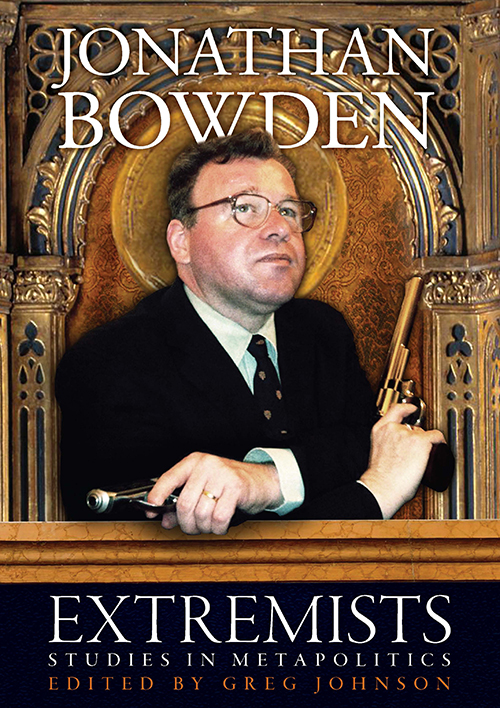
You can buy Jonathan Bowden’s Extremists: Studies in Metapolitics here.
2,665 words
Part 2 of 7
Edited by Greg Johnson and Peter Jacobi
In 1995, Jonathan Bowden self-published his Collected Works in 6 volumes (London: Avant-Garde, 1995), edited by Jürgen Schwartz, one of Bowden’s pen names. The six volumes comprise 27 distinct books, 12 of which had been previously published. Altogether, the Collected Works contain more than 2,600 pages of rare early Bowden.
Suck is the second book in volume 2. It was first published as a distinct book under Bowden’s pen name John Michael McCloughlin (London: Avant-Garde, 1994). We will publish it online in 7 installments. The titles are editorial.
Suck covers a wide range of political and cultural topics, interspersed with fictional narratives that may be loosely based on real people and events.
Eventually, a fully annotated version of Suck will appear at the Jonathan Bowden Archive. It will then be followed by similar editions of the rest of the Collected Works, plus a couple more early volumes that were not included. — Greg Johnson
There is also another problem here, and this is essentially the nature of religious belief, and the problem which it poses for liberals who tend to regard it as reactionary or atavistic. In relation to religious belief, however, an interesting book has just been published which details the light and dark side of an ecstatic religiosity; a heightened sense of doom (as against light) and a form of illumination which attempts to light up the shadows. Although this book, which I discussed with Delirium Tremens, the religious affairs correspondent of The Daily Telegraph, ultimately dealt with extreme forms of religious experience. One of the most interesting examples in the book concerned a young and somewhat distraught man who had joined a coven, without necessarily being aware of that at the time. Although there was an undercurrent of darkness, a premonition of the supernatural, to which he was directly attracted, even in the initial stages. For the coven itself presented a different face to the world and masqueraded, at least in part, as an alternative theatre group or troupe. It was led by a purposeful figure, a master or shaman, who essentially kept the group together. He was responsible for its somewhat morbid subject matter, such as Ibsen’s Ghosts, Strindberg’s Inferno, Huysman’s decadent touches, and a rendition of Daphne du Maurier’s The Birds, essentially a reading of the script which was later filmed by Hitchcock. The master of this particular coven was a male witch or warlock (as they are called); and he exercised a compulsive degree of power over the others in the group. In a strange way, he had a somewhat magnetic personality, a strange and shamanistic quality, at once attractive and repulsive. For the people who associated with him in the theatre group came increasingly under his sway—as if they had always wished to be beholden to him—and never really wished to break away. The individual concerned was also bi-sexual, like Aleister Crowley, and this exercised a particular fascination on the young man, who was already in his thrall because he was a homosexual, a man who was in a confused and turbulent state in relation to his sexuality. He was a man who was in any event filled with a sense of loathing and self-disgust, but who battened himself on to the attentions of this individual, the blandishments of the master. It is interesting to note that in such circumstances, where the erotic and the spiritual co-exist, a bi-sexual man, a man within whom there is a strong masculine and feminine polarity, can exercise considerable power over others. Particularly when religions always contain a strong masculine and feminine element, a matter of Ying and Yang, a purposeful leader and the Marian Cult. Ultimately because religion is inclusive rather than exclusive; it aims at a form of completeness, even if it is an attenuated form of completeness. There is also another reason for a polymorphous sexuality on behalf of the master, however, and this has to do with the satanic doctrine of kaos; the power over the nature of one’s indeterminacy, the nature of one’s own chaos, confusion and anguish. In short, this is the desire to experience everything in order to destroy (not conditioning) but the meaningful nature of experience. As such, the doctrine of chaos is a matter of pride. It is a doctrine which (à la Nietzsche) wishes to see a transvaluation of all values into no values whatsoever. As a result, it is a form of nihilism which creates the circumstances of its own nothingness. It is a type of irretrievable fate, a forgotten moment, which is arrived at in a moment of abnegation, if not negation. Finally, the reluctant initiate to this particular coven was invited to a party after one of their theatrical performances which occurred late at night. He arrived at a large, gloomy house somewhere in North London, such as Stoke Newington or Stamford Hill, and he found himself conducted into a high chamber at the back of the house. When he entered the room there was a sort of shock of recognition; a certain epiphany, a dropping away of the scales, during which he saw revealed what had been going on all along. There was a “shock of the new,” the revelation that everything he had experienced was heading towards this moment, this initiation into the darker side of the mysteries, the occult. When the tableaux which revealed itself to his gaze was that of the Black Mass; the satanic mass, which is depicted in Huysman’s novel La Bas, (“Down There”), and he saw a long trestle table, a mock-altar, covered by some sort of brown cloth, an excremental covering, at the back of the room. He was able to make out other distant objects, such as bell, book, and candle, a few pewter vessels, and even more dimly silhouetted in the candle-light at one end of the table, a crucifix, the symbol of the redeemer. While he stood there eyeing this state of affairs the ceremony began; and it started with a rendition of the Roman Mass; a sort of copy-cat version which had elements subtly altered and distorted. All of which began to take on a more blasphemous direction as the ceremony continued, using expletives, fake hosts, and whipping up the contestants, the votaries, to a pitch of excitement. Occasionally, when one of the females who was present laughed in incredulity and embarrassment at the blasphemy, the master attempted to calm her and reassure her of the ‘worth’ of the ceremony. He asked her to enter into the spirit of the thing; and not to allow a sense of rationality or absurdity to intervene.—To ‘enter into the spirit of the thing,’ to ‘get with it,’ as it were.
The ceremony continued for a long time, for several hours in fact, during the course of which the initiates at this particular rite became more and more demented, more stimulated, more liable to actions of extremity and self-disgust. During the course of this ceremony, a process of decomposition, of moral squalor was occurring—whereby the company was reduced to a gibbering, insensate mass. It was as if the whole thing was accompanied by a particular fetor, an unholy smell or stench, an olfactory nightmare, which was merely an accompaniment to the moral decomposition that was occurring. Although the book does not detail the obscene acts which occurred, it is not difficult to guess what these amounted to—namely, the mixing of sexual and religious acts, fornication on or near the altar, mutual masturbation which was laced with a liturgy of despair, together with the use of blood, excrement, and other unhallowed sources—tokens of “excess” as Bataille would call them—in the provision of the religious act. When in fact this religious act is not religious at all. It is actually irreligious in the extreme. It is designed to be a form of anti-religion, the inversion of a religious performance. Although the author of this particular book insisted on giving it a false salaciousness, a sense of titillation, an undue sense of excitement, by not revealing what was going on—when many descriptions of the Black Mass abound in other places. In many respects, however, this was the only mistake which the author made, and it was more than compensated for by his accurate description of the devil’s carnival, of the Bacchanalia which ensued. Particularly when we remember that the young man was a somewhat reluctant initiate, an unwilling satanist. In short, a man who had been led in that direction by a mixture of introversion and sexual confusion. For the young man in question, unless he was fantasising about the whole incident, was certainly prone to various types of religious disturbance—in that he was a lightweight, tremulous, filled with self-loathing, and liable to be moved by the irrational. The most important incident he experienced, however, occurred towards the end of this Black Mass; this demonic mass. When in a fit of self-loathing and disgust, he was invited by the master to look over into the corner, the corner of the room—where he was invited to meet the devil who was believed to reside there. At first, the young man refused to look over into the corner of the room. He refused to be drawn in that direction, and involuntarily his eyes moved in the opposite direction, in the direction of the far side of the room—so that he would not be in danger of seeing something which could not exist (so the rational part of his mind told him). But over time he felt an irresistible urge to look over into that particular corner, and when he did so, something was observed. It was something which was small and shrunken; toad-like and black in colour, which existed in the corner of the room, if only momentarily. Of course, the apparition which he saw can easily be dismissed as a will-o’-the-wisp, the sort of scene which only occurs in a penny dreadful novel by someone like Dennis Wheatley, but the effect which it had on the young man leads us to a different conclusion. For the young man says that the apparition which he saw consisted of a low, runtish thing: a bat-like object, a piece of arcana from film noir; at once reptilian and mammalian. It was a strange creature which also resembled a crow; a cramped bird-like form—something which is reminiscent of the crow pie that gypsies used to cook in the village where I come from. But in this case the crow-like being possessed gelatinous wings, extensions of undeniable filth, because these wings, these permeable cataracts of skin were covered with excrement—human faeces. While from the head or mouth of this particular bird, this armorial crow, a large penis was seen to flick and dart in lieu of a tongue. As you can see from the above, this image has a particular feel to it, a sense of sexual turmoil and disturbance. All of which militates against the fact that the image which the young man saw was real; extant, an actual phenomenon—something which anyone who hears this is attempting not to believe. Since the belief that there are some things out there, supernatural events which cannot be explained by science, particularly on the dark side, is part of our humanity, part of our imaginative powers, a redemptive element in our being. Although the fact that the image of the devil that the young man saw was so obviously a metaphor; so obviously a concretization of his own sexual fears; his sense of disgust at the nature of his own buggery, means that any suggestion of its reality falls away completely (insofar as such things can’t exist anyway). Yet they existed in the mind of the young man. He saw what he saw and was terrified at the vista of blood, dung, and emptiness which opened up before him. It was as if what had been made manifest wasn’t the devil but his innermost anxieties; a profound sense of self-disgust and self-alienation, a belief in his utter worthlessness as an individual. Hence we see his attraction to the Master and the circle of devotees which he had gathered around him, all of which had led to this disturbing experience. Indeed, the Master had been able to make use of his anxiety, his putative depression and absence of self-control, ultimately his irresponsibility, his lack of responsibility towards himself and his own self-interest. In short, this was his inability to look after himself, the masochism and craven need for pain which the Master detected—it was his forte after all—and which he determined to use for his own purposes. Another way of looking at the apparition, however, is to see it as a stunt, a genuine apparition. If you like, it was a Phantom of the Opera (or more accurately) an example of Pepper’s Ghost—an illusion which can be created in the theatre. When mirrors that are placed adjacent to one another can be used to create an illusion, particularly when we remember that the circle around the Master was a theatrical group. One of the more interesting aspects of this case, however, is the Cultic nature of the group gathered around the Master. This is the fact that he dominated it to such a degree, and that all the members of the group fed off him, usually in a destructive and cross-grained way. It was as if the Master had created his own Luciferian Church; his own anti-church, a tabernacle to Satan, the ur-text of a liturgical tract (as it were), from the human dross, the flotsam and jetsam which he came into contact with, and that he studied, classified and defined in the way an entomologist deals with beetles. In a sense, therefore, the Master was a collector of human beings; a divine antiquarian, an antique dealer of the soul. He collected around him a group of people who were there to be manipulated; a collection of personal objets d’art. They were a series of mechanical dolls whose skin had an alabaster whiteness, a creamy dexterity admixed with machinery, the cybernetics of their internal organs—all of which were manipulated by the Master, the puppet master, who only had to raise his little finger to set off a reaction in one of his charges, one of his ventriloquist’s dummies. Rather like the Marvel Comics villain, the Puppet Master, who used to star in the Fantastic Four magazine, the Master of this particular Satanic Lodge had an implicit faith in his deconstructive powers, in his manipulative intent, in his ability to coax, threaten, and cajole the people around him—all of which takes place with their assistance (to a certain extent). He knew the limits of his powers, the extension of his dominion. This was the degree to which he could extend the threads of his puppets which ran to the trestle in his hand without breaking them. One other factor which has not been mentioned is this, was the apparition real (?). Did it have a natural existence as an observable phenomenon (?)—and the answer is “no,” because the apparition existed in the mind of the young man who saw it. Yet it did not have an existence in fact. In other words, it was actual not factual, willed rather than imagined, decadent and yet not forced. Yet one other question also remains; and this is do archetypes exist in the mind? Are they personifications of the human qualities, such as good, evil, redemption, pain, and the prospect of forgiveness? Are they tragic metaphors or redundant certainties for the human condition (?)—i.e., are there circumstances of dislocation and joy, of strength through joy, in which the human mind turns to archetypes, personal typescripts, to express its innermost feelings? If so—the young man did see something, if it was only in his own mind.
1 comment
The demon had objective reality and could be seen by others, Bowden was a Nietzschean and so couldn’t see. He never knew himself.
Comments are closed.
If you have a Subscriber access,
simply login first to see your comment auto-approved.
Note on comments privacy & moderation
Your email is never published nor shared.
Comments are moderated. If you don't see your comment, please be patient. If approved, it will appear here soon. Do not post your comment a second time.