 1,087 words
Original in Czech: https://deliandiver.org/sadonacismus-ve-filmu-cast-1/
Translated by Ondrej Mann
“The standard in this restaurant is going downhill. The venison is tough and stringy—as bad as if they had cooked an old Jew and then served him to us.” [1]
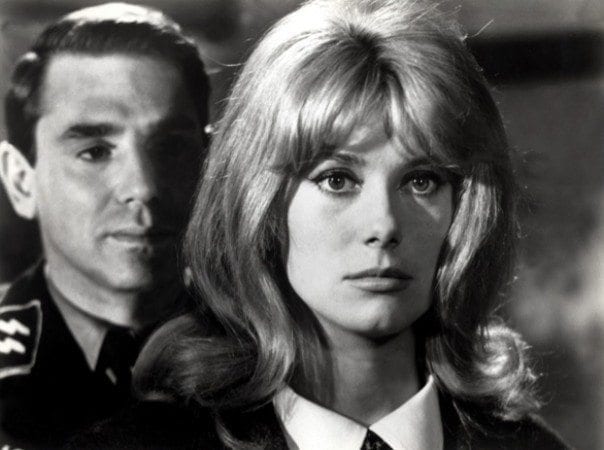
Sadonacism refers to a film subgenre from the 1960s and 1970s [2], whose first film was the French Vice and Virtue (Le Vice et la vertu, 1963, directed by Roger Vadim), whose plot is loosely based on the theme of “The Divine Marquis”: it tells the story of two sisters, one symbolizing Vice and the other Virtue, set during the Nazi occupation, with Virtue having to endure every imaginable insult and torment at the hands of the Nazis, while Vice leads a life of fame and pleasure. The director, who was also the “discoverer” of Brigitte Bardot, described his work as “madly baroque,” i.e., visually and otherwise opulent, but domestic audiences, who still had the “dark years” 1940–1944 still too vividly in their memories, and many of whom were apparently burdened by a “guilty conscience,” booed it at the premiere, and even the happy ending did not help. Resistance organizations even demanded that it be banned, as they found it difficult to accept the lightness with which the author’s “vision” rose above the officially accepted interpretation of recent history. Vadim had to wait two years for critical acclaim, when the film was released in New York and San Francisco, then maturing centers of “freedom of thought” and “love.” Even today, this “beautiful trash” can be interesting, if only for the participation of actors who went on to become stars of cinema: Annie Girardot, Catherine Deneuve, and especially Robert “De Peyrac” Hossein in the role of SS Colonel Erik Schörndorf! Connoisseurs will appreciate one of the most talented screenwriters of the New Wave, Paul Gégauff, in the role of the second “sadistic SS officer,” who is eventually stabbed to death by one of his victims.
Before we continue mapping this bizarre film production, a brief digression on the convergence of “sadism” and “Nazism,” because while Vadim followed in the footsteps of the Marquis and benefited from the reputation that his rich literary reception had built for him, more than official bans, most of his later films are more indebted to Freudian theories. However, there are points of contact between the two.
Sade, or rather the “Sade phenomenon,” was known in certain circles even before the physician Richard von Krafft-Ebbing used the word sadism in his book Psychopathia Sexualis (1886) as a term for “a feared perversion of fornication, a monstrous and antisocial phenomenon, contrary to nature.” The Marquis influenced several late Romantic writers with his work, including Baudelaire, Flaubert, and D’Aurevilly. The author of Les Fleurs du Mal (1857) saw in it, logically, “the essence of evil”: “One must constantly return to Sade, otherwise it is impossible to understand the natural manifestations of humanity,” he wrote, whereupon Flaubert, in Madame Bovary (1857), described Sade as an “ultra-Catholic writer,” since, after all, for Catholics, man is a sinner by nature! D’Aurevilly, who embraced Sade’s imagery in The Devil’s Novels (1874), only reinforced the “reactionary” odor of “sadism” with his personal anti-democratic, anti-liberal, and radically Catholic stance. However, when the Jew Marcel Proust, in In Search of Lost Time (the first volume, “Swann’s Way,” was published before World War I), most clearly identified the origin of sadism in authoritarian Catholic morality, a somewhat different interpretation than oppressed bastard of Catholicism began to emerge. . .
In 1909, Apollinaire declared Sade to be “the freest spirit” who ever walked the earth, and ten years later Freud’s “A Child is Being Beaten” was published. [3] Soon after, the Marquis’s legacy was appropriated primarily by the Surrealists, who provoked and sought to challenge all remaining bourgeois “certainties.” It was in their “dreamlike” interpretation that Sade became a mythical figure with tendencies toward both fascism (“reactionary” component) and communism (“libertarian” component [4]): Did not his literary heroes, with their authoritarian cruelty, become “supermen” acting according to their own convictions outside the conventions of good and evil a hundred years before Nietzsche? Did they not state long before Lenin, Trotsky, and other revolutionary “Marxists” that mass repression is inevitable to achieve great goals? [5]
This is the palette from which the “neo-Marxist” image of “sadistic fascism” with “camps and stripes” in the middle and in the foreground was mixed. The decisive moves were made by Jews Wilhelm Reich, Erich Fromm, and Theodor W. Adorno. In his book The Function of Orgasm (1927), Reich reflects on what brought fascism to power, for example: “It was above all the attraction of dark, mystical feelings; vague, nebulous, but extremely powerful desires. . . At first, only perverse instincts broke through.” In the 1930s, Fromm simply replaced the adjective “sadomasochistic” with “authoritarian,” allowing Adorno to subsequently “analyze” the “authoritarian personality” (1950), in which a significant part of what European cultures are based on (a sense of hierarchy, respect for order, cultivation of power) is qualified as a deviation or “complex.”
With this insight into “projection,” we can now return to cinema. [6]
Notes
- . . . as discovered in a Paris restaurant by Helmut Berger as SS Colonel Ernst Ritter (sic!) in the film Code Name: Emerald (Code Name: Emerald 1985).
- The term “sadiconazista” appeared in Italy in the late 1960s and early 1970s precisely for the “sexploitation” of the “seductive deception” of the SS.
- This is the starting point for Foucault, himself homosexual, in his celebration of “others” (Discipline and Punish, 1975). It’s basically as simple as that. . .
- Not to be confused with libertinism, “libertarianism” is a broader term that also encompasses political expressions (anarchism, etc.)!
- When, 20 years after 1945, Roger Nimier confronts the words of André Breton, the “pope of surrealism,” from his pre-war “Commandments” with his actions in one of his essays (Le Grand d’Espagne), he naturally concludes that “the real surrealists and revolutionaries were rather the Nazi occupiers.”
- We would add that the “French school” was not far behind, as evidenced by Sartre’s novel Death in the Soul (1949) and Genet’s The Funeral Rites (1947). In the former, Daniel, a homosexual, is overwhelmed by the beauty of the Germans entering Paris after they “cut through France like a knife through butter” and longs, among other things, “to be a woman so that he can shower them with flowers.” The author develops the equation “active collaboration—passive pederasty,” which he had already addressed in his essay “What is a Collaborator?” (1945). The “saintly” Genet, a notorious pederast, was brought out of obscurity by Sartre to be incorporated into the “alternative theology” taught today at universities (gender feminism, “minorities,” etc.) to “disarm” the white man. . .
12 comments
Mmmm,
This De Sade fellow can go take a jump.
I rather like “Salon Kitty” though. Ingrid Thulin’s role as Madame Kitty is great, as well as her (or maybe someone else) singing the Weimar-tinged nightclub ditties.
Wait for the next episodes, you’ll be thrilled! Of course, Salon Kitty and many other little-known films will also be featured.
Sounds good Ondrej. You seem to have similar tastes and interest to me.
Wilhelm Reich was all kinds of special for sure!
Personally, I also consider him an interesting author, even though he was Jewish and a neo-Marxist, just like Alejandro Jodorowski. However, this author is not very popular among nationalists. For example, Alex Kurtagić wrote negatively about him.
Interesting. Many years ago I saw The Night Porter and was very impressed by some elements of it. Would that fit into this genre?
I gather that Adorno’s Authoritarian Personality had a very large and very malign influence within academia and the media, and this influence doesn’t seem to have subsided much. I believe it resulted in all sorts of damage including relentless attacks on traditional European family structures and hierarchies.
Speaking of de Sade, a long time ago I also started a very interesting book, Forbidden Knowledge by Roger Shattuck, which explored de Sade, among other things. Unfortunately I got sidetracked and wasn’t able to finish the book. Has anyone else read it? It looked very promising.
Yes, the film The Night Porter definitely belongs to this genre and will be discussed in detail in the next installment of this series. Unfortunately, various Jewish neo-Marxists have had a negative influence on psychology and academic studies. But that is precisely why we have the only nationalist online university, Counter-currents. Unfortunately, I have not read this book, but I have read The Philosophy of Forbidden Knowledge: Friedrich Nietzsche and the Dark Side of Thinking Konrad by Paul Liessmann.
I read most of the Marquis de Sade’s books when I was studying at a Catholic high school. Maybe I’ll write something about him and his work for CC.
They didn’t have De Sade in the high-school library, did they?
I thought “The Night Porter” was a bit disappointing. I like Dirk Bogard and I certainly like the scintillating Charlotte Rampling, and was expecting great things, but over all, I was a bit under-whelmed. There were good parts of course. The ballet dancer-fellow’s routine to an excerpt form Gluck’s “Don Juan” (whilst being rather gay, but with superb music) was interesting with that expectation of high-culture mixed with athleticism and devotion to the new state. Didn’t Ezra Pound state that the Fascist State of Italy represent the “perfect synthesis of Art and State”?
Yes, The Night Porter is a mixed bag. One thing I like about it is what would be called, I guess, its aesthetics: Charlotte Rampling walking around beautiful Vienna; the beautiful, mournful music throughout; the beautiful old hotel; the rainy, subdued atmosphere with formally-dressed people walking around; and yes, those scenes with the ballet-dancer are spectacular, and among my favorite parts. Dirk Bogarde was a great actor. He could express a lot with subtle facial expressions. And of course I like how the movie is politically incorrect.
Interesting that I wasn’t the only one who was struck by those “ballet” scenes.
Sometimes the movie gets a bit absurd and over-the-top, and in my old-fashioned opinion too graphic (some might accuse me of being prudish but I don’t care). Overall I like it.
Yes, it’s definitely an interesting piece of art. Try reading the entire film series. I believe you’ll find something new that you don’t know yet.
Yes, it seems we have similar tastes in art, music, and favorite authors. Of course, there was no De Sade in the library at the church high school, but I became friends with the librarian there and she gave me a specialized magazine for librarians for free. She left one copy under the counter for me, and that copy was dedicated to erotic literature and the Marquis de Sade. She blushed a lot at the time. I bought De Sade’s Justine with surrealistic illustrations by the Czech painter Toyen. Sometimes I lent some erotic literature to my classmates at the church high school, or I lent them a paperback copy of White Power! by Rockwell. These things were roughly equally forbidden at the church high school. I did a lot of forbidden and humorous things there. I’ll write about it for CC someday.
I read a biography of De Sade by Donald Thomas which was published in 1976, which was good, as it was free of that irritating “Divine Marquis” carry-on which is rather common-place. A more measured approach. I recall (from the book) that our “Divine Marquis” thought the French Revolution was revolting! A book worth tracking down, if one is interested in such things.
Comments are closed.
If you have a Subscriber access,
simply login first to see your comment auto-approved.
Note on comments privacy & moderation
Your email is never published nor shared.
Comments are moderated. If you don't see your comment, please be patient. If approved, it will appear here soon. Do not post your comment a second time.