1,384 words 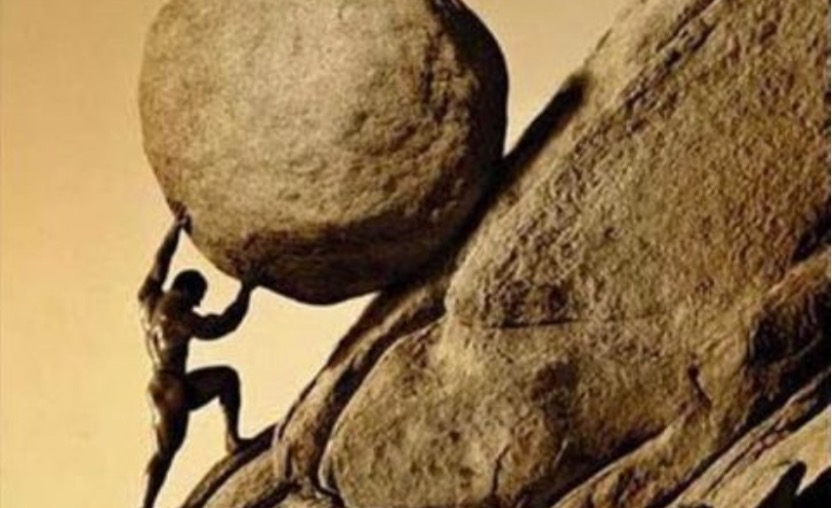
Man stands face to face with the irrational. He feels within him his longing for happiness and for reason. The absurd is born of this confrontation between the human need and the unreasonable silence of the world.
– Albert Camus, The Myth of Sisyphus
***
Am I happy? Well, I’m not ecstatic, but yeah, life is more good than bad and it is not only a life worth living but one that I do not want to end. If I had access to life-extending technology I would use it without hesitation. I don’t fret over what is “natural” or believe there is nobility in death.
Also, the concept of a creator God has never rang true to me, and since childhood, has not appeared very plausible either. I don’t see a reward or final judgment coming when I die. Swedish film director Ingmar Bergman confronted this very issue in his 1957 classic The Seventh Seal. His crusading knight Antonious Block, played by Max von Sydow, asks during a crisis of faith, “Is it so terribly inconceivable to comprehend God with one’s senses? Why does he hide in a cloud of half-promises and unseen miracles?…Faith is a torment. It is like loving someone who is out there in the darkness but never appears, no matter how loudly you call.” Nevertheless, I’ve taken a few really important lessons from many world religions, from Christianity to Daoism. Just because the supernatural claims may be bollocks doesn’t mean there’s no underlying wisdom being conveyed. Something valuable can be gained in Eastern religious ideas, which may be shocking coming from someone the media calls a “white supremacist.”
I do believe that suffering is an important component in understanding what drives humanity, including the self. And there is no doubt about it: I have suffered. Strip away all our rationalizations and most of our actions can be boiled down to seeking pleasure… and avoiding pain. Yet paradoxically, we can often prevent greater pain in the future, by willingly shouldering it in the present.
Another thing I believe in is the power of meditation. The science on meditation is clear: that it is not hokum but empirically useful. You can obtain what some might call a transcendent consciousness by entering inside of yourself and calming all other thoughts.
Zen in the Art of Archery is a book I read at UVA about using a skill, in this case archery, but it could be anything from gardening to cycling. The idea is that after you have done something long enough it becomes grooved in your subconscious and you can do it without thinking anything at all. This is the meditative state through activity, sometimes called the “flow state”. It is marked by a lack of anxiety and negative thoughts.
When I bike, or lift weights, or anything that I love, I try to lose myself in it. That is where my peace of mind exists. Almost anything can become a meditative activity if done consistently enough to automatize it in the brain: archery, gardening, surfing, sharpshooting, martial arts, etc.
This is both a subjective and an objective state: subjective in the sense that its “goodness” or “badness” are in the eye of the beholder, not some external force like a supreme consciousness, but also objective in the sense that it can be quantified with empirical measurements with proven efficacy. Examples of objective markers of the flow state can be seen in neural scans of brain activity, as well as the release of feel-good chemicals like dopamine, seratonin and endorphins, leading to reported feelings of happiness and satisfaction. Lower stress levels from time spent rejuvenating in the flow state can be further observed through reduction of the stress hormone cortisol, improved heart and immune function and sleep quality.
In the realm of religion and spirituality, empirical observation is considered unnecessary and possibly even a hindrance to the experience of purported invisible forces. But for me, I have deduced that much of what doesn’t appear to be there, really isn’t. And what I can see with my own eyes is worth its weight in gold.
A top contender for most popular “meaning of life” is love. The Beatles sang, “All you need is love.” More recently country singer Sturgill Simpson crooned, “Love is the only thing that ever saved my life.” It’s always a little fuzzy whether the love in question is specific romantic love or just the feeling of love in the abstract, able to be applied to anyone you meet, but I think it’s quite easier to say that when you’re in the most popular boy band of all time, with legions of adoring girls from sea to shining sea. But if it’s the answer for someone without loving parents, friends, or lovers, it’s a poor one. Maybe it means loving yourself, at the very least. If you cannot love yourself, despite your flaws, life is guaranteed dissatisfaction and misery.
Should there even be an expectation of ecstasy in life? Truthfully, no. Too many highs can permanently dull them. The highs are that much sweeter when they are few and hard to come by. Ultimate contentedness should not require anything but the biological necessities for life to continue. The more you can find peace in the midst of scarcity, the more powerful your mind has become. That said, ecstatic experiences should not be avoided either. There is no point in denying the animal drives that are a natural part of our being.
Speaking of animal drives, there is nothing inherently sordid about accumulation of material wealth and accolades. The meditative state is achieved organically, allowing the natural operation of your mind to quiet into a mechanical autopilot. Trying to resist things which do not need resisting, and are in fact, biological imperatives coded into our DNA will only accrue the anxiety of cognitive dissonance. There is nothing objectively “wrong” about the pleasure of sexual gratification or even recreational inebriation, when done in moderation. However, it is a particularly dangerous spiritual corruption when we have programmed ourselves with toxic pursuits, like gambling addiction, drug addictions, or an overly sedentary lifestyle. In this case, cognitive dissonance is your friend. A major part of spiritual growth is self-improvement, and the most successful human beings excel at reprogramming a consistently better version of themselves. This is real enlightenment: providing the meaning we crave, to deeply personal questions of identity.
The pursuit of knowledge, both practical and for its own sake, is almost universally beneficial to the student. Therefore it is one of the highest possible virtues in pursuit of a meaningful life. Whether it’s something from history, philosophy, science, applied knowledge, or art learning is close to guaranteed to improve the student.
Ultimately, I agree with the French existentialist Albert Camus, whose The Myth of Sisyphus uses Greek myth allegorically. In the myth, King Sisyphus is punished by Zeus, for revealing his abduction of the nymph Aegina, to an immortal existence in the Underworld, ceaselessly rolling a massive boulder up a hill. Whenever he reaches the summit, the boulder is rolled back down again to start Sisyphus’ labors anew.
The point Camus makes in the book is that there is no objective meaning. All of us are rolling our own metaphoric boulders up the hill, repeating whatever routines we’ve created until death. The meaning is not in the task itself, but in the meaning we impart to it. Therefore something as dreary as boulder rolling can be just as meaningful as anything else if we choose it to. This is not so very different from the concept I discussed in Zen in the Art of Archery. Instead of shooting a bow and arrow, Sisyphus’ flow state could be achieved in what was intended to be a punishment.
If this answer seems bleak to you, at least it’s something very real. As Camus himself wrote, “Seeking what is true is not seeking what is desirable.” There are plenty of fragrant supernatural lies you can tell yourself to brighten the dark corners of your mind, but do you want the truth or sweet smelling illusion? We all hopefully have many tasks which are much more enjoyable than manual labor, but that isn’t the point. If we can find meaning, even in our darkest hours, we have embraced true power within ourselves.
9 comments
That was a pretty good essay, but I would have connected meaning with the cause of white nationalism. White nationalism has given me a grounding and center in my life, even if I’m fundamentally pessimistic about its success. We should write some sort of Bushido Code of white nationalism. The Boy Scout handbook was supposedly based in part on the bushido code. Some odd dietary restrictions would be a good addition, like in kosher. For example, we can eat Wendy’s, but not Taco Bell. These gain a power from their mystery.
Sam Hyde already made the connection with white nationalism:
https://www.youtube.com/results?search_query=Sam+hyde+sisyphus
And all the other peripheral side issues that voters care about through an explicitly racialist perspective: The White National’s approach to gun rights, banking, taxation, environmental concerns, energy, etc. I feel there’s often too much circumscribing to just the racial and judeo but not enough of what’s palatable to the masses.
I hear you, but here I’m talking about something more private and specific to us. A pathway for the soul. To create a race of knights or samurai who live by a standard. Something timeless and independent of the particular political context or temporal situation, which are mutable.
I’m sure Europe has or has had something like a knightly chivalric order before the victory of the money power. I do agree that a selfless, martial ethos and duty-bound protectorship cadre must return to public prominence. Not merely the survivalist brawn of Delta Force, SAS, or GSG 9.
Some odd dietary restrictions would be a good addition, like in kosher. For example, we can eat Wendy’s, but not Taco Bell.
How about always eating your own, or friends’, home-cooked food and going to a restaurant only in cases of emergency?
Or was the Wendy’s VS Taco Bell just a funny example? Eating out is, I think, one of the best examples of how far we have fallen. We don’t know the cook, we don’t know what is happening behind the scenes (as in the cook spitting on your order, most restaurant personnel not being of our race anymore), we don’t know the quality, we can’t control anything – yet we want to put that into our body?
Via evolution, the purpose of life is to beget new life, so the meaning is found in raising them well.
I briefly saw on Fox news just now (May 3; 1:45 PM) mention of the possibility of some kind of baby bonus to improve declining birth rates. Trump said it sounded like a good idea to him when he was questioned on that.
Boy o boy, is the devil ever in the details if this comes to pass!!! You know what I mean.
I really hope that they make marriage a prerequisite for that baby bonus if they’re dead set on it.
Comments are closed.
If you have a Subscriber access,
simply login first to see your comment auto-approved.
Note on comments privacy & moderation
Your email is never published nor shared.
Comments are moderated. If you don't see your comment, please be patient. If approved, it will appear here soon. Do not post your comment a second time.