2,418 words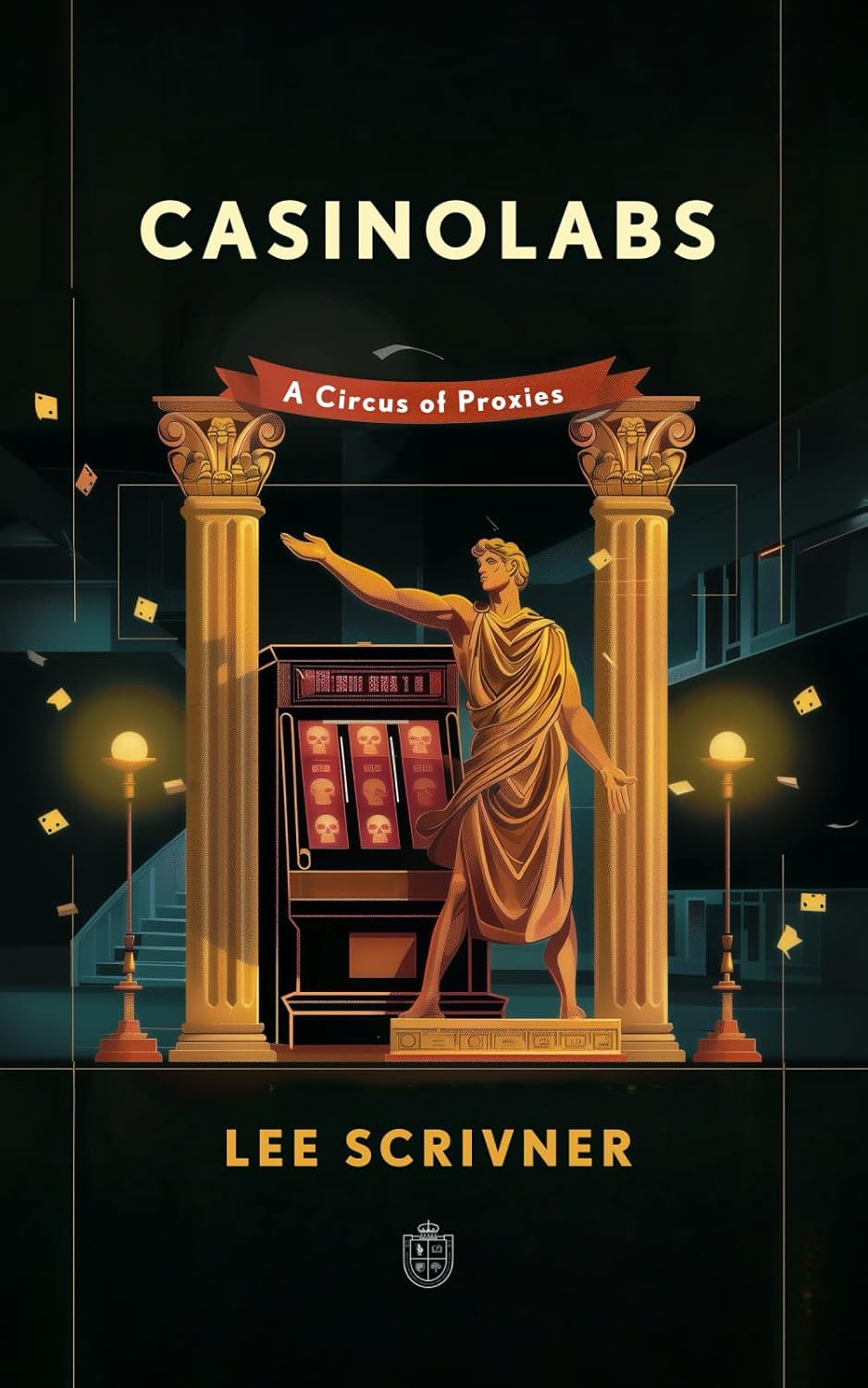
Lee Scrivner
Casinolabs
Exeter House Publishing, 2025
Casinolabs is a satirical mystery, a psychological thriller novel set in Las Vegas by Lee Scrivner. The book’s protagonist Morton Waterhouse works as a greeter at the Roman themed casino, Caesars Empire, which is based on Caesars Palace. Morton wears a Roman toga like those that Caesars Palace’s greeters used to wear. Morton is obsessed with history and his job allows him to LARP as a Roman aristocrat, often distracting him from his job.
Morton is somewhat bitter that his Master’s in history did not pay off career-wise, thus his Roman persona is a cover for his low social and economic status and lack of identity. However, he is stoic and not necessarily the angry incel archetype. Morton reminds me of Ignatius J. Reilly in A Confederacy of Dunces. He also reminds me of Spencer Grunhauer in Dan Baltic’s satirical novel, NUTCRANKR, as far as the humor of his autistic philosophical views getting intertwined into his work environments and being a young man at odds with modern society.
Morton gets in trouble for greeting guests in Latin, “salvete cives Romani,” which means “greetings citizens of Rome”. His boss tells him to say “hail Caesars” in plural, which implies that everyone is a Caesar or king. This was America’s marketing mantra of the post WWII era which no longer exists. Morton rejects this, thinking, “If everyone is a Caesar, then what am I?” Morton has contempt for the clientele of Vegas who he views as rubes and plebeians. There is a need for many to feel like they are special and have had an effect on the world and history. Later in the novel, Morton boasts to himself that he is an author of civilization’s story. Contrary to marketing messages and social media, the reality is that most people don’t matter and are just cogs.
Morton hopes that his obsession with Ancient Rome will finally have real world relevance when he is recruited to work at Casinolabs, a casino theme design firm. Morton desires more wholesome casino themes and finds hypocrisy in the family friendly rebranding. In response to a discussion on how to make the casino more kid friendly, Morton makes an autistic comment about natalist family policies in Ancient Rome. Morton also hopes to see Roman temples at the casino.
Despite Morton’s idealistic and perhaps naïve nature, he is skeptical and confused about why Casinolabs recruited him. His role becomes Kafkaesque in its unclearness. For instance, he initially has a surprisingly successful presentation and is complimented on how much of an asset he is, but then he gets into trouble and is later told that he doesn’t work there. The deeper he gets into Casinolabs, the more he realizes that it is not what he initially thought and there is an element of blackmail involving these bizarre experiments.
There is this vast secret labyrinth-like network of corridors underneath Casinolabs. The labyrinth becomes more and more surreal and disorienting and at one point Morton ends up in the storm tunnels where the homeless live. There is an experiment in which he plays video poker and his consciousness enters into the game, though the book takes place before VR technology. While the book veers into magical realism, it is not quite of that genre. The book follows a mostly linear and coherent plot and is not quite William S. Burroughs’ Naked Lunch or a David Lynch film.
There is a concurrent narrative about a psychologist, Dr. Steven Nichols, who is being investigated for fraud, regarding a claim from his patient Bill about a Cold War era military experiment at a nuclear test site that caused ailments including “atomic amnesia.” Dr. Nichols has unconventional methods, such as role playing, which he uses as a defense regarding the fraud allegations. Dr. Nichols suspects that Bill has Munchausen Syndrome, in which he fakes symptoms to garner sympathy and attention, as well as stolen valor to create an identity for himself, as his family does not respect him. It is revealed that Bill is Morton’s estranged father and Morton only reunites with his father when he says that he only has days to live.
Out of the blue, Bill receives a settlement of $752,321.63 cash from some mysterious government agents in exchange for agreeing to shut up about the military experiment. Bill ends up splurging on strippers, his new much younger girlfriend, and gambling, to relive his glory days as a high roller. Dr. Nichols is worried that this could incriminate him for fraud, so he discourages Bill from spending. This is symbolic of older generations squandering the inheritance of their descendants whom they have contempt for. However, Bill offers Morton some cash which he turns down.
All these different narratives, events, and characters become intertwined, hinting that there is some grand destiny beyond random coincidences. Morton’s sister, Scarlett, works for Casinolabs, then Desi who is Morton’s roommate and the cousin of Bill’s girlfriend, Sveta, gets hired to work there as a dancer, and then what is Nichols doing at Casinolabs? There is also a theme of MK Ultra mind control, secret government black sites, and Area 52 in Nevada. The mind control could also be a metaphor for how mass media erases people’s memories of the past.
A lot of the zany humor is in the fighting throughout the book, starting from when Morton visits Bill’s house for the first time in a long time, and then involving Bill and Nichols at the casino. This fighting and chaos continue with Casinolabs’ staff Helen, Stuart, and Dough which get really catty. They behave more like theater kids than a top secret organization. There is also a scene where some frat bros taunt Morton at his casino job, “Look it’s Caesar” and joke, “Come toss my Caesar salad.”
Casinolabs is a critique of social atomization and the breakdown of families. Morton’s parents are divorced, his mother is not in the picture, and he is estranged from his father. He also has a bad relationship with his sister who has utter contempt for him, viewing him as a loser and an embarrassment, getting angry when he makes politically incorrect comments at Casinolabs. Dr. Nichols has a daughter who he lost touch with but meets up with again due to a random turn of events. Despite Morton’s bad relationship with his family, he is unhappy, desiring to live in a society where family ties and cultural ancestral inheritance are valued and to mend relations with his family.
While the book is not overtly political, certain themes may resonate more with a right-leaning audience. Just the protagonist Morton being a struggling young cis white male goes against the intersectional narrative. There are certain terms that Morton thinks that those who are terminally online would recognize like phenotype and sportsball. However, since the book is satirical, a wide range of people would enjoy it, as it does not aggressively push a political agenda. Right-wing art tends to fail because it tries too hard to be political propaganda, while the left has been more effective at winning people over subconsciously.
While Casinolabs is not explicitly about when it takes place, I assume it takes place in the 90s since Vegas is rapidly expanding, and transforming to become more family friendly. Also, Morton’s father Bill is a war veteran who served during the Eisenhower era, and the author, Lee Scrivner, grew up in Vegas during the 90s. You can tell by reading the book that it describes Vegas the way a local might, going into the nitty geographic details.
On the surface, Las Vegas epitomizes hyper-capitalism, consumerism, hedonism, and this radical “End Of History” break with all tradition and convention. This is why a lot of social conservatives and trad types as well as anti-capitalist lefties hate Vegas. Vegas is the most postmodernist city in America if not the world, which is different from modernism in both politics and aesthetics. Instead of creating something entirely new and cut off from the past like modernism, postmodernism cuts and pastes various parts of the past. However, it is replicas of the aesthetics and symbolism of the past that lack real historical connection. As a jingle from Casinolabs says:
Welcome to Casinolabs!
Now postmodernity’s not so drab.
You can dismantle civilizations and rebuild them at convenient locations
Like it’s all prefab.
You can build sultan’s pleasure-domes, pirate ships, pyramids, and Stonehenge slabs.
You’ll help roamin’ plebs and serfs become omnipotent emperors! Casinolabs!
Las Vegas was practically built from scratch and is constantly reinventing itself and destroying its past. Casinolabs references the demolition of iconic old casinos like the Sands. Recently, The Tropicana, which was one of the oldest casinos on the Strip, and The Mirage, which was the first of the themed postmodernist mega-resorts, were shuttered. There is nothing like the cathedrals and monuments of the past that were built for permanence. One of the Casinolabs proposals is for a Las Vegas-themed casino that has miniatures of all the major casinos in the city. It is a parody of remake culture, such as the Paris and New York New York casinos in Vegas, which to be fair, both have a certain charm to them. Not to mention California Adventure at Disneyland, a theme park with replicas of California landmarks in California for those too lazy to travel the State, or movie remakes. It is symbolic of a late-stage empire, late-stage capitalism, and people running out of new ideas and lacking creative vision.
On the record, I love Vegas’s aesthetics and atmosphere and enjoy visiting there. The question is can we find deeper meaning from postmodernism? Morton is trying to figure out what our inheritance from the past is. Vegas has all this Indo-European pagan iconography, which Morton finds meaning from. A more optimistic way to look at Vegas is as Retrofuturism which is creating something futuristic inspired by the past.
The postmodernist architecture of the 80s and 90s is a lot more interesting and dynamic than the minimalism of the 2010s. The newer casinos in Las Vegas like Cosmopolitan and Aria moved away from the postmodernist themes and almost feel like they could be anywhere from Century City in LA to Brickell in Miami to Buckhead in Atlanta to Tysons Corner in Northern Virginia. There have been renovations of signage to be uglier or more bland. For instance, Treasure Island originally had a really cool pirate sign but its current sign looks like something you’d see at a suburban strip mall. Also, more charming and aesthetically dynamic neon signage has been replaced by soulless LED lights and screens. When Morton shows up for his first day at Casinolabs, he is surprised that it is in a nondescript office park, much like how tech corporations’ headquarters are, as minimalism conceals power.
Minimalist renovations have become overtly political, which Casinolabs hints at when Scarlett makes a feminist comment that The Rape of The Sabine Women statue at Caesars Empire needs to be removed. Examples of minimalist renovations as woke iconoclasm include The Sir Francis Drake Hotel in San Francisco being renovated and rebranded due to Sir Francis Drake’s involvement in the slave trade and the Hollywood & Highland Mall in Hollywood which underwent a minimalist renovation that removed its giant postmodernist elephant statues. This was because the original mall and statues were inspired by the set of D.W. Griffith’s film, Intolerance, depicting ancient Babylon. D.W. Griffith’s previous film, The Birth of a Nation, glorified the Ku Klux Klan.
Casinolabs plans to make Caesars Empire more multicultural, rejecting the White supremacy of Roman imperialism. Morton describes Vegas as multiculturalism, albeit more like ethnopluralism than leftwing multiculturalism in that there are lines of demarcation from one themed casino to another. What if we built self-contained communities like Las Vegas’ themed casinos that could serve specific cultural or demographic groups that match their themes?
Vegas is filled with this endless stimuli so it is not a place one associates with intellectual, philosophical, or spiritual contemplation. However, people go to Vegas to forget their mundane lives. The city is an otherworldly escape from mundane American life where everything looks the same with bland and boring chain businesses and strip malls. In Vegas, one can travel the world and different eras in time. Morton says that there is no time and space, almost like the astral plane.
The casino floor plan designs and the use of scents are designed as psychological manipulation to disorient people so that they hang around to drink and gamble. The labyrinth underneath Casinolabs represents this. Visual effects and the built environment are used to radically alter one’s consciousness, which has a metaphysical and mystical component. This also relates to what Jean Baudrillard called “The Simulation”, which is referenced in the book.
There are a lot of similar themes in Casinolabs to my novel Vaporfornia. Both novels are about a social outcast who is taken on for a dream creative role that has some nefarious ulterior motive. In Vaporfornia, the protagonist gets blackmailed into being on a show revolving around incel culture that involves a lot of experimentation and humiliation rituals linked to a shadowy Hollywood cabal. There is a scene in Vaporfornia where the protagonist is taken to an undergrown network and experimented on, involving VR and accessing one’s subconscious in a laboratory setting, much like in Casinolabs.
Like Vaporfornia, Casinonlabs has detailed descriptions of architecture and interior spaces. Morton makes architectural renderings, naively thinking they are going to be implemented. He also gets super autistic about how his desire for a medieval French-themed Charlemagne casino next door to the existing medieval English-themed Excalibur.
In a review in the Las Vegas Review Journal, the author, Lee Scrivner is referenced as saying that people have been comparing Casinolabs to the show Severance, a sci-fi thriller about a medical experiment that splits people’s personalities so that they retain no memories of their personal life at work and no recollection of their job once they leave work. Casinolabs also reminds me of Hunter S. Thompson’s Fear and Loathing in Las Vegas, due to the surreal segments, the zany characters and antics, and of course being set in Las Vegas. The psychology of gambling addiction in Casinolabs is portrayed in a surreal manner much like how the movie Requiem for a Dream does with drug addiction. There are also similarities to the movie A Clockwork Orange, as far as the experiments go. Casinolabs feels a bit like a movie and hopefully, there will be a cinematic adaption.
Follow Robert Stark on his Substack page, “Robert Stark’s Newsletter”.
11 comments
I haven’t read this book, but it strongly reminds me of the atmosphere of the film Passage (1996) by Slovak director Juraj Herz.
Reminds me of the movie Under the Silver Lake (2018) with all the subterranean passages. If I interpreted the article correctly, modernism is bad because it destroys history, and postmodernism is good because it draws its inspiration from history—sounds like the jews at work to me. 🙃
I have a Love/Hate relationship with Las Vegas, where I went to Kindergarten and part of 1st Grade in 1966-67.
My Dad had gotten his Masters in Mathematics & Statistics in 1964 and was then employed in Las Vegas by Edgerton, Germeshausen, and Grier (EG&G) as a nuclear weapons test data analyst.
We lived just off of Tropicana Avenue, not far from the Liberace mansion.
I started Kindergarten here in 1966:
UNLV Paradise Campus
851 E Tropicana Ave, Las Vegas, NV 89119
(LINK circa 2020)
In the 1960s, housing grades K-2, if I remember correctly, I wanted to take some nostalgic pictures of my old school while passing through town ─ which about twenty-five years ago was the UNLV law school ─ but now I find that the charming 1948 building has been completely torn down!
Very sad.
Yeah, in the 1960s in Las Vegas there was no Diversity, no smog, low crime, and the traffic was low.
This was long before the 1990s when the Las Vegas Chamber of Commerce made “Sin City” their official brand, and it became an “adult Disneyland.”
Las Vegas is still fun to visit. Many conventions and trade shows attend there, and the food and lodging is pretty reasonable, and other than the smog now, the climate is good. The nearby Hoover Dam, which put the place on the map in the 1930s, fascinated me as a kid and now has a first-class visitor’s center.
What I hate the most about Las Vegas is that they have no concept whatsoever of architectural preservation and history.
Last October, they tore down the iconic Tropicana Hotel. Is nothing sacred?
I can remember the Landmark Hotel being built in 1967 ─ later owned by Howard Hughes ─ when our nuclear family moved to New Mexico to continue the aerospace and atom craft. Las Vegas razed that landmark in 1995.
I could go on and on ─ but in my old age, it is really a weird feeling to have so many memories violated by the wrecking ball.
🙁
That’s interesting. I’d never been to LV until 2014. I’m not a big gambler, but I did allot $150. with which to gamble with over ~4 days. I immediately lost all 150. in 3 roulette spins at the Bellagio while waiting to see Cirque du Soleil perform. Due to this, I spent the following day attending timeshare presentations in order to score $150. in Visa gift cards, (because I was not about to leave Las Vegas down $150!)
Interestingly, none of the new deluxe “higher-roller” suites had balconies that you could step out onto. I asked the tour guide about it, & she remarked that there had just been too many suicides. During that trip I also toured the Hoover Dam, went to the mobster museum, and stopped by the Pawn Stars shop (which seemed on the inside to be very staged for TV, & not so much like a functional store.)
My uncle worked for Sandia Labs in NM – helped on the MX missile project. A real rocket scientist. That’s the only connection my family had to nukes. But I recall being able to feel the occasional underground testing blasts early in the morning in the 80s – the opening scene in the novel and a quite unsettling feeling for a kid.
Vegas has changed indeed. I was recently looking through 1960s yearbooks of some Vegas high schools – searching for the birth parents of an adopted friend – and I was struck by how beautiful and healthy and blonde everyone looked. Mormons and camping and soccer – sums up my experience of suburban Vegas in the 80s. It seems all so surprisingly wholesome. Then there were the gen-X tribes – the working class skate punks, the New Wave and goth rich kids, random stoners – all in search of (mostly) harmless fun. Now, apart from the endless tourists, Vegas is just tweakers stalking every parking lot asking you for change.
I’ve heard that Las Vegas was hit hard by the Covid lockdowns and may have changed somewhat from what it used to be ─ less smog, less congestion, etc. I don’t know, as I have not been back recently. I’m very disappointed that my old grade school has now been torn down.
Usually I can find my 1960s Paradise Elementary School class photos Online, which show the “unbearable Whiteness of being,” as some Boomers will have actually posted them onto Faceberg or something like that.
Anyway, Las Vegas was founded in 1905 by Mormons and they were part of the police and government infrastructure in the 1960s before it was Jews. The Marriott hotel chain was founded by a Mormon after WWII. Although there were slot machines in the grocery store and you might run into Dyan Cannon and Cary Grant on their honeymoon ─ which actually happened to my Uncle, who was an EG&G software engineer ─ our family never went to casinos or bars when we lived in Las Vegas. Once my Dad had to attend a three-martini work meeting in a topless-waitress titty bar with some visiting military officials, which was certainly bizarre.
One problem that always bothered me about the casinos is that there would always be scads of elderly ladies in there just feeding their Social Security checks into the one-armed bandits and chain-smoking the rest of their lives away. This is true of the local Arizona casinos on the Indian Reservations as well, except that since COVID the Injuns now conform to state law and no longer allow smoking everywhere.
Anyway, I’ve never been to the Mobster museum, but I remember the adults in church talking about how the Hollywood image of Las Vegas as a gangster’s paradise was unfounded ─ in spite of Bugsy Siegel and Mario Puzo novels, I guess. Recluse Howard Hughes said that he liked having Mormons handle his personal affairs and finances because they were honest.
A job with a contractor for Sandia Labs in Albuquerque, NM is where the family moved to in late 1967. Our old house there is a couple miles away from the fictional Walter White residence from the TV show Breaking Bad.
The problem with aerospace/nuclear jobs in those days was that Government contracts only lasted a year or two, so my Dad aways had to change jobs, and this usually happened right in the middle of my school year. No Union protections for these kinds of workers ─ or “prostitutes” as my Dad and his colleagues called themselves.
🙂
Never been to Vegas but, like Dubai, is a place that I instinctively hate and feels so typically jewish in its construction and operations to induce a hedonism haze almost at gunpoint to squeeze the goylings out of everything they can. Even the anti-suicide measures are to ensure they stay alive just to rob them more. If only card-counting math nerds can rip that place off for all its worth. It’d look better as a rubbish heap overrun with vines and rattlesnakes.
The electronics engineer Konrad Zuse (1910-1995), who independently invented the world’s first programmable electronic computer in Germany during World War II, used to attend trade shows in Las Vegas near the end of his life. He found Las Vegas as fascinating as I did when I was a kid. I don’t remember his eloquent quote, and I don’t feel like searching for his book in my storage unit right now, but he did not see Las Vegas as a town dedicated to hedonism or in the usual degenerate way.
The point is that I have always thought that “Sin City,” as the Jewish media and the business establishment billed itself by the 1990s, was a little bit unfair.
One of the funnest times that I have had as an adult in Las Vegas was in 1998 when the Star Trek Experience had just opened at the Hilton Hotel ─ the same lodgings with some sleazy “indecent proposal” business contracted earlier with some high roller between spouses Woody Harrelson and Demi Moore.
Anyway, the food was excellent and the room was reasonably priced, with a view of the city lights in a grid on the flat playa of the Mojave desert that was just as amazing as I remembered as a kid when we first moved there. I can’t remember if there was a balcony or not in our room, but I got to have Cardassian calimari at the restaurant served by a nice Bajoran waitress ─ with dutifully obsequious Ferengi in full theatrical costumes milling about everywhere and entertaining all the wide-eyed kids.
More recently, my cousin and his family were on the Strip during the 2017 mass shooting near the Mandalay Bay and Luxor casinos. Other than the shooting, the Strip was nothing if not family friendly.
I don’t like that the neon cowboy ─ we called him Howdy Pardner in the 1960s ─ can no longer be driven by on Fremont Street as it is inside an enclosed air-conditioned pavilion now. We loved it when my Dad would drive us by there and the neon cowboy would wave.
We did not have any air conditioning other than a basic swamp cooler when I was a kid living in Las Vegas. That is a huge change that has caused people to swarm to the Sunbelt States in the latter part of the 20th century. Hoover Dam made neon lights and air conditioning feasable, and the same for Phoenix with its nearby Palos Verde nuclear plant.
To be honest, the massive influx of White people from other parts of the country since WWII is far preferable to other types of immigration. In 1960, all of Clark County only had a population of about 130 thousand. It was over two-million in 2020. But Diversity is not its strength.
🙂
Well, Zuse’s Z3 is an electromechanic machine, not electronic. The first fully electromic computer is ENIAC. Yes, Zuse’s machine is the first programmable, and he also invented Plankalkül.
Yes, great point. I should have been more clear. The Zuse Z3 and the Harvard Mark I used binary telephone relays to build the logic gates and processors necessary instead of vacuum tubes (aka thermionic valves), solid state transistors or semiconductor chips. But in digital computers, these electronic components are basically used as binary on-off switches anyway.
🙂
Of course, you can use any physical implementation, including hydraulic. From that point, Z3 is the first “Turing-approved” machine, but generally only electronic devices are considered “computers”.
Dirk Gently would call it “holistic universe” – a discussion of a novel set in Las Vegas gets into digital equipment. 🙂
To continue the trend: in my university, acad. Brusentsov actually built the world’s only ternary computer, Setun-70. Although in reality it’s not honestly ternary, but uses a reduced quadrary basis. I actually think of building a real ternary machine when time allows. In English, it would be called WRATH – White Racist Applied Ternary Heater. Without delays, I’ll publish a Git repository around September-October. Other White raycist engineers are welcome.
Comments are closed.
If you have a Subscriber access,
simply login first to see your comment auto-approved.
Note on comments privacy & moderation
Your email is never published nor shared.
Comments are moderated. If you don't see your comment, please be patient. If approved, it will appear here soon. Do not post your comment a second time.