Counter-Currents
  • Advertise
  • Private Events
  • T&C
  • About
  • Contact
  • RSS
    • Main feed
    • Podcast feed
    • Videos feed
    • Comments feed
  • Welcome
  • Webzine
  • Books
  • Merch
  • Podcasts
  • Videos
  • Donate
  • Patrons
  • Subscribe
  • Crypto

LEVEL2

Donate Now Mailing list
Upcoming podcasts
  • Rob Rundo on Counter-Currents Radio

    Rob Rundo on Counter-Currents Radio

    Counter-Currents Radio

    06/13/2026 — 3 pm EST / 9 pm CET
  • Daniel Tyrie on Counter-Currents Radio

    Daniel Tyrie on Counter-Currents Radio

    Counter-Currents Radio

    06/20/2026 — 3 pm EST / 9 pm CET

Writers of May

(2 votes) Morris van de Camp David M. Zsutty Derek Stark Jayant Bhandari Greg Johnson

Articles of May

The Lunch Wars by David M. Zsutty Heidegger on Nietzsche, Part One by Collin Cleary 2 votes
  • Welcome
  • Webzine
  • Books
  • Merch
  • Podcasts
  • Videos
  • Donate
  • Patrons
  • Subscribe
  • Crypto
    • The Union Jackal, June 2026

      Mark Gullick

      6

    • The Inferiority Behind Immigrant Superiority

      Jayant Bhandari

      2

    • Counter-Currents Radio Podcast No. 690
      Greg Johnson & David Zsutty Discuss Current Things: AI, Henry Nowak, the Iran Crisis, & More

      Counter-Currents Radio

      1

    • Collin Cleary: What Rome Means to Me

      Collin Cleary

      2

    • Paul Krugman: Closet Bolshevik

      Spencer J. Quinn

      13

    • Fugue of Ideas:
      Ibram X. Kendi’s Chain of Ideas

      Greg Johnson

      15

    • Based Blacks

      Lipton Matthews

      7

    • Black Intellectual Fatigue

      Derek Stark

      33

    • Why White Advocates Should Avoid “Based Blacks”

      Dani Vypont

      20

    • Nietzsche & Race

      Mark Gullick

    • Editor’s Update
      Rob Rundo Rescheduled to Next Week on Counter-Currents Radio;
      Tonight Greg Johnson & David Zsutty Answer Your Questions;
      Fundraiser Update & a New $20,000 Matching Grant

      Greg Johnson

    • The Counter-Currents 2026 Fundraiser
      Lifetime Subscriber Welcome Packages Extended

      Greg Johnson

    • Nationalism This Week
      Who’s Looking Back?

      Greg Johnson

      29

    • China’s Threat to American Security:
      Food, Farmland, Foreign Control, & Energy Policy

      Lipton Matthews

      5

    • The Bitter End of Western Metaphysics:
      Heidegger on Nietzsche, Part Two

      Collin Cleary

      15

    • The Killing of Henry Nowak

      Mark Gullick

      38

    • The Crisis of Chinese Technology Thieves

      Morris van de Camp

      1

    • The Strange World of Gender Bender Fiction:
      & What This Genre Tells Us About Autosexuality

      Dani Vypont

      3

    • Watching the Watchers:
      The Dark Triad Question

      David M. Zsutty

      14

    • The Remigration Movement Solidifies

      F. Roger Devlin

      1

    • Casting Aspersions:
      The Fatal Consequences of Race-Swapped Casting, From Helen of Troy to Henry of Southampton

      Steven Tucker

      20

    • The Murder of Henry Nowak

      Millennial Woes

      23

    • Don’t Forget to Vote in Our Writer & Article of the Month Poll

      Greg Johnson

    • The Robot Hotdog Stand

      Greg Johnson

      37

    • Laughing Our Way to Victory

      Dave Chambers

      7

    • The Zodiac Killer

      Mark Gullick

      11

    • Jared Taylor: What Rome Means to Me

      Jared Taylor

      1

    • An Interview with Endeavour:
      My Way of Life Is an Adventure!

      Ondrej Mann

      6

    • José Pedro Zúquete’s The Identitarians

      Greg Johnson

      3

    • Editor’s Update
      Fundraiser Update & How to Watch the Remigration Summit

      Greg Johnson

      5

    • The Bitter End of Western Metaphysics:
      Heidegger on Nietzsche, Part One

      Collin Cleary

      11

    • Berlin: City of Stones

      Spencer J. Quinn

      6

    • True Folk-Horror Is Horror of Your Own Folk:
      Mark Gatiss vs the Brexit Blind Dead  

      Steven Tucker

      4

    • Counter-Currents Radio Podcast No. 689
      Thomas Massie, the America 2050 Bust, the Need for Whites to Divest from America, the AI Economic Apocalypse, & Pro-White Project Pitches to Billionaires

      Counter-Currents Radio

      7

    • Nationalism This Week
      Remigration is Inevitable, Part 3

      Greg Johnson

      27

    • Why Billionaires Should Fund White Identity Politics

      Lipton Matthews

      8

    • How Cold War Two Came About

      Morris van de Camp

      5

    • Now Available for Pre-Order at a Special Price!
      Greg Johnson’s The Philosopher Is In

      Greg Johnson

    • David Zsutty’s Elevator Pitch to a Billionaire

      David M. Zsutty

      1

    • Headbanging Lite

      Mark Gullick

      5

    • White Advocacy Past and Present

      Peter Bradley

      13

    • The Lunch Wars

      David M. Zsutty

      47

    • The Russians are Coming/The Russians are Coming

      Steven Clark

      1

    • Peak Fatigue in Fort Wayne

      Gabriel Anderson

      24

    • Keith Woods’ Elevator Pitch to a Billionaire

      Keith Woods

    • The Cruelty of Kindness

      Morris van de Camp

      9

    • Predation Wearing the Mask of Civilization

      Jayant Bhandari

      13

    • The Mandalorian & Grogu

      Trevor Lynch

      24

    • Editor’s Update
      Fundraiser Update & a New $20,000 Matching Grant
      Greg Johnson & David Zsutty Discuss Thomas Massie on Counter-Currents Radio

      Greg Johnson

      2

    • How the Jews Defeated Thomas Massie—& Themselves

      David M. Zsutty

      27

    • Jocelynn Cordes

      Fugue of Ideas:
      Ibram X. Kendi’s Chain of Ideas

      I don’t know how you are able to exercise such restraint, to first read this insanity and then...

    • Peter Quint

      The Inferiority Behind Immigrant Superiority

      Is that a statue of a monkey man, being propitiated by a squirrel? 🙃

    • Jocelynn Cordes

      Black Intellectual Fatigue

      "The black “intellectuals” are not so far off the mark when they claim that our institutions are...

    • Jocelynn Cordes

      Black Intellectual Fatigue

      Lipton Mathews writes structurally perfect essays--a rarity.

    • Derek Stark

      The Inferiority Behind Immigrant Superiority

      Very interesting. I recall Eric Hoffer discussing the two-sided superiority/inferiority complex of...

    • Peter Quint

      The Union Jackal, June 2026

      The very idea that an interjected false accusation of racism could even be considered as exonerating...

    • Fire Walk With Lee

      Based Blacks

      I don’t know, I still think his greatest contribution was the numerous shitty rap songs about the...

    • Mark Gullick

      The Union Jackal, June 2026

      Craggy Island would be an excellent entry in the Third-World Cup. You obviously know Father Ted, and...

    • Mark Gullick

      The Union Jackal, June 2026

      A lot of folk on the British Right share your opinion. Lowe is the only politician who speaks for...

    • Jank

      Paul Krugman: Closet Bolshevik

      Jews pick all sides. It's how they hide. They do it to trick the general public. Make them think...

    • Thomas Johnson

      The Union Jackal, June 2026

      And on top of this we now have the latest "migrant" atrocity, the knife attack in Belfast by a...

    • Greg Johnson

      The Robot Hotdog Stand

      Do tell

    • Hdkbdd

      The Robot Hotdog Stand

      Marxist philosophy does offer a theoretical solution.

    • Moss

      The Union Jackal, June 2026

      Excellent summary of the state of the UK and Ireland this week. Invader atrocities committed...

    • Chud

      Counter-Currents Radio Podcast No. 690
      Greg Johnson & David Zsutty Discuss Current Things: AI, Henry Nowak, the Iran Crisis, & More

      "If it's not radically new, why are they branding it as artificial intelligence" When...

    • Collin Cleary

      Collin Cleary: What Rome Means to Me

      Thank you!

    • countenance

      Fugue of Ideas:
      Ibram X. Kendi’s Chain of Ideas

      Kendi (or whoever wrote this for him, and I'll get to that) mentioned the Potsdam meeting in late...

    • Anon

      The Union Jackal, June 2026

      I think Rupert Lowe needs to stand down in Makerfield. I'm basing this off the analysis from Mark...

    • Beau Albrecht

      Paul Krugman: Closet Bolshevik

      If he had any power, he might well be up to tremendous mischief.  It's true that his bluster has a...

    • Beau Albrecht

      Fugue of Ideas:
      Ibram X. Kendi’s Chain of Ideas

      His shtick is about stitching together Ivory Tower leftist talking points into a Grand Unified...

    • Earth Day Special

      John Morgan

      12

    • A Robertson Roundup
      Remembering Wilmot Robertson
      (April 16, 1915 – July 8, 2005)

      Margot Metroland

      13

    • The Paranoid Style in White Nationalism

      Greg Johnson

      30

    • Join the Dance!

      Andrew Hamilton

      1

    • We Can’t Save the Earth Without Reducing African Birth Rates

      James Dunphy

      36

    • “I’m Not a Conspiracy Theorist, but . . .”:
      Jeffrey Epstein’s Death Gives New Life to “Conspiracy Theories”

      Greg Johnson

      22

    • Sylvia Plath: Stasis in Darkness

      Vic Olvir

      17

    • Vanguardism, Vantardism, & Mainstreaming

      Greg Johnson

      80

    • Aviation, Geography, & Race

      Charles Lindbergh

      3

    • Some Thoughts on Yule

      Collin Cleary

      4

    • Living in Truth:
      A Yuletide Homily

      Jef Costello

      7

    • John Kennedy Toole’s A Confederacy of Dunces

      Greg Johnson

      20

    • On Aleksandr Solzhenitsyn’s Warning to the West

      Spencer J. Quinn

      7

    • Elitism, British Modernism, & Wyndham Lewis

      Jonathan Bowden

      6

    • Philip K. Dick’s Do Androids Dream of Electric Sheep? as Anti-Semitic/Christian-Gnostic Allegory

      Greg Johnson

      20

    • “Conspiracy Theory” or Conspiracy?

      Andrew Hamilton

      21

    • Remembering H. P. Lovecraft
      (August 20, 1890–March 15, 1937)

      Greg Johnson

      3

    • Who Are We?
      Nordics, Aryans, & Whites

      Greg Johnson

      71

    • Remembering William Gayley Simpson
      (July 23, 1892–December 31, 1990)
      A Pleasant Afternoon with Harriet & Bill Simpson

      Margot Metroland

      18

    • Here are the Young Men
      Remembering Ian Curtis
      (July 15, 1956–May 18, 1980)

      Mark Gullick

      18

    • Percy Grainger
      Artist of the Right

      Alex Graham

      7

    • Remembering Revilo Oliver
      (July 7, 1908–August 20, 1994)

      Greg Johnson

      18

    • The Meaning of July 4th for the White Man

      Gregory Hood

      13

    • The Front National’s Evolution

      Bruno Mégret

    • Merwin K. Hart
      Forgotten American Hero & Man of the Right

      Morris van de Camp

      10

    • George Orwell’s Nineteen Eighty-Four

      Jonathan Bowden

      8

    • Carleton S. Coon
      Scientist & Reluctant White Advocate

      Morris van de Camp

      3

    • The Kwanzaa Absurdity Will Be Dwarfed by Juneteenth

      Robert Hampton

      10

    • Stravinsky

      Alex Graham

      7

    • Like the Roman:
      Remembering Enoch Powell (1912-1998)

      Mark Gullick

      23

    • Neo-Fascism in Film
      Part 5

      Karel Veliky

      15

    • The Game of Tarot

      Mark Gullick

      2

    • Institutions Cannot Be Transplanted

      Jayant Bhandari

      5

    • Jonathan Bowden’s Deliverance
      Part 5

      Jonathan Bowden

    • Crosstown Traffic:
      Jimi Hendrix & The Post-War Rock ‘N’ Roll Revolution

      Mark Gullick

      1

    • Slaves from the North:
      Finns & Karelians in the East European Slave Trade, 900–1600

      Lipton Matthews

      14

    • Neo-Fascism in Film
      Part 4

      Karel Veliky

      2

    • David Lean’s A Passage to India

      Spencer J. Quinn

      1

    • Elites are Essential to Development

      Lipton Matthews

      7

    • Jonathan Bowden’s Deliverance
      Part 4

      Jonathan Bowden

    • Neo-Fascism in Film
      Part 3

      Karel Veliky

      6

    • E. M. Forster’s A Passage to India & the Indian Mentality

      Spencer J. Quinn

      25

    • Jonathan Bowden’s Deliverance
      Part 3

      Jonathan Bowden

    • The Rest Is Silence
      Heidegger’s Quietism

      Mark Gullick

      2

    • Dispelling the Historical Fallacy of Indian Nationalism

      Lipton Matthews

      8

    • Neo-Fascism in Film
      Part 2

      Karel Veliky

      8

    • Jonathan Bowden’s Deliverance
      Part 2

      Jonathan Bowden

    • Life of a Klansman

      Mark Gullick

      8

    • Jonathan Bowden’s Deliverance, Part 1

      Jonathan Bowden

    • Decolonial Ideas are Holding Back Developing Countries

      Lipton Matthews

      8

    • Neo-fascism in Film, Part 1

      Karel Veliky

      21

    • Jonathan Bowden’s Onslaught, Part 8
      Divigations on Decadence

      Jonathan Bowden

    • Jonathan Bowden’s Onslaught, Part 7
      Intrigues in the National Front

      Jonathan Bowden

      1

    • Rotten to the Core

      Mark Gullick

      8

    • Strauss on Husserl’s “Philosophy as Rigorous Science”

      Greg Johnson

    • Jonathan Bowden’s Onslaught, Part 6
      Francis Bacon & Right-Wing Nihilism

      Jonathan Bowden

    • London After (& Before) Midnight:
      Aleister Crowley, The Landlord’s Worst Nightmare

      James J. O'Meara

      2

    • Jonathan Bowden’s Onslaught, Part 5
      The Post-War British Far Right

      Jonathan Bowden

    • No Rules: Rollerball

      Mark Gullick

      4

    • Jonathan Bowden’s Onslaught, Part 3
      Brett Easton Ellis’ American Psycho

      Jonathan Bowden

    • András László
    • Derek Hawthorne
    • Beau Albrecht
    • Alain de Benoist
    • Kerry Bolton
    • Jonathan Bowden
    • Collin Cleary
    • Jef Costello
    • Savitri Devi
    • Julius Evola
    • Jim Goad
    • Gregory Hood
    • Juleigh Howard-Hobson
    • Greg Johnson
    • Charles Krafft
    • Anthony M. Ludovici
    • Trevor Lynch
    • H. L. Mencken
    • J. A. Nicholl
    • James J. O’Meara
    • Christopher Pankhurst
    • Tito Perdue
    • Michael Polignano
    • Spencer J. Quinn
    • Fenek Solère
    • Irmin Vinson
    • Leo Yankevich
    • Francis Parker Yockey
    • Multiple authors
  • Editor-in-Chief

    • Greg Johnson, Ph.D.

    Featured Writers

    • Beau Albrecht
    • Gunnar Alfredsson
    • Collin Cleary, Ph.D.
    • Jef Costello
    • Morris V. de Camp
    • F. Roger Devlin, Ph.D.
    • Stephen Paul Foster, Ph.D.
    • Jim Goad
    • Alex Graham
    • Mark Gullick, Ph.D.
    • Greg Johnson, Ph.D.
    • Travis LeBlanc
    • Trevor Lynch
    • Margot Metroland
    • James J. O’Meara
    • Angelo Plume
    • Spencer J. Quinn
    • Fred Reed
    • Clarissa Schnabel
    • Michael Walker
    • David M. Zsutty

    Frequent Writers

    • Asier Abadroa
    • Aquilonius
    • Alain de Benoist
    • Kerry Bolton, Ph.D.
    • Dave Chambers
    • Steven Clark
    • James Dunphy
    • Endeavour
    • Richard Houck
    • Jason Kessler
    • Titus Livius
    • Ondrej Mann
    • Lipton Matthews
    • Mark Mazari
    • John Morgan
    • Jaroslav Ostrogniew
    • Kathryn S.
    • Christian Secor
    • Anne Wilson Smith
    • Thomas Steuben
    • William De Vere
    • Kenneth Vinther
    • Max West

    Classic Authors

    • Maurice Bardèche
    • Jonathan Bowden
    • Julius Evola
    • Guillaume Faye
    • Ernst Jünger
    • Kevin MacDonald, Ph.D.
    • D. H. Lawrence
    • Charles Lindbergh
    • Jack London
    • H. P. Lovecraft
    • Anthony M. Ludovici
    • Sir Oswald Mosley
    • National Vanguard
    • Friedrich Nietzsche
    • Revilo Oliver
    • William Pierce
    • Ezra Pound
    • Saint-Loup
    • Savitri Devi
    • Carl Schmitt
    • Miguel Serrano
    • Oswald Spengler
    • P. R. Stephensen
    • Jean Thiriart
    • John Tyndall
    • Dominique Venner
    • Leo Yankevich
    • Francis Parker Yockey

    Other Authors

    • Howe Abbott-Hiss
    • Michael Bell
    • Giles Corey
    • Jack Donovan
    • Richardo Duchesne, Ph.D.
    • Emile Durand
    • Guillaume Durocher
    • Mark Dyal
    • Tom Goodroch
    • Andrew Hamilton
    • Robert Hampton
    • Huntley Haverstock
    • Derek Hawthorne
    • Gregory Hood
    • Juleigh Howard-Hobson
    • Alexander Jacob
    • Ruuben Kaalep
    • Tobias Langdon
    • Julian Langness
    • Patrick Le Brun
    • G A Malvicini
    • John Michael McCloughlin
    • Millennial Woes
    • Michael O’Meara
    • Christopher Pankhurst
    • Michael Polignano
    • J. J. Przybylski
    • Quintilian
    • Edouard Rix
    • C. B. Robertson
    • C. F. Robinson
    • Herve Ryssen
    • Alan Smithee
    • Fenek Solere
    • Ann Sterzinger
    • Robert Steuckers
    • Tomislav Sunic
    • Donald Thoresen
    • Marian Van Court
    • Irmin Vinson
    • Book Reviews
    • Movie Reviews
    • TV Reviews
    • Music Reviews
    • Art Criticism
    • Graphic Novels & Comics
    • Video Game Reviews
    • Fiction
    • Poems
    • Interviews
    • Videos
    • English Translations
    • Other Languages
      • Arabic
      • Bulgarian
      • Croatian
      • Czech
      • Danish
      • Dutch
      • Estonian
      • Finnish
      • French
      • German
      • Greek
      • Hungarian
      • Italian
      • Lithuanian
      • Norwegian
      • Polish
      • Portuguese
      • Romanian
      • Russian
      • Slovak
      • Spanish
      • Swedish
      • Ukrainian
    • Commemorations
    • Why We Write
  • Archives
  • Top 100 Commenters
  • The Looney Bin
  • Advertise
  • Private Events
  • T&C
  • About
  • Contact
  • RSS
    • Main feed
    • Podcast feed
    • Videos feed
    • Comments feed
Sponsored Links
Europa.com Above Time Coffee Antelope Hill Publishing Paul Waggener IHR-Store Spencer J. Quinn American Renaissance Jim Goad The Occidental Observer
Print March 28, 2023 23 comments

Women Philosophers

Richard Knight

Judith Butler

4,207 words

Introduction

Why do Mary Wollstonecraft, Simone de Beauvoir, and Hannah Arendt appear alongside Aristotle, Leibnitz, and Wittgenstein in a list of the 50 greatest philosophers of all time, which omits Spinoza, Frege, and Popper?[1] Why does a list of 90 supposedly famous philosophers include people like St. Teresa of Avila and Anna Comnena, whoever they were?[2] It is done to be politically correct. The lack of great female philosophers is so complete that it is felt that one or two women must be put on such lists so as to suggest that it is not beyond a woman to think deeply.

It was in the 1980s that political correctness began to affect philosophy departments, which started preferentially hiring women. It didn’t matter if they were inferior philosophers to those men who were rejected; the important thing was that they were women. But such was the dearth of female philosophers that soon women who weren’t even philosophers but only feminists started being hired, as a result of which we are now overrun by women described as philosophers who can hardly think but only pursue their political agenda under this description. Little do they care about justice, truth, or logic, which preoccupied those who came before them. They are obsessed with differences between the circumstances of the sexes while unwittingly demonstrating the explanation: that men and women differ, as in women’s tendency to place feelings over reason and their special capacity for self-deception, which enables them to think that they have said something profound when they have only said something fashionable.

This essay illustrates this in a way that can be readily verified by anyone willing to take a glance at YouTube.

1. Erin McKenna

Speaking in 2013, Erin McKenna felt that it was no accident that men dominated in philosophy, yet wasn’t sure why this was.[3] Could it be because philosophers traditionally argued, she wondered, arguing being something that could be seen as aggressive? In other words, perhaps women were too nice for philosophy. She went on to ask why philosophy had to sideline feelings. Why did reason have to be the thing? She said she got her students to say whether they thought that reason was better than emotion and told them that, according to neurobiologists, the two could not be separated. Her point was presumably that if you can’t have one without the other, then you can’t value one above the other, or therefore say that an effusion of emotion might not be as much philosophy as a reasoned argument. According to the title of the video, its topic was women in philosophy, yet Erin McKenna didn’t mention any philosophy done by women despite there having been perfectly respectable female philosophers such as Iris Murdoch and Janet Radcliffe Richards. She gave no sign of actually being interested in philosophy.

2. Catarina Dutilh Novaes

Catarina Dutilh Novaes is another female philosopher who seems to find the sex disparity in philosophy more interesting than philosophy. Of all the subjects in the humanities, she said in 2017, philosophy was the one with the lowest proportion of women, of whom there were especially few in logic and the philosophy of mathematics.[4] What could explain this? Were women simply less interested in philosophy than were men, and perhaps especially uninterested in the philosophy of logic and mathematics? She didn’t think so, and referred to Cordelia Fine’s The Delusion of Gender. Could it be sexism, then? There was a lot of this about, but it couldn’t be the whole explanation, she thought. Perhaps it was a matter of unconscious psychological phenomena, she speculated, spinning away from her first suggestion, which had hit the nail on the head. Not that there aren’t excellent female logicians, such as Susan Haack.

3. Cordelia Fine

Cordelia Fine, also described as a philosopher, began a talk in 2015 by mentioning books like Men Are From Mars, Women Are From Venus and the suggestion that men and women differ because their brains are different, which could make men interested in building systems and solving problems while women are disposed to nurture people and tune in to their feelings.[5] Presenting such “gender-essentialist” ideas as patently absurd, she got a laugh each time she mentioned one. But seriously, she said, she wouldn’t be arguing that there were no differences between the sexes. We should just be careful when making assumptions about how brain differences relate to behavioral differences and be aware that neuroscience might be being led astray by misperceptions of sex differences.

Without giving any reason to think that we might be being careless in our alleged assumptions or that the eyes of neuroscientists might be deceiving them, she said that she would make three points. First, there are large overlaps between men and women on any sex-related trait. So far, so obvious, except in the case of a trait like getting pregnant, I suppose. Secondly, the sex differences we see are not found everywhere. She gave no examples of places where they were not found. Thirdly was “mosaicism,” which turned out to mean that masculine and feminine traits do not always line up with the sexes. Feminine traits can be found in men, and masculine traits can be found in women: again, obvious. Contrary to her statement that she would not be arguing that the sexes are essentially the same, she seemed to be grasping at any poor point that might suggest this.

4. Jennifer McWeeny

Interviewed in 2014, Jennifer McWeeny, an Associate Professor of Philosophy, said that she became a feminist after reading The Women’s Room, where the fate of the main character made her realize that society’s problems were structural.[6] Would she have concluded after reading Noddy Goes to Toyland that Noddy had gone to Toyland?
You can buy Greg Johnson’s From Plato to Postmodernism here

For her, the great question of the day is whether we ignore oppression or resist it. Feminists resist it in all its forms, not just as sexism but also as racism, heterosexism, classism, ableism, and speciesism. What philosopher would use such words, at least so unreflectingly?

On the subject of maps, she said that we needed something like them to help us theorize the social world, not seeming to realize that she was using maps as a metaphor for theories, so she was therefore only saying that we need theories to help us theorize. The insight came to her when she was hill-walking with a map — but since then she has found a problem with the map idea: Maps look at the landscape from above, and are therefore related to conquest and colonialism.

Coming to taxonomy, which she called ontology, she said that the most basic distinction we draw is between ourselves and other animals, warning that we must make sure that our categories represent reality. She didn’t say how we could have gone wrong with this distinction, but stated that we must not think that our categories of human and non-human mean that humans connect only with other humans. How many people might think that humans “connect” only with other humans? Aren’t most people familiar with the concept of a farm animal or a pet? Growing solemn, she said that we had many opportunities to benefit from harming animals, such as by wearing clothes or doing medical research.

This woman could have done little harm as an infant-school teacher, but feminism had made her an Associate Professor of Philosophy.

5. Kate Richardson

In a debate in 2018, Kate Richardson, a Professor of Ethics, argued on the following grounds, among others, that sex robots should be banned.[7] First, when men can marry their robots, what will happen to us? Did her opponent in the debate, who worked for a robotics company, want to “skip women”? Secondly, sex robots come out of the “egocentric misogyny” seen in men’s lack of empathy for prostitutes. She didn’t say how much empathy she thought prostitutes had for men, or explain, given the assumption that sex robots come out of egocentric misogyny, what vibrators come out of. Thirdly, she asked what would happen if someone painted an agricultural robot black, which would be racist. She derived her ethics from anti-slavery, she said, which was odd, since one would normally derive a position like anti-slavery from one’s ethics. Fourthly, half of the world’s wealth belongs to six people, she said, most of whom are white, while women are exploited, raped, and murdered. Fifthly, corporations are unelected and thus have no mandate. It is a myth to say that they were useful. Some men think themselves free to buy a child in the Philippines and watch it being raped. Her general idea seemed to be that capitalism is bad and men are bad, especially if they are white, therefore sex robots should be banned. I repeat: She is a professor of ethics.

She also stated: “Robotics is capitalism’s god system, because under capitalism, human beings are in the loop because they need to be, and to make money.”[8] Sorry? According to her, porn stars undergo extreme torture; therefore men who watch porn want women they can torture. She said she made a “radical distinction” between people and property. Didn’t she know, as someone interested in slavery, that people can be property? She said that our culture turns women and children into sex objects, missing a “radical distinction” between the two, nor is it “our culture” that turns women into sex objects. They turn themselves into sex objects — very rationally, if they want to attract a man — but they can be criticized if they present their young daughters as sex objects, as by putting them into glamour contests for the under-tens, just as homosexuals can be criticized for presenting young boys as sex objects when making them mascots in their parades.

In a discussion with two men on the future of technology, she proposed a new definition of consciousness.[9] Everyone in the audience, she suggested, had been thinking about people all day; therefore the essence of consciousness is that it is concerned with people. Not only was this a poor definition of consciousness, which would mean that ceasing to think about people would render one unconscious, but it was a typically egocentric thing for a woman to say. She might have been thinking about people all day, but plenty of men would have spent the day working on abstract or technical problems without thinking about people even once. As a woman, she couldn’t see this. She could not rise above her sex.

6. Patricia MacCormack

In 2019 Patricia MacCormack, a Professor of Continental Philosophy, published a book called The Ahuman Manifesto: Activism for the End of the Anthropocene, which argued that we should stop reproducing. No more people: We must wipe ourselves out. Her basic premise, she was quoted in a newspaper article as saying, was that “humanity has caused mass problems and one of them is creating this hierarchical world where white, male and heterosexual able-bodied people are succeeding, and people of different races, genders, sexualities and those with disabilities are struggling to get that.”[10] Get that? And how could the alleged failure of certain groups to “get it” be so grave a problem that we must put an end to ourselves as a species? But then this multiply tattooed and pierced woman changed tack, saying that her central argument was actually that mankind was enslaved to the point of zombiedom by capitalism, which had damaged the world so badly that we should phase out reproduction. According to the book’s blurb on Amazon, the term “ahuman” had paved the way for a mode of thinking that actively embraced issues like human extinction, death studies, and the apocalypse as an optimistic beginning. So here was another valuable contribution to philosophy from a woman.

7. Judith Butler

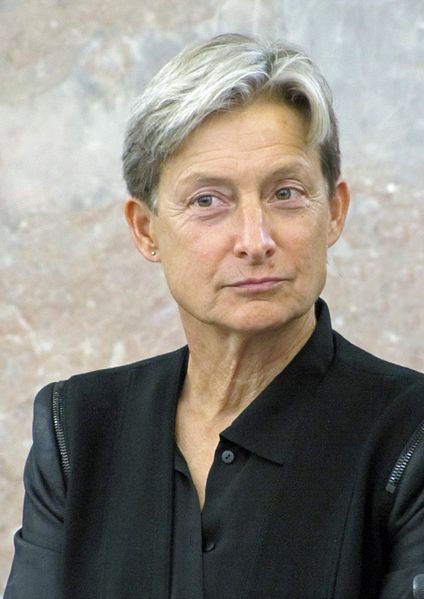
The world’s most famous female philosopher is Judith Butler, so let us see what she has to say. In 2015 she began a talk on impressions and responsiveness like this: “When we speak about becoming formed as a subject, we invariably presume a threshold of susceptibility or impressionability that may be said to precede the formation of our conscious and deliberate I”.[11] Okay, what might this mean? If by becoming formed as a subject Judith Butler meant being conscious and capable of receiving impressions through the senses, whereas by forming one’s “I” she meant becoming conscious of oneself, she was saying that consciousness precedes self-consciousness. Yet even having obscured this statement of the obvious by clouds of verbiage, she still did not dare to go that far. It wasn’t that consciousness preceded self-consciousness, but that it may be said to precede it. May be said by whom? May be said truly or falsely? Her statement added up to nothing. This appeared to be a small intellect trying to look big.

8. Patricia Williams

Coming to black women philosophers, they differ from white ones in that what concerns them is racial politics. In 1997 Patricia Williams, a Professor of Law at Columbia University who since 2019 has been a member of the American Philosophical Society, gave the Reith lectures, which were published as Seeing a Color-Blind Future.[12] Again, it was hard to see through the fog of her words, but it did not seem that a color-blind future was the kind she wanted to see.

She felt, no doubt to everyone’s astonishment, that black people are victimized by whites. How? Well, when her son was at nursery school, his teachers feared that he might be color-blind, yet an ophthalmologist found that his eyes were fine. It turned out that he had only taken his teachers’ endlessly repeated statement that we mustn’t see color, because color doesn’t matter, too literally. How did this mean that he had been victimized? According to Williams, his teachers had seen his “anxious response” as a physical deficiency — which, she suspected, is typical of the way black people are treated by certain types of whites:

This anxiety redefined as deficiency suggests to me that it may be illustrative of the way in which the liberal ideal of color-blindness is too often confounded. That is to say, the very notion of blindness about color constitutes an ideological confusion.

But was it white people with a belief in equal treatment who were confused here, or Patricia Williams, who seemed to find a problem with this principle on account of an irrelevant story about her son? But according to her, only by escaping our ideological confusion could we save black people from being “pulled between the clarity of their own experience and the often alienating terms in which they must seek social acceptance.” In other words, where black people are concerned equal treatment is no good. They must continue to be favored under programs such as affirmative action.

Most of that was on the first page. Further down page 2 she states: “There’s a lot of that in the world right now: someone has just announced in no uncertain terms that they hate you because you’re dark, let’s say.” Let’s say? Well, why not? Why don’t we say that white people go round telling black people that they hate them? It might help Williams make her next point, which is that although color-blindness might be a legitimate hope for the future, to embrace it now would be “to enshrine the notion with a utopianism whose naivety will assure its elusiveness.” Well, isn’t this just the problem? Treat black people like other citizens and you’ll only enshrine the notion of equal treatment with a utopianism whose naivety will assure its elusiveness —  especially if you can’t stop telling them how much you hate them.

9. Kimberlé Crenshaw
You can buy Greg Johnson’s Graduate School with Heidegger here

Kimberlé Crenshaw, an early exponent of “critical race theory” who is also a Law Professor at Columbia and also described as a philosopher, gave a TED talk in 2016, ostensibly about intersectionality, a concept of her own invention, the burden of which turned out to be to say that black women are being killed left, right, and center by the police.[13] She began by explaining why we hadn’t heard of any of the victims. It was because of a lack of frames: “There are no frames for us to see them, no frames for us to remember them, no frames for us to hold them.” Without explaining what a frame is, she said that their absence results in a “trickle-down approach to social justice” that lets people “fall through the cracks of our movement.” Only with frames can we see how certain problems impact every member of a targeted group. Thus far she had asserted little, yet see what she had presupposed! Her audience belonged to a movement concerned with social justice and was trying, without success, to catch or save members of targeted groups — presumably meaning black women, who were presumably being targeted by the police.

Proceeding as though she had established that any of this was true, she asked how the situation could be remedied. She held out hope: “It doesn’t have to be this way!” she exclaimed, and told a story about a black woman who was turned down for a job before it was found that she had not been discriminated against on grounds of sex or race. Without showing that the woman had been discriminated against, or even affirming that she had been qualified to do the job, she said that the court’s failure to find that she had been victimized demonstrated the law’s “refusal to protect African American women.” It was this case, she said, that had made her see the importance of frames, which had led her to the concept of intersectionality. Had this existed at the time, it could have provided an “alternative narrative,” which might have enabled us to “rescue this woman from the cracks in the law.” Nor was intersectionality applicable only to racism and sexism: It applied equally to classism, xenophobia, transphobia, heterosexism, and ableism: a concept to solve every problem!

Returning to the police’s alleged campaign against black women, it is so bad, said Kimberlé Crenshaw, that it is hardly surprising that some women had not survived. She described some ways in which black women had died:

They have been shot to death, they have been stomped to death, they have been suffocated to death, they have been manhandled to death . . . They’ve been killed when they’ve called for help, they’ve been killed when they were alone . . .

And so on. She cited no specific case and did not say when or where or why any of these women had been killed — or, more importantly, by whom — leaving it to her audience to assume that it was by the police. “It’s time for a change!” she cried, and then ran a film showing pictures of deceased black women and their names. “We must bear witness!” she yelled, and called ungrammatically on her audience to call out the names “randomly, disorderly, [in] a cacophony of sound!” Women in the audience got up and started shouting. A black woman came up from the wings and let out a gospel wail. But, said Kimberlé Crenshaw, “We must move from mourning to action! It’s up to us!” And that was it; her talk was over. Her philosophical disquisition was complete.

Women postmodernist philosophers

It is striking when reading Cynical Theories, published in 2020,[14] to see how women vastly outnumber men among postmodernist “philosophers,” just as it was striking to see in Dictatorship of Virtue, published in 1994, how women outnumbered men among the early activists of political correctness.[15] Given an idea by men — in the case of postmodernists, men such as Foucault and Derrida — women implement it obediently and zealously. For example, in Cynical Theories we read about Lydia X. Y. Brown, who says that to prefer being able-bodied to being disabled is to oppress the disabled, and about Fiona Campbell, who finds it problematic to see a disability as something to be cured. Kathleen LeBesco says that if an obese person thinks that they have a problem, they have been conditioned into accepting their oppression, while Lucy Aphramor and Jacqui Gringas say that diet plays no part in human health. Robin DiAngelo says that if you deny that you’re a racist, you’re a racist, while Naima Lowe, a lecturer at one of America’s most excruciatingly politically-correct institutions, Evergreen State College, said that the place is overrun by white supremacy. Women’s urge to comply and show that they are up-to-date without seeing any need for thought is something that has not been sufficiently recognized, although the ancient Greeks were aware of it, which is why they did not allow women to take part in politics lest they lead the state to ruin.[16]

A male and a female philosopher

Finally, let us look at two philosophers setting out their stalls, a man and a woman, to see how they compare in saying anything sensible or comprehensible. In 1969 John Searle wrote: “The hypothesis then of this work is that speaking a language is engaging in a rule-governed form of behavior.”[17] The previous year Sandra Harding had written: “The feminist standpoint epistemologies ground a distinctive feminist science in a theory of gendered activity and social experience.”[18] Searle made himself easy to understand, whereas Sandra Harding’s sentence raised the following questions: What is a standpoint epistemology? What is a feminist standpoint epistemology, and how many of them are there? What is feminist science as opposed to science? What is gender? Is it the same as sex? What is gendered activity, and what sort of thing might a theory of gendered activity say? What might a theory of social experience look like? How might feminist science be grounded in a theory of gendered activity and social experience, why would it need to be, and how might such a grounding be effected by feminist standpoint epistemologies? It was Sandra Harding, incidentally, presumably writing as a philosopher of science, who said that Newton’s Principles of Mechanics should be called Newton’s Rape Manual.[19]

Conclusion

The female “philosophers” looked at above display many of the characteristics traditionally associated with women in being more emotional, less rational, and less acute than their male peers. Some appear not only weak in logic, but unable to see the point of it, preferring the world of their own subjectivity. Faithful followers of intellectual fashion — and sometimes vicious with it — they show little interest in the truth and appear to find it easy to think that they have said something important when they have done no such thing. They have produced not philosophy, but inanity or feminist advocacy. This has occurred because, a long time ago now, the bar for entry to philosophy was lowered to a ludicrous extent for women when it should never have been lowered by an inch. No doubt if it were said today that women aspiring to be philosophers should be judged by the same standards as men, the implication being that this is not happening at the moment, would be seen as outlandish, and so the only practical conclusion to be drawn is that anyone wanting to read something by a female philosopher should pick a book published before about 1990, when the effects of this sex discrimination began to be seen.[20] If this rule excludes decent female philosophers who have written later, that is too bad. Missing out on them would be a small price to pay for avoiding the tosh produced by the others.

* * *

Like all journals of dissident ideas, Counter-Currents depends on the support of readers like you. Help us compete with the censors of the Left and the violent accelerationists of the Right with a donation today. (The easiest way to help is with an e-check donation. All you need is your checkbook.)

GreenPay™ by Green Payment

Select donation type

Select or enter an amount to give

Select or enter an amount to give monthly

For other ways to donate, click here.

Notes

[1] Famous philosophers, 2013, “Famous philosophers.”

[2] TheFamousPeple, no date, “Philosophers.”

[3] americanphilosopher, Sept. 11 2013, “On Women in Philosophy.”

[4] Philosophy Overload, April 1st 2017, “Being a Woman in Philosophy.”

[5] Santa Fe Institution, Oct. 14, 2015, “Questioning the Science of Gender Difference: A New Perspective.”

[6] villanovauniversity, July 28, 2014, “Feminist Ontology for the Twenty-first Century.”

[7] 6oodfella, Mar. 26, 2018, “Response To ‘We Must Ban Sex Robots’.”

[8] Thales’ Well, Oct. 5, 2018, “On Sex Robots and Personhood with Kathleen Richardson.”

[9] Conway Hall, July 17, 2015, “London Thinks: Waiting for GLaDOS (at Conway Hall).”

[10] CambridgeshireLive, Feb. 18, 2020, “‘The only solution for climate change is letting the human race become extinct.’”

[11] UCD — University College Dublin, Mar. 6, 2015, “Judith Butler — The Difference of Philosophy (2015); Notes on Impressions & Responsiveness.”

[12] Patricia Williams, Seeing a Color-Blind Future: The Paradox of Race (London: Virago, 1997.)

[13] TED, Dec. 7, 2016, “The urgency of intersectionality.”

[14] Helen Pluckrose & James Lindsay, Cynical Theories: How Universities Made Everything about Race, Gender and Identity — and Why This Harms Everybody (Swift, 2020).

[15] Richard Bernstein, Dictatorship of Virtue: How the Battle Over Multiculturalism Is Reshaping Our Schools, Our Country, and Our Lives (New York: Vintage, 1994).

[16] Mary Beard cites the examples from Greek mythology of Medea and Clytemnestra. Carl Jung’s view was that the anima meant chaos as opposed to the animus, which meant order. To observe women’s propensity for inducing chaos is not to say that there haven’t always been plenty of capable women in middle-ranking positions as matrons or headmistresses, for example, and still today there are principled women.

[17] John R. Searle, Speech Acts: An Essay in the Philosophy of Language (London: Cambridge University Press, 1969), p.22.

[18] Sandra Harding, “From Feminist Empiricism to Feminist Standpoint Epistemologies”, Chapter 6 of The Science Question in Feminism [Ithaca, N.Y.: Cornell University Press, 1986], pp.141-161, reproduced in Lawrence E. Cahoone (ed.), From Modernism to Postmodernism (Cambridge, Mass.: Blackwell, 1996), pp. 617-637.

[19] Dennis McCallum (ed.), The Death of Truth (Minneapolis: Bethany House, 1996), p. 194, cites Constance Holden, “Reason Under Fire,” Science, vol. 268, June 30, 1995 quoting Sandra Harding.

[20] Kathleen Stock has shown that she is up to par as a philosopher. See Claremont McKenna College, April 10, 2017, “Are there limits to what we can imagine? Kathleen Stock.”

Women Philosophers

Women%20Philosophers

Share

  • Gab

Enjoyed this article?

Be the first to leave a tip in the jar!

Instant Echeck GreenPay™

Related

  • The Cruelty of Kindness

  • Finding Atlantis Part 4

  • Do You Want to Play a Game?

  • Neo-Fascism in Film, Part 3

  • E. M. Forster’s A Passage to India & the Indian Mentality

  • Jonathan Bowden’s Deliverance, Part 3

  • The Rest Is Silence: Heidegger’s Quietism

  • Dispelling the Historical Fallacy of Indian Nationalism

Tags

black womenCatarina Dutilh NovaesCordelia Finecritical race theoryErin McKennafeminismJennifer McWeenyJohn SearleJudith ButlerKate RichardsonKimberlé CrenshawPatricia MacCormackPatricia Williamspaywallphilosophersphilosophypolice shootingspostmodernismRichard KnightSandra Hardingwomen philosophers

23 comments

  1. Greg Johnson says:
    March 28, 2023 at 1:12 pm

    Richard, thanks for this witty reminder of why I am glad I left academia.

    0
    0
  2. Teutonic Path says:
    March 28, 2023 at 3:36 pm

    It’s no coincidence that all the most capable female philosophers are also all anti-feminist

    0
    0
    1. OMC says:
      March 28, 2023 at 3:52 pm

      If they were truly opposed to feminism they wouldn’t be philosophers. At best they’re paying lip service to tradition.

      0
      0
      1. Teutonic Path says:
        March 28, 2023 at 9:51 pm

        I see you’re from the Ben Shapiro school of traditionalism. Real tradition has female philosophers and sages.

        0
        0
        1. OMC says:
          March 28, 2023 at 11:46 pm

          That’s a very recent tradition. There were no women philosophers in the ancient world or the Middle Ages.

          0
          0
          1. Teutonic Path says:
            March 29, 2023 at 1:58 am

            Hypatia disagrees

            0
            0
          2. OMC says:
            March 29, 2023 at 5:06 am

            Hypatia didn’t philosophize.

            0
            0
  3. Margot Metroland says:
    March 28, 2023 at 5:21 pm

    As a woman, I can assure you that I don’t like thinking about thinking about thinking.  That’s what we call abstract thought. I may or may not be typical. I can deal with physics and architectural design. I did very well on the Johnson-O’Connor (mathematical aptitude) punch-paper test. I just think most philosophy is stupid unless it’s rooted in history (Hegel) or some other solid discipline, perhaps statecraft (Machiavelli? Clausewitz?). You’re not going to get women interested in this stuff because they’re not interested in the underlying material.

    Please accept this in the humor in which it is given.


    0
    0
  4. Ultrarightist says:
    March 28, 2023 at 9:19 pm

    A bemusing and informative look into the farce that is American academia, further solidifying my belief that the American universities are the source of the civilizational rot that plagues us. These so-called female philosophers are the very antithesis of Logos. I suppose this proves that women use philosophy as a fish uses a bicycle.

    And Judith Butler looks very mannish.

    0
    0
    1. Desert Flower says:
      March 29, 2023 at 12:04 pm

      I know academics who know Judith Butler and these academics (all on the left side of the political spectrum) think she is a nut.

      I sense she is not as widely respected as some think she is (and not just Camille Paglia, who clearly despises her).

      Academia is a mess.

      0
      0
  5. James J. O'Meara says:
    March 29, 2023 at 3:11 am

    I recently found, in a European bookstore, a shelf of little paperbacks, like the Oxford Past Masters or the Very Short Introductions series, but in French or something, with Plato, Spinoza, Wittgenstein, Fichte (OK, maybe…) and … Judith Butler. But then, the French thought Jerry Lewis was a genius.

    0
    0
  6. Charlotte says:
    March 29, 2023 at 8:24 am

    So before feminism, women were not philosophers because they were barred from academia. After feminism, in henceforth Judaised universities, only feminist philosophy is allowed to be propagated. Mr Knight has failed to account for all of the variables here. Perhaps the only truly anti feminist position is to not say anything at all, in which case why should women be criticised for their failures in philosophy? It appears to me to be a rather irrational response.

    0
    0
    1. Desert Flower says:
      March 29, 2023 at 12:16 pm

      “So before feminism, women were not philosophers because they were barred from academia. After feminism, in henceforth Judaised universities, only feminist philosophy is allowed to be propagated.”

      Yes, exactly.

      I wish women were educated through four years of college, and then become wives and mothers with a solid foundation in literature and the classics, and yes, some math and business classes, too, because she has to run a household in the modern world. But that’s not what the university is for today, as we all know.

      0
      0
      1. OMC says:
        March 29, 2023 at 2:07 pm

        It’s not necessary to go to college to become educated, and especially not to “run a household in the modern world” as if that requires calculus and economics.

        Educating yourself is as easy as checking books out from your local library, or Archive.org. There is no reason to waste time and money on university courses to teach yourself how to make a budget.

        The only reason for a woman to go to college is to obtain credentials. No one cares about your degree, except maybe employers, and no man wants to pay off your debt. A college degree makes a woman less attractive as a mate. This would be the case even in a supposedly ideal world where academia was full of based feminists like Camile Paglia.

        0
        0
      2. Charlotte says:
        March 29, 2023 at 3:05 pm

        That sounds wonderful. I studied the sciences so my knowledge of the Arts is definitely lacking, and why I keep coming back to CC. I will have to homeschool my children in order to keep them out of the hellholes the Anglosphere attempts to pass for schools these days. Surely that’s one educational bone for the White Sharia crowd to chew on.


        0
        0
  7. Jud Jackson says:
    March 29, 2023 at 11:19 am

    Elizabeth Anscombe was a great philosopher.  Although she had the good fortune to be married to Peter Geach who was also a very good philosopher and undoubtedly helped her quite a bit in her research and writing.

    0
    0
  8. James Kirkpatrick says:
    March 29, 2023 at 3:55 pm

    A lot of people don’t know that Butler’s friends actually held an intervention for her a while back.

    They felt the philosophy bit was becoming a distraction from her real job: singing and playing guitar with The Eagles.

    0
    0
  9. Enoch Powell says:
    March 30, 2023 at 1:09 pm

    I am a big fan of the thoughts of Ayn Rand Rosenbaum. Not sure if she is considered a woman philosopher by people other than me.

    0
    0
    1. Kök Böri says:
      April 29, 2023 at 3:08 am

      I think Mrs Rand was just a writer. If we call her “a philosopher”, then we could call alike “philosophers” such writers as Ann Coulter or Diana West, and this would be wrong. West is one of my most favorite writers, but she still is not a philosopher. Nesta Webster was an interesting author too, but neither she could be called a philosopher.

      0
      0
    2. Beau Albrecht says:
      April 29, 2023 at 6:31 am

      I say she legitimately qualifies.  She wrote quite a bit about it, with a clarity that one doesn’t often see these days.  Although there are parts I don’t agree with, it’s worlds apart from the overrated puffery on display above.

      0
      0
  10. Kök Böri says:
    April 28, 2023 at 5:01 am

    I have found pictures of all mentioned women philosophers in Net, and was impressed (not positive). Patricia MacCormack is a real Goth, and I would not say anything, if she would be an actress or singer, but as a professor I could not accept her.

    0
    0
  11. Kök Böri says:
    April 29, 2023 at 3:01 am

    Well, maybe the women philosophers now write only some stupid things, OK. But are MEN philosopher of 2000’s and later better? Do they exist at all? Are they someway at least comparable to Plato or Aristoteles? Do they write something worth to read, in our times, not in 1960’s or even 1980’s? If not, then there are no really differences between men and women philosophers of today, and the problem is not in their sex/gender, but in our times, when really significant philosophers of any sex simply do not have place. Then the women philosophers are worse than the men only because they produce more noise publicly.

    0
    0
  12. Beau Albrecht says:
    April 29, 2023 at 6:33 am

    “First, there are large overlaps between men and women on any sex-related trait. So far, so obvious, except in the case of a trait like getting pregnant, I suppose.”

    What – you mean men can’t get pregnant?  Why, you… you monster!

    😉

    0
    0

Comments are closed.

If you have a Subscriber access,
simply login first to see your comment auto-approved.

Note on comments privacy & moderation

Your email is never published nor shared.

Comments are moderated. If you don't see your comment, please be patient. If approved, it will appear here soon. Do not post your comment a second time.

Upcoming podcasts
  • Rob Rundo on Counter-Currents Radio

    Rob Rundo on Counter-Currents Radio

    Counter-Currents Radio

    Sat, Jun 13th — 3 pm EST / 9 pm CET
  • Daniel Tyrie on Counter-Currents Radio

    Daniel Tyrie on Counter-Currents Radio

    Counter-Currents Radio

    Sat, Jun 20th — 3 pm EST / 9 pm CET

Writers of May

(2 votes) Morris van de Camp David M. Zsutty Derek Stark Jayant Bhandari Greg Johnson

Articles of May

The Lunch Wars by David M. Zsutty Heidegger on Nietzsche, Part One by Collin Cleary 2 votes
    • The Union Jackal, June 2026

      Mark Gullick

      6

    • The Inferiority Behind Immigrant Superiority

      Jayant Bhandari

      2

    • Counter-Currents Radio Podcast No. 690
      Greg Johnson & David Zsutty Discuss Current Things: AI, Henry Nowak, the Iran Crisis, & More

      Counter-Currents Radio

      1

    • Collin Cleary: What Rome Means to Me

      Collin Cleary

      2

    • Paul Krugman: Closet Bolshevik

      Spencer J. Quinn

      13

    • Fugue of Ideas:
      Ibram X. Kendi’s Chain of Ideas

      Greg Johnson

      15

    • Based Blacks

      Lipton Matthews

      7

    • Black Intellectual Fatigue

      Derek Stark

      33

    • Why White Advocates Should Avoid “Based Blacks”

      Dani Vypont

      20

    • Nietzsche & Race

      Mark Gullick

    • Editor’s Update
      Rob Rundo Rescheduled to Next Week on Counter-Currents Radio;
      Tonight Greg Johnson & David Zsutty Answer Your Questions;
      Fundraiser Update & a New $20,000 Matching Grant

      Greg Johnson

    • The Counter-Currents 2026 Fundraiser
      Lifetime Subscriber Welcome Packages Extended

      Greg Johnson

    • Nationalism This Week
      Who’s Looking Back?

      Greg Johnson

      29

    • China’s Threat to American Security:
      Food, Farmland, Foreign Control, & Energy Policy

      Lipton Matthews

      5

    • The Bitter End of Western Metaphysics:
      Heidegger on Nietzsche, Part Two

      Collin Cleary

      15

    • The Killing of Henry Nowak

      Mark Gullick

      38

    • The Crisis of Chinese Technology Thieves

      Morris van de Camp

      1

    • The Strange World of Gender Bender Fiction:
      & What This Genre Tells Us About Autosexuality

      Dani Vypont

      3

    • Watching the Watchers:
      The Dark Triad Question

      David M. Zsutty

      14

    • The Remigration Movement Solidifies

      F. Roger Devlin

      1

    • Casting Aspersions:
      The Fatal Consequences of Race-Swapped Casting, From Helen of Troy to Henry of Southampton

      Steven Tucker

      20

    • The Murder of Henry Nowak

      Millennial Woes

      23

    • Don’t Forget to Vote in Our Writer & Article of the Month Poll

      Greg Johnson

    • The Robot Hotdog Stand

      Greg Johnson

      37

    • Laughing Our Way to Victory

      Dave Chambers

      7

    • The Zodiac Killer

      Mark Gullick

      11

    • Jared Taylor: What Rome Means to Me

      Jared Taylor

      1

    • An Interview with Endeavour:
      My Way of Life Is an Adventure!

      Ondrej Mann

      6

    • José Pedro Zúquete’s The Identitarians

      Greg Johnson

      3

    • Editor’s Update
      Fundraiser Update & How to Watch the Remigration Summit

      Greg Johnson

      5

    • The Bitter End of Western Metaphysics:
      Heidegger on Nietzsche, Part One

      Collin Cleary

      11

    • Berlin: City of Stones

      Spencer J. Quinn

      6

    • True Folk-Horror Is Horror of Your Own Folk:
      Mark Gatiss vs the Brexit Blind Dead  

      Steven Tucker

      4

    • Counter-Currents Radio Podcast No. 689
      Thomas Massie, the America 2050 Bust, the Need for Whites to Divest from America, the AI Economic Apocalypse, & Pro-White Project Pitches to Billionaires

      Counter-Currents Radio

      7

    • Nationalism This Week
      Remigration is Inevitable, Part 3

      Greg Johnson

      27

    • Why Billionaires Should Fund White Identity Politics

      Lipton Matthews

      8

    • How Cold War Two Came About

      Morris van de Camp

      5

    • Now Available for Pre-Order at a Special Price!
      Greg Johnson’s The Philosopher Is In

      Greg Johnson

    • David Zsutty’s Elevator Pitch to a Billionaire

      David M. Zsutty

      1

    • Headbanging Lite

      Mark Gullick

      5

    • White Advocacy Past and Present

      Peter Bradley

      13

    • The Lunch Wars

      David M. Zsutty

      47

    • The Russians are Coming/The Russians are Coming

      Steven Clark

      1

    • Peak Fatigue in Fort Wayne

      Gabriel Anderson

      24

    • Keith Woods’ Elevator Pitch to a Billionaire

      Keith Woods

    • The Cruelty of Kindness

      Morris van de Camp

      9

    • Predation Wearing the Mask of Civilization

      Jayant Bhandari

      13

    • The Mandalorian & Grogu

      Trevor Lynch

      24

    • Editor’s Update
      Fundraiser Update & a New $20,000 Matching Grant
      Greg Johnson & David Zsutty Discuss Thomas Massie on Counter-Currents Radio

      Greg Johnson

      2

    • How the Jews Defeated Thomas Massie—& Themselves

      David M. Zsutty

      27

    • Jocelynn Cordes

      Fugue of Ideas:
      Ibram X. Kendi’s Chain of Ideas

      I don’t know how you are able to exercise such restraint, to first read this insanity and then...

    • Peter Quint

      The Inferiority Behind Immigrant Superiority

      Is that a statue of a monkey man, being propitiated by a squirrel? 🙃

    • Jocelynn Cordes

      Black Intellectual Fatigue

      "The black “intellectuals” are not so far off the mark when they claim that our institutions are...

    • Jocelynn Cordes

      Black Intellectual Fatigue

      Lipton Mathews writes structurally perfect essays--a rarity.

    • Derek Stark

      The Inferiority Behind Immigrant Superiority

      Very interesting. I recall Eric Hoffer discussing the two-sided superiority/inferiority complex of...

    • Peter Quint

      The Union Jackal, June 2026

      The very idea that an interjected false accusation of racism could even be considered as exonerating...

    • Fire Walk With Lee

      Based Blacks

      I don’t know, I still think his greatest contribution was the numerous shitty rap songs about the...

    • Mark Gullick

      The Union Jackal, June 2026

      Craggy Island would be an excellent entry in the Third-World Cup. You obviously know Father Ted, and...

    • Mark Gullick

      The Union Jackal, June 2026

      A lot of folk on the British Right share your opinion. Lowe is the only politician who speaks for...

    • Jank

      Paul Krugman: Closet Bolshevik

      Jews pick all sides. It's how they hide. They do it to trick the general public. Make them think...

    • Thomas Johnson

      The Union Jackal, June 2026

      And on top of this we now have the latest "migrant" atrocity, the knife attack in Belfast by a...

    • Greg Johnson

      The Robot Hotdog Stand

      Do tell

    • Hdkbdd

      The Robot Hotdog Stand

      Marxist philosophy does offer a theoretical solution.

    • Moss

      The Union Jackal, June 2026

      Excellent summary of the state of the UK and Ireland this week. Invader atrocities committed...

    • Chud

      Counter-Currents Radio Podcast No. 690
      Greg Johnson & David Zsutty Discuss Current Things: AI, Henry Nowak, the Iran Crisis, & More

      "If it's not radically new, why are they branding it as artificial intelligence" When...

    • Collin Cleary

      Collin Cleary: What Rome Means to Me

      Thank you!

    • countenance

      Fugue of Ideas:
      Ibram X. Kendi’s Chain of Ideas

      Kendi (or whoever wrote this for him, and I'll get to that) mentioned the Potsdam meeting in late...

    • Anon

      The Union Jackal, June 2026

      I think Rupert Lowe needs to stand down in Makerfield. I'm basing this off the analysis from Mark...

    • Beau Albrecht

      Paul Krugman: Closet Bolshevik

      If he had any power, he might well be up to tremendous mischief.  It's true that his bluster has a...

    • Beau Albrecht

      Fugue of Ideas:
      Ibram X. Kendi’s Chain of Ideas

      His shtick is about stitching together Ivory Tower leftist talking points into a Grand Unified...

    • Earth Day Special

      John Morgan

      12

    • A Robertson Roundup
      Remembering Wilmot Robertson
      (April 16, 1915 – July 8, 2005)

      Margot Metroland

      13

    • The Paranoid Style in White Nationalism

      Greg Johnson

      30

    • Join the Dance!

      Andrew Hamilton

      1

    • We Can’t Save the Earth Without Reducing African Birth Rates

      James Dunphy

      36

    • “I’m Not a Conspiracy Theorist, but . . .”:
      Jeffrey Epstein’s Death Gives New Life to “Conspiracy Theories”

      Greg Johnson

      22

    • Sylvia Plath: Stasis in Darkness

      Vic Olvir

      17

    • Vanguardism, Vantardism, & Mainstreaming

      Greg Johnson

      80

    • Aviation, Geography, & Race

      Charles Lindbergh

      3

    • Some Thoughts on Yule

      Collin Cleary

      4

    • Living in Truth:
      A Yuletide Homily

      Jef Costello

      7

    • John Kennedy Toole’s A Confederacy of Dunces

      Greg Johnson

      20

    • On Aleksandr Solzhenitsyn’s Warning to the West

      Spencer J. Quinn

      7

    • Elitism, British Modernism, & Wyndham Lewis

      Jonathan Bowden

      6

    • Philip K. Dick’s Do Androids Dream of Electric Sheep? as Anti-Semitic/Christian-Gnostic Allegory

      Greg Johnson

      20

    • “Conspiracy Theory” or Conspiracy?

      Andrew Hamilton

      21

    • Remembering H. P. Lovecraft
      (August 20, 1890–March 15, 1937)

      Greg Johnson

      3

    • Who Are We?
      Nordics, Aryans, & Whites

      Greg Johnson

      71

    • Remembering William Gayley Simpson
      (July 23, 1892–December 31, 1990)
      A Pleasant Afternoon with Harriet & Bill Simpson

      Margot Metroland

      18

    • Here are the Young Men
      Remembering Ian Curtis
      (July 15, 1956–May 18, 1980)

      Mark Gullick

      18

    • Percy Grainger
      Artist of the Right

      Alex Graham

      7

    • Remembering Revilo Oliver
      (July 7, 1908–August 20, 1994)

      Greg Johnson

      18

    • The Meaning of July 4th for the White Man

      Gregory Hood

      13

    • The Front National’s Evolution

      Bruno Mégret

    • Merwin K. Hart
      Forgotten American Hero & Man of the Right

      Morris van de Camp

      10

    • George Orwell’s Nineteen Eighty-Four

      Jonathan Bowden

      8

    • Carleton S. Coon
      Scientist & Reluctant White Advocate

      Morris van de Camp

      3

    • The Kwanzaa Absurdity Will Be Dwarfed by Juneteenth

      Robert Hampton

      10

    • Stravinsky

      Alex Graham

      7

    • Like the Roman:
      Remembering Enoch Powell (1912-1998)

      Mark Gullick

      23

    • Neo-Fascism in Film
      Part 5

      Karel Veliky

      15

    • The Game of Tarot

      Mark Gullick

      2

    • Institutions Cannot Be Transplanted

      Jayant Bhandari

      5

    • Jonathan Bowden’s Deliverance
      Part 5

      Jonathan Bowden

    • Crosstown Traffic:
      Jimi Hendrix & The Post-War Rock ‘N’ Roll Revolution

      Mark Gullick

      1

    • Slaves from the North:
      Finns & Karelians in the East European Slave Trade, 900–1600

      Lipton Matthews

      14

    • Neo-Fascism in Film
      Part 4

      Karel Veliky

      2

    • David Lean’s A Passage to India

      Spencer J. Quinn

      1

    • Elites are Essential to Development

      Lipton Matthews

      7

    • Jonathan Bowden’s Deliverance
      Part 4

      Jonathan Bowden

    • Neo-Fascism in Film
      Part 3

      Karel Veliky

      6

    • E. M. Forster’s A Passage to India & the Indian Mentality

      Spencer J. Quinn

      25

    • Jonathan Bowden’s Deliverance
      Part 3

      Jonathan Bowden

    • The Rest Is Silence
      Heidegger’s Quietism

      Mark Gullick

      2

    • Dispelling the Historical Fallacy of Indian Nationalism

      Lipton Matthews

      8

    • Neo-Fascism in Film
      Part 2

      Karel Veliky

      8

    • Jonathan Bowden’s Deliverance
      Part 2

      Jonathan Bowden

    • Life of a Klansman

      Mark Gullick

      8

    • Jonathan Bowden’s Deliverance, Part 1

      Jonathan Bowden

    • Decolonial Ideas are Holding Back Developing Countries

      Lipton Matthews

      8

    • Neo-fascism in Film, Part 1

      Karel Veliky

      21

    • Jonathan Bowden’s Onslaught, Part 8
      Divigations on Decadence

      Jonathan Bowden

    • Jonathan Bowden’s Onslaught, Part 7
      Intrigues in the National Front

      Jonathan Bowden

      1

    • Rotten to the Core

      Mark Gullick

      8

    • Strauss on Husserl’s “Philosophy as Rigorous Science”

      Greg Johnson

    • Jonathan Bowden’s Onslaught, Part 6
      Francis Bacon & Right-Wing Nihilism

      Jonathan Bowden

    • London After (& Before) Midnight:
      Aleister Crowley, The Landlord’s Worst Nightmare

      James J. O'Meara

      2

    • Jonathan Bowden’s Onslaught, Part 5
      The Post-War British Far Right

      Jonathan Bowden

    • No Rules: Rollerball

      Mark Gullick

      4

    • Jonathan Bowden’s Onslaught, Part 3
      Brett Easton Ellis’ American Psycho

      Jonathan Bowden

    • András László
    • Derek Hawthorne
    • Beau Albrecht
    • Alain de Benoist
    • Kerry Bolton
    • Jonathan Bowden
    • Collin Cleary
    • Jef Costello
    • Savitri Devi
    • Julius Evola
    • Jim Goad
    • Gregory Hood
    • Juleigh Howard-Hobson
    • Greg Johnson
    • Charles Krafft
    • Anthony M. Ludovici
    • Trevor Lynch
    • H. L. Mencken
    • J. A. Nicholl
    • James J. O’Meara
    • Christopher Pankhurst
    • Tito Perdue
    • Michael Polignano
    • Spencer J. Quinn
    • Fenek Solère
    • Irmin Vinson
    • Leo Yankevich
    • Francis Parker Yockey
    • Multiple authors
  • Editor-in-Chief

    • Greg Johnson, Ph.D.

    Featured Writers

    • Beau Albrecht
    • Gunnar Alfredsson
    • Collin Cleary, Ph.D.
    • Jef Costello
    • Morris V. de Camp
    • F. Roger Devlin, Ph.D.
    • Stephen Paul Foster, Ph.D.
    • Jim Goad
    • Alex Graham
    • Mark Gullick, Ph.D.
    • Greg Johnson, Ph.D.
    • Travis LeBlanc
    • Trevor Lynch
    • Margot Metroland
    • James J. O’Meara
    • Angelo Plume
    • Spencer J. Quinn
    • Fred Reed
    • Clarissa Schnabel
    • Michael Walker
    • David M. Zsutty

    Frequent Writers

    • Asier Abadroa
    • Aquilonius
    • Alain de Benoist
    • Kerry Bolton, Ph.D.
    • Dave Chambers
    • Steven Clark
    • James Dunphy
    • Endeavour
    • Richard Houck
    • Jason Kessler
    • Titus Livius
    • Ondrej Mann
    • Lipton Matthews
    • Mark Mazari
    • John Morgan
    • Jaroslav Ostrogniew
    • Kathryn S.
    • Christian Secor
    • Anne Wilson Smith
    • Thomas Steuben
    • William De Vere
    • Kenneth Vinther
    • Max West

    Classic Authors

    • Maurice Bardèche
    • Jonathan Bowden
    • Julius Evola
    • Guillaume Faye
    • Ernst Jünger
    • Kevin MacDonald, Ph.D.
    • D. H. Lawrence
    • Charles Lindbergh
    • Jack London
    • H. P. Lovecraft
    • Anthony M. Ludovici
    • Sir Oswald Mosley
    • National Vanguard
    • Friedrich Nietzsche
    • Revilo Oliver
    • William Pierce
    • Ezra Pound
    • Saint-Loup
    • Savitri Devi
    • Carl Schmitt
    • Miguel Serrano
    • Oswald Spengler
    • P. R. Stephensen
    • Jean Thiriart
    • John Tyndall
    • Dominique Venner
    • Leo Yankevich
    • Francis Parker Yockey

    Other Authors

    • Howe Abbott-Hiss
    • Michael Bell
    • Giles Corey
    • Jack Donovan
    • Richardo Duchesne, Ph.D.
    • Emile Durand
    • Guillaume Durocher
    • Mark Dyal
    • Tom Goodroch
    • Andrew Hamilton
    • Robert Hampton
    • Huntley Haverstock
    • Derek Hawthorne
    • Gregory Hood
    • Juleigh Howard-Hobson
    • Alexander Jacob
    • Ruuben Kaalep
    • Tobias Langdon
    • Julian Langness
    • Patrick Le Brun
    • G A Malvicini
    • John Michael McCloughlin
    • Millennial Woes
    • Michael O’Meara
    • Christopher Pankhurst
    • Michael Polignano
    • J. J. Przybylski
    • Quintilian
    • Edouard Rix
    • C. B. Robertson
    • C. F. Robinson
    • Herve Ryssen
    • Alan Smithee
    • Fenek Solere
    • Ann Sterzinger
    • Robert Steuckers
    • Tomislav Sunic
    • Donald Thoresen
    • Marian Van Court
    • Irmin Vinson
    • Book Reviews
    • Movie Reviews
    • TV Reviews
    • Music Reviews
    • Art Criticism
    • Graphic Novels & Comics
    • Video Game Reviews
    • Fiction
    • Poems
    • Interviews
    • Videos
    • English Translations
    • Other Languages
      • Arabic
      • Bulgarian
      • Croatian
      • Czech
      • Danish
      • Dutch
      • Estonian
      • Finnish
      • French
      • German
      • Greek
      • Hungarian
      • Italian
      • Lithuanian
      • Norwegian
      • Polish
      • Portuguese
      • Romanian
      • Russian
      • Slovak
      • Spanish
      • Swedish
      • Ukrainian
    • Commemorations
    • Why We Write
  • Archives
  • Top 100 Commenters
  • The Looney Bin
Sponsored Links
Europa.com Above Time Coffee Antelope Hill Publishing Paul Waggener IHR-Store Spencer J. Quinn American Renaissance Jim Goad The Occidental Observer
Donate Now Mailing list
Books for sale
  • The Philosopher Is In
  • Sexual Utopia in Power (Expanded Edition)
  • In Defense of Prejudice
  • Loving Our Own
  • Tyranny & Wisdom
  • The Populist Moment
  • Is America Doomed?
  • To all books
Copyright © 2026 Counter-Currents Publishing, Ltd.

Paywall Access


Please enter your email address.

Lost your password?

Edit your comment

Writer & Article of the Month May 2026

Voting for this month has concluded. Here are the final results!

Top Writers

  • #1 Morris van de Camp 2 votes
  • #2 David M. Zsutty 2 votes
  • #3 Derek Stark 2 votes
  • #4 Jayant Bhandari 2 votes
  • #5 Greg Johnson 2 votes
  • #6 Jared Taylor 1 vote
  • #7 Collin Cleary 1 vote
  • #8 Spencer J. Quinn 1 vote
  • #9 Mark Gullick 1 vote
  • #10 Lipton Matthews 1 vote
  • #11 Keith Woods 1 vote
  • #12 Steven Tucker 1 vote

Top Articles

  • #1 The Lunch Wars 2 votes
  • #2 Heidegger on Nietzsche, Part One 2 votes
  • #3 Predation Wearing the Mask of Civilization 1 vote
  • #4 Peak Fatigue in Fort Wayne 1 vote
  • #5 Keith Wood's Elevator Pitch to a Billionaire 1 vote
  • #6 Do You Want to Play a Game? 1 vote
  • #7 Why Billionaires Should Fund White Identity Politics 1 vote
  • #8 The 1970s: The Golden Age of Hijacking 1 vote
  • #9 True Folk-Horror Is Horror of Your Own Folk 1 vote
  • #10 Finding Atlantis Part 4 1 vote
  • #11 Berlin: City of Stones 1 vote
  • #12 The Ghost of the Confederacy 1 vote
  • #13 Lothrop Stoddard’s The Revolt Against Civilization 1 vote
  • #14 Could Fascism Work? 1 vote
  • #15 Jared Taylor's Elevator Pitch to a Billionaire 1 vote

Total votes cast: 17