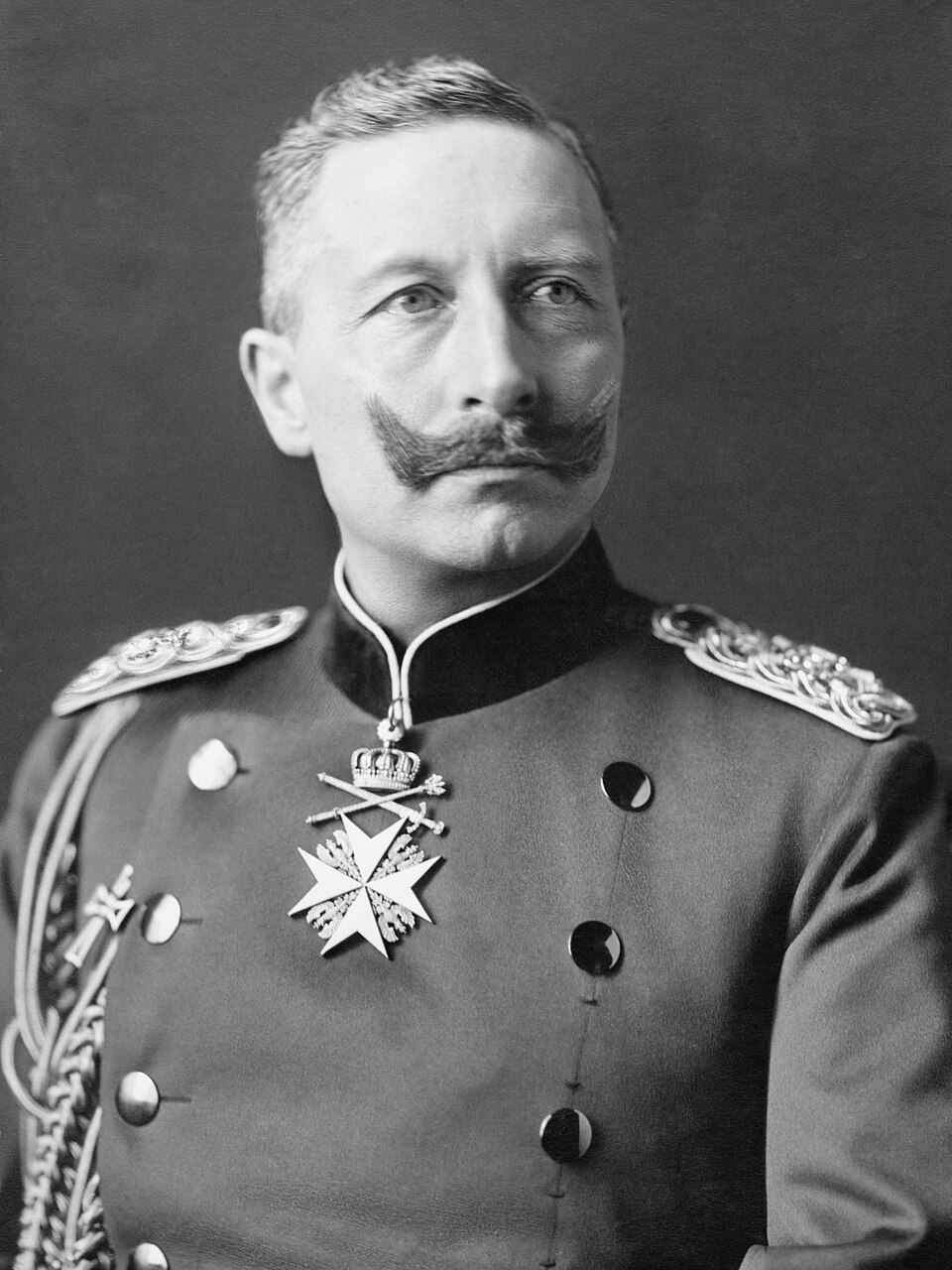
Kaiser Wilhelm II
1,504 words
One of the most fundamental distinctions in politics is between leadership and pandering. Failing to understand this distinction can lead to disaster. Leadership and pandering have the same object: the people, or more specifically the politically empowered people, the electorate. Leadership and pandering also have the same goal: to harvest political power from the people, primarily through elections.
How do leadership and pandering differ?
At any given time, the people have a set of beliefs and preferences: an understanding of what’s real and desirable, what’s right and wrong. Let’s just call these “given ideas” or “given preferences.” Leadership and pandering are two attitudes toward these “givens.”
If your goal is simply power, the best way to get it is to appeal to as many people as possible. The best way to do that is to conform your message to the given ideas and preferences of the electorate.
But what if the electorate is wrong? That doesn’t really matter if your goal is power. What if you personally disagree with the electorate? Again, your personal convictions don’t really matter if your goal is power. Thus you should keep your convictions private and pretend to agree with the public.
Pursuing power by setting aside one’s own beliefs and pretending to share the illusions and follies of the masses is my definition of pandering.
Pandering also happens in the economic realm. You can grow very rich my setting aside your tastes and pandering to the tastes of the masses.
What about politicians or businessmen who are wholly in step with the given ideas and preferences of the public? You can’t really call them panderers. There’s an element of condescension and self-betrayal to pandering. At least that’s what’s being asked of us when pandering is recommended as a path to wealth and power.
How do we define leadership? The simplest definition of a leader is someone who organizes a group and conducts them from point A to B.
You can buy Greg Johnson’s The White Nationalist Manifesto here.
Political leaders can be in complete accord with the given ideas and preferences of the public. In a way, this is the ideal leader. But a perfect servant of the people is ideal only if the people themselves require no improvement. If the people are unhealthy, however, then a statesman who merely serves them is making them worse off. But he isn’t pandering, because he doesn’t know any better.
The more people have in common, the more comfortable they are socializing with one another. But a different model should apply to professional and political relationships. When you get sick, you go to a doctor who knows more about medicine than you do. When you get your hair cut, you go to a barber who can do it better than you. That’s simply rational. Likewise, it is rational to want political leaders who are better at politics than you.
That difference opens up the possibility of leadership as well as pandering. I will call political leadership that makes people better edifying, because it builds people up by changing bad ideas into better ideas, bad preferences into better ones.
Edifying leaders can and do exist. But they are very rare in democracies, because in democracies, the path to political power is catering to the given ideas and preferences of the electorate, not trying to improve them. Indeed, in a democracy, people feel insulted by the suggestion that they need to improve their ideas and values. They much prefer candidates who flatter them with the message that they are perfect just the way they are.
The only superiority that people gladly suffer in democratic political leaders is merely a matter of skill, which basically means: the technical ability to satisfy given preferences.
That’s why White Nationalists don’t make much headway in electoral politics. Most people don’t want what we want—or at least they don’t think they do. To change their minds, we must edify them, not pander to them. Basically, we must convince them that every people has the right to its own homeland; that they are losing their homelands to diversity, multiculturalism, and immigration; and that they must take their own sides in ethnic conflicts—including closing borders and remigration—if they wish to have a future again. “This land is ours. Invaders and colonizers must go back.”
But is changing people’s minds about these sorts of issues best done in a democratic political campaign? Is a political speech enough to undo decades of school, television, movies, and pop songs all celebrating diversity and tolerance? Probably not. Thus the electorate needs to be educated before we can even hope to reap power from them.
The kind of education that must come before political campaigns is called “metapolitics,” which just means “before politics.” We must awaken in the public the same longing we feel for community, order, and beauty. Once people want what we want, we can lead them there politically.
We’ve made tremendous metapolitical progress, especially in the last decade, which is why political parties supporting elements of our agenda are taking off. But metapolitical work can never stop. Political work must simply be added on.
But can we meet the public halfway? This is the argument for “mainstreaming” our position. The answer is: yes and no. We need to make another distinction here, this one between substance and style. Substance refers to our basic principles and ultimate goals. Style refers to how we communicate them. No, we cannot meet people halfway on matters of substance, but yes, we can do that on matters of style.
The substance of White Nationalism is to create or restore white homelands for all white peoples. Either we have a right to our own homelands or we don’t. There is no halfway point between the right to a homeland and multiculturalism/globalism. There’s no way to split the difference. It’s all or nothing. Either we stand up for our fundamental principles or we don’t. Compromising on fundamental principles is simply self-defeating.
However, I am all for meeting the public halfway—or even more than halfway—on matters of style. The principle we should follow is the Latin maxim suaviter in modo, fortiter in re. This means that we should be as supple and pragmatic and persuasive as possible in our style of communication, in our outreach, in our propaganda. But we should be unbending and uncompromising about our essential basic principles.
Our goal is to make the public like us in terms of fundamental principles, by making ourselves more relatable to the public in terms of style.
Elitists love to accuse populists of “pandering.” That’s because they feel that ethnic identity and preference are hideous vices that should not be tolerated. These are the same people who happily give needles to addicts. Leftists think it is progress to replace a patriot with a junkie.
You can buy Greg Johnson’s From Plato to Postmodernism here
People who share a lot in common are more comfortable around each other. Thus they gravitate toward leaders with a common touch, a populist style. They are attracted to leaders with whom they can identify. This often works against us, but we should not disdain it. After all, it is an expression of our own deep desire for community and identity. It is the core of what we want. Thus we must build on it. This is the opposite of pandering. For us, populism is not just a matter of style but of substance.
But there’s no contradiction between populism and edifying leadership. This brings us to another distinction: between what the public really wants and what they think they want at any given moment. We believe that identity is the root of politics. People have a deep longing for community. But at any given moment, they also long for cheap goods and thrills, even though such economic motives open the door for globalism and rootlessness.
One of our central metapolitical tasks is to convince people that such economic motives must bow to communal needs whenever they conflict. And once in power, populist politicians must be willing to say “no” to the economic arguments for globalism, which leads straight to perdition. But we must say, “No, you only think you want that. But that’s not what you really want. For these reasons . . .”
Life is full of decisions. Principles are how we make them. We are constantly faced with the choice to edify or pander. The temptation to pander is always strong when economic motives intervene. This is especially problematic for the nationalist Right, since many of us have classical liberal backgrounds and some of those assumptions linger on. All too many of us think that things must be going well if money is flowing in.
Moreover, economic temptations to pander are everywhere, because so much of the populist Right is an online take-selling operation. If you want a distinction between true populism and cynical “slopulism,” it is simply this: whenever one is forced to choose between advancing our cause or simply pleasing the public, the true populist chooses the edifying upward path, while the slopulist panders to fill his pockets.
If you have a Subscriber access,
simply login first to see your comment auto-approved.
Note on comments privacy & moderation
Your email is never published nor shared.
Comments are moderated. If you don't see your comment, please be patient. If approved, it will appear here soon. Do not post your comment a second time.