
You can order Jonathan Bowden’s The Cultured Thug here.
2,443 words
Part 7 of 7
Edited by Greg Johnson and Peter Jacobi
In 1995, Jonathan Bowden self-published his Collected Works in 6 volumes (London: Avant-Garde, 1995), edited by Jürgen Schwartz, one of Bowden’s pen names. The six volumes comprise 27 distinct books, 12 of which had been previously published. Altogether, the Collected Works contain more than 2,600 pages of rare early Bowden.
Suck is the second book in volume 2. It was first published as a distinct book under Bowden’s pen name John Michael McCloughlin (London: Avant-Garde, 1994). We will publish it online in 7 installments. The titles are editorial.
Suck covers a wide range of political and cultural topics, interspersed with fictional narratives that may be loosely based on real people and events.
Eventually, a fully annotated version of Suck will appear at the Jonathan Bowden Archive. It will then be followed by similar editions of the rest of the Collected Works, plus a couple more early volumes that were not included. — Greg Johnson
There is also a degree to which modern intellectual activity is based on an escape from the existing world; a form of theoretical escapism, if you will. This is the degree to which the mind floats off into the spaces of its own imagining. As in the case of existentialist thought, where existence is measured in relation to non-being, the presence of non-being in life. But life itself is also made up as you go along; it is subject to narrative invention. In works as disparate as Sartre’s Nausea and Barbusse’s Hell, for instance, there is a profound disquiet, a sense of distaste, even hatred, for the modern world. Even going beyond this there is a hatred of the material world, of materiality itself, of the fungible and unquestioned nature of matter, of the facts themselves, the very nature of the real, which is perceived as a breakdown in thought and all moral order.

You can buy Jonathan Bowden’s Reactionary Modernism here.
While a group of anti-modernist fanatics such as the Romantic Movement (with a large R and a large M), the devotees of Romantia—an invisible island amidst modernity; an archipelago of nostalgia—would doubtless say that Sartre and Barbusse were disabused. They were affected with the decadence and deracination of their time. They were enthused with and disgusted by modernity, its approaches and accretions. When we remember that this Romantic Movement, these neo-Romantics or inhabitants of Romantia, are in a state of perpetual war with the modern world, with the nature of modernity, and advocate a form of secession, a type of abrogation or breaking with the actual, a deliverance from the fates. Whereby, with the assistance of a little cross-dressing, a little Edwardian transvestism, the modern world can be renounced. In that these individuals represent a complete break with the modern world, a world from which they wish to separate themselves, to reject its innermost nooks and crannies, including the objects which are in daily use in one’s home. All of which should be replaced by objects which fulfil the same function, but are Victorian or Edwardian in appearance, except in the case of machines developed since that date, where more tasteful versions, for example, are found to be more suitable. Yet this is by no means all, in that the architects of Romantia, such as her imperial Highness, the Queen Bee, Miss I. Grace, advocate a magical as well as a realistic breaking with the modern world, a sundering which is psychological as well as physical. Whereby the individual who is initiated in such rites is transported back in time (conceptually speaking), becomes a time-traveller, a devotee of the redundant moment, a person who encounters a Narnian quest (to use an image drawn from C. S. Lewis), a quest back to a Romantic vision which is perceived on the astral plane. All of which leads upwards in the manner of such things, the manner of such Occult workings, to a sort of transcendent glory. It is a vision of heaven, a sight of the doves and pigeons (whatever they are), a transcendental vision of the Imperial Queen herself, Miss I. Grace, astride the gates of Heaven, surrounded by dappled light and opulent colour, a sort of parody—without sarcasm—of Spenser’s Faery Queen; a vision of Hinge & Bracket without irony; a sort of blasphemous parody of the Queen herself.
It is as if these Romantics have retreated into a world of their own, a world which hovers around the twenties and the thirties. But it also draws on the Victorian and Edwardian periods, together with a dose of materialism which lies a good deal further back, and Miss I. Grace (doubtless a pseudonym) and her confederate, wish to construct an alternative reality; a Cult of their own; a neo-Edwardian Cult (hence the fascination with the use of the term, a sort of unacknowledged transposition.) In that their pretensions are just as Cultic as the world they wish to leave behind, if not more so. Since they plan a complete transformation in circumstances; a reversal in roles, a role change, if you will, a complete transformation in circumstances, in a manner which is reminiscent of Nietzsche’s transvaluation of all values, in that it involves the destruction of modernity and the triumph of Romantia!
When several questions are left begging by this procedure, in that the decadence they wish to escape from, the elements in the modern world they find so ugly and disquieting, have a way of returning to haunt them. In a manner which is reminiscent of the Freudian return of the repressed, the resurfacing of the unconscious mind, the return to consciousness of a fully-fledged perversity which had been kept out of sight. This is particularly true of the people behind this Romantic revival, a couple who once lived in Ireland, but who now live in Oxford. (Where they give lectures at the Union under the auspices of the Oxford Imperial Rightwing Reactionary Society.) In that the decadence they wish to escape from, the down-market clubs and discotheques of the Tottenham Court Road, for example, returns to haunt them in another way. When we remember that one of the periods they are most enamoured by, namely the 1920s, was itself a period of untrammelled decadence. This was a time which is best illustrated by the jokes, the wit and verbal chicanery, not to say flannel, of Noël Coward. He was an entertainer with an aristocratic air who originated from the slums, according to an acerbic Osbert Sitwell. When in actual fact it was the suburbs—but in Coward’s demeanour one sees a compressed eroticism, a type of male-to-female bi-sexuality, a rodomontade of compressed Eros. This was something which was waspish, sticky, and vain—if heavily brilliantined—and ultimately self-defeating, something which this particular couple have picked up on. Namely the fact that there was something mask-like and transfixed about Coward’s demeanour. It was something which was reminiscent of the manner of the mask—not the man in the iron mask certainly—but the man in the crinoline mask, the man in the mask made out of papier mache. Ultimately the man who attended the May Ball with a small heart-shaped black mask, with slits for the eyes, held by a stick in order to conceal his identity. All of which is indicated by the fascination with female fashions contained in The Romantic and The English Magazine (their main publications). For the self-referential and even semi-pornographic tone of these line drawings, these elegant sub-Beardsley pieces, leads one to suspect that it is a female mind which is behind them. It is a mind that is feminine in its comportment—if not its encastellation—but masculine in its rigour, the strange sense you receive when reading his/her/its prose. It is as if a strong, masculine intellect (if a slightly hectoring one, admittedly) were writing through lace net curtains, possibly gingham blinds. For the writing is in a spidery hand, using an old fountain pen, whilst wearing a pair of white gloves, with the black impress of the lips not necessarily hovering over the page, but remaining close by, mouthing the words as many people do when they write. As a consequence, this particular couple have created an inversion of an inversion. They have attempted to get away from the modern world, to lay its ghost (as it were), but all they have actually done is to further its cause in another direction. In that they have modelled their own escape from decadence on the decadence of the nineteen thirties. This was in itself little more than a prototype, a haute bourgeois prototype to be fair, of the events which were to consume the nineteen sixties, a mere four decades later. When we remember that the 1920s were essentially a popularised—if indisputably a middle-class (not to mention upper middle-class)—version of the 1890s. When this was the true era of the surreal, the decadent, and the fantastical—all of which was held in a relatively aristocratic embrace, if a somewhat foppish and sentimental one. Whereas the nineteen sixties were a proletarianized and cathode ray-tube version of the 1920s. In that the frivolity, shamelessness, and abandonment of the twenties—the rich and febrile twenties—was seen to return in a popularised form, a cross-class form (in middle and working-class terms) in the sixties. Hence the fact that drugs or mass stimulants had to be used, for a mass form of social debauchery!
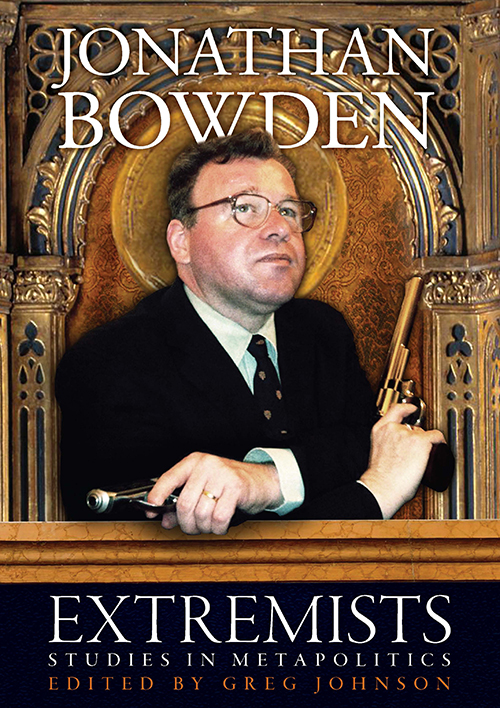
You can buy Jonathan Bowden’s Extremists: Studies in Metapolitics here.
Indeed this Oxford couple have a considerable amount to hide; given the fact that one of them may be a man dressed up. He was a man who is dressed up as a woman; a transvestite, an Eonist (to use the classical or Grecian term) and such a figure is a male version of Noël Coward in reverse, a type of Hinge & Bracket which is played “straight,” without any sense of irony. Whereas Coward himself was an effeminate man, at once arrogant and waspish, a closet invert, not a man dressed as a woman, but a woman dressed as a man, who happened to possess a set of male genitalia. When we also remember that Coward’s facade—for such it was—was mask-like, congealed, extraordinary, translucent and fixed—an ugly Harlequinade; a sort of Noh mask in the English drawing room.
Although this alarm may be false, in that a team of journalists from The Observer went up to see this couple in Oxford, and in their subsequent article they referred to them as “women.” Yet the photograph which accompanied the piece showed one of the “women,” a dark and lumpish figure in the background, with a mask over “her” face. So your guess is as good as mine! In any event, it is a rather dramatic step for a journalist to doubt the sex, the gender, of the person he is interviewing. He may have his suspicions certainly, but he is not likely to air them, particularly given the state of the British libel laws. Nevertheless this couple have retreated into a world of their own, and by a peculiar process of reversal, they have achieved a decadent posture in their retreat from a decadent world. They do not appreciate that each affirmation contains its opposite within itself, and their romanticism contains its own decadent flourish, its own converse, the convexity of its own concavity, its own anguish (to use Mario Praz’s phrase). When we remember that the truth, insofar as there is such a thing, is arrived at by a process of statement and reversal, of proposition and interdiction, signification and withdrawal. Nor is this just a case of Hegelian dialectic, a form of dialecticism which is bereft of synthesis, even when it contains one, because arguments are not just counter-pointed one against the other. They occur in a dynamic system, whereby the argument moves along even as it is challenged—in other words, the truth is arrived at through the clash of opposites which are resolved on a higher level.
It is the same with our two “sisters” in Oxford, because underneath a surface which appears polite and decorous, even demure, there is a fully fledged perversity. At the very best it is an oddity, a true example of English eccentricity, at worse, it is a wild and brazen thing; a black orchid, a four-leaf clover—something which is decadent and efflorescent; rather like a bacteriological spore which has been allowed to grow in its preservation dish for a little too long. When we remember that Romanticism has its secrets, its dungeons, hidden chambers and pitiless extremities. It has, if you like, its own secret life, which is represented by the Gothic, the outré, the degree to which Baudelaire, Blackwood, Crowley, Huysmans, Lautremont, and Machen are all Romantic authors. Instead of a purely literary romanticism, however, we find a sensual exoticism with these two sisters—“women” who pronounce themselves to be cousins rather than sisters, and although their attitude towards the modern world has much to commend it, most people would find it too complete, too totalitarian in its assumptions, too much like a Cult pretending not to be a Cult. In that some of the ‘de-programming’ societies, the deintoxication programmes, the anti-cults as it were, are actually Cults themselves. Nevertheless the perversity of this particular couple, the fact that they are engaged in a menage a trois of the senses; a “blue of noon” as Georges Bataille has put it, is the chief thing which can be said against them. It is the dressing up, the putting on of masks, the emptying out of bottles, valises, and wardrobes. It is the desire to play a role—whether a Burgundian Prince or a Victorian dairy maid. Moreover, it is the strange sexual posturing which accompanies these roles that gives cause for concern. This is the degree to which, as in sado-masochism, people believe in dressing-up and adopting new identities. Indeed the entire affair has a strange, lurid quality. It is the degree to which this couple is loyal to the fag-end of Weimar—in the way that Spender, Isherwood, and Auden were, rather than the Reich which was going to replace it, as evidenced by the Brownshirts growling in the streets. As a consequence, there is a strange mismatch here, a certain imponderable. In the case of a couple who espouse tradition and yet who reject traditional morality. A couple who may be heterosexual, but who dress up as women. In short, two persons who embrace tradition, but reject puritanism, two individuals who engage in a form of lesbianism which cannot name itself.
If you have a Subscriber access,
simply login first to see your comment auto-approved.
Note on comments privacy & moderation
Your email is never published nor shared.
Comments are moderated. If you don't see your comment, please be patient. If approved, it will appear here soon. Do not post your comment a second time.