 3,082 words
Part 1 of 8
Edited by Greg Johnson and Peter Jacobi
In 1995, Jonathan Bowden self-published his Collected Works in 6 volumes (London: Avant-Garde, 1995), edited by Jürgen Schwartz, one of Bowden’s pen names. The six volumes comprise 27 distinct books, 12 of which had been previously published. Altogether, the Collected Works contain more than 2,600 pages of rare early Bowden.
Onslaught is the third book in volume 2. It had not been previously published. We will publish it online in 8 installments. The titles are editorial.
Like many of the Collected Works volumes, Onslaught covers a wide range of political and cultural topics, interspersed with fictional narratives that may be loosely based on real people and events.
Eventually, a fully annotated version of Onslaught will appear at the Jonathan Bowden Archive. It will then be followed by similar editions of the rest of the Collected Works, plus a couple more early volumes that were not included. — Greg Johnson
Of course, ritualistic child-sex abuse is almost a heaven-sent opportunity for Beatrix Campbell[1] and libertarianism in general, whether right or left. It brings together a whole range of things which Campbell and those like her are opposed to: such as the family, masculinity, heterosexuality, childbirth (particularly if it is not artificial insemination by donor), and so on. It also brings together a whole range of interest groups who have little in common except their interest in Satanic abuse, such as New Leftists—the advocates of the Communist Party’s New Times published by Lawrence & Wishart—left-liberals, feminists, men-haters, semi-separatists (political lesbians) and Radical Feminists (those who demand complete separation between the sexes pending some ‘revolution’); together with Gay Liberationists—in a qualified way—and fundamentalist Christians, members of the Evangelical Alliance, family pressure groups, the morally authoritarian or Christian right; call it what you will, and ‘pro-life’ campaigners. In a sense it is an odd assortment; a heterogeneous mixture of diverse elements which have no clear relationship with each other. Although they do have one thing in common and this is the belief, the almost obsessional belief, that ritualised abuse not only occurs, but that it takes a Satanic, a devil-worshipping or Occult form. Indeed much of modern politics resembles a cross-section of people who have little in common, except their concern with one particular cause or other.
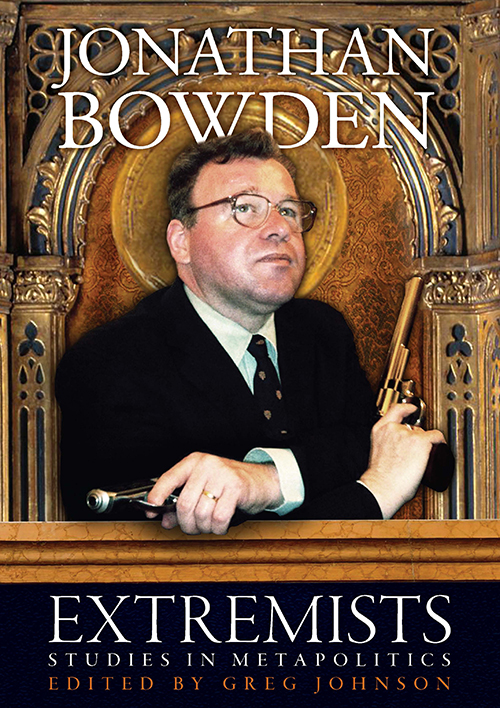
You can buy Jonathan Bowden’s Extremists: Studies in Metapolitics here.
Satanic child-sex abuse is a form of “moral panic” or modern “urban myth”; essentially unprovable, difficult to verify, and almost impossible to substantiate. In essence those people who believe it is occurring everywhere, at all times and in all places, want it to occur; in other words, they have an ideological commitment to it. In B. Campbell’s case, of course, it is meant to prove the inadequacy of heterosexual men together with the villainy of the ‘nuclear family’, (as it was called in the sixties)—its hidden passions, frustrations and tensions. In a sense, though, Campbell has found a vehicle for her own alienation from the society; namely the poor abused infant of indeterminate sex who is subject to molestation. Moreover, this is a child—an infant prodigy in reverse—who is an identikit victim; a victim of molestation by ‘the Power’; namely the power of Fathers, heterosexual men. It also represents a form of middle-class leftism; of what we might call anti-working class ‘social work’, always from a centre-left perspective but with a discernible anti-proletarian bias. After all, none of the children who have been snatched from their families, often in the dead of night, have been middle-class, suburban or educated; on the contrary, they tended to be lower working class, poor, and virtually uneducated. Indeed in both the cases in the North of England; namely in Cleveland in the North East and Rochdale in Greater Manchester in the North West, the families concerned were lower working-class; while the social workers were indisputably middle-class or ‘educated’ working-class which amounts to the same thing. As a result these “dawn raids” as it were, are a form of leftwing vengeance against the working-class; a form of social coercion; what we might call ‘social work as a form of social policing’. When we remember that this point—about the anti-proletarian bias of these investigations—would only be made politically by the anarchist Ultra-left and parts of the conservative Ultra-right. In a sense, therefore, the politics of child sex-abuse is a struggle within the Left or at the very least within the class-based conspectus of the Left. As a result it is a clash between two cultures and two views of reality; both of which were formally associated with the centre-left in British political life. Moreover, this can be seen in the trenchant opposition to this “child-sex abuse by the courts” on behalf of certain Labour MPs and councillors, together with more traditionalist elements of the police. This was something which was again reflected in the bitter hostility towards rightwing Labour MPs, such as Stuart Bell, who supported the families throughout this ordeal. In a sense, therefore, this is a split between two different kinds of left; the one middle-class, feminist and New Leftist; the other working-class to post-working-class and ‘traditionalist’. If you like, this dispute has a whiff of the division amongst left-literati during the nineteen thirties, when positive views of family life were entertained by Proletarian writers, amidst a stew of homosexual bohemianism a la Auden, Spender, Isherwood, and Co … which was described by Cecil Day Lewis, referring to Auden, as “a cheerful contempt for women and the family”. Of course, the situation is different today, but there are some similarities with the past, particularly when Beatrix Campbell speaks of labourism as a reactionary tradition; namely when the Labour Party is seen as white, working class, male, and inevitably anti-feminist and anti-homosexual. In many respects this is the only reason why Beatrice-Dominatrix or Beatrix is in the Communist Party, in that she is a New Left marxist, a sub-marxist, even a post-marxist, merely a left-liberal of the New Times school of journalism; a decadent form of euro-communism.
Ultimately whether there has been any Satanic child-sex abuse will depend on evidence and so far there is hardly any to go on. In several ways, rather like the ‘snuff movie’ of recent years, the whole thing is an elaborate hoax; a middle-class nightmare; a modern urban myth; slightly above the level of the “video nasties” controversy but not a million miles away from it. It also shows up a major cultural difference on the Left, between the promiscuous sixties New Left, on the one hand, and the fastidious if not puritanical—and usually feminist—Old Left, on the other. Nevertheless it is not really a dispute between the Old and New Lefts, as attractive as such a simple solution would doubtless be. It is actually a dispute between those who wish to ban certain forms of behaviour, usually by the great unwashed, and those who do not believe that such infamies actually occur. Hence we see a tension, an almost metaphysical tension, on the Left—not between puritan and libertarian as such, but between moralism and populism. In a sense this is a dispute between mystagogues and the advocates of popular disdain; between the progressive morality leagues and their more cynical (if not more lecherous) opponents. If you like, it is a dispute between the more socially real (the libertines by default) and those who wish to stamp down on certain types of behaviour; those who wish to see a moral improvement; a change of heart. As a result this is essentially a religious dispute; in any event, a dispute which has religious origins, and it exists between those who want a ‘moral improvement’ and those who are contemptuous of such niceties. It is really a dispute between socialists who think that things can be changed morally for the better and those who merely reflect the economic self-interest of their class. When we remember that working-class socialism is essentially proletarian capitalism—the mere expression of economic self-interest—when Socialism in the higher sense of that term is ethical or conceptual and nearly always linked to the politics of national renewal. In a sense, therefore, this dispute is a split between feminists who earlier in the century were opposed to prostitution, under-age sex, brothels, and the general bordello culture (whether frock-coated and respectable or proletarian “rough and tumble”) and those who preferred to look the other way. As a result these campaigners—these post-religious zealots, if you like—had a lot going for them; they were more honest than their contemporaries for a start, and they wanted the society to look at its own sewer; its own underworld. When this was a world which tolerated the Cult of the Lady, on the one hand, and yet allowed sixty thousand women, many in their teens, to walk the streets of Victorian England, on the other. Yet this type of morality always makes many mistakes, and it tends to confuse morality with censoriousness, anger at social squalor with bourgeois conformity, and proletarian bawdiness with sin. In a sense it becomes a form of middle-class prejudice against close, hot, promiscuous working-class quarters, whether at home or at work—the prevalence of gin, the paucity of diet, the sexual mores, the brutality of the men and their amusements; gambling, drinking, whoring, cheap cultural amusements, and so on … Ultimately it is a form of middle-class moralism—a picture of John Wesley staring down from his pulpit—a species of compassion—a token of bewilderment—finally, middle-class people (social reformers) telling their social inferiors how they should be behaving. As a consequence it shows up the morally authoritarian, prissy, and fraudulent parts of the Left; its desire for control over the classes it alternately fears and despises and seeks to rule over. We might say, therefore, that such a split brings out the difference between the amorality, the antinomianism, of the working-class left—its sheer self-interest—and its middle-class counter-part. Indeed an echo of this can be seen in a leftwing Labour MP (Claire Short’s) attempt to ban Page 3 in The Sun—where “girlie” posters are displayed—and the average reaction to this by a group of male trade unionists.

You can order Jonathan Bowden’s The Cultured Thug here.
Nevertheless a more honourable and inevitably more rightwing attitude towards these matters would take a completely different tack. If it restricted pornography or degeneracy in the social interest then it would have little illusion about acting morally or attempting to improve people, no, that is not the object. In short, this entire form of behaviour would be based on a different premiss—namely the fallen nature of the human condition; the naturalness of man’s fate—his inherent barbarism—the innate human capacity, in other words, for destructivity—the absence of what we might call the redemptive moment—and the recognition that without barbarism you cannot have civilization. When this is said to justify the state intervening in the society in the support of age-old structures, traditions, norms, and values held dear by human beings for millennia. This is not, let it be said, for moral reasons, to improve men and women, merely to enforce the absence of error; to marginalize the anti-social, restrict human folly, and turn it into more regulated channels. This is not an attempt to make human beings better but to stop them getting worse; to prevent them from falling; from dropping down to the true evaluation of their own instincts; in a sense to use the prohibitions of the state against nature; whilst remaining true to the brutality endemic in our animal natures. When we remember that human beings are sentient animals, mammals with self-consciousness, whose natural urges need to be canalised by the state for the glory of the nation—so that degeneracy is turned into barbarism in the service of the state, in the service of the nation, in accordance with a higher good, a greater evil. As a result forms of degeneracy such as prostitution, pornography, homosexuality, paedophilia, drug usage, and so on … are restricted by the state, not in the belief that they will disappear, but in the belief that they need to be restricted, lest other evils befall. As a consequence the working-class as well as other social groups accept the leadership of the state, of the class which rules through the state, as part of a natural necessity; a natural law; a biological donnée or given—a certifiable dream.
The one thing which needs to be said about child-sex abuse is that it has nothing to do with Satanism—merely a version of Satanism. When this is a type of Satanism which has been invented by Christians and glossed from Huysman’s novel La Bas (Down There). Indeed Huysman’s book was a product of the naughty nineties—French Gallicisms, dark secrets, venereal spores—Yellow Book whisperings—and Edgar Allan Poe’s The Masque of the Red Death. In a sense, therefore, the eighteen-nineties were a ‘happening’; a type of ante-dated counter-culture; a worship of the Phallus, the God Pan (a la Aleister Crowley) and the hidden delight. It was a heady and perverse decade, at once naughty, devious, devilish and prone to what Henry Miller later called the occult and the obscene, those tokens of renewal. Although most people only saw psychic waste—inanition, debauchery—little more than masturbation without wit or pleasure—a mixture of creme de menthe, Parisian brothels, and Turkish delight. Nevertheless many forms of satanism actually exist, at least six in my reckoning, and they are off-shoots of the Christian religion as well as rebellions against it. The main form of satanism, as I detailed in my third book Sade,[2] is a form of paganism (if not neo-paganism) at least a form of epicureanism, little more than a worship of material pleasure—wine, women and song, all dressed up with a degree of ceremonial, a tincture of regalia. In a sense it is a cult of health, nature and spirit; hikes in the mountains, German youth troops, sacrificial pundits, and mock-solemnity—the sort of pathos which Llewyln Powys[3] stood for without the boxer shorts.
To return to a familar point—Beatrix Campbell and her associates fail to understand the nature of child-sex abuse because of their libertarian bias. This is the fact that they view human beings in an instrumental way; in what we might call a mechanistic or utilitarian manner. Of course, certain libertarian thinkers would dispute this and Martin Summers, a member of the Institute for Economic Affairs (the IEA), has done so in my presence. This is an important qualification, however, because it illustrates the limitation of ideas—even at the moment of their complete triumph. It is the moment, in turn, when they cease to be what they are and tend to become what they always might have been. This is the moment, in other words, of their elixir, the moment which philosophers call—somewhat unnecessarily—their hypostatization; when these ideas become greater than the sum of their constituent parts. Although it is important to point out, as Martin has done, that you can hold an idea without necessarily being a slave to all of its formulations. Nevertheless the fact that libertarianism, whether right or left, has a nominalist view of human beings—what we might call a test-tube view of human beings—affects its judgement. This view of the world sees human beings as individual entities—solipsistic beings—who are trapped in the dungeon of their own flesh. Such a view of reality sees human beings as completely independent or autonomous; indeed, it is a cult of autonomy, a cultivation of the inner life and its vagaries and desires. We might say, therefore, that it views human beings like multicoloured balls—such as snooker or pool balls when they are racked up in their triangle prior to the commencement of a game. Of course, there is one important difference here and this is that the balls are acted upon from without; they react rather than act; in short, they are propelled into action by an exterior force. In a sense, therefore, the momentum of such a ball on the green beize is equal to its mass multiplied by its velocity; whereas its acceleration to a target is its mass times the square of its velocity. Either way, the ball is completely controlled by the force which propels it; it has no inner-life; no interiority or sense of self-worth. In short, it cannot plan or predict events—in libertarian jargon—it cannot maximise its potential within the contingencies of a free market. Where the free market is a forcing house of possible desire—it is the difference in choice between similar things; a sort of valency, an evaluation or opportunity-cost. In such a world the individual chooses to be free or at the very least he makes free choices, he determines between different courses of action. Nevertheless how far does this indicate he is free?—is he just free to consume (?)—according to this analogy—or is there something else to it. As a result the individual is free to make certain choices—he is not a billiard ball after all—but he is propelled to make certain decisions as well. He is not entirely free. In other words, he is under some form of compulsion and he is propelled between different objects like a pin-ball in a slot-machine. Needless to say, he does have some of the attributes of an interior life, such as his family, sexual passion, infantile remembrance and so forth, but he is not altogether free. Ultimately he is in the grip of forces he cannot understand and these are tensions and possibilities—fleeting moments of self—which exist beyond his comprehension. Indeed Brian Micklethwait, a doyen of the Libertarian Alliance, once became very angry with me about these things at a meeting, and he confirmed that libertarians do not deny certain definitions of individuality. When these definitions, these desiderata, such as the family, are inevitably inhibitions to individual freedom—they define and limit the choices available. Although this, in turn, can be used to illustrate the fact that they adumbrate the choices available; in short, they extend these choices through their limitation of them.
Notes
[1] Authoress of Unofficial Secrets: Child Abuse: The Cleveland Case (Virago, 1988).
[2] Fourth book, in fact, written in his early twenties, after Attack, Mad and Aryan.
[3] Llewelyn Powys, writer and brother of the writers John Cowper Powys and T. F. Powys.
If you have a Subscriber access,
simply login first to see your comment auto-approved.
Note on comments privacy & moderation
Your email is never published nor shared.
Comments are moderated. If you don't see your comment, please be patient. If approved, it will appear here soon. Do not post your comment a second time.