1,002 words
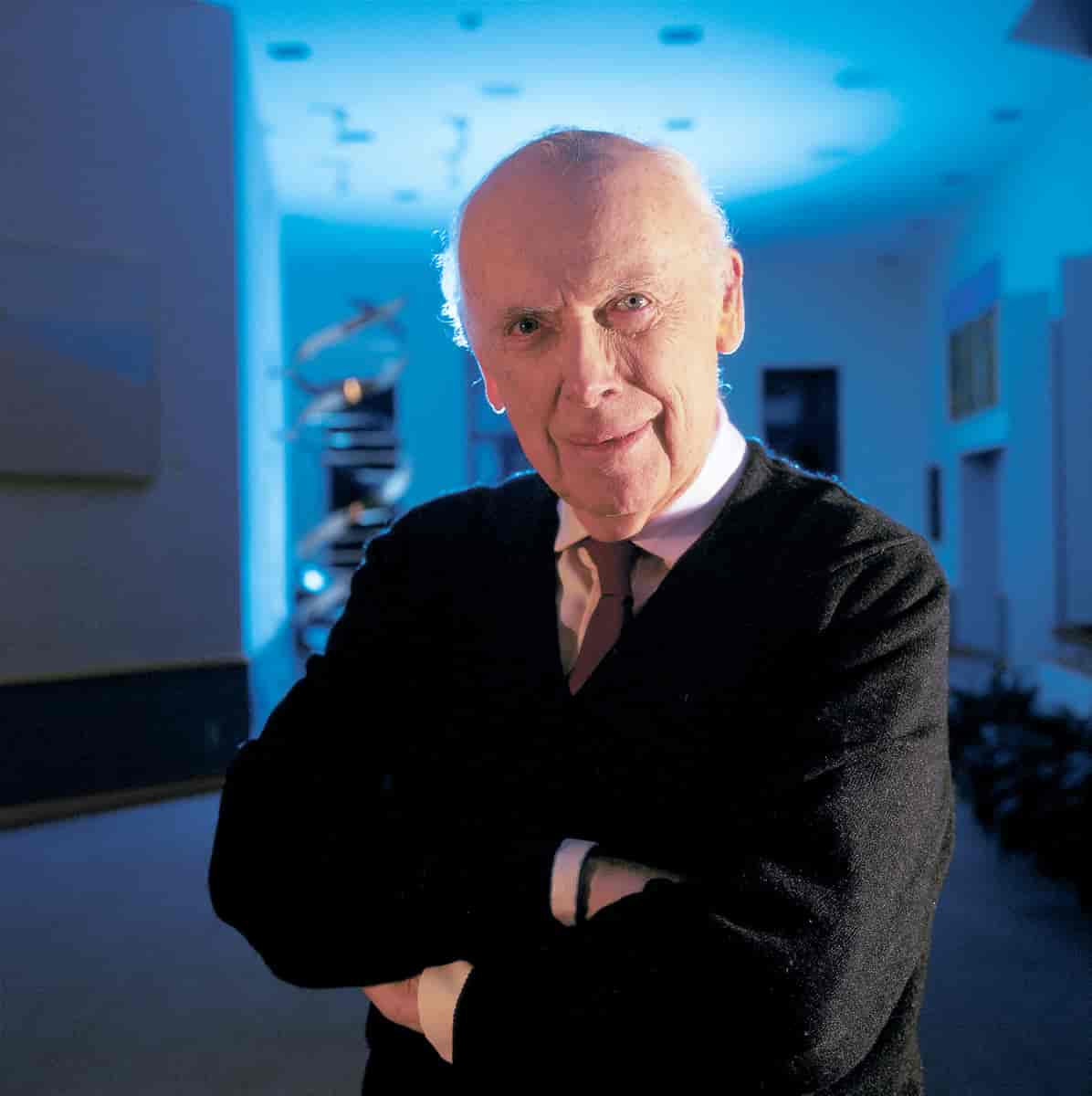
Nobel laureate Dr. James D. Watson, Chancellor, Cold Spring Harbor Laboratory.
James Watson, one of the great scientific minds of the past century, has died at the age of 97. In 1953, still in his mid-twenties, he and colleague Francis Crick discovered the structure of the DNA molecule. It was an essential precondition for just about all the advances made in genetics since that time. Later in life he was the subject of a moral panic due to some candid remarks on racial differences, and was stripped of many of his honors. As Ed Dutton has written in a book on Watson which I recently reviewed for Counter-Currents, this was our age’s equivalent of the 1633 condemnation of Galileo for voicing ideas disapproved by the powerful.
James Dewey Watson was born in 1928 and grew up on Chicago’s South Side, attending public schools. In 1943, at the age of just 15, he was awarded a scholarship to the University of Chicago, where he concentrated on zoology. He did not get the best grades, devoting much time to birdwatching to the detriment of his academic studies.
Watson graduated in 1947 at the age of 19 and went on to be a PhD student at the University of Indiana. The admissions officer made it plain to him that he would be left free to research whatever happened to interest him. This was perfect for a young man like Watson. As he later recalled, if he had been made to follow some set plan, “I might have grown bored with my thesis research and been obliged to wait until after my Ph.D. was completed, some three or four years, before experiencing true intellectual excitement. And by then I would have left the most thrilling problem of all—the DNA structure—for others to solve.” He obtained his PhD in 1950 at the age of just 22.
Watson was then a post-doctoral researcher at the University of Copenhagen, before transferring to Clare College at Cambridge University. In 1953, he and the English biologist Francis Crick (1916-2004) worked out the double helical structure of the DNA molecule. He later told his own version of how the discovery came about in a brutally frank memoir The Double Helix: A Personal Account of the Discovery of the Structure of DNA (1968).
Leaving Cambridge, Watson worked at Cal Tech before transferring to Harvard, as a biologist, in 1955. He was Professor of Biology at Harvard between 1961 and 1976. Awarded the Nobel Prize for Physiology or Medicine for his earlier research at Cambridge in 1962, in 1968, Watson became the director of the Laboratory of Quantitative Biology at Cold Spring Harbor on Long Island, a privately funded scientific research establishment. In 1994, Watson became the laboratory’s president. A talented fundraiser, Watson was responsible for making Cold Spring Harbor a world leader in biological research.
In 2007, Watson was touring England to promote his autobiography Avoid Boring People: Lessons from a Life in Science when London’s Sunday Times Magazine published some offhand remarks of his:
[Watson] says that he is “inherently gloomy about the prospect of Africa” because “all our social policies are based on the fact that their intelligence is the same as ours – whereas all the testing says not really.” His hope is that everyone is equal, but he counters that “people who have to deal with black employees find this not true”. He says that you should not discriminate on the basis of colour, because “there are many people of colour who are very talented, but don’t promote them when they haven’t succeeded at the lower level”. He writes that “there is no firm reason to anticipate that the intellectual capacities of peoples geographically separated in their evolution should prove to have evolved identically. Our wanting to reserve equal powers of reason as some universal heritage of humanity will not be enough to make it so.”
So many of Watson’s planned speaking engagements were cancelled in response to the publication of these remarks that he simply called off the book tour and returned to the United States.
The prestigious scientific journal Nature, which had published the original Watson-Crick Double Helix paper in 1953, denounced him in an editorial with such language as: “his notorious propensity for making outrageous statements”, “a track record of making distasteful remarks”, “on many previous occasions voiced unpalatable views tinged with racism and sexism”, “his views have finally been deemed beyond the pale”, “demonstrates a sheer unacceptable offensiveness”, “unpleasant utterances”, and “crass comments lacking in ‘sensitivity'”. Conspicuously absent from all this emotive verbiage was any concern with whether his statements were true or not.
Watson was relieved of his responsibilities at Cold Spring Harbor Laboratory. Many members of the Board of Trustees must have known that Watson’s observations were sound, but they voted to force him to step down believing this was necessary to save the lab. A public statement declared that the board “vehemently disagree with his statements and are bewildered and saddened if he made such comments.”
In 2014 Watson was forced to auction off his Nobel Prize medal to raise cash. It was purchased by a sympathetic Russian billionaire for 2.6 million pounds and returned to him.
In 2019 Watson was asked whether his opinions on racial matters had changed. He said:
Not at all. I would like for them to have changed, that there be new knowledge that says that your nurture is much more important than nature. But I haven’t seen any knowledge. And there’s a difference on the average between blacks and whites on IQ tests. I would say the difference is genetic.
All hell broke loose a second time. Cold Stream Harbor Laboratory told newspapers that Watson’s remarks were “unsubstantiated and reckless […] reprehensible, unsupported by science.” They stripped him of his remaining honorary titles. The following year, during the Black Lives Matter protests, they even decided to rename of their graduate school because it had been named after Watson.
As with Galileo, none of this will have any effect on Watson’s historical standing as a pioneering scientist, but let us hope it will long be remembered to the disgrace of the age in which we are now living.
James D. Watson, R.I.P.
38 comments
I admire Watson as a scientist and all, but I think he just liked to say shocking things to get a rise out of people and hurt feelings. Some years before the race/IQ kerfuffle he was deemed notorious for saying gays could be tested and be aborted in utero and that the only loss for humanity might be less ballet. Just because his remarks happen to coincide with the truth on race and iq doesn’t necessarily make him our ally ideologically. It was a useful episode but I’m not sure he intended to be a crusader for justice.
Well said. WN views are, and should always be based in science, but we don’t want to get too muddled in rationalism. That type of person is not any help.
Take a look into Watson’s life, and it’s not hard to see he was basically an annoying sperg.
I don’t mean to judge him harshly, I read his book on the history of dna and it was great, but I think he simply inadvertently stepped into a tar pit too deep even for him with race and IQ.
you know though, I don’t think this sort of attack would work now. The left sort of trashed its credibility with trump derangement.
DarkPlato: November 10, 2025 … I think he just liked to say shocking things to get a rise out of people and hurt feelings. Some years before the race/IQ kerfuffle he was deemed notorious for saying gays could be tested and be aborted in utero and that the only loss for humanity might be less ballet. Just because his remarks happen to coincide with the truth on race and iq doesn’t necessarily make him our ally ideologically….
—
You’ve got to be kidding, DP. Watson wasn’t awarded the Nobel Prize for humor. For combining groundbreaking scientific truth with humor in your highlighted anecdote, if true, he could have been awarded the Humor Prize if there was such a category.
His courage to not back down on obvious truths of IQ differences between Blacks and others puts him as an ally.
Agree, he showed character by not backing down. All I mean is I think it was something bumbled into. He wasn’t on a mission to convey a single important truth to humanity like Shockley was.
We sometimes expect too much from people like Watson. Their motivation is often driven mainly by their autism and quarrelsomeness. Extreme individualism prevents them from speaking out in favor of any political ideology apart from extreme libertarianism. Their cases of cancellation are often beneficial to our cause, but personally, they are not really pleasant, pro-social people. This is evident, among other things, in their inability to effectively support younger academics with non-woke views. They usually only decide to do so when they themselves have been canceled or are retired.
While your obituary celebrating James Watson is good and right, your mentionning Galileo as a martyre of science fighting the powerful is totally wrong. You really should read *The Sleepwalkers* by Arthur Koestler.
Could you elaborate a little bit?
Whether apocryphal or not, it seems to me that the refusal of the Inquisition to look through Galileo’s telescope defines a major breakthrough in how we understand the world.
If the officials had only done so, they would have seen the Jovian moons orbiting the celestial body, and that perhaps the Holy Scriptures were not all of what they were claimed to be.
Of course a few empirical observations can be flawed, which is why a methodology had to be devised to make broad measurements and to comprehensively catalog minutia to form testable hypotheses and ultimately to approximate the truth itself.
Can this be the entire truth? Maybe not. There are limits to how big we can make telescopes and atom smashers to better gauge our world. But by my way of thinking, the less Superstition the better.
Also, it seems to me that we are facing an alarming trend for what I call Epistemological Nihilism, where the most obvious and parsimonious paradigms must be flawed somehow by “MK-Ultra” or by “the” FBI Narrative, etc.
There is nothing wrong with asking questions; that is the beginning of critical-thinking. But at some point a refusal to find any answers becomes a grifting problem all of its own.
🙂
Great article, but didn’t we read the same thing a few months back? 🙃
Yes, I reviewed Ed Dutton’s book Genius Under House Arrest: The Cancellation of James Watson a few weeks ago, which is presumably why Greg Johnson asked me to contribute this obituary. “Originality” in such a context seemed to me superfluous, so I allowed myself a bit of copy-and-paste. Readers who want more of Watson’s story than I provide in this brief obituary notice are encouraged to go back to the review: https://counter-currents.com/2025/09/cancelling-our-galileo/
It was purchased by a sympathetic Russian billionaire for 2.6 million pounds and returned to him.
Just for information, this Russian billionaire (the word oligarch could be used too) was Alisher Usmanov, an Uzbek.
“Usmanov bought the medal to return it to Watson, stating that it was unacceptable for an outstanding scientist to have to sell it, and to ensure the money from the sale went to scientific research. The medal was subsequently returned to Watson, while the funds were donated to institutions supporting research”.
Couldn’t find more than this on the subject and it’s quite something if this was the simple motivation to fork out 2.6m GBP. I know he’s a scazillionaire but 2.6 million because what’s right is right? Noble!
Usmanov is an interesting man. With all bad traits typical for any post-Soviet oligarch, he is still unusual in what he is really interesting for history, for example. He bought some very expensive ancient maps of the Great Tartary in Europe and brought them to Russia. Russia is a descendant of the Great Tartary, but official establishment history does not recognize these relations.
I remember a lot of people being angered when Watson said the following:
“I am inherently gloomy about the prospect of Africa. All our social policies are based on the fact that their intelligence is the same as ours – whereas all the testing says not really.”
Regarding the hope, that all are equal, he counters “people who have to deal with black employees find this not true.”
Wow! jasmine crockshit and cardi b are not on par with Francis Parker Yockey. Who would’ve thought?
I need to repeat what made woke cancellation campaigns so deadly: the trick was that attacks on the target person were always coordinated from both inside and outside the institution where the person worked. As a rule, the victim first had conflicts with wokeists within the institution or their field. When the conflict escalated, they then brought in woke activists and the media against the victim. Sometimes it was the other way around. This was then joined by a screaming mob on twitter. At the height of their power, woke activists also applied the principle that the target person should also be prosecuted, so that the media lynching was followed by dismissal from employment, police investigation, and dragging before the courts for “hate speech” and “defamation.”
I agree with some radical theories of education which advocate allowing students the freedom to pursue their own interests. In order to stimulate “true intellectual excitement”, a young person should be free to pursue his interests and passions outside of the Victorian era classroom. As long as you can read and write, then if you want to watch birds all day, go ahead.
John Taylor Gatto would agree with you. Our modern educational system is based on the Prussian model of education established in the early 19th century.
It is absurd and anti-life to be part of a system that compels you to listen to a stranger reading poetry when you want to learn to construct buildings, or to sit with a stranger discussing the construction of buildings when you want to read poetry.
Is there an idea more radical in the history of the human race than turning your children over to total strangers whom you know nothing about, and having those strangers work on your child’s mind, out of your sight, for a period of twelve years? Could there be a more radical idea than that? Back in Colonial days in America, if you proposed that kind of idea, they’d burn you at the stake, you mad person! It’s a mad idea!
https://www.azquotes.com/author/5389-John_Taylor_Gatto
Interesting quotes. The schools really became nightmares after desegregation. Teachers had to waste time on unruly blacks who could not keep up. Maybe AI will take over and people can learn from home like during covid.
AI seems to be the wokest of all. It puts the Court Historians working for the educational institutions to shame.
🙂
And what’s worse, AI itself has no shame.
Just looked up his fellow Nobel Laurates. Both Crick and Maurice Wilkins were born in 1916 and both died in 2004. So they both lived 88 years but Watson beat them by a hefty 9 years (dying at the age of 97). So maybe it pays off to be mean? 🙂
Hate can be invigorating! Perhaps he hated people who hated truth and denied facts. After reading about him, I think he is a hero. Thanks for the article!
Oh, and the poor Rosalind Franklin died in 1958 (from ovarian cancer), 4 years before the other 3 shared the Nobel. I am not sure though if she was a good person 🙁
So, Watson should have co-discovered DNA + have a sweet personality, is that correct? Isaac Newton apparently was not “nice”, either. Neither was Beethoven, etc.
Isaac Newton was known for his peevishness and lack of social graces, which may have contributed to a perception of him having a poor personality. He exhibited traits such as obsessive behavior and difficulty in social interactions, which were noted by those around him.
Grown-up folks know that every coin has two sides, and that includes quality of interactions with fellow humans. When someone acts and talks like an SOB (in some ways) yet has made substantial worthwhile contributions, yes, that can be hard to deal with. Maybe these geniuses should’ve been enrolled in finishing school before being allowed to work. It could be argued that, overall, things in the world would have been “better” if these mental pathologies just never happened, and we all stayed in the stone age or at best the early neolithic. Seriously.
miescher discovered nuclei acids in pus in 1860s; kossel won Nobel prize for showing it had nuclei acid, levene differentiates rna from dna 1910, but get the structure wrong; Oswald Avery shows dna is the genetic material 1944; Watson crick Wilkins define 3d structure of dna 1952. Point–Watson didn’t discover dna.
You have a point. Virtually every big “discovery” is where a scientist is standing on the shoulders of others if you want to dig deep enough.
The story of the DNA structure discovery is quite a fascinating one. As it turns out, the crucial X-ray image was produced by Rosalind Franklin’s PhD student called Raymond Gosling. According to the story, Gosling was assigned to work with Franklin by John Randall, the director of the Centre for Cell and Molecular Biophysics at King’s College whereas he originally was supervised by Maurice Wilkins. This previous working relationship led Gosling to show the groundbreaking Photo 51 to Wilkins, who in turn showed it to Watson (and the rest is history). However, Gosling didn’t ask for the permission of Franklin to show it to Wilkins (by the way, Wilkins was a superior of Franklin and he had hired her on a 3-year fellowship).
The strangest thing is that I read this info yesterday in wikipedia about Gosling, however it disappeared by today. Somebody is actively editing it! Nevertheless, you still can read the whole story by loading the German version and have google translate it for you (I am saving this version now).
Another interesting tidbit: “Because of his close relationship with her, Gosling wrote his doctoral dissertation ( Ph.D. ) not at King’s College London, but under the supervision of Rosalind Franklin. He hoped to be able to continue his DNA research afterward and was convinced that it would take about a year for scientists to find ways to cure cancer . This hope, however, proved to be false, and he turned his attention to other topics.”
Hah, if only.
Thanks for fleshing this out. But there’s probably even more on that topic to be found. When it comes to “history” we need to double check everything, even that Greatest of All Atrocities.
I am NOT suggesting he should have had a sweet personality AT ALL. Just the opposite, sort of, i.e. it was good for him to be mean if that contributed to his long lifespan. Isaac Newton seems to be another example: he lived 84 years! That is quite remarkable for that age (18th century).
I am sure that the smug righteous types who cast this man into outer darkness for a scientific truth that threatened their worldview are the same people who think they would be on Galileo’s side in his conflict with the Pope.
Content changes but the characters keep repeating.
The same spineless retards condemning Watson are the same people who centuries earlier would be saying schizophrenics are demon-possessed witches who should be burned to purge the devil from their souls. The Authoritarian Personality worshippers and the pro-transmutilating kids crowd—their deranged beliefs are no less loopy than shaving a chicken’s ass to draw poison from lymph nodes or claiming female hysterics are caused by a ghost-in-the-womb of a wandering mobile uterus. “Progress” hasn’t made moderns any less nuttily indoctrinated.
The way such a man was treated by intellectually negligible hobgoblins was a disgrace for science. I don’t remember many boffins rushing to defend him. I wonder if the BBC will run an obituary, like they would for a minor black cricketer. RIP, indeed.
Yes, BBC does have an obituary: https://www.bbc.com/news/articles/cn8xdypnz32o They also claim his Nobel was bought by a Russian billionaire (they don’t give a hoot about ethnic minorities in other countries, it seems).
Thank you. The BBC, of course, are going through a period of bias-denial. Still. White science. Over-rated, what?
It is also interesting, how Rosalind Franklin’s wikipedia interprets the events around Photo 51:
“In 1951, she moved to London. She joined a group of scientific researchers at King’s College. Her assignment was to take pictures of DNA. She looked at the structure and function of DNA in the pictures. This job was very difficult because technology was simple at that time. During this job, Franklin worked with a man named Raymond Gosling. He was also trying to photograph the DNA. Franklin also had to work with Maurice Wilkins. The scientists had many arguments, but Franklin kept working. Instead of working with Wilkins, Franklin liked to work with Gosling. She created X-ray pictures that showed that DNA is shaped like a double helix.[1]”
So Gosling is simply “a man”, Franklin worked with, and SHE “created” the pictures “that showed that DNA is shaped like a double helix.”. A falsification, IMO.
Msg to Stronza (could not insert a reply to your comment): you are right, we need to double check everything. I also realized that the discrepancy between two days’ wikipedia about the people involved in the discovery of DNA structure is not caused by somebody actively editing wikipedia. Instead, google, when I looked up the names, offered first the simple version, e.g.: https://simple.wikipedia.org/wiki/Rosalind_Franklin Hence the naming of Raymond Gosling, the PhD student, “a man”. Who would’ve thought that a Nobel-winning discovery is also interpreted for the masses (who, apparently, wouldn’t know what a PhD student is).
BTW, there is another interesting turn of events, taken from the “nonsimple” wikipedia version about Franklin:
“As vividly described by Watson, he travelled to King’s on 30 January 1953 carrying a preprint of Linus Pauling’s incorrect proposal for DNA structure. Since Wilkins was not in his office, Watson went to Franklin’s lab with his urgent message that they should all collaborate before Pauling discovered his error. The unimpressed Franklin became angry when Watson suggested she did not know how to interpret her own data. Watson hastily retreated, backing into Wilkins who had been attracted by the commotion. Wilkins commiserated with his harried friend and then showed Watson Franklin’s DNA X-ray image.[78] Watson, in turn, showed Wilkins a prepublication manuscript by Pauling and Robert Corey, which contained a DNA structure remarkably like their first incorrect model.[79]”
So, it was Franklin’s hubris, probably, that made her leave King’s College and sort of left out (o.k., she died before the Nobel, but still) from the mainstream discovery. How many times we see the human factor affecting even science (which we would consider one of the most objective fields), amazing.
Well, Franklin took the picture but she didn’t understand the importance of it. If the picture simply “showed that DNA is shaped like a double helix”, then there would have been nothing for Watson and Crick to do. The picture provided a crucial insight to two men who had been thinking long and hard about the structure of DNA. The meaning of the picture was not obvious to others.
Comments are closed.
If you have a Subscriber access,
simply login first to see your comment auto-approved.
Note on comments privacy & moderation
Your email is never published nor shared.
Comments are moderated. If you don't see your comment, please be patient. If approved, it will appear here soon. Do not post your comment a second time.