3,213 words
“What do I know?” asked French thinker Michel de Montaigne in the 16th century. Two hundred years later, the German philosopher Immanuel Kant refined the question, asking rather, “What can I know?”. In philosophy, however, there is rarely anything new under the sun, and this was not a new query. Both Montaigne’s and Kant’s questions were first asked by Plato, through his mentor and mouthpiece Socrates, in the dialogue known as Theaetetus, in which the central question is: what is knowledge?
For Western philosophy, knowledge is generally agreed to be true belief, and is the subject of the philosophical field known as epistemology. There are two basic theories of knowledge, the justificatory and the causal, although the latter may be said to have superseded the former after the work of the American philosopher, Edmund Gettier. His theory can be summed up as follows (using logical terms):
- I justifiably believe that proposition q is true, although it turns out to be false. From q, I infer p, which turns out to be true. From this, the result is that, although p is true, its inference from a false presupposition, q, means that we cannot know that p is true. Any weak link in an inductive chain does not threaten to break the chain, it breaks it.
The causal theory, on the other hand, puts more emphasis on the connection between the propositions, although this seems to me to be a methodological nicety which brings us closer not to knowledge of the real world, but the use of the signs and symbols (language, either linguistic or logical) we use to attempt its description. These differing approaches to knowledge (along with counterfactuals, which are a separate category) are known as “externalist”. What of “internalist” theories, which emphasize conditions of which the subject is aware, and have nothing to do with falsifiability with reference to the real world? All of these differing attempts to prove what knowledge is are present in the Platonic dialogues, and not least in the Theaetetus.
Epistemology comes from the ancient Greek episteme, itself one half of a Platonic pairing, the other pole being doxa, or “opinion”. As definitions go, this seems straightforward until we arrive at the problem of the difference between knowledge and mere opinion. Although it is grammatically correct, it makes little sense to say that, in my opinion, two plus two is equal to four because it cannot be sensibly doubted. However, to state your opinion, for example, on the nature of justice (as Plato discusses in Republic) does make sense, although the only truth-value applicable to it is that it is the opinion of the speaker. If it should be the opinion of the majority of speakers addressing the question, we have moved from epistemology to politics. What comes between and regulates these two statements – and the overall theory of knowledge of which they represent two poles – is skepticism, and knowledge is genuine if it cannot reasonably be doubted. It is not possible to be skeptical concerning a sound mathematical, geometric, or logical statement (unless it is wrong, which is demonstrable due to the internal logic involved). With empirical concerns, skepticism is an essential stage in the process of refining what knowledge is, and what it is not. This is at the core of Platonism.
The problem of knowledge is and will always remain a problem for philosophy, and cannot be solved in the same way as a mathematical or scientific question. To return to Plato, then, will not provide an answer to the question of what knowledge is but, like all worthwhile philosophy, it will help frame the right questions to assist the enquirer in approaching closer to what the truth might or might not be. This is the great lesson Martin Heidegger took from the Greeks. The dialogue of the Theaetetus ends, as so many of Plato’s works do, without the definition of knowledge for which it seeks, and could thus be considered a failure. But Socratic method does not expect to arrive at definition, merely to examine the potential falsehood of those with which the mind habitually works.
Alfred North Whitehead, who co-wrote the Principia Mathematica with Bertrand Russell, famously described all philosophy as “footnotes to Plato”, and this is astute. The discussions and monologues in Plato’s dialogues contain all the important philosophical problems which followed down the millennia to today. The Platonic dialogues could be compared with the seed from which a plant grows, or the anlage, the tiny ball of fertilized cells in the mammalian womb which contain all the information required to grow into an adult animal.
Although there is still some dispute as to the order of composition of the Platonic dialogues, Plato scholars agree that they form a dramatic whole, and Theaetetus is the first of the seven final dialogues which pass through Socrates’ trial as recounted in the Apology, and ends in the death-cell of the Phaedo. Theaetetus is also linked to two others of the seven, Sophist and Statesman, forming a triumvirate both thematically linked and featuring the mysterious and unnamed “Eleatic stranger”, the most enigmatic character in Plato precisely because of his anonymity.
Theaetetus begins with a meeting between two scholars, Euclides and Terpsion, who meet just as the great warrior Theaetetus is being carried wounded from the battlefield. This prompts Euclides to ask Terpsion to recount a story from his youth, and involved a conversation between Socrates and Theaetetus when the older philosopher was just a few weeks from his state-mandated death. Theaetetus was a promising young geometrician, and the student of Theodorus, also present at the earlier conversation. But Theaetetus seemed unable to make the shift from mathematics to metaphysics, from indubitable knowledge to abstract truths. As is so often the case with the Platonic dialogues, this difference is central to the discussion, and the values of truth in mathematics and metaphysics are crucially different, and not to be confused.
Theaetetus becomes Socrates’ interlocutor during the dialogue’s attempt to define knowledge. Socrates enjoyed speaking with Athenian youth precisely because he saw them as larval minds, and thus as representing the future of the state of philosophy in the state of Athens. Many Plato scholars agree that this was the only one of Plato’s dialogues to have been transcribed as it was taking place. This is perfectly feasible. In simple geographical terms, Plato lived a short walk from Megara, where Terpsion and Euclides meet at the beginning of Theaetetus.
The Socratic style is well represented here, and many Socratic devices are present and correct, although the dialogue is placed among those which took place before Socrates became “Platonized.” Despite there being none of the discussion of the ideal world so familiar to readers of Plato, Socrates’ method is already familiar through his dialectical method of simple conversation.
The use of artisans to illustrate his enquiries, for example, is present and correct here, and plays a role in pursuing the meaning of knowledge. But Socrates does not want to know what knowledge can be used for, he wants to know what it is.
While the carpenter has knowledge of making furniture, the cobbler of repairing shoes, and so on, this tells us nothing about the nature or essence of knowledge itself. It shows us the usefulness of knowledge, but not what it is. What, then, could it be?
Theaetetus tells Socrates that, as he who knows perceives that which he knows, it would seem that knowledge is perception. The problem for Socrates here is that perceptions differ between people – a breeze may be warm to one person, cool to another – and knowledge ought to be a universal value. “When we were asked about knowledge”, Socrates observes, “we no more answered what is knowledge than what is not knowledge”. This isolates the central position that Socrates wishes to question, the centrality of man in the task of knowing. This subjective variable concerning perception as knowledge centers on a saying of Protagoras, that “man is the measure of all things.”
Protagoras, a sophist and rhetorician of the 5th century BC, is the subject of one of Plato’s dialogues by name, and is a natural target for Socrates by virtue of his sophistry, something of which Socrates – and, by extension, Plato – did not thoroughly approve. Our modern use of the word “sophistry” in English is pejorative, but in Plato’s era the sophist was a professional philosopher and rhetorician who could teach youth how to win arguments, and often travelled the country doing so. Their rhetorical tactics were actually what the dicasts (the Athenian judges) used against Socrates at his trial, at which it is alleged that Socrates “makes the weaker argument appear the greater”, but that is not sufficient to dismiss every sophistic argument as deception. It all depends whose opinion of what is a “stronger” or “weaker” argument prevails. What are the arguments for the nature of knowledge? Socrates asks, at first, not what knowledge is, but what it is not.
The order in which differing potential answers to the problem of knowledge progresses from perception to opinion, and thence to reasoning. An early questioning of the criterion of what is and is not to be counted as knowledge is discussed in Theaetetus and will reappear at the critical point of Descartes’ Meditations, almost two millennia later, as Socrates asks of the young man:
How can you determine whether at this moment we are sleeping, and all our thoughts are a dream; or whether we are awake, and talking to one another in the waking state?
Before we can know anything at all, we must first know whether we sleep or are awake. Before we can ask what knowledge is, we must first ascertain that it is not illusory, not just a dream. At the end of Theaetetus, and the failure to define knowledge, Socrates notes that “what we fancied to be a perfect definition of knowledge is a dream only.” The key faculty here is that of skepticism.
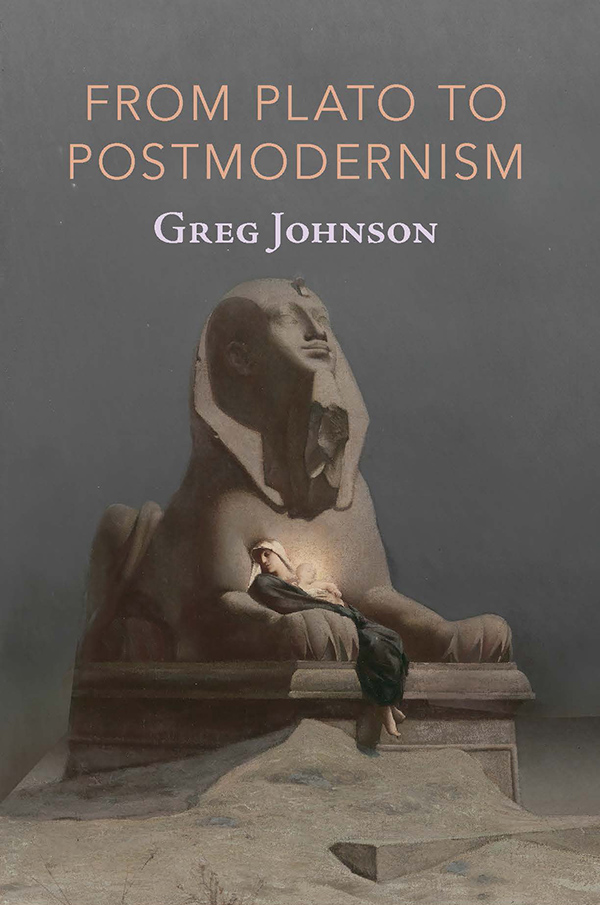
You can buy Greg Johnson’s From Plato to Postmodernism here
Cartesian skepticism is a pivotal moment in Western philosophy (and seems incidentally very close to a range of modern mental disorders involving disassociation from reality), and is an essential faculty. Its presence in Theaetetus, in line with Whitehead, foreshadows some of the major philosophical schools of the last few centuries. The subject of dreams pre-empts Heidegger’s mentor, Edmund Husserl, the founder of phenomenology, as Socrates considers knowledge of the past:
Someone will say, can a man who has ever known anything, and still has and preserves a memory of that which he knows, not know that which he remembers at the time when he remembers?
Let us say that you remember the dream you had last night in some detail. As you are now awake, and the dream a fading memory, you know the experience not to have been true at the time, in the sense of not having taken place in the real world. You were not really at sea as you were in your dream, or in conversation with a dead parent. But you still had the dream. That fact is knowledge. As Husserl writes in Ideas:
That which floats before us in fluid unclarity, with a greater or less intuitional remoteness, must therefore be brought into normal nearness and made perfectly clear before it can be used as a basis for a correspondingly valuable eidetic intuition in which the essences and eidetic relationships are intended to attain perfect givenness.
“Eidetic” simply refers to the vividness of mental images, and one thinks of Russell’s example of the thought of a golden mountain. This mountain does not exist anywhere in our real world, but my thought of it exists, and this is the foundation of Husserlian phenomenology. Husserl emphasizes that experience is not simply that which we inhabit naturally, a world of things and events, but also a world of mental phenomena every bit as real in terms of the knowledge Socrates seeks to define as the world we see and touch and experience.
After the question of perception, the conversation in Theaetetus goes on to consider opinion and reasoning as two possible areas of experience which may lead to the surety of knowledge. Having dismissed Protagoras’ doctrine that man is the measure of all things – “a wise man only is a measure”, says Socrates – and the validity of sense impressions as knowledge, Socrates asks a further question:
Then knowledge does not consist in impressions of sense, but in reasoning about them; in that only, and not in the mere impression, truth and being can be attained?
Here, we can see the foreshadowing of a whole school of philosophical thought which would come to encapsulate philosophy of language, phenomenology, and even logic. Part of experience is not simply that which we experience sensually, but our experience of our knowledge of the relations between those experiences.
Here, Socrates makes something of a leap as he proposes that we “remove the question out of the sphere of knowing or not knowing, into that of being and not-being.” At the same time, Theaetetus turns its attention to language, and Socrates suggests an attempt to understand the verb “to know.” This shows a further problem in linguistic usage:
The truth is, Theaetetus, that we have long been infected with logical impurity. Thousands of times have we repeated the words ‘we know’, and ‘do not know, and ‘we have or have not science or knowledge’, as if we could understand what we are saying to one another, so long as we remain ignorant about knowledge; and at this moment we are using the words ‘we understand’, we are ignorant, as though we could still employ them when deprived of knowledge or science.
Language became a focal point for philosophy in the 20th century, and much discussion centers around how we use language to interact with the world and how it might be used accurately to reflect that world. But it is also the case that the use of language reflects human reasoning as the instantiation of how we use things such as symbol, expression, logical connection and so on. English philosophers such as A. J. Ayer, J. L. Austin, and Ludwig Wittgenstein will do much work in this area.
Socrates rather prides himself on drawing knowledge out of men. With his habitual humility, he claims only that “I only know just enough to extract [ideas] from the wisdom of another, and to receive them in a spirit of another.” In Theaetetus, he uses the analogy of the midwife (Socrates’ mother actually was a midwife), and Theaetetus tells the old man that “you have elicited from me a good deal more than was ever in me.” But it was there, and Socrates has merely drawn it out, just as he did with Meno’s slave-boy in the dialogue Meno, a young man who, it turns out, knew more about geometry than he thought he did. At the very end of Theaetetus, and sounding rather like Shakespeare’s Prospero at the end of The Tempest, Socrates gives a sort of personal job description, a job which would ultimately lead to his execution by an ungrateful Athenian state:
These are the limits of my art; I can no further go, nor do I know aught of the things which great and famous men know or have known in this or former ages. The office of a midwife I, like my mother, have received from God; she delivered women, I deliver men.
In the end, Theaetetus shows the impossibility of a rigid definition of knowledge, as many of the Platonic dialogues do on a variety of subjects, but it does show that we possess more certain knowledge than we think we do. What is needed is for it to be brought out, and this needs midwives such as Socrates. The Socratic approach to the eliciting of knowledge from another is sorely needed today, in our dogmatic age, and Socrates already warns us of the modern sophistry inherent in our modern ideologues.
Argument today is bounded by dogma. The tenets of, for example, Critical Race Theory (which has done so much to infect our thinking) could be the subject of Socrates’ warning against false thinking disguised as profundity. This type of argument relies on not allowing the other party to settle on an idea and expand it by discussion, but rather to be in thrall to concepts and arguments which have been pre-ordained. I’ve called these dicta “ex cathedra arguments formed ex nihilo”, or supposedly indisputable facts (such as “it is not possible for blacks to be racist towards whites”) which have no foundation in reason or logic.
In an aside during his conversation with Theaetetus, Socrates expresses the wish that they are disputing in order to get closer to the truth, and not merely to win an argument, as today’s ideologues unfailingly do:
For, in accordance with their text-books, they are always in motion; but as for dwelling upon an argument or a question, and quietly asking and answering in turn, they can no more do so than they can fly; or rather, the determination of these fellows not to have a particle of rest in them is more than the utmost powers of negation can express. If you ask any of them a question, he will produce, as from a quiver, sayings brief and dark, and shoot them at you; and if you enquire the reason of what he has said, you will be hit by some other new-fangled word, and will make no way with any of them, nor they with one another; their great care is, not to allow of any settled principle either in their arguments or in their minds.
How familiar this is to us today. It is the reason the political left are averse to debate, as the vampire shuns crucifix or sunlight.
For the dissident right, a return to classical philosophy, and Plato in particular, is not some antiquarian pursuit but an essential component of a way of thinking – a way to think – which is essential in resisting the nihilistic, anti-philosophical regimes which run – and ruin – our lives today. The attitude to classical philosophy held by the new left is perfectly miniaturized by a remark I have noted before, that made by Donna Zuckerberg (sister of Mark) in her doctoral thesis. Classical philosophy, she wrote, is read by “the worst men on the internet.” Apart from being a banner under which we should march (and possibly even a fetching tattoo for the more adventurous), this line shows the fear the left have of our founding thinkers and the influence they can still wield on the modern world. Classical philosophy is empowering, to use a word usually used by our enemies, and this is what they fear, having worked hard to take our power away. First, however, we must do as the child in the garden advised St. Augustine to do with his Bible: take up the book and read.
You cannot grasp philosophy with a few YouTube shorts or a For Dummies book. You have to do the legwork, put in the man hours, read the books themselves rather than reading about them. As far as Plato is concerned, if we seek knowledge, Theaetetus is the perfect book to take up and read.
3 comments
What can I know?
1) I know that the jews are pure evil!
2) I know that white peoples have no rights, or representation!
3) I know that the future is going to be a hell on earth for our collective descendants!
4) I know that there is a distinct possibility that between 200 to 500 years from now, the white race will become extinct! 🙃
So Mark, in your opinion, what is knowledge and how can we come to know things as opposed to merely believing them?
When I taught undergrad philosophy, “Theaetetus” was the first text that we read.
Comments are closed.
If you have a Subscriber access,
simply login first to see your comment auto-approved.
Note on comments privacy & moderation
Your email is never published nor shared.
Comments are moderated. If you don't see your comment, please be patient. If approved, it will appear here soon. Do not post your comment a second time.