 600 words
Jean Raspail was born on July 5, 1925 and died in 2020, less than a month before his 95th birthday. He was a French explorer, travel writer, and novelist. He published 40 books in a literary career that lasted almost 60 years, from 1952 to 2019. The Académie française awarded Raspail two of its most prestigious literary honors, the Grand Prix du roman and the Grand Prix de littérature. In 2003, the French government made him an Officer of the Legion of Honor, which is the highest order of merit.
Raspail is most famous for his prophetic anti-immigration novel, The Camp of the Saints, which was published in 1973 and first translated into English in 1975. The Camp of the Saints tells the story of the extinction of white civilization by migrant flows from the Third World, made possible by a shadowy conspiracy promoting white guilt and decadence and enabling mass non-white migration. As the Great Replacement has gained momentum, The Camp of the Saints seems less like a dystopian prophecy and more like the daily news. Although the original translation of Camp is out of print, a new translation will be released sometime in Raspail’s 101st year by Vauban Books.
Raspail was an artist of the Right: a conservative, a traditionalist Catholic, a monarchist, and a quite frank “racist.” Yet Raspail was hardly provincial. He traveled quite widely and wrote about non-whites in their homelands, unburdened with romantic illusions but often with great respect and sympathy. In truth, he deplored the destruction of all races and cultures: “I like those who preserve the purity of their race, one beside the other, for everyone has the right to favor his own skin and to pass it on unmixed” (source).
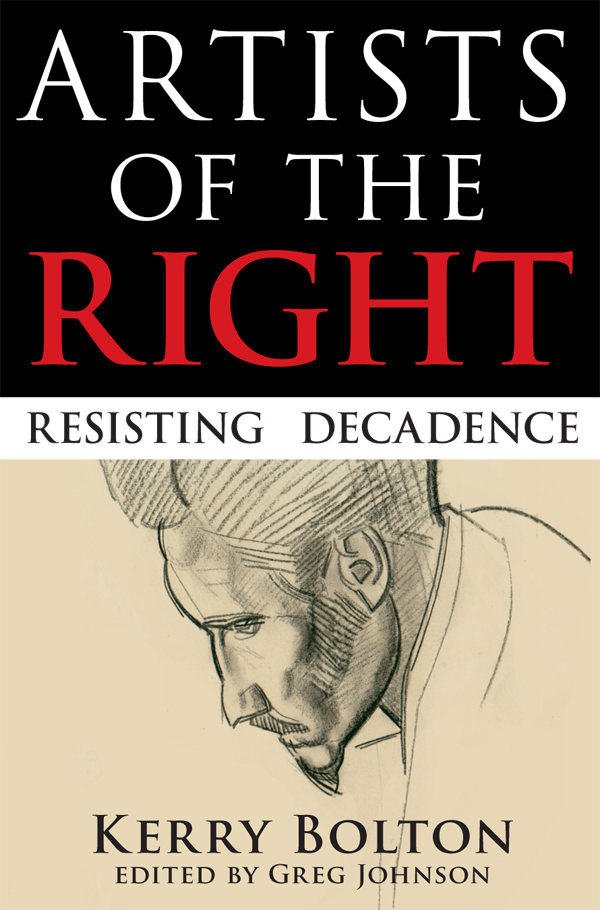
You can buy Kerry Bolton’s Artists of the Right here.
But, as a white man, Jean Raspail was especially concerned about his own race. As life in Europe came to more closely resemble the dark vision he had conjured in 1973, Raspail did not hesitate to criticize the French government for its unwillingness to address the immigration crisis. Because of this, he was unsuccessfully sued by the International League against Racism and Anti-Semitism in 2004.
Aside from Camp, only a handful of Raspail’s books have been translated into English: Welcome Honorable Visitors, Who Will Remember the People?, Blue Island, and Septentrion. Camp is not Raspail’s only political book. Septentrion presents the decline of Europe as seen in 2041, and Sire is about the restoration of the French monarchy in 1999. You can read about Raspail’s early, untranslated writings here.
Prophets of doom generally want to be proven wrong. Sadly, when Raspail died, he had every reason to think that he had been proven right. The best way to honor Jean Raspail is to continue his struggle and make The Camp of the Saints fiction again.
The following items have been published about Jean Raspail at Counter-Currents:
- Zuzana Adamson, “Remembering Jean Raspail: The Great French Novelist & Adventurer Has Passed Away.”
- Beau Albrecht, “When Reality Is Worse than Fiction: A Review of The Camp of the Saints,” Part 1, Part 2.
- Anonymous, “Before and After The Camp of the Saints: The Untranslated Writings of Jean Raspail” (Czech translation here).
- Eric Blair, “Septentrion: A Novel by Jean Raspail, an Old Bloyian at Heart.”
- Counter-Currents Radio, “Could That Be One Explanation?,” Greg Johnson, Angelo Plume, Jared Taylor, and Endeavour discuss The Camp of the Saints.
- Greg Johnson, “Jean Raspail’s The Camp of the Saints.“
- Jean Raspail, “‘Our Civilization Is Disappearing’: Interview with Jean Raspail” (German translation here).
- Fenek Solère, “Apocalypse Now,” Part 1, Part 2, Part 3.
- Michael Walker, “Remembering Jean Raspail.”
Jean Raspail is also tagged when he is mentioned in passing at Counter-Currents.
3 comments
Thank you for remembering and honoring this great man who wrote the landmark book of our movement.
This is from an interview Raspail gave:
“There are only two solutions. Either we accommodate them and France — its culture, its civilization — will be erased without even a funeral. In my view, that’s what’s going to happen. Or we don’t accommodate them at all — that means stop sacralizing the Other and rediscover your neighbor, that means those next to you. Which means that we stop giving a damn sometime about these Christian ideas gone mad, as Chesterton said, or these depraved human rights, and that we take the indispensable measures to distance ourselves, without appeal, to avoid the dissolution of our country into a general métissage [literally race-mixing but used as a sort of equivalent of the English diversity]. I don’t see any other solution. I travelled a lot in my youth. All peoples are fascinating but when you mix them too much, it is much more animosity that develops than sympathy. Métissage is never peaceful. It is a dangerous utopia. Look at South Africa!”
In my view, that’s what’s going to happen. Rather death than no fight. In the podcast chats I listen to, the odds are either on Ireland or amerika being the first place where the true revolutionary spark first ignites and spreads. Nobody is betting on Germany or Canada.
Great article! On my walk today, I passed a middle-aged, white woman standing behind a dumpster—eating the food she had found! She was dirty, haggard, and had not taken a shower in days, or weeks. She had the weirdest look in her eyes; it was a scene you might have found in a history book about Germany after WWII—this is a small town in Kentucky. 🙃
If you have a Subscriber access,
simply login first to see your comment auto-approved.
Note on comments privacy & moderation
Your email is never published nor shared.
Comments are moderated. If you don't see your comment, please be patient. If approved, it will appear here soon. Do not post your comment a second time.