4,284 words 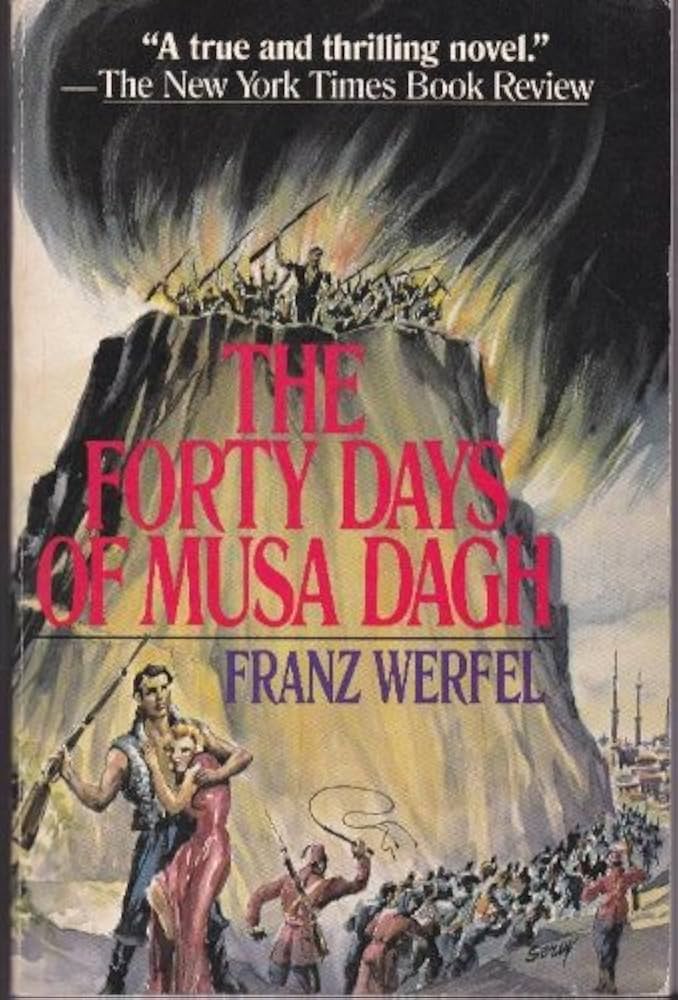
You know you’re reading a great novel when you effectively stop your life in order to finish it. This is what happened to me when I picked up and devoured Franz Werfel’s 1933 novel The Forty Days of Musa Dagh. The elevator pitch is exciting enough. Several thousand Armenian villagers hole up in a mountain during the First World War in order to escape deportation and genocide from the Turks. Beyond this, the plot churns relentlessly, characters develop naturally, and the prose—at least as it was translated into English from the German by Geoffrey Dunlop in 1934—remains seamless throughout. There were so few wasted words that 800-plus pages felt like 250, something I have not experienced since reading Dostoevsky decades ago.
Aside from these sterling qualities, The Forty Days of Musa Dagh deserves additional attention because in it, ethnocentrism is everywhere. In the lines, between them, before them, after them—if such a thing is even possible. White identitarians can see themselves on nearly every page and in nearly every character—Armenian, Turk, and other. Questions constantly arise regarding the identity of diasporas and nations, and there are no easy answers. For example, is what’s good for a diaspora necessarily good or bad for its host nation?
Forty Days is both convenient and not for racial dissidents. Did you know that the novel was banned in Nazi Germany for its depiction of Turks, the former German allies during the First World War? Did you know that readers have drawn direct parallels between it and the Jewish Holocaust? (Werfel was Jewish, by the way, but was fascinated by Christianity if his later novel The Song of Bernadette is any indication.) On the other hand, white dissident readers can draw poignant parallels of their own. The existential challenges faced by these Armenian holdouts greatly resemble what white South Africans and Zimbabweans face today vis-à-vis their genocidal black oppressors. Whites can even see themselves a little bit in the Turks themselves, who were struggling to maintain their nation’s identity during a crisis and had to deal with a sizeable ethnic minority of questionable loyalty. Any of that sound familiar?
No matter which way one approaches The Forty Days of Musa Dagh, it will reveal itself as a conundrum, like any great work of art should be. As with all of my book reviews, I give no spoilers. However, if you are considering reading this great novel, I would strongly urge you not to read the Wikipedia article on it, which does.
***
Gabriel Bagradian seems to have left it all behind. Ethnically Armenian and nationally Ottoman, his cosmopolitan interests outstripped the backwater milieu of his upbringing in southeastern Anatolia. He grew up the son of a wealthy merchant under the shadow of the great mountain Musa Dagh, and as a boy would dream of defending his ancient people against the marauding sultans of history—all within sight of the hermitage founded by the Apostle St. Thomas himself. Could this also be the very location of the Garden of Eden?
As an adult, he naturally outgrew such silliness. What should it matter which nation or empire a man of his talent and insight belongs to? Werfel describes him as “a thinker, an abstract man, an individual.” So it made sense he would get an education, move to the West, and work as an art critic. After settling in France, he married Juliette, a beautiful Frenchwoman. “All my life I’d only sought what was foreign to me,” he admits. “I loved the exotic.” At the story’s start, their son Stephan is 13.
In the summer of 1914, Gabriel receives a letter from his dying brother. He must return home to settle accounts with the family business. The brother dies before Gabriel and his small family arrive in Constantinople, and the Great War is declared shortly after. After this there is no going back.
Back in his childhood home in the village of Yoghonoluk, near the Mediterranean coast just north of modern-day Syria, Gabriel confronts the warlike ghosts of his childhood. He realizes that he had internalized the geography and topology of his former environs, and is both proud of and embarrassed by the people—especially in front of his wife. They are simple and ignorant, or they strut most pretentiously. They are repugnant and primitive and incurably provincial in mindset—so jarringly unlike the sophisticated folks he rubbed elbows with back in France. In all, however, they are fiercely Christian, something that he for some reason cannot bring himself to be. Despite many of them being Protestant, they remain in thrall of Ter Haigasun, the wise and ancient Catholic priest of their vilayet, or province.
Years ago, Gabriel had served as an officer in the Ottoman Army, and had been on good terms with the Young Turks, who at the time were secular reformers seeking modernize the Ottoman Empire and ensure rights for all its ethnic minorities: Armenians, Arabs, Greeks, Assyrians, and Kurds, mostly. Finally back at his family estate with Juliette and Stephan, he waits pensively to be called up to fight in the war. But when the notice never arrives and rumors begin to spread of Armenians being stripped of their passports, he grows suspicious. He visits Antioch, the district capital, and meets with a minor functionary who assures him that there are no plans to move against the Armenians. They are, after all, citizens in the proudly multi-ethnic Ottoman Empire. Any untoward measures must be considered within the context of war and the state’s need to control the movement of peoples to maintain a secure homeland. This satisfies Gabriel somewhat, but after overhearing Turkish officials in a bathhouse discussing the Young Turks’ genocidal plans for the Armenians—“melun Ermeni millet (the treacherous Armenian race)”—he hurries home, his mind flashing with apprehension and desperate plans for resistance.
This is really all of the story I wish to give away. Suffice it to say that Werfel introduces characters and plot points for good reasons, and follows through on these reasons as the story unfolds. Nothing is neglected or left behind. One would expect riveting plot points in a story so immersed in primal conflict (and based on a true story to boot). But the characters—my goodness, what a gallery of characters! The neurotic pastor, the pompous dwarf, the nihilistic deserter, the uxorious mayor, the genius apothecary, the feral orphan girl, the warrior widow, the humanist physician, the graveyard sorceress. Werfel offers a plush tapestry of provincial life, petty and transcendental, as his characters face bloodshed, starvation, disaster, and madness during the inevitable siege.
Saying that ethnocentrism is everywhere in Forty Days is not overstatement. Before the villagers ascend the mountain, Ter Haigasun insists they take with them several barrels of cemetery soil consecrated by the bodies of their ancestors. As Gabriel immerses himself in the defense of his ancient homeland, instincts awaken in him that had lain dormant for so many years back in France. He finds himself becoming one with his people, who are Oriental yet Western, superstitious yet rational, savage yet civilized. He can’t help it. He also feels fatherliness towards them, like any proper aristocrat should.
Upon returning from Antioch, he has this conversation with his uncomprehending wife, who is beginning to realize that Gabriel is going to remain in Yoghonoluk much longer than expected:
“We could go to Aleppo. There you can place yourself under the protection of a European consul, the American, or the Swiss, it doesn’t matter. And you’ll be safe, whatever happens here—or there. Stephan’ll go with you. You’ll be able to leave Turkey without difficultly. Of course I’ll make over my property and the income to you. . . .”
He had said this with difficultly, but quickly, so that she should not interrupt. But Juliette’s face came close to his. “Are you really taking this madness seriously?”
“If I’m alive when it’s all over, I’ll come back to you.”
“But yesterday we were quietly discussing what was to happen when you got called up. . . .”
“Yesterday? Yesterday was all an illusion. The world’s changed since.”
“What’s changed? This business with the passports? We shall be given new ones. Why, you yourself said that in Antioch you heard nothing terrible.”
“I heard all kinds of disturbing things—but that’s not the point. Perhaps, really, very little may have changed. But it always comes suddenly, like a desert storm. It’s in my bones. My ancestors in me, who suffered incredible things, can feel it. My whole body feels it. No Juliette, you can’t understand! Nobody could understand who hasn’t been hated because of his race.”
From this, a cynical reader might conclude that Werfel simply transposed his Jewish ethnocentrism onto another people, and told his story as if his precious protagonists were Jews. After all, Jews think about their ancestors all the time. Well, so what if he did? In 1909, riots in the Anatolian city of Adana led to the slaughter of 20,000 to 30,000 Armenians—and this was only the latest in a series of mass slaughters of Armenians in the Ottoman Empire. In fact, Adana represents the first time in the twentieth century the term “holocaust” was used to describe mass killings. It was also fittingly dubbed “the Cilician Vespers,” a clever play on both Cilicia, the ancient Armenian stronghold in southern Anatolia, and the Sicilian Vespers, the bloody thirteenth-century rebellion against the French-born king of Sicily in which 13,000 French were killed. So Gabriel is not off base here. Having recently witnessed state-sanctioned threats of genocide against whites in South Africa—threats that have been covered up or downplayed by Western media—white people should also be aware of what it’s like to be hated because of one’s race.
Despite apparently not knowing what ethnocentrism feels like, Juliette eventually buckles under the rude privations of war and finds herself scandalously drawn to the only Occidental man on the mountain. She cannot even recognize her own son, whom she tried to raise in the civilized French manner back home. Now, he’s a glittery-eyed barbarian like the rest of them, running about, neglecting his heritage, his education, and his hygiene. Werfel makes pains to point out, however, that Stephan cannot shed his European blood so easily either. Although his peers care little for his fluency in French, his fancy clothes, and the pompous manner in which he carries his books—under his arm rather than on his head—they do care for his other talents:
Even Haik, already past fourteen, muscular, tall, and well set up, the undisputed head of the gang, could not boast the purposeful concentration, the planned logical thought, which Stephan brought with him from Europe.
This is because “two blood-streams ran in his veins,” which can neither be denied nor suppressed. The importance of genetics even transcends humanity in Forty Days. During a locust swarm, late in the novel, Werfel writes:
Nothing suggested that individuals made up the unity of the swarm. A single locust, caught in the palm of a man’s hand, betrayed the same pitiful fear as other insects, and strove to escape. Back in the swarm, he realized his own true nature, feeling his own pushful greed as the service of a great cause.
Hand in hand with ethnocentrism in Forty Days is an overt Christian triumphalism which rivals anything found in Quo Vadis or Ben Hur. Given that nearly all the practicing Christians in the story are Armenian and that Werfel often distinguishes Muslim ethnicities (Turk, Arab, or Kurd) by degrees of their unflattering characteristics, I find this hardly a coincidence. Christianity may be the moral code which binds our Armenian protagonists together, but in Werfel’s prose, blood is a parallel, yet deeper, line.
Why should it have been Musa Dagh which gushed forth such innumerable springs, most of whose waters fell, in long, cascading veils, to the sea? Why Musa Dagh, and not Turkish mountains, like Naulu Dagh and Jebel Akra? Truly, it seemed as though, miraculously, the divine quality in water, offended in some unknown previous time by Moslems, the sons of the desert, had withdrawn from off these arid, imploring heights to enrich with superabundance a Christian mountain.
What is natural and righteous among the Armenians, however, appears twisted and unnatural in the Turks. Werfel commits many chapters to his Turkish characters, and all but one of the recurring ones are villains. While in Antioch, Gabriel visits an old Islamic mystic named Agha Rifaat Bereket, who desires peace with the Ermeni millet and mourns the gruesome state of affairs between his people and Gabriel’s. He does however state that both sides are to blame for the current troubles. Is this diplomacy or truth? Since Werfel obscures this issue in his devilish portrayals of the Turks—as opposed to his realistic yet romanticized depictions of Armenians—The Forty Days of Musa Dagh may not be the best text to consult for answers to this question. From the perspective of Werfel’s omniscient narrator, the Turks, with perhaps three exceptions, are little better than orcs. They are cruel, lazy, insecure, brutish, self-serving, incompetent, and proud. And the one Turkish villain who is not any of these things, a martinet lieutenant-colonel called “the bimbashi,” is treated almost comically. He loses an arm during one of the assaults on Musa Dagh, and Werfel still writes him more as a caricature of a military officer than as a human being.
Other examples abound, and in most cases Werfel doesn’t even give his Turks names. The “red-haired müdir” (the minor official Gabriel meets in Antioch) brims with a priori hatred for the Armenians. After rejecting the bimbashi’s sensible advice to leave Musa Dagh alone, the yüs-bashi (major) with the deep-set eyes calls for all-out assault upon the mountain. This causes the bimbashi to call him as “a Satan.” The toadyish Kaimakam (province governor) with his “bloated body” and “liverish face,” cares primarily about his career, and so acquiesces right away. Ironically, the Kaimakam is the only villain in Forty Days who grows a conscience, but does so only when asleep.
Turkish women are portrayed as eager to loot abandoned Armenian homes for household goods and valuables. Werfel dedicates a few paragraphs to their gossip, and it’s vicious. Werfel describes the village police chief as “by nature a bully” who acts the part due to a comical facial deformity. “A particularly evil-looking gendarme” stomps on Juliette’s clothing when raiding her wardrobe. At one point, Werfel explicitly compares the arrogant industriousness of the Armenian with the “lazy dignity of the Turk.” A Turkish military band is described as downright cacophonous. General Jemal Pasha, part of the Young Turk leading triumvirate, is depicted as spiteful, small-minded, and vindictive. Nearly all of the assaults upon Musa Dagh suffer from haphazard leadership. Most of the Turkish gains comes as a result of Armenian mistakes rather than Turkish valor or planning. Meanwhile, the Turks themselves have no problem with shooting their comrades if seen retreating down the mountain. At one point, Werfel offhandedly mentions “Turk and Arab scum.” He even reminds us that, although many pious Muslims such as Agha Rifaat Bereket opposed the genocide, many, such as the influential Mevlevi and Rufai orders, were “blind haters of the Armenians” and did not.
Then, of course, there is the atrocity. Firing squads, torture, rape, starvation. It’s all there—just as it was in history. In the two books on the Armenian genocide I have read since finishing The Forty Days of Musa Dagh, I encountered no mention of inaccuracies or exaggerations in this novel. And Werfel makes it all as gripping and as heartrending as possible. After depicting the grisly mass-murder of unarmed Armenian soldiers, Werfel treats us to what happened after:
The corpse dispatchers of the neighborhood were anxious not to waste any government property still worn by these “executed” men. They had a special eye on sound pairs of army boots. As they quietly worked, they kept grunting out one of those songs inspired by the recent decree of banishment. It began with the onomatopoeic line: “Kessé Kessé sürür yarlara.”—“Killing, killing, we rout them out.”
A Turkish captain later recounts his time in an Armenian concentration camp [ellipses in the original]:
Their dehumanized misery is so great that they have ceased to be able to distinguish between friend and enemy[…] Whenever I came into a camp, they came around me swarms […] Usually there were only women and old men, all half naked[…] they roared with hunger[…] the women scraped up my horse’s dung to pick out the undigested oat grains […] Then later they almost tore me to bits with their prayers.
Should I continue? Should I describe the scene of wanton infanticide and necrophilia perpetrated by Turkish storm troopers against a perfectly innocent Armenian family? Perhaps not. But we should remember that according to the Wikipedia article I told you not to read, translator Geoffrey Dunlop had omitted scenes of violence and rape he felt were too much for the English-speaking public in 1934. So, as bad as it was presented in the novel, the original was worse. (The scenes were restored in the 2018 edition of the novel, which I have not read.)
It would be unfair to exclude how Werfel does, from time to time, mention Turkish officers repulsed by the deportations, or Turkish gendarmes alarmed by the prospect of slaughtering the defenseless, or ordinary Turks who do indeed behave decently. But that’s all he gives us—mere mentions. In contrast, when it comes to the darker characteristics of the Turkish soul, Werfel dwells and dwells and dwells.
Now we see the reason why the Turks pressured Hollywood in the 1930s not to produce the film version of this popular novel. Now we see the reasons why the Turks pressured Nazi Germany to ban the book. And from a political standpoint at the very least, these are excellent reasons. After reading The Forty Days of Musa Dagh, one who knows nothing about the Armenian genocide can legitimately ask if there is any redemption at all for the Turk.
Perhaps the most unsettling chapter in The Forty Days of Musa Dagh is chapter 5, “Interlude of the Gods”, which contains the conversation between German pastor and relief worker Johannes Lepsius and Enver Pasha, the Ottoman Minister of War and one of the architects of the genocide. Werfel writes the scene as if it’s an interview with the devil, but the devil, as we all know, is in the details. We begin with Lepsius worried sick over the plight of the Armenians whose deportations have already begun. He arrives late to their meeting, being held up in a rowdy throng in Istanbul (not Constantinople, as Werfel calls it in chapter 1). The crowd was celebrating the removal of all foreign-language signs in the city. “Turkey for the Turks,” a stranger tells him. Lepsius is skeptical, of course, since he fears such ultra-nationalism will do in hundreds of thousands of his clientele. On the other hand, why shouldn’t Turkey be for the Turks? If Werfel is going to wax poetically on the ancient Armenian links to the land, shouldn’t he do the same for the Turks who’d been masters of the Anatolian peninsula for at least half a millennia by that point?
Lepsius begins pleading with Enver as soon as their meeting begins. Enver, by Werfel’s pen, is poised, effeminate, boyish, and urbane. A “porcelain war god,” who articulates the Turkish perspective regarding the cursed Ermeni millet. He’s entirely amoral and godless, yet charming for all that. In response to Lepsius’ Christian moralism, soft-hearted sentimentalism, and civic nationalist pieties, Enver is rational, to the point, and, frighteningly enough, persuasive. He’s also ethnonationalist to the core:
“But when, after war was declared, cases of high treason, felony, and subversive tendencies kept increasing, when desertion assumed alarming proportions, when it came to open revolt—I’m only thinking, mind, of the great revolt in Zeitun—then we found ourselves obliged either to take action and repress it or lose our right to direct the war and remain the leaders of our people.”
Feeling uncomfortable yet? When Lepsius argues—also convincingly—against the veracity of Enver’s information, Enver asks for Lepsius’ source. When told it is the American Ambassador Henry Morgenthau, Enver responds with another truth bomb: “Mr. Morgenthau is a Jew. And Jews are always fanatically on the side of minorities.” Werfel may have intended this to be a gotcha moment in his story, but to modern ears, especially dissident ones, this sounds unnervingly astute.
The existential banter continues, and since both men were historical figures, it doesn’t spoil anything by revealing that Lepsius fails to convince Enver to halt the deportations. It’s also ironic how Werfel describes Enver as effeminate, while Lepsius is the one who gets emotional like a woman.
One last terrifying moment, one that will echo tragically beyond the story and into the future—and if you listen carefully, you can still hear it buzzing today. Enver asks Lepsius to imagine a Germany forced to suffer traitors in her midst during a time of great crisis. And who might these traitors be, you ask? Oh, I don’t know. Alsace-Lorrainers? Poles? Social-Democrats? Those pesky Jews, perhaps?
“Would you, Herr Lepsius, not endorse any and every means of freeing your country, which is fighting for its life against a whole world of enemies without, from those within? . . . Would you consider it so cruel if, for the sake of victory, all dangerous elements in the population were simply to be herded together and sent packing into distant, uninhabited territory?”
Johannes Lepsius had to hold on tight by both hands to keep himself from springing to his feet and giving full rein to his indignation.
“If my government,” he said very distinctly, “behaved unjustly, unlawfully, inhumanely” (“in an un-Christian way” was the expression on the tip of his tongue) “to our fellow-countrymen of a different race, a different persuasion, I should clear out of Germany at once and go to America.”
A long, wide-eyed stare from Enver Pasha. “Sad for Germany if many other people think as you do there. A sign that your people lacks the strength to enforce its national will relentlessly.”
I can honestly say that I have never grappled with such an inexorable conundrum in my decades of reading literature. How to unpack this? How to wrap one’s mind around this? In one sense, this scene reminds me of the chapters in Vasily Grossman’s Life and Fate in which the Jewish author offers first-person narration from the perspective of high-ranking Nazis such as Adolf Eichman, ostensibly humanizing them. Of course, that’s not really what he’s up to. Thus with Franz Werfel we have the personification of evil within an eminently pleasant and charismatic young man. Then again, Enver Pasha says some things that ethno-nationalists should not overlook—because in spite of everything he does have some truth on his side. Not all, of course, but some. This idea might have horrified Werfel, but that does not make it any less true.
This is no justification for atrocity. The Turkish people are the villains in The Forty Days of Musa Dagh—and rightly so. Approximately a million Armenians were deported, starved, and massacred in 1915 and 1916—to say nothing of the hundreds of thousands of Ottoman Greeks and Assyrians who were also deported. Lepsius makes his evidence, which consists of eye-witness accounts, quite clear, as if the events on Musa Dagh were not evidence enough. And not all of this came from the top down. Far too many ordinary Turks were on board with the genocide because they hated the Armenians to the point of rape and murder as well. Still, I hesitate to pile on the Turks the way Werfel intended his readers to simply because this same demonization—especially by Jewish authors—has been leveled at Germans, and increasingly at whites, since the Second World War. Reportedly, Werfel had much of the book completed by the time Adolf Hitler rose to power in 1933, and then did a slew of editing afterwards. Perhaps he made the Turks so vile because they were stand ins for Nazis? I don’t know.
Then again, these are Turks, the traditional enemy of Europe. The fall of Constantinople in 1453 and the siege of Vienna in 1683 should lurk hauntingly in our minds even today. More than this, the Ottoman Empire was the driving force behind the capture and enslavement of over a million white Europeans from 1500 to 1800. In 2025, I’m certainly willing to let bygones be bygones, but that alone will not stop me from joining Franz Wefel in pointing a finger at the Turkish people for what they did to the Armenians and others during the First World War.
Why ordinary Turks did what they did sadly surpasses the scope of the book—it’s only a novel, after all. But my reading of it tells me that the ethnonationalist principles upon which the Young Turks acted were correct; they were just over-applied in response to faulty and incomplete information about the actual threat the Armenians posed to the Turkish people and their war effort. Whether the Young Turks knew this information was faulty and incomplete is another matter. This is all in Werfel’s text and born out in my additional studies of the genocide (The Armenian Genocide in Perspective, ed. Richard Hovannisian and They Can Live in the Desert but Nowhere Else by Ronald Suny).
So Franz Werfel did his homework and deserves credit for showing humility before the truth as much as he does for telling the unforgettable story of Gabriel Bagradian and his people, who contemplate first and last things while resisting overwhelming odds upon the mountain of Musa Dagh.
12 comments
Genocide, the divide between civilized military states and Regiones Civitatum Barbararum
I’ve looked into the matter, but haven’t gotten to the bottom of how the Armenian situation deteriorated so badly back then. Was it simply a lack of Turkish standards of civilization at the time? Surely that didn’t help. Still, there’ve been plenty of times Americans have lost our heads over war fever to one degree or another.
In the next 1-2 months or so I will review Ronald Suny’s They Can Live in the Desert but Nowhere Else: A History of the Armenian Genocide, wherein I will do my best to answer your questions.
One of the factors could be that (((merchants))) of Turkey were disappointed that Armenians held a significant sector of trade, thus being an obstacle. Of course, it’s not the only reason.
The two books I read barely mention Ottoman Jews. There was also no mention of Jews being influential in the Young Turk government. I’m pretty sure the Armenian genocide was a gentile affair through and through, in part revenge for the Ottoman defeat in the Balkan Wars in which they lost a good chunk of their empire in a very brief time. Most of the Young Turks were from Rumelia and not Anatolia, so they lost their homes to Christians. Plus hundreds of thousands of Muslims had been displaced because of the wars and as a result had to vie with land and resources with Armenians in Anatolia who unlike the Greeks did not have a nearby nation to speak up for their interests. They had little defense against against Turkish wrath, and so met with tragic disaster.
“Young Turks” was a euphemism for a jewish movement in the Turkish government, whose goal was to influence the caliph (or whatever he was called) to help establish a jewish homeland in Palestine. So when you say “Young Turk” you are saying jew. That is my understanding of it after reading Douglas Reed’s, The Controversy of Zion. 🙃
Are Armenians white, if not, who cares what happened to them? 🙃
Difficult to tell. Their origins are Aryan. Some look very White. Generally, they are a good and proud, healthy people. They are also Christian. I wish them good (but in Armenia 🙂 ; their diasporas form additional ethnic mafias parasiting on host countries).
Well, probably not, but i would imagine they are pretty close.
Also, the history of the Armenian genocide, aside from being fascinating in its own right, allows us to draw many parallels, especially regarding whites in South Africa and Zimbabwe. It contains many lessons.
One day I would like to review a book on the vast famine that Mao’s Great Leap Forward caused in the 1950s and 1960s. 20-40 million starved to death. Should I just not care about that historical episode because the victims were Chinese?
I’m not sure if they are white, but they are Caucasian and their language is found to be Indo-European after all. They are a market dominant minority, similar to Jews. They hold great wealth in the caucas region and many famous scientists and chess players. Garry Kasparov is half Armenian! The similarities to Jews are fascinating. A typical observation: Armenians are very dominant in Olympic sports, as individuals, boxing, wrestling, etc. But why aren’t they good at team sports such as basketball? Because in an Armenian is not about to put anything in anybody else’s basket!
Tigran Petrosian, an Armenian, was world chess champion in the 1960s as well.
That takes me back to the research I did for an article in the Journal of the T. E. Lawrence Society in 2019/20… Dagobert von Mikusch, the man I wrote about, was right in the middle of it as a German officer attached to the Ottoman army and is mentioned repeatedly in the existing sources.
Comments are closed.
If you have a Subscriber access,
simply login first to see your comment auto-approved.
Note on comments privacy & moderation
Your email is never published nor shared.
Comments are moderated. If you don't see your comment, please be patient. If approved, it will appear here soon. Do not post your comment a second time.