Counter-Currents
  • Advertise
  • Private Events
  • T&C
  • About
  • Contact
  • RSS
    • Main feed
    • Podcast feed
    • Videos feed
    • Comments feed
  • Welcome
  • Webzine
  • Books
  • Merch
  • Podcasts
  • Videos
  • Donate
  • Patrons
  • Subscribe
  • Crypto

LEVEL2

Donate Now Mailing list
Upcoming podcasts
  • Rob Rundo on Counter-Currents Radio

    Rob Rundo on Counter-Currents Radio

    Counter-Currents Radio

    06/13/2026 — 3 pm EST / 9 pm CET
  • Daniel Tyrie on Counter-Currents Radio

    Daniel Tyrie on Counter-Currents Radio

    Counter-Currents Radio

    06/20/2026 — 3 pm EST / 9 pm CET

Writers of May

(2 votes) Morris van de Camp David M. Zsutty Derek Stark Jayant Bhandari Greg Johnson

Articles of May

The Lunch Wars by David M. Zsutty Heidegger on Nietzsche, Part One by Collin Cleary 2 votes
  • Welcome
  • Webzine
  • Books
  • Merch
  • Podcasts
  • Videos
  • Donate
  • Patrons
  • Subscribe
  • Crypto
    • Editor’s Update
      Rob Rundo Rescheduled to Next Week on Counter-Currents Radio;
      Tonight Greg Johnson & David Zsutty Answer Your Questions;
      Fundraiser Update & a New $20,000 Matching Grant

      Greg Johnson

    • The Counter-Currents 2026 Fundraiser
      Lifetime Subscriber Welcome Packages Extended

      Greg Johnson

    • Nationalism This Week
      Who’s Looking Back?

      Greg Johnson

      18

    • China’s Threat to American Security:
      Food, Farmland, Foreign Control, & Energy Policy

      Lipton Matthews

      1

    • The Bitter End of Western Metaphysics:
      Heidegger on Nietzsche, Part Two

      Collin Cleary

      11

    • The Killing of Henry Nowak

      Mark Gullick

      28

    • The Crisis of Chinese Technology Thieves

      Morris van de Camp

      1

    • The Strange World of Gender Bender Fiction:
      & What This Genre Tells Us About Autosexuality

      Dani Vypont

      3

    • Watching the Watchers:
      The Dark Triad Question

      David M. Zsutty

      14

    • The Remigration Movement Solidifies

      F. Roger Devlin

      1

    • Casting Aspersions:
      The Fatal Consequences of Race-Swapped Casting, From Helen of Troy to Henry of Southampton

      Steven Tucker

      20

    • The Murder of Henry Nowak

      Millennial Woes

      23

    • Don’t Forget to Vote in Our Writer & Article of the Month Poll

      Greg Johnson

    • The Robot Hotdog Stand

      Greg Johnson

      35

    • Laughing Our Way to Victory

      Dave Chambers

      7

    • The Zodiac Killer

      Mark Gullick

      11

    • Jared Taylor: What Rome Means to Me

      Jared Taylor

      1

    • An Interview with Endeavour:
      My Way of Life Is an Adventure!

      Ondrej Mann

      6

    • José Pedro Zúquete’s The Identitarians

      Greg Johnson

      3

    • Editor’s Update
      Fundraiser Update & How to Watch the Remigration Summit

      Greg Johnson

      5

    • The Bitter End of Western Metaphysics:
      Heidegger on Nietzsche, Part One

      Collin Cleary

      11

    • Berlin: City of Stones

      Spencer J. Quinn

      6

    • True Folk-Horror Is Horror of Your Own Folk:
      Mark Gatiss vs the Brexit Blind Dead  

      Steven Tucker

      4

    • Counter-Currents Radio Podcast No. 689
      Thomas Massie, the America 2050 Bust, the Need for Whites to Divest from America, the AI Economic Apocalypse, & Pro-White Project Pitches to Billionaires

      Counter-Currents Radio

      7

    • Nationalism This Week
      Remigration is Inevitable, Part 3

      Greg Johnson

      27

    • Why Billionaires Should Fund White Identity Politics

      Lipton Matthews

      8

    • How Cold War Two Came About

      Morris van de Camp

      5

    • Now Available for Pre-Order at a Special Price!
      Greg Johnson’s The Philosopher Is In

      Greg Johnson

    • David Zsutty’s Elevator Pitch to a Billionaire

      David M. Zsutty

      1

    • Headbanging Lite

      Mark Gullick

      5

    • White Advocacy Past and Present

      Peter Bradley

      13

    • The Lunch Wars

      David M. Zsutty

      47

    • The Russians are Coming/The Russians are Coming

      Steven Clark

      1

    • Peak Fatigue in Fort Wayne

      Gabriel Anderson

      24

    • Keith Woods’ Elevator Pitch to a Billionaire

      Keith Woods

    • The Cruelty of Kindness

      Morris van de Camp

      9

    • Predation Wearing the Mask of Civilization

      Jayant Bhandari

      13

    • The Mandalorian & Grogu

      Trevor Lynch

      24

    • Editor’s Update
      Fundraiser Update & a New $20,000 Matching Grant
      Greg Johnson & David Zsutty Discuss Thomas Massie on Counter-Currents Radio

      Greg Johnson

      2

    • How the Jews Defeated Thomas Massie—& Themselves

      David M. Zsutty

      25

    • Jared Taylor’s Elevator Pitch to a Billionaire

      Jared Taylor

      15

    • Nationalism This Week
      Remigration Is Inevitable, Part 2

      Greg Johnson

      8

    • Could Fascism Work?

      Mark Gullick

      40

    • Jonathan Bowden’s Deliverance
      Part 7

      Jonathan Bowden

    • China’s Quiet Hand:
      Influence, Infiltration, & the Western Blind Spot

      Lipton Matthews

      9

    • Counter-Currents Radio Podcast No. 688
      Tyler Dykes on Running for US Congress in South Carolina

      Counter-Currents Radio

      3

    • Lothrop Stoddard’s The Revolt Against Civilization

      Spencer J. Quinn

      14

    • Lewis Strauss Did Nothing Wrong:
      How the politics of the Atom Bomb during the early Cold War Apply to Artificial Intelligence Today

      Morris van de Camp

      14

    • The Ghost of the Confederacy

      Dave Chambers

      12

    • America’s Century of Humiliation has Begun

      Greg Johnson

      27

    • Collin Cleary

      Heidegger on Nietzsche, Part Two

      Oh no, not so. For the Overman, truth is entirely relative and subjective. Remember: he gets to...

    • Connor McDowell

      Who’s Looking Back?

      HAL9000 in 2001 was never truly “sentient”. “His” programming had a conflict that couldn’t be...

    • Will Williams

      Nationalism This Week: Victory First

      There are several C-C essays that mention Gaza, but this appears to be the only one where comments...

    • Observer

      Heidegger on Nietzsche, Part Two

      In Platonism, we find the insistence that being, true being, is identical with “the forms.” The...

    • JBP

      Heidegger on Nietzsche, Part Two

      Thanks. Unfortunately I must fall into the 95% that Jane refers to. My brain is not putting the...

    • Will Williams

      Who’s Looking Back?

      Vauquelin: June 7, 2026 ...You must judge AI/LLM based on those who control it. With the likes of...

    • Hi-ya!

      Heidegger on Nietzsche, Part Two

      Love to engage in this with more attention ; I’ve never seen “clearing” in presocratics and my hot...

    • Vauquelin

      Who’s Looking Back?

      You must judge AI/LLM based on those who control it. With the likes of Sam Altman and Alex Karp...

    • Chud

      Who’s Looking Back?

      There's another dangerous option where homebrew AI models scale up and the consumers get their...

    • Gabe

      Who’s Looking Back?

      Boom. Nailed it.

    • Joe Gould

      The Killing of Henry Nowak

      This is a good article. The only thing I want to add is, above all we must guard ourselves against...

    • Greg Johnson

      Who’s Looking Back?

      Thank you I also wonder if these AI bots are being used to gather intelligence on influential...

    • E_Perez

      Heidegger on Nietzsche, Part Two

      "Philosophy helps Western man understand how we got to where we are, and where things went wrong...

    • Chud

      Who’s Looking Back?

      I'll try to give a rundown. AI is a language learning model (LLM) that uses floating point...

    • Will Williams

      How the Jews Defeated Thomas Massie—And Themselves

      Massie to Honor USS Liberty Crew on House Floor [email protected]  June 6, 2026  thomas...

    • JBP

      Editor’s Update

      Sorry but... Wrong, wrong wrong and wrong. The current momentum of history will not change with a...

    • Will Williams

      The SPLC Indictment

      The indictment of the Southern Poverty Law Center by the Department of Justice on 21 April is...

    • Zarathustra

      Heidegger on Nietzsche, Part Two

      I rather liked this song by Puscifer.

    • Will Williams

      The Killing of Henry Nowak

      Pray in one hand, shit in the other, and see which hand fills up first.Connor McDowell: June 6...

    • Julius Strange

      Who’s Looking Back?

      It is always possible to run AI models locally to prevent data being collected. The bigger and more...

    • Earth Day Special

      John Morgan

      12

    • A Robertson Roundup
      Remembering Wilmot Robertson
      (April 16, 1915 – July 8, 2005)

      Margot Metroland

      13

    • The Paranoid Style in White Nationalism

      Greg Johnson

      30

    • Join the Dance!

      Andrew Hamilton

      1

    • We Can’t Save the Earth Without Reducing African Birth Rates

      James Dunphy

      36

    • “I’m Not a Conspiracy Theorist, but . . .”:
      Jeffrey Epstein’s Death Gives New Life to “Conspiracy Theories”

      Greg Johnson

      22

    • Sylvia Plath: Stasis in Darkness

      Vic Olvir

      17

    • Vanguardism, Vantardism, & Mainstreaming

      Greg Johnson

      80

    • Aviation, Geography, & Race

      Charles Lindbergh

      3

    • Some Thoughts on Yule

      Collin Cleary

      4

    • Living in Truth:
      A Yuletide Homily

      Jef Costello

      7

    • John Kennedy Toole’s A Confederacy of Dunces

      Greg Johnson

      20

    • On Aleksandr Solzhenitsyn’s Warning to the West

      Spencer J. Quinn

      7

    • Elitism, British Modernism, & Wyndham Lewis

      Jonathan Bowden

      6

    • Philip K. Dick’s Do Androids Dream of Electric Sheep? as Anti-Semitic/Christian-Gnostic Allegory

      Greg Johnson

      20

    • “Conspiracy Theory” or Conspiracy?

      Andrew Hamilton

      21

    • Remembering H. P. Lovecraft
      (August 20, 1890–March 15, 1937)

      Greg Johnson

      3

    • Who Are We?
      Nordics, Aryans, & Whites

      Greg Johnson

      71

    • Remembering William Gayley Simpson
      (July 23, 1892–December 31, 1990)
      A Pleasant Afternoon with Harriet & Bill Simpson

      Margot Metroland

      18

    • Here are the Young Men
      Remembering Ian Curtis
      (July 15, 1956–May 18, 1980)

      Mark Gullick

      18

    • Percy Grainger
      Artist of the Right

      Alex Graham

      7

    • Remembering Revilo Oliver
      (July 7, 1908–August 20, 1994)

      Greg Johnson

      18

    • The Meaning of July 4th for the White Man

      Gregory Hood

      13

    • The Front National’s Evolution

      Bruno Mégret

    • Merwin K. Hart
      Forgotten American Hero & Man of the Right

      Morris van de Camp

      10

    • George Orwell’s Nineteen Eighty-Four

      Jonathan Bowden

      8

    • Carleton S. Coon
      Scientist & Reluctant White Advocate

      Morris van de Camp

      3

    • The Kwanzaa Absurdity Will Be Dwarfed by Juneteenth

      Robert Hampton

      10

    • Stravinsky

      Alex Graham

      7

    • Like the Roman:
      Remembering Enoch Powell (1912-1998)

      Mark Gullick

      23

    • The Game of Tarot

      Mark Gullick

      1

    • Institutions Cannot Be Transplanted

      Jayant Bhandari

      5

    • Jonathan Bowden’s Deliverance
      Part 5

      Jonathan Bowden

    • Crosstown Traffic:
      Jimi Hendrix & The Post-War Rock ‘N’ Roll Revolution

      Mark Gullick

      1

    • Slaves from the North:
      Finns & Karelians in the East European Slave Trade, 900–1600

      Lipton Matthews

      14

    • Neo-Fascism in Film
      Part 4

      Karel Veliky

      2

    • David Lean’s A Passage to India

      Spencer J. Quinn

      1

    • Elites are Essential to Development

      Lipton Matthews

      7

    • Jonathan Bowden’s Deliverance
      Part 4

      Jonathan Bowden

    • Neo-Fascism in Film
      Part 3

      Karel Veliky

      6

    • E. M. Forster’s A Passage to India & the Indian Mentality

      Spencer J. Quinn

      25

    • Jonathan Bowden’s Deliverance
      Part 3

      Jonathan Bowden

    • The Rest Is Silence
      Heidegger’s Quietism

      Mark Gullick

      2

    • Dispelling the Historical Fallacy of Indian Nationalism

      Lipton Matthews

      8

    • Neo-Fascism in Film
      Part 2

      Karel Veliky

      8

    • Jonathan Bowden’s Deliverance
      Part 2

      Jonathan Bowden

    • Life of a Klansman

      Mark Gullick

      8

    • Jonathan Bowden’s Deliverance, Part 1

      Jonathan Bowden

    • Decolonial Ideas are Holding Back Developing Countries

      Lipton Matthews

      8

    • Neo-fascism in Film, Part 1

      Karel Veliky

      21

    • Jonathan Bowden’s Onslaught, Part 8
      Divigations on Decadence

      Jonathan Bowden

    • Jonathan Bowden’s Onslaught, Part 7
      Intrigues in the National Front

      Jonathan Bowden

      1

    • Rotten to the Core

      Mark Gullick

      8

    • Strauss on Husserl’s “Philosophy as Rigorous Science”

      Greg Johnson

    • Jonathan Bowden’s Onslaught, Part 6
      Francis Bacon & Right-Wing Nihilism

      Jonathan Bowden

    • London After (& Before) Midnight:
      Aleister Crowley, The Landlord’s Worst Nightmare

      James J. O'Meara

      2

    • Jonathan Bowden’s Onslaught, Part 5
      The Post-War British Far Right

      Jonathan Bowden

    • No Rules: Rollerball

      Mark Gullick

      4

    • Jonathan Bowden’s Onslaught, Part 3
      Brett Easton Ellis’ American Psycho

      Jonathan Bowden

    • An Alternate History of the Harris Presidency

      Beau Albrecht

      5

    • András László
    • Derek Hawthorne
    • Beau Albrecht
    • Alain de Benoist
    • Kerry Bolton
    • Jonathan Bowden
    • Collin Cleary
    • Jef Costello
    • Savitri Devi
    • Julius Evola
    • Jim Goad
    • Gregory Hood
    • Juleigh Howard-Hobson
    • Greg Johnson
    • Charles Krafft
    • Anthony M. Ludovici
    • Trevor Lynch
    • H. L. Mencken
    • J. A. Nicholl
    • James J. O’Meara
    • Christopher Pankhurst
    • Tito Perdue
    • Michael Polignano
    • Spencer J. Quinn
    • Fenek Solère
    • Irmin Vinson
    • Leo Yankevich
    • Francis Parker Yockey
    • Multiple authors
  • Editor-in-Chief

    • Greg Johnson, Ph.D.

    Featured Writers

    • Beau Albrecht
    • Gunnar Alfredsson
    • Collin Cleary, Ph.D.
    • Jef Costello
    • Morris V. de Camp
    • F. Roger Devlin, Ph.D.
    • Stephen Paul Foster, Ph.D.
    • Jim Goad
    • Alex Graham
    • Mark Gullick, Ph.D.
    • Greg Johnson, Ph.D.
    • Travis LeBlanc
    • Trevor Lynch
    • Margot Metroland
    • James J. O’Meara
    • Angelo Plume
    • Spencer J. Quinn
    • Fred Reed
    • Clarissa Schnabel
    • Michael Walker
    • David M. Zsutty

    Frequent Writers

    • Asier Abadroa
    • Aquilonius
    • Alain de Benoist
    • Kerry Bolton, Ph.D.
    • Dave Chambers
    • Steven Clark
    • James Dunphy
    • Endeavour
    • Richard Houck
    • Jason Kessler
    • Titus Livius
    • Ondrej Mann
    • Lipton Matthews
    • Mark Mazari
    • John Morgan
    • Jaroslav Ostrogniew
    • Kathryn S.
    • Christian Secor
    • Anne Wilson Smith
    • Thomas Steuben
    • William De Vere
    • Kenneth Vinther
    • Max West

    Classic Authors

    • Maurice Bardèche
    • Jonathan Bowden
    • Julius Evola
    • Guillaume Faye
    • Ernst Jünger
    • Kevin MacDonald, Ph.D.
    • D. H. Lawrence
    • Charles Lindbergh
    • Jack London
    • H. P. Lovecraft
    • Anthony M. Ludovici
    • Sir Oswald Mosley
    • National Vanguard
    • Friedrich Nietzsche
    • Revilo Oliver
    • William Pierce
    • Ezra Pound
    • Saint-Loup
    • Savitri Devi
    • Carl Schmitt
    • Miguel Serrano
    • Oswald Spengler
    • P. R. Stephensen
    • Jean Thiriart
    • John Tyndall
    • Dominique Venner
    • Leo Yankevich
    • Francis Parker Yockey

    Other Authors

    • Howe Abbott-Hiss
    • Michael Bell
    • Giles Corey
    • Jack Donovan
    • Richardo Duchesne, Ph.D.
    • Emile Durand
    • Guillaume Durocher
    • Mark Dyal
    • Tom Goodroch
    • Andrew Hamilton
    • Robert Hampton
    • Huntley Haverstock
    • Derek Hawthorne
    • Gregory Hood
    • Juleigh Howard-Hobson
    • Alexander Jacob
    • Ruuben Kaalep
    • Tobias Langdon
    • Julian Langness
    • Patrick Le Brun
    • G A Malvicini
    • John Michael McCloughlin
    • Millennial Woes
    • Michael O’Meara
    • Christopher Pankhurst
    • Michael Polignano
    • J. J. Przybylski
    • Quintilian
    • Edouard Rix
    • C. B. Robertson
    • C. F. Robinson
    • Herve Ryssen
    • Alan Smithee
    • Fenek Solere
    • Ann Sterzinger
    • Robert Steuckers
    • Tomislav Sunic
    • Donald Thoresen
    • Marian Van Court
    • Irmin Vinson
    • Book Reviews
    • Movie Reviews
    • TV Reviews
    • Music Reviews
    • Art Criticism
    • Graphic Novels & Comics
    • Video Game Reviews
    • Fiction
    • Poems
    • Interviews
    • Videos
    • English Translations
    • Other Languages
      • Arabic
      • Bulgarian
      • Croatian
      • Czech
      • Danish
      • Dutch
      • Estonian
      • Finnish
      • French
      • German
      • Greek
      • Hungarian
      • Italian
      • Lithuanian
      • Norwegian
      • Polish
      • Portuguese
      • Romanian
      • Russian
      • Slovak
      • Spanish
      • Swedish
      • Ukrainian
    • Commemorations
    • Why We Write
  • Archives
  • Top 100 Commenters
  • The Looney Bin
  • Advertise
  • Private Events
  • T&C
  • About
  • Contact
  • RSS
    • Main feed
    • Podcast feed
    • Videos feed
    • Comments feed
Sponsored Links
Europa.com Above Time Coffee Antelope Hill Publishing Paul Waggener IHR-Store Spencer J. Quinn American Renaissance Jim Goad The Occidental Observer
Print November 28, 2023 5 comments

“A Few More Steps and We Were . . . On Some Edge of Things”:
Staircases That Lead Nowhere
Part 1

Kathryn S.

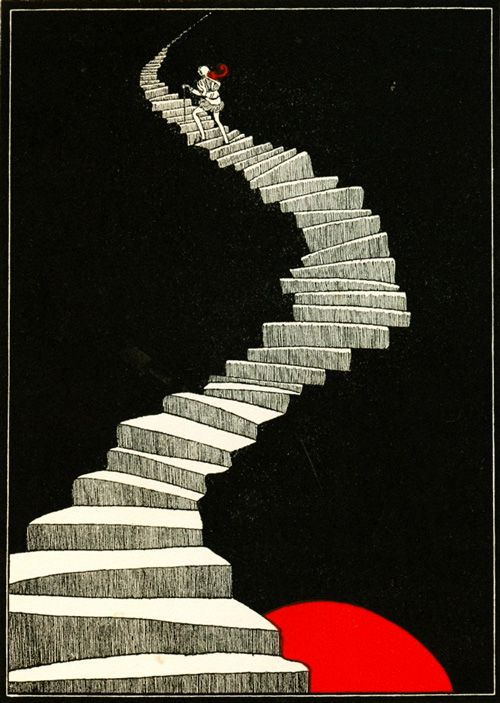
Unknown artist and date

3,498 words

Part 1 of 2 (Part 2 here)

I’ve recently become bogged down in several areas — working, writing, etc. — and only my continued inspiration from Napoleon the Great and the Counter-Currents community has kept up my spirits. No self-pity or fishing for sympathy here; these moods happen to us all, and in due course pass into other, better seasons of life. As I was lying awake thinking about things that crowd the brain during the least crowded hours of the night, my mind’s eye summoned an imaginary staircase. If I could take the first steps up, perhaps I could ascend to enlightenment, will, and maybe even answers. But immediately on the heels of that thought, there came another. What if I were to climb the staircase? What if it led . . . nowhere? Had I just turned a hopeful image into a despairing one? On the contrary, readers. It made the air sparkle. Transitional, haunted autumn, when we make our annual crossing-over, can have that effect. So, I dedicate this essay to the exploration of that structure which allows us to explore in the first place.

But first, let’s discuss the meaning and history of stairs. Our word “stair” translates in the Old English to upstîge, or simply “stair.” We can easily see that upstîge is related to the following modern lexemes: upstairs, story/storey, and stage (“stage” as in one of a sequence of levels). The term has even older roots in the Germanic staegar, which is close to the Dutch steiger, meaning: scaffolding/climb. We recognize from these our own “stagger,” “stumble,” and “step.” In turn, “step” is related to the German treppe and the Danish trappe. And because our nuanced English language, the subtlety of which allows us to pick and choose just the right word with just the right valence from our unusually large vocabulary (by some estimates over a million words, but who really knows?), multiple synonyms for “stair” abound. Take the word “scale” (as in to scale the heights of). The Romance languages’ word for “stair” comes from the Latin scalaria. The Italian has its scala; French its escalier; Spanish its escalara; Romanian its scara. Meanwhile, the Latin transliteration of the ancient Greek “ladder” is klimax. We can rightly conclude that our inherited tongue is a pleasing marriage of the great Classical and Teutonic traditions. Love your language, readers!

Our earlier human ancestors probably got their inspiration for stair technology from first, nature; second, necessity; then the demands of more complex societies; and finally, from the aesthetic awe that staircases can impress upon the senses. We can find natural examples of stairs at places like Italy’s Scala die Turchia, or the “Giant’s Causeway” off the coast of northern Ireland. The first manufactured stair was its most primitive, mostly two-dimensional iteration: the ladder. As civilizations matured and its members became ever-more invested in height and grandeur, their stairs had to evolve in complexity as well. Spiral staircases — economical in space, but rich to the eye — trace their origins to at least the fifth century BC, and became common after the completion of Trajan’s Roman Column in the early second century AD. During the medieval period, sometimes accused of being dominated by incurious sticks-in-the-mud, staircases became things of exquisite artistry. Building on this knowledge, Renaissance-man Leonardo da Vinci engineered the mazy double-helix staircase in central France’s Château de Chambord. Indeed, stair structures have long been “diverse,” but not at all “inclusive.” They exclude based on age — daunting, or impossible for small children and the elderly. They are obstacles for those suffering handicaps, injury, or exhaustion. Nowadays, they weed out the lazy.

Since their invention, staircases have been laden with symbolic meaning: They represent both the ascent to heaven and the descent into darkness or the unknown; a transition and a celebration, or perhaps regression and dread. Stairs can indeed be treacherous: a lure for a victim, a portal for a predator, with the goal of making contact. Untold numbers of people have suffered injuries or worse after losing their feet on a flight of stairs. They can be frail bridges over fantastic depths that combine the human fear of indefinite extension and definitive end. There is sometimes a queasy feeling that comes over us as we gaze up or down a long, winding flight of stairs, and then gauge the danger of climbing them — to who knows where? Who can say? We, too, are struggling through a transitional period in our race’s history for which there are no shortcuts. We have no choice but to take the stairs.

So, readers, fix your eyes on the vanishing point, and let us begin the climb together as we hoist ourselves over an invention that has remained a central architecture in all our worlds, real and imaginary, natural and man-made, things of dreamscapes and nightmares. What’s the worst that could happen?

“No Firm Steps Could Be Stamped”: Mountain Stairs to Nowhere

You can buy Alain de Benoist’s Ernst Jünger between the Gods and the Titans here.

One of the scariest staircases that people have climbed were those on the cliff-steps of an ancient mountain. The thought that crosses one’s mind on the side of a lonely hill, or before the threshold of huddled mountain ranges, is similar to his second thoughts while taking a flight of darkened, creaky stairs: I shouldn’t be here. I am disturbing old memories. I am awakening monsters, cruel gods, or vengeful ghosts. One push, or fright from them, and I will fall off the edge, and keep falling forever. Veteran climbers have described mountain ascension as though they had passed into an alternate existence, or another dimension, where all else fell away. They breathed in ragged “lungfuls of the diamond air.”[1] It was like climbing a huge staircase, for one started from down there and made his torturous way up there. But in the meantime, he was neither here, nor there — a weird nowhere emphasized by the void above and the yawning chasm below.

Mountain-climbing as a popular sport began in the late eighteenth and early nineteenth centuries. In a manner characteristic of the age, it matured into a flurry of nationalist-imperialist campaigns, as furious as any Alpine blizzard.[2] Indeed, climbing or forging paths in the mountains have long been associated with the most exciting imperial conquerors in history: Hannibal crossed the Alps in the third century BC, and Alexander had earlier approached the Indian Subcontinent when matching wills with the Hindu Kush. The most successful painting of Napoleon was Jacques-Louis David’s Napoleon Crossing the Alps (1801). “Soldiers!” the general declared to his troops after his crowning victory at Marengo, “Hannibal stormed the Alps, we have turned them!” From the gigantic bastions of Tyrol “the clangour of their trumpets resounded.”[3] In this spirit, and when squaring off against an as-yet unclimbed mountain, the idea was not to woo, but to lay siege to its foothills. Sometimes more than 200 people showed up, all so that a handful of mountaineers might successfully stake their national colors atop the summit. These latter-day crusaders included peasants and courtiers: the climbers themselves, native guides, journalists, soldiers, photographers, porters, scientists, geographers, politicians, etc. If we bring overwhelming force to bear, the Mountain will have no choice but to surrender. Or so they must have thought. The foreign Mountain was an antagonist whom the army of European expeditioners would conquer for themselves and their empires.

One of the first men to try for the tallest summit in the world was a young Englishman named George Mallory (1886-1924). Handsome and intrepid, Mallory typified the passage in Rudyard Kipling’s Kim that explained how “from time to time God causes men to be born . . . who have a lust to go abroad” at the risk of any and all peril and to “discover news — today it may be of a far-off thing, tomorrow of some hidden mountains.”[4] And the risk was great, indeed. Not only were mountains physically hazardous — more so than today, for lack of modern safety equipment — but they excited an awful feeling, part ecstasy and part dread. Amid the fluttering heights, the sky there was a darker blue, the sun more luminous. There have been no staircases so spiritually moving as those carved by Divine hand upon the greatest of our mountains. They are a gift of beauty that, like all true beauty, does not conceal, but emphasizes its deadliness.

When attempting a Himalayan ascent, there are narrow straits of both footpaths and timelines from which climbers mustn’t stray. In the case of George Mallory’s Everest — and throughout the greater Asian range — the stern dictator of these is the Monsoon. Like all storms, the South Asian Monsoon begins with air — with invisible heats and colds that conjure some of the largest and most visible phenomena on Earth. The hot, dry summer drafts that rise from India’s baking interior draw vast amounts of moisture from the Bay of Bengal and the Arabian Sea.[5] They swirl together, then unleash seemingly endless curtains of rainfall. But the seasonal storms that first overtake and then flood all before them suddenly meet the impenetrable wall of 229,500 square miles that is the planet’s greatest land barrier: the Himalayas. Like soldiers aligned in rank upon titanic rank, they bar any advance. The Monsoon clouds find the rocks too tall to surmount, and too solid to break through. Thus, they pack against the Indian side of the slopes and spend themselves in downpours, ferocious and long-lasting. This epic war between land and sky has been going on for unfathomable ages past and will continue to be waged for unfathomable ages to come. We humans have only a blink of the eye given to us with which to marvel at this natural drama; it’s no surprise that many are drawn to share a piece of space and time with our more majestic neighbors, tiny though it must be. It is within this window between Monsoon rains that Himalayan climbers must make their bid.

George Mallory “taking the stairs,” ca. 1920

By the 1924 attempt at Everest, George Mallory had become skeptical of the aggressive method — the imperial siege mentality that dominated mountain-climbing strategy — and he longed to whittle the expedition down to essentials in personnel and equipment. At times, he thought of the mountain’s hewn sides as a “staircase for men to walk up and down.” But during others, he condemned such a view as “Lies, all lies! To think at all of mountains in [those] terms was a lie. The whole mood was [false], mean, vaunting, blasphemous . . .”[6] If I had to guess why he favored this “truer,” more intimate meeting with the mountain, I would say that it had to do with his recent experiences during the First World War.[7] In the most graphic way possible, that conflict had illustrated the folly of throwing more and more bodies over the top and expecting that a massive storm of men would be enough to flush out a fortified enemy. It was a crude, arrogant way to wage war. He also knew that no matter how many of their supporters and team-organizers encircled the mountain, at a certain point thousands of feet skyward, climbers would be alone — alone with their oxygen-starved thoughts and agonized steps; alone while half-crawling up the stairway that led to the “roof of the world.” That certain light, found only in the mountains, was the only thing that went with them as they ascended. But despite Mallory’s private wishes, the 1924 Everest Expedition mirrored its previous and grandly-outfitted attempts. As if speaking of an entrenched foe, Mallory admitted, “From Everest, we expect no mercy.”[8]

Both the trenches and Himalayan mountain-tops were indeed merciless, lifeless places, but they could not have been more visually or spiritually different. The muds of France sucked a man under, while the mountains uplifted his eyes to rungs leading heavenward. The promise must have been irresistible to a soul still healing from his wartime wounds. In his notes, Mallory referred to the “unshouldering” of burdens that was needed to take up a higher one, a process he called, “the golden dream.” During that late spring, he and his winnowing team reached the rare, lung-starving heights of 28,000 feet, near the First Step below the summit. In his final diary entry, Mallory was tired, but optimistic. “Sic istur ad astra,” he wrote, “so we go to the stars.”[9] On June 8, 1924, 28,230 feet up the side of Everest, Mallory and his climbing partner Andrew (“Sandy”) Irvine were last seen by a fellow-mountaineer,[10] who waited behind near Camp VI:

At 12:50 [p.m.], [I] saw M & I . . . on a ridge nearing the base of [the] final pyramid . . . There was a sudden clearing of the atmosphere, and the entire summit ridge and final peak of Everest were unveiled. My eyes became fixed on [two] tiny black spot[s] silhouetted on a small snow crest beneath a rock step in the ridge; the black spot[s] moved . . . [and] approached the great rock step and shortly emerged on top . . . Then the whole fascinating vision vanished, enveloped in cloud once more.[11]

No one knows whether Mallory and/or Irvine made the summit. In 1999 several climbers discovered the former’s frozen remains lying face-down on the snow just below the famous Yellow Band.[12] His camera, still sheltered beneath his body and protected from all those intervening years of high-altitude blizzards, birds, and ultraviolet sun-rays, contained well-preserved negatives that nevertheless failed to solve the 75-year-old mystery. The romantic in me rejects this image in favor of his companion’s “fascinating vision.” I prefer to think that he did indeed reach the top, and then, as if ascending Jacob’s Dream-Ladder, “vanished” into clouds that no longer hid “the stars” from his eyes. It “may even be that he found [his] Kingdom.”[13]
You can buy Charles Krafft’s An Artist of the Right here.

Not all ascents have been made with such jubilant expectations. Indeed, mountains are an effective, but underrated setting for a horror story. Since ancient times, people have held them in great fear and respect. When turning toward the north, Livy contemplated “the dreadfulness of the Alps.” During a sojourn in Tyrol, a sixteenth-century Jesuit felt himself “displaced in an unknown, alien world.” High in the hills, there was “nothing elegant [or] lovely . . . only things huge and immense . . . and a certain appearance of infinity.” Frowning precipices rose, wreathed in mist. When he turned to one side, he saw blank flats and “contemplated the even surface of the sea, stretching on and on, as far as the sight of the eyes could ever reach.” Turning to the other, there was its impossible opposite: “the most riven face of the earth, enormous masses lifted up and depressed in various ways, towering, overhanging, leaning back, thrown together, in every kind of uneven and confused position.”[14] The startled priest could almost hear the cracking of these ancient plates. Half-dreaming, he cocked an ear toward the trickling noises of infant rivers, the murmur of “dark trees,” and “the vast waiting silence that brooded behind all sound.”[15]

Mountainous areas have maintained their capacity to astonish and frighten us into the modern era. Patagonian peaks look like a small child’s drawing of mountains — impossibly vertical and piercing — spears in the void. Films about “Blue Light” filtering through the crystals of split rocks have borrowed from this pervasive, siren-like aura that inhabits all desolate places — particularly the frozen towers that crown our planet’s high ground.[16] The 1933 Tibetan authorities forbade Western pilots — notably the Houston Flying Expedition — from overflying the northern slopes of Everest. Foul-tempered demons lived there and should on no account be disturbed from their slumber, they explained. While climbing the Alps’ Matterhorn, a group of mountaineers felt themselves “surrounded by the weird, unearthly flicker of innumerable will-o’-the-wisps that appeared to shadow [their] every move.” A terrified Swissman whispered, “Look . . . the dead people!” All present felt that “the fiends who haunt the crags of the Matterhorn were already gloating over their prey.”[17] They knew that most people who go missing in the mountains are never found. Present-day mountaineer Stephen Alter described his own eerie experience near cliffs he knew well. On purpose, he had come alone. The area had always been “a private sanctuary.” But as he “ascended a natural staircase in the rock,” his sanctuary became an uncomfortable exposure. Alter “felt suddenly uneasy and afraid . . . [A]ll at once, [he] was gripped by a feeling of vulnerability . . . a primal impulse warning [him] of danger.” He froze in terror, “as if confronting a malevolent presence. Every shadow seemed to conceal a threat. Every rustling leaf signaled ambush.”[18] Alter obeyed his sixth sense, and went back the way he came.

In comparison to the white clouds and spiritually stirring peaks of the Alps and Himalayas, the mountains of J. R. R. Tolkien’s Ered Lithui (Ash Mountains) enveloped its climbers in putrid fogs and impenetrable darks. No armies yet lay siege to the foothills of Sauron’s kingdom; only two hobbits, whose hopes for success were less likely than Mallory’s, ”crept along the road towards the mountains.” Soon, the path “began to bend away southwards, until it came right under the great shoulder of rock that they had seen from the distance. Black and forbidding it loomed above them, darker than the dark sky behind.” Eastward it curved, then rose “steeply.” The “imprisoned moonlight” did not illuminate their way, but only emphasized the “countless black holes looking inward into emptiness.” The sheer face of the mountain lifted before them, vertical as a ladder, for “they had come to the first stair that Gollum [their unreliable guide] had spoken of. The darkness was almost complete, and they could see nothing much beyond their hands’ stretch.” Each uneven step taxed their aching knees, until the hobbits were ready to give in to their exhaustion and collapse. Gollum encouraged them with an unhelpful, “We’re up . . . [the] First stair’s past . . . Next comes the Winding Stair.” A “chill draught” blew down “from the invisible heights above.”[19] At no previous point had the hobbits regretted their journey more. If the stairs of Cirith Ungol led anywhere at all, it was no place for “decent folk.”

Ice demons, yetis, and abominable snowmen aside, the mountains have more often been a source of transcendent joy. “He who goes to the Hills goes to his mother,” was a Hindu proverb that Mallory may have heard from his native guides.[20] If so, he must have agreed. As he scaled cliffs of ice, his “burdens” fell away. Indeed, mountaineers have always repeated the same refrain: “our bodies and souls vanish into a bottomless crevasse, even as we continue to seek the summit.”[21] Whether emblazoned by a light too rich and bright in an atmosphere too thin, or haunted by unseen forces that lurked in a darkness deeper than night, the mountains have made the most beautiful and demanding of staircases, for they demand nothing less than surrender. Vanishing into them forever would, by contrast, be the easiest thing in the world.

Notes

[1] Rudyard Kipling, Kim (1901), 172.

[2] See E. Mévillot, “Une image identitaire alpine à travers les récits de voyages, XVIIIe-XIXe siècles,” Revue de géographie alpine, vol. 83, no.1 (1995) pp. 67-87 for an exploration of this topic; among its observations is that in the nineteenth century, the European sportsmen’s conquest of the Alps was equivalent to the adventure-imperialism going on in the rest of the world. However, with mass tourism and the popularization of many Alpine retreats, they and the other European wilds were considered banal. Exoticism became “l’apanage de l’Afrique ou de l’Asie.”

[3] Reginald C. Burton, Napoleon’s Campaigns in Italy: 1896-1897 and 1800 (New York: 1912), 131.

[4] Ibid, 120.

[5] In India this monsoon season occurs roughly between the months of June and September.

[6] George Mallory, Climbing Everest: The Complete Writings of George Mallory, ed. Peter Gillman (London: Gibson Square, 2012), 45.

[7] Among other engagements, George Mallory took part in the infamously bloody 1916 Battle of the Somme.

[8] Climbing Everest, 12.

[9] Ibid., 32.

[10] Noel Odell was the witness.

[11] Noel Odell et al., “The Mount Everest Dispatches,” in Alpine Journal, vol. 36, no. 229 (November 1924), pp. 196–241, 223.

[12] It is one of God’s natural wonders that the peak of Everest — the highest spot of land in the world — was once at the bottom of the sea. The summit features marine limestone that was submerged by the Tethys Ocean, a body of water that separated Asia from the Indian Subcontinent tens of millions of years ago. Directly beneath this limestone is the “Yellow Band,” the uppermost layer, or “step,” of the North Col Formation complex. It is a distinctive, golden-colored marble mixed with other sedimentary rock. Within it, geologists have found crinoid ossicles and evidence of marine life.

[13] A quotation from M. M. Kaye’s The Far Pavilions (New York: Penguin, 1978), 1311.

[14] Dennis Gunton, Lands of the Himalayas (Flint River Press, 1995), 12, 16-18.

[15] The Lord of the Rings, 1107.

[16] A reference to Leni Riefenstahl’s 1932 The Blue Light, a mountain film about an Alpine-dwelling woman with a special, preternatural connection to the mountains.

[17] A quotation attributed to notable mountaineer A. F. Mummery in John Garth’s The Worlds of J. R. R. Tolkien: The Places that Inspired Middle-earth (Princeton, N.J.: Princeton University Press, 2020), 34.

[18] Stephen Alter, Becoming a Mountain: Himalayan Journeys in Search of the Sacred and Sublime (Arcade, 2015), 39.

[19] J. R. R. Tolkien, The Lord of the Rings (London: Harper-Collins, 2005), 987, 988, 994, 995.

[20] Lands of the Himalayas, 15.

[21] Becoming a Mountain, 199.

“A Few More Steps and We Were . . . On Some Edge of Things”: Staircases That Lead Nowhere Part 1

%E2%80%9CA%20Few%20More%20Steps%20and%20We%20Were%20.%20.%20.%20On%20Some%20Edge%20of%20Things%E2%80%9D%3A%0AStaircases%20That%20Lead%20Nowhere%0APart%201%0A

Share

  • Gab

Enjoyed this article?

Be the first to leave a tip in the jar!

Instant Echeck GreenPay™

*  *  *

Counter-Currents has extended special privileges to those who donate at least $10/month or $120/year.

  1. Donors will have immediate access to all Counter-Currents posts. Everyone else will find that one post a day, five posts a week will be behind a “paywall” and will be available to the general public after 30 days. Naturally, we do not grant permission to other websites to repost paywall content before 30 days have passed.
  2. Paywall member comments will appear immediately instead of waiting in a moderation queue. (People who abuse this privilege will lose it.)
  3. Paywall members have the option of editing their comments.
  4. Paywall members get an Badge badge on their comments.
  5. Paywall members can “like” comments.
  6. Paywall members can “commission” a yearly article from Counter-Currents. Just send a question that you’d like to have discussed to [email protected]. (Obviously, the topics must be suitable to Counter-Currents and its broader project, as well as the interests and expertise of our writers.)

To get full access to all content behind the paywall, please visit our redesigned Paywall page. 

Related

  • Who’s Looking Back?

  • Finding Atlantis Part 3: The Stories We Tell

  • Screaming Blue Mordor: Is The Lord of the Rings Secretly About Ex-Tory MP Michael Heseltine and His Senile Attitudes Towards Mass Immigration?

  • My literary ballet

  • The Name of the Highest Peak in North America

  • America’s Thermidorian Reaction

  • Served Cold: The Fateful Consequences of Going to Dinner Parties – Part 3

  • Served Cold: The Fateful Consequences of Going to Dinner Parties – Part 2

Tags

AlpsGeorge MalloryJ. R. R. TolkienKathryn SMount Everestmountain climbingmountain filmsmountaineeringmountainsNapoleon Bonapartestairsstairwaysthe AlpsThe Blue LightThe Lord of the Rings

5 comments

  1. Fred C. Dobbs says:
    November 28, 2023 at 4:20 pm

    Great to have you back Kathryn . I look forward to part 2

    1
    1
    • Kathryn S
  2. Philippe Régniez says:
    November 29, 2023 at 1:37 pm

    Very good and pleasurable essay (as usual), thank you.

    Regarding the Indian monsoon. I lived for some time, three years, in the city of Benares. When all was very dry and hot like a frying pan on charcoal, we used to climb to the flat roofs at the same time as all the other inhabitants of the city; there to watch the armada of clouds, each a separate vessel, coming from the Indian Ocean and going to confront the might of the Himalayas, hoping that one of them, giving the signal to the others, would burst. Many late afternoons were passed in this way, under the grits and sighs of the spectators, for this was a real sport. Until one day, all broke loose and became water with the Ganges, suddenly wide as a sea, running like a steam train.

    The Hindu poet Kalidasa wrote a long poem, the Meghaduta, where these passing clouds of the monsoon take a great place.

    0
    0
    1. Kathryn S says:
      December 1, 2023 at 4:08 pm

      Hi, Philippe,

      Thanks for your thoughtful comments, as always. You must have some fascinating stories to tell about your sojourn in the East. That’s a great way of putting it — an endless armada of clouds sailing toward their Himalayan doom. I have always envied people who live near the mountains. One day, I’ll move to the foothills of some ridge, or wonderful range. In the meantime, I’ll make do with the imagery in poems like the Meghaduta.

      0
      0
      1. Philippe Régniez says:
        December 2, 2023 at 7:41 am

        Hi Kathryn,

        I did encounter in the mountains that sense of an ascent leading into another dimension.

        I had been commissioned by a French newspaper to cross the Alps on foot and to keep a diary that would be published later every week. High up in a valley, I reached a small village with a tall and massive church in the centre. On the side of that church, there was a frail interminable black ladder, almost vertical, leading into the utter darkness. Obviously, it was the darkness of the church’s attic, but it did not feel that way, it felt as if the ladder was leading into another dimension. The church contained other mysterious features but I couldn’t make any sense of these, and the locals were uncommunicative and hostile, somehow as if inbred as in the movie “Deliverance”. This coexistence of different realities is taken for granted by the mountain folks, though they rarely talk about it.

        From personal experience, I wouldn’t recommend settling in the foothills of mountains, although the Rockies, the Himalayas or the Cordillera might be a different story. I would rather settle near the sea. Perhaps a combination of both would be ideal.

        Speaking of clouds, Charles Baudelaire wrote the wonderful “L’Etranger”.

        0
        0
        1. Kathryn S says:
          December 5, 2023 at 9:49 pm

          Wow, what a neat assignment! And that’s an interesting observation about the Alpine villagers and their mountain church. It’s something that seems to be true across time and civilizations: most mountain people have, if not a hostile, then a standoffish attitude when it comes to outsiders. Thus, we must attribute it to the open, yet “incestuous” ecosystem of the hills — and as you suggest — its  mysteries/magical qualities. It is literally otherworldly.

          0
          0

Comments are closed.

If you have a Subscriber access,
simply login first to see your comment auto-approved.

Note on comments privacy & moderation

Your email is never published nor shared.

Comments are moderated. If you don't see your comment, please be patient. If approved, it will appear here soon. Do not post your comment a second time.

Upcoming podcasts
  • Rob Rundo on Counter-Currents Radio

    Rob Rundo on Counter-Currents Radio

    Counter-Currents Radio

    Sat, Jun 13th — 3 pm EST / 9 pm CET
  • Daniel Tyrie on Counter-Currents Radio

    Daniel Tyrie on Counter-Currents Radio

    Counter-Currents Radio

    Sat, Jun 20th — 3 pm EST / 9 pm CET

Writers of May

(2 votes) Morris van de Camp David M. Zsutty Derek Stark Jayant Bhandari Greg Johnson

Articles of May

The Lunch Wars by David M. Zsutty Heidegger on Nietzsche, Part One by Collin Cleary 2 votes
    • Editor’s Update
      Rob Rundo Rescheduled to Next Week on Counter-Currents Radio;
      Tonight Greg Johnson & David Zsutty Answer Your Questions;
      Fundraiser Update & a New $20,000 Matching Grant

      Greg Johnson

    • The Counter-Currents 2026 Fundraiser
      Lifetime Subscriber Welcome Packages Extended

      Greg Johnson

    • Nationalism This Week
      Who’s Looking Back?

      Greg Johnson

      18

    • China’s Threat to American Security:
      Food, Farmland, Foreign Control, & Energy Policy

      Lipton Matthews

      1

    • The Bitter End of Western Metaphysics:
      Heidegger on Nietzsche, Part Two

      Collin Cleary

      11

    • The Killing of Henry Nowak

      Mark Gullick

      28

    • The Crisis of Chinese Technology Thieves

      Morris van de Camp

      1

    • The Strange World of Gender Bender Fiction:
      & What This Genre Tells Us About Autosexuality

      Dani Vypont

      3

    • Watching the Watchers:
      The Dark Triad Question

      David M. Zsutty

      14

    • The Remigration Movement Solidifies

      F. Roger Devlin

      1

    • Casting Aspersions:
      The Fatal Consequences of Race-Swapped Casting, From Helen of Troy to Henry of Southampton

      Steven Tucker

      20

    • The Murder of Henry Nowak

      Millennial Woes

      23

    • Don’t Forget to Vote in Our Writer & Article of the Month Poll

      Greg Johnson

    • The Robot Hotdog Stand

      Greg Johnson

      35

    • Laughing Our Way to Victory

      Dave Chambers

      7

    • The Zodiac Killer

      Mark Gullick

      11

    • Jared Taylor: What Rome Means to Me

      Jared Taylor

      1

    • An Interview with Endeavour:
      My Way of Life Is an Adventure!

      Ondrej Mann

      6

    • José Pedro Zúquete’s The Identitarians

      Greg Johnson

      3

    • Editor’s Update
      Fundraiser Update & How to Watch the Remigration Summit

      Greg Johnson

      5

    • The Bitter End of Western Metaphysics:
      Heidegger on Nietzsche, Part One

      Collin Cleary

      11

    • Berlin: City of Stones

      Spencer J. Quinn

      6

    • True Folk-Horror Is Horror of Your Own Folk:
      Mark Gatiss vs the Brexit Blind Dead  

      Steven Tucker

      4

    • Counter-Currents Radio Podcast No. 689
      Thomas Massie, the America 2050 Bust, the Need for Whites to Divest from America, the AI Economic Apocalypse, & Pro-White Project Pitches to Billionaires

      Counter-Currents Radio

      7

    • Nationalism This Week
      Remigration is Inevitable, Part 3

      Greg Johnson

      27

    • Why Billionaires Should Fund White Identity Politics

      Lipton Matthews

      8

    • How Cold War Two Came About

      Morris van de Camp

      5

    • Now Available for Pre-Order at a Special Price!
      Greg Johnson’s The Philosopher Is In

      Greg Johnson

    • David Zsutty’s Elevator Pitch to a Billionaire

      David M. Zsutty

      1

    • Headbanging Lite

      Mark Gullick

      5

    • White Advocacy Past and Present

      Peter Bradley

      13

    • The Lunch Wars

      David M. Zsutty

      47

    • The Russians are Coming/The Russians are Coming

      Steven Clark

      1

    • Peak Fatigue in Fort Wayne

      Gabriel Anderson

      24

    • Keith Woods’ Elevator Pitch to a Billionaire

      Keith Woods

    • The Cruelty of Kindness

      Morris van de Camp

      9

    • Predation Wearing the Mask of Civilization

      Jayant Bhandari

      13

    • The Mandalorian & Grogu

      Trevor Lynch

      24

    • Editor’s Update
      Fundraiser Update & a New $20,000 Matching Grant
      Greg Johnson & David Zsutty Discuss Thomas Massie on Counter-Currents Radio

      Greg Johnson

      2

    • How the Jews Defeated Thomas Massie—& Themselves

      David M. Zsutty

      25

    • Jared Taylor’s Elevator Pitch to a Billionaire

      Jared Taylor

      15

    • Nationalism This Week
      Remigration Is Inevitable, Part 2

      Greg Johnson

      8

    • Could Fascism Work?

      Mark Gullick

      40

    • Jonathan Bowden’s Deliverance
      Part 7

      Jonathan Bowden

    • China’s Quiet Hand:
      Influence, Infiltration, & the Western Blind Spot

      Lipton Matthews

      9

    • Counter-Currents Radio Podcast No. 688
      Tyler Dykes on Running for US Congress in South Carolina

      Counter-Currents Radio

      3

    • Lothrop Stoddard’s The Revolt Against Civilization

      Spencer J. Quinn

      14

    • Lewis Strauss Did Nothing Wrong:
      How the politics of the Atom Bomb during the early Cold War Apply to Artificial Intelligence Today

      Morris van de Camp

      14

    • The Ghost of the Confederacy

      Dave Chambers

      12

    • America’s Century of Humiliation has Begun

      Greg Johnson

      27

    • Collin Cleary

      Heidegger on Nietzsche, Part Two

      Oh no, not so. For the Overman, truth is entirely relative and subjective. Remember: he gets to...

    • Connor McDowell

      Who’s Looking Back?

      HAL9000 in 2001 was never truly “sentient”. “His” programming had a conflict that couldn’t be...

    • Will Williams

      Nationalism This Week: Victory First

      There are several C-C essays that mention Gaza, but this appears to be the only one where comments...

    • Observer

      Heidegger on Nietzsche, Part Two

      In Platonism, we find the insistence that being, true being, is identical with “the forms.” The...

    • JBP

      Heidegger on Nietzsche, Part Two

      Thanks. Unfortunately I must fall into the 95% that Jane refers to. My brain is not putting the...

    • Will Williams

      Who’s Looking Back?

      Vauquelin: June 7, 2026 ...You must judge AI/LLM based on those who control it. With the likes of...

    • Hi-ya!

      Heidegger on Nietzsche, Part Two

      Love to engage in this with more attention ; I’ve never seen “clearing” in presocratics and my hot...

    • Vauquelin

      Who’s Looking Back?

      You must judge AI/LLM based on those who control it. With the likes of Sam Altman and Alex Karp...

    • Chud

      Who’s Looking Back?

      There's another dangerous option where homebrew AI models scale up and the consumers get their...

    • Gabe

      Who’s Looking Back?

      Boom. Nailed it.

    • Joe Gould

      The Killing of Henry Nowak

      This is a good article. The only thing I want to add is, above all we must guard ourselves against...

    • Greg Johnson

      Who’s Looking Back?

      Thank you I also wonder if these AI bots are being used to gather intelligence on influential...

    • E_Perez

      Heidegger on Nietzsche, Part Two

      "Philosophy helps Western man understand how we got to where we are, and where things went wrong...

    • Chud

      Who’s Looking Back?

      I'll try to give a rundown. AI is a language learning model (LLM) that uses floating point...

    • Will Williams

      How the Jews Defeated Thomas Massie—And Themselves

      Massie to Honor USS Liberty Crew on House Floor [email protected]  June 6, 2026  thomas...

    • JBP

      Editor’s Update

      Sorry but... Wrong, wrong wrong and wrong. The current momentum of history will not change with a...

    • Will Williams

      The SPLC Indictment

      The indictment of the Southern Poverty Law Center by the Department of Justice on 21 April is...

    • Zarathustra

      Heidegger on Nietzsche, Part Two

      I rather liked this song by Puscifer.

    • Will Williams

      The Killing of Henry Nowak

      Pray in one hand, shit in the other, and see which hand fills up first.Connor McDowell: June 6...

    • Julius Strange

      Who’s Looking Back?

      It is always possible to run AI models locally to prevent data being collected. The bigger and more...

    • Earth Day Special

      John Morgan

      12

    • A Robertson Roundup
      Remembering Wilmot Robertson
      (April 16, 1915 – July 8, 2005)

      Margot Metroland

      13

    • The Paranoid Style in White Nationalism

      Greg Johnson

      30

    • Join the Dance!

      Andrew Hamilton

      1

    • We Can’t Save the Earth Without Reducing African Birth Rates

      James Dunphy

      36

    • “I’m Not a Conspiracy Theorist, but . . .”:
      Jeffrey Epstein’s Death Gives New Life to “Conspiracy Theories”

      Greg Johnson

      22

    • Sylvia Plath: Stasis in Darkness

      Vic Olvir

      17

    • Vanguardism, Vantardism, & Mainstreaming

      Greg Johnson

      80

    • Aviation, Geography, & Race

      Charles Lindbergh

      3

    • Some Thoughts on Yule

      Collin Cleary

      4

    • Living in Truth:
      A Yuletide Homily

      Jef Costello

      7

    • John Kennedy Toole’s A Confederacy of Dunces

      Greg Johnson

      20

    • On Aleksandr Solzhenitsyn’s Warning to the West

      Spencer J. Quinn

      7

    • Elitism, British Modernism, & Wyndham Lewis

      Jonathan Bowden

      6

    • Philip K. Dick’s Do Androids Dream of Electric Sheep? as Anti-Semitic/Christian-Gnostic Allegory

      Greg Johnson

      20

    • “Conspiracy Theory” or Conspiracy?

      Andrew Hamilton

      21

    • Remembering H. P. Lovecraft
      (August 20, 1890–March 15, 1937)

      Greg Johnson

      3

    • Who Are We?
      Nordics, Aryans, & Whites

      Greg Johnson

      71

    • Remembering William Gayley Simpson
      (July 23, 1892–December 31, 1990)
      A Pleasant Afternoon with Harriet & Bill Simpson

      Margot Metroland

      18

    • Here are the Young Men
      Remembering Ian Curtis
      (July 15, 1956–May 18, 1980)

      Mark Gullick

      18

    • Percy Grainger
      Artist of the Right

      Alex Graham

      7

    • Remembering Revilo Oliver
      (July 7, 1908–August 20, 1994)

      Greg Johnson

      18

    • The Meaning of July 4th for the White Man

      Gregory Hood

      13

    • The Front National’s Evolution

      Bruno Mégret

    • Merwin K. Hart
      Forgotten American Hero & Man of the Right

      Morris van de Camp

      10

    • George Orwell’s Nineteen Eighty-Four

      Jonathan Bowden

      8

    • Carleton S. Coon
      Scientist & Reluctant White Advocate

      Morris van de Camp

      3

    • The Kwanzaa Absurdity Will Be Dwarfed by Juneteenth

      Robert Hampton

      10

    • Stravinsky

      Alex Graham

      7

    • Like the Roman:
      Remembering Enoch Powell (1912-1998)

      Mark Gullick

      23

    • The Game of Tarot

      Mark Gullick

      1

    • Institutions Cannot Be Transplanted

      Jayant Bhandari

      5

    • Jonathan Bowden’s Deliverance
      Part 5

      Jonathan Bowden

    • Crosstown Traffic:
      Jimi Hendrix & The Post-War Rock ‘N’ Roll Revolution

      Mark Gullick

      1

    • Slaves from the North:
      Finns & Karelians in the East European Slave Trade, 900–1600

      Lipton Matthews

      14

    • Neo-Fascism in Film
      Part 4

      Karel Veliky

      2

    • David Lean’s A Passage to India

      Spencer J. Quinn

      1

    • Elites are Essential to Development

      Lipton Matthews

      7

    • Jonathan Bowden’s Deliverance
      Part 4

      Jonathan Bowden

    • Neo-Fascism in Film
      Part 3

      Karel Veliky

      6

    • E. M. Forster’s A Passage to India & the Indian Mentality

      Spencer J. Quinn

      25

    • Jonathan Bowden’s Deliverance
      Part 3

      Jonathan Bowden

    • The Rest Is Silence
      Heidegger’s Quietism

      Mark Gullick

      2

    • Dispelling the Historical Fallacy of Indian Nationalism

      Lipton Matthews

      8

    • Neo-Fascism in Film
      Part 2

      Karel Veliky

      8

    • Jonathan Bowden’s Deliverance
      Part 2

      Jonathan Bowden

    • Life of a Klansman

      Mark Gullick

      8

    • Jonathan Bowden’s Deliverance, Part 1

      Jonathan Bowden

    • Decolonial Ideas are Holding Back Developing Countries

      Lipton Matthews

      8

    • Neo-fascism in Film, Part 1

      Karel Veliky

      21

    • Jonathan Bowden’s Onslaught, Part 8
      Divigations on Decadence

      Jonathan Bowden

    • Jonathan Bowden’s Onslaught, Part 7
      Intrigues in the National Front

      Jonathan Bowden

      1

    • Rotten to the Core

      Mark Gullick

      8

    • Strauss on Husserl’s “Philosophy as Rigorous Science”

      Greg Johnson

    • Jonathan Bowden’s Onslaught, Part 6
      Francis Bacon & Right-Wing Nihilism

      Jonathan Bowden

    • London After (& Before) Midnight:
      Aleister Crowley, The Landlord’s Worst Nightmare

      James J. O'Meara

      2

    • Jonathan Bowden’s Onslaught, Part 5
      The Post-War British Far Right

      Jonathan Bowden

    • No Rules: Rollerball

      Mark Gullick

      4

    • Jonathan Bowden’s Onslaught, Part 3
      Brett Easton Ellis’ American Psycho

      Jonathan Bowden

    • An Alternate History of the Harris Presidency

      Beau Albrecht

      5

    • András László
    • Derek Hawthorne
    • Beau Albrecht
    • Alain de Benoist
    • Kerry Bolton
    • Jonathan Bowden
    • Collin Cleary
    • Jef Costello
    • Savitri Devi
    • Julius Evola
    • Jim Goad
    • Gregory Hood
    • Juleigh Howard-Hobson
    • Greg Johnson
    • Charles Krafft
    • Anthony M. Ludovici
    • Trevor Lynch
    • H. L. Mencken
    • J. A. Nicholl
    • James J. O’Meara
    • Christopher Pankhurst
    • Tito Perdue
    • Michael Polignano
    • Spencer J. Quinn
    • Fenek Solère
    • Irmin Vinson
    • Leo Yankevich
    • Francis Parker Yockey
    • Multiple authors
  • Editor-in-Chief

    • Greg Johnson, Ph.D.

    Featured Writers

    • Beau Albrecht
    • Gunnar Alfredsson
    • Collin Cleary, Ph.D.
    • Jef Costello
    • Morris V. de Camp
    • F. Roger Devlin, Ph.D.
    • Stephen Paul Foster, Ph.D.
    • Jim Goad
    • Alex Graham
    • Mark Gullick, Ph.D.
    • Greg Johnson, Ph.D.
    • Travis LeBlanc
    • Trevor Lynch
    • Margot Metroland
    • James J. O’Meara
    • Angelo Plume
    • Spencer J. Quinn
    • Fred Reed
    • Clarissa Schnabel
    • Michael Walker
    • David M. Zsutty

    Frequent Writers

    • Asier Abadroa
    • Aquilonius
    • Alain de Benoist
    • Kerry Bolton, Ph.D.
    • Dave Chambers
    • Steven Clark
    • James Dunphy
    • Endeavour
    • Richard Houck
    • Jason Kessler
    • Titus Livius
    • Ondrej Mann
    • Lipton Matthews
    • Mark Mazari
    • John Morgan
    • Jaroslav Ostrogniew
    • Kathryn S.
    • Christian Secor
    • Anne Wilson Smith
    • Thomas Steuben
    • William De Vere
    • Kenneth Vinther
    • Max West

    Classic Authors

    • Maurice Bardèche
    • Jonathan Bowden
    • Julius Evola
    • Guillaume Faye
    • Ernst Jünger
    • Kevin MacDonald, Ph.D.
    • D. H. Lawrence
    • Charles Lindbergh
    • Jack London
    • H. P. Lovecraft
    • Anthony M. Ludovici
    • Sir Oswald Mosley
    • National Vanguard
    • Friedrich Nietzsche
    • Revilo Oliver
    • William Pierce
    • Ezra Pound
    • Saint-Loup
    • Savitri Devi
    • Carl Schmitt
    • Miguel Serrano
    • Oswald Spengler
    • P. R. Stephensen
    • Jean Thiriart
    • John Tyndall
    • Dominique Venner
    • Leo Yankevich
    • Francis Parker Yockey

    Other Authors

    • Howe Abbott-Hiss
    • Michael Bell
    • Giles Corey
    • Jack Donovan
    • Richardo Duchesne, Ph.D.
    • Emile Durand
    • Guillaume Durocher
    • Mark Dyal
    • Tom Goodroch
    • Andrew Hamilton
    • Robert Hampton
    • Huntley Haverstock
    • Derek Hawthorne
    • Gregory Hood
    • Juleigh Howard-Hobson
    • Alexander Jacob
    • Ruuben Kaalep
    • Tobias Langdon
    • Julian Langness
    • Patrick Le Brun
    • G A Malvicini
    • John Michael McCloughlin
    • Millennial Woes
    • Michael O’Meara
    • Christopher Pankhurst
    • Michael Polignano
    • J. J. Przybylski
    • Quintilian
    • Edouard Rix
    • C. B. Robertson
    • C. F. Robinson
    • Herve Ryssen
    • Alan Smithee
    • Fenek Solere
    • Ann Sterzinger
    • Robert Steuckers
    • Tomislav Sunic
    • Donald Thoresen
    • Marian Van Court
    • Irmin Vinson
    • Book Reviews
    • Movie Reviews
    • TV Reviews
    • Music Reviews
    • Art Criticism
    • Graphic Novels & Comics
    • Video Game Reviews
    • Fiction
    • Poems
    • Interviews
    • Videos
    • English Translations
    • Other Languages
      • Arabic
      • Bulgarian
      • Croatian
      • Czech
      • Danish
      • Dutch
      • Estonian
      • Finnish
      • French
      • German
      • Greek
      • Hungarian
      • Italian
      • Lithuanian
      • Norwegian
      • Polish
      • Portuguese
      • Romanian
      • Russian
      • Slovak
      • Spanish
      • Swedish
      • Ukrainian
    • Commemorations
    • Why We Write
  • Archives
  • Top 100 Commenters
  • The Looney Bin
Sponsored Links
Europa.com Above Time Coffee Antelope Hill Publishing Paul Waggener IHR-Store Spencer J. Quinn American Renaissance Jim Goad The Occidental Observer
Donate Now Mailing list
Books for sale
  • The Philosopher Is In
  • Sexual Utopia in Power (Expanded Edition)
  • In Defense of Prejudice
  • Loving Our Own
  • Tyranny & Wisdom
  • The Populist Moment
  • Is America Doomed?
  • To all books
Copyright © 2026 Counter-Currents Publishing, Ltd.

Paywall Access


Please enter your email address.

Lost your password?

Edit your comment

Writer & Article of the Month May 2026

Voting for this month has concluded. Here are the final results!

Top Writers

  • #1 Morris van de Camp 2 votes
  • #2 David M. Zsutty 2 votes
  • #3 Derek Stark 2 votes
  • #4 Jayant Bhandari 2 votes
  • #5 Greg Johnson 2 votes
  • #6 Jared Taylor 1 vote
  • #7 Collin Cleary 1 vote
  • #8 Spencer J. Quinn 1 vote
  • #9 Mark Gullick 1 vote
  • #10 Lipton Matthews 1 vote
  • #11 Keith Woods 1 vote
  • #12 Steven Tucker 1 vote

Top Articles

  • #1 The Lunch Wars 2 votes
  • #2 Heidegger on Nietzsche, Part One 2 votes
  • #3 Could Fascism Work? 1 vote
  • #4 Jared Taylor's Elevator Pitch to a Billionaire 1 vote
  • #5 Predation Wearing the Mask of Civilization 1 vote
  • #6 Peak Fatigue in Fort Wayne 1 vote
  • #7 Keith Wood's Elevator Pitch to a Billionaire 1 vote
  • #8 Do You Want to Play a Game? 1 vote
  • #9 Why Billionaires Should Fund White Identity Politics 1 vote
  • #10 The 1970s: The Golden Age of Hijacking 1 vote
  • #11 True Folk-Horror Is Horror of Your Own Folk 1 vote
  • #12 Finding Atlantis Part 4 1 vote
  • #13 Berlin: City of Stones 1 vote
  • #14 The Ghost of the Confederacy 1 vote
  • #15 Lothrop Stoddard’s The Revolt Against Civilization 1 vote

Total votes cast: 17