 5,476 words
I have been watching 1970s Nazisploitation movies lately. This started when, on a whim, I thought it would be funny to write a review of Ilsa: She Wolf of the SS, which is one of those movies that everyone has heard of — because, credit where it’s due, it is one hell of a name — but which very few people have ever actually seen. Nonetheless, you still hear people drop the name as a punchline all the time. If some conservative bimbo offers a milquetoast take that is mildly critical of Black Lives Matter, someone will inevitably say, “Who does she think she is, Ilsa: She Wolf of the SS?” So I thought I’d watch it just to know where the joke came from.
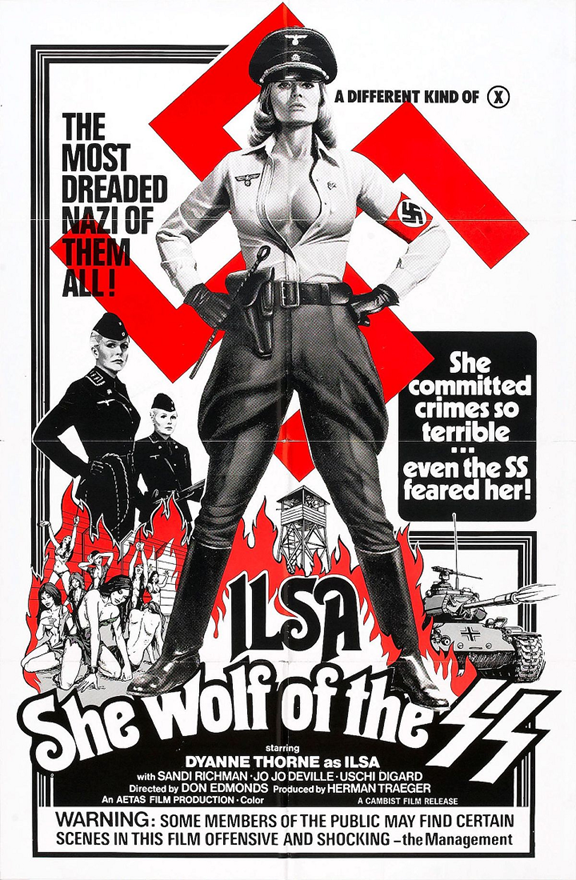
And as it turns out, Ilsa: She Wolf of the SS is a terrible movie. It’s basically Stalag Fiction: The Movie. Ilsa fails as entertainment on every level. It’s too humorless to be good camp, despite its obvious camp potential. It even fails as pornography, as some of the torture scenes are so gruesome that I can’t imagine how anyone could be aroused by them (and those who do should probably get Ilsa’s “special treatment” for the good of society). It’s also simply too dumb to be decent anti-Nazi propaganda. If it wasn’t, I could at least deconstruct the propaganda element. But as it is, there’s nothing worth saying about it.
While researching Ilsa, however, I discovered a documentary entitled Fascism on a Thread: The Strange Story of Nazisploitation Cinema. I highly recommend it if you’re a film history nerd or into old-school underground cinema. It made me curious to watch some of the other movies featured — in part in the hope that I would find a Nazisploitation movie that is actually worth writing about.
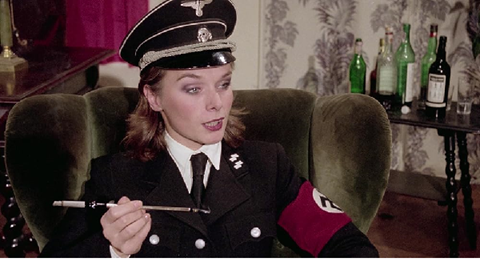
Macha Magall as Dr. Ellen Kratsch in The Beast in Heat
I found an uncensored copy of The Beast in Heat and saw for myself why it is one of ten “video nasties” that is still banned in the United Kingdom to this day. I would write something about it, but there is very little that could be published about it at a family-friendly outlet such as Counter-Currents. So I watched The Night Porter. Not bad — it has a tad bit more gay sex than I usually prefer in a movie about Nazis, but it’s a decent effort.
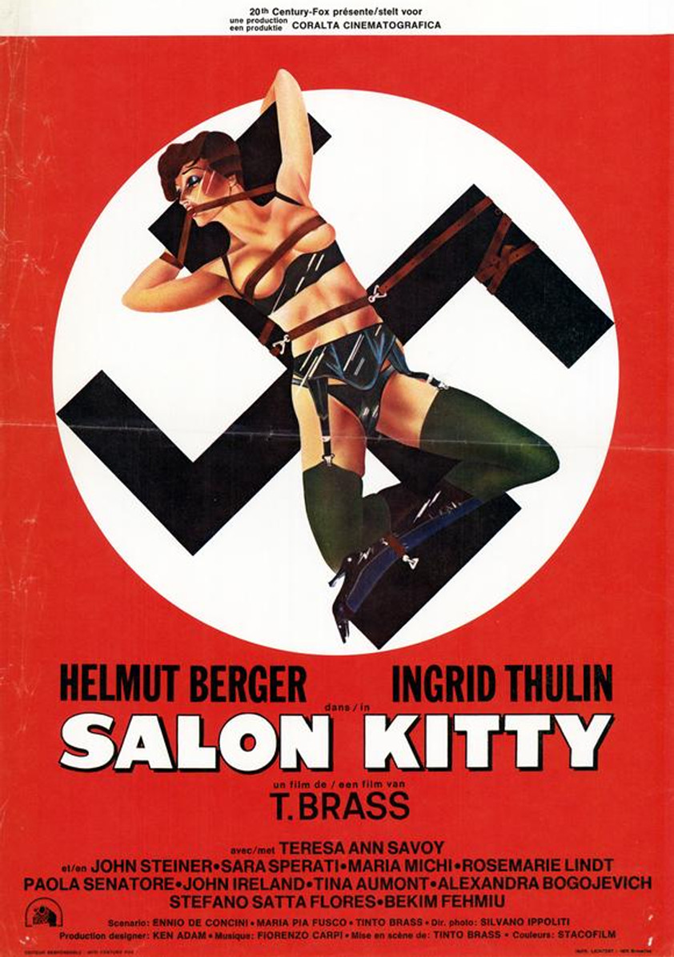
Then I watched Salon Kitty. Here is a Nazisploitation movie I can say a thing or two about.
Salon Kitty’s trailer (NOT SAFE FOR WORK):
Salon Kitty, first released in 1976, is about the infamous — and possibly apocryphal — SS espionage program called Operation Salon Kitty. Salon Kitty was a high-class Berlin brothel that was frequented by a who’s who of Nazi bigwigs and foreign dignitaries. Joseph Goebbels, Joachim von Ribbentrop, and Galeazzo Ciano were all regulars. But little did they know that all the prostitutes there were SS spies, the rooms were all bugged with microphones, and that in the basement, there was a crew recording it all onto wax discs, which was state-of-the-art technology at the time.
It wasn’t a bad idea. Veteran prostitutes will attest that many men visit prostitutes for simple companionship, and to have someone to talk to. They can be themselves with a prostitute, because there is no chance of anything they say getting back to anyone they know. Moreover, as Project Veritas’ undercover videos have shown time and again, men also enjoying bragging to women and will reveal insider information to them as a way of showing off how important they are. Thus, if you are an agent of the secret police and want to know what a particular man really thinks, find out what he is saying to prostitutes.
The story goes that the idea for Operation Salon Kitty came from Reinhard Heydrich and was put into operation by his ambitious subordinate, Walter Schellenberg. The brothel’s day-to-day management was handled by one Katharina Zammit, better known by her professional name of Kitty Schmidt (hence the name of the venue). Schmidt was an experienced Berlin madam who had spent the early years of the National Socialist regime illegally smuggling money out of Germany into British banks until she was finally arrested by the Gestapo in 1939 while attempting to flee the country. Schellenberg then used her arrest to force her to become an SS informant. Schmidt was given a new venue and supplied with new prostitutes who were handpicked by the SS. The operation continued until 1942, when the brothel was destroyed in a British air raid.
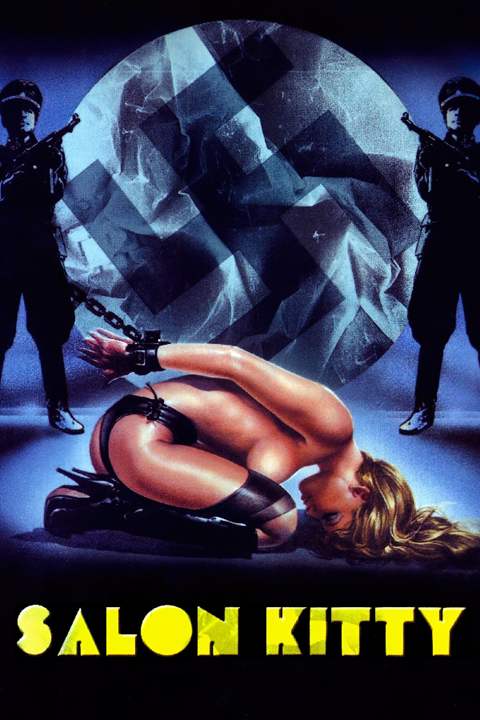
There are no official German records which confirm that Salon Kitty was an espionage operation, however, nor have any of the alleged 25,000 wax disc recordings made there ever been found. Hence, some have theorized that the story is merely a legend. The primary source for it is Walter Schellenberg’s 1956 memoir The Labyrinth, and it’s entirely possible that Schellenberg made the spicy story up to sell more books.
What is known for certain is that there was indeed a brothel named Salon Kitty that was frequented by many Nazi bigwigs and which was run by a madam named Kitty Schmidt. Schmidt, who died two years before the publication of Schellenberg’s memoir, never spoke about a spying operation at her brothel. On the other hand, there are some surviving letters from elite SS men, including Himmler himself, in which Salon Kitty is recommended. “If you’re in Berlin and are looking for a good time . . .”
The film Salon Kitty was an Italian production aimed at the Italian audience, and this is relevant in several ways. First, the film’s critique of Nazism — which is at a least a novel one as far as anti-Nazi movies go — has a very Italian flavor to it. In fact, I’d say it’s more a critique of Italian Fascism than German National Socialism, but uses the Nazis as stand-ins.
Second, the story begins just before the invasion of Poland, and the closing act takes place at the same time as the fall of Paris in May 1940. In other words, the whole movie takes place during the period when Italy was still neutral in the Second World War. Thus, an Italian can watch Salon Kitty as an outsider looking in. There’s even a minor character, Dino, who is an Italian diplomat who helps the good guys defeat the bad Nazi — and he is not a traitor to his people since Italy wasn’t in the war yet.
I should also note that Ilsa: She Wolf of the SS is somewhat of an outlier in the Nazisploitation genre, as it was a North American production. The vast majority of Nazisploitation movies of both the highbrow and lowbrow variety came from Italy.
What is a “Nazisploitation” movie? In essence, Nazisploitation is about mixing Nazi imagery with erotic imagery. It’s about making the Nazis look sexy. They’re not always merely exploitation movies, either, as there have been some artsy-fartsy movies with major distribution that have been described with the term. Thus, Nazisploitation movies can be put into two different categories: arthouse and grindhouse.
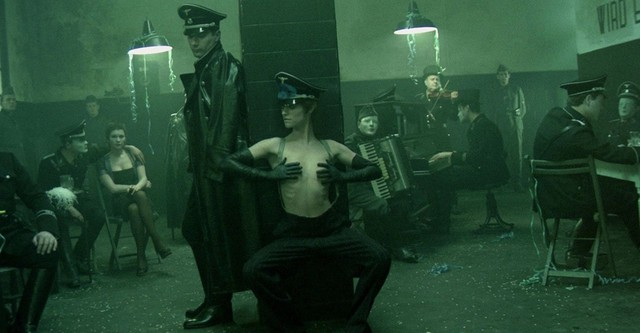
In The Night Porter Charlotte Rampling plays the daughter of a Communist who gets sent to a concentration camp, falls in love with an SS officer, and goes full Stockholm Syndrome.
The arthouse Nazisploitation movies emerge from the European auteur tradition. They usually have some sort of message about the nature of fascism or are about reconciling Italy’s role in the war. The sex is often there only to portray the Nazis as closet degenerates. Examples of this arthouse style of Nazisploitation would be The Damned and The Night Porter. Salò, or the 120 Days of Sodom, while it is about Italian Fascists rather than Nazis, is sometimes considered an honorary arthouse Nazisploitation film.
The grindhouse style is closer to what you would expect a Nazisploitation film to be: a Nazi- themed sexploitation movie. Ilsa: She Wolf of the SS is the most famous of this type, but Love Camp 7, released in 1969, is considered the first true Nazi sexploitation film.
Part softcore porn and part horror movie, grindhouse Nazisploitation movies always take place in a concentration camp and feature lots of female prisoners having lots of non-consensual sex with lots of Nazi guards. The horror part comes from all the gore involved in the unimaginably sadistic Nazi medical experiments, interrogation methods, and torture-for-the-hell-of-it. There’s also usually some femdom Nazi bitch running around and barking orders at people in their tight-fitting SS uniforms — and they usually have titles such as Gestapo’s Last Orgy, Nazi Love Camp 27, or SS Experiment Camp.
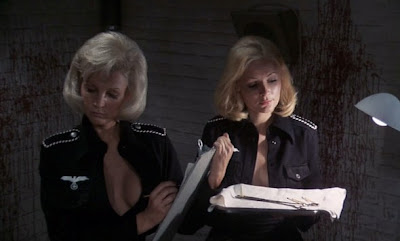
A scene from Ilsa: She Wolf of the SS. It has a statement at the beginning claiming that it is based on historical fact.
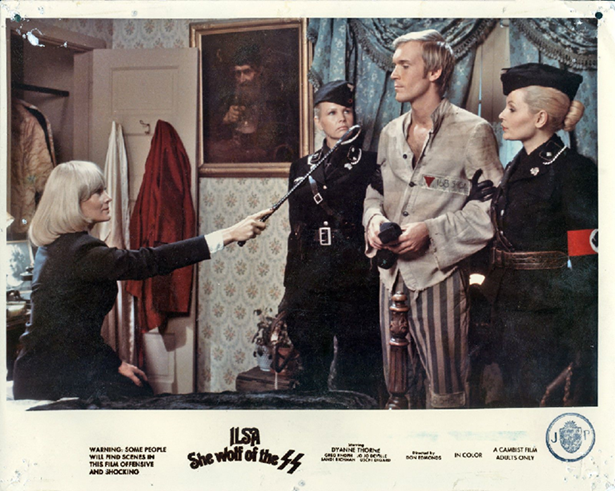
Ilsa the She Wolf with two of her She Cubs.
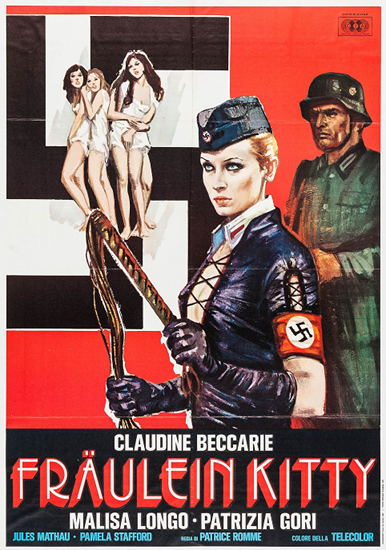
Fraulein Kitty, a French Ilsa rip-off, was marketed in some countries as Elsa Fraulein SS with the tagline “Nazi Elsa, a former hooker with a penchant for S&M, leather boots, nakedness, and a hatred for the French Resistance is on a roll.”
Salon Kitty stands out in the Nazisploitation genre by being halfway between these two styles. It’s 50% arthouse and 50% grindhouse.
On one hand, Salon Kitty has a degree of arthouse cred. It was made by famed Italian auteur Tinto Brass, who had previously received critical acclaim for his early avant-garde Spaghetti Westerns. In 1968, Brass was offered the job of directing A Clockwork Orange but had to decline due to other obligations. Additionally, Salon Kitty’s set designer was Ken Adam, best known for his work on the James Bond films.
On the other, Salon Kitty has far more sex and full frontal nudity — both male and female — than is necessary to tell the story or to make the point Tinto is trying to make. The proverbial “more wangs than a Chinese phone book” comes to mind. Even making allowances for the fact that it is a film about an actual whorehouse, there is still far more sex than is needed for historical authenticity. In America, where the film was titled Madame Kitty, it was rated X and much of the political dialogue was toned down so that it could be marketed as straight sexploitation.
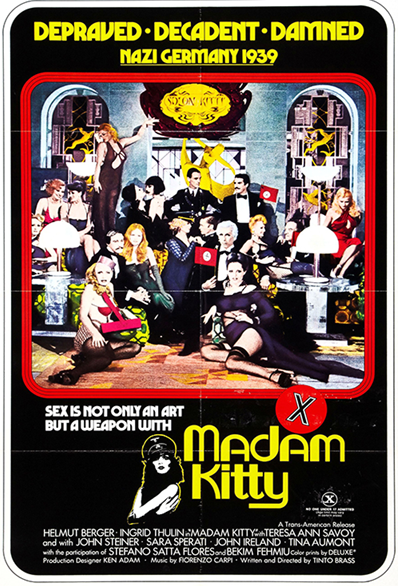
Is Salon Kitty a porno movie? Absolutely not. Porn is a Jewish thing. Gentiles don’t make porn. We make “art films.”
For readers who are too young to get the reference, the stereotype throughout the twentieth century was that Americans were shocked by how much sex and nudity there was in European films, and that Europeans for their part were appalled by how much violence there was in American movies. Europeans were apparently more freaked out by blood than boobs.
In the 1960s and ‘70s, “art film” was a common euphemism for European softcore porn — ahem, I mean “erotic cinema” — which was just barely artsy-fartsy enough to be defensible on artistic grounds. In the scandalous 1966 novel Valley of the Dolls, one of the main characters, Jennifer North (played by Sharon Tate in the movie), has a phenomenal body but no acting talent, so she ends up going to Europe and starring in “art films.” Without having to spell it out, everyone reading Valley of the Dolls in the 1960s knew what that implied.

“Art film” was great marketing, because it made it sound as if going to see a movie with lots of naked women in it was a very sophisticated and cosmopolitan thing to do. “You see, baby, in Europe they have totally different attitudes about nudity. In their culture, it’s no big deal. They don’t have the same Victorian hangups that we do, and so they can appreciate the beauty of the human form. You think this is just porn, but in Europe, they consider it serious art. This director is considered a genius in France. Look, baby, I’m just trying to step out of my comfort zone and broaden my horizons by engaging with another culture. Stop being so provincial.”
So, no, Salon Kitty is not porn. It is an art film, because it was made by a gentile. But about that gentile . . .
Tinto Brass, who is still living (he’s 90 today), is best known nowadays for his follow-up to Salon Kitty, the three-hour monstrosity Caligula, which includes so many hardcore sex scenes that it makes Salon Kitty look like Sesame Street. Caligula was roundly disavowed by just about everyone who watched it, including Gore Vidal, who worked on the script. Many consider Caligula a strong contender for the worst film of all time, but as with anything, if it is bad enough, it has a cult following. I watched it while researching this article, and all I’ll say is that it’s one of those movies that is so bad that you almost have to see it. You won’t like it, but you will never forget it.

Malcolm McDowell as Caligula.
Politically, Tinto Brass is a Left-libertarian and supports the anti-statist Italian Radicals party. His anti-statism is apparent in both Salon Kitty and Caligula, which are about the corrupting influence of power and the kinds of people who seek it.
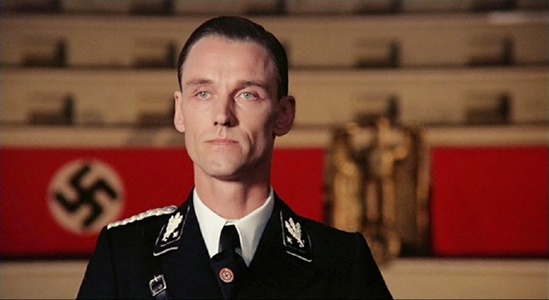
English actor John Steiner as Biondo.
Salon Kitty opens in 1939. Madame Kitty is performing a degenerate, Weimar-style cabaret number. Six years into the National Socialist era, the spirit of the previous Germany lives on in the underground brothel. In the audience is SS honcho Biondo, who is based on Reinhard Heydrich, and he has a lightbulb moment.
Biondo calls his number two, Helmut Wallenberg (played by Helmut Berger and based on Walter Schellenberg), over and tells him:
I need at least 20 girls. It’d be easy for you to find them, except they can’t just be beautiful. They also have to be intelligent and especially of indisputable National Socialist belief. You must comb through all Germany, through every city, every region. Sift through the countryside, the factories, the universities, the offices, middle class or blue collar, housewives or employed women, virgins or married ones. Examine them carefully. But most of all, I repeat, choose them based on their political belief system!
Rather than find prostitutes and teach them how to be spies, Biondo wants to find girls who are true believers in National Socialism and train them to be prostitutes for the Reich. As Biondo later explains to the selected women, while it would have been easier to choose prostitutes, “The Fuehrer has greater confidence in political faith than in technique. Where there is good will, technique can be learned quickly.”
This is an example of slight creative license. In the actual story of the Salon Kitty operation, the SS sought out prostitutes who had nationalist tendencies. More specifically, the order was to find “women and girls, who are intelligent, multilingual, nationalistically minded, and furthermore, man-crazy.” But having the girls be dedicated Nazis turned whores makes for a better story and adds a fish-out-of-water element to the tale. Part of the film’s drama comes from the girls having to reconcile their devotion to National Socialism with the degrading and humiliating things they must put themselves through for the good of the cause.
We then get a montage of the girls who are selected for this special mission. We see a married woman in a movie theater with her family, passionately Roman-saluting during a Hitler speech. We see another woman in a meatpacking factory, horsing around with Nazis. Both women get the call.
There is also a college coed attending a lecture on racial theory by a Nazi biologist who asks, “Professor, is it true that Jesus Christ was son of a Roman prostitute and a German mercenary?” The biologist responds, “Without a doubt! There can’t be found the slightest trace of Jewish characteristics in Jesus Christ. He was blond with blue eyes. Typical signs of his German origin. Can you tell me who was the first man in the world who realized this fact and revealed it to the human race?” The girl answers, “Yes, sir. Our Fuehrer, Adolf Hitler.” She has clearly swallowed even the most far-fetched elements of Nazi propaganda — so of course she is ideal Biondo’s operation.
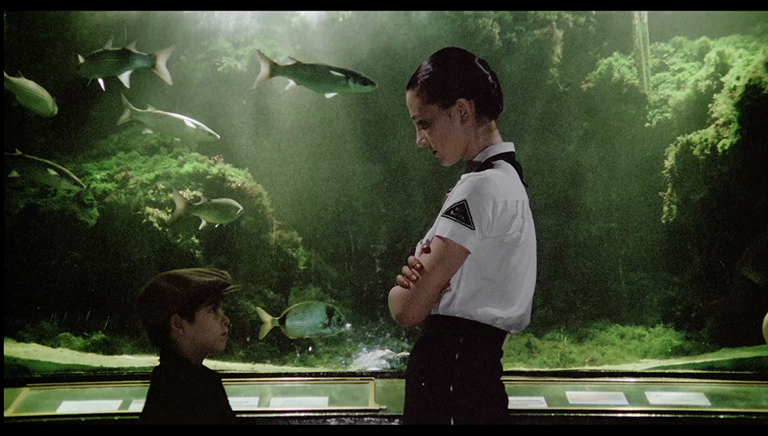
There’s another brief scene in an aquarium where a Jewish family runs into a group of girls from the Bund Deutscher Mädel (League of German Girls) in their uniforms. As theJewish family tries to quickly walk past them, a mechanical toy falls out of the Jewish boy’s pocket and starts hopping around on the ground. The head BDM chick walks up to the kid, looks him dead in the eyes, and without changing her expression, steps on his toy. There is a lot of sex in Salon Kitty of almost every type you can imagine, but this is by far the sexiest scene. I know that sounds flippant, but you have to watch the scene to know what I’m talking about. In my opinion, this scene alone is worth the price of admission.
Naturally, this BDM baddie is another ideal candidate for Biondo’s mission and gets called up.
Most importantly we are introduced to the main protagonist, Margherita, who is played by Teresa Ann Sayoy. When we first meet rich girl Margherita, she is at the dinner table with her bougie parents and family friends when the subject of Hitler comes up. We see the generational clash of opinions between the young, true-believing National Socialist Margherita and the older, more cynical generation of the First World War.[1]
Margherita’s father: He promised he would free us from Communists and labor unions in six months and, by God, he kept his promise.
Dinner guest #1 (a decorated German officer): Today, our racial laws are the most socially advanced of all, far more than the Fascist code in Italy.
Margherita’s mother: It’s so Italian.
Margherita: I admire the Italians, mother.
Margarita’s mother: And so do I, darling. They’re more Mediterranean. But they are very nice.
Margherita’s father: A little too exotic for my tastes. Too colorful.
Margherita’s mother: Our party also suffers from a certain lack of style. All those brown shirts. Such a common color.
Dinner guest #2 (a fat woman): And his manners, my dear. Have you noticed how he drinks his tea with his little finger raised?
(Everyone at the table laughs except Margherita)
Margherita: You forget, Mrs. Henckel, just as my mother and father sometimes do, that the National Socialists can’t afford to lose time studying etiquette. They are too busy trying to rebuild that order which you failed to defend, since you were too busy checking your little finger and choosing your stylish colors. Don’t you realize? You’re a dead generation.
(Everyone at the table is shocked)
Margherita: Goodnight.
(Margherita departs)
Margherita’s father: (apologetically to the guests) Yes, well, National Socialism has a great hold over the young.
Dinner Guest #3 (a fat man): Well, after all, that’s what we were hoping for when we backed Hitler in ’33, isn’t it?
Margherita’s mother: The most important thing is to be on the winning side.
Dinner guest #1: That’s the side of history, my dear.
(Everyone at the table laughs maniacally)

Teresa Ann Savoy as Margherita. Savoy first rose to prominence after appearing naked in the Italian edition of Playboy. She would later appear in Tinto Brass’ Caligula, where she played the mad Emperor’s sister and lover, Drusilla.
This scene depicts the German bourgeois class as completely frivolous. While everyone at the table supports Hitler, Margherita is the only one who is a true believer. The older generation simply thinks Hitler is good for business. At most, they see National Socialism as something to keep the kids from becoming commies.
A major theme of the film is that of true believers versus opportunism. The point Brass is building towards is that true believers are willing to make huge sacrifices for their principles, while in the regime’s upper echelons there are mere cynics who view it all as a Machiavellian power game.
The line about being on the winning side represents another major theme, and is part of what gives the film its Italian flavor. Italy entered the war on the Axis side only when a German victory seemed imminent — not necessarily because they saw Germany as the good guys, but simply because they wanted to be on the winning side.
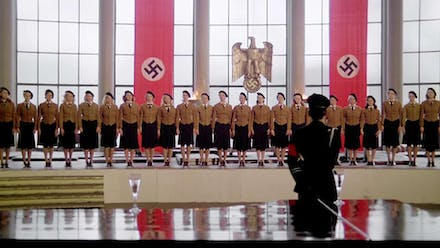
Once all the girls are selected for Biondo’s operation, they are brought together in a gymnasium. Biondo gives them a pep talking, explaining that their mission is similar to what men experience on the battlefield: “It’s like killing. The first time one may feel remorse, be induced to vomit, even have insomnia. But by the third time, one sleeps peacefully. By the fifth time, one eats a sandwich. Actually, it gets exciting. There is a stimulus. They are just the same for you.”
The women are then all made to undress and are paired up with strapping SS hunks to have sex with. This is their first round of auditioning. A giant Nazi orgy ensues. It’s all very “artistic,” I assure you.
And from here, the movie gets “artistic” as fuck.
Getting a woman to have sex with a random SS chad for the Reich is child’s play. A true prostitute needs to be willing to have sex with literally anyone, and so a second round of auditions is held where they are paired up with random people. One is made to have sex with a midget, another must copulate with an amputee, yet another is made to have lesbian sex. Some girls break psychologically during the second round and are dismissed.
With the prostitutes now selected, Biondo disappears from the story and his henchman, Helmut Wallenberg, takes over. Throughout the audition process, Wallenberg become smitten with Margherita and invites her to his home. Margherita is like a groupie with a rockstar. She’s a Nazi superfan, and Wallenberg is “in the band.” She therefore quickly and eagerly become Wallenberg’s mistress.

Margharita and Wallenberg.
Wallenberg has his whores, but still needs a whorehouse and a madame to run the place. The Gestapo shuts down Madame Kitty’s brothel and bring her in for questioning. Wallenberg informs Kitty that they are going to set her up with a new brothel and new girls. Kitty is not informed that this all part of an espionage operation, however. The ostensible reason for it is because the Nazis need her building, and given that Nazi bigwigs will be frequenting it, the SS wants to make sure they will only be banging racially pure Aryan whores. (Kitty previously employed people of other races.)
The prostitutes, for their part, know that they are spies, but they do not know that the building is bugged and that their conversations are being recorded. They are therefore required to submit a written report after each encounter. This becomes a plot point later on.
Kitty is introduced to her new batch of whores and is initially unimpressed with them. While they are pretty, she finds them too uptight and insufficiently slutty. They are, after all, autistic Right-wing political spergs. Thus, Kitty has to train the girls how to look, act, and dress properly whorish.
The girls soon settle into their roles and learn to be proper prostitutes. All is going well until Margherita and one of her clients, Luftwaffe Captain Hans Reiter, begin to develop deep romantic feelings for each other. Reiter has ten days left before he must return to the front and spends most of his time with Margherita. One night during a British bombing raid, Reiter pours Margherita a glass of champagne. This symbolizes the beginning of Margherita’s turning away from National Socialism, since earlier in the movie she says that she doesn’t drink alcohol — because Hitler doesn’t.

Margherita and Captain Reiter.
On the eve of Reiter’s departure, he confesses to Margherita that he has become disillusioned with National Socialism and intends to defect to the Allies. “From Warsaw to Leopoli, gutted houses and burned fields, dead horses rotting in the Sun and men, women, and children,” he laments. “Piles of corpses. Silent, deformed bodies bloated and rotting. We massacred everybody. I, too, have gunned down defenseless citizens in a nosedive. People screaming, their arms in the air. I was born for this. I thought my destiny was to build houses to live and love in. Instead, I’ve become the architect of a cemetery.”
Margherita tries to dissuade Reiter by reminding him that regardless of his personal feelings, fighting is still his duty as a soldier. “I know,” Reiter says. “And until yesterday, I accepted this without discussion. But now I’ve made up my mind. I’m going to fight against Hitler. Against his madness. Against the violence that is corrupting us all. . . . Margherita, man belongs to humanity, not to a nation or a race or to a religion. My conscience is clear.”
Reiter is committing treason, and Margherita is therefore obligated to turn him in. But she instead lies for him in her written report, claiming that he is still a steadfast Nazi. Little does she know that Wallenberg has audio recordings of all her conversations with him. Wallenberg intends to use this information to tighten his control over her.
Shortly thereafter, when Margherita is talking with a client she has just had sex with, she discovers that he is in the same Luftwaffe squadron as Captain Reiter.
Client: You’re Margherita, right? Hans Reiter’s girl. We were in the same squadron. He told me about you.
Margherita: Yes, I know him.
Client: Did you know he was in love with you?
Margherita: These things happen. Fortunately, he got over it quickly.
Client: I don’t think he did.
Margherita: Too bad. A man should never fall in love with a girl like me.
Client: Why?
Margherita: I’m a whore. Where is he now?
Client: Don’t you know? He was hanged a few days after he returned to base for defeatism and anti-patriotism. There was an SS report from Berlin. He was planning to desert. He was going over to the other side, the swine. We thought he was a good comrade, but he was just an asshole. With us he played the National Socialist, but in private, he called us murderers. He was a coward, a traitor with no balls. Fortunately, he gave himself away. They hanged the son of a bitch on a meat hook. I got a kick out of seeing that bastard hanging up there like a stuck pig. I even had the satisfaction of spitting on his corpse.
Margherita then shoots the man in the face. Kitty comes in and helps her to place the pistol in the man’s hand to make his death look like a suicide.

Margherita has now completely broken from National Socialism, while the man she killed was a true believer. Brass continually emphasizes that the top levels of the Nazi hierarchy were run by cynics, perverts, and self-conscious frauds. He ends up making true believers such as Margherita look far more sympathetic by comparison. Compared to the nihilistic Wallenberg or the frivolous bourgeois twits, the sincere Nazis seem admirable.
Margherita and Kitty meet and figure out that if Wallenberg knew of Reiter’s plan despite Margherita lying in her written report, then the brothel must be bugged. Margherita resolves to avenge Reiter by taking down Wallenberg. Her plan is to do to him what he made her do to so many others: seduce him and get him to express his true feelings on record. The pair recruits the brothel’s resident Italian and American regulars, who provide Margherita with the necessary equipment to record Wallenberg.
When Margherita arrives at Wallenberg’s mansion, Wallenberg is snorting cocaine and his narcissism has achieved new heights. No longer is he dressed in an ordinary SS uniform, but in what can only be described as some sort of Nazi superhero costume. He is enthralled with visions of infinite power and is already imagining himself as a god. Wallenberg tells Margherita that soon he will be powerful enough to dispose of his wife and be with her.
Margherita makes her move by playing with Wallenberg’s ego. This gets Wallenberg on a roll until he reaches the point where he’s finally giving a full-blown supervillain speech.
Margherita: There is no place for illusions here.
Wallenburg: They are not illusions. (Wallenburg removes a large cloth from his chandelier, revealing a menorah hidden underneath) Look! My wife’s grandfather was Jewish.
Margherita: That could be dangerous for you, too, if they find out.
Wallenburg: Not when I have the power I deserve — the power of Himmler.
Margherita: You’re crazy!
Wallenburg: I have in my hands the bedroom secrets of all Germany: Ribbentrop, Goebbels, Keitel, Jodel . . . even Heinrich Himmler. I know the weakness of every single one of them. The cocaine they take. Their impotence, their perversions, their thieving, their betrayals, their rivalries. Social climbers and cowards!
Margherita: What do your superiors think about it?
Wallenburg: Soon they won’t have time to think. The original idea wasn’t my idea, I admit, but I know how I can get rid of them all whenever I wish.
Margherita: Maybe your power is an illusion.
Wallenburg: No. Every word is true. Every single word of mine is true. It’s true! Get that through your head! I don’t give a damn about National Socialism. Just as none of our leaders give a damn! They all have one goal: power! There are no ideals. There is no faith. You are the one with illusions, Margherita. You and the millions of Germans like you who believed in us. It was a way to get you all under our thumb. You, a bourgeois, at the mercy of a pimp. I brought you down to my level, just like all the others. Now you’re servants to a bunch of gangsters. We made criminals out of you. Murderers, thieves, corrupted accomplices, and slaves!
Far from being an ideologically-driven hate machine, Brass’ Nazi Germany is more akin to Orwell’s Oceania, where the true believers can only be found in the outer rings of the power structure, while in the innermost circle it’s all sociopaths playing a ruthless game of power for its own sake.
As a general rule, people who have power tend to be less idealistic than those who don’t because they have a better understanding of how the sausages are made. Maybe they had good intentions at one time, but once inside the power structure, they discover all the corruption, nepotism, and backroom deals — and soon abandon their principles in order to play politics. Tinto Brass is therefore on to something.
But it’s hard to apply this to a regime such as National Socialist Germany, where there were true believers going all the way to the top — with Hitler as the truest believer of all. In fact, many of Hitler’s biggest strategic errors were the result of him stubbornly putting ideology over remorseless realpolitik. Hitler’s refusal to incorporate anti-Soviet Slavs into the Axis is but one example.
It therefore seems to me that Tinto is projecting an Italian worldview onto the Germans. Italy entered both world wars when it was under no obligation to do so, but rather for entirely cynical reasons that led to catastrophic consequences for them. Italy was basically bribed into entering the Great War, and threw their lot in with the Nazis in the Second World War just to “be on the winning side.” Likewise, the Italian Fascist regime which was far more opportunistic — similar to ancient Rome, where assassinations and purges were all about naked power and nothing more.
In the end, the American ambassador records Wallenberg’s supervillain speech and Margherita takes it to SS headquarters, reporting Wallenberg for treason. Biondo listens to it as he practices fencing, offering no reaction. But after hearing that Wallenberg wants to use the information he has gained to destroy his rivals and achieve ultimate power, Biondo orders his death. He says nothing else, so we don’t know whether or not he agrees with Wallenberg’s claims about the regime.
Overall, I give Salon Kitty a thumbs up — assuming that you are not a philistine and can handle all the “art.” There is a lot of “art” in this movie.
* * *
Like all journals of dissident ideas, Counter-Currents depends on the support of readers like you. Help us compete with the censors of the Left and the violent accelerationists of the Right with a donation today. (The easiest way to help is with an e-check donation. All you need is your checkbook.)
For other ways to donate, click here.
Note
[1] There are multiple versions of Salon Kitty out there, each of which slightly different dialogue. The English-dubbed version has slightly different dialogue than the English-subtitled one, and the English subtitles in the English-dubbed version differ from the English subtitles in the Italian dub. The dialogue you see therefore may differ slightly from what I quote. Since the dialogue seems to have been altered to be less political in the original English dub, I quote from the subtitles on the Director’s Cut Blu-ray, which are hopefully closer to the director’s original intent. They seem to me a shade spicier than the dubs.
14 comments
“It is an art film, because it was made by a gentile.” Not sure if Italians count as “gentiles”, but they certainly would never ever do porn.
The shtick of the film is to make the Third Reich look like a surreal extension and deliciously perverse upgrading of the Weimar republic. It fetishistically indulges in Nazi aesthetics, while ridiculing the ideology.
I think the direct inspiration was Visconti’s much more high brow “The Damned”, also featuring Helmut Berger and Ingrid Thulin. Brass’ casting must have been deliberate. There is already a lot of psychosexual delirium connected to Nazis in Visconti’s film, and Brass ups the ante up to a hysterical, parodistic point.
The ancestry of Jesus thing is quite twisted here. The story of the Roman soldier (named “Panthera”) has probably Jewish/Talmudic origins, intended to smear the Christians, and there were no “German” origins of the soldier implied. The “Aryan Jesus” was suggested by Houston Stewart Chamberlain in his book “Die Grundlagen des 19. Jahrhunderts”, claiming that Galilee’s population during Roman times was religiously/culturally Jewish, but racially Aryan. Alfred Rosenberg picked up this idea in his NS sequel “Der Mythus des 20. Jahrhunderts”, which is surprisingly respectful of Jesus given the author’s generally anti-Christian outlook.
“Art movies” are also referred in “Lolita”, proposed by Clare Quilty as a great acting chance to the not-so wanton nymph title character.
I saw Ilsa: She-Wolf of the SS when I was around 25 or so and even my drunk, younger self thought it was ridiculous. The SS officer cackling like a comic book villain over the woman standing on a block of ice with a noose around her neck has to be seen to be believed. I’m sure there’s never been any actual scientific studies on this, but I’d be interested to see if the “Nazis” had any higher instances of sadism in their officer ranks than any other military involved in WWII. No war in world history has been as heavily propagandized as that one.
The funny thing about Caligula is that historians have actually started to backtrack a little about some of the excesses attributed to him. So as ahistorical as the movie may have been at the time, it’s even more so now. That machine (as anachronistic as it was) lopping off heads in the Colosseum was pretty cool looking though, I must say.
The film is the classic Nazi exploitation stuff that Italy seems to excel at. The director, Tinto Brass, had a hand in destroying Gore Vidal’s script Caligula. Vidal said he should be named ‘Tinto Zinc.’
Salon Kitty was began as an attempt to entice foreign diplomats and such and the ladies would extract valuable information from them. Not much came of it, though. The Gestapo had microphones installed in the rooms, but they mostly recorded a lot of grunts and cries. As it was, most of the clientele soon became Nazi and government bureaucrats. I doubt the film has this. Shame a comedy wasn’t made. “Monty Python Meets Salon Kitty.”
Imagine John Cleese as head of the Gestapo.
I remember tons of nazi porn when growing up. You’d see all these men’s adventure mags in the drugstore with cover after cover of nubile, almost naked women being tortured by gleeful SS uniformed guards or vampish SS women, many times the latter doing their worst on helpless, bare chested captive GIs looking very beefcake. This was very much part of the wonderful fifties. Franz Josef Strauss, the conservative German politician, complained about this in the 60’s. It gave a very false image of Germany; which, I suppose, was the point.
On the less “artsy” side, there’s the German production Lebensborn (1961). No nudity, even when – according to the script – there should have been, but it’s all about… that.
Apparently, when it was released back in the day, there were quite violent protests by former Waffen-SS soldiers.
Wikipedia currently states that Signor Brass disavowed Caligula after the producers, including Bob Guccione the proprietor of Penthouse, added unsimulated sex scenes which they filmed in post-production. As well as McDowell, Savoy and Steiner Helen Mirren, Peter O’Toole and John Gielgud were persuaded to take part. I was amazed to see these screen legends in such an exploitative piece of filth. It certainly does to the Romans what Salon Kitty does to the Germans.
Great review Greg.
I took your advice and read your review of Caberet. You were spot on. I was wondering if you’ve ever seen Bob Fosse’s portrayal of Jewish degenerate, drug addict and unfunny “comedian “ Lenny Bruce in the film Lenny? Josef Goebells would have its approval.
Have not seen it. Will check it out.
I couldn’t sit through more than about 15 minutes of that garbage. Lenny Bruce is basically the prototype for the type of repulsive ball-fanning that stand-up “comics” receive from the critical establishment when they have Something Important To Say but aren’t one goddamn bit funny. He spawned a plethora of comics who have a reputation for being “edgy” while all the time vomiting up all the acceptable platitudes of the day. See also: George Carlin, Richard Pryor, Bill Hicks, Louis C.K., Bill Burr, etc.
Yes, following Bruce, they were all just vulgar. At least Richard Pryor was funny, though.
If anyone needs more Dyanne Throne content, she also stars in Point of Terror, which I reviewed here:
https://counter-currents.com/2013/10/thanks-for-watching-part-1/
“Like the rest of films shown on Channel 62 and the like, the only reason to watch Point of Terror was the promise of numerous well-endowed women, among them Dyanne Thorne (the future Ilsa: She-Wolf of the SS; how many young boys have become Nazis thanks to her? Greatest recruitment tool ever.)”
As for “art films,” I like to point out that Bryant Haliday, perhaps only remembered today for starring in two British films worthy of being mocked on Mystery Science Theater (Devil Doll and The Projected Man), was actually an American, who dropped out of Harvard Law to start a theatrical company, the Brattle Theater Company in Cambridge. In 1956 he founded Janus Films, the Criterion of its time, and ran the 55th Street Playhouse in NYC, which showed Janus-distributed films, including the films of Ingmar Bergman, Federico Fellini, Akira Kurosawa and Michelangelo Antonioni. Arguably the first “art house theater.”
He became rather rich, enough to indulge his uniquely hammy acting chops and love of horror films in British B-flicks like those referenced above.
Devil Doll also stars another American, William Sylvester, who specialized in playing Americans in British films, three of which (!) were Mst’d. While Halliday is a ham, Sylvester is uniquely wooden. Four years later, he was immortalized as “Dr. Heywood Floyd, American” in 2001. Also in Devil Doll is the guy who would play Bowman’s dad in the birthday message video (here he only talks to Sylvester on the phone “from Berlin” to save on the budget, just as in 2001 Sylvester talks by video phone to his daughter, played by Kubrick’s kid). I like to think of Kubrick watching Devil Doll and jumping up: “I’ve found my Heywood Floyd!”
“Ham! I love it!”
https://youtu.be/zYFVtYnfiSY?si=3UDKzGo19tVauMRK
If anyone needs more Dyanne Throne content, she also stars in Point of Terror
She would show up in the strangest places sometimes. She can also be found in the odd and not-so-great (yet relatively mainstream) 1987 movie Real Men, starring John Ritter and Jim Belushi. She played the Belushi character’s sex-crazed tranny father who appears to have recently transitioned. Since it’s 1987, this was of course played for laughs. It’s not terribly funny, but still refreshing to see a movie that pokes fun at these beasts. See also: the first Ace Ventura movie and Naked Gun 33 and 1/3.
Interesting slice of film history. I tried to watch Salo, expecting to like it, but I found it tedious and revolting. I find the level of actors in those types of movies just don’t look good enough. It’s the same reason I never watched 50 shades of gray.
As for the historic trope of Salon Kitty, do you think that could be somewhat projectional? It sounds highly reminiscent of Epstein type stuff.
Aside from how tasteless and disturbing Salo is, it’s boring as hell.
Comments are closed.
If you have a Subscriber access,
simply login first to see your comment auto-approved.
Note on comments privacy & moderation
Your email is never published nor shared.
Comments are moderated. If you don't see your comment, please be patient. If approved, it will appear here soon. Do not post your comment a second time.